Sample Category Title
GBPUSD Outlook: Sterling Slumps on Signals of Brexit Talks Stall
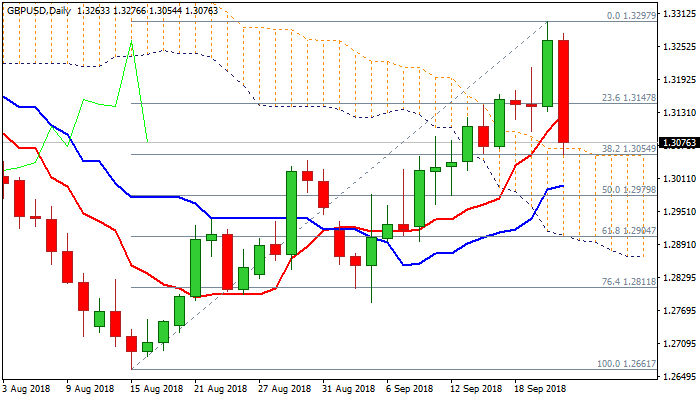
Sterling crashed on Friday, losing 1.45% for the day so far, on dip to session low at 1.3063, driven by signals that Brexit talks stalled. UK PM May said the UK and EU Brexit negotiations are at an impasse after the EU rejected proposals from Britain and offered no alternative. May also said that the UK will continue preparations for scenario on no-deal Brexit. Cable's fall is for now the biggest one-day loss since 02 Nov 2017. Fresh bearish acceleration pressures key supports at 1.3066/55 (daily cloud top / Fibo 38.2% of 1.2661/1.3297 ascend, firm break of which would generate fresh bearish signal for further weakness. Weaker daily techs, with slow stochastic in vertical descend and momentum heading south and creating bear-cross, add to negative outlook. Fresh weakness also changes the picture on daily chart, as the pair is on track for the first negative weekly close after five weeks of strong rally. Strong bearish sentiment is building and could cause further losses, with penetration of thick daily cloud to expose converged 20/55SMA's at 1.3010 zone and psychological 1.30 support.
Res: 1.3134; 1.3172; 1.3214; 1.3276
Sup: 1.3054; 1.3010; 1.3000; 1.2980
GBP/USD Mid-Day Outlook (Update)
Daily Pivots: (S1) 1.3169; (P) 1.3233; (R1) 1.3335; More...
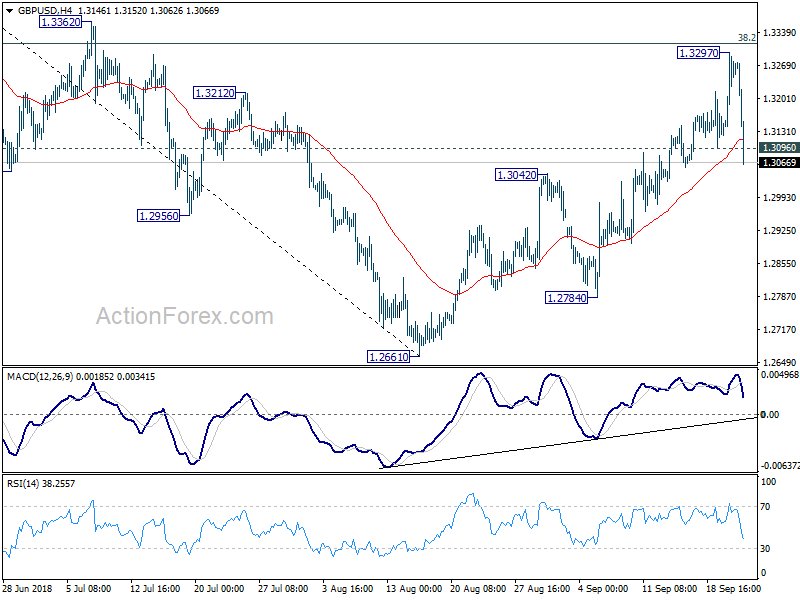
GBP/USD's sharp fall and break of 1.3096 minor support argues that rebound from 1.2661 might be completed at 1.3297 already. That was accompanied by rejection from 1.3316 key fibonacci resistance and is in line with our original view. Intraday bias is turned back to the downside for 1.2784 support first. Break there will likely resume larger decline from 1.4376.
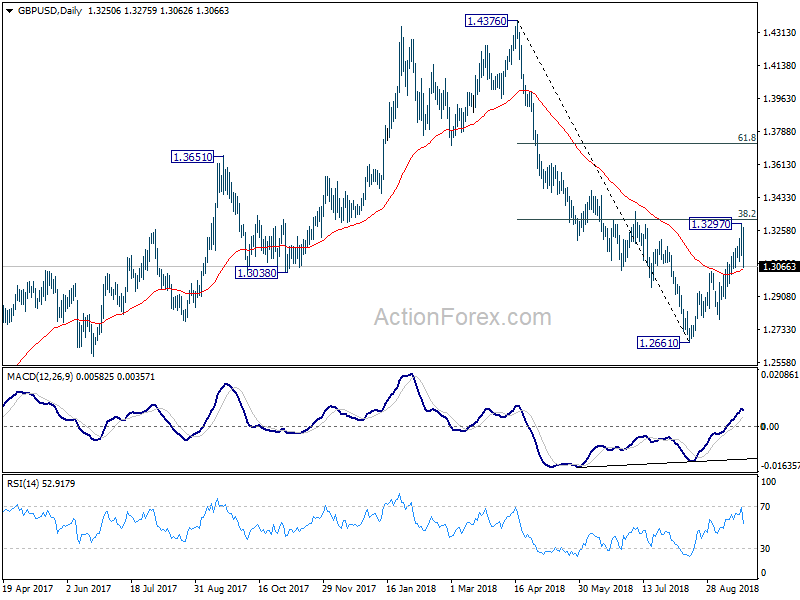
In the bigger picture, whole medium term rebound from 1.1946 (2016 low) should have completed at 1.4376 already, after rejection from 55 month EMA (now at 1.4062). The structure and momentum of the fall from 1.4376 argues that it's resuming long term down trend. And this will be the preferred case as long as 38.2% retracement of 1.4376 to 1.2661 at 1.3316 holds. However, firm break of 1.3316 would bring stronger rebound to 61.8% retracement at 1.3721. And, the eventual depth of the fall from 1.4376, and the chance of hitting 1.1946 low, will depend on the strength of the interim corrective rebound from 1.2661.
Canada: Headline Inflation Eases in August, but Core Measures Accelerate
Consumer prices rose 2.8% year-on-year in Canada in August, a slight deceleration from the 3% posted in July but right in line with market expectations. Adjusted for seasonal patterns, prices rose 0.1% month-on-month following a large 0.5% increase in July.
Some of the key categories that boosted inflation in July have eased off in August. Air transportation prices declined, following a 16.4% jump in a prior month. Ditto for gasoline prices, with price growth slowing from 25.4% to 19.9% on a year-over-year basis. As a result, the transportation index advanced by 7.2% y/y, down from 8.2% in July, but remained the fastest growing category.
Looking at broader categories, prices for durable goods rose 1.1% year over year, following a 0.8% increase in July. Meanwhile price growth for non-durable goods (+3.8% down from +4.4%) and services (+3.1% down from +3.2%) remained robust despite a light monthly deceleration.
All of the Bank of Canada's core measures edged higher on the month. CPI-common, CPI-median, and CPI-trim edged up by 0.1pp to 2.0%, 2.1% and 2.2%, respectively.
Key Implications
As expected, following a large jump in July, headline inflation cooled off in August. July's surge was largely a result of one-off factors, such as a large increase in air transportation prices as airlines responded to higher fuel and labor costs. Pressure from gasoline prices has also eased this month, with prices at the pump declining. Excluding the often volatile food and energy components, inflation remained unchanged in August at 2.3% y/y.
While the headline inflation has eased off somewhat, the Bank of Canada core measures continued to move forward. Continued progress on the inflation front alongside a well-performing economy and a range of indicators pointing to limited excess capacity suggest that maintaining stable inflation will require further rate hikes by the central bank, with another one likely coming next month.
Sunset Market Commentary
Markets
Global core bonds trade mixed today with German Bunds outperforming US Treasuries. The only noteworthy move of the day occurred at the start of European trading after disappointing French and German PMI’s. The Bund leapfrogged higher. EMU PMI’s remain at decent levels though, pointing to 0.5% Q/Q Q3 GDP growth, but details of the PMI’s suggest that risks to future growth appear tilted to the downside. Core bonds treaded water after this one-off move even as equity and oil prices extended gains. The US yield curve bear steepens at the time of writing with yields 1.1 bp (2-yr) to 2.4 bps (30-yr) higher. German yields decline by 0.7 bps to 1 bp across the curve. 10-yr yield spread changes vs Germany ranged between -2 bps and +1 bp.
Yesterday’s positive risk environment reverberated throughout today’s trading session as the recent dominating market moving themes stayed low profile. However, unlike yesterday, the euro couldn’t benefit. EMU composite PMI’s showed a manufacturing led decrease to 54.2 (down from 54.5) but had little and in any case only temporarily impact on trading. The euro eventually did lose some ground against the dollar as American trading kicked in before extending losses after Theresa May’s statement following the EU’s informal summit. Failing the 1.18 test twice this morning, EUR/USD turned south to meet support at 1.175, where it is hovering at the moment. USD/JPY’s profit from the current risk mood remains modest. The pair is currently trading around 112.70. All in all, USD trading was confined to narrow ranges as investors are gradually turning the attention to the Fed meeting next week.
In the recent markets sterling often traded to the tone of the (hoped for, presumed, expected) progress in the Brexit progress. From time to the time, the market had to amend its assumptions on the Brexit-path. In retrospect, it looks that yesterday was again such an inflection point. Over the previous two weeks, markets saw tentative signs that the compromise might come closer. The EU was rumoured to adapt a softer approach on the Irish boarder, in order to provide PM May with a deal that would give her more leverage at home. This hope supported sterling. However, the EU summit in Salzburg didn’t confirm this hope. Both sides openly stick to their positions as deadlines are coming closer. Everyone including the PM can’t but admit that a big gap still needs to be closed, both on the future relationship and on the issue of the Irish boarder. Sterling as a barometer of Brexit-optimism reversed a big part of recent rebound. A no deal scenario remains realistic. EUR/GBP jumped back higher and is again trading in the 0.8975 area. Cable also lost almost two big figures (currently in below 1.31).
News Headlines
IHS Markit reports that Eurozone business activity grew in September at the second-weakest rate since late-2016 (composite PMI fell from 54.5 to 54.2) as manufacturing growth (53.3 from 54.6) was subdued by export orders stagnating for the first time in over 5 year. Service sector output growth meanwhile picked up for a second consecutive month (54.7 from 54.4) even if new inflows of business and backlogs of work hint at slower activity in coming months. Q3 PMI’s suggests that the EMU economy is growing by 0.5% Q/Q.
UK PM May delivered an unexpected statement, following-up on yesterday’s Salzburg Summit where European leaders snubbed May’s proposals. May said the EU and UK are at an impasse, repeated her no go’s and put the ball in the EU camp to come up with new proposals in order to avoid a no deal exit. Sterling lost more ground after her declaration.
Rating agency S&P maintained its Chinese A+ rating (stable outlook), citing the government’s reform agenda, growth prospects and strong external metrics.
Canadian Retail Sales Up in July Though Volumes Dipped
Highlights:
- Retail sales rose 0.3% in July though were off 0.1% in volume terms (excluding the impact of prices)
- The volume of sales ex motor vehicles, parts and gasoline increased 0.7%
- E-commerce sales — only some of which are captured in headline retail sales — were up 9.4% from a year earlier
Our Take:
Retail sales rose a modest 0.3% in July, although dipped 0.1% excluding the impact of prices. This marked the second monthly dip in sales volumes but did little to retrace the 2.2% surge in buying activity in May. The volume of motor vehicles and parts sales declined though the auto sector is still on track for another historically strong year. Given the boost to sales in May, even with the modest declines in June and July, sales started the third quarter running at a 2.1% annualized pace.
Today’s report combined with strong manufacturing data for July are likely to be swamped by a sharp drop in oil and gas production when the July GDP report is released on September 28. A shutdown of a major oil producer for the entire month will act as a major weight on GDP growth in July though with production starting to come back on line in August, the factor will be reversed in subsequent months. On net, while the temporary disruption will inject volatility in the GDP data, it should not be interpreted as signaling a weakening in the economy’s momentum. Our view is that growth in the second half of the year will average 2.1%, firmer than the economy’s potential growth rate and sufficiently strong to keep the bank on its gradual tightening path.
Canada’s Headline Inflation Rate Eased Mildly in August; Core Measures Up
Highlights:
- CPI dipped 0.1% in August in line with expectations
- The year-over-year rate slid to 2.8% from 3.0% in July
- Bank of Canada’s core measures averaged 2.1% in August, after holding around 2.0% over the prior six months
Our Take:
Canada’s inflation rate dipped in August from July’s 3% but remained elevated at 2.8%. Relative to July, prices slid 0.1% meeting market expectations. The decline reflected the partial reversal of the sizeable increase in travel tours and air fares reported in July and modest decline in gasoline prices. Even with the decline relative to a month earlier, upward pressure on the annual inflation rate came from the 19.9% jump in gasoline prices and 26.4% rise in airfares followed by a 5.8% increase in mortgage interest costs.
More important for the outlook for monetary policy is that the bank’s underlying measures of inflation ticked up to average 2.1% after holding around the bank’s 2.0% target for six months running. Given the tightness in the labour market and capacity strains reported by companies, risks favour upward pressure on prices being in the pipeline. At present these inflation risks aren’t likely to keep policymakers awake at night and aren’t sufficient for them to deviate from their gradual tightening approach. With the bank taking a pass at the September meeting and both the economy and core inflation aligning with their forecasts, we look for a 25bps rate hike to be announced in October.
Sterling Down on May Brexit Warnings
Theresa May took to the podium on Friday in an attempt to hit back at the EU after she was humiliated in Salzburg in what was meant to be a positive meeting ahead of the Tory Party Conference.
While May will be desperate for the takeaway from the speech to be that the UK is serious in its no deal threats and the EU should take their proposal seriously and resume dialogue based on the government’s Chequers plan or risk such an outcome, the speech itself was nothing but a stern rehash of what has been said in the past. As ever, these talks are showing themselves to be a frustrating and soul destroying game of chicken among a group of officials that agree that no deal is a bad outcome but are determined to drag them out in the hope of slightly better terms.
The pound came under pressure in the lead up to May’s speech and that continued during and in the aftermath, with traders potentially seeing this as a sign that no deal is a real and increasingly likely outcome. That may be exactly the message May wanted to send to the media, her party – particularly the Brexiteers – and the EU but I do not believe it changes anything. A fudged 11th hour deal that kicks the can down the road on the toughest decisions still remains the most likely outcome and I do not believe the appetite exists on either side for no deal that makes it as likely as we’re being led to believe.
GBP/JPY Mid-Day Outlook
Daily Pivots: (S1) 147.99; (P) 148.64; (R1) 149.94; More...
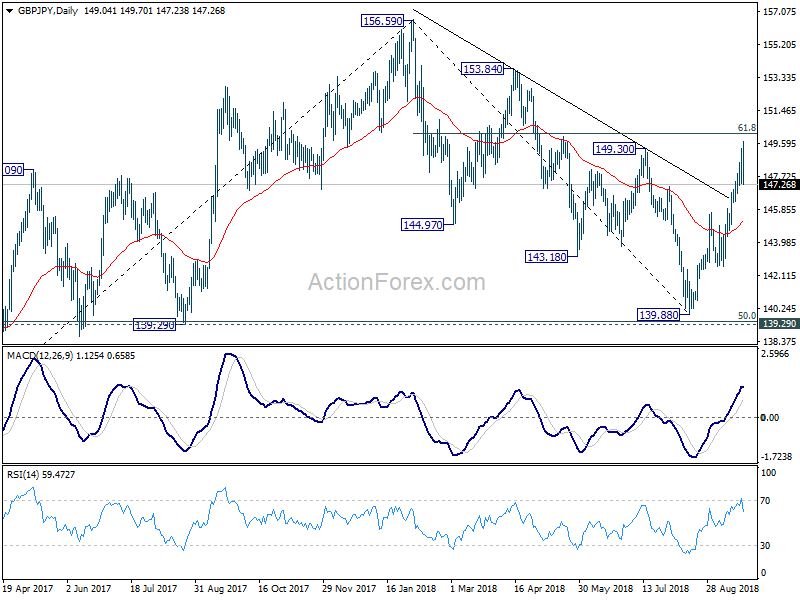
GBP/JPY's sharp fall and break of 148.51 minor support suggests temporary topping at 149.70. Intraday bias is turned neutral first. For now, further rise is still expected as long as 145.67 resistance turned support holds. Break of 149.70 will target 153.84/156.69 resistance zone. However, break of 145.67 will suggests that the rebound from 139.88 has completed and turn near term outlook bearish again.
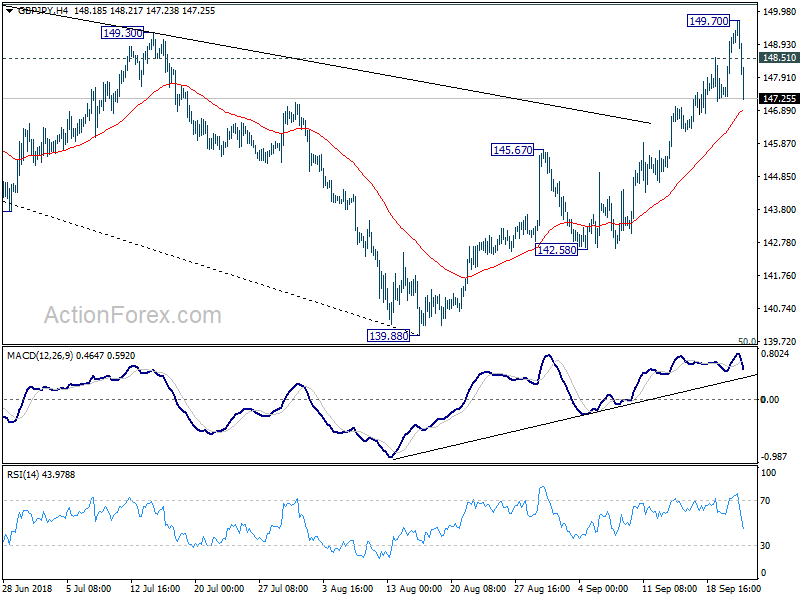
In the bigger picture, current development suggests that GBP/JPY has successfully defended 139.29 cluster support (50% retracement of 122.36 to 156.59 at 139.47). And, the rally from 122.36 (2016 low) is still intact. Such medium to long term rise would extend through 156.96 high. This will now be the preferred case as long as 145.67 near term support holds.
EUR/GBP Mid-Day Outlook
Daily Pivots: (S1) 0.8850; (P) 0.8871; (R1) 0.8897; More...
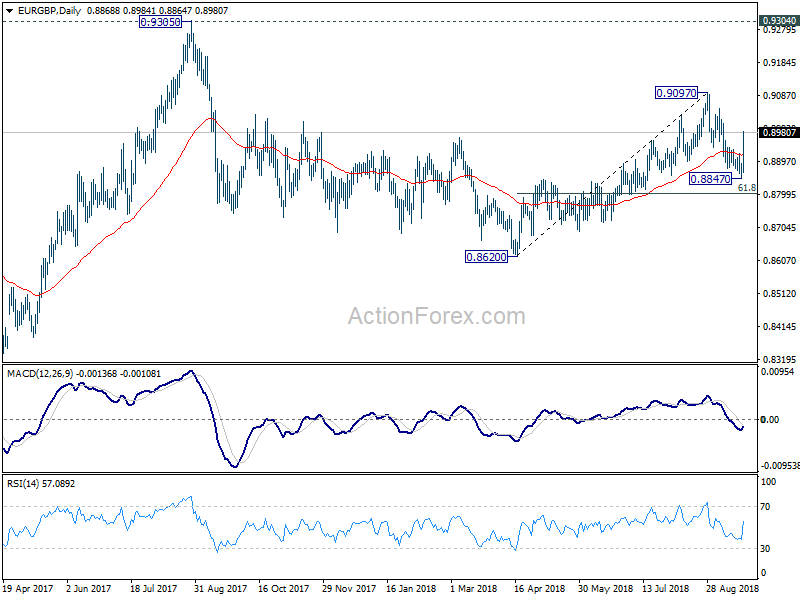
EUR/GBP surges strongly to as high as 0.8984 and takes our 0.8935 minor resistance decisively. The strong upside momentum, with bullish convergence condition in 4 hour MACD, argues that pull back from 0.9097 has completed at 0.8847 already. The corrective structure in turns carries bullish implication. Intraday bias is back on the upside for 0.9051/9097 resistance zone next. Break will resume whole choppy rise from 0.8620
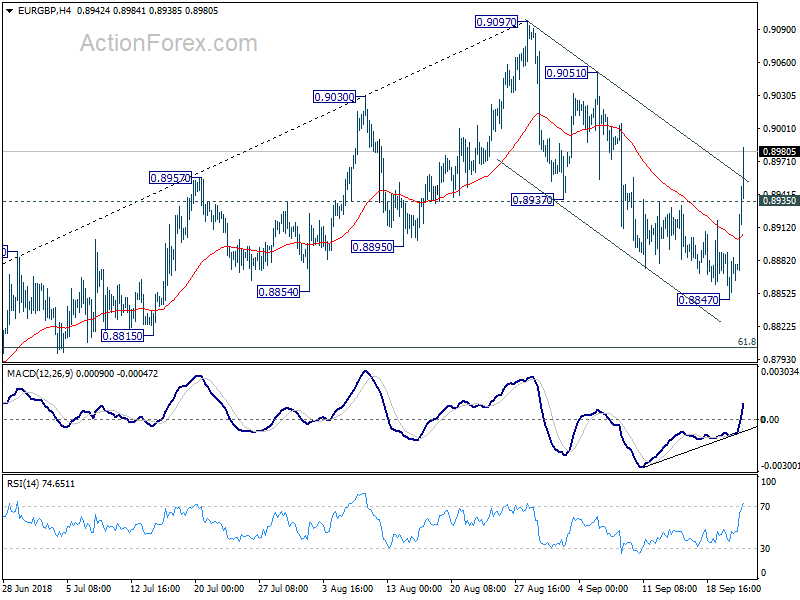
In the bigger picture, EUR/GBP is staying in long term range pattern from 0.9304 (2016 high). At this point, there is no clear sign of range break out yet. And more corrective trading would continue. On the upside, in case of another rise, we'd stay cautious on strong resistance from 0.9304/5 to limit upside in case of further rally. Meanwhile, if there is another medium term decline, strong support will likely be seen from 0.8303 to contain downside.
EUR/USD Mid-Day Outlook
Daily Pivots: (S1) 1.1702; (P) 1.1744; (R1) 1.1819; More.....
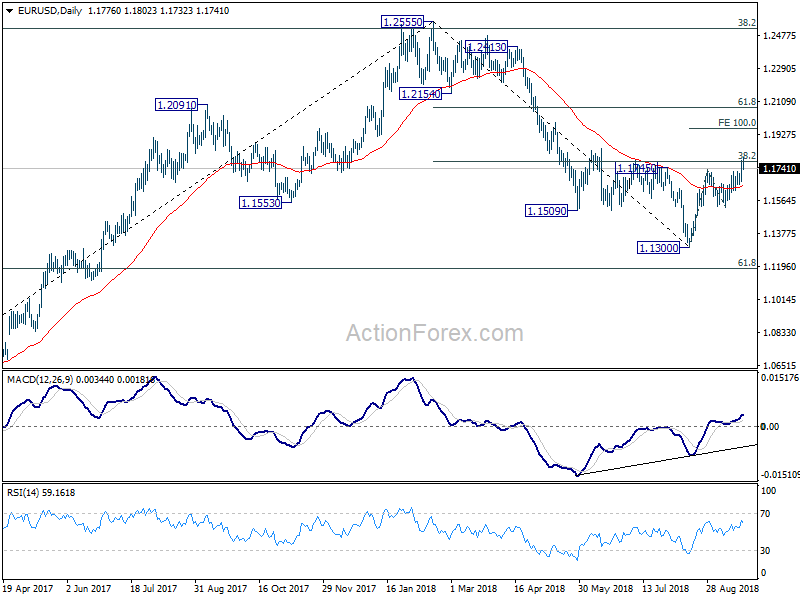
Focus in EUR/USD remains on 38.2% retracement of 1.2555 to 1.1300 at 1.1779 key resistance level. Rejection from 1.1779 and break of 1.1649 minor support will indicate that corrective rise from 1.1300 has completed. That will be in line with our original view and turn bias to the downside for 1.1525 support for confirmation. However, sustained break of 1.1779 will extend the corrective rise from 1.1300 to 100% projection of 1.1300 to 1.1733 from 1.1525 at 1.1958 before completion.
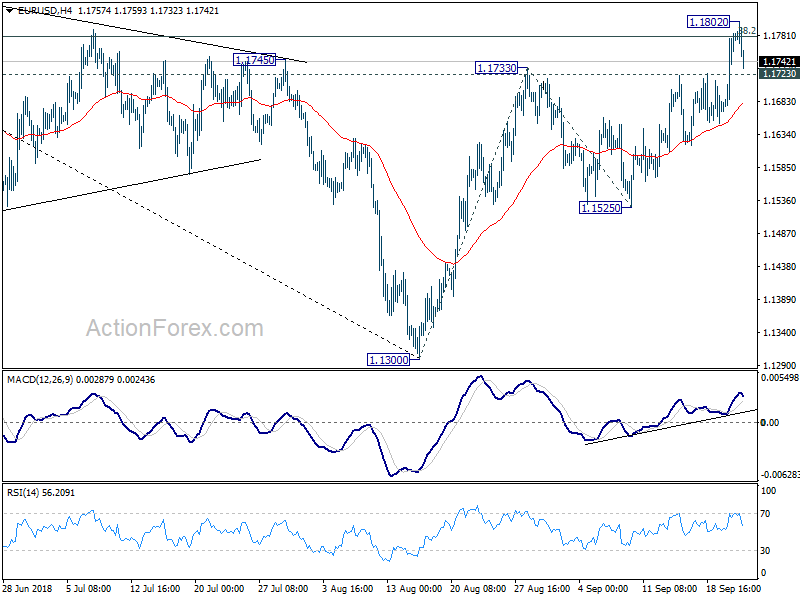
In the bigger picture, a medium term bottom should be in place at 1.1300, on bullish convergence condition in daily MACD and some consolidations would be seen. But still, note that EUR/USD was rejected by 38.2% retracement of 1.6039 (2008 high) to 1.0339 (2017 low) at 1.2516. That carries some long term bearish implications. Thus, we'd expect fall from 1.2555 high to resume after consolidation completes. Below 1.1300 should send EUR/USD through 61.8% retracement of 1.0339 to 1.2555 at 1.1186. And, in that case, EUR/USD would head to retest 1.0339 (2017 low).