

Sample Category Title
USD/CHF Mid-Day Outlook
Daily Pivots: (S1) 0.9558; (P) 0.9621; (R1) 0.9654; More...
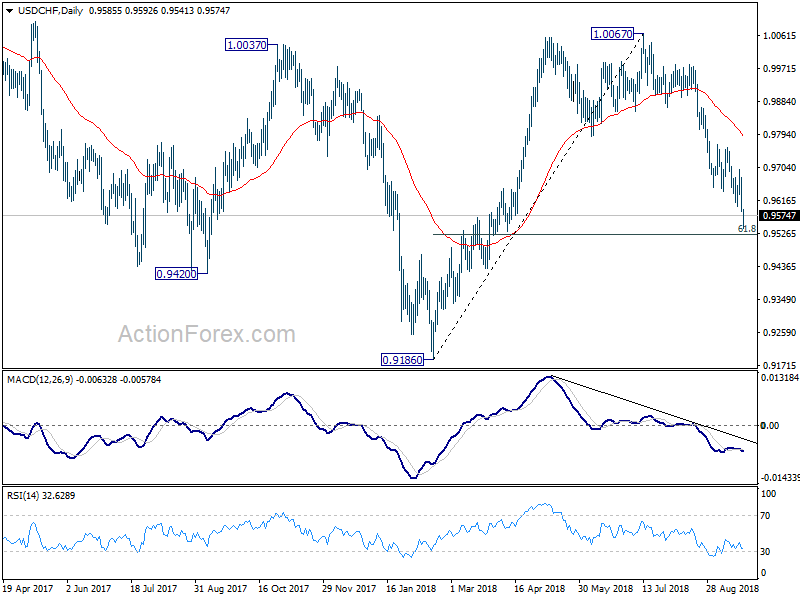
Intraday bias in USD/CHF remains on the downside as current decline is in progress for 0.9523 fibonacci level. We'd look for bottoming sign there to bring rebound. On the upside, break of 0.9699 minor resistance will indicate short term bottoming and target 0.9757 resistance. However, sustained break of 0.9523 would pave the way to retest 0.9186 low.
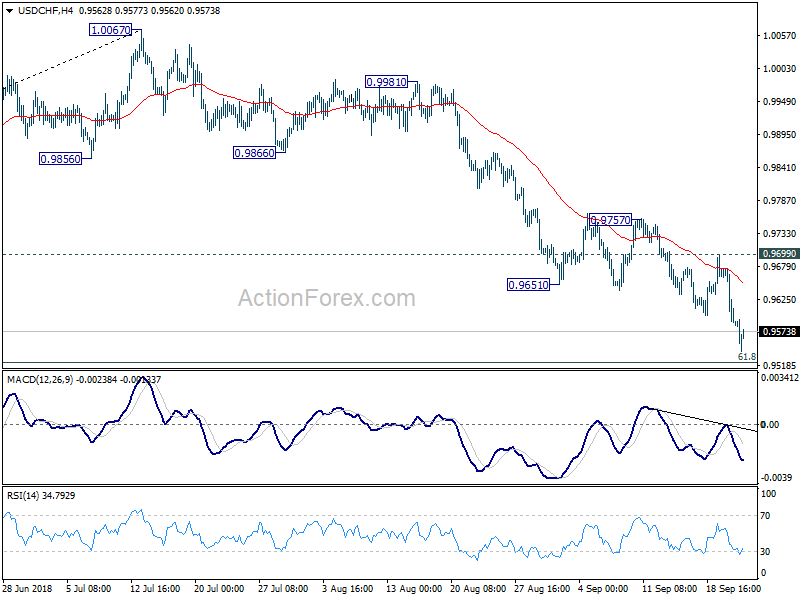
In the bigger picture, rise from 0.9186 low has completed at 1.0067, after failing to sustain above 1.0037 resistance. Fall from 1.0067 could extend to 61.8% retracement of 0.9816 to 1.0067 at 0.9523 and below. But for now, we don't expect a break of 0.9186 low. On the upside, firm break of 0.9866 support turned resistance will suggests that fall from 1.0067 has completed and rise from 0.9186 is resuming.
USD/JPY Mid-Day Outlook
Daily Pivots: (S1) 112.17; (P) 112.38; (R1) 112.71; More...
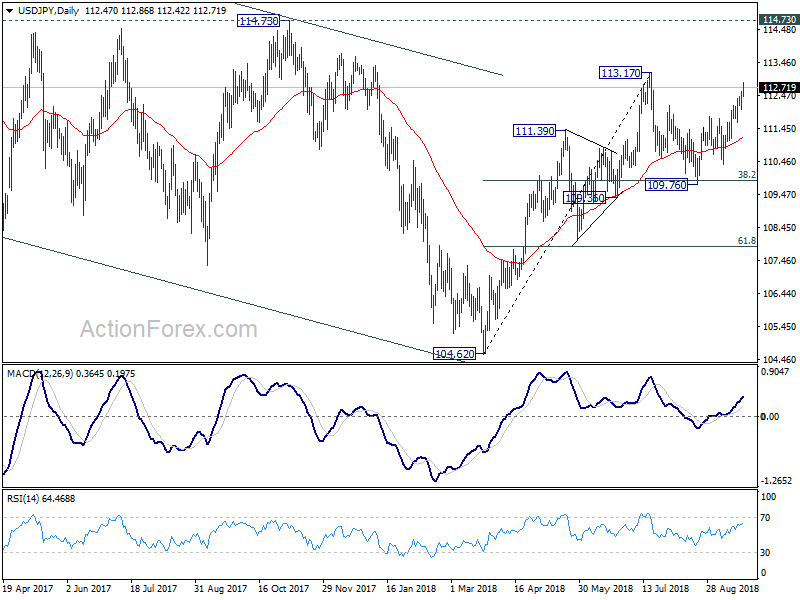
Intraday bias in USD/JPY remains on the upside for 113.17 resistance. Decisive break there will resume whole rally from 104.62 and target 114.73 resistance next. On the downside, below 112.38 minor support will turn intraday bias neutral first. But near term outlook will now stay cautiously bullish as long as 111.82 resistance turned support holds.
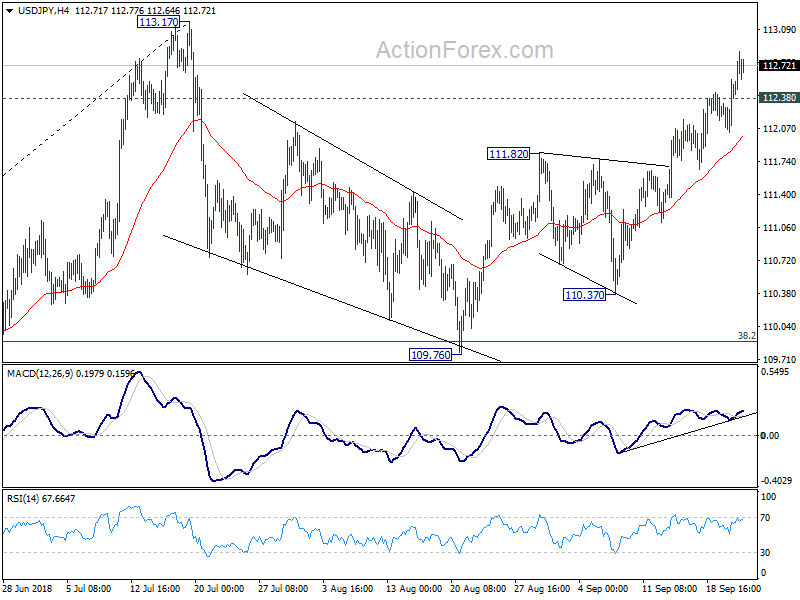
In the bigger picture, corrective fall from 118.65 (2016 high) should have completed with three waves down to 104.62. Decisive break of 114.73 resistance will likely resume whole rally from 98.97 (2016 low) to 100% projection of 98.97 to 118.65 from 104.62 at 124.30, which is reasonably close to 125.85 (2015 high). This will stay as the preferred case as long as 109.36 support holds. However, decisive break of 109.36 will mix up the outlook again. And deeper fall should be seen back to 61.8% retracement of 104.62 to 113.17 at 107.88 and below.
Canada: July Sees a Modest Retail Rebound
Canadian retail spending gained 0.3% month-on-month in July. Despite a stumble in June, July's gain was sufficient to send nominal sales to a new high. Stripping price effects out, the volume of goods sold was effectively flat.
Excluding the swing factors of auto and gasoline sales (-1.4% and 1.9% respectively), a gain of 0.7% would have been recorded.
Beyond these swing factors, it was a generally positive month for sales in major categories. Gains at food and beverage stores (+1.3%) and clothing stores (+1.1%) helped to offset some declines at health/personal care stores (-0.8%) and general merchandise retailers (-0.2%).
Regionally, gains were widespread, with 8 provinces reporting increased sales. Manitoba (-0.7%) and B.C. (-0.5%) were the exceptions.
Key Implications
Well alright. This was a not too hot, not too cold type of report. Beneath a modest headline lay decently positive details. Stripping out the noise of volatile auto and gasoline sales, we had yet another month of positive gains in both nominal and volume terms. Canadians may not be rushing to buy cars, we're still happy to go shopping.
Today's data is another sign of an economy that continues to perform well despite a number of headwinds. We continue to track third quarter GDP growth around the 2.2% mark or slightly above, consistent with our latest economic forecast.
That retail spending is holding up despite a string of interest rate increases should give the Bank of Canada confidence that the Canadian consumer continues to manage higher borrowing costs. The stars remain aligned for another policy interest rate hike on October 24th.
Sterling dives as UK PM May delcares Brexit negotiation an impasse
Sterling tumbles broadly as UK Prime Minister Theresa May declares that the Brexit negotiation with the EU is "at an impasse". And urged the nation to prepare for a no-deal scenario.
May talked about the two options the EU has offered. She criticized the Norway way as "would make a mockery" of the Brexit referendum. And, the second one, a border in the Irish Sea was already rejected by the parliament. Further she said if EU thinks she's going to budge on an Irish Sea border, they're making a serious mistake.
Additionally, May also criticized that there is no counter-proposal from the EU after rejecting her Chequers plan. While EU could say it has softened its stance on the Irish border, May said they cannot offer anything more generous.
Clear reacitons are seen in Sterling pairs after May's statement.
https://www.youtube.com/watch?v=wUnAGAakzt4
GBP/USD Mid-Day Outlook
Daily Pivots: (S1) 1.3169; (P) 1.3233; (R1) 1.3335; More...
GBP/USD's sharp fall suggests temporary topping at 1.3297 and intraday bias is turned neutral first. On the downside, break of 1.3096 will indicate rejection from 1.3316 key fibonacci resistance. That would be in line with our original view. In that case, corrective rebound from 1.2661 could have completed and intraday bias will be turned back to the downside for 1.2784 support. However, decisive break of 1.3315 will dampen our view and extend the rebound to next fibonacci level at 1.3721 instead.
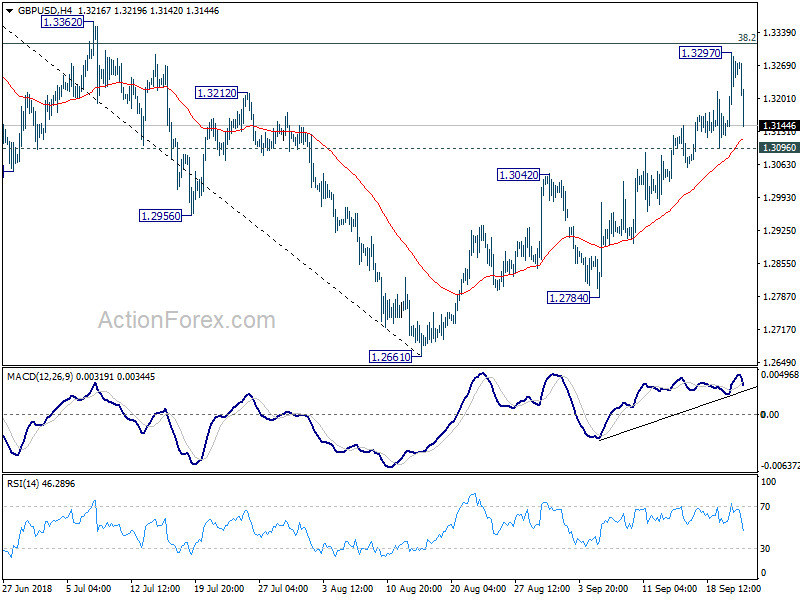
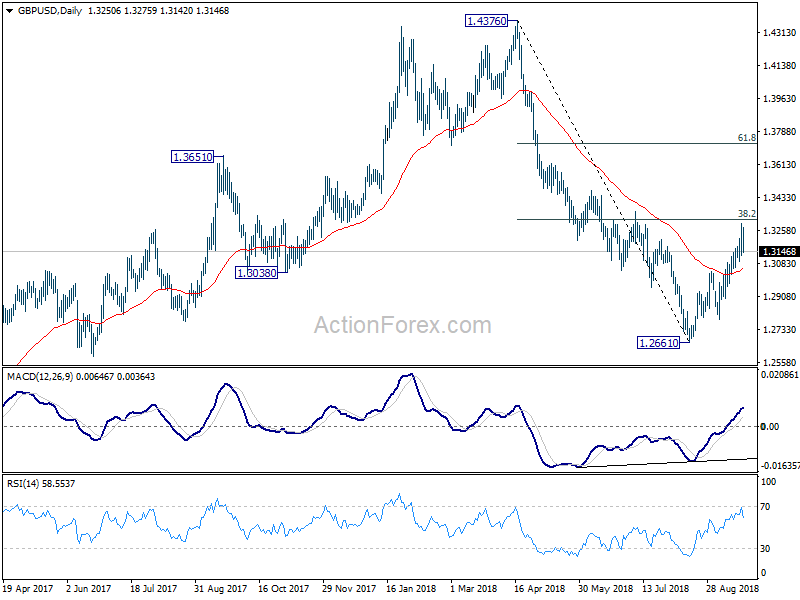
In the bigger picture, whole medium term rebound from 1.1946 (2016 low) should have completed at 1.4376 already, after rejection from 55 month EMA (now at 1.4062). The structure and momentum of the fall from 1.4376 argues that it's resuming long term down trend. And this will be the preferred case as long as 38.2% retracement of 1.4376 to 1.2661 at 1.3316 holds. However, firm break of 1.3316 would bring stronger rebound to 61.8% retracement at 1.3721. And, the eventual depth of the fall from 1.4376, and the chance of hitting 1.1946 low, will depend on the strength of the interim corrective rebound from 1.2661.
Dollar Paring Losses after a Long Losing Weak, Sterling Tumbles on the Pathetic Chequers Plan
Swiss Franc is trading as the strongest major currency today, but it's now followed by Dollar as the second weakest, who's paring some of the steep losses this week. Sterling is the weakest one after Prime Minister Theresa May's Chequers Brexit proposals were rejected by the EU. And May is being bashed by media at home. Yen isn't the second weakest one though, as it's also paring some of this week's loss. Canadian Dollar gets not support from stronger than expected retails and is trading mixed.
Quick update: Sterling dives further after May declares Brexit negotiation an impasse.
Technically, EUR/GBP's break of 0.8935 minor resistance suggests earlier than expected bottoming in the cross. GBP/USD's sharp pull back is an early signal of rejection by 1.3316 fibonacci resistance. EUR/USD breached 1.1779 fibonacci resistance earlier today but it's now back below. Focus will now turn to 1.3096 minor support in GBP/USD and 1.1723 in EUR/USD for more sign of bottoming for the greenback.
Released from Canada, headline retail sales rose 0.3% mom in July, matched expectation. Ex-auto sales rose 0.9% mom, above expectation of 0.6% mom. Headline CPI slowed from 3.0% yoy to 2.8% yoy in August as expected. Core CPI common rose from 1.9% to 2.0%. Core CPI Media rose from 2.0% to 2.1%. Core CPI trim rose from 2.1% to 2.2%. The set of data should be Canadian Dollar supportive, but we haven't seen it manifested in the markets yet.
UK PM May bashed by British media for failure at EU summit
UK media generally bashed Prime Minister Theresa May's performance at the informal EU summit in Austria. There are headlines today like "May humiliated," "Humiliation for May," "Embarrassing rebuff for PM in Salzburg," "Your Brexit's broken,"etc. It's rather common for UK politicians to get the harshest words back at home. Comments from the EU were so far rather gentle.
However, Scottish First Minister Nicola Sturgeon said, "Now that the EU has explicitly rejected it, the Chequers pretence has to stop. At the very least, single market/customs union membership must be back on the table and the Article 50 clock stopped to avoid a cliff edge".
Separately, European Commission President Jean-Claude Juncker urge EU and UK to be like "two loving hedgehogs". And, "when two hedgehogs hug each other, you have to be careful that there will be no scratches."
May is expected to make a statement today to defend her pathetic Chequers plan, which is disliked by EU as well as Brexiteers.
Eurozone PMIs: Slowdown limited to manufacturing.
Eurozone PMI manufacturing dropped to 53.3 in September, down from 54.4 and missed expectation of 54.5. That's also the lowest reading in 28 months. PMI services rose to 54.7, up from 54.5 and beat expectation of 54.5. PMI composite dropped to 54.2, down from 54.5. Still, growth in service sector offset weakness in manufacturing. And the survey data still pointed to solid 0.5% growth in Q3.
Chris Williamson, Chief Business Economist at IHS Markit said that "a near stagnation of exports contributed to one of the worst months for the Eurozone economy for almost two years. Trade wars, Brexit, waning global demand (notably in the auto industry), growing risk aversion, destocking and rising political uncertainty both within the Eurozone and further afield all fuelled the slowdown in business activity... Thankfully, the slowdown was limited to manufacturing. A buoyant service sector, boosted in part by domestic demand being supported by strong job gains, means the survey data are running at a level indicative of the economy growing by a solid 0.5% in the third quarter"
Also released, Germany PMI manufacturing dropped to 53.7 in September, down from 55.9 and missed expectation of 55.8. That's also lowest in 25 months PMI services rose to 56.5, up from 55.0 and beat expectation of 55.1. PMI composite dropped to 55.3, down from 55.6 and hit 2-month low.
France PMI manufacturing dropped to 52.5 in September, down from 55.3, missed expectation of 53.3. {MI services dropped to 54.3, down from 55.4, missed expectation of 55.4. PMI composite dropped to 53.6, down from 54.9 and hit a 21-month low.
Japan PMI manufacturing rose to 52.9, international trade tensions weigh on sentiments
Japan PMI manufacturing rose to 52.9 in September, up from 52.5, but missed expectation of 53.1. Markit noted that input cost inflation accelerated at the fastest pace since March 2011. Also, geopolitical tensions weigh on sentiment, with Future Output Index dipping further.
Joe Hayes, Economist at IHS Markit, said "manufacturing sector business cycle continued along its upward path". Also, "business conditions remained robust despite a number of natural disasters over the past month." "Recent demand pressures have been primarily driven by the domestic market, latest flash data pointed to the first rise in export sales since May amid ongoing global trade frictions." However, "business sentiment dipped further in September to a 22-month low as firms remain uncertain to how international trade tensions could impact the Japanese economy".
Japan core CPI ticked up to 0.9% yoy, core-core sluggish at 0.4% yoy
Japan all item CPI rose 0.5% mom 1.3% yoy in August. Core CPI (ex-fresh food) rose 0.3% mom, 0.9% yoy. Core-core CPI (ex-fresh food and energy) rose 0.2% mom, 0.4% yoy. While core CPI ticked up from 0.8% yoy in July, it's still way off BoJ's target of 2%. More importantly, the core-core continued to show sluggishness in underlying inflation.
GBP/USD Mid-Day Outlook
Daily Pivots: (S1) 1.3169; (P) 1.3233; (R1) 1.3335; More...
GBP/USD's sharp fall suggests temporary topping at 1.3297 and intraday bias is turned neutral first. On the downside, break of 1.3096 will indicate rejection from 1.3316 key fibonacci resistance. That would be in line with our original view. In that case, corrective rebound from 1.2661 could have completed and intraday bias will be turned back to the downside for 1.2784 support. However, decisive break of 1.3315 will dampen our view and extend the rebound to next fibonacci level at 1.3721 instead.
In the bigger picture, whole medium term rebound from 1.1946 (2016 low) should have completed at 1.4376 already, after rejection from 55 month EMA (now at 1.4062). The structure and momentum of the fall from 1.4376 argues that it's resuming long term down trend. And this will be the preferred case as long as 38.2% retracement of 1.4376 to 1.2661 at 1.3316 holds. However, firm break of 1.3316 would bring stronger rebound to 61.8% retracement at 1.3721. And, the eventual depth of the fall from 1.4376, and the chance of hitting 1.1946 low, will depend on the strength of the interim corrective rebound from 1.2661.
Economic Indicators Update
| GMT | Ccy | Events | Actual | Forecast | Previous | Revised |
|---|---|---|---|---|---|---|
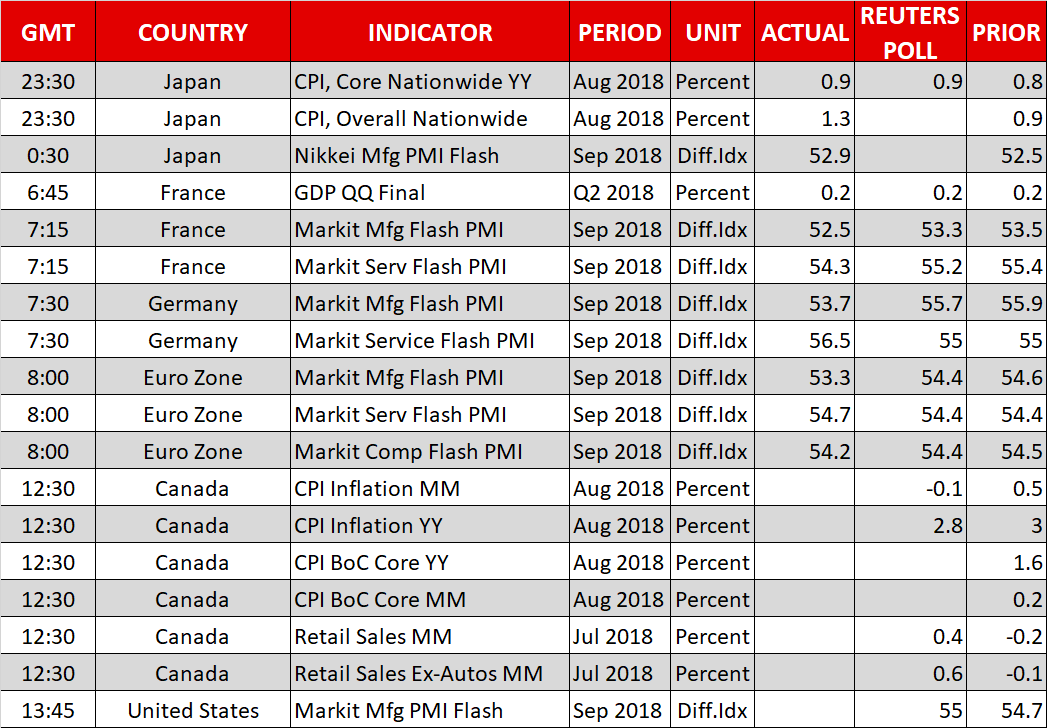
| 23:30 | JPY | National CPI Core Y/Y Aug | 0.90% | 0.90% | 0.80% | |
| 00:30 | JPY | PMI Manufacturing Sep P | 52.9 | 53.1 | 52.5 | |
| 04:30 | JPY | All Industry Activity Index M/M Jul | 0.00% | 0.20% | -0.80% | -0.90% |
| 06:45 | EUR | French GDP Q/Q Q2 F | 0.20% | 0.20% | 0.20% | |
| 07:15 | EUR | France Manufacturing PMI Sep P | 52.5 | 53.3 | 53.5 | |
| 07:15 | EUR | France Services PMI Sep P | 54.3 | 55.4 | 55.4 | |
| 07:30 | EUR | Germany Manufacturing PMI Sep P | 53.7 | 55.8 | 55.9 | |
| 07:30 | EUR | Germany Services PMI Sep P | 56.5 | 55.1 | 55 | |
| 08:00 | EUR | Eurozone Manufacturing PMI Sep P | 53.3 | 54.4 | 54.4 | |
| 08:00 | EUR | Eurozone Services PMI Sep P | 54.7 | 54.5 | 54.5 | |
| 08:30 | GBP | Public Sector Net Borrowing (GBP) Aug | 5.9B | 3.0B | -2.9B | -3.9B |
| 12:30 | CAD | Retail Sales M/M Jul | 0.30% | 0.30% | -0.20% | |
| 12:30 | CAD | Retail Sales Ex Auto M/M Jul | 0.90% | 0.60% | -0.10% | |
| 12:30 | CAD | CPI M/M Aug | -0.10% | -0.10% | 0.50% | |
| 12:30 | CAD | CPI Y/Y Aug | 2.80% | 2.80% | 3.00% | |
| 12:30 | CAD | CPI Core - Common Y/Y Aug | 2.00% | 1.90% | ||
| 12:30 | CAD | CPI Core - Median Y/Y Aug | 2.10% | 2.00% | ||
| 12:30 | CAD | CPI Core - Trim Y/Y Aug | 2.20% | 2.10% | ||
| 13:45 | USD | US Manufacturing PMI Sep P | 55.1 | 54.7 | ||
| 13:45 | USD | US Services PMI Sep P | 54.9 | 54.8 |
European Equities March Higher as Dollar Consolidates Losses; Canadian Data in Focus
Here are the latest developments in global markets:
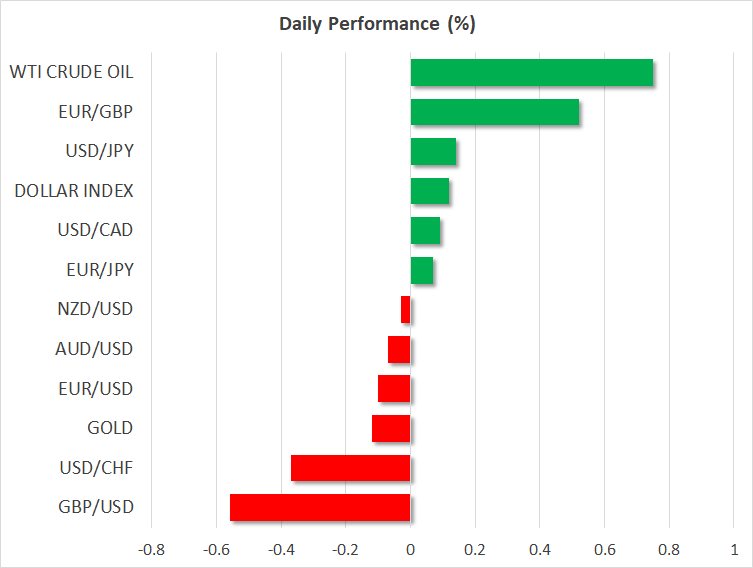
FOREX: The dollar’s index against a basket of six major currencies traded higher by 0.1% after touching its lowest since early July of 93.81 earlier on Friday. Still, the index mostly consolidated yesterday’s considerable losses. Dollar-advancing on Friday was most evident against the yen and sterling. The former, unable to attract safe-haven flows, took a beating lately. Evidently, dollar/yen, euro/yen and pound/yen scaled two-, five- and four-month highs on Friday; the latter though later retreated, trading lower by 0.4% on the day. Pound/dollar was down by 0.6%. Sterling’s fall probably came on the back of profit-taking following gains which allowed cable to rise to a two-and-a-half-month high near 1.33 on Thursday, and in light of the fact that fears for a no-deal Brexit remain in place after the impasse at the Salzburg summit this week. Euro/dollar was down by 0.1% at 1.1761 after piercing through the 1.18 handle earlier in the day to post a three-month high of 1.1803. The reaction to the eurozone’s September flash PMIs was muted, though the common currency fell earlier in the day when data showed the respective PMI prints for Germany and France coming in below expectations for the most part. In terms of the euro-wide data, the divergence between services and manufacturing was evident; the PMI reading for the latter was below expectations, coming in at its lowest since September 2016; though at 53.3 it still remained in expansion territory.
STOCKS: Upbeat equity market sentiment from Wall Street and Asia reverberated into Europe, with major benchmarks in the continent all being in the green. At 1145 GMT, the pan-European Stoxx 600 was up by 0.35% and not far below a one-and-a-half-month high of 385.20 tracked earlier on Friday. The blue-chip Euro Stoxx 50 traded up by 0.5%, being on its 10th straight session of advances, something not experienced in more than twenty years. Meanwhile, the UK’s FTSE 100, the German DAX and the French CAC 40 rose by 0.8%, 0.4% and 0.6% correspondingly. The bullish movement was again attributed to easing concerns over global trade. This raises questions though: is there really concrete evidence that this is the case? – the implication is that markets may be running ahead of themselves. Elsewhere, futures tracking the Dow, S&P 500 and Nasdaq 100 were little changed. The Dow and S&P finished at all-time highs on Thursday, with the Nasdaq 100 closing not far below its record peak. Heightened volatility may be in store for US equities on Friday due to “quadruple witching” (see below).
COMMODITIES: WTI and Brent crude traded higher by 0.8% and 1.1%, at $70.89 and $79.57 per barrel respectively. The two benchmarks retreated yesterday after President Trump used Twitter to criticize OPEC for pushing prices up; the cartel and its allies will be meeting to discuss output this weekend. In precious metals, dollar-denominated gold is marginally down, having hit an eight-day high of $1,211.02 per ounce earlier on Friday. The metal benefitted on the back of the greenback’s recent retreat and looks set to finish the week on a positive note.
Day ahead: Canadian data due, with trade developments also in focus
Inflation and retail sales figures out of Canada at 1230 GMT will be the highlight in terms of data releases in the remainder of Friday’s session. Meanwhile, any potential updates regarding the US-China trade skirmish, the NAFTA negotiations, and the Brexit talks are also likely to attract attention.
In Canada, CPI inflation is forecast to have cooled to 2.8% in annual terms during August, from 3.0% in the previous month. The core figure – which excludes volatile items such as energy – will also be in focus, though no forecast is available. As for retail sales, projections point to a 0.4% growth in July on a monthly basis, a rebound following a 0.2% decline previously. The core print, which strips out automobile sales, is also expected to bounce to 0.6%, after falling by 0.1% in June.
Overall, these seem like very decent prints that – if confirmed – could stoke even further market expectations for a BoC rate increase in October. Although inflation is expected to slow, it’s still anticipated to remain far above the midpoint of the BoC’s target of 2% +/- 1%, hence allowing the Bank to proceed with normalizing policy uninterrupted. The market-implied probability for an October hike currently rests at 86% (Canada’s OIS), and in case of strong data prints that push it even higher, the loonie could extend its latest gains.
Besides data, any updates in the US-China trade spat could also prove crucial for market sentiment. Investors breathed a sigh of relief recently that the latest tariffs were not as aggressive as feared, leading to a widespread market rally. That said, it bears mention that neither side has actually shown concrete signs of backing off, suggesting that the recent melt-up in stocks may be more fragile than it seems, with a single alarming headline possible to “ruin the party” at any moment. In other words, have investors run ahead of themselves in discounting a less-aggressive scenario for trade?
Also stock-related, today is “quadruple witching” day in the US, a quarterly event when futures and options on indices and individual stocks expire. Trading volumes are generally higher than usual in such sessions, as investors rush to close, roll over, or rebalance some of their existing positions. This implies that market moves may be abrupt and perhaps larger in magnitude than average, without much in the way of fundamentals behind them.
In energy markets, the weekly Baker Hughes report on active oil rigs in the US is due out at 1700 GMT. Beyond that, a weekend meeting between OPEC and other allies taking place in Algeria may be of interest.
As for the speakers, UK PM Theresa May is anticipated to deliver remarks at 1245 GMT. Her tone regarding the Chequers plan, which was recently rejected by the EU, may be crucial for sterling’s forthcoming direction. If she sticks to her proposals, or appears generally unwilling to surrender some ground, that may spell trouble for the pound as speculation for a continued deadlock in the talks regains steam.
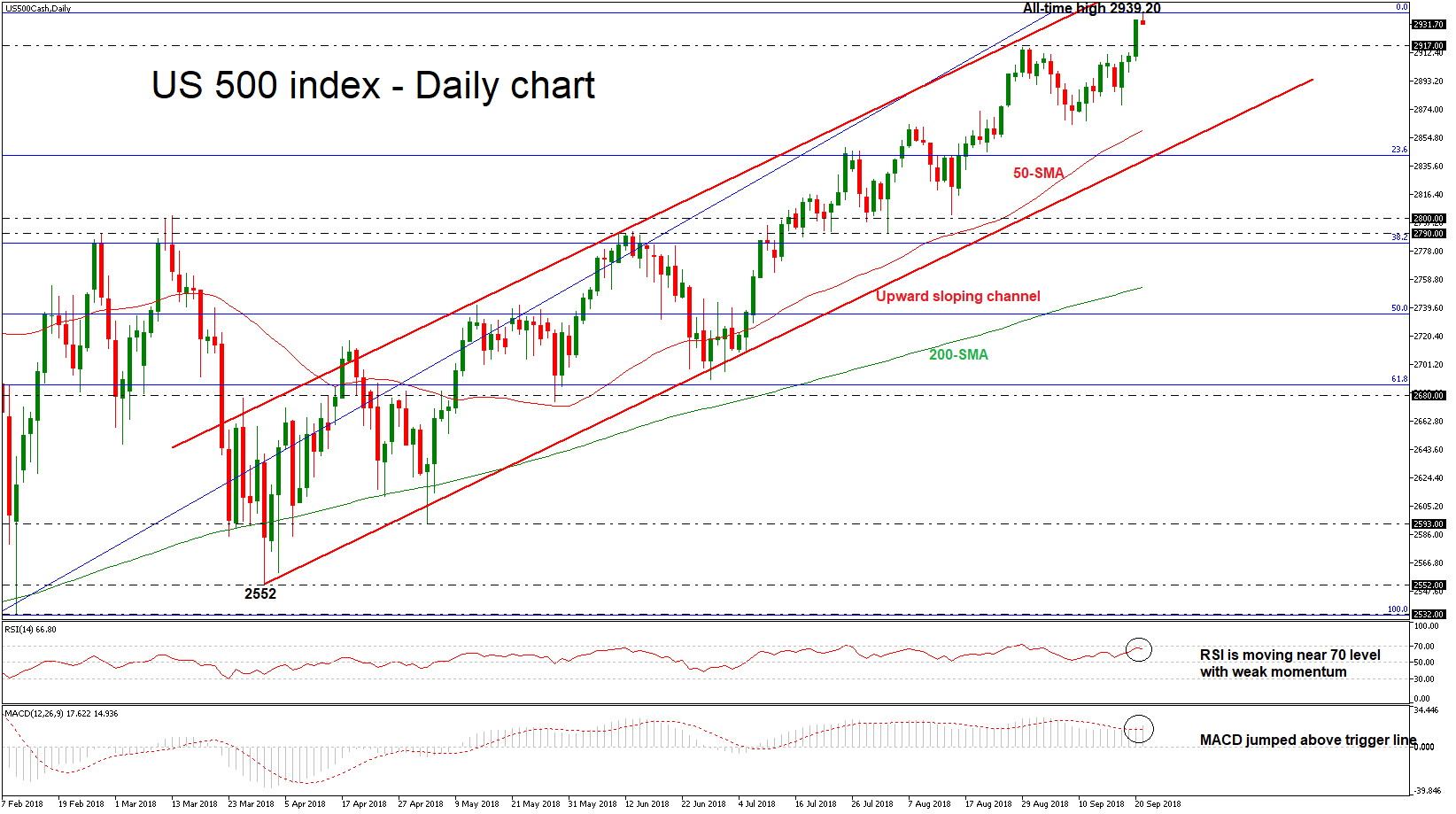
US 500 Index Achieves New All-Time High; Holds in Upward Sloping Channel
The US 500 index reached a fresh all-time high of 2939.20 earlier today and has been stuck in a channel titled to the upside since April 2. The bullish picture seems to be overstretched as the RSI indicator is flattening near the 70 level, however, the MACD oscillator posted a bullish crossover with its trigger line in the positive zone.
More upside movements and a surpass above the aforementioned all-time high could challenge the next strong psychological level of 3000. There are no significant obstacles before this handle.
If prices head lower, support could come from the 50-day simple moving average (SMA) around 2860, before being able to challenge the 23.6% Fibonacci retracement level of the upleg from 2532 to 2939.20, near 2843, which stands near the medium-term ascending trend line. A significant sell-off below this area, could shift the bullish outlook to bearish and hit the 2800 key level.
To conclude, in the medium-term, the outlook remains positive since prices hold above all the moving average lines and within the upward sloping channel.
Surging Canadian Dollar at 14-Week High, CPI and Retail Sales Next
The Canadian dollar is trading sideways in the Friday session, after posting strong gains in the Thursday session. Currently, USD/CAD is trading at 1.2924, up 0.13% on the day. On the release front, Canada releases key consumer data. CPI is expected to post a rare decline, with an estimate of -0.1%. Retail Sales is forecast to rebound and record a gain of 0.6%. There are no major releases out of the U.S.
The U.S dollar is broadly lower this week, and the Canadian dollar has jumped on the bandwagon, posting gains of close to 1%. On Thursday the pair dropped to 1.2884, its lowest level since June 11. However, the Canadian currency’s gains have been pared due to pressure on oil prices. If this continues, the Canadian dollar could surrender some of its recent gains.
The US-China trade war is heating up, with the two economic giants exchanging tariffs this week. On Monday, U.S President Trump announced 10% tariffs on some $200 billion worth of Chinese goods. China quickly responded, slapping 10% tariffs on $60 billion in US exports. These tit-for-tit tariffs have become a familiar script, only this time investors haven’t panicked and snapped up U.S dollars. Investors are somewhat relieved that the tariffs are just 10%, and China is taking measures to reduce the effect of the tariffs on its economy, including increasing stimulus and infrastructure spending. Global growth remains strong, despite the tariff spat. However, China has also threatened to cancel upcoming trade talks with the U.S, in protest of the recent U.S tariff.
DAX Rally Continues as Investors Ignore Tariff War
The DAX index has posted strong gains in the Friday session. Currently, the index is at 12,393, up 0.54% on the day. On the release front, German and eurozone manufacturing PMIs disappointed, missing their estimates.
It’s been a good week for the DAX, which has jumped 2.9 percent. Earlier on Friday, the DAX touched 12,458 points, a high for September. Clearly, risk appetite remains strong, despite the U.S and China exchanging another round of tariffs this week. On Monday, U.S President Trump announced 10% tariffs on some $200 billion worth of Chinese goods. China quickly responded, slapping 10% tariffs on $60 billion in US exports. These tit-for-tit tariffs have become a familiar script, only this time investors haven’t panicked and snapped up U.S dollars. Investors are somewhat relieved that the tariffs are just 10%, and China is taking measures to reduce the effect of the tariffs on its economy, including increasing stimulus and infrastructure spending. Global growth remains strong, despite the tariff spat. Although China has threatened to cancel upcoming trade talks with the U.S in protest of the recent tariff decision, investors are in an optimistic mood.
German and eurozone manufacturing PMIs were soft in September. The German indicator dropped sharply, from 56.1 to 53.7, missing the estimate of 55.7 points. This marked the weakest reading since August 2016. It was a similar story from eurozone manufacturing PMI, which fell from 54.6 to 53.3, the lowest level since October 2016. This marked the ninth straight month that the indicator has weakened – in December 2016, the indicator stood at 60.6 points. There was better news from services PMIs. German Flash Final Services PMI rose to 56.5, above the estimate of 55.1 points. The eurozone release improved to 54.7, above the estimate of 54.5 points.