

Sample Category Title
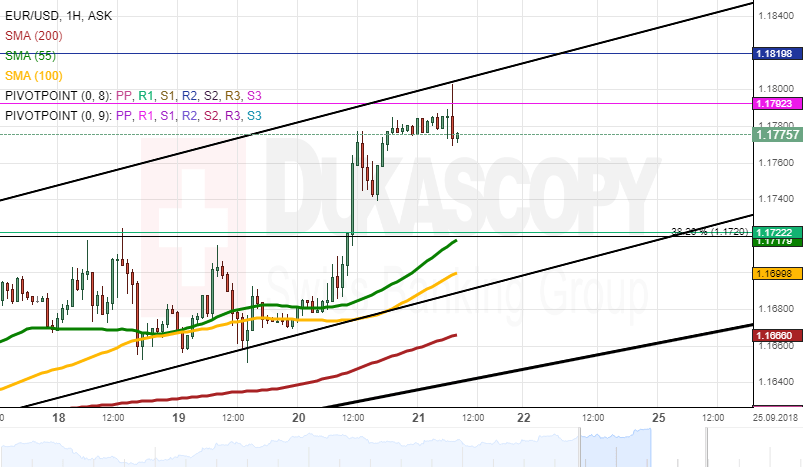
EURUSD Analysis: Jumps To 1.1785
On Thursday, the European Single Currency jumped against the US Dollar as it was expected. The rate ignored most technical levels to continue trading at the 1.1778 mark during Friday morning hours.
In regards to the near-term future, most likely, the rate will continue to surge upwards until the rate meets the monthly R1 at 1.1792 mark, which could bounce the rate to go downwards to the 1.1760 level during the session.
On the other hand, the rate could break the resistance of the monthly R1 at 1.1792 to trade between the monthly R1 and the weekly R2 at 1.1819 mark on Friday.
GBPUSD Analysis: Breaks Patterns To Trade At 1.3228
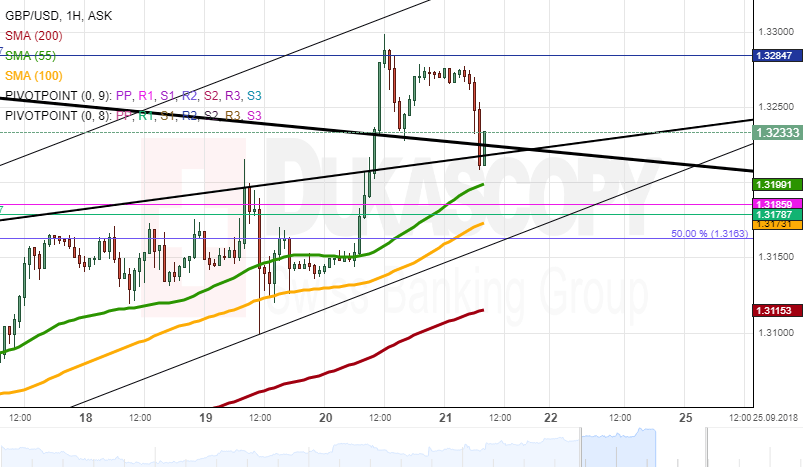
The British pound appreciated 0.90. % against the US Dollar since Thursday's session. The currency exchange pair broke the previously drawn medium pattern and the upper boundary of the large descending pattern to trade at the 1.3228 mark on Friday.
In the near-term future, the rate should move downwards to bounce off the upper boundary of the large pattern with the support of the 55-hour and the 200-hour simple moving averages to trade in the 1.3250 area during the day.
On the other hand, the rate may break the large channel again to trade near the monthly at R1 1.3185 on Friday.
USDJPY Analysis: Will Be Stopped By R2 At 113.01
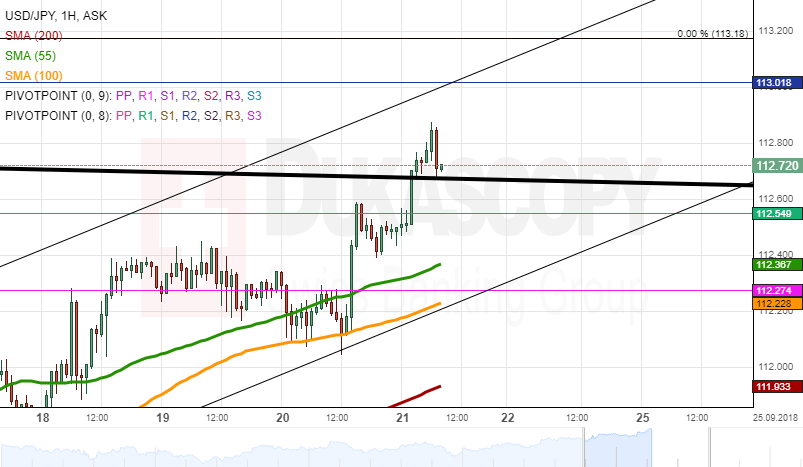
The US Dollar appreciated 0.54% against the Japanese Yen since Thursday's session. The currency pair broke the upper boundary of the large descending pattern to trade at the 112.83 mark during Friday morning hours.
In regards to the near future, the rate will surge upwards to the weekly R2 at 113.01 mark, which could stop the rate from surge due to its resistance for the rate. Most likely, the US Dollar will be traded in the 112.80 area during Friday session.
On the other side, the US Dollar may break the resistance of the weekly R2 at 113.01 mark to surge to the Fibonacci retracement level at 113.18 mark.
XAUUSD Analysis: Surges To 61.80% Fibo
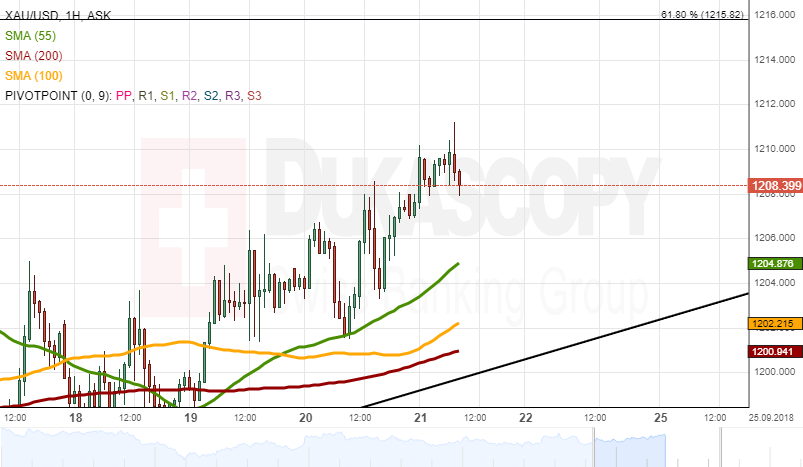
The gold price appreciated 0.59% since Thursday's trading session. On Friday, the yellow metal was surging upwards locating at the 1,2100.00 mark.
During Thursday's trading session, the simple moving averages pushed the yellow metal to surge as it was expected. The gold is moving closer to the 61.80% Fibonacci retracement level, which gold should reach in next couple of days.
Moreover, the simple moving averages are trying to catch up the rate to support the yellow metal to break through the Fibonacci retracement level in the near-term future.
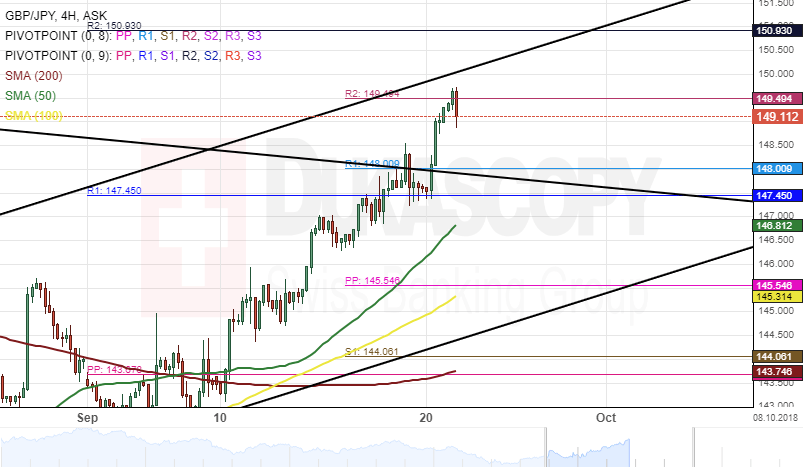
GBP/JPY 4H Chart: Potential Breakout
The British Pound has increased its trading range against the Japanese Yen. This bullish momentum started on August 20 and had since breached the upper boundary of a six-month descending channel at 148.00.
Currently, the exchange rate has tested a resistance level formed by the weekly R2 at 149.49 and also, trading near the upper boundary of a one-month ascending channel and could be set for a breakout.
However, If that resistance region holds, the GBP/JPY currency exchange rate is likely to make a temporary pullback towards a support cluster formed by the weekly and the monthly pivot points near the 147.45 mark.
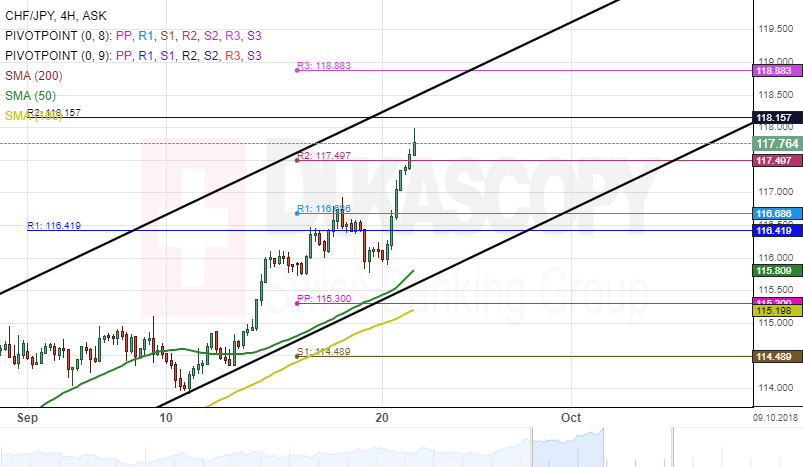
CHF/JPY 4H Chart: Tests Weekly R2 At 117.49
The Swiss Franc has been trading in a one-month ascending channel against the Japanese Yen. The CHF/JPY exchange rate bounced off the bottom border of the channel on August 20 and had since reached an eight-month high level at the 117.49 area.
The currency pair breached a resistance line formed by the weekly R2 at 117.49 during the morning hours of today's session. Given that the price has tested the resistance level as mentioned earlier, the next target for the rate will be the upper boundary of the one month channel at 118.15.
However, if that resistance line holds, the currency exchange rate could make a brief retracement towards a support cluster formed by the combination of the weekly and the monthly PPs at 116.68.
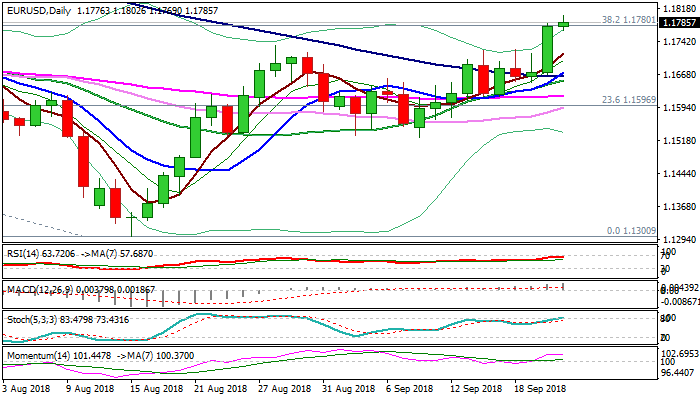
EURUSD Outlook: Bulls Are Consolidating Around Pivotal 1.1780 Barrier Before Continuing Rally
The Euro is consolidating in early Friday's trading after 0.9% rally previous day (the biggest one-day gains since 29 June) and facing strong headwinds from pivotal Fibo barrier at 1.1780 (38.2% 1.2555/1.1300).
Thursday's rally was capped here, with today's probes higher (new high at 1.1802, the highest since 14 June, was posted) being so far short-lived. Bullish daily techs favor further advance, which would be preceded by consolidative/corrective action on overbought conditions.
Dips should be ideally contained at 1.1720/00 zone before resuming. Weekly close above 1.1780 pivot would open 1.1848 (14 June high), with stronger bullish acceleration to challenge 1.1928/45 (50% retracement of 1.2555/1.1300/200SMA).
Lower pivots lay at 1.1671 (rising 10SMA which made bull-cross with 100SMA) and 1.1653 (rising 20SMA), loss of which would weaken the structure.
Res: 1.1802, 1.1848, 1.1928, 1.1945
Sup: 1.1769, 1.1733, 1.1700, 1.1671
Yen & Dollar Pummeled Amid Stock Exuberance, Key Eurozone And Canadian Data Due
Here are the latest developments in global markets:
FOREX: The dollar index is higher by a marginal 0.05% on Friday, recouping some of the significant losses it posted in the previous session as risk appetite remained firm and investors pared back more of their safe-haven bets on the US currency. The haven-perceived yen was also on the back foot, performing even worse than the greenback amid this risk-on environment. Meanwhile, the euro and sterling capitalized, both staging a spectacular recovery to touch a three- and two-month high against the dollar respectively.
STOCKS: Both the Dow Jones (+0.95%) and the S&P 500 (+0.78%) closed at fresh record highs on Thursday, with the former finally managing to recover all the ground it lost during the early stages of the year. Trade concerns have taken a back seat for now, with investors breathing a sigh of relief that the latest tariff shots were not as aggressive as feared. The Nasdaq Composite (+0.98%) also surged, though it fell slightly short of reaching its own all-time highs. According to futures, the Dow, S&P, and Nasdaq 100 are all set for a higher open today as well. Asian benchmarks were a sea of green on Friday too. Japan’s Nikkei 225 (+0.82%) and Topix (+0.92%) surged as the yen lost ground, painting a brighter picture for Japanese exporters. In Hong Kong, the Hang Seng climbed by 1.63%. In Europe, all the major benchmarks were set to open higher today, futures indicate.
COMMODITIES: Oil prices are somewhat higher on Friday, with WTI and Brent gaining 0.16% and 0.27% respectively, both attempting to recover the Trump-induced losses they recorded in the previous session. The US President tweeted on Thursday that although the US protects Middle East countries, they continue to push for higher oil prices, concluding that 'the OPEC monopoly must get prices down now!”. In precious metals, gold is up by 0.10% at $1,209 per ounce, looking set to advance for a third straight session. The dollar-denominated metal has taken advantage of the retreat in the greenback lately, and now looks ready to challenge the upper bound of the sideways range it has been trading in recently, at $1,214.
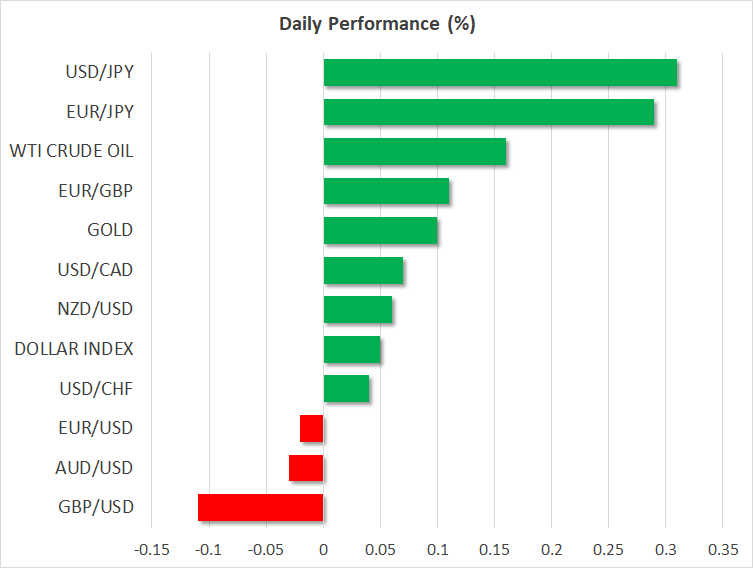
Major movers: Yen and dollar plummet as risk appetite firms; sterling & euro capitalize
In another session characterized by risk-taking exuberance, major US stock indices like the S&P 500 and the Dow Jones broke fresh records highs on Thursday as investors continued to favor riskier assets, shunning safer ones. Accordingly, the haven-perceived Japanese yen was the biggest underperformer among the G10 currencies, collapsing to a five-month low against the euro. The dollar was the second weakest, as investors continued to unwind safe-haven bets on the world’s reserve currency amid sustained optimism that the Sino-American trade skirmish can still be resolved in a diplomatic manner.
Capitalizing on the weakness seen in the yen and greenback, were the euro and sterling. Euro/dollar surged by over 1 cent in the session to touch 1.1785, a high last seen in early July. Meanwhile, sterling/dollar soared – coming a few pips shy of touching 1.3300 – on the back of strong UK retail sales, though it later gave back some of its gains to settle near 1.3250, as the EU summit in Austria concluded without any signs that a Brexit deal is inching closer. Indeed, EU officials including Commission President Juncker confirmed the UK’s Irish border backstop is not a viable solution, though they maintained a cautiously optimistic tone overall, expressing hopes that common ground can be reached in the coming weeks.
In Japan, PM Shinzo Abe won his third term as the leader of his ruling Liberal Democratic Party. Considering that he’s seen as a major proponent of loose monetary policy, his victory may have signaled the BoJ will continue uninterrupted with its ultra-loose tactics, potentially explaining some of the weakness in the yen. Recall that 'aggressive monetary policy” is one of the three arrows in Abenomics, the PM’s flagship strategy for fighting deflation.
On the trade front, reports suggest China plans to reduce the tariffs it charges on imported goods from most of its trading partners. Strategically, there was no mention of whether the US will be among these nations, with China likely aiming to use these reductions as a bargaining chip in its forthcoming negotiations with America. Meanwhile, the NAFTA talks between the US and Canada continued, though there was little to suggest a deal is imminent as the unofficial September 30 deadline draws closer.
Day ahead: Eurozone flash PMIs on the agenda alongside Canadian inflation & retail sales
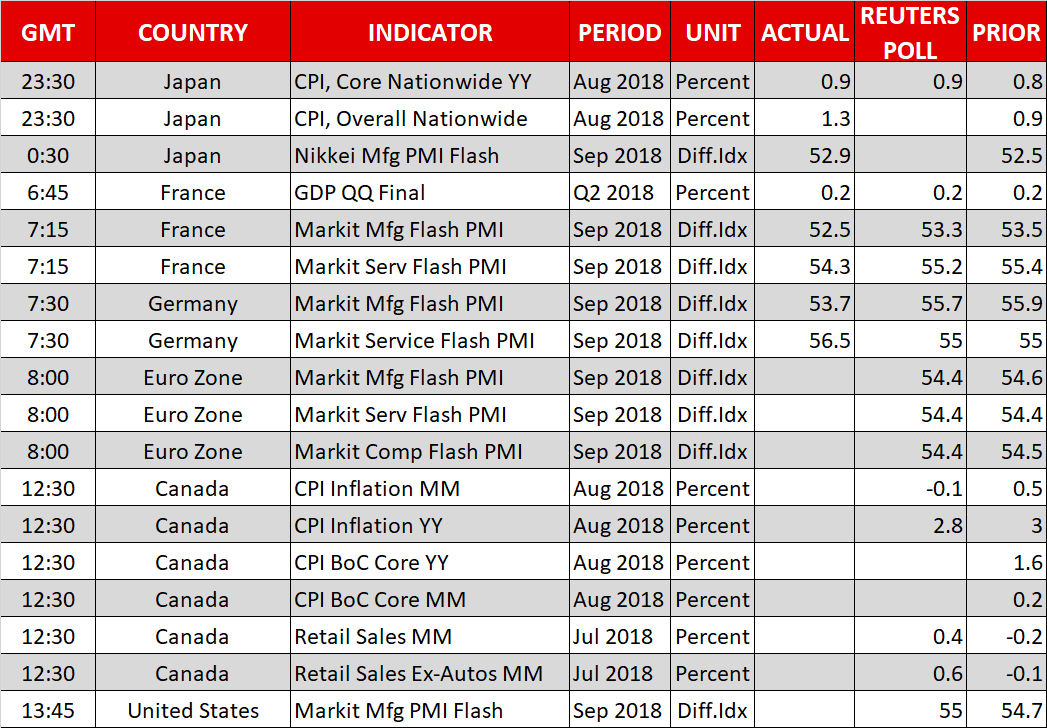
Friday’s calendar includes preliminary September PMI readings out of the eurozone, with the US being on the receiving end of its respective manufacturing PMI print. Elsewhere, important data on inflation and retail sales are due out of Canada which have the capacity to render an October hike by the Bank of Canada a done deal.
At 0800 GMT, eurozone flash manufacturing and services PMIs, as well as the composite PMI that blends the two sectors and which is viewed as a good overall growth indicator for euro area economies, will be made public. The manufacturing PMI is projected to slightly weaken relative to August, maintaining its overall down movement after hitting its highest on record in December last year. Specifically, it is expected at 54.4, its lowest since late 2016. The services PMI is forecast to remain steady at 54.4 and the composite PMI to marginally weaken to 54.4, both standing at a distance to peak levels tracked in January of the current year.
Despite these measures retreating from robust levels recorded in late 2017 – early 2018, it bears mention that they still remain comfortably in expansion territory above 50. Meanwhile, it would be interesting to see whether rising global trade tensions yet again weighed on these gauges.
Germany and France, the eurozone’s two largest economies, saw the release of their respective PMI prints earlier in the day. The French prints dissapointed, declining by more than expected, as did the German manufacturing index, though Germany’s services figure surprised positively.
Canadian inflation and retail sales figures for August and July respectively are due at 1230 GMT. Inflation as measured by the consumer price index (CPI) is anticipated to contract by 0.1% m/m, after rising by 0.5% in July. This would put the annual pace of growth at 2.8%, below July’s 3.0% which was the fastest pace of expansion since September 2011. Core CPI that excludes volatile items including energy which was the primary contributor to July’s rise in headline inflation will be monitored, as well as the core measures of inflation utilized by the BoC in its policymaking (CPI common, median and trimmed); no polls are available for these data.
On the retail sales front, both headline and core retail sales that exclude automobiles are anticipated to re-enter positive territory after contracting in June. Upbeat data out of Canada can even more conclusively put on the table a 25bps rate increase by the Canadian central bank in late October; the odds for such an outcome are already running high according to Canadian OIS (86%).
Also Canada-related, ongoing efforts for a new North American trade deal remain fruitless. Any headlines on this have the potential to move the loonie.
Markit’s September flash manufacturing PMI for the US is projected to show an improvement, with the gauge standing at 55.0, from August’s 54.7. The reading is slated for release at 1345 GMT.
In energy markets, the weekly Baker Hughes report on active oil rigs in the US due out at 1700 GMT will be attracting interest. Beyond this, a weekend meeting between OPEC countries and other allies taking place in Algeria may offer short-term direction to oil prices; oil output will be discussed during the gathering. In the meantime, some Trump Twitter comments managed to weigh on oil prices.
The US equity session might be lively due to 'quadruple witching”.
Lastly, on Sino-US trade relations, there seems to be some euphoria stemming from the belief that the two sides are getting less confrontational. This is somewhat puzzling to say the least, given no concrete indication pointing to that direction.
Technical Analysis: EURUSD pierces through 1.18 to hit 3-month high; RSI close to overbought levels
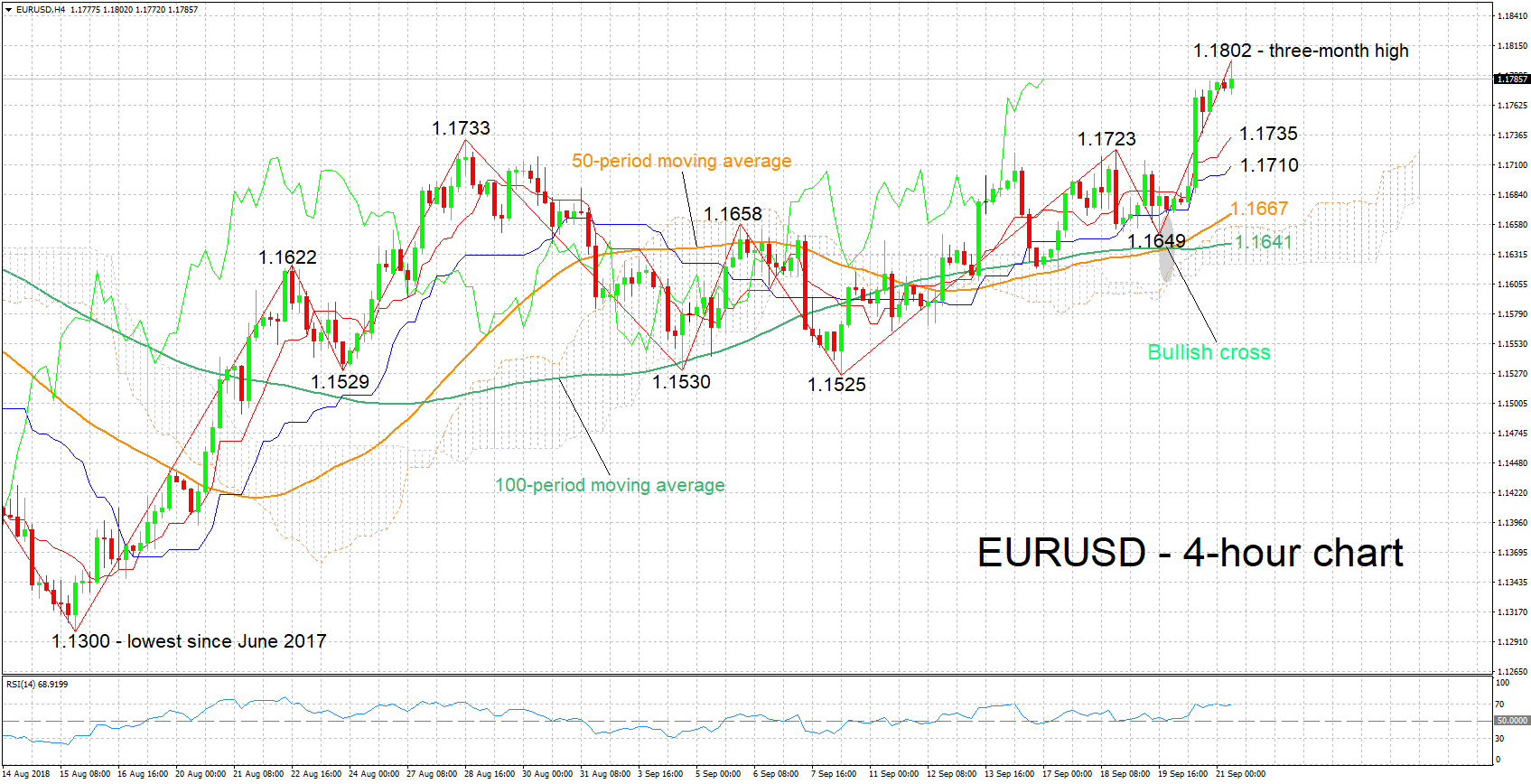
EURUSD hit a three-month high of 1.1802 earlier in the day. The Tenkan- and Kijun-sen lines are positively aligned, in support of a bullish bias in the short-term. The rising RSI lends credence to this view. Notice though as well that the indicator is close to its 70 overbought zone.
Upbeat eurozone PMI figures are likely to push the pair further up. Immediate resistance may come around the 1.802 peak, with the 1.19 round figure increasingly coming into focus afterwards.
On the downside and in case of disappointing numbers, support may come around the current levels of the Tenkan- and Kijun-sen lines at 1.1735 and 1.1710 correspondingly. Further below, the region around the 50-period moving average at 1.1667 would be eyed.
GBPUSD Outlook: Pound Pulls Back From New High As Brexit Concerns Rise After Comments From UK Minister
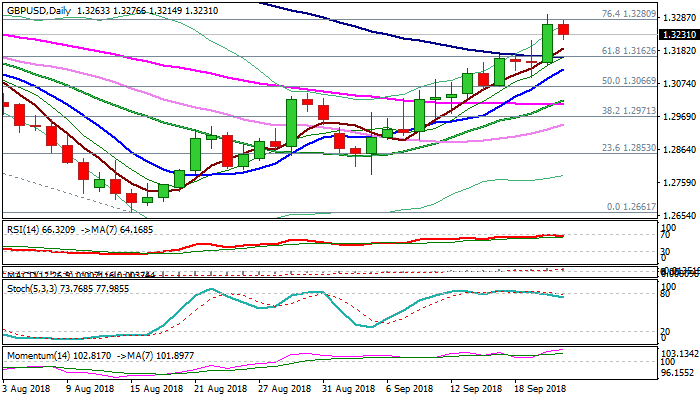
Cable dipped to session low at 1.3214 at the beginning of European session on Friday, on comment from UK minister that there will be no Brexit deal unless the European Union softens its position on the Irish border.
Pound rallied nearly 1% on Thursday, driven by weakening dollar and positive sentiment, but faced headwinds at 1.3280 Fibo barrier (76.4% of 1.3472/1.2661 fall), with the latest news adding pressure.
Pullback from new 2 ½ month high at 1.3297 could extend as profit-taking and softer tone on the latest news, as well as reversal of daily slow stochastic from overbought territory, weigh on near-term action. Initial support at 1.3213 (former high of 26 July) has been cracked, with extended dips expected to find ground above broken 100SMA (1.3157), to keep bulls intact for renewed attempt above 1.3280 barrier and possible extension towards 1.3362 (09 July high).
Negative scenario sees break below 100SMA as initial bearish signal, with extension and weekly close below rising 10SMA (1.3121) needed to put bulls on hold.
Res: 1.3280' 1.3297' 1.3362' 1.3400
Sup: 1.3214' 1.3188' 1.3157' 1.3121
Optimism Builds That Dollar Turning Corner Lower
Currencies throughout Asia have welcomed the news that the Dollar has tumbled to a near 3-month low. A number of different currencies in the region have advanced against the Greenback, with the weakening momentum for the Dollar benefiting the Indian Rupee the most at time of writing.
Indications that the market is turning more negatively towards the Greenback would represent very positive news for emerging market currencies, in particular those having received a pounding over the past couple of months in response to prolonged Dollar strength. This can be seen during trading today with the Thai Baht, Chinese Yuan, Philippine Peso, Indonesian Rupiah, Malaysian Ringgit and Indian Rupee all strengthening.
The exact catalyst behind why the Dollar is weakening is not easy to point out, but the main contender is that fading fears over trade tensions are providing traders with a reason to take profit on Dollar positions that have been building for months. Another round of reassuring comments from authorities in China indicating that the Yuan will not be used as a weapon during-trade tensions has also been looked upon positively by the market
It does go without saying overall that the prospects for more potential weakness in the Dollar moving forward would of course be widely welcome news for a long list of currencies across the globe.
As we head into the conclusion of the trading week the South African Rand has benefited the most from weakness in the Greenback. The Rand has strengthened above 4% over the past five days, with traders looking very positively on the news that the South African Reserve Bank (SARB) was able to leave monetary policy unchanged yesterday. The news earlier this week that inflationary pressures in South Africa unexpectedly eased in August allowed the SARB to maintain resilience and not follow the recent path of both the Russian and Turkish central banks to raise interest rates, which was a move needed in both the cases of Russia and Turkey to ease inflationary pressures and defend both the Ruble and Lira from further weakness.
It is not surprising that the Turkish Lira remained volatile and has shifted between both gains and weakness in the aftermath of Turkey's finance minister announcing his plan to combat the Lira currency crisis. The market, as you would expect, has looked negatively upon the announcement that there has been a sharp downgrade in GDP growth forecasts for both 2018 and 2019. Growth is now expected to slow below 4% this year and narrowly above 2% in 2019, which is sharp contrast to the overall growth of 7.4% that the economy enjoyed last year.
I would keep a very close eye on the British Pound over the upcoming sessions despite the news that the Cable has rallied to its highest levels in nearly three months. Traders appear to have repositioned in recent sessions that there will eventually be a breakthrough in the UK and EU negotiations over Brexit. However, the latest summit in Salzburg failed to result in a positive outcome and the rally in the Pound could fall like a house of cards if markets begin to reprice into the market a potential hard-Brexit eventuality.