Sample Category Title
USDJPY Outlook: Bulls Eye Key Barriers At 113.20 Zone, Dip Buying Remains Favored
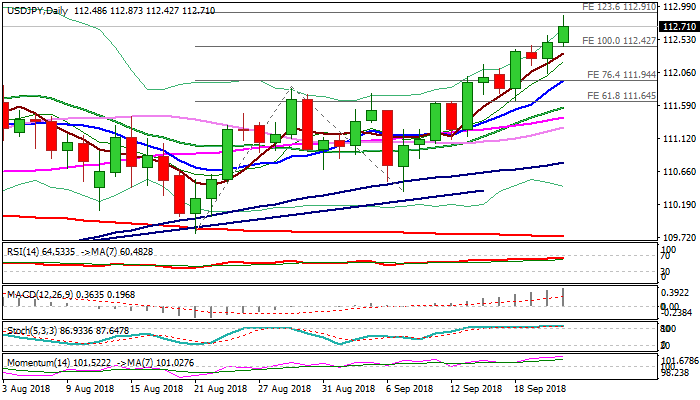
The pair hit new two-month high at 112.87 on Friday, in extension of broader uptrend, after fresh bullish signal was generated on Thursday's close above 112.37 (Fibo 76.4% of 113.17/109.77 fall).
Bullish techs suggest further gains for eventual attack at key 113.20 zone (19 July high / Fibo 138.2% of current wave C of five-wave cycle from 109.77).
Bulls may consolidate before continuing, as overbought daily slow stochastic suggests. Corrective dips face support at 112.37 (broken Fibo 76.4% barrier), with deeper pullback expected to find ground at 112.00 zone (Thursday's low / rising daily Tenkan-sen) to keep bulls in play.
Conversely, break here would delay bulls for deeper correction.
Res: 112.87, 113.00, 113.20, 113.69
Sup: 112.37, 112.04, 111.96, 111.66
Japan Inflation Maintains Positive Momentum
Japan inflation maintains positive momentum
Japan August inflation report came in roughly in line with expectations and left investors with no choice but to look abroad for a driver. Headline inflation beat forecast as it rose to 1.3%y/y compared to 1.1% expected and 0.9% in the previous month. However, most of the upside surprise come from the rise in fresh food prices, as the core measure, which excludes fresh food, matched estimates of 0.9%y/y, up from 0.8% in July. Even though it is only halfway to the BoJ’s target, the core measure has been maintaining a positive momentum since April and this trend is set to continue in the coming months.
USD/JPY rose 0.20% to 112.85 this morning amid renewed risk appetite. Equities rose across the board with the Chinese market surging the most, thanks to circulating rumours that China is about to cut import taxes from the majority of its trading partners. The timing of the announce suggests that the move is not only a way to stimulate domestic consumption but also to show the world that the country is of goodwill and continues to open up.
We expect the yen will recovers against the greenback as the BoJ started to reduce its bond purchase program for super-long maturity, while the Fed will most likely slowdown the pace of rate hike.
USD slides ahead of rate hike
The American economy has underwhelmed: the Federal Reserve will raise rates only 0.25% next week. Lack of a steeper hike has taken steam out of the USD rally and given risky emerging markets room to recover. The Turkish lira recovered, despite an inept economic plan. EUR/USD is near the top of the midterm range located at 1.1851. Euro Stoxx 50 futures are up, following the lead of U.S. stocks, which hit other record high, and Asian stocks that followed the US optimism.
US Treasury 10-year yields remain above 3.07%, rising but still historically low. Perhaps the market is mispricing the top of the Fed interest rate cycle. Risk appetite should remain buoyant, even though there are plenty of risks including rising trade tensions, Brexit, October German elections, US mid-term elections, Q4 corporate earnings and general geopolitics. Buy risk and volatility, but trade nimbly.
Asia Market Closing Note: HKMA In Focus
EM sentiment continues to improve, and regional equities all in the green and USD broadly weaker. China complex in focus today following headlines that PBOC will issue bills via HKMA.
Hong Kong Dollar
The PBoC will via HKMA issue notes ( bills) Hong Kong. The market has interpreted this as one more tool to control liquidity in the offshore market, hence capping offshore spot upside.
Massive liquidation in long USDHKD positions sent liquidity tighter this morning as a pass-through from elevated funding rates following Pboc announcement to issue bills in Hong Kong, and the CNH curve gapped much higher.
I guess are we going to see more Pboc presence in HK money markets after the memorandum of cooperation was signed between HKMA and the Pboc and will probably continue taping and draining the HK money markets and pushing rates?? Which is an ominous sign for property markets
While this takes a tremendous amount of pressure off the peg, but none the less a worrisome sign for property investors who given soaring real estate prices in Hong Kong are highly leveraged and remain at the mercy of floating HIBOR rates.
I suspect funding will remain tight for the foreseeable future until the Pboc intentions are fully vetted.
The other big discussion in Asia is China reducing Import Tax
Reuters
Two significant takeaways, there could be a more bilateral trade with the rest of the world to compensate for increase tariff is one theory. However, if you look across Asia at the new iPhone release, I wonder just how much mainland consumer preference will change from what will amount to a 10 % increase on selected US products.
The other takeaway which is more significant in my view is that this tax break accelerates Mainland’s push to increase domestic demand and move off the reliance on traditional brick and mortars to stimulate the economy.
Finally, I think this a brilliant and measured response from Chinese authorities to not fight fire with more fire.
USDCAD Pauses Downside Pressure, Finds Obstacle At 38.2% Fibonacci
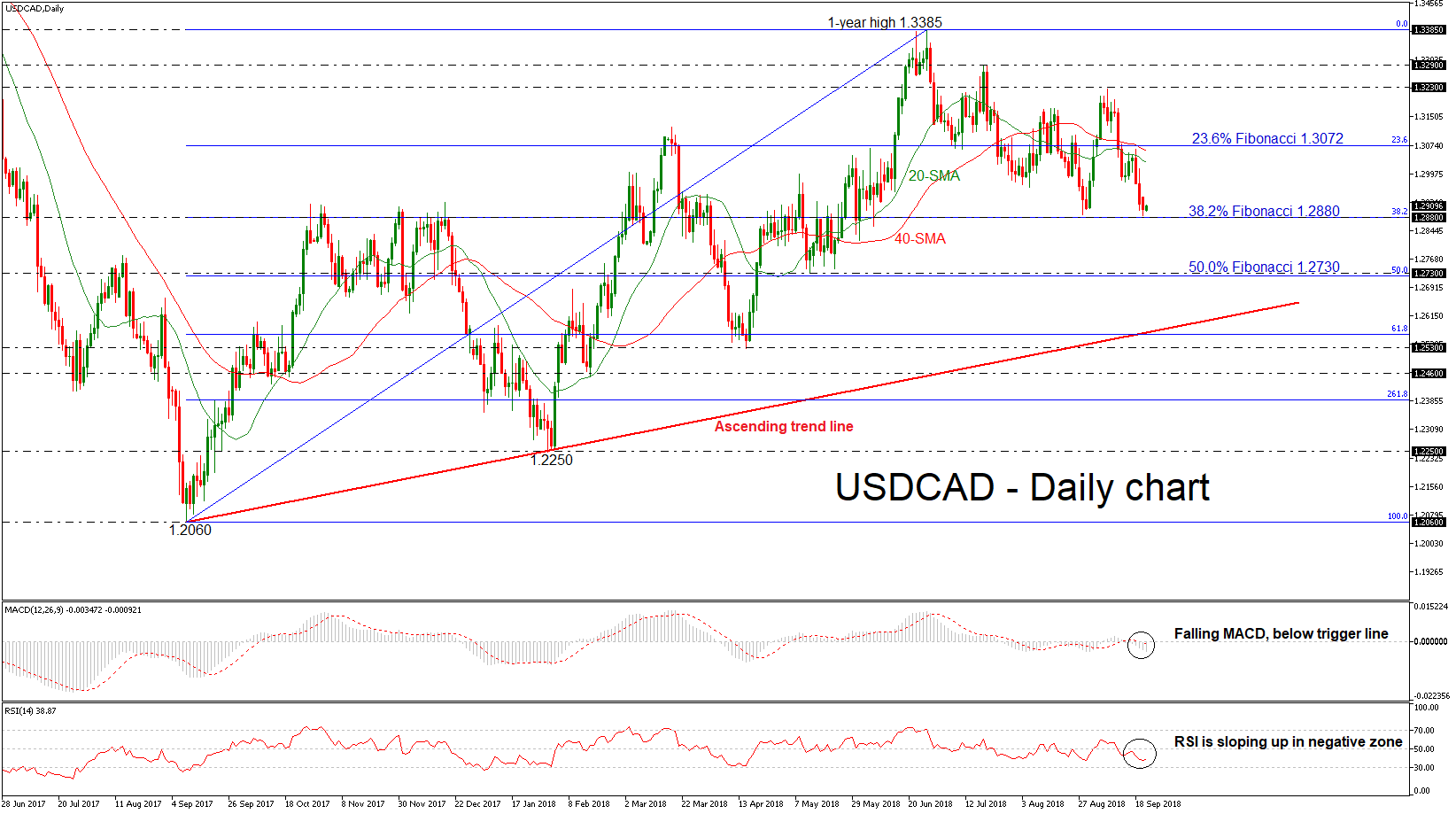
USDCAD dipped aggressively over the previous consecutive three days, which have taken the pair below the 20- and 40-simple moving averages (SMAs). The sharp sell-off, drove the pair below the 23.6% Fibonacci retracement level of the upleg from 1.2060 to 1.3385, near 1.3072.
The momentum indicators are supportive of the bearish picture in the short-term, with the RSI holding in the negative territory below 50 but is sloping slightly to the upside. The MACD has dropped below the trigger line and is strengthening its negative movement below the zero line.
Immediate support is being provided by the 38.2% Fibonacci mark of 1.2880, which is acting as major obstacle for the bears. If prices dip lower of this area, the next support would likely come from the 50.0% Fibonacci around the 1.2730 barrier, taken from the low on May 11. A drop below the 50% Fibonacci level would signal the start of a deeper bearish phase, challenging the medium-term rising trend line again.
In case of an upward attempt, dollar/loonie would likely meet resistance at the 20- and then at the 40-SMA, currently around 1.3030 and 1.3060. A break above these levels and the 23.6% Fibonacci would send prices until the 1.3230 resistance level, identified by the September 6 high. Further gains would push the market until the 1.3290 level.
In the medium-term, the bullish outlook remains intact as the pair stands above the ascending trend line, which has been holding since September 2017. The short-term downside pressure would be erased if the price surpasses the 1-year high of 1.3385.
UK PM May bashed by British media for failure at EU summit
UK media generally bashed Prime Minister Theresa May's performance at the informal EU summit in Austria. There are headlines today like "May humiliated," "Humiliation for May," "Embarrassing rebuff for PM in Salzburg," "Your Brexit's broken,"etc. It's rather common for UK politicians to get the harshest words back at home. Comments from the EU were so far rather gentle.
House Minister James Brokenshire defended her in a BBC radio interview, saying " the prime minister is getting the right deal for our country. She is sticking up for Britain, sticking up what will work for country. These are tough negotiations."
However, Scottish First Minister Nicola Sturgeon said, "Now that the EU has explicitly rejected it, the Chequers pretence has to stop. At the very least, single market/customs union membership must be back on the table and the Article 50 clock stopped to avoid a cliff edge".
Separately, European Commission President Jean-Claude Juncker urge EU and UK to be like "two loving hedgehogs". And, "when two hedgehogs hug each other, you have to be careful that there will be no scratches."
Eurozone PMIs: Slowdown limited to manufacturing.
Eurozone PMI manufacturing dropped to 53.3 in September, down from 54.4 and missed expectation of 54.5. That's also the lowest reading in 28 months. PMI services rose to 54.7, up from 54.5 and beat expectation of 54.5. PMI composite dropped to 54.2, down from 54.5.
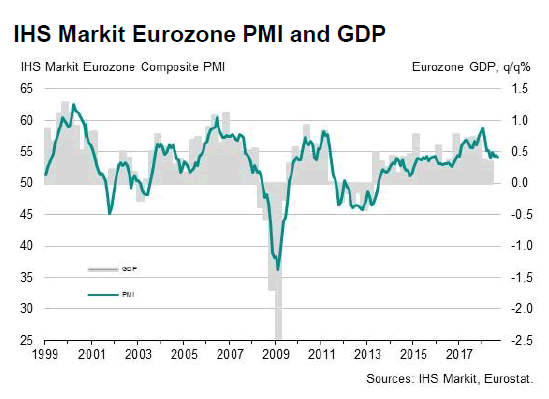
Commenting on the flash PMI data, Chris Williamson, Chief Business Economist at IHS Markit said:
"A near stagnation of exports contributed to one of the worst months for the Eurozone economy for almost two years. Trade wars, Brexit, waning global demand (notably in the auto industry), growing risk aversion, destocking and rising political uncertainty both within the Eurozone and further afield all fuelled the slowdown in business activity.
"Thankfully, the slowdown was limited to manufacturing. A buoyant service sector, boosted in part by domestic demand being supported by strong job gains, means the survey data are running at a level indicative of the economy growing by a solid 0.5% in the third quarter.
"However, with new orders and backlogs of work rising at much reduced rates compared to earlier in the year, export growth evaporating and future expectations remaining close to two-year lows, the risks to future growth appear tilted to the downside."
German PMIs: Manufacturers’ confidence took a big hit
Germany PMI manufacturing dropped to 53.7 in September, down from 55.9 and missed expectation of 55.8. That's also lowest in 25 months PMI services rose to 56.5, up from 55.0 and beat expectation of 55.1. PMI composite dropped to 55.3, down from 55.6 and hit 2-month low.
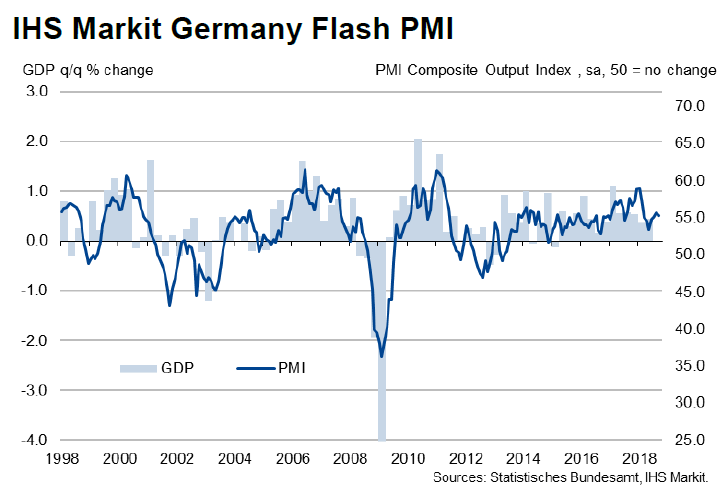
Commenting on the flash PMI data, Phil Smith, Principal Economist at IHS Markit said:
"The service sector was left to do most of the heavy lifting in September, as manufacturing put in its worst overall performance since August 2016. Service providers enjoyed the biggest boost to new business in over seven years in a further sign of strong domestic demand. Manufacturing new orders, however, were broadly flat as export sales declined for the first time in more than three years.
"Manufacturers' confidence took a big hit in September, deteriorating to its lowest for almost four years. Goods producers foresee output barely rising over the next 12 months and have cited growing uncertainty towards the outlook.
"The September flash data meanwhile showed another solid gain in private sector employment, the one area where manufacturing and services both made strong positive contributions during the month. Falling backlogs of work in the manufacturing sector suggests that capacity may have finally caught up with demand, so there's a good chance the pace of factory job creation will lose momentum in coming months."
France PMI composite dropped to 53.6, 21-month low
France PMI manufacturing dropped to 52.5 in September, down from 55.3, missed expectation of 53.3. {MI services dropped to 54.3, down from 55.4, missed expectation of 55.4. PMI composite dropped to 53.6, down from 54.9 and hit a 21-month low.
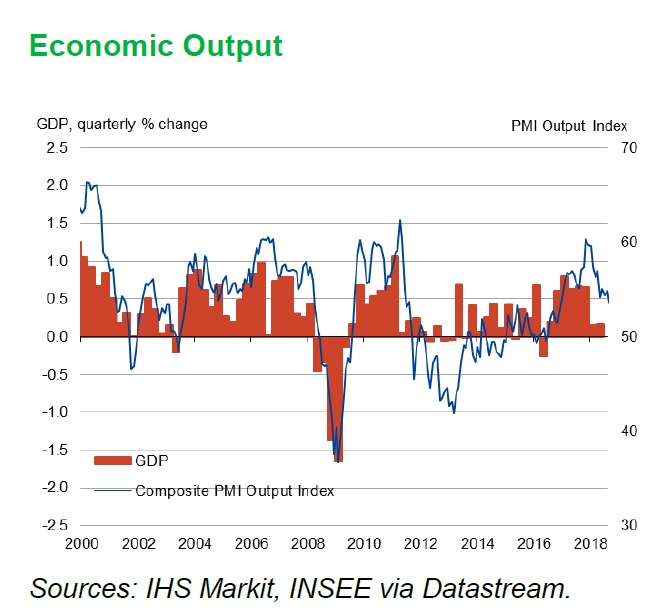
Commenting on the Flash PMI data, Sam Teague, Economist at IHS Markit said:
"Output growth across the French private sector slipped to its lowest since December 2016 during the latest survey period, with data indicating a broad-based slowdown across both the manufacturing and service sectors. Manufacturing businesses frequently reported a deterioration in the automotive sector. Moreover, the survey data saw a general slowdown in new business across the whole private sector, with growth reaching a near two-year low in September.
"Input price pressures sharpened at a faster pace in the latest survey, reflecting higher wage and fuel bills. Nonetheless, despite higher cost burdens, optimism among French businesses improved during September, evidenced by a further marked improvement in job creation."
The US Dollar Index Has Updated Local Lows
The US dollar fell against the basket of major currencies but strengthened relative to the Japanese yen. The US dollar index (#DX) updated monthly lows and closed in the negative zone (-0.67%). Yesterday, the ambiguous economic statistics were published in the US. Philadelphia Fed manufacturing index counted to 22.9 in September and was above the forecasted value of 17.0. However, existing home sales declined to 5.34M in August instead of 5.35M.
The trade conflict between the United States and China has receded into the background. The demand for risky assets has grown significantly. At the moment, investors' attention is focused on the summit of the European Union leaders, which takes place in Austria. The main subject of discussion is the conclusion of a deal between the UK and the EU after Brexit.
The "black gold" prices have become stable. At the moment, futures for the WTI crude oil are testing a mark of $70.50 per barrel.
Market Indicators
Yesterday, the bullish sentiment was observed in the US stock market: #SPY (+0.81%), #DIA (+0.99%), #QQQ (+1.11%).
At the moment, the 10-year US government bonds yield is at the level of 3.08-3.09%.
The news feed on 21.09.2018:
The index of economic activity in the German manufacturing sector at 10:30 (GMT+3:00);
Core retail sales in Canada at 15:30 (GMT+3:00).
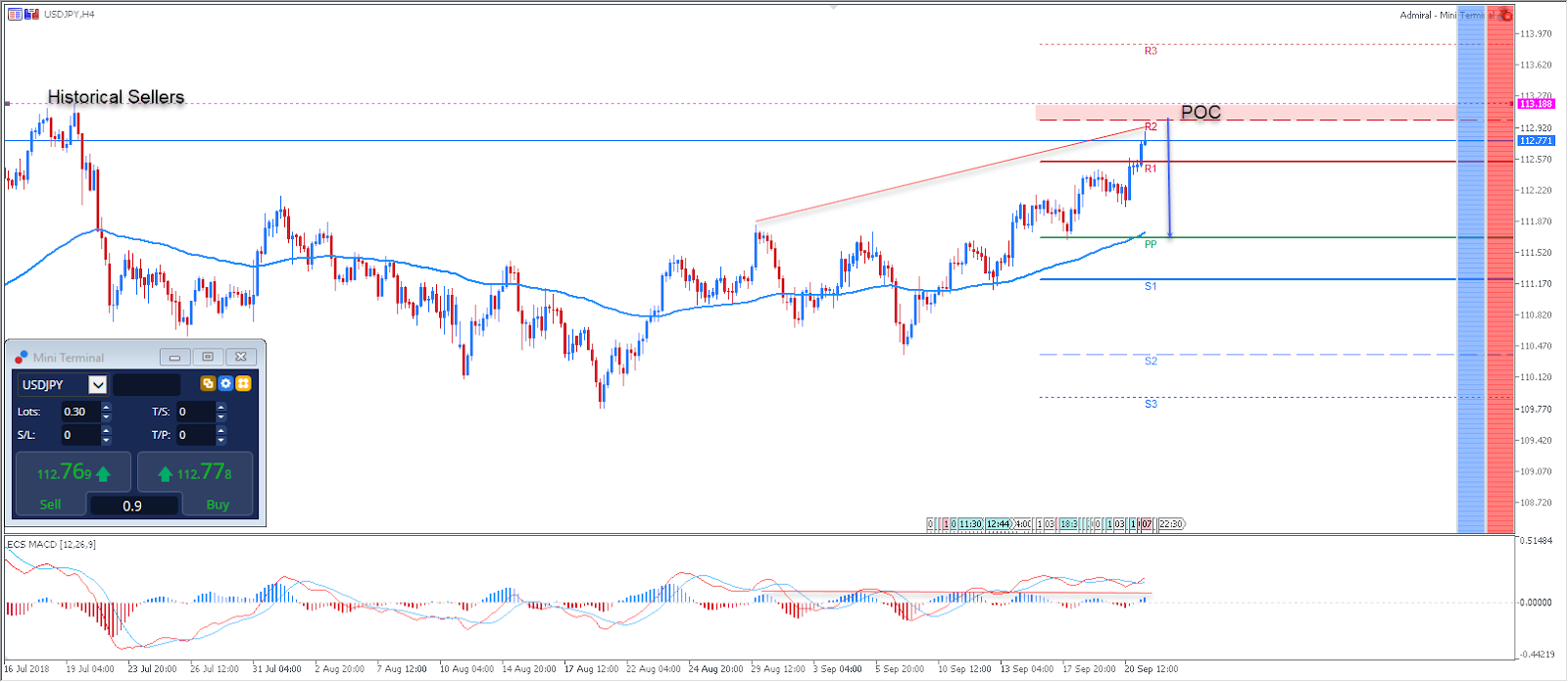
USDJPY Historical Sellers Are Close
As long as the Bank Of Japan is inactive there is a potential risk of the USDJPY currency pair going downside. In addition, Prime Minister (PM) Abe's victory at the LDP election is probably priced by the markets. Traders should also consider paying attention to the resumption of US-Japan trade talks on Friday, and the US-Japan Summit on September 25. Today, there are no major news in the USD except for Flash Manufacturing PMI and Services light data that is going to be released in the afternoon. Flash Manufacturing PMI measures a level of a diffusion index based on surveyed purchasing managers in the manufacturing industry. It's a good indicator of economic health, as businesses react quickly to market conditions, and their purchasing managers hold perhaps the most current and relevant insight into the company's view of the economy.
Technically, the USD/JPY currency pair has developed a form of bearish divergence, with the price making a higher high while the MACD is a bit flat. The MACD flatness could result in a lower high soon, and the divergence will be complete by then. We can also see the price near an important pivot point, that has been within the vicinity of historical sellers. We could see also see a rejection soon. The POC zone for short trades is between 113.00-113.20. However, a strong close above 113.40 prompts a further risk-on in the markets. Traders should consider paying close attention to these levels and possibly apply a divergence trend line break or a MACD cross strategy for a potential short trade.
Short Pivot Lines - Daily Support and Resistance
Long Pivot Lines - Weekly Support and Resistance
POC - POC - Point Of Confluence (The zone where we expect the price to react - aka the entry zone)