

Sample Category Title
Week Ahead – Aussie in Focus as GDP and RBA Awaited; BoC and Riksbank also Meet; US Jobs Report...
The Australian dollar will fall under the spotlight next week as a raft of data is due to be published out of Australia and the Reserve Bank of Australia holds a policy meeting. However, central bank meetings in Canada and Sweden, where near-term policy changes are on the cards, pose bigger risks for traders than the RBA’s. Monthly job reports will also be vying for attention as both the US and Canada release their respective figures for August. Also important will be PMI numbers out of the UK.
Australian GDP could disappoint after poor capex data
It’s been a volatile couple of weeks for the Australian currency as last week’s political drama and this week’s unexpectedly dismal capital expenditure figures have seen the local dollar see-saw up and down. The aussie looks set for more rough rides in the coming days with a flurry of economic data scheduled for release as well as an RBA rate decision. First up on Monday are July retail sales and the business inventories number for the second quarter. They will be followed by quarterly trade data on Tuesday, which will include net exports contribution – the final clue to Q2 growth before Wednesday’s GDP release. The RBA policy meeting will be the highlight on Tuesday with no change in interest rates expected. While the central bank is not anticipated to change its stance in its statement, investors will be watching for any alterations to its language on the growth and inflation outlook and whether it is growing more worried about the US-China trade dispute.
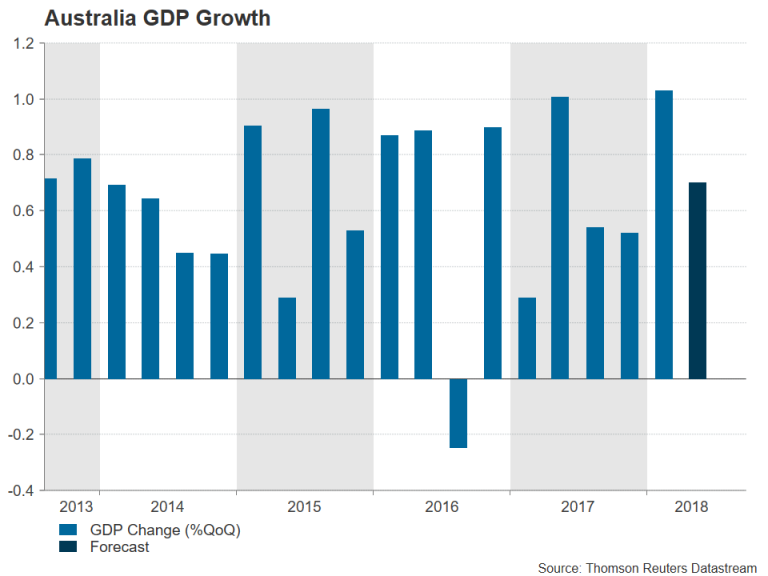
On Wednesday, GDP data is expected to show the Australian economy expanded by 0.7% quarter-on-quarter in the three months to June, slowing somewhat from the prior 1.0%. Rounding up the week will be monthly trade numbers on Thursday and housing finance figures on Friday, both for July.
Sticking with the antipodean currencies, the New Zealand dollar also came under pressure this week from disappointing data. The kiwi may find some support next week from the quarterly indicator on the terms of trade, which is expected to show an improvement in the overall terms of trade during the second quarter, with exports forecast to have increased by 2.3% after dropping by 2.9% in the first quarter.
Chinese exports eyed as more tariffs loom on the horizon
China will too be publishing trade figures next week and will likely attract more attention than usual given the ongoing sell-off in Chinese equities and the yuan’s respite from its recent steep falls looking temporary. With the US threatening to impose a further $200 billion worth of duties on Chinese goods, investors will be assessing the country’s export performance in August for any signs that the existing tariffs on $50 billion of exports to the US are starting to hurt the economy. Exports are forecast to have grown by 10% year-on-year in August versus 12.2% in July. However, the market’s response will have to wait until the following Monday as the data are not due until Saturday. More relevant for the coming week will be the Caixin manufacturing and services PMIs, out on Monday and Wednesday respectively.
Japanese household spending
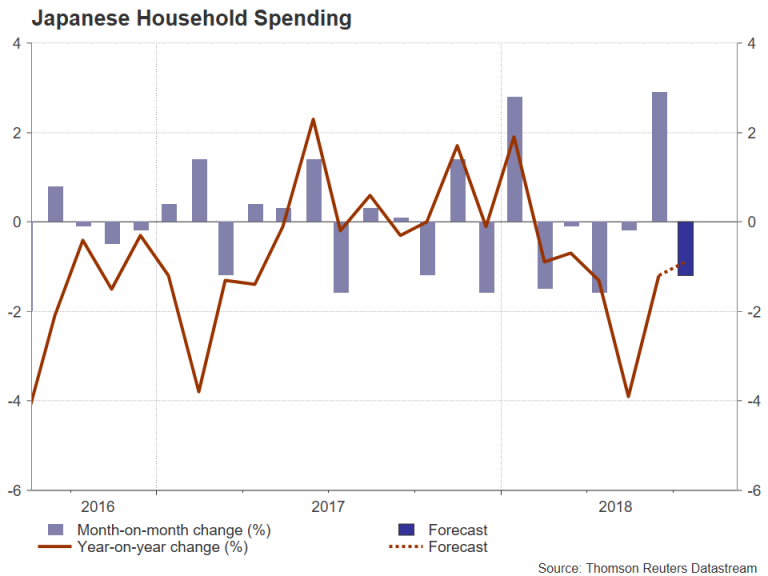
Household spending in Japan rebounded by a solid 2.9% month-on-month in June, rising for only the second time in 2018, while retail sales also picked up in June and July. A pullback in household spending of 1.2% m/m is forecast for July when released on Thursday, though the trend remains positive. One reason for the improvement in household consumption has been higher wage growth. Nominal earnings rose by 3.3% on an annual basis in June – the highest in 21 years – and the latest figure is out on Friday. Further acceleration in wage growth in July would be seen as a sign that domestic demand in Japan is on an upward path and could provide the Bank of Japan with the excuse it needs to lift interest rates above negative territory. Also to watch from Japan next week is the second quarter data on business expenditure on Monday.
Quiet week for the Eurozone
There will be several key releases coming out of the Eurozone next week, though none will be very headline grabbing, which could result in traders relying on broader market sentiment and political events to drive the euro. Developments in the EU-US trade talks and news on the Italian government’s new budget could move the euro, which this week has been struggling to hold onto the $1.17 handle. Nevertheless, investors will have plenty of data to sift through: July producer prices on Tuesday, the final IHS Markit PMIs for August and July retail sales on Wednesday, German industrial orders on Thursday, and German industrial production and revised Eurozone GDP estimates for the second quarter on Friday.
Swedish krona at risk of further losses ahead of Riksbank meeting and elections
Swedes will vote for a new government on Sunday, September 9, but with polls currently pointing to a tight race, no party/alliance is expected to win a clear majority. The possibility of a political stalemate has brought the Swedish krona under downside pressure; it hit a 9-year low of 10.7285 per euro this week. However, another factor weighing on the krona in recent weeks is growing expectations among some traders that the Riksbank will not raise interest rates in late 2018 as planned. Inflation data published earlier in August showed underlying inflation tracked by the central bank fell to 1.3% in July. The Riksbank will announce its latest policy decision on Thursday and could signal that it may keep its repo rate on hold at -0.5% for the rest of the year. The krona could suffer further losses if policymakers do indeed turn more dovish.
UK PMIs to be mixed
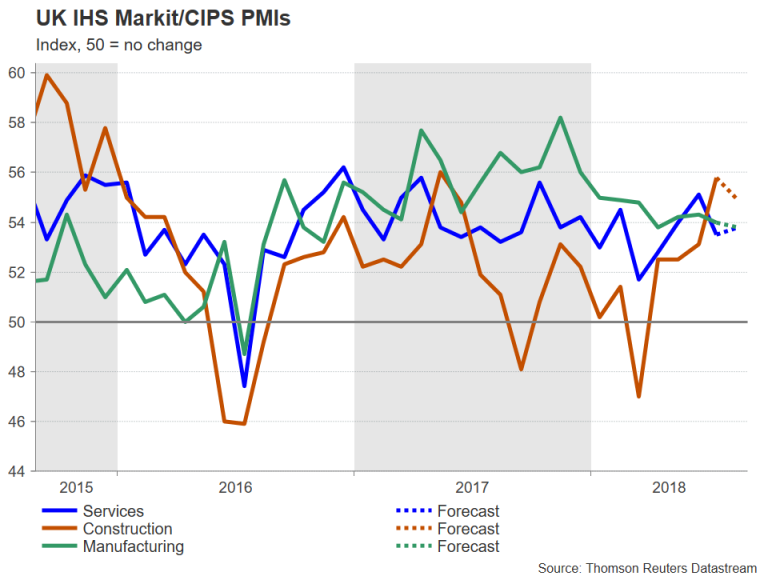
Staying in Europe, the pound is on track for its best 5-day performance since February, having risen by around 1.2% so far this week. Sentiment for the British currency took a positive turn after the EU’s chief Brexit negotiator suggested that the European Union is prepared to make the UK a special partnership offer for after it’s left the bloc. Sterling could be given a further helping hand next week from the Markit/CIPS PMI releases. The manufacturing PMI, up first on Monday, is forecast to ease slightly to 53.8 in August. The construction PMI due on Tuesday is also expected to fall a bit, but the more important services PMI out on Thursday is anticipated to edge up to 53.8 in August from 53.5, potentially lifting the pound.
Another source of volatility for the pound could come from comments from Bank of England policymakers, including Governor Mark Carney, who will be testifying before Parliament’s Treasury Committee on Tuesday.
Bank of Canada to stand pat
The Bank of Canada meets on Wednesday for its latest policy decision, but investors are pricing in only a low probability that the Bank will raise its overnight target rate in September, with the consensus being for an October hike. This week’s disappointing GDP figures for the second quarter dashed the odds of an early move. However, given the BoC’s history to surprise and recent Canadian data being reasonably strong, not to mention the increased optimism of a NAFTA deal, the possibility of a rate rise as early as next week should not be completely dismissed. The Canadian dollar had advanced substantially early in the week on the back of the renewed effort to wrap up the NAFTA renegotiation, reaching a 12-week high of C$1.2883 to the US dollar, but fell back after the GDP miss. A hawkish BoC could help the loonie regain a positive footing but attention will quickly turn to data as the August employment report is due on Friday, along with the Ivey PMI for the same month.
ISM PMIs and NFP report to be dollar’s focal points
The dollar index is heading for its third straight week of declines as traders unwind some of their positions in the greenback that were driven by flight to safety from the escalating trade tensions. Strong data has so far only managed to slow the slide and next week’s releases may also lack the impetus to reverse the dollar’s downtrend. However, the greenback is at risk of seeing fresh safe-haven bids as President Trump will have to decide whether to proceed with the next round of tariffs against China when the public comment period ends on September 6.
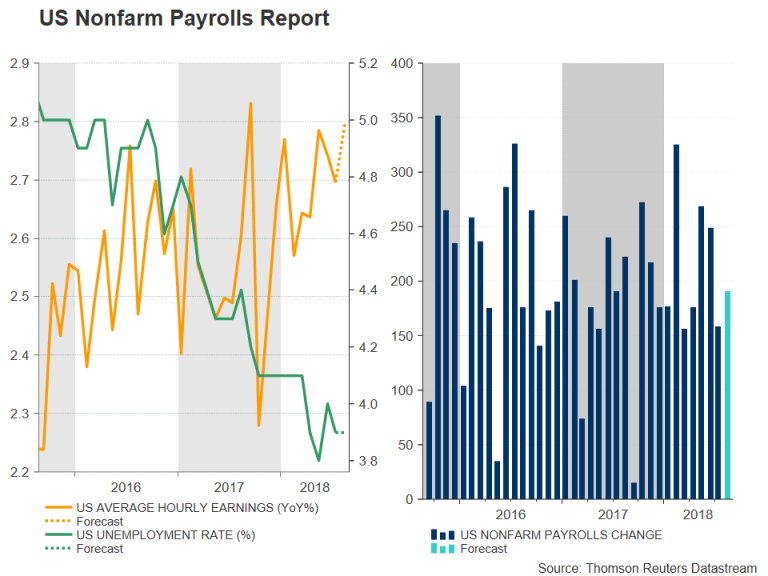
Regardless of the trade story though, a packed US calendar should keep traders fairly busy. With markets closed on Monday for Labor Day, the trading week will start on Tuesday with the ISM manufacturing PMI. The index is forecast to fall for the second straight month to 57.6. On Wednesday, July trade numbers will be watched as the Trump administration’s fiscal stimulus appears to have only fuelled the US’s appetite for imports and higher tariffs are not yet having much impact in reducing the country’s massive trade deficit. The ADP employment report and factory orders for July will be the focus on Thursday, along with the ISM non-manufacturing PMI. Finally, on Friday, the August nonfarm payrolls report will be looked at for any evidence of an uptick in wage growth. The US economy is projected to have created 190k jobs in August, which would be an improvement on the prior 157k. The jobless rate is forecast to remain at 3.9%, while growth in average earnings is forecast to inch up from 2.7% to 2.8% y/y.
Weekly Focus: Moment of Truth Approaching for the Riksbank
Market Movers ahead
- The hearing period for the planned US tariffs on USD200bn worth of Chinese imports is ending, and an announcement of the tariffs is likely to follow.
- The US job report is expected to show steady wage growth and rebounding employment.
- Brexit will return to centre stage as the House of Commons returns from summer holiday.
- Sweden's election is likely to result in a frail p olitical situation, but before that, it is a close call as to whether the Riksbank will maintain its expectation of a rate hike this year at its upcoming policy meeting.
Global macro and market themes
- Italy trading out of line compared with peers according to rating.
- NAFTA revamp close to being concluded.
- EM continues to struggle.
- No frontrunner to replace Draghi
Silver Consolidates Near 1-Year Lows; Bearish in Long Term
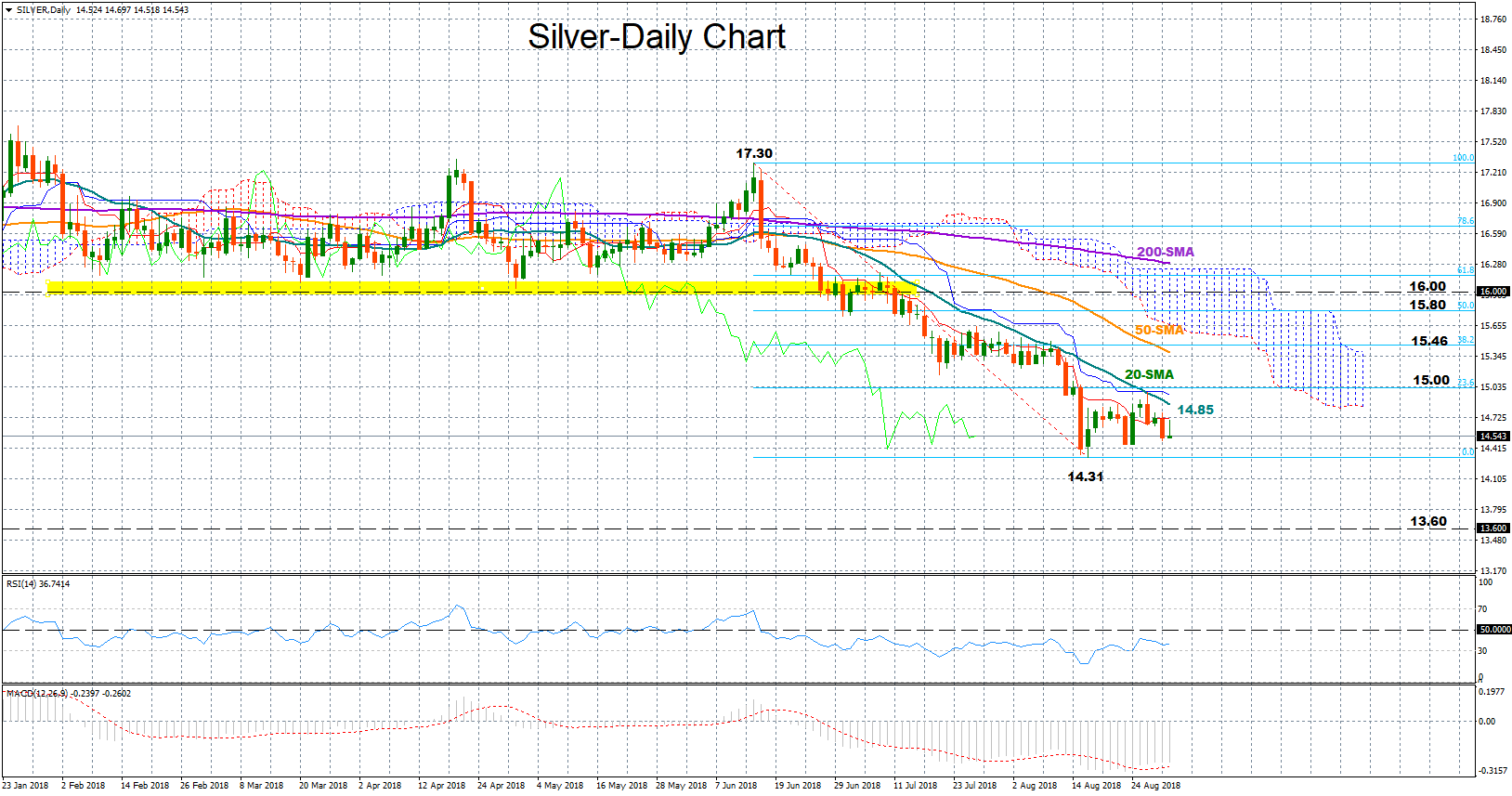
Silver turned increasingly bearish after it dropped below the 16.00 key-level, the bottom of its range-bound trading recorded between early February and mid-June, printing lower lows and lower highs until it reached one-year lows at 14.31 on August 16. Since then, the market has been moving sideways, with the RSI and the MACD supporting that chances for a bull market are minimal in the short-term; the RSI is negatively sloped below 50 and the MACD holds steady marginally above its red signal line and far below zero.
If the price extends to the downside, support may come between 14.31 and the July 2017 trough of 14.28. A failure to hold above that zone could send the market down to 13.60, a level last seen in December 2015, while steeper declines could also unlock the 13.00 psychological mark before reaching 12.00, a frequently tested area during 2008-2009.
On the flip side, a correction to the upside could quickly meet the 20-day simple moving average currently at 14.85, ahead of the 23.6% Fibonacci of the downleg from 17.30 to 14.30, at 15.00. Further up, bullish actions could try to close the day above the 38.2% Fibonacci of 15.46, seen as a strong resistance during the past couple of weeks. Even higher and above the 50% Fibonacci of 15.80, traders could confirm the start of an uptrend.
In the bigger picture, silver is trading bearish below the Ichimoku cloud and under all its negatively-sloped moving averages.
EURUSD Outlook: Break Below Daily Cloud Base Risks Deeper Pullback
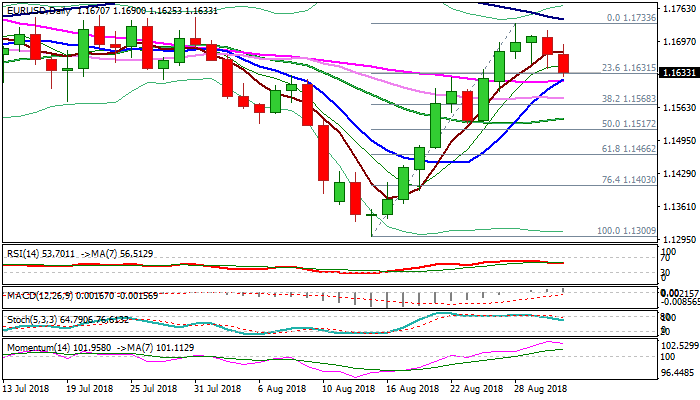
The Euro stands in red during mid-European and early US trading and extends pullback through initial support at 1.1656 (base of thin daily cloud). Thursday's close in red created bearish outside day pattern, generating initial negative signal which was confirmed with today's break below daily cloud base. Negative action was additionally supported by south-turning 14-d momentum and slow stochastic trending lower after forming bearish divergence and emerging from overbought territory. Also, weaker than expected Eurozone inflation (2.0% in Aug vs 2.1% f/c) which supported the view of the ECB that recent spike in inflation could be short-lived, despite continuous monetary stimulus as underlying inflation is still weak. Pullback may extend lower after cloud base was lost, with end-of-week profit-taking expected to increase pressure. Fresh weakness eyes next support at 1.1616 (converged 10/55SMA, attempting to form bull-cross) and could extend towards pivotal support at 1.1568 (Fibo 38.2% of 1.1300/1.1733). Reversal above here is needed to keep larger bullish picture intact for renewed attempt at key 1.1750 resistance zone (Fibo 38.2% of 1.2476 / 1.1300 / falling 100SMA). Conversely stronger bearish signal could be expected on break and weekly close below 1.1568 pivot, which could spark further weakness towards 1.1540 (20SMA) and 1.1517 (50% retracement of 1.1300/1.1733 rally).
Res: 1.1656; 1.1681; 1.1718; 1.1733
Sup: 1.1616; 1.1568; 1.1540; 1.1517
Sunset Market Commentary
Markets
Global core bonds resumed yesterday’s upward trend, but the pace slowed especially in the Bund. US Treasuries are the outperformers today with event risk looming (US/Canadian trade talks) over the long US weekend (Labour Day on Monday). Core bonds only gained momentum from the start of US trading onwards, with the Bund ignoring a weaker opening for European stock markets. The latter stabilized afterwards. Yesterday’s EM FX sell-off stalled, though the dollar gains traction and might still hurt them going forward. August EMU CPI data fell just short of consensus for both headline and core readings, but that didn’t wrongfoot investors following yesterday’s Spanish and German readings. The US yield curve bull flattens at the time of writing with yields 1.6 bps (2-yr) to 2.6 bps (30-yr) lower. German yield declines range between -0.4 bps (2-yr) and -1.7 bps (10-yr). Peripheral yield spreads vs Germany widen up to 5 bps with Italy underperforming going into tonight’s rating update by Fitch. We don’t expect the BBB rating to be downgraded yet (waiting the budget verdict), but a negative outlook is likely. The 10-yr yield spreads vs Germany is currently testing the post-election high of 290 bps.
Today, global (FX) markets tried to assess the potential consequences of latest comments from US president Trump on trade politics. Yesterday, press articles indicated is considering additional tariffs on Chinese imports. The US president also rejected EU proposals for the automobile sector and accused China en the E(M)U of artificially weakening their currency. Initially, the damage for the euro was modest. EUR/USD even temporary rebounded to the high 1.16 area, but lost ground later. EMU August CPI printing softer than expected (2.0% Y/Y) might have been a slightly negative for the single currency. EUR/USD dropped to yesterday’s low (1.1640/45 area) and finally broke through this level early in US dealings. Even so, the euro losses remain modest given rising trade tensions. USD/JPY is also holding a modest downside bias as the yen attracts safe have flows (USD/JPY currently near 110.75/80).Among the smaller currencies, the outperformance of the safe haven Swiss franc is catching the eye. The EUR/CHF pair is nearing the 1.1242 August multi-month low. Markets are pondering the chances of renewed SNB interventions.
Sterling entered calmer waters after the repositioning/short squeeze on Wednesday and, to a lesser extent, yesterday. EU’s Barnier stressed after a meeting with UK’s Raab the urgency of backstop deal on the Irish border. Without a workable agreement on this issue there is no deal. The aim is still to reach a deal by October but there is flexibility till November. The comments of Barnier didn’t bring any high profile news on the Brexit progress. Contrary to Wednesday, the reaction of sterling was very limited. EUR/GBP held a tight sideways range roughly in the 0.8960/90 area. Cable is losing a few ticks (currently 1.2960 area), but this is mostly due to some modest USD gains.
News Headlines
Eurozone inflation dropped to 2.0% (YoY) in August, slightly lower than the 2.1% from July. The inflation is close to the ECB’s goal of just under 2%, but is mainly caused by high increase in energy and food prices. Core inflation, without energy and food, remains weak in August at 1% (against 1.1% in July).
European Commission President Jean-Claude Jucker said he hoped the July “ceasefire” agreement with US President Trump remains intact, after Trump rejected an EU offer to eliminate tariffs on cars. He added that the EU would react in kind if the US would break the agreement and impose new tariffs anyway.
Turkey’ President Tayyip Erdogan has said that the Turkish lira was being targeted in an operation. He added the country will in response take the necessary measures and overcome its currency volatility . This morning, the government raised taxes on dollar deposits up to a year, ending four days of lira depreciation.
GBP/USD Mid-Day Outlook
Daily Pivots: (S1) 1.2984; (P) 1.3013; (R1) 1.3042; More...
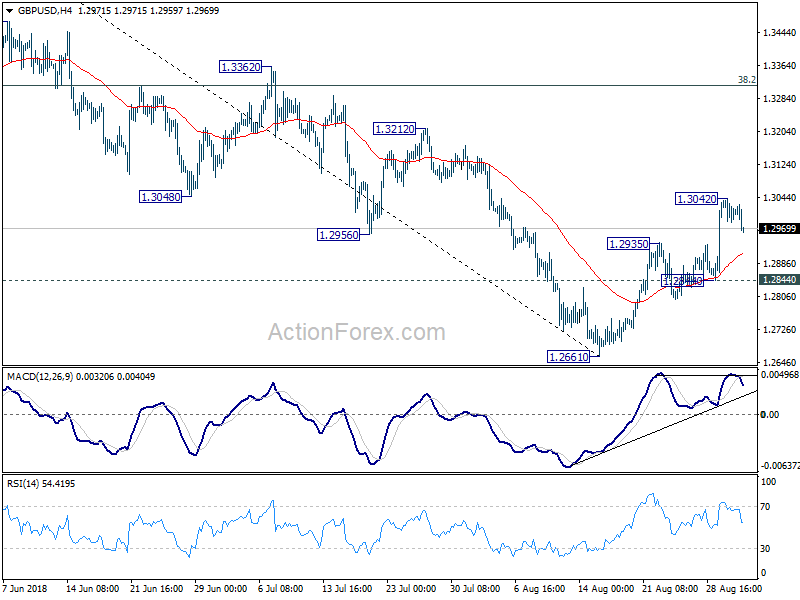
A temporary top in in place at 1.3042 with today's retreat. Intraday bias is turned neutral first. With 1.2844 minor support intact, rebound from 1.2661 could extend higher. But in that case, we'd expect strong resistance from 1.3316 fibonacci level to limit upside, at least on first attempt. On the downside, break of 1.2844 support will argue that the rebound is completed and bring retest of 1.2661 low.
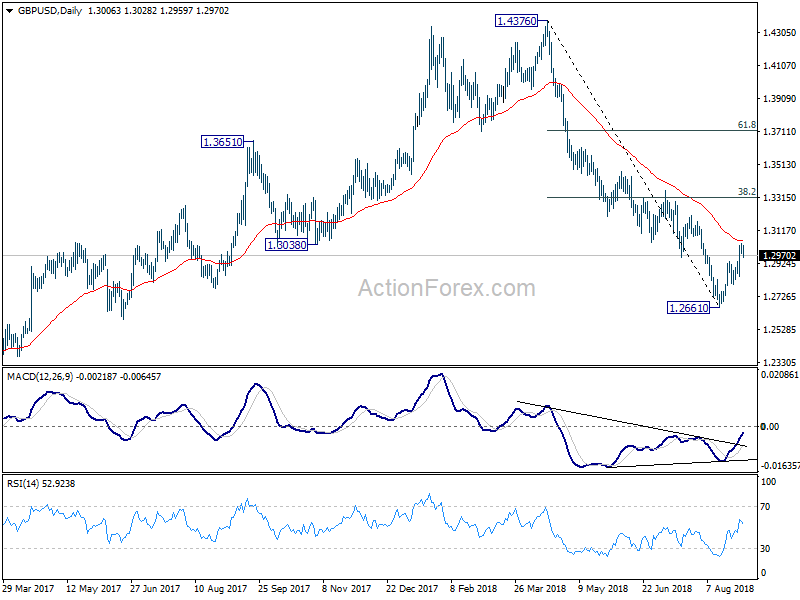
In the bigger picture, whole medium term rebound from 1.1946 (2016 low) should have completed at 1.4376 already, after rejection from 55 month EMA (now at 1.4091). The structure and momentum of the fall from 1.4376 argues that it's resuming long term down trend. And this will be the preferred case as long as 38.2% retracement of 1.4376 to 1.2661 at 1.3316 holds. However, firm break of 1.3316 would bring stronger rebound to 61.8% retracement at 1.3721. And, the eventual depth of the fall from 1.4376, and the chance of hitting 1.1946 low, will depend on the strength of the interim corrective rebound from 1.2661.
EUR/USD Mid-Day Outlook
Daily Pivots: (S1) 1.1632; (P) 1.1676; (R1) 1.1709; More.....
EUR/USD gyrates lower today but for now, intraday bias remains neutral first. Another rise could still be seen. But we'd continue to expect strong resistance from 38.2% retracement of 1.2555 to 1.1300 at 1.1779 to limit upside, at least on first attempt, to bring near term reversal. On the downside, break of 1.1529 minor will indicate completion of the rebound and turn bias to the downside for retesting 1.1300 low. After all, consolidation from 1.1300 will extend for a while before completion.
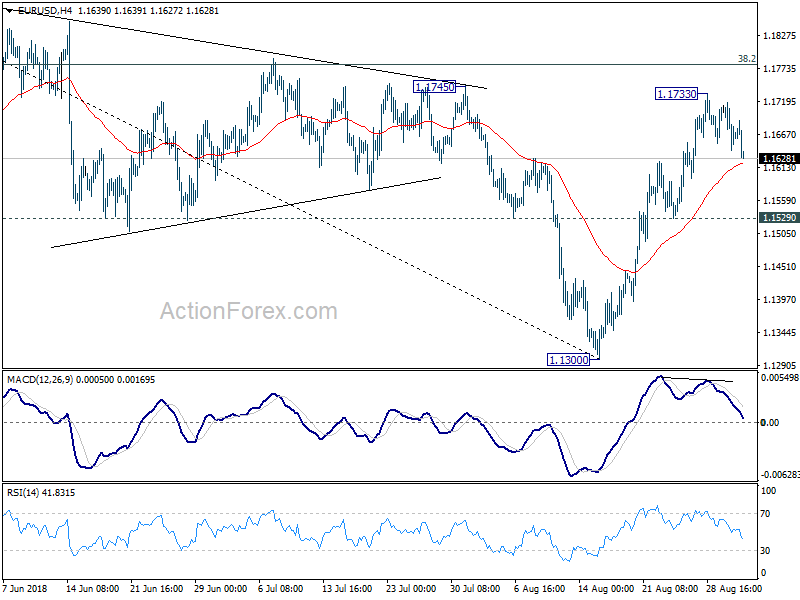
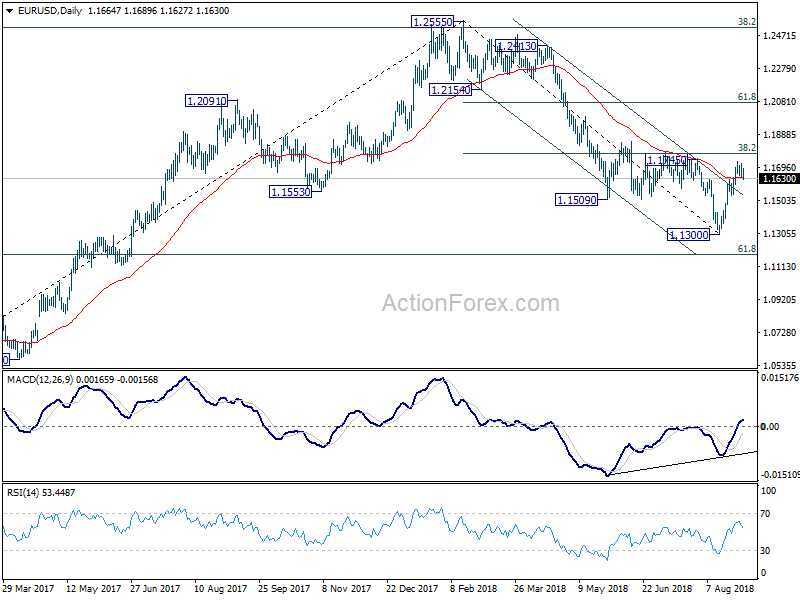
In the bigger picture, a medium term bottom should be in place at 1.1300, on bullish convergence condition in daily MACD and some consolidations would be seen. But still, note that EUR/USD was rejected by 38.2% retracement of 1.6039 (2008 high) to 1.0339 (2017 low) at 1.2516. That carries some long term bearish implications. Thus, we'd expect fall from 1.2555 high to resume after consolidation completes. Below 1.1300 should send EUR/USD through 61.8% retracement of 1.0339 to 1.2555 at 1.1186. And, in that case, EUR/USD would head to retest 1.0339 (2017 low).
USD/CHF Mid-Day Outlook
Daily Pivots: (S1) 0.9679; (P) 0.9701; (R1) 0.9716; More.....
USD/CHF reaches as low as 0.9651 so far today as the decline from 0.9981 accelerates. Intraday bias stays on the downside. Sustained break of 161.8% projection of 1.0067 to 0.9866 from 0.9981 at 0.9656 will target 200% projection at 0.8579 next. On the upside, above 0.9714 minor resistance will turn intraday bias neutral and bring recovery. But outlook will now stay bearish as long as 0.9866 support turned resistance holds. And deeper fall will remain in favor even in case of recovery.
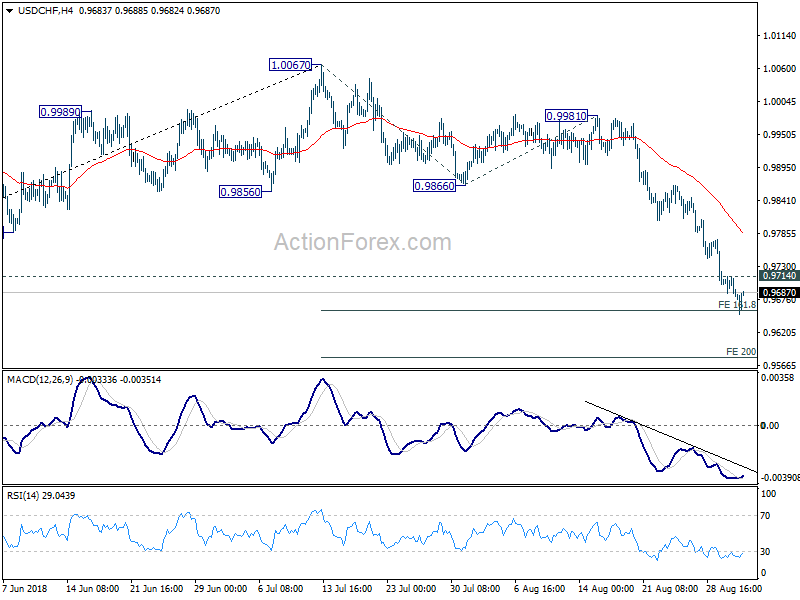
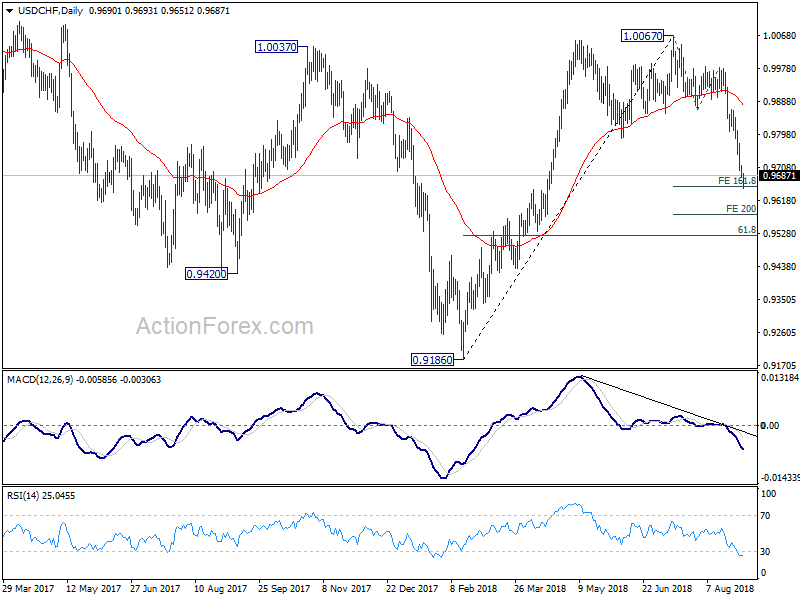
In the bigger picture, current development suggests that rise from 0.9186 low has completed at 1.0067, after failing to sustain above 1.0037 resistance. Fall from 1.0067 could extend to 61.8% retracement of 0.9816 to 1.0067 at 0.9523 and below. But for now, we don't expect a break of 0.9186 low. On the upside, firm break of 1.0067 will resume the rise to 1.0342 key resistance (2016 high).
USD/JPY Mid-Day Outlook
Daily Pivots: (S1) 111.23; (P) 111.53; (R1) 111.98; More...
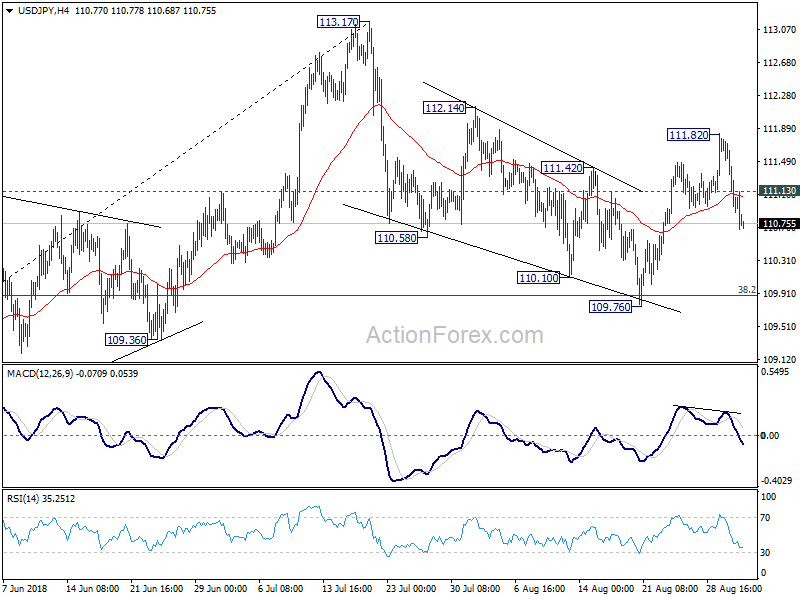
USD/JPY's rebound from 109.76 could have completed at 111.82 already. Intraday bias stays on the downside for 109.76 low. For now, we'd still expect 109.36/76 key support to hold and bring rebound. But decisive break there will carry larger bearish implications. On the upside, above 111.13 will turn bias back to the upside for 111.82. Break there will revive the bullish case and target a retest on 113.17 high.
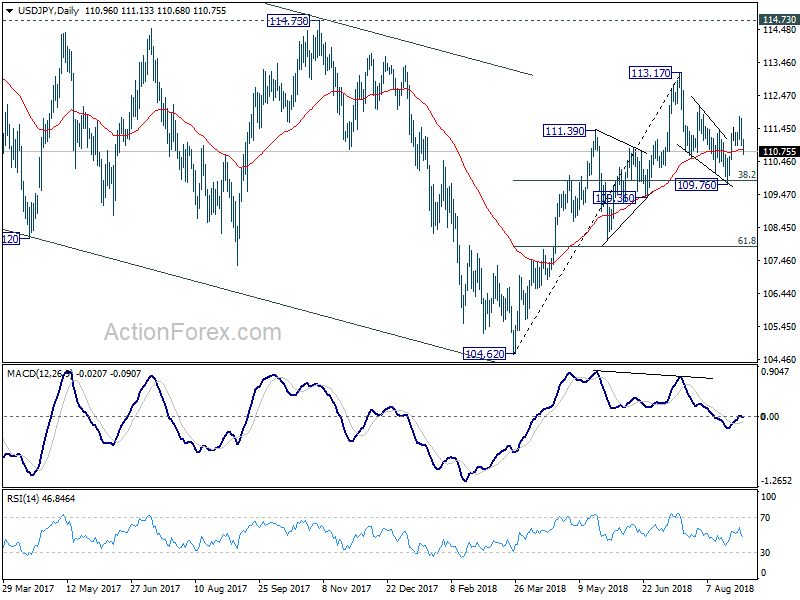
In the bigger picture, corrective fall from 118.65 (2016 high) should have completed with three waves down to 104.62. Decisive break of 114.73 resistance will likely resume whole rally from 98.97 (2016 low) to 100% projection of 98.97 to 118.65 from 104.62 at 124.30, which is reasonably close to 125.85 (2015 high). This will stay as the preferred case as long as 109.36 support holds. However, decisive break of 109.36 will mix up the outlook again. And deeper fall should be seen back to 61.8% retracement of 104.62 to 113.17 at 107.88 and below.
Canadian Dollar Selloff Accelerates on Talk of No Trade Deal, Yen and Swiss Franc Stay Strong
Trade war is back into the spot light today, sparkled by Trump's Bloomberg interview with hostile comments on EU and China. Investor sentiments are clearly weighed down. At the time of writing, FTSE is down -0.58%, DAX down -0.75% and CAC down -1.04%. That followed broad based selling in Asian, with HK HSI down -0.98%, Shanghai SSE down -0.46%. Nikkei, though, was resilient and closed just down -0.02%.
Naturally, Yen and Swiss Franc are the strongest ones today on risk aversion. Dollar follows as the third strongest one, as it's always stronger when trade tensions rises. Commodity currencies are broadly pressured with steep selling seen in Canadian Dollar in early US session.
Let's not forget that today's the the dead for Canada-US trade talk that Trump unilaterally, forcefully imposed. Words from officials have been positive on the talks up till yesterday. But a news report emerged today saying that the negotiations have turned sour. And a deal couldn't be met by the end of the day. Let's see.
EU responds strongly to Trump's regrettable trade war rhetorics
Trump's hostile rhetorics against the EU seem to have draw strong reactions from the latter. European Commission President Jean-Claude Juncker points to the "ceasefire agreement" with Trump made just a month ago, and said he hoped Trump will refrain from imposing auto tariffs. However, Juncker warned that the EU won't let others dictate its own trade policies. And, if Trump violates the deal impose auto tariffs, the EU will "also do that".
ECB Governing Council member Olli Rehn also urged Trump to stop the "regrettable" trade war rhetoric. And he warned that US exit from the WTO could damage international order. And he hit on Trump's ungrounded claims and said ECB is certainly not manipulating the Euro. Rehn also defended China and said the Yuan is weaker because of trade war threat.
Another ECB Governing Council member Ewald Nowotny also said "the economic policy of the United States is currently one of the substantial risks to the global economy." And he warned that unpredictable trade and economic policy, biased rulings in U.S. courts and the dominant role of the Dollar were bad for Europe. He added that there was an increasing interest for Europe "to free oneself from a one-sided dominance."
In a Bloomberg interview, Trump rejected EU's offer to scrap auto tariffs on cars if US does the same. He said "it's not good enough" and added that "Their consumer habits are to buy their cars, not to buy our cars." He also added that EU is "almost as bad as China, just smaller."
UK Raab stubbornly optimistic on a Brexit deal
UK Brexit Minister Dominic Raab and EU chief negotiator Michel Barnier are going to have a marathon six-hour session today. Raab said that he was "stubbornly optimistic" to reach a deal with the EU. He added that "valuable progress" was made but there is clearly "more work to do. And, he is "confident, if not more confident, now that a Brexit deal can be reached".
Barnier, on the other hand, emphasized that with "no backstop" no the Irish border, "there's no deal". And he urged that "operational backstop is a matter of some urgency". He also reiterated the upbeat comment that the future partnership with the UK is "unprecedented". And he's optimistic that a deal could be reached by October.
Turkish Lira lifted mildly as Turkey raised tax on foreign currency savings
Turkish Lira is given a mild lift after the government announce to raise tax of foreign currency savings while scrapping tax on Lira savings. The decision was published in the Official Gazette today. Withholding tax on foreign currency savings of up to six months was increased from current 18% to 20%. On the other hand, withholding tax on Lira savings of more than one year was lowered from 10% to 0%.
Lira was sold off this week on deepening worries on Turkish banks. Fitch warned that "Turkish banks are particularly exposed to refinancing risk, given their reliance on external funding." Moody's also said "there is a heightened risk of a downside funding scenario, where a deterioration in investor sentiment limits access to market funding."
On the data front
Canada IPPI dropped -0.2% mom in July, RMPI rose 0.7%. Eurozone CPI slowed to 2.0% yoy in August, core CPI also dropped to 1.0% yoy. Eurozone unemployment rate was unchanged at 8.2% in July. UK Gfk consumer confidence improved to -7 in August, up from -10 and beat expectation of -11. Japan industrial production dropped -0.1% mom in July versus expectation of 0.3% mom. Housing starts dropped -0.7% yoy versus expectation of 0.4.3% yoy. Unemployment rate rose 0.1% to 2.5% versus expectation of 2.4%. Tokyo CPU core rose to 0.9% yoy in August versus expectation of 0.8% yoy. China official PMI manufacturing rose 0.1 to 51.3 in August, above expectation of 51.0. Official non-manufacturing PMI rose 0.2 to 54.2, above expectation of 53.8.
USD/CAD Mid-Day Outlook
Daily Pivots: (S1) 1.2922; (P) 1.2961; (R1) 1.3021; More...
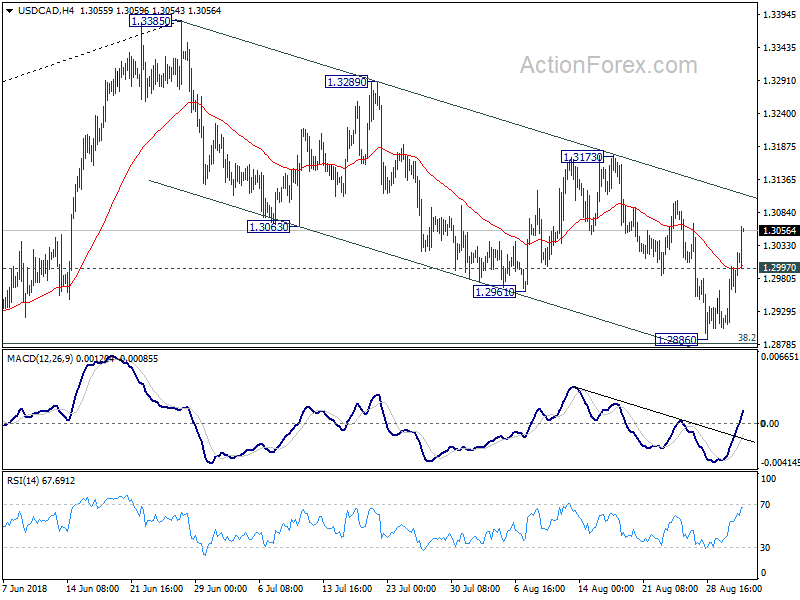
USD/CAD's rebound from 1.2886 short term bottom accelerates to as high as 1.3062 so far in early US session. Intraday bias remains on the upside for short term channel resistance (now at 1.3116). Note again that the pair is staying in near term falling channel, and thus, there is no indication of bullish reversal yet. On the downside, below 1.2997 minor support will turn bias back to the downside for 1.2879 fibonacci level. However, sustained break the of the channel resistance will be the first sign of bullish reversal and bring stronger rise to 1.3173 resistance for confirmation.
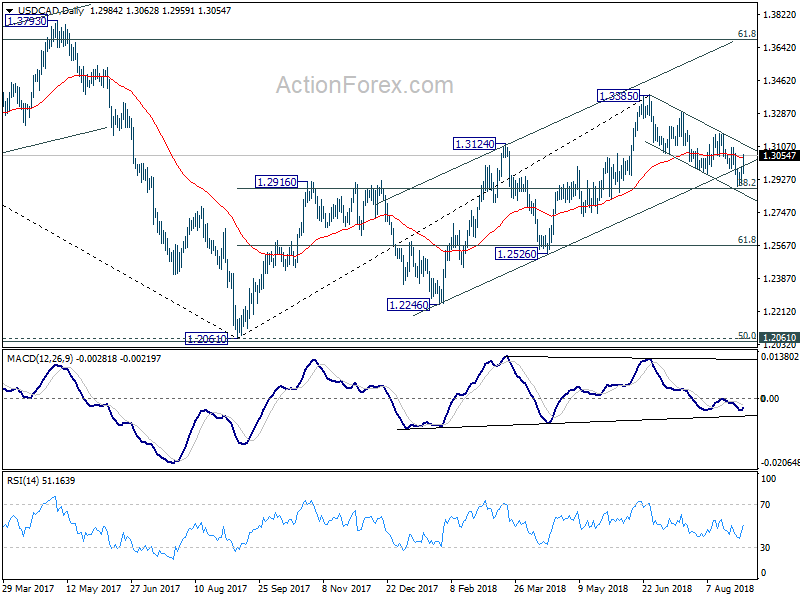
In the bigger picture, the break of channel support (now at 1.2988), argues that rise from 1.2246, as well as that from 1.2061, has completed at 1.3385. Focus is back on 38.2% retracement of 1.2061 to 1.3385 at 1.2879. Decisive break there will affirm the case of medium term reversal and target 61.8% retracement at 1.2567 and below. That will also put key long term support at 50% retracement of 0.9406 (2011 low) to 1.4689 (2015 high) at 1.2048 into focus. On the upside, break of 1.3173 resistance will revive the bullish case and target 61.8% retracement of 1.4689 to 1.2061 at 1.3685 and above.
Economic Indicators Update
| GMT | Ccy | Events | Actual | Forecast | Previous | Revised |
|---|---|---|---|---|---|---|
| 23:01 | GBP | GfK Consumer Confidence Aug | -7 | -11 | -10 | |
| 23:30 | JPY | Jobless Rate Jul | 2.50% | 2.40% | 2.40% | |
| 23:30 | JPY | Tokyo CPI Core Y/Y Aug | 0.90% | 0.80% | 0.80% | |
| 23:50 | JPY | Industrial Production M/M Jul P | -0.10% | 0.30% | -1.80% | |
| 01:00 | CNY | Manufacturing PMI Aug | 51.3 | 51 | 51.2 | |
| 01:00 | CNY | Non-manufacturing PMI Aug | 54.2 | 53.8 | 54 | |
| 01:30 | AUD | Private Sector Credit M/M Jul | 0.40% | 0.30% | 0.30% | |
| 05:00 | JPY | Housing Starts Y/Y Jul | -0.70% | -4.30% | -7.10% | |
| 09:00 | EUR | Eurozone Unemployment Rate Jul | 8.20% | 8.20% | 8.30% | 8.20% |
| 09:00 | EUR | Eurozone CPI Estimate Y/Y Aug | 2.00% | 2.10% | 2.10% | |
| 09:00 | EUR | Eurozone CPI Core Y/Y Aug A | 1.00% | 1.10% | 1.10% | |
| 12:30 | CAD | Industrial Product Price M/M Jul | -0.20% | 0.00% | 0.50% | |
| 12:30 | CAD | Raw Materials Price Index M/M Jul | 0.70% | -0.30% | 0.50% | |
| 13:45 | USD | Chicago PMI Aug | 64 | 65.5 | ||
| 14:00 | USD | U. of Mich. Sentiment Aug F | 95.8 | 95.3 |