

Sample Category Title
USD/CAD Mid-Day Outlook
Daily Pivots: (S1) 1.2922; (P) 1.2961; (R1) 1.3021; More...
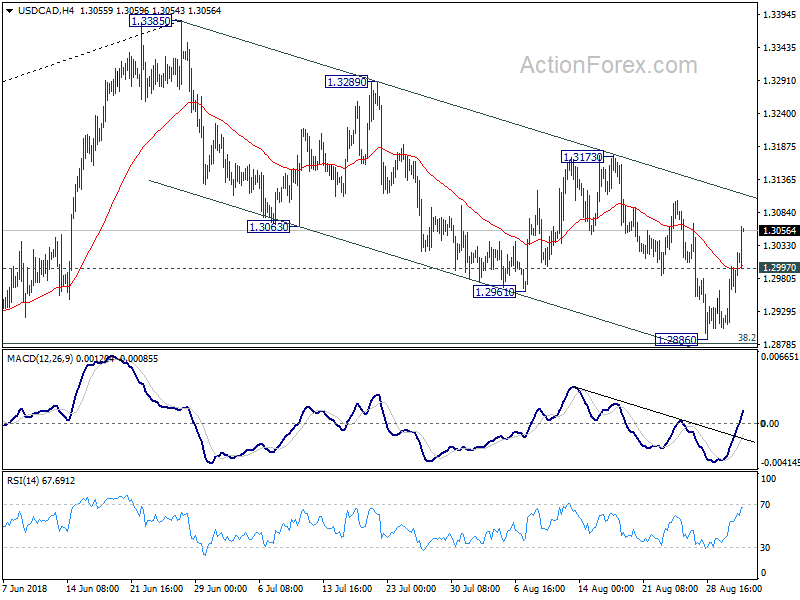
USD/CAD's rebound from 1.2886 short term bottom accelerates to as high as 1.3062 so far in early US session. Intraday bias remains on the upside for short term channel resistance (now at 1.3116). Note again that the pair is staying in near term falling channel, and thus, there is no indication of bullish reversal yet. On the downside, below 1.2997 minor support will turn bias back to the downside for 1.2879 fibonacci level. However, sustained break the of the channel resistance will be the first sign of bullish reversal and bring stronger rise to 1.3173 resistance for confirmation.
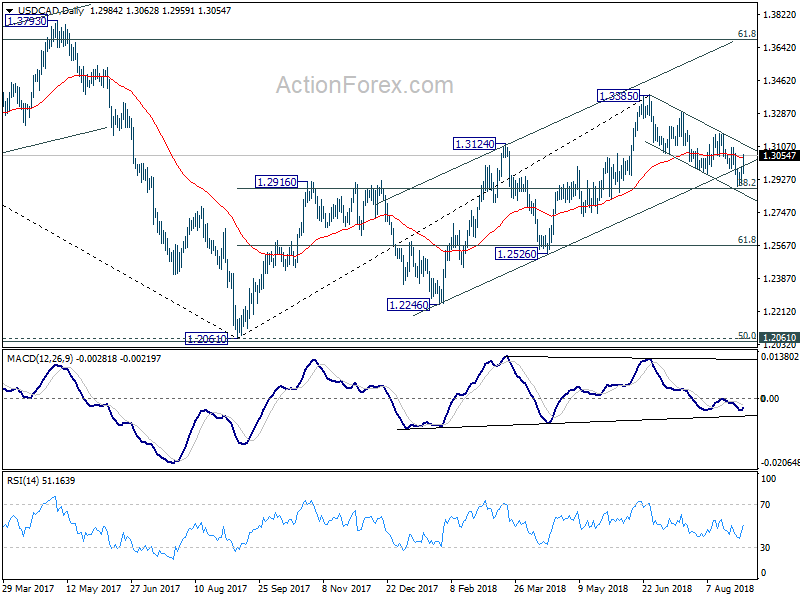
In the bigger picture, the break of channel support (now at 1.2988), argues that rise from 1.2246, as well as that from 1.2061, has completed at 1.3385. Focus is back on 38.2% retracement of 1.2061 to 1.3385 at 1.2879. Decisive break there will affirm the case of medium term reversal and target 61.8% retracement at 1.2567 and below. That will also put key long term support at 50% retracement of 0.9406 (2011 low) to 1.4689 (2015 high) at 1.2048 into focus. On the upside, break of 1.3173 resistance will revive the bullish case and target 61.8% retracement of 1.4689 to 1.2061 at 1.3685 and above.
UK Raab stubbornly optimistic on a Brexit deal
UK Brexit Minister Dominic Raab and EU chief negotiator Michel Barnier are going to have a marathon six-hour session today. Raab said that he was "stubbornly optimistic" to reach a deal with the EU. He added that "valuable progress" was made but there is clearly "more work to do. And, he is "confident, if not more confident, now that a Brexit deal can be reached".
Barnier, on the other hand, emphasized that with "no backstop" no the Irish border, "there's no deal". And he urged that "operational backstop is a matter of some urgency". He also reiterated the upbeat comment that the future partnership with the UK is "unprecedented". And he's optimistic that a deal could be reached by October.
Trade Fears Hold Major Currencies in the Red; Loonie Weakens as NAFTA Deadline Looms
Here are the latest developments in global markets:
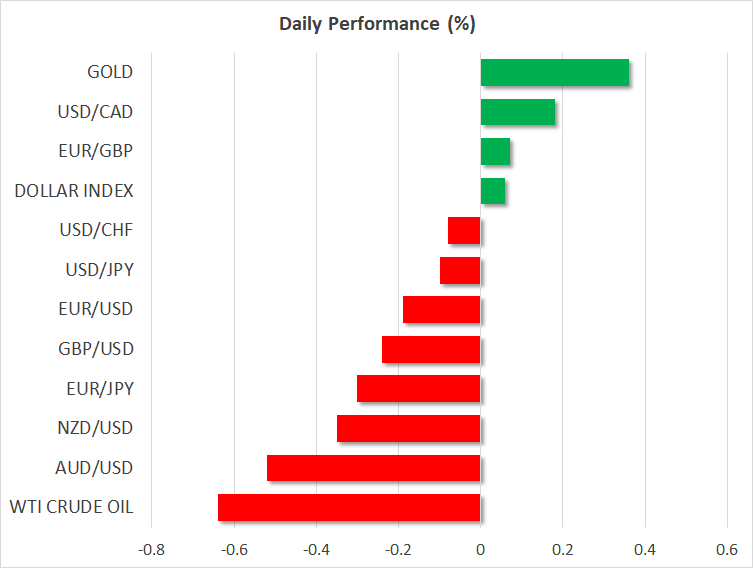
FOREX: Trump’s stubborn stance the previous day aiming to enhance US’s trade protective measures against China and keep the pressure on the EU, shifted funds away from riskier assets, pushing dollar/yen down to 110.78 (-0.16%) and dollar/franc to 0.9666 (-0.23%). The dollar index, which is set to close in the red for the third consecutive week , was also declining but marginally, last seen at 94.68 (-0.04%) as the euro and the pound felt the trade pain as well. Euro/dollar inched down to 1.1647 after Eurozone’s flash CPI figures for the month of August were slightly lower than expected, while the President of the European Commission, Jean-Claude Junker expressed his hope that the ceasefire with the US on trade will continue. Pound/dollar crossed below the 1.30 level to touch 1.2990 (-0.13%) despite the EU reiterating its intention to avoid a hard Irish border. Euro/pound stood lower at 0.8960 (-0.09%). Dollar/loonie was the best performer, trading higher at 1.3006 (+0.19%) ahead of a NAFTA deadline later today and after GDP growth readings out of Canada disappointed. In the antipodean space, aussie/dollar and kiwi/dollar were posting sharper losses, with the former standing at 0.7226 (-0.51%) and the latter at 0.6631 (-0.36%). The Indonesian rupiah dived to 14,730 per dollar, a level never seen since the 1998 crisis, on the face of the EM sell-off. The Indian rupee tumbled to a record low of 71 per dollar earlier in the day, while the Turkish lira managed to rebound to 6.58 per dollar (+1.13%) after reaching a two week low of 6.39 per dollar on Thursday.
STOCKS: European stocks were in a sea of red for the second day on renewed trade threats. The pan-European STOXX 600 and the blue-chip Euro STOXX 50 were losing 0.70% and 0.77% respectively. The German DAX 30 declined by 0.98% at 1030 GMT, the Italian FTSE MIB retreated by 0.80%, while the French CAC was the worst performer, diving by 1.2%. The British FTSE 100 was also on the backfoot, being down by 0.47%. Futures tracking US indices such as the S&P 500, Dow Jones and Nasdaq 100 were in negative territory as well, pointing to a marginally lower open today.
COMMODITIES: Crude oil prices reversed lower after reaching fresh peaks on Thursday, with WTI crude dropping to $69.73/barrel (-0.74%) and Brent slipping to $77.19 (-0.75%). The weakness appeared as investors feared that the ongoing global trade war could negatively affect demand for oil, though concerns about supply tightening on the back of renewed US sanctions on Iran limited steeper declines in crude prices. In precious metals, dollar-denominated gold had fully recovered yesterday’s decline, bouncing back towards 1,206.20 (+0.56%).
Day ahead: Trade developments including NAFTA and Brexit to make headlines; Chicago PMI & final University of Michigan Economic Sentiment Index pending
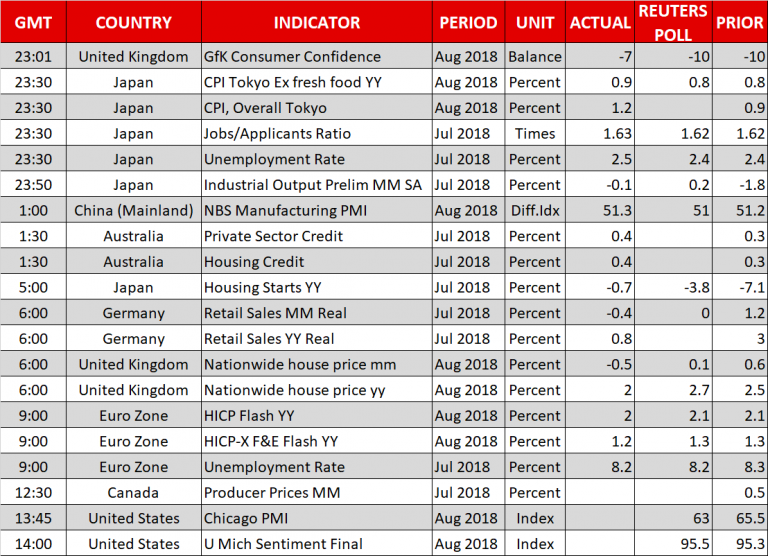
Friday’s economic calendar will get lighter later in the day, with the Chicago PMI and the University of Michigan Consumer Sentiment index out of the US being in focus. Still, any developments on the trade front as well as Brexit could prove of more interest as uncertainty around the topics keeps investors on their toes. Emerging markets will be closely watched given the recent collapse of the Argentinian peso and the Turkish lira’s free fall.
At 1345 GMT, PMI figures out of Chicago, which is a home to some of the largest US companies, are expected to show that manufacturing activity in the region has slowed down in August, driving the corresponding index lower from 65.5 to 63.0. However, this might not cause much worry as any reading above 50 translates to a healthy growing industry. A few minutes later at 1400 GMT, the University of Michigan is anticipated to revise its August US economic sentiment index higher by 0.2 points to 95.5.
Yet investors could ignore the data and remain focused on the growing trade standoff between the US and China. Yesterday the US President reminded markets that import tariffs on $200 billion of Chinese goods could still be possible once the September 6 deadline passes until which recommendations on the plans are awaited. If Trump allows bigger tariffs to go ahead, that would be the largest hit on China so far in the months-long trade battle between the counties.
Regarding US-EU trade tensions, those also resurfaced after Trump rejected the EU’s proposal to eliminate tariffs on US cars if Washington does the same, calling the offer as “not good enough” at his interview with Bloomberg on Thursday.
In the meantime, the more than a year NAFTA talks could take the front and center stage on Friday as US and Canadian trade officials are scheduled to continue intense negotiations before today’s crucial deadline with scope to reach a trilateral agreement including Mexico as well. Discussions have kicked into high gear after Trump said he had formed a preliminary trade deal with Mexico on Monday, leaving the ball in Canada’s court. While Trump’s hawkish tone raised hopes that a deal could be achieved today, the countries still need to resolve some disagreements regarding tariffs in the automotive industry.
Safe havens such as the yen are expected to attract demand if trade conflicts escalate even further, though the dollar has proved recently that it could gain in the wake of stronger trade risk as well.
Brexit could make headlines today as well, as the Brexit Secretary, Dominic Raab is preparing for a six-hour meeting with his EU negotiator, Michel Barnier in Brussels on Friday. Recall that Barnier admitted on Wednesday that the UK could be offered a special partnership “such that has never been with any other country” providing significant support to the pound. However, on Thursday he talked down expectations of a Brexit deal, saying that the EU must be prepared for a “disorderly” exit. Any news hinting that talks are on a good path, could increase long positioning on the pound.
In oil markets, Baker Hughes will report the number of active US rigs for oil drilling at 1700 GMT.
A public appearance by ECB Vice President Luis de Guindos is on the agenda at 1700 GMT. A public appearance by ECB Vice President Luis de Guindos is on the agenda at 1700 GMT.
Of note, US and Canadian markets will be closed for the Labor Day holiday on Monday. At the same day, New Zealand and Australia will be publishing data on Q2 trade terms (2245 GMT Sunday) and retail sales for the month of July (0130 GMT) respectively, while August manufacturing PMIs (0030 GMT) will come out of Japan. Chinese Caixin Manufacturing PMIs for the month of August (0145 GMT) will be also under review on Monday
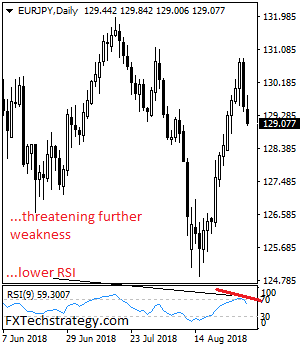
EURJPY: Weakens, Threatens Move Towards The 128.79 Area
EURJPY: The pair looks to weaken further leaving risk of a move towards the 128.79 zone on the cards. Support comes in at the 128.50 level where a break if seen will aim at the 128.00 level. A cut through here will turn focus to the 127.50 level and possibly lower towards the 127.00 level. On the upside, resistance resides at the 129.50 level. Further out, we envisage a possible move towards the 130.00 level. Further out, resistance resides at the 130.50 level with a turn above here aiming at the 131.00 level. On the whole, EURJPY continues to face further downside pressure on correction.
Canadian Dollar Under Pressure as NAFTA Talks Heat Up
The Canadian dollar has lost ground on Friday, ahead of the North American session. Currently, USD/CAD is trading at 1.3034, up 0.41% on the day. On the release front, Canada releases Raw Materials Price Index, which is expected to drop to a flat 0.0%. In the U.S, the key event is UoM Consumer Sentiment, which is expected to drop to 95.5 points.
Investors are glued to the NAFTA talks, as Canadian and U.S negotiators are scrambling to reach an agreement before a Friday deadline (which may have to be extended). The U.S and Mexico reached an agreement earlier in August, leaving Canada out in the cold, much to the annoyance of Canadian policymakers. If Canada and the U.S can hammer out an agreement, this would pave the way to a new NAFTA pact being signed by all three countries. The stakes are enormous, with some $1 trillion in trade between the three countries under the current NAFTA agreement. Canada will likely have to make some concessions, such as reducing hefty tariffs which protect the Canadian dairy industry. Still, Canadian equity markets have been on the rise, as investors remain confident that a NAFTA 2.0 deal can be reached.
The trade spat between the US and China may have take a pause, but investors remain jittery. The trade war has taken a bite out of Chinese exports, as the “new export order” subindex in China’s official PMI dropped below 50 in August, the third straight month that the index has contracted. President Trump has threatened to slap additional tariffs on some $200 billion of Chinese products, a move which could take place as early as next week. Further tariffs would have a damaging effect on the Chinese economy, and it’s likely that China would respond in kind. The current trade spat has already seen the U.S dollar gain ground against rivals such as the euro, and fears of a global trade war could see the greenback make further gains.
Into US session: Stocks down on renewed trade threats, JPY and CHF Higher
Entering into US session, Yen and Swiss Franc are trading as the strongest ones for today on risk aversion. Trump's comments in Bloomberg interview regarding the EU is as bad as China revived the concerns over trade war across the Atlantic, including auto tariffs. The comments attracted strong responses from the EU as they realized Trump is not someone who keep promises. Anyway, Dollar follows as the third strongest, as it strengthens every time as trade tensions escalate. Australian and New Zealand Dollar are the weakest ones for today. Canadian Dollar as the third weakest even though it could make a turn around. Focuses are on the final hours of US-Canada trade negotiations.
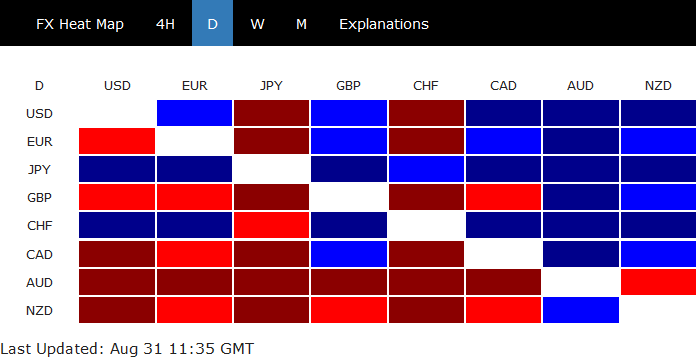
Euro is mixed today as on the one hand it's pressured by renewed tariff threats. Also, Eurozone CPI unexpectedly slowed back to 2.0% yoy August, reaffirming ECB's stance that it won't raise interest rates any time soon. On the other hand, Turkish Lira recovers mildly after the government raised tax on foreign currency savings, while scrapped taxes on local deposits.
In other markets, major European indices are all down today. FTSE is losing -0.4%, DAX falls -0.81% while CAC drops -1.14% at the time of writing. In Asian, Nikkei closed down -0.02%, Hong Kong HSI dropped -0.98%, China Shanghai SSE lost -0.46% and Singapore Strait Times declined -0.38%.
DAX Slide Continues On US-China Trade Tensions
The DAX index has posted sharp losses in the Friday session, after dropping close to 1.0 percent on Thursday. Currently, the index is at 12,395, down 0.79% on the day. On the release front, German retail sales came in at -0.4%, missing the estimate of -0.1%. This marked the second decline in three months. On the inflation front, Eurozone CPI Estimate posted a gain of 2.0%, just shy of the forecast of 2.1%.
Eurozone inflation is expected to tick lower in August, but still remain close to the ECB target of just under 2 percent. CPI Flash Estimate dropped from 2.1% to 2.0%, shy of the estimate of 2.1%. Core CPI is also forecast to tick lower to 1.0%, missing the estimate of 1.1%. Earlier in the week, German Preliminary CPI rose 1.9% in August (year-on-year), down from 2.1% a month earlier. These releases were within expectations, and the slight easing in inflation is unlikely to change plans at the ECB. The central bank is scheduled to wrap up its EUR 2.6 trillion asset-purchase scheme in December. However, it’s unclear when the ECB will raise interest rates. ECB policymakers have been somewhat vague on the issue, saying that rates will not rise until after next summer. Some analysts have circled October 2019 as a possible date for the first ECB rate hike in years.
The trade war between the US and China continues to spook investors. The trade war has hurt Chinese exports, as the “new export order” subindex in China’s official PMI dropped below 50 in August, the third straight month that the index has contracted. President Trump has threatened to slap additional tariffs on some $200 billion of Chinese products, a move which could take place as early as next week. Further tariffs would have a damaging effect on the Chinese economy, and it’s likely that China would respond in kind. The current trade spat has already taken a toll on the equity markets and this is trend is likely to continue if there is no improvement in the troubled trade relationship between the U.S and China.
Trump Trade Talk Hurts Stocks And EM Currencies
Friday August 31: Five things the markets are talking about
The threat of global growth taking a hit from a damaging U.S-China relationship remains ‘front and center.’
Global equities trade under pressure in the last session of the month after U.S President Trump stepped up his tough talk on trade. The ‘big’ dollar and Treasuries both trade steady.
Ahead of the open, the Euro auto sector is again one of the big losers as Trump casts doubt on the scope of the E.U-U.S trade deal and after he suggested moving towards further tariffs on Chinese goods as soon as next week.
Emerging market currencies continue to experience the fall out of a plummeting Argentina peso. On contagion fears, the Indian rupee has dropped to a new record low outright, while South Africa’s rand slid to the lowest in two-years.
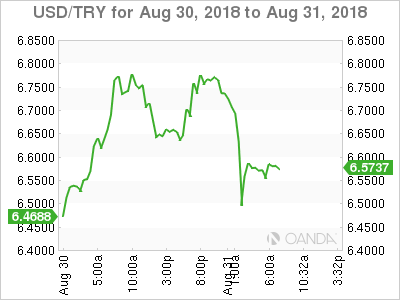
Elsewhere, the EUR (€1.1673) has edged a tad higher, while and the yen (¥110.75) trades somewhat steady. An exception, the Turkish lira, TRY (down -0.9% at $6.5822) has rallied after Turkey announced measures designed to encourage local currency saving, cutting a tax on lira deposits and increasing a tax on foreign currency deposits.
1. Stocks see red
In Japan, the Nikkei ended flat overnight, snapping an eight-session rally after President Trump said he is ready to quickly intensify ‘his’ trade war with China. The Nikkei has ended the day -0.02% lower after gaining +1.2% for the week and +1.4% for the month.
Down-under, Aussie shares fell on Friday, as investors feared an escalation in global trade wars. The S&P/ASX 200 index closed -0.5% lower, but added +1.2% for the week. In S. Korea, the Kospi closed down -0.07%. The index is down around -6.5% so far this year, and up by +0.75% in the previous 30 days.
In Hong Kong and China, stocks fall in renewed Sino-U.S trade war fears. Investor sentiment was also hurt by a slump in the index heavyweight Tencent, as Beijing’s proposed tougher measures against online gaming hit game operators. The Hang Seng index fell -1.0%, while the China Enterprises Index lost -0.8%. In China, the CSI300 index fell -0.5%, while the Shanghai Composite Index dropped -0.45%.
In Europe, regional bourses have opened lower across the board on global trade concerns. The Euro-auto sector is under pressure from reports that President Trump felt E.U tariff s are “not good enough,” while Italian stocks are under pressure due to the country’s exposure to Argentina.
U.S stocks are set to open in the ‘red’ (-0.04%).
Indices: Stoxx50 -0.8% at 3,404, FTSE -0.3% at 7,496, DAX -1.0% at 12,374, CAC-40 -0.7% at 5,438; IBEX-35 -0.7% at 9,400, FTSE MIB -0.5% at 20,391, SMI -0.5% at 8,993, S&P 500 Futures -0.04%
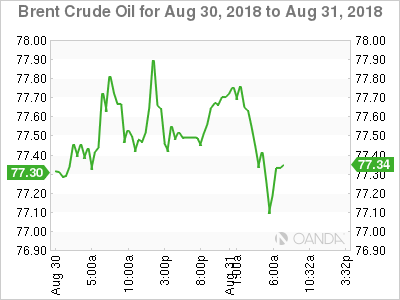
2. Oil prices dip on Sino-U.S trade worries
Oil prices are under pressure amid concerns that the Sino-U.S trade war could intensify, although looming U.S sanctions against Iran is limiting the decline.
Brent oil futures are at +$77.55 per barrel, down -22c, or -0.3% from Thursday’s close. U.S West Texas Intermediate (WTI) crude futures are down -6c at +$70.19 a barrel.
Nevertheless, with Venezuelan supply falling sharply and concerns around U.S. sanctions against Iran that will target its oil exports from November, crude prices this month are expected to record +4% rise for Brent and a +2% increase for WTI.
Note: The central theme for Q4 should be global trade disputes and their effects on economic growth and, by extension, fuel demand.
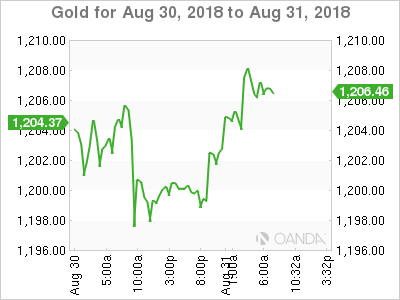
Ahead of the U.S open, gold prices rise, but are set for longest monthly losing streak in nearly six-years. Spot gold is up +0.6% at +$1,207.06 an ounce, after touching a near one-week low of +$1,195.95 yesterday. Prices are down -1.3% so far this month, and are on track for a fifth straight monthly decline. U.S gold futures are up +0.7% at +$1,212.80 an ounce.
3. Yields lower on risk aversion
Euro trade tensions are again at the forefront and are pushing 10-year German Bund yields back below +0.40% at +0.36% as investors seek safe havens.
Note: There is no government bond supply in the eurozone today but France and Spain will announce the details of their upcoming bond auctions to be held on Sept. 6.
More importantly, Italy’s battered bond market is steady as investors wait for a today’s Fitch Ratings review – there are market concerns that the Italian government’s spending plans will put further strain on already high debt levels.
Note: Fitch Ratings is expected to release its review after markets close. It rates Italy BBB with a stable outlook.
Elsewhere, the yield on 10-year Treasuries has climbed less than +1 bps to +2.86%, while in the U.K, the 10-year Gilt yield has dipped -1 bps to +1.455%.
4. Thus far, dollar steady on month-end
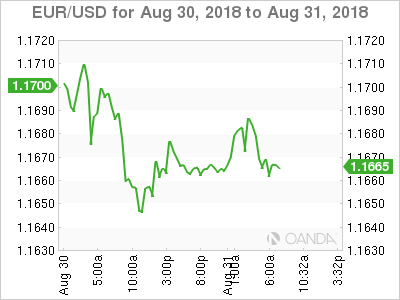
EUR (€1.1673) received some support in late Asia trading as ECB’s Nowotny believed that the central bank should focus on moving the “deposit” rate out of negative territory as he saw “no immediate risks arising due to Italy.” Investors are wary that the single unit could find late afternoon support if Italy’s sovereign rating is not cut by Fitch. Also, providing some support was this morning’s Eurozone “flash” CPI print (see below) remaining above the ECB’s target for the third consecutive month, but it did come in below expectations.
Elsewhere, investor focus remains on EM FX pairs as various central banks take action to address their recent currency weakness.
Brazil’s central bank announced FX intervention – first intervention in two months – Argentina Central Bank (BCRA) raised its LELIQ Rate by +1500 bps to +60.00% for its fifth intra-policy move this year. Indonesia’s Central Bank reiterated its commitment to guard against volatility in FX and bond markets and continue with its duel interventions, while in Turkey, the government revised its withholding tax related TRY deposits which cut the withholding tax on lira deposits while raising tax on FX currency deposits of up to 1year
5. Eurozone inflation eases
Data this morning showed that Eurozone inflation cooled slightly this month, which could suggest that the ECB may remain cautious its approach to dialling back monetary stimulus.
The E.U’s statistics agency said in a preliminary estimate today that consumer prices in the eurozone rose +2% on the year in August, a tad weaker than the +2.1% recorded in July.
Digging deeper, energy prices rose at a slower pace than in July, as did prices for services and industrial goods.
Last month, ECB officials concluded that the Eurozone economy still needed “significant” stimulus from monetary policy to ensure inflation continues to climb and today’s data will likely reinforce that thinking.
Officials in July felt that “monetary policy had to remain patient, prudent and persistent,” the ECB’s minutes said.
Note: In June, the ECB reiterated that it expects to phase out its bond-purchasing program by the end of 2018, although it has signalled that its policy rates will remain unchanged at least through next summer.
Turkish Lira lifted mildly as Turkey raised tax on foreign currency savings
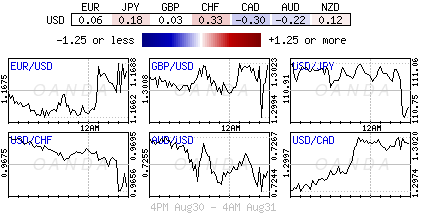
Turkish Lira is given a mild lift after the government announce to raise tax of foreign currency savings while scrapping tax on Lira savings. The decision was published in the Official Gazette today.
Withholding tax on foreign currency savings of up to six months was increased from current 18% to 20%. On the other hand, withholding tax on Lira savings of more than one year was lowered from 10% to 0%.
Lira was sold off this week on deepening worries on Turkish banks. Fitch warned that "Turkish banks are particularly exposed to refinancing risk, given their reliance on external funding." Moody's also said "there is a heightened risk of a downside funding scenario, where a deterioration in investor sentiment limits access to market funding."
USD/TRY's rebound has stalled now at 6.8396. Immediate threat of 7.0000 handle is eased.
EUR/USD – Euro Steady As Eurozone CPI Estimate Close To Estimate
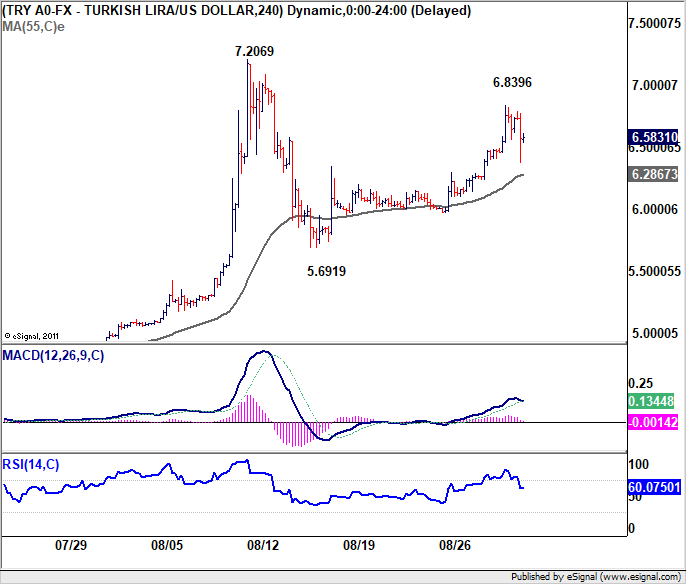
EUR/USD is showing little movement in the Friday session. Currently, the pair is trading at 1.1661, up 0.08% on the day. On the release front, German Preliminary CPI is expected to dip to 0.1%. The US will release key consumer spending and inflation reports, as well as unemployment claims. On Friday, Germany releases retail sales and the eurozone publishes CPI Estimate. In the U.S, the key event is UoM Consumer Sentiment, which is expected to drop to 95.5 points.
Eurozone inflation is expected to dip lower in August. CPI Flash Estimate dropped from 2.1% to 2.0%, shy of the estimate of 2.1%. Core CPI is also forecast to tick lower to 1.0%, missing the estimate of 1.1%. Earlier in the week, German Preliminary CPI rose 1.9% in August (year-on-year), down from 2.1% a month earlier. These releases were within expectations, and the slight easing in inflation is unlikely to change plans at the ECB. The central bank is scheduled to wrap up its EUR 2.6 trillion asset-purchase scheme in December. However, it’s unclear when the ECB will raise interest rates. ECB policymakers have been somewhat vague on the issue, saying that rates will not rise until after next summer. Some analysts have circled October 2019 as a possible date for the first ECB rate hike in years.
The trade spat between the US and China may have take a pause, but investors remain jittery. The trade war has taken a bite out of Chinese exports, as the “new export order” subindex in China’s official PMI dropped below 50 in August, the third straight month that the index has contracted. President Trump has threatened to slap additional tariffs on some $200 billion of Chinese products, a move which could take place as early as next week. Further tariffs would have a damaging effect on the Chinese economy, and it’s likely that China would respond in kind. The current trade spat has already seen the U.S dollar gain ground against rivals such as the euro, and fears of a global trade war could see the greenback make further gains.