Sample Category Title
Sunset Market Commentary
Markets:
Global core bonds gained ground today ahead of the weekend. A new sell-off in TRY caused safe haven flows ahead of the weekend, especially with Turkish markets closed next week for national holidays. EUR/TRY surged back above 7. European stock markets turned south, registering losses of up to 1%. Both the German Bund and the US Note future tested the intraweek highs. Traded volumes were extremely low though, probably amplifying the moves. The eco calendar was empty apart from a below-consensus August Univ. of Michigan consumer confidence which didn’t affect trading. The US yield curve bull flattens marginally at the time of writing with yields 0.8 bps (2-yr) to 1.2 bps (30-yr) lower. German yields drop by 0.9 bps to 2 bps with the belly of the curve outperforming the wings. 10-yr yield spread changes vs Germany widened by up to 3 bps with Greece underperforming (+7 bps). Next week’s eco calendar because somewhat more interesting with FOMC Minutes (Wednesday), EMU PMI’s (Thursday) and Fed Powell’s speech on the economy and monetary policy in Jackson Hole (Friday).
Recently improved risk sentiment convinced some investors to close some EUR/USD shorts ahead of the weekend pushing the pair above 1.14 in early European trade. The move proved to be premature with TRY back in the defensive ahead of European noon. EUR/USD reacted accordingly with the dollar taking over from the euro. The pair touched an intraday low of 1.1375. As TRY stabilized throughout the day, EUR/USD followed the move, gradually pushing the pair back towards 1.14. While EUR/USD showed more intraday volatility than other markets, moves remained limited and technically insignificant. Fortune won’t change in favor of the euro as long as the currency pair remains below the key 1.1510. The Japanese Yen fulfilled its traditional safe haven status, pulling USD/JPY back to 110.40. EUR/GBP followed the similar early move of EUR/USD higher and entered a technical sideway narrow range afterwards. EUR/GBP currently trades around 0.8960, compared to yesterday’s close around 0.8945.
News Headlines:
Canada’s year-on-year inflation rose to 3.0% in July, from a 2.5% rise in June, as energy prices ticked higher. The core inflation, CPI trim (YoY), also rose 2.1% against the 2.0% increase from June, supporting the Bank of Canada’s fourth rate hike in July. The Canadian dollar gained more than half a percentage on the news.
Germany is facing chronic labor shortages and wants to decide on a proposal to facilitate the process for skilled workers from outside the EU to take a job inside the country. In 2015, they hoped that more than a million refugees could fill the gap, but a lack of language skills and no proof of qualifications has slowed the process.
Slovenia has put an end to a two-month political deadlock as lawmakers approved election runner-up Marjan Sarec as new prime minister over the likes of election winner Janez Jansa, a populist and eurosceptic Victor Orban ally. The new minority government vowed to keep the country at the core of the European Union.
US President Donald Trump has announced that he asked the Securities and Exchange Commission to investigate a possible switch from quarterly reporting to a six month system, in order to ease regulations and spur growth for US businesses. Some corporate leaders and trade groups have stated that a short-term focus on earnings and revenues limits business to grow and create jobs.
U of Michigan dropped to 95.3, 11-month low, consumers have little tolerance for overshooting inflation
US University of Michigan consumer sentiment dropped sharply to 95.3 in August, down from 97.9 and missed expectation of 98.1. That's also the lowest level since last September.
Some quotes from Surveys of Consumers chief economist, Richard Curtin:
- Decline concentrated among households in the bottom third of the income distribution
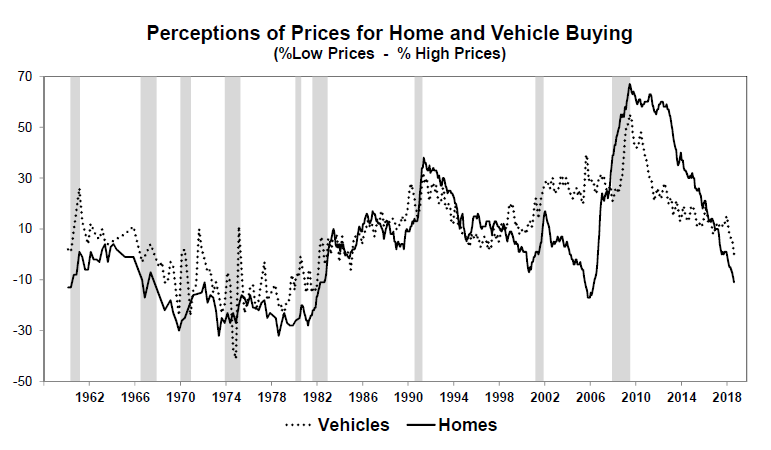
- The dominating weakness reflected much less favorable assessments of buying conditions, mainly due to less favorable perceptions of market prices.
- Consumers have become much more sensitive to even relatively low inflation rates than in past decades.
- Some price resistance has been neutralized by rising wages
- Falloff in favorable price perceptions has been much larger than ever before recorded.
- Overall, the data indicate that consumers have little tolerance for overshooting inflation targets, and to the benefit of the Fed, interest rates now play a more decisive role in purchase decisions.
Canadian July CPI Jumps Significantly Higher
Highlights:
- The July CPI rose 0.5% in the month, which compared to expectations of a 0.1% increase.
- The year-over-year rate jumped to 3.0% rather than holding steady at the June rate of 2.5%.
- About one-half the upward surprise in the month reflected outsized increases in airfares (16.4%) and travel services (7.5%).
Our Take:
Canadian inflation report for July came in much stronger than expected with the year-over-year rate unexpectedly jumping to 3.0% rather than expectations for an unchanged 2.5%. A lion’s share, though not all, of the upward surprise could be attributed to sizeable increases in airfares and travel services. Despite evidence of price pressure emerging in the overall CPI, the Bank of Canada will likely take some comfort from the annual increase in its core measures remaining at 2.0% in July and thus in line with its inflation target. Recent retaliatory tariffs on U.S. imports announced July 1 could directionally have been an upward factor though the magnitude would likely have been insignificant. With the Bank of Canada only assuming a cumulative 0.1 percentage point hit on the level of prices this upward impact is not likely to be significant even going forward though this assumes that no further retaliatory tariff actions by Canada will be announced. A more immediate inflation risk is the Canadian economy currently operating slightly beyond capacity as evidenced by the current unemployment rate of 5.8%. This risk is expected to keep the Bank of Canada tightening policy. Our forecast assumes another 25 basis points hike in the overnight rate before the end of this year and another 50 basis points over the first half of 2019 with this official rate finishing next year at 2.25%.
EUR/USD Mid-Day Outlook
Daily Pivots: (S1) 1.1339; (P) 1.1374 (R1) 1.1413; More.....
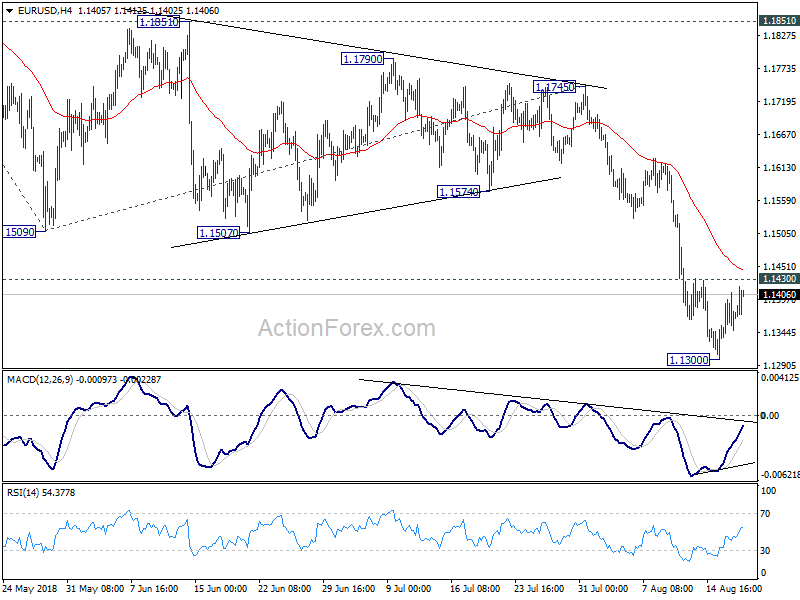
Intraday bias in EUR/USD remains neutral at this point. With 1.1430 minor resistance intact, further decline remains in favor. Break of 1.1300 will target 61.8% projection of 1.2413 to 1.1509 from 1.1745 at 1.1186. Note that it's a cluster level with 61.8% retracement of 1.0339 to 1.2555 at 1.1186. Hence, we'll tentatively look for short term bottoming around 1.1186. Meanwhile, considering mild bullish convergence condition in 4 hour MACD, break of 1.1430 will indicate short term bottoming. In that case, lengthier consolidation would be seen first before down trend resumption.
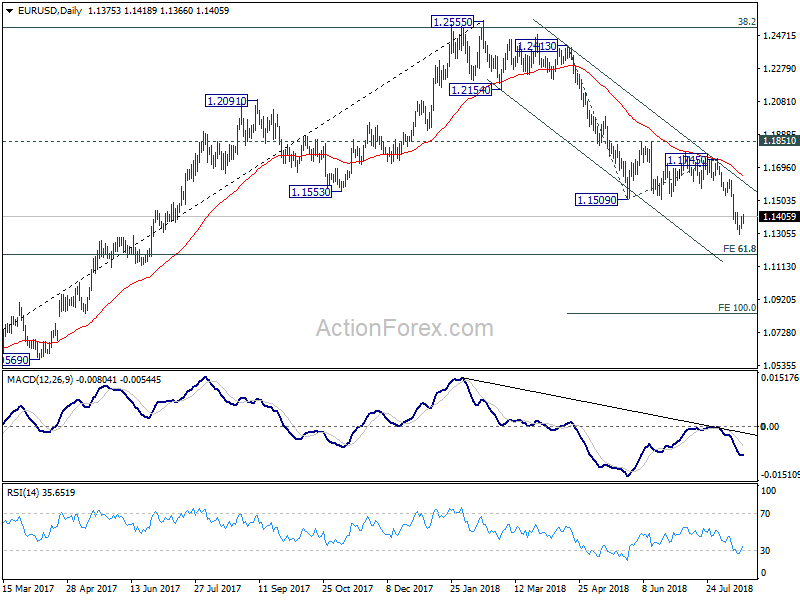
In the bigger picture, the down trend from 1.2555 medium term is in progress for 61.8% retracement of 1.0339 to 1.2555 at 1.1186. Note again that EUR/USD was rejected by 38.2% retracement of 1.6039 (2008 high) to 1.0339 (2017 low) at 1.2516. That carries some long term bearish implications. Sustained break of 1.1186 could pave the way back to retest 1.0339 low. For now, outlook will remain bearish as long as 1.1851 resistance holds, even in case of strong rebound.
GBP/USD Mid-Day Outlook
Daily Pivots: (S1) 1.2679; (P) 1.2717; (R1) 1.2749; More...
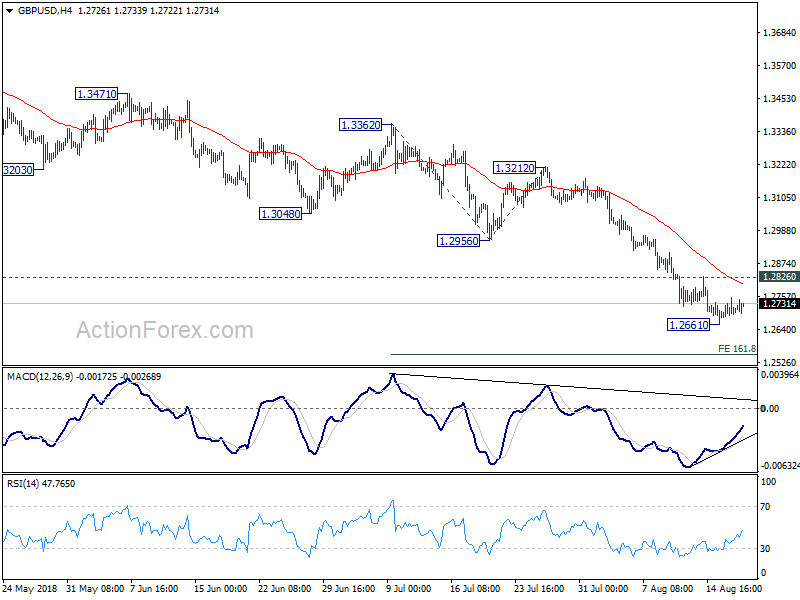
GBP/USD is staying in consolidation above 1.2661 temporary low and intraday bias stays neutral. As long as 1.2826 minor resistance holds, deeper decline is expected. Break of 1.2661 will resume the whole fall from 1.4376 and target 161.8% projection of 1.3362 to 1.2956 from 1.3212 at 1.2555. Though, break of 1.2826 will indicate short term bottoming on bullish convergence condition in 4 hour MACD. And that would bring lengthier consolidation first.
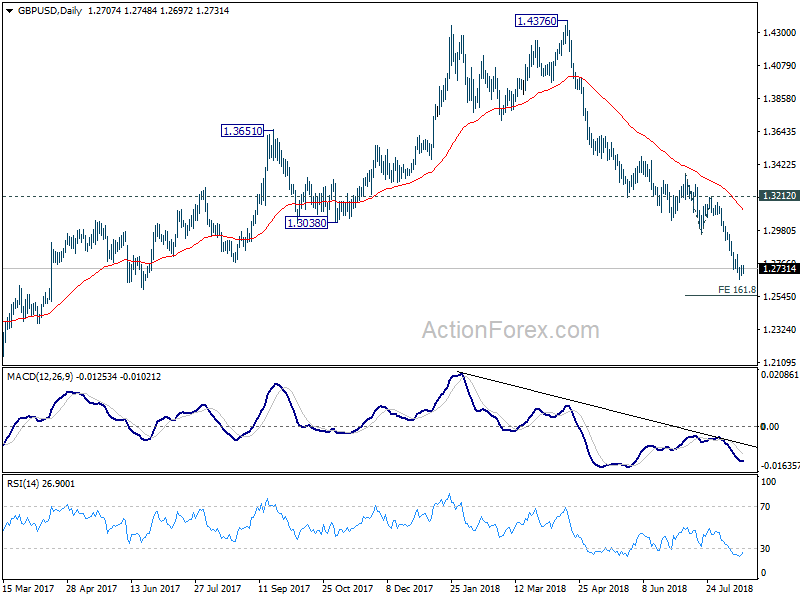
In the bigger picture, whole medium term rebound from 1.1946 (2016 low) should have completed at 1.4376 already, after rejection from 55 month EMA (now at 1.4141). Current downside acceleration argues that it's possibly resuming long term down trend. In any case, outlook will stay bearish as long as 1.3212 resistance holds. Retest of 1.1946 should be seen next.
USD/CHF Mid-Day Outlook
Daily Pivots: (S1) 0.9930; (P) 0.9953; (R1) 0.9990; More....
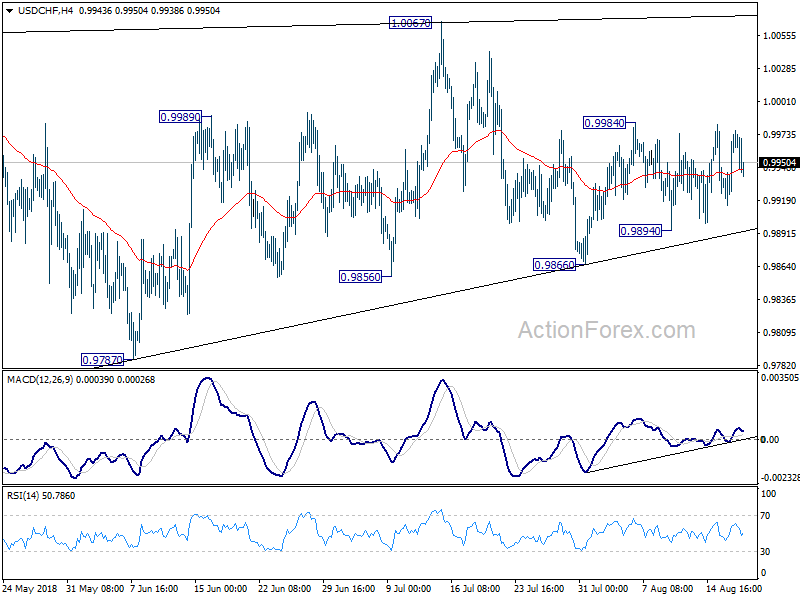
No change in USD/CHF's outlook. Intraday bias remains neutral at this point. On the upside, above 0.9984 will resume the rebound from 0.9866 to retest 1.0067 high. Decisive break there will resume whole rally from 0.9186. On the downside, below 0.9894 might extend the consolidation pattern from 1.0056 with another falling leg. But downside should be contained by 38.2% retracement of 0.9186 to 1.0056 at 0.9724 to bring rebound.
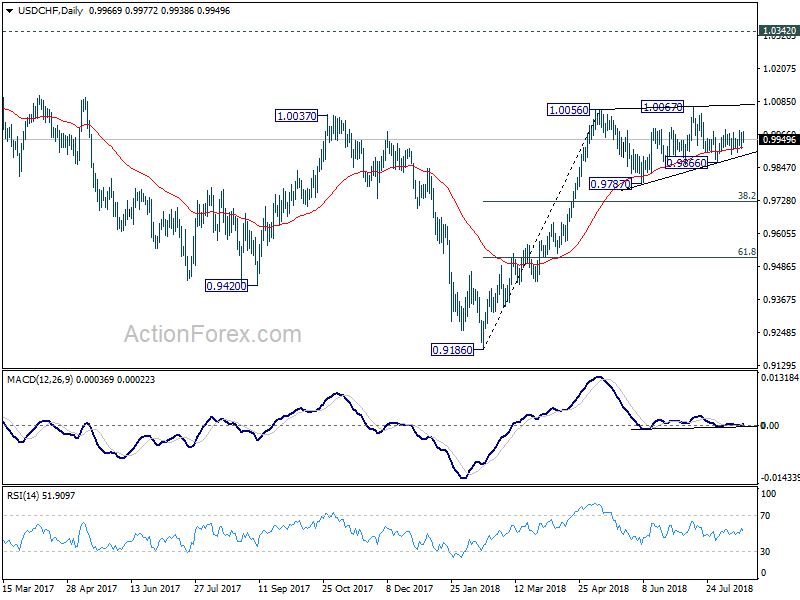
In the bigger picture, current development suggests that the consolidation pattern from 1.0056 is extending with another leg. As long as 38.2% retracement of 0.9186 to 1.0056 at 0.9724 holds, we'd expect rise from 0.9186 to resume at a later stage to retest 1.0342 key resistance (2016 high). However, sustained break of 0.9724 fibonacci level will bring deeper fall, as another declining leg in the long term range pattern.
USD/JPY Mid-Day Outlook
Daily Pivots: (S1) 110.54; (P) 110.82; (R1) 111.19; More...
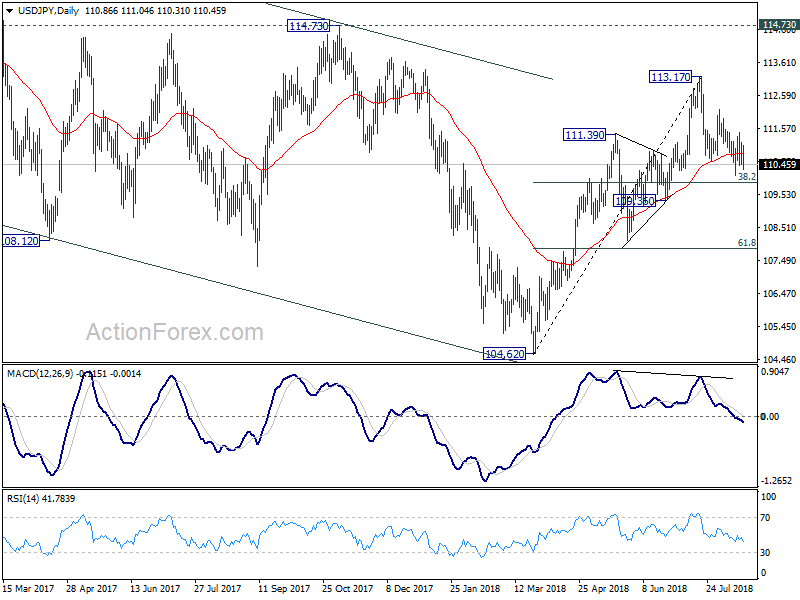
No change in USD/JPY's outlook. Intraday bias in USD/JPY remains neutral for the moment. The corrective decline from 113.17 might extend lower. But downside should be contained by 38.2% retracement of 104.62 to 113.17 at 109.90 to bring rebound. On the upside, above 111.42 will target 112.14 minor resistance first. Break will argue that larger rally is possibly resuming for above 113.17.
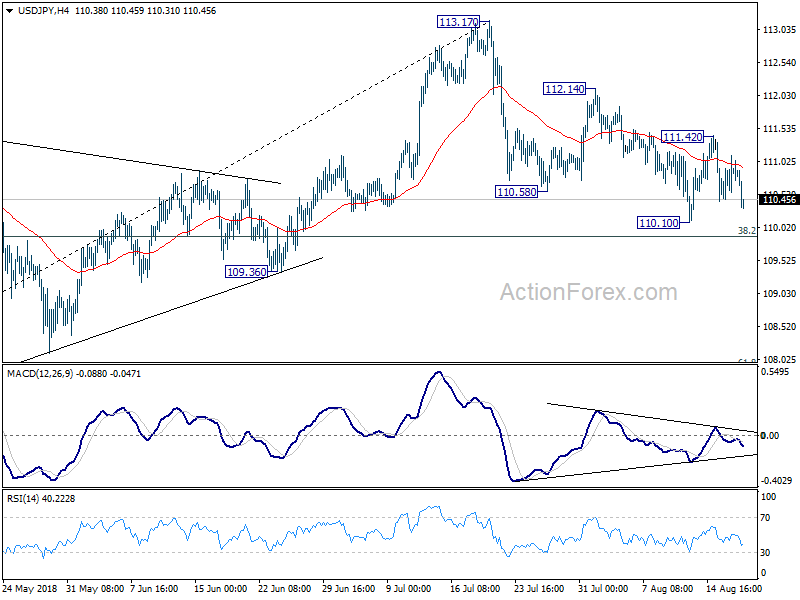
In the bigger picture, corrective fall from 118.65 (2016 high) should have completed with three waves down to 104.62. Decisive break of 114.73 resistance will likely resume whole rally from 98.97 (2016 low) to 100% projection of 98.97 to 118.65 from 104.62 at 124.30, which is reasonably close to 125.85 (2015 high). This will stay as the preferred case as long as 109.36 support holds.
Canada: Inflation Comes in Hot in July, Rising to 3.0%
Consumer prices rose 3.0% year-on-year in Canada in July, up from 2.5% in June and well ahead of median expectations for an unchanged print. Adjusted for seasonal patterns, prices rose 0.5% month-on-month.
Energy prices were a key contributor to inflation, up 14.2% over the past year, but the other big factor was air transportation (+28.2%). Air transportation rose 16.4% on the month – the highest month-on-month growth in nearly 30 years.
The Bank of Canada's core measures were broadly unchanged. CPI-common and CPI-median remained at 1.9% and 2.0% respectively, while CPI-trim edged up to 2.1% (from 2.0% in June). The average of the three measures is now bang on 2.0%.
Key Implications
Headline inflation jumped unexpectedly in July. The jump in air transportation was a big factor, adding over 0.3 percentage points to price growth over the past year. This looks to be a one-off, reflecting the impact of higher fuel and labour costs on the airline industry.
The relative stability of core inflation measures may give the Bank of Canada some solace. Still, with an economy beating expectations and a range of indicators pointing to limited excess capacity, maintaining stable inflation is likely to require further rate hikes by the central bank with the next one likely coming in October.
AUDUSD: Remains Bullish On Correction
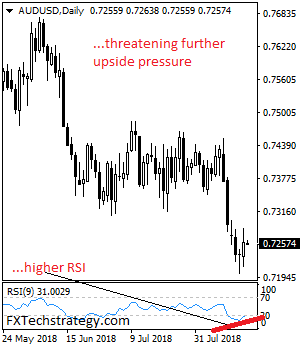
AUDUSD. The pair looks to strengthen further after closing higher on Thursday. Support resides at the 0.7200 level where a breach will aim at the 0.7150 level. Below that level will set the stage for a run at the 0.7100 level with a cut through here targeting further downside pressure towards the 0.7050 level. On the upside, resistance lies at the 0.7250 level. A cut through here will turn attention to the 0.7300 level and then the 0.7350 level where a violation will set the stage for a retarget of the 0.7400 level. On the whole, AUDUSD faces further upside threats.
EURGBP Pulls Back from 10-Month High, Positive Trend Still in Force
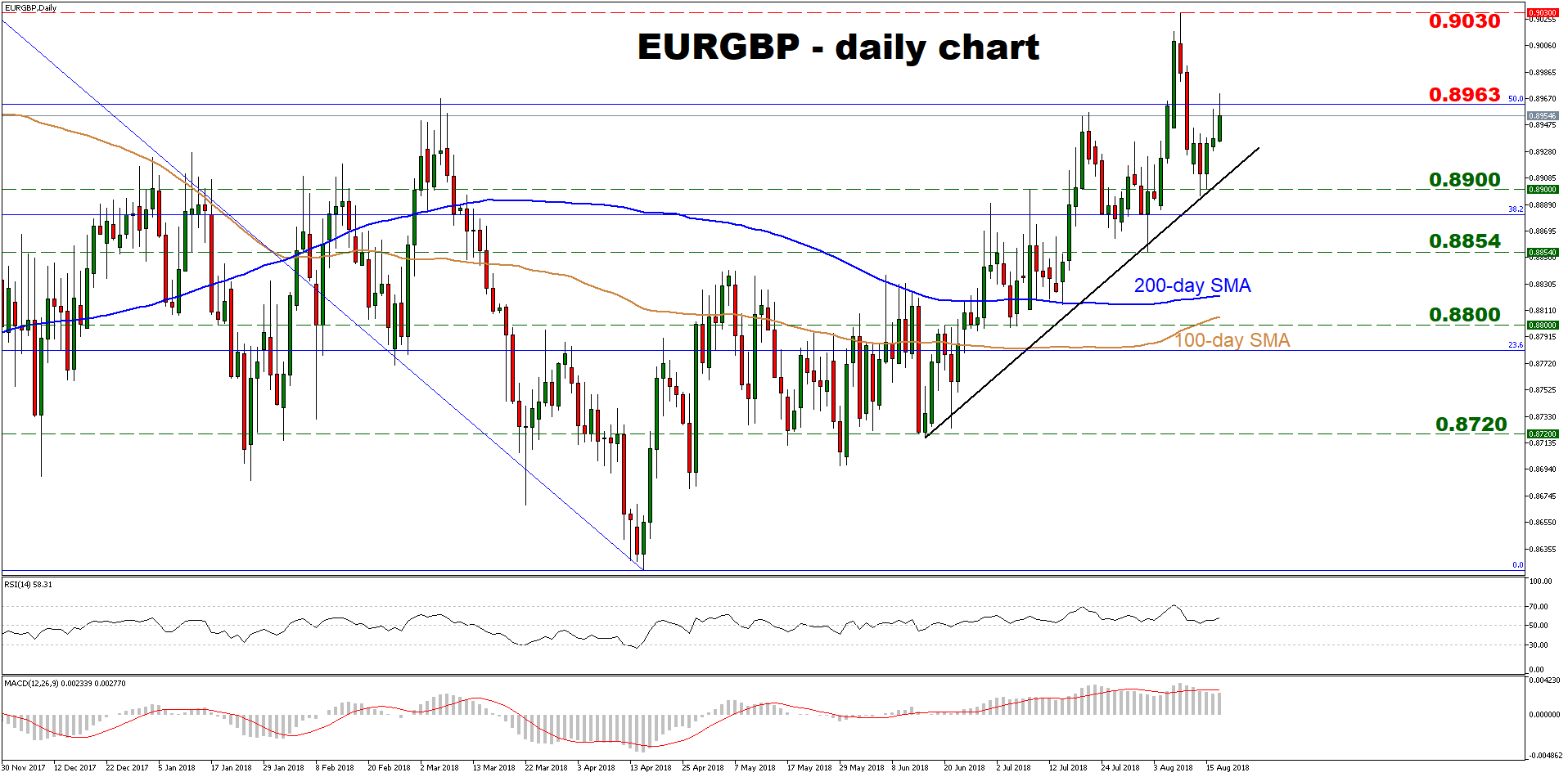
EURGBP retreated in recent days, after meeting resistance near the 10-month high of 0.9030 recorded on August 9. Despite the pullback, the price structure on the daily chart remains higher peaks and higher troughs above the uptrend line drawn from the lows of June 15, as well as above the pair’s 100- and 200-day moving averages. These suggest that the broader bullish trend is still in force.
Looking at short-term momentum oscillators, they are also in support of a broadly positive picture. The RSI – already above its neutral 50 line – is pointing upwards, detecting upside momentum. The MACD, meanwhile, although slightly below its red trigger line, remains safely in positive territory.
In case of further advances, a clear closing candle above the 0.8963 barrier, which is the 50% Fibonacci retracement of the 0.9300 to 0.8620 downleg, could open the way for the multi-month low of 0.9030. Even steeper advances could see scope for a test of the 0.9100 round figure.
On the downside, support to declines may come near the crossroads of the 0.8900 handle and the aforementioned upside support line. If the bears overcome that barrier, declines could stall near the 0.8854 level, this being the low of August 2. Even lower, the 200- and 100-day moving averages could provide support, at 0.8821 and 0.8806 respectively, with the area around them also encapsulating the psychological number of 0.8800.
Overall, the short-term picture remains bullish, though the medium-term outlook of the pair is largely neutral, with a break above 0.9030 needed to turn that to positive as well.