

Sample Category Title
USD/CAD Mid-Day Outlook
Daily Pivots: (S1) 1.3123; (P) 1.3149; (R1) 1.3185; More...
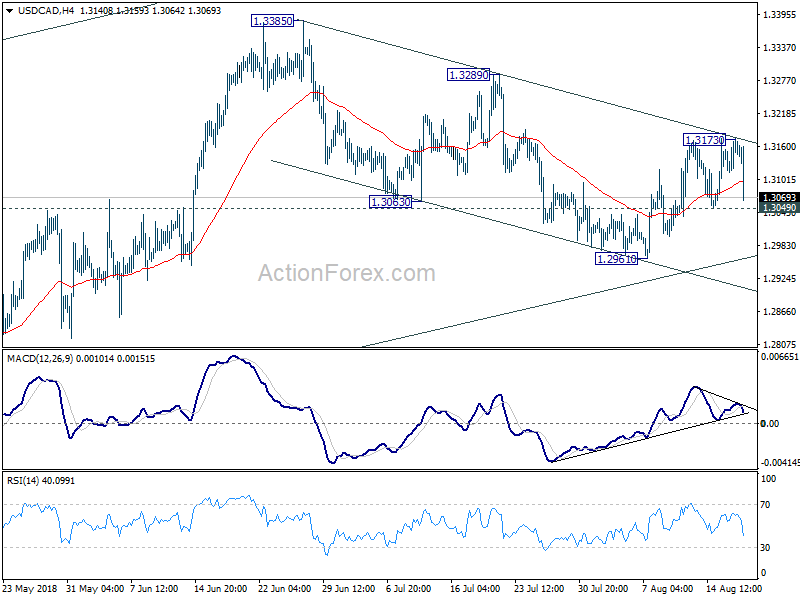
UD/CAD was rejected by near term falling channel resistance and drops sharply in early US session. Nonetheless, it's staying above 1.3049 minor support and intraday bias remains neutral. While the view is looking shaky, we're still favoring that corrective pull back from 1.3385 has completed at 1.2916. Rebound from 1.2961 should extend higher and above 1.3173 will target 1.3289 resistance. However, on the downside, break of 1.3049 minor support will dampen this bullish view and turn focus back to 1.2961 low instead.
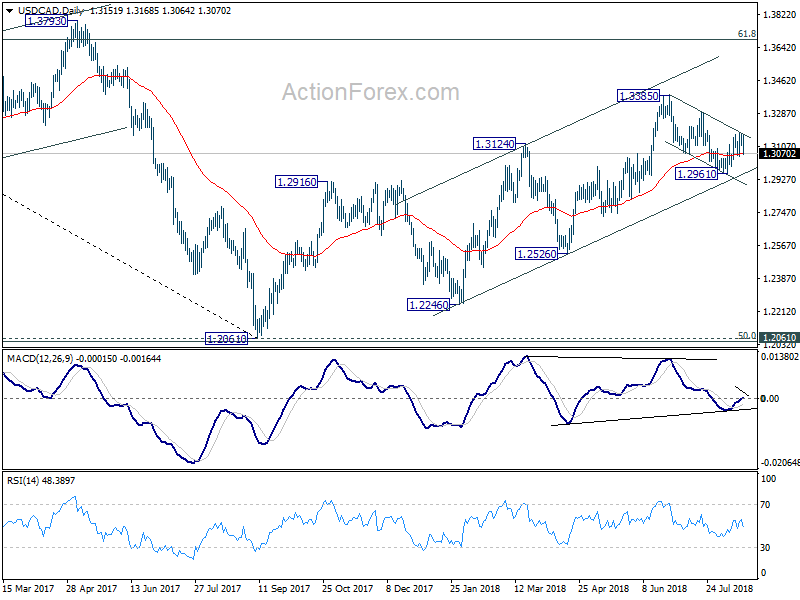
In the bigger picture, as long as channel support (now at 1.2958) holds, we're holding to the bullish view. That is, fall from 1.4689 (2015 high) has completed at 1.2061, ahead of 50% retracement of 0.9406 (2011 low) to 1.4689 (2015 high) at 1.2048. Further rally should be seen for 61.8% retracement of 1.4689 to 1.2061 at 1.3685 and above. However, sustained break of the channel support will argue that rise from 1.2061 has completed and will bring deeper fall to 1.2526 support to confirm.
Canadian Dollar Surges on Strong Inflation, Yen Strong on Risk Aversion
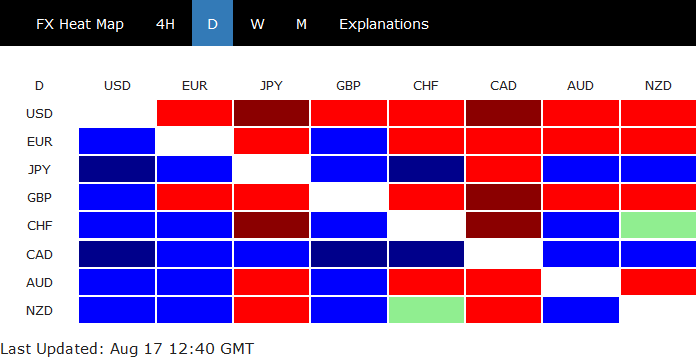
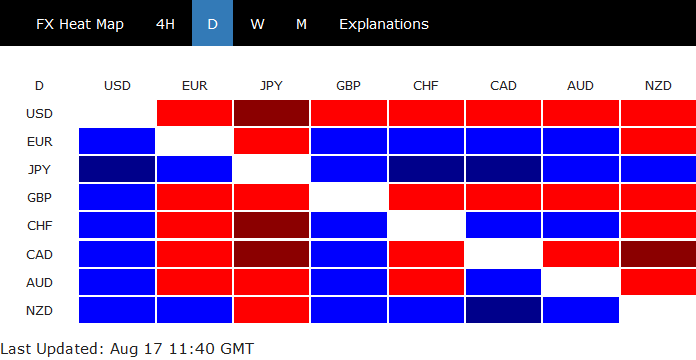
Canadian Dollar makes a massive strike back as boosted by very strong inflation reading. The Loonie is now trading as the biggest gainer for today. While Yen's no.1 place is taken, it's staying the second strongest as supported by risk aversion. Dollar is trading as the weakest one for today, but it's holding above yesterday's low against all but Yen and Canadian. Sterling follows as the second weakest one.
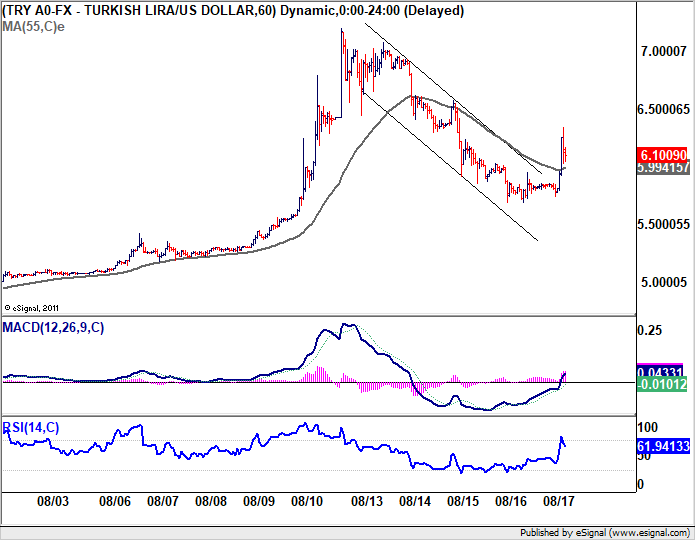
At the time of writing, FTSE is down -0.47%, DAX down -0.80% and CAC is down -0.54%. Turkish Lira is back in the spotlight on worries of further US sanction, if American pastor Andrew Brunson is not released. Also, S&P Global Ratings is set to announce a review on Turkey and another downgrade looks inevitable. USD/TRY hit as high as 6.3467 earlier today and it's now up more than 4.5% at 6.1040.
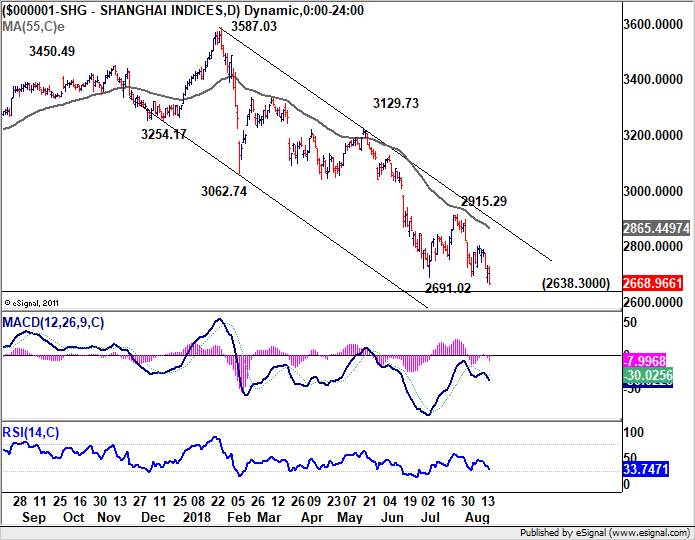
Weakness in Chinese stocks is another source of concerns for investors. Asian markets closed generally up today. Nikkei gained 0.35%, Hong Kong HSI rose 0.42%. However, the Shanghai SSE closed down -1.35% at 2668.97. The SSE has indeed broke July's low at 2691.02, and it's on course for 2638.30 (2016 low). More importantly, the selloff happened despite news of resumption of US-China trade talks. This highlights underlying vulnerable in the Chinese stocks markets. A break of 2638.30 could trigger some downside acceleration and spread to other parts markets, at least to Asia.
Canada CPI surges to 3.0% in July, a big step to October BoC hike
Canadian consumer inflation data comes in much stronger than expected. Headline CPI rose 0.5% mom, 3.0% yoy versus expectation of -0.1% mom, 2.4% yoy. It's also much stronger than June's reading of 0.1% mom, 2.5% yoy. CPI core Common was unchanged at 1.9% yoy. CPI core Median was unchanged at 2.0% yoy. CPI core Trim rose to 2.1% yoy, up from 2.0% yoy.
"While continued strength in energy prices contributed most to the year-over-year increase, higher prices for various services, including air transportation and travel tours, also contributed to consumer price growth in July," Statistics Canada said.
The strong inflation reading certainly pushes BoC a big step closer to an October rate hike.
Also from Canada, international securities transactions rose to CAD 11.5B in June versus expectation of CAD 4.9B.
Eurozone CPI finalized at 2.1%, core CPI at 1.1%
Eurozone CPI was finalized at 2.1% in July, up from June's 2.0% and compares with 1.3% a year earlier. EU CPI was finalized at 2.2% in July, up from June's 2.1%, compares with 1.5% a year earlier. Core CPI was finalized at 1.1%.
Geographically, CPI ranged from 0.8% in Greece, 0.9% in Denmark and 1.0% in Ireland, to Romania (4.3%), Bulgaria (3.6%), Hungary (3.4%) and Estonia (3.3%). CPI in Germany was at 2.1%, France at 2.6% and Italy at 1.9%. Composition-wise, highest contribution came from energy at 0.89%, services at 0.64%, food alcohol and tobacco at 0.49%.
Also from Eurozone, current account surplus narrowed to EUR 23.5B in June, below expectation of EUR 23.2B.
Australia Trade Minister Ciobo: Countries double down on trade pacts due to protectionist Trump
Australia's Trade Minister Steven Ciobo said today that the country is going to conclude free trade agreement with Hong Kong and Indonesia by the end of the year. Hong Kong is Australia's 12th largest trading partner with two-way trade at roughly AUD 16B. The two-way trade with Indonesia is at roughly the same size. And indeed, the FTA with Indonesia could come as soon as next month during Prime Minister Malcolm Turnbull's visit.
Ciobo also said that he's hopeful of signing FTA with Pacific Alliance, a Latin American trade bloc, this year. In addition, agreement with China-led Regional Comprehensive Economic Partnership could be in place too.
Ciobo added that due to Trump's protectionist rhetoric and policies, there has been a "desire from a number of countries to double down" on trade pacts. And that helps him seal deals.
RBA Lowe warned of trade tension and highly unusual US fiscal stimulus
RBA Governor Philip Lowe appeared before the House of Representatives Standing Committee on Economics today. He reiterated the three points in communications about monetary policy. Firstly, employment and inflation are "moving in the right direction". Secondly, the next move is interest rates is "to be up". Thirdly, progresses is expected to be "gradual" and there is "not a strong case for near term adjustment in interest rates.
Lowe also highlighted a few global risks. Firstly, in some countries, businesses are delaying investment due to rising trade tensions. If it become a "more general story", it's the channel through which trade tensions would "sap the current positive momentum" in the global economy.
Secondly, it's "highly unusual" for the US to have "sizeable fiscal stimulus" at a time of "limited capacity". Growth could "surprise on the upside. And Lowe is "less relaxed" than others on the implications on inflation. He warned that Fed could have to withdraw monetary accommodation "more quickly than currently projected"with possibly disruptive consequences in financial markets.
A third set of global risks are from individual economies with "country-specific structural and/or institutional vulnerabilities", including Argentina, Brazil, Italy and Turkey.
Japan manufacturers sentiment hit 7-month high, but non-manufacturing at 1.5 year low
Reuters Tankan manufacturers index rose to 30 in August, up from 25. However, the non-manufacturers index dropped sharply to 25, down from 34.
With the sharp 5 pts rise in index, manufacturer's sentiment, hit the highest level since January. Back then it was an 11-year high of 35. The index is expected to improve further in the new few months. It highlights the robustness of the manufacturing sector despite rising global trade tension and emerging markets risks.
On the other hand, services sentiments tumbled sharply by -9 to the lowest level since December 2016. It's partly due to once-off factors including abnormal whether including flood rains and heat waves. But the deterioration still indicates fragility in the sector and thus casts doubt on domestic demand. Domestic weakness could amply should there be deterioration in global trade tensions.
USD/CAD Mid-Day Outlook
Daily Pivots: (S1) 1.3123; (P) 1.3149; (R1) 1.3185; More...
UD/CAD was rejected by near term falling channel resistance and drops sharply in early US session. Nonetheless, it's staying above 1.3049 minor support and intraday bias remains neutral. While the view is looking shaky, we're still favoring that corrective pull back from 1.3385 has completed at 1.2916. Rebound from 1.2961 should extend higher and above 1.3173 will target 1.3289 resistance. However, on the downside, break of 1.3049 minor support will dampen this bullish view and turn focus back to 1.2961 low instead.
In the bigger picture, as long as channel support (now at 1.2958) holds, we're holding to the bullish view. That is, fall from 1.4689 (2015 high) has completed at 1.2061, ahead of 50% retracement of 0.9406 (2011 low) to 1.4689 (2015 high) at 1.2048. Further rally should be seen for 61.8% retracement of 1.4689 to 1.2061 at 1.3685 and above. However, sustained break of the channel support will argue that rise from 1.2061 has completed and will bring deeper fall to 1.2526 support to confirm.
Economic Indicators Update
| GMT | Ccy | Events | Actual | Forecast | Previous | Revised |
|---|---|---|---|---|---|---|
| 22:45 | NZD | PPI Input Q/Q Q2 | 1.00% | 0.20% | 0.60% | |
| 22:45 | NZD | PPI Output Q/Q Q2 | 0.90% | 0.10% | 0.20% | |
| 08:00 | EUR | Eurozone Current Account (EUR) Jun | 23.5B | 23.2B | 22.4B | 24.4B |
| 09:00 | EUR | Eurozone CPI M/M Jul | -0.30% | 0.10% | 0.10% | |
| 09:00 | EUR | Eurozone CPI Y/Y Jul F | 2.10% | 2.00% | 2.00% | |
| 09:00 | EUR | Eurozone CPI Core Y/Y Jul F | 1.10% | 1.10% | 1.10% | |
| 12:30 | CAD | International Securities Transactions (CAD) Jun | 11.5B | 4.91B | 2.18B | 3.0B |
| 12:30 | CAD | CPI M/M Jul | 0.50% | -0.10% | 0.10% | |
| 12:30 | CAD | CPI Y/Y Jul | 3.00% | 2.40% | 2.50% | |
| 12:30 | CAD | CPI Core - Common Y/Y Jul | 1.90% | 1.90% | ||
| 12:30 | CAD | CPI Core - Median Y/Y Jul | 2.00% | 2.00% | ||
| 12:30 | CAD | CPI Core - Trim Y/Y Jul | 2.10% | 2.00% | ||
| 14:00 | USD | Leading Index Jul | 0.40% | 0.50% | ||
| 14:00 | USD | U. of Mich. Sentiment Aug P | 98.1 | 97.9 |
Canadian Dollar soars as CPI hit 3%
Canadian consumer inflation data comes in much stronger than expected. And the Loonie soars.
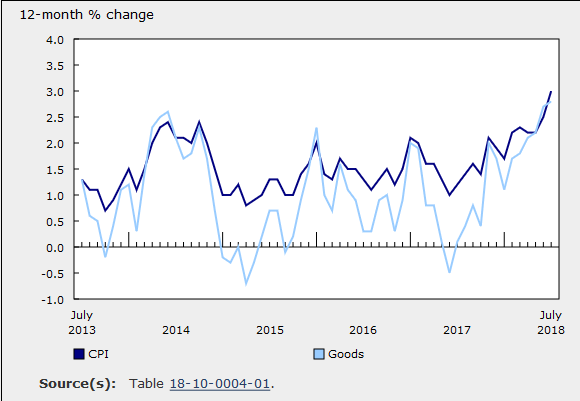
Headline CPI rose 0.5% mom, 3.0% yoy versus expectation of -0.1% mom, 2.4% yoy. It's also much stronger than June's reading of 0.1% mom, 2.5% yoy.
CPI core Common was unchanged at 1.9% yoy. CPI core Median was unchanged at 2.0% yoy. CPI core Trim rose to 2.1% yoy, up from 2.0% yoy.
"While continued strength in energy prices contributed most to the year-over-year increase, higher prices for various services, including air transportation and travel tours, also contributed to consumer price growth in July," Statistics Canada said.
Also from Canada, international securities transactions rose to CAD 11.5B in June versus expectation of CAD 4.9B.
So now, is an Oct BoC hike a done deal?
GBPUSD Sterling On The Defensive Below 1.2700
The British pound continues to trade to the downside against the US dollar on Friday, after being strongly rejected from the 1.2750 level. The GBPUSD pair is likely to weaken further if the 1.2700 support level is broken during the last trading session of the week. The sentiment towards the British pound remains weak today after reports surfaced that UK Conservative party are taking extra steps to prepare for a Brexit no-deal scenario.
The GBPUSD pair is bearish while trading below the 1.2700 level, key support is found at the 1.2665 and 1.2610 levels.
If the GBPUSD pair moves above the 1.2750 level, key intraday resistance is found at the 1.2800 and 1.2830 levels.

EURUSD Further Bullish Above 1.1430
The euro currency is once again trading above the 1.1400 resistance level against the US dollar, as the recovery from the 1.1300 level gathers pace. The EURUSD pair is likely to advance further if the 1.1430 level is broken, it remains a key area that traders have struggled with this week. A bullish inverted head and shoulders pattern is also clearly visible across the lower time frames.
The EURUSD pair is bullish while trading above the 1.1430 level, key resistance is found at the 1.1480 and 1.1507 levels.
If the EURUSD pair moves below the 1.1400 level key support is found at the 1.1370 and 1.1335 levels.

Into US session: Yen strong again as Turkish Lira drops 5%, Chinese stocks hit new low
Entering into US session, Yen is now back trading as the strongest one as markets seem to have turned back to risk off-mode. More time is needed to confirm this but sentiments are once again looking shaky.
At the time of writing, FTSE is trading down -0.17%, DAX down -0.42% and CAC down -0.14%.
Turkish Lira comes back to spotlight with another -5% decline. The trigger is concerns of mores sanction from the US if American pastor Andrew Brunson is not released. The question for us is, in today's world, whether economic war is considered war. And if yes, then are tariffs and sanctions considered weapons? If the POTUS needs to go through a process, with check and balance, to hit the nuclear button, what does he need to go through to fire an "economic missile"? So far, it seems there is no mechanism to control a dictator in the US to attack another country, even a NATO ally, in the economic sense and cause massive damages and casualties. It's a big threat to the world. Anyways.
Weakness in Chinese stocks is another concerns for investors. Asian markets closed generally up today. Nikkei gained 0.35%, Hong Kong HSI rose 0.42%. However, the Shanghai SSE closed down -1.35% at 2668.97. The SSE has indeed broke July's low at 2691.02, and it's on course for 2638.30 (2016 low). There is no sign of bottoming by market force, nor there is any sign of government intervention. And more importantly, the selloff happened despite news of resumption of US-China trade talks. This highlights underlying vulnerable in the Chinese stocks markets. A break of 2638.30 could trigger some downside acceleration and spread to other parts markets, at least to Asia.
Euro Steady As Eurozone CPI Meets Expectations
EUR/USD is showing little movement in the Friday session. Currently, the pair is trading at 1.1382, up 0.07% on the day. In economic news, Eurozone Final CPI improved to 2.1%, matching the estimate. The eurozone current account surplus widened to EUR 23.5 billion, above the estimate of EUR 23.2 billion. In the U.S, the key event is Preliminary UoM Consumer Sentiment, which is expected to improve to 98.1 points.
There were no surprises from eurozone inflation readings in July, as Final CPI and Final Core CPI both matched expectations. Final CPI came in at 2.1%, edging above the 2.0% gain in June. Final Core CPI followed the same trend, with a gain of 1.1%, compared to 0.9% in June. Inflation remains well below the ECB target of just below 2.0%, so there is no pressure on the ECB to raise interest rates. The focus remains on the ECB’s asset-purchase program, which is expected to wind up in December.
The euro has endured a rough August, losing 2.7 percent in that time. Weak growth in the eurozone and trade tensions with the U.S have affected investor sentiment, and the euro has struggled as a result, trading this week at 14-month lows against a strong U.S dollar. However, the euro’s fortunes could improve, with news that the U.S and China will be holding trade talks. The negotiations will be handled by low-level officials and are being billed as ‘talks about talks’. Still, the fact that the two sides are talking rather than slapping tariffs against each other should raise risk appetite and give the euro a boost.
Euro Bounce Fades, Canadian Inflation Prints Pending
Here are the latest developments in global markets:
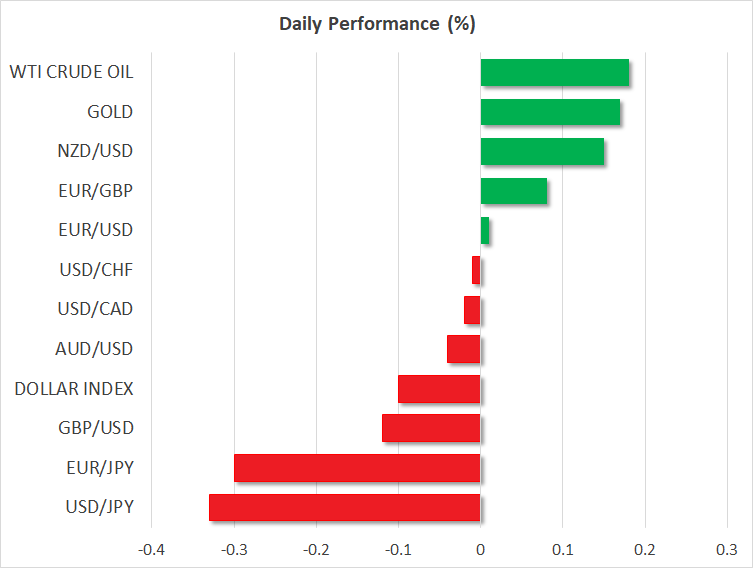
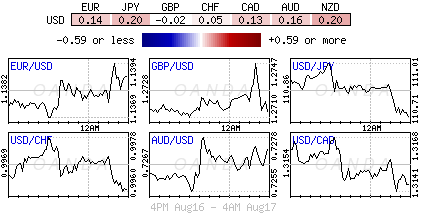
FOREX: The dollar index – which gauges the greenback’s strength against six major currencies – remained negative (-0.10%), though it pared most of its earlier losses, aided by a return of risk-off tones in markets. Dollar/yen moved down by 0.33% and held below the bearish cross of the 20- and 40-day simple moving averages (SMAs). In the euro area, the annual inflation rate was confirmed at 2.1% in July, above June’s 2.0%. Euro/dollar rose by 0.04% today, but held below the intraday high of 1.1419, giving back most of its gains from earlier in the session as attention diverted back to the situation in Turkey. Pound/dollar is set to post the sixth red week in a row and on Friday, it stood near the 14-month low of 1.2660 (-0.10%) hit earlier in the week. In the antipodean sphere, aussie/dollar dropped by 0.03% at 0.7258, while kiwi/dollar climbed by 0.17% at 0.6592. Dollar/loonie was steady near its opening level of 1.3154. Meanwhile, dollar/lira surged by 5.00% at 6.1100.
STOCKS: European equities were negative on Friday as the market remained cautious about the situation in Turkey, with the Turkish lira sliding again during the European session. The pan-European STOXX 600 and the blue-chip Euro STOXX 50 were down by 0.28% and 0.31% respectively. The German DAX 30 dropped by 0.33%, the French CAC 40 fell by 0.18%, while the Italian FTSE MIB plummeted by 1.03%. UK’s FTSE 100 dropped by 0.19%. In the US, futures tracking the major stock indices (Dow Jones, S&P 500, Nasdaq 100) were pointing to a negative open.
COMMODITIES: Oil prices headed higher today, supported by optimism that the US-China trade dispute may deescalate moving forward, hence brightening the outlook for oil demand. West Texas Intermediate (WTI) crude oil has moved higher since yesterday after the rebound from the almost 2-month low of $64.54 (+0.12%) per barrel. Also, Brent advanced by 0.31% and is approaching the $72.00/barrel handle. In precious metals, gold prices edged higher by 0.18% after posting a doji candle yesterday, reaching a 20-month low of $1,159.96.
Day ahead: Canadian inflation figures the highlight
The main data release on Friday will be inflation figures out of Canada. The University of Michigan (U of M) survey gauging US consumer confidence may also attract some attention. Beyond economic data, any remarks on Brexit from the relevant negotiators will be closely eyed, as will any developments in the US-China trade standoff and the Turkish saga.
At 1230 GMT, Canadian inflation numbers for July will be in the spotlight. The nation’s CPI rate is projected to have held steady at an elevated 2.5% in yearly terms, while no forecast is available for the core print, which excludes food and energy items; it stood at 1.3% in June. Indeed, gauges of inflationary pressures were optimistic during the month, with the nation’s Markit manufacturing PMI noting that prices charged for final products rose at the highest pace since the survey began in 2010. While another quarter-point rate hike by the BoC this year is practically fully priced in according to Canada’s OIS, a potential upside surprise in the CPIs could still stoke speculation for two more rate increases by year-end and thereby, benefit the loonie.
In the US, the preliminary U of M survey for August will be made public at 1400 GMT. Consumers are expected to have turned more optimistic during the month, with the relevant index projected to move slightly higher. Note though, this is usually not a major market mover for the dollar.
The situation in Turkey will likely remain at the forefront for a while more, even despite some signs of stabilization in recent days. The US Treasury threatened the nation with more sanctions yesterday, should Turkey not release pastor Brunson “quickly”. Beyond the political standoff with the US, investors will also look to a reassessment of Turkey’s credit rating by Standard and Poor’s today. The nation’s bonds are already rated as junk, but should the agency cut their rating even further, the lira could still come under renewed selling interest.
In energy markets, the weekly Baker Hughes survey tracking the number of active US oil rigs will be in focus at 1700 GMT.
Turkish Lira Rally Halted On U.S Sanctions Threat
Friday August 17: Five things the markets are talking about
Global trade worries have not disappeared, they are just on hiatus, as market participants prefer to regroup and strategize in this unorthodox U.S trade and foreign policy environment.
Emerging market worries are not going away any time soon. They continue to straddle in bear market territory. U.S Treasury Secretary Mnuchin stated Thursday that Turkey would face more sanctions if the country did not release a detained American pastor and coupled with a weeklong Turkish public holiday, beginning Monday, should provide further EM market volatility.
For now, the possibility of a Sino-U.S trade deal has brought some calm to the market, but trade and currency wars remain to the fore.
Euro equities opened in the ‘black,’ but trade under pressure, after Asian bourses closed out a volatile week on a positive note. Both the U.S dollar and Treasuries trade steady.
For the Loonie (C$1.3136), following a relatively quiet week on the data front, this morning’s inflation numbers (08:30 am EDT) should provide some direction, though actual will need to be better than forecast for the CAD to get support.
After last Friday’s employment numbers where Canada added a net +54.1K jobs in July on a seasonally adjusted basis and an unemployment rate ticking down to +5.8% adds to the probability that the Bank of Canada (BoC) will hike the benchmark interest rate one more time in 2018.
Don’t expect the BoC to stray too far away from the Fed’s rate normalization plan. Include any positives on Nafta and like the Mexican peso, the loonie will roll.
1. Asian shares gain on Sino-U.S trade talks
In Japan, the Nikkei rallied overnight on hopes that talk between China and the U.S next week (Aug 21 & 22) would ease trade tensions. The Nikkei share average ended +0.4% higher, while the broader Topix added +0.6%.
Note: The two largest economies are due to implement tariffs on billions of dollars of each other’s goods on Aug. 23, in addition to taxes that took effect on July 6.
Down-under, Aussie shares rallied overnight, supported by financials and stronger earnings. The S&P/ASX 200 index closed +0.2% higher. The benchmark closed unchanged on Thursday and recorded a weekly gain of about +1%. In S. Korea, the Kospi stock index ended higher on China-U.S trade talk news. The Kospi was up +0.28%. For the week, the benchmark index tumbled -1.6%, marking its biggest weekly loss since five-weeks.
In China, shanghai stocks closed of their 31-month low overnight, dragged down by a slump in healthcare firms amid vaccine scandal fallout. The blue-chip CSI300 index ended -1.5% down at 3,229.62 points, while the Shanghai Composite Index closed down -1.3%. In Hong Kong, the Hang Seng Index, down for a fifth consecutive session Thursday, gained +0.42% as tech stocks recovered.
In Europe, regional bourses trade sideways, however, the potential of renewed Sino-U.S talks is helping risk sentiment going into the weekend, but the treat of further Turkey sanctions will sour investor risk appetite.
U.S stocks are set to open unchanged (+0.0%).
Indices: Stoxx50 -0.1% at 3,379, FTSE flat at 7,555, DAX -0.1% at 12,226, CAC-40 +0.2% at 5,357; IBEX-35 -0.1% at 9,419, FTSE MIB -0.5% at 20,421, SMI +0.2% at 9,017, S&P 500 Futures flat
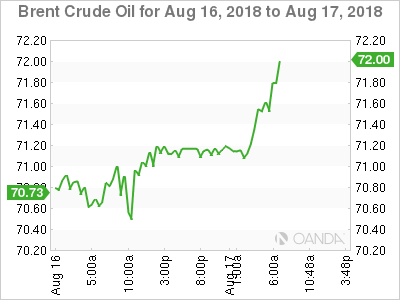
2. Oil prices slip on global economic worries
Oil prices have eased a tad in overnight trading, with U.S crude heading for a seventh-weekly decline amid market concerns about slowing global growth that could hit demand as U.S inventories build.
Brent crude oil is down -9c at +$71.34 a barrel, while U.S West Texas Intermediate (WTI) crude has fallen -5c to +$65.41 a barrel.
Note: Brent is heading for a -2% decline this week, a third consecutive weekly drop, while WTI is on track for a seventh week of losses, with a fall of more than -3%.
EIA data this week showed that output of U.S crude rose by +100K bpd in the week ending Aug. 10, to +10.9M bpd. At the same time, U.S crude inventories climbed by +6.8M barrels, to +414.19M barrels.
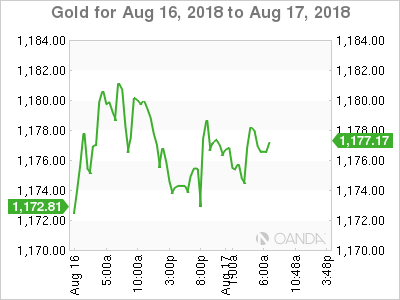
Ahead of the U.S open, gold prices are small better bid, nevertheless, the yellow metal is set for its biggest weekly fall in 15-months.
Spot gold is up +0.1% at +$1,175.22 an ounce, while U.S gold futures are down -0.2% at +$1,181.30 an ounce.
For the week, spot gold has shed -2.9%, its sixth consecutive weekly decline. It hit its lowest since January 2017 at +$1,159.96 yesterday on some aggressive stop-loss selling.
3. CBRT average cost of funding to rise to rise
The Central Bank of the Republic of Turkey (CBRT) cost of funding will rise to +19.25% today, from +18.14% on Thursday, after the bank did not open a repo auction for the second consecutive day.
The current weekly repo rate is at +17.75%, but the CBRT has decided not to fund the market at that rate due to “unhealthy price formations and excessive fluctuations in the market” during this currency crisis that has seen the TRY crash to a record low ($7.24).
In a speech overnight down-under, RBA Governor Lowe indicated that the domestic economy is moving in the right direction. He reiterated the view that he expected the next move in interest rates is to be up, but the board’s view is likely to hold rates steady for a while yet. The most likely trigger for a rate cut would be ‘China shock’ and he still believed that a lower AUD (A$0.7263) would be helpful.
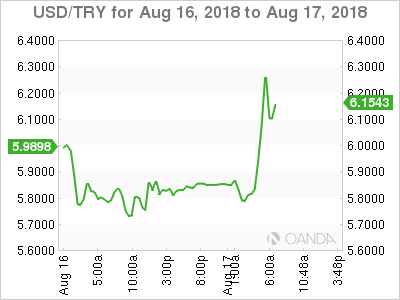
4. USD/TRY – TRY rally halted
The USD was a tad softer overnight vs. the Turkish lira, but that fall has since halted ahead of the U.S open (+$6.3056 up +8%) on fear of further U.S sanctions to be imposed on Turkey. Other EM currencies (ZAR, RUB, IDR and INR) are again under pressure.
The Turkish government announced a number of measures yesterday – will curb FX funding, will review Turkey’s investment portfolio and will not compromise fiscal discipline. Are these short-term fixes?
Turkey is preparing for a week-long public holiday beginning mid-day Monday.
Note: TRY plunged to a record low of $7.24 at the beginning of the week as a worsening of relations between Turkey and the U.S added to losses driven by concerns over President Erdogan’s influence over the CBRT.
The EUR/USD (€1.1382) is slightly higher in the session and hovers within striking distance of the psychological €1.14 level, supported by this morning’s Eurozone July final CPI reading (see below).
China guided the yuan +0.1% stronger outright after a string of lower fixes. The PBoC put today’s reference rate at ¥6.8894, vs. ¥6.8946 on Thursday. The yuan rose as much as +0.4% yesterday before ending at ¥6.8960. Expect the U.S to pressure China to lift the yuan at next week’s talks.
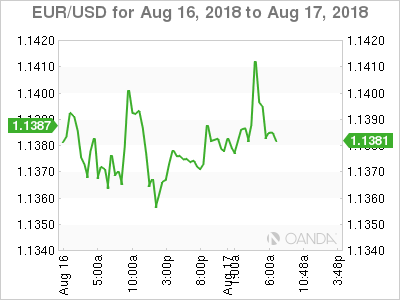
5. Eurozone July final CPI stays above the ECB target
Data from Eurostat this morning showed that the eurozone annual inflation rate was +2.1% in July 2018, up from +2.0% in June 2018. A year earlier, the rate was +1.3%.
E.U annual inflation was +2.2% in July 2018, up from +2.1% in June. A year earlier, the rate was +1.5%.
The lowest annual rates were registered in Greece (0.8%), Denmark (0.9%) and Ireland (1.0%). The highest annual rates were recorded in Romania (4.3%), Bulgaria (3.6%), Hungary (3.4%) and Estonia (3.3%).
Euro Zone July Final CPI Stays Above The ECB Target
Notes/Observations
- Euro Zone July Final CPI stayed above the ECB target but is it sustainable?
- Turkish Lira trying to eek out a 5th day of gains but faces headwinds as govt action appears to have larger implications down the road
Asia:
- South Korea Fin Min Kim: Government to employ all available policy tools to counter slow job growth; gov't had 'grave' concerns with the sluggish job market
- RBA Gov Lowe: Domestic economy moving in the right direction; reiterated view that expected the next move in interest rates to be up, board's view likely to hold rates steady for a while yet. The most likely trigger for a rate cut would be 'China shock'. Still believed that s lower Australian dollar currency (AUD) would be helpful
Europe:
- EU Dombrovkis says EU Capital Markets Union plan could be delayed
Americas:
- Fed Chair Powell to speak on Friday, Aug 24 at Jackson Hole conference; topic is 'monetary policy in a changing economy'
- Treasury Sec Mnuchin reiterated that further Turkey sanctions were being prepared if Pastor Brunson was not released
- Trade Rep Lighthizer: hopes to have a breakthrough in NAFTA discussion in next few days
Energy:
- US Sec of State Pompeo named Brain Hook as new special Iran representative; hoped one day soon to reach agreement with Iran
Economic Data:
- (AT) Austria July CPI M/M: -0.2% v +0.2% prior; Y/Y: 2.1% v 2.0% prior
- (TR) Turkey Aug Consumer Confidence: 68.3 v 73.1 prior (lowest level since Dec)
- (CN) Weekly Shanghai copper inventories (SHFE): 155.1K v 171.1K tons prior
- (EU) Euro Zone Jun Current Account (Seasonally Adj): €24.0B v €24.0B prior
- (IT) Italy Jun Current Account: €5.1B v €2.4B prior
- (PL) Poland July Employment M/M: 0.1% v 0.2%e; Y/Y: 3.5% v 3.6%
- (PL) Poland July Average Gross Wages M/M: -0.5% v -0.2%e; Y/Y: 7.2% v 7.6%e
- (RU) Russia Narrow Money Supply w/e Aug 10th: 10.35T v 10.25T prior
- (TW) Taiwan Q2 Final GDP Y/Y: 3.3% v 3.3%e
- (IT) Italy Jun General Government Debt: €2.323T v €2.327T prior
- (HK) Hong Kong July Unemployment Rate: 2.8% v 2.8%e (matched lowest level since Jan 1998)
- (EU) Euro Zone July Final CPI Y/Y: 2.1% v 2.1%e; CPI Core Y/Y: 1.1% v 1.1%e (2nd month above ECB target
Fixed Income Issuance:
- None seen
SPEAKERS/FIXED INCOME/FX/COMMODITIES/ERRATUM
Equities
- Indices [Stoxx50 -0.1% at 3,379, FTSE flat at 7,555, DAX -0.1% at 12,226, CAC-40 +0.2% at 5,357; IBEX-35 -0.1% at 9,419, FTSE MIB -0.5% at 20,421, SMI +0.2% at 9,017 , S&P 500 Futures flat]
- Market Focal Points/Key Themes: European indices open largely flat and maintained direction as the session progressed; potential of renewed US-China talks helping risk sentiment going into the weekend; telecom and utilities among better performing sectors; materials on the backfoot following slip in commodity prices; chip stocks including STMicroelectronics under pressure following weak forecast from Applied Materials; Atlantia recovering after Italian government divided over how to respond to Genoa bridge collapse, with Deputy PM Salvini reportedly negotiating a fine of €500M against Autostrade; earnings expected in the upcoming US session include Deere, The Cato and Zoe's Kitchen
Equities
- Consumer discretionary: Air France-KLM AF.FR -3.1% (new CEO, analyst action), Rovio Entertainment ROVIO.FI +3.3%(results)
- Financials: Royal Bank of Scotland RBS.UK +0.3% (CFO steps down)
- Energy: Gazprom Neft SIBN.RU +1.7% (results)
- Industrials: Atlantia ATL.IT +6.0%(expected to hold board meeting), Golden Ocean GOGL.NO +3.4%(results), Maersk MAERSK.BE +2.9% (results), Peab PEABB.SE +9.6% (results), Schindler SCHP.CH +0.8% (results)
- Real estate: Vopak VPK.NL -6.5% (results)
Speakers
- Italy's Deputy PM Salvini said to be seeking €500M fine from Autostrade due to the recent bridge collapse in Genoa
- Turkey Govt announced new measures for banks and companies to mitigate the economic attack on the country in which loan channels would remain open for the real sector and no extra collateral to be demanded on any TRY currency (TRY) declined
- Hungary Central Bank's Nagy: Domestic corporate FX debt was not a risk. he decline in Govt FX debt had made Hungary less vulnerable
- RBA’s Ellis: Wage growth could be slow to tighter job market
- Thailand Fin Min Apisak stated that saw signs of improvement in all aspects of Q2 GDP (**Note: Q2 GDP data set for release on Monday, Aug 20th)
Currencies
- The USD was marginally softer as the Turkish lira continued to show signs of some stabilization. The Turkish govt had announced measures in recent sessions but some analyst ponder that the moves that appear to be working in the short term would remove the ability of foreigners to hedge against Turkish lira weakness and curb investment flows into the country. As the NY morning approached the TRY was on some soft footing (along with other emerging market currencies)
- The EUR/USD was slightly higher in the session and hovered around the 1.14 level as some position traders covered euro short positions. The Euro Zone July final CPI reading stayed above ECB target of around 2% the for the 2nd straight month and keeping the timeline intact for now of the 1st possible rate hike after summer 2019.
Looking Ahead
- 05:30 (ZA) South Africa to sell ZAR600M in I/ L 2029, 2033 and 2050 bonds
- 06:00 (UK) DMO to sell €5.5B in 1-month, 3-month and 6-month bills (£2.0B, £2.0B and £1.5B respectively)
- 06:45 (US) Daily Libor Fixing
- 07:00 (BR) Brazil Aug IGP-M Inflation (2nd Preview): 0.7%e v 0.5% prior
- 07:30 (TR) Turkey Jun Central Bank TCMB Survey of Expectations
- 07:30 (IN) India Weekly Forex Reserves
- 08:15 (UK) Baltic Dry Bulk Index
- 08:30 (CA) Canada July CPI M/M: 0.1%e v 0.1% prior; Y/Y: 2.5%e v 2.5% prior, CPI Core- Common Y/Y: 2.0%e v 1.9% prior, CPI Core- Median Y/Y: No est v 2.0% prior, CPI Core- Trim Y/Y: No est v 2.0% prior, Consumer Price Index: No est v 133.6 prior
- 08:30 (CA) Canada Jun Int'l Securities Transactions (CAD): No est v 2.2B prior
- 08:30 (US) July Philadelphia Fed Non-Manufacturing General Regional Business Conditions: No est v 39.1 prior
- 09:00 (RU) Russia July Unemployment Rate: 4.7%e v 4.7% prior; Real Disposable Income: 0.5%e v 0.2% prior; Real Wages Y/Y: 7.0%e v 7.2% prior
- 09:00 (RU) Russia July Real Retail Sales Y/Y: 3.0%e v 3.0% prior
- 09:00 (RU) Russia July PPI M/M: 1.1%e v 3.4% prior; Y/Y: 17.4%e v 16.1% prior
- 10:00 (US) Aug Preliminary University of Michigan Confidence: 98.0e v 97.9 prior
- 10:00 (US) July Leading Index: 0.4%e v 0.5% prior
- 11:00 (EU) Potential Sovereign ratings after European close (Hungary and Turkey Sovereign Debt to be rated by S&P; Russia Sovereign Debt to be rated by Fitch; Egypt Sovereign Debt to Be Rated by Moody's
- 13:00 (US) Weekly Baker Hughes Rig Count data