

Sample Category Title
Japanese Yen Dips, BoJ Removes Inflation Timeframe
The Japanese yen has lost ground in the Monday session, erasing the gains which marked the Friday session. In North American trade, USD/JPY is trading at 109.39, up 0.31% on the day. On the release front, key US indicators were mixed. Personal Spending improved to 0.4%, matching the forecast. This marked a 3-month high. The news was not as positive from the housing sector, as Pending Home Sales dropped to 0.4%, down sharply from 3.1% in the previous release. Later in the day, Japanese Final Manufacturing PMI is expected to edge up to 53.3 points. On Tuesday, the key event is ISM Manufacturing PMI.
On Friday, the Bank of Japan maintained its monetary policy but surprised the markets by ditching its target timeframe for reaching its inflation target. Governor Haruhiko Kuroda stated that the removal of the timeframe would prevent market speculation on additional easing each time the BoJ pushed back the timeframe for reaching its inflation goal. The bank has pushed back its inflation timeframe six times, due to weak inflation. In his remarks, Kuroda said that the reluctance of the business sector to raise wages continued to hamper the inflation outlook. In its quarterly review, the bank projected an inflation rate of 1.8% in fiscal 2019.
US indicators ended the week with the first GDP report for the first quarter. Advance GDP posted a respectable gain of 2.3% which beat the estimate of 2.0 percent. Still, this was a significant drop from GDP in the fourth quarter of 2018, which came in at 2.8 percent. Analysts also took note of the Employment Cost Index, which rose from 0.6% to 0.8%, another indication that inflation is moving higher. There is growing sentiment that the Federal Reserve will raise interest rates four times this year, although Fed policymakers continue to project a total of three increases in 2018. One scenario envisions the Fed raising rates once each quarter until the economy shows signs of slowing down. If inflation continues to move higher and economic conditions remain strong, the US dollar could continue to make headway against its major rivals, including the Japanese yen.
GBPAUD Retreats after Steep Losses; Holds in Consolidation Area in Near Term
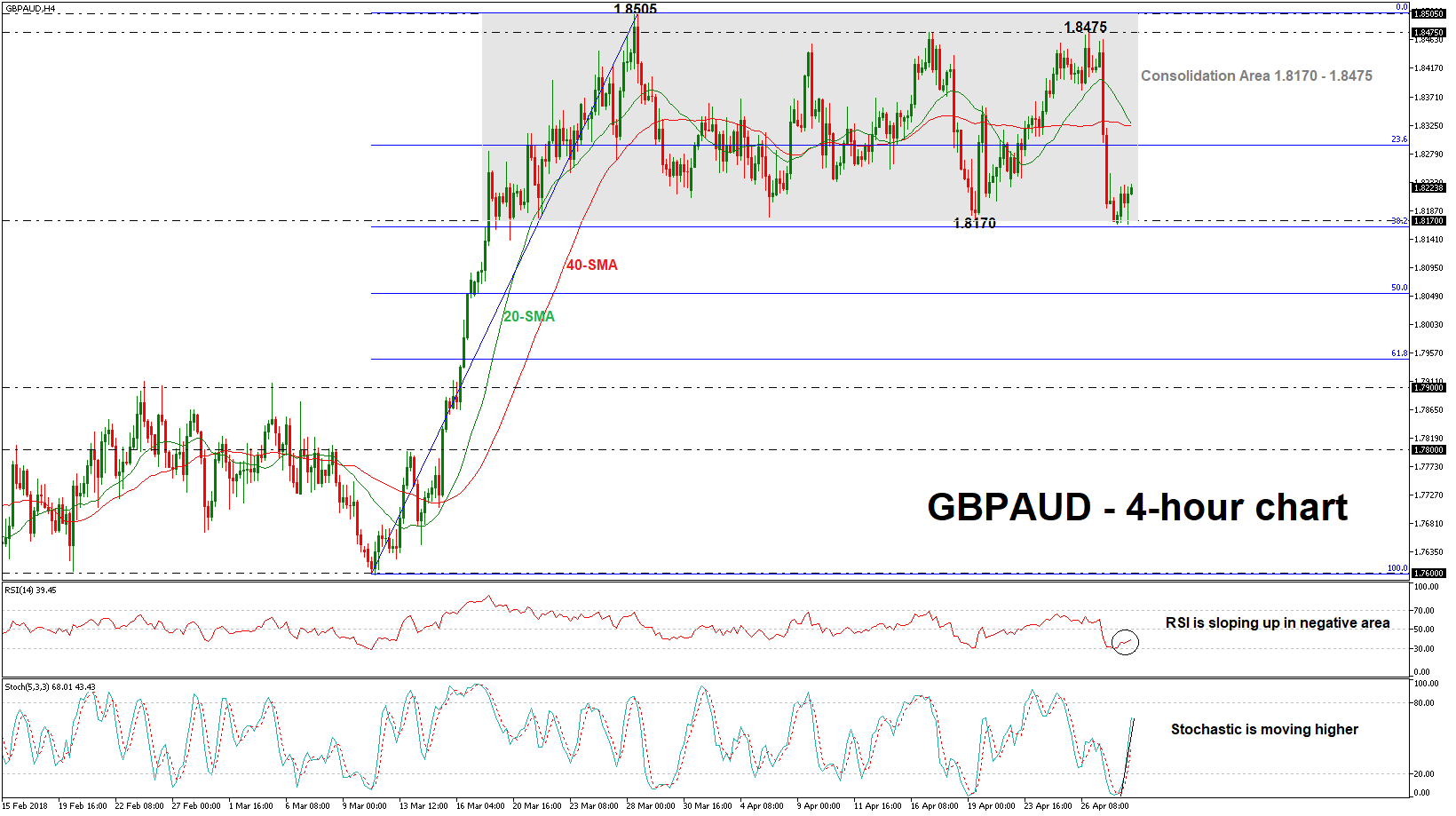
GBPAUD edged sharply lower over yesterday's trading session and touched the 1.8170 support level. The pair has been holding within a sideways channel since March 19 with upper boundary the 1.8475 resistance level and lower boundary the 1.8170 support, which coincides with the 40-day simple moving average. In the short-term, the technical indicators turned their momentum to positive.
Momentum indicators are pointing up in the short term, although the RSI remains in the negative zone. The stochastic oscillator is moving higher, suggesting an upside reversal is nearing. The 20-SMA is ready for a bearish cross with the 40-SMA, acting as a significant barrier on the upside.
If price action remains above the lower boundary, there is scope to test the 20- and 40-SMAs near 1.8325 in the 4-hour chart. This is considered to be a strong resistance area while clearing this level would see additional gains towards the upper boundary of 1.8475. In case of an upward penetration of the channel, this would open the way towards 1.8505.
On the flip side, a move to the downside and a break of the consolidation area could see the next support of 50.0% Fibonacci retracement level around 1.8050 of the upleg from 1.7600 to 1.8505. A stronger barrier thought, could be found at the 61.8% Fibonacci of 1.7950.
EUR/USD Mid-Day Outlook
Daily Pivots: (S1) 1.2078; (P) 1.2105 (R1) 1.2156; More....
EUR/USD is staying above 1.2054 temporary low and intraday bias remains neutral. More consolidation could be seen. But in case of another rise, upside should be limited by 1.2214 support turned resistance to bring another decline. Below 1.2054 will target 161.8% projection of 1.2475 to 1.2214 from 1.2413 at 1.1991 first. Break will target 200% projection at 1.1891.

In the bigger picture, current decline and firm break of 1.2154 support confirms rejection by 38.2% retracement of 1.6039 (2008 high) to 1.0339 (2017 low) at 1.2516. A medium term top should be in place at 1.2555 and deeper decline would be seen back to 38.2% retracement of 1.0339 to 1.2555 at 1.1708 first. We'll look at the structure and momentum of such decline before decision if it's an impulsive or corrective move.

USD/CHF Mid-Day Outlook
Daily Pivots: (S1) 0.9859; (P) 0.9890; (R1) 0.9908; More...
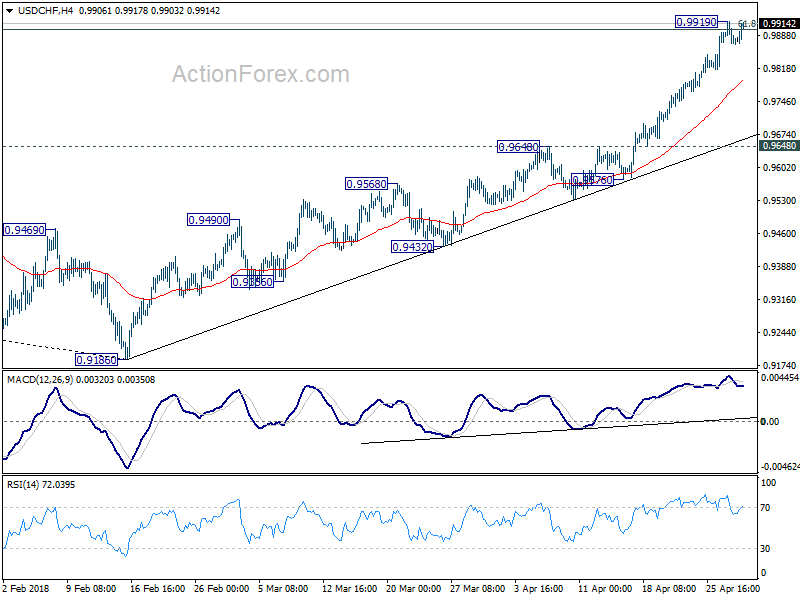
USD/CHF is staying below 0.9919 temporary top. Consolidation from there might extend and intraday bias stays neutral. . Deeper retreat could be seen after hitting 0.9900 fibonacci resistance. But downside should be contained above 0.9648 resistance turned support and bring another rally. Above 0.9919 will target 1.0037 resistance next.
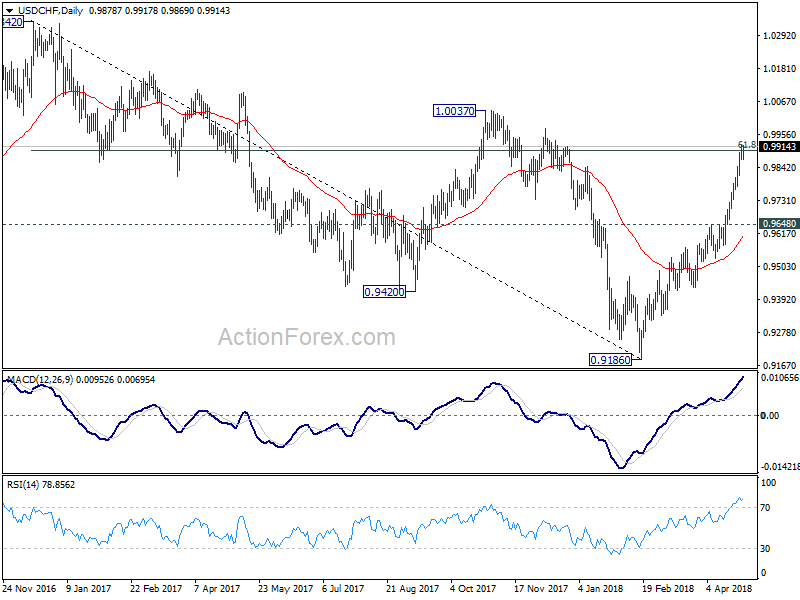
In the bigger picture, medium term decline from 1.0342 has completed with three waves down to 0.9186. Rise from there is currently viewed as a leg inside the long term range pattern. Hence, while further rally would be seen, we'd be cautious on strong resistance from 1.0342 to limit upside. For now, further rise is expected as long as 0.9648 resistance turned support holds, even in case of pull back.
USD/JPY Mid-Day Outlook
Daily Pivots: (S1) 108.79; (P) 109.16; (R1) 109.42; More...
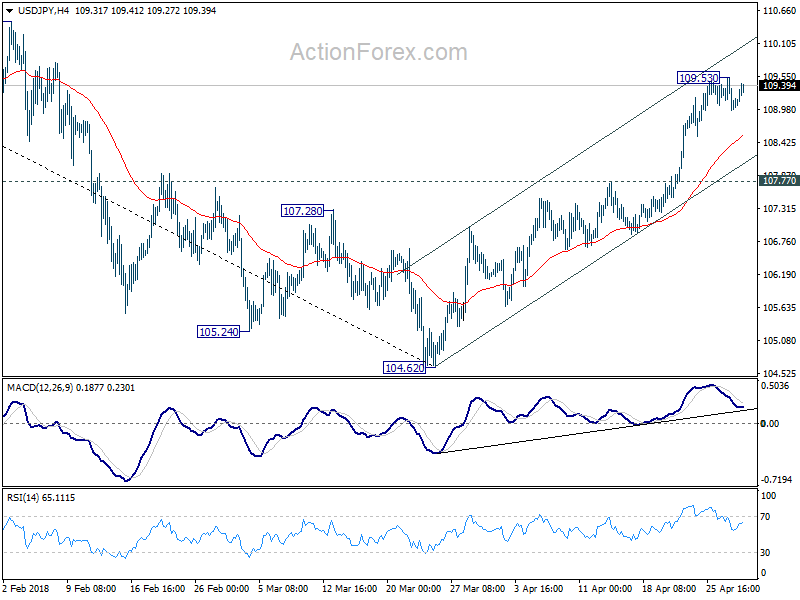
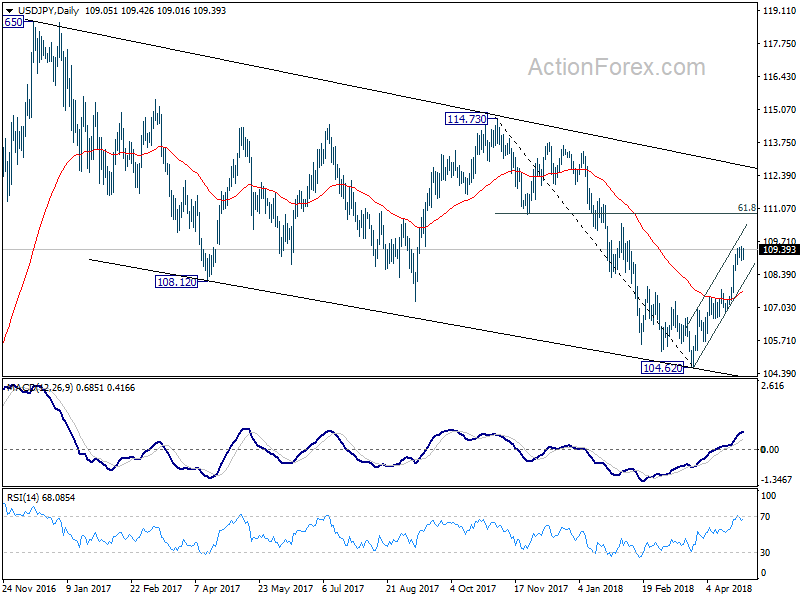
USD/JPY's consolidation from 109.53 temporary top is still in progress and intraday bias remains neutral. Another fall cannot be ruled out as the consolidation extends. But downside should be contained by 107.77 resistance turned support to bring another rally. Break of 109.53 will resume the rise from 104.62 and target 61.8% retracement of 114.73 to 104.62 at 110.86 next.
In the bigger picture, break of 108.12 support turned resistance now suggests that corrective fall from 118.65 (2016 high) has completed with three waves down to 104.62. And, rise from 98.97 (2016 low) could be resuming. Focus is back on 114.73 resistance and break there will pave the way to 118.65 and above. This will now be the preferred case as long as USD/JPY stays above 55 day EMA (now at 107.60).
US: Consumer Spending Bounces Back in March as Inflation Hits 2.0%
Personal income rose 0.3% in March, a hair below expectations for 0.4%. Adjusted for inflation and removing taxes, real disposable income was up 0.2% in the month.
Personal spending rose a robust 0.4% in both real and nominal terms in March, as month-on-month price growth was roughly flat. All major components rebounded in March, with real durable goods leading the way (up 1.1%) and non-durable goods and services both up 0.3%.
Price growth in the month was held down by energy prices, which fell 2.8%in March. Still, headline inflation rose to 2.0% year-on-year, hitting the Fed's target for the first time in a year. Core inflation, meanwhile, rose 0.2% (month-on-month) in March, taking core inflation to 1.9% (year-on-year), its highest reading since January 2017.
The personal saving rate fell two ticks to 3.1%, from a downwardly revised 3.3% in February.
Key Implications
March's strong spending outturn makes up for the pullbacks in February and January, and sets the second quarter up nicely. With tax cuts continuing to support income, we expect to see spending bounce back soundly, bringing real GDP growth along with it.
Inflation continues to gain traction. Services inflation, in particular, is notable, rising to 2.8% year-on-year – its highest level in nearly a decade. Soft services price growth has been a key reason for inflation's relative underperformance in the post-recession period, and its re-acceleration suggests that the days of serially-disappointing price growth are numbered.
The acceleration in spending alongside faster inflation will be a point of conversation as the Federal Open Market Committee meets this week to deliberate on interest rates. While the Fed is unlikely to raise the fed funds rate at this meeting, it will set the stage for an increase at its meeting in June.
GBPUSD – Bears Met Target at 1.3711 But Without Break Lower for Now
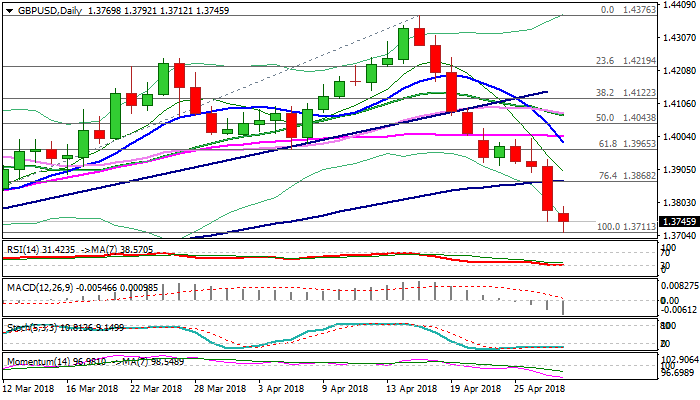
Cable extended weakness on Monday and eventually tested target at 1.3711 on Monday, marking full retracement of 1.3711/1.4376 bull-phase. The price bounced after touching 1.3711 target, signaling strong support, where bears may show stronger hesitation. Deeply oversold slow stochastic is moving sideways on daily chart, lacking firmer bullish signal and keeping bears firmly in play for probe through 1.3711 and test of another strong supports at 1.3655/50 (former high of 17 Sep / bull-trendline of 2016 low, hit after post-Brexit vote bearish acceleration). Firm break of 1.3711 pivot is also needed to complete double-top pattern on weekly chart and signal further weakness. Meanwhile, stronger upticks are expected to run out of steam on approach to broken 100SMA at 1.3870, to keep intact firm near-term bearish structure.
Res: 1.3792; 1.3840; 1.3870; 1.3901
Sup: 1.3711; 1.3650; 1.3613; 1.3549
GBP/USD Mid-Day Outlook
Daily Pivots: (S1) 1.3703; (P) 1.3819; (R1) 1.3891; More...
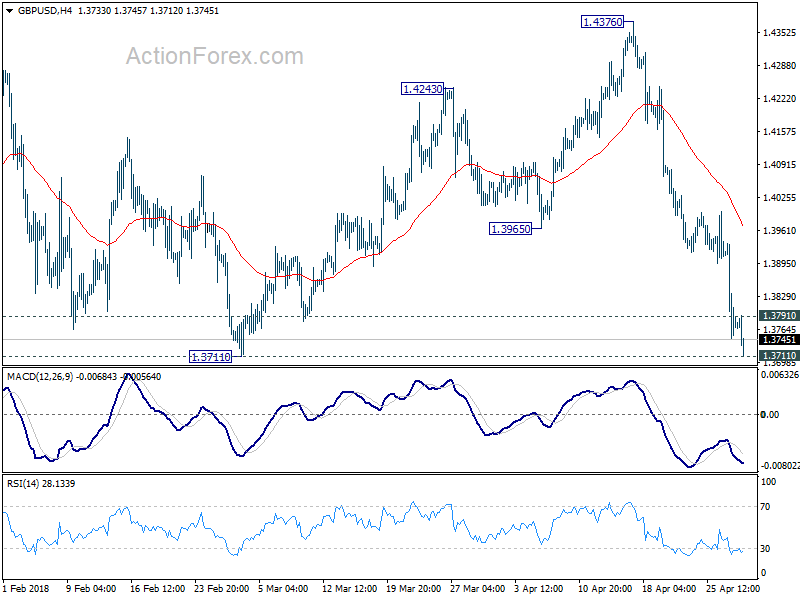
GBP/USD's fall extends to as low as 1.3712 so far today and intraday bias remains on the downside. Decisive break of 1.3711 key support should confirm medium term reversal. That is whole rally from 1.1946 has completed. And deeper fall should be seen to 1.3448 fibonacci level next. On the upside, above 1.3791 minor resistance will turn intraday bias neutral and bring consolidations first, before staging another fall.
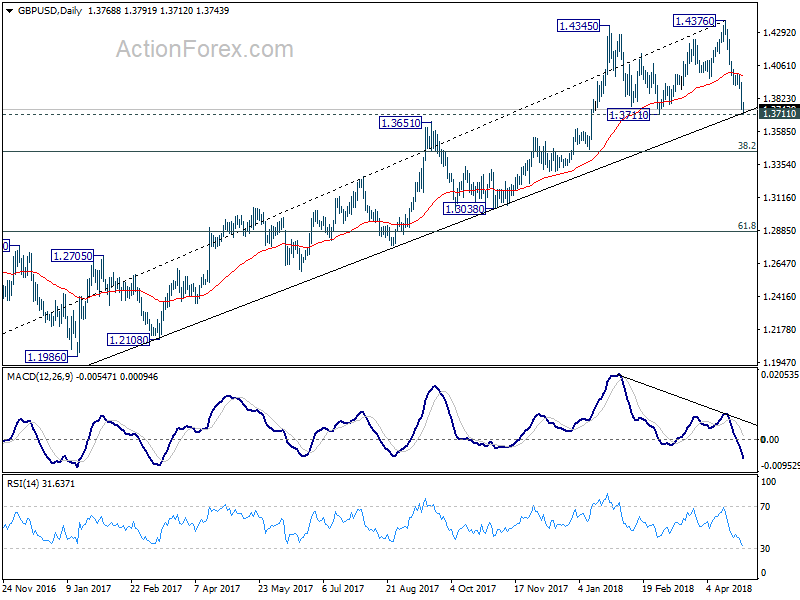
In the bigger picture, bearish divergence condition in daily MACD is raising the chance of medium term reversal. Also, note that GBP/USD has just failed to sustain above 55 month EMA (now at 1.4257) again. Focus is back on 1.3711 support. Firm break there will confirm medium term reversal and target 38.2% retracement of 1.1936 (2016 low) to 1.4376 at 1.3448 first. Break will target 61.8% retracement at 1.2874 and below. For now, sustained break of 55 month EMA is needed to confirm medium term upside momentum. Otherwise, we won't turn bullish even in case of strong rebound.
Dollar Staying Range Bound an PCE Matched Expectations, Sterling Rebounds after Initial Selloff
Dollar remains firm in early US session after release of personal income and spending data. But now, the green back is held below Friday's high against all but Sterling. Canadian Dollar follows as the second strongest. The Pound was initial sold off earlier today but then quickly rebounded. It's Aussie and Kiwi that are trading as the weakest ones. Elsewhere, European indices are trading generally higher today even though gains are limited so far. FTSE and CAC are up around 0.3% while DAX is nearly flat. US futures point to to higher open as DOW could have a take on 24400.
Technically, GBP/USD dipped to as low as 1.3712 so far, just inch above 1.3711 key support. This is an important level to watch in the session as firm break there will indicate medium term reversal. AUD/USD, trading at around 0.7540, will be eying 0.7500 key support. This is also a level to watch considering there will be RBA rate decision tomorrow.
Released from the US, personal income rose 0.4% mom in March, below expectation of 0.4%. Personal spending rose 0.4%, in-line with consensus. Headline PCE accelerated to 2.0% yoy in March, up from 1.7% yoy in February, matched expectations. Core PCE accelerated to 1.9% yoy, up from 1.6% yoy, also met expectations. From Canada, IPPI rose 0.8% mom in March, above expectation of 0.2% mom. RMPI rose 2.1% mom, above expectation of 0.6%.
Swiss KOF Economic Barometer rose to 105.3, "tiny" but "broadly visible" improvements
Swiss KOF Economic Barometer rose to 105.3 in April, up from 105.1 but missed expectation of 106.0. KOF noted in the release that "although the Barometer currently does not reach the positive values seen at the turn of the year 2017/2018, the current value is clearly above long-term average." And, "the Swiss economic outlook remains favourable."
Also KOF said that even though the 0.2 pts rise was "tiny", "it is broadly visible in the economic sectors included." It noted that "the indicator bundles for manufacturing, accommodation and food service activities, banking, construction and consumption all showed slight increases in April." However, "an exception is the indicator set for export prospects; it deteriorated in April."
EU Malmström to talk to US Ross on steel tariff exemptions
Regarding the US steel tariffs, EU Trade Commissioner Cecilia Malmström will speak with US Commerce Wilbur Ross today. Malmström will try to get last minute consent from the US to exempt the tariffs on EU, which temporary exemption expires tomorrow. However, it's reported that EU officials are concerned with impossible demands from the US. European Commission spokes Margaritis Schinas said in a news conference calmly that "we are patient but we are also prepared." EU's stance was made clear after German Chancellor spoke with French President Emmanuel Macron and UK Prime Minister Theresa May on Sunday. Merkel said Europe was "resolved to defend its interests within the multilateral trade framework".
On April 16, EU has already submitted a request to WTO to determine how the US can compensate if trade flows into the EU are affected by the new tariffs. That's request was under TWO's Safeguard Agreements. EU also plans to join another separate WTO complaint against the US, arguing that the steel tariffs violate the most-favored nation principle, which forbid discrimination between their trading partners. In addition, it's reported that EU could retaliate by imposing levies on EUR 2.8b of American goods. And that could start as soon as on June 21, 90 days after the US steel tariffs took effect.
Released from Eurozone, German retail sales dropped -0.6% mom in March versus expectation of 0.8% mom. German CPI rose 0.0% mom, 1.6% yoy in April. The annual rate was unchanged and beat expectation of 1.5% yoy. Eurozone m3 rose 3.7% yoy in March, below expectation of 4.1% yoy.
US steel tariff temporary exemptions to end on May 1
The temporary exemptions on US steel and aluminum tariffs will expire tomorrow on May 1. There is little progress made on trade negotiation between the US and other countries. Commerce Secretary Wilbur Ross was quoted saying that some countries will have their exemptions extended, but not all. But there is no more information from the White House regarding the pressing issue.
So far, only South Korea is granted permanent exemptions after revising the bilateral free trade agreements with the US. There, South Korea agreed to a quota of around 2.7 million tons of steel exports to the US. And, the quota for US car imports was doubled to 50,000, without the requirement to meet local safety standards.
NAFTA negotiations made some progress last week after intensive work, but it's not ready to be wrapped up before May 1 target. Talks will instead resume on May 7 after US Trade Representative Robert Lighthizer returns from his China trip. It's believed that Canada and Mexico will have their exemptions extended but it's only confirmed when it's announced.
Official PMI Shows Slowdown in China's Manufacturing Sector
China's National Bureau of Statistics reported that manufacturing PMI eased to 51.4 in April, from 51.5 a month ago. This, however, came in better than consensus of 51.3. The non-manufacturing improved to 54.8 in April from 54.6 in the prior month. The composite PMI output index also edged +0.1 point higher to 54.1 for the month. The moderation in the manufacturing sector was driven by slowdown in foreign demand, as well as the aftermath of the rapid easing in credit growth in the first quarter. Focusing on small and medium firms, Caixin/ Markit's manufacturing PMI, due Wednesday, probably slipped -0.1 point to 50.9, while services PMI, due Friday, steadied at 52.3 in April. More in Official PMI Shows Slowdown in China's Manufacturing Sector
RBA to stand pat and lower GDP growth forecast this week
RBA is going to announce rate decision tomorrow. And, it's widely expected the it would keep the cash rate unchanged at 1.50%, and maintain a neutral stance. The message has been delivered repeatedly, while the next move is a hike, there is no pressing need to act in the near term.
The more interest part could be the new economic forecasts. Back in February, RBA projected GDP to grow 3.25% in both 2018 and 2019. And, they were above the government's forecasts released back in December. The government projected growth to be at 3.0% in fiscal 2018/19 and fiscal 2019/20. There are some expectations for RBA to lower 2018 growth forecast this week, while the government may raise it as it delivers the May Budget.
Also, RBA projected underlying inflation (in February) to hit 1.75% in 2018 and 2.00% in 2019. But there is sofar no sign of any up trend in inflation yet. It's more likely for RBA to keep inflation projections unchanged.
GBP/USD Mid-Day Outlook
Daily Pivots: (S1) 1.3703; (P) 1.3819; (R1) 1.3891; More...
GBP/USD's fall extends to as low as 1.3712 so far today and intraday bias remains on the downside. Decisive break of 1.3711 key support should confirm medium term reversal. That is whole rally from 1.1946 has completed. And deeper fall should be seen to 1.3448 fibonacci level next. On the upside, above 1.3791 minor resistance will turn intraday bias neutral and bring consolidations first, before staging another fall.
In the bigger picture, bearish divergence condition in daily MACD is raising the chance of medium term reversal. Also, note that GBP/USD has just failed to sustain above 55 month EMA (now at 1.4257) again. Focus is back on 1.3711 support. Firm break there will confirm medium term reversal and target 38.2% retracement of 1.1936 (2016 low) to 1.4376 at 1.3448 first. Break will target 61.8% retracement at 1.2874 and below. For now, sustained break of 55 month EMA is needed to confirm medium term upside momentum. Otherwise, we won't turn bullish even in case of strong rebound.
Economic Indicators Update
| GMT | Ccy | Events | Actual | Forecast | Previous | Revised |
|---|---|---|---|---|---|---|
| 01:00 | AUD | TD Securities Inflation M/M Apr | 0.50% | 0.10% | ||
| 01:00 | CNY | Manufacturing PMI Apr | 51.4 | 51.3 | 51.5 | |
| 01:00 | CNY | Non-manufacturing PMI Apr | 54.8 | 54.5 | 54.6 | |
| 06:00 | EUR | German Retail Sales M/M Mar | -0.60% | 0.80% | -0.70% | |
| 07:00 | CHF | KOF Leading Indicator Apr | 105.3 | 106 | 106 | 105.1 |
| 08:00 | EUR | Eurozone M3 Money Supply Y/Y Mar | 3.70% | 4.10% | 4.20% | |
| 12:00 | EUR | German CPI M/M Apr P | 0.00% | -0.10% | 0.40% | |
| 12:00 | EUR | German CPI Y/Y Apr P | 1.60% | 1.50% | 1.60% | |
| 12:30 | CAD | Industrial Product Price M/M Mar | 0.80% | 0.20% | 0.10% | 0.30% |
| 12:30 | CAD | Raw Materials Price Index M/M Mar | 2.10% | 0.60% | -0.30% | -0.40% |
| 12:30 | USD | Personal Income Mar | 0.30% | 0.40% | 0.40% | 0.30% |
| 12:30 | USD | Personal Spending Mar | 0.40% | 0.40% | 0.20% | 0.00% |
| 12:30 | USD | PCE Deflator M/M Mar | 0.00% | 0.00% | 0.20% | |
| 12:30 | USD | PCE Deflator Y/Y Mar | 2.00% | 2.00% | 1.80% | 1.70% |
| 12:30 | USD | PCE Core M/M Mar | 0.20% | 0.20% | 0.20% | |
| 12:30 | USD | PCE Core Y/Y Mar | 1.90% | 1.90% | 1.60% | |
| 13:45 | USD | Chicago PMI Apr | 58 | 57.4 | ||
| 14:00 | USD | Pending Home Sales M/M Mar | 0.80% | 3.10% |
US personal income rose 0.4% mom, spending rose 0.4% mom, core PCE accelerated to 1.9% yoy
US personal income rose 0.4% mom in March, below expectation of 0.4%. Personal spending rose 0.4%, in-line with consensus. Headline PCE accelerated to 2.0% yoy in March, up from 1.7% yoy in February, matched expectations. Core PCE accelerated to 1.9% yoy, up from 1.6% yoy, also met expectations.
From Canada, IPPI rose 0.8% mom in March, above expectation of 0.2% mom. RMPI rose 2.1% mom, above expectation of 0.6%.
Also German CPI was unchanged at 1.6% yoy in April, above expectation of slowing to 1.5% yoy.
Dollar is steady after the release. Firm, but limited below Friday's low except versus Sterling.