Sample Category Title
GBP/USD Daily Outlook
Daily Pivots: (S1) 1.3720; (P) 1.3755; (R1) 1.3799; More...
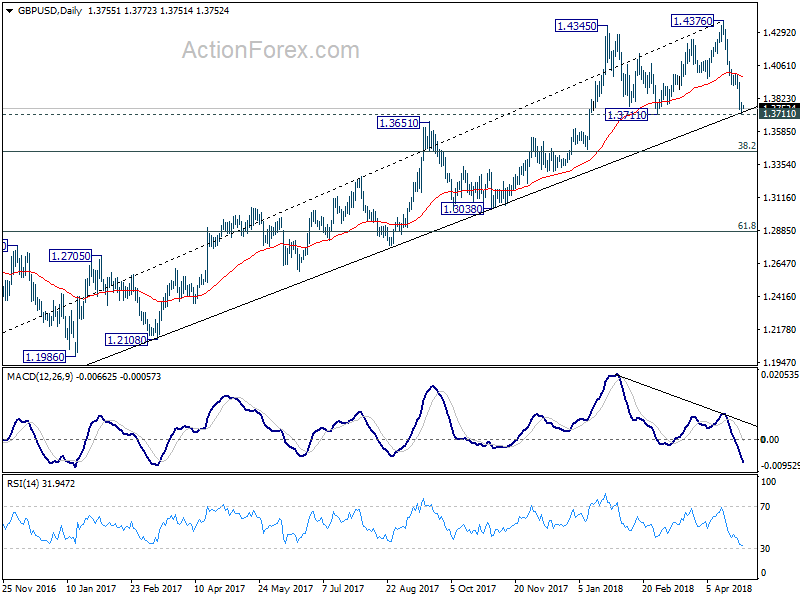
With 1.3791 minor resistance intact, intraday bias in GBP/USD stays on the downside with focus on 1.3711 key support. Decisive break of 1.3711 key support should confirm medium term reversal. That is, whole rally from 1.1946 has completed. And deeper fall should be seen to 1.3448 fibonacci level next. On the upside, above 1.3791 minor resistance will turn intraday bias neutral and bring consolidations first, before staging another fall.
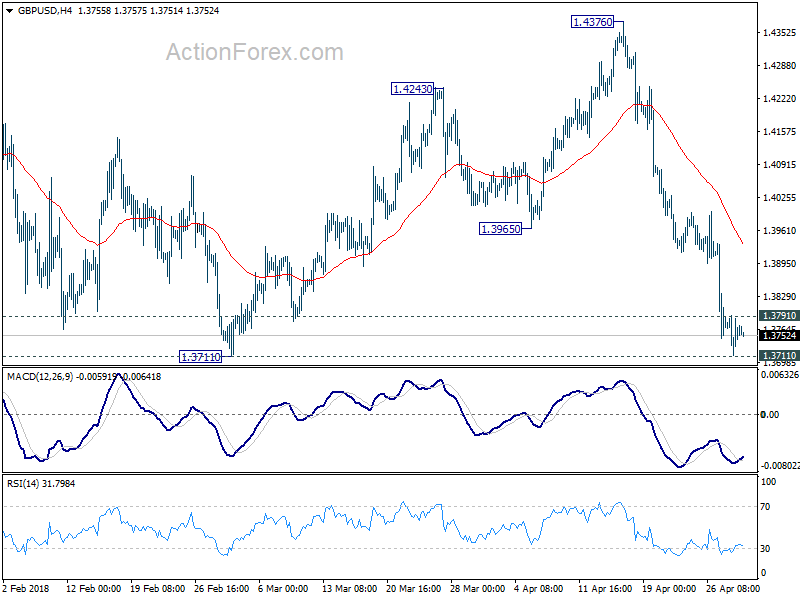
In the bigger picture, bearish divergence condition in daily MACD is raising the chance of medium term reversal. Also, note that GBP/USD has just failed to sustain above 55 month EMA (now at 1.4248) again. Focus is back on 1.3711 support. Firm break there will confirm medium term reversal and target 38.2% retracement of 1.1946 (2016 low) to 1.4376 at 1.3448 first. Break will target 61.8% retracement at 1.2874 and below. For now, sustained break of 55 month EMA is needed to confirm medium term upside momentum. Otherwise, we won't turn bullish even in case of strong rebound.
Brent Crude Jumped Above USD75/bbl
Market movers today
On a day where much of Asia and Europe are out for holiday, the main event is US ISM manufacturing: we expect a fall from 59.3 to 58.0. Looking ahead, we expect a further decline over the coming months but stress that ISM manufacturing has been elevated for quite some time now compared with other indicators and hard data.
In the UK, we expect the manufacturing PMI to remain unchanged at 55.1 as it is already below the equivalent euro area index. Note that on Thursday we will get the service PMI.
Overnight, we will get Caixin PMIs in China, where we expect a moderate decline in the manufacturing index as was the case with the official PMIs released yesterday morning.
Selected market news
As expected, the White House announced that President Donald Trump has extended the exemption period of steel and aluminium tariffs on the European Union, Mexico and Canada for 30 days to allow for further negotiations. According to the statement, the US has finalised a deal with South Korea and reached agreements-in-principle with Australia, Brazil and Argentina.
The price on Brent crude jumped above USD75/bbl yesterday after Israeli Prime Minister Benjamin Netanyahu said that Israel has evidence Iran has lied about its nuclear programme. The US and EU will decide whether to scrap the Iran nuclear deal from 2015 on 12 May; hence a key date.
Yesterday brought inflation data in both the US and the eurozone. In the US , minor revisions to previous months' PCE core data meant we got a low 0.2% m/m (0.153%) against an expected 0.1% following Friday's GDP report. Irrespective, base effects from wireless telephone services last year brought yearly PCE core up to 1.9% y/y. Like markets and the current signals from the Fed, we expect an additional two rate hikes this year with risks skewed towards a third hike.
German Länder figures together with French, Italian and Spanish prints suggests Thursday's eurozone HICP print will turn out at 1.24% %y/y - just below our original estimate of 1.25%. We still expect core inflation to drop to 0.9% and see downside risks to this call.
On a related note, yesterday's monetary aggregates in the eurozone disappointed on the downside. Historically, an inflation-adjusted version of M1 has been a reliable leading indicator for eurozone growth, which in isolation suggests further growth headwinds, see this chart .
In Norway , yesterday brought the final key data releases ahead of Thursday's Norges Bank (NB) meeting. Domestic activity data releases have generally been on the weak side of expectations since the last monetary policy meeting in March, and the risk remains that NB could emphasise this on Thursday rather than weighing it against the weaker-than-expected NOK and higher oil price. However, over the past years NB has tended to give very little news to markets at the short interim meetings - like the one this week - and with yesterday's retail sales figures surprising on the upside (see chart ), we think this will once again be the case. See our Norges Bank Preview: No new signals - September hike still in store .
This morning, the Reserve Bank of Australia as expected kept the cash rate unchanged at 1.5%. We continue to pencil in one 25bp hike over the coming 12M, namely in Q1 19.
USD/JPY Daily Outlook
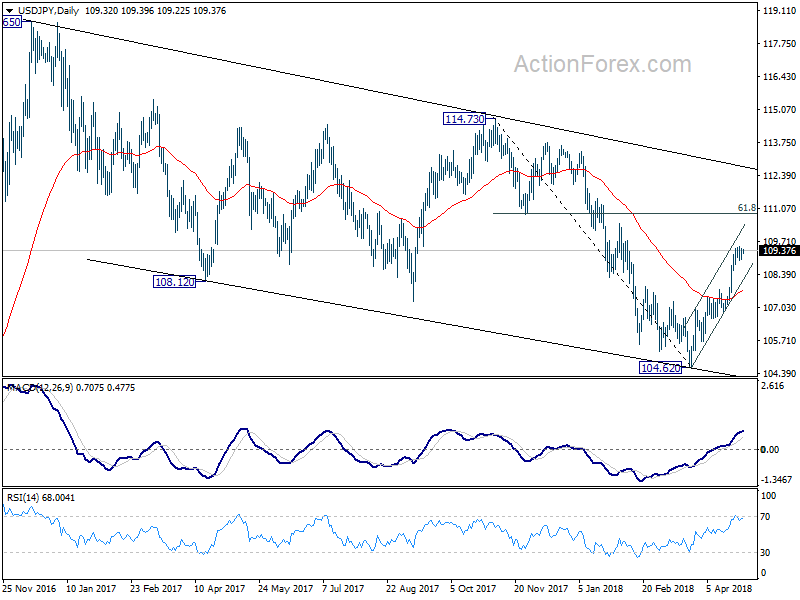
Daily Pivots: (S1) 109.04; (P) 109.25; (R1) 109.52; More...
Intraday bias in USD/JPY remains neutral as consolidation from 109.53 is still in progress. Another fall cannot be ruled out as the consolidation extends. But downside should be contained by 107.77 resistance turned support to bring another rally. Break of 109.53 will resume the rise from 104.62 and target 61.8% retracement of 114.73 to 104.62 at 110.86 next.
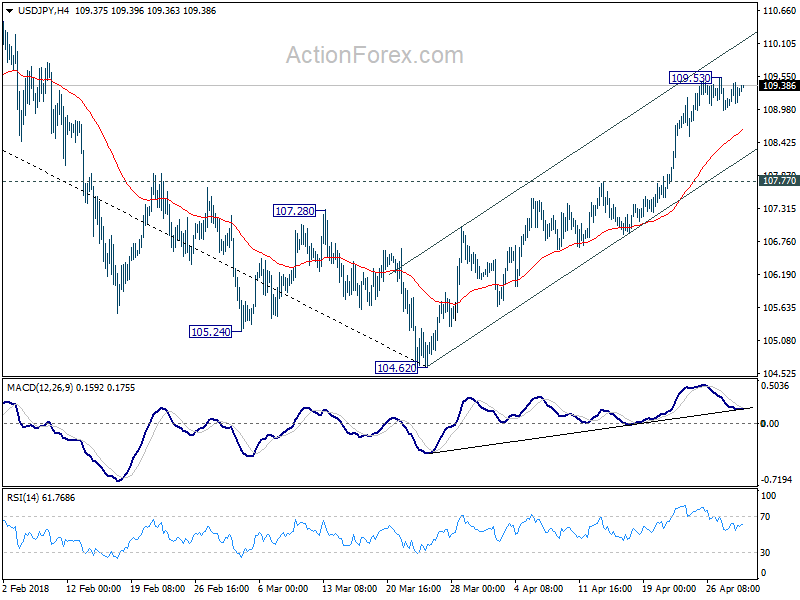
In the bigger picture, break of 108.12 support turned resistance now suggests that corrective fall from 118.65 (2016 high) has completed with three waves down to 104.62. And, rise from 98.97 (2016 low) could be resuming. Focus is back on 114.73 resistance and break there will pave the way to 118.65 and above. This will now be the preferred case as long as USD/JPY stays above 55 day EMA (now at 107.60).
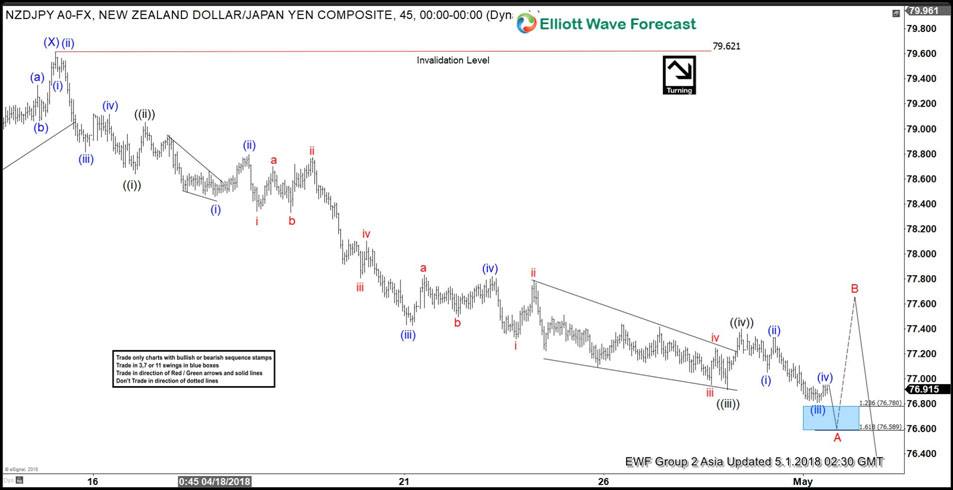
Elliott Wave View: NZDJPY Impulse Sequence In Progress
NZDJPY Elliott Wave view in short-term cycles suggests that the bounce to 79.62 high ended Intermediate wave (X). Down from there, Intermediate wave (Y) remains in progress as a Zigzag Elliott Wave structure in which the first leg of the zigzag (Minor wave A) is unfolding as an impulse Elliott Wave structure looking to see another push lower before ending Minor wave A.
Down from 79.62 high, Minute wave ((i)) of A ended at 78.63. Minute wave ((ii)) of A ended at 79.06. Minute wave ((iii)) of A ended at 76.91 and Minute wave ((iv)) of A ended at 77.4 high. As an impulse, the subdivision of Minute wave ((i)), ((iii)), and ((v)) in Minor wave A has an internal distribution of smaller degree 5 waves. Minute wave ((v)) of A remains in progress as 5 waves structure towards 76.78-76.58, which is inverse 1.236-1.618% Fibonacci extension area of a Minute wave ((iv)).
Afterward, the pair can complete Minor wave A and end cycle from 4/13 peak, then it should bounce in Minor wave B to correct cycle from 4/13 high (79.62) in 3, 7 or 11 swings. As far as Minor wave B rally fails below 79.62 high, the pair should resume lower again in Minor wave C of (Y). We don’t like buying the proposed rally.
NZDJPY Elliott Wave 1 Hour Chart
USD/CAD Daily Outlook
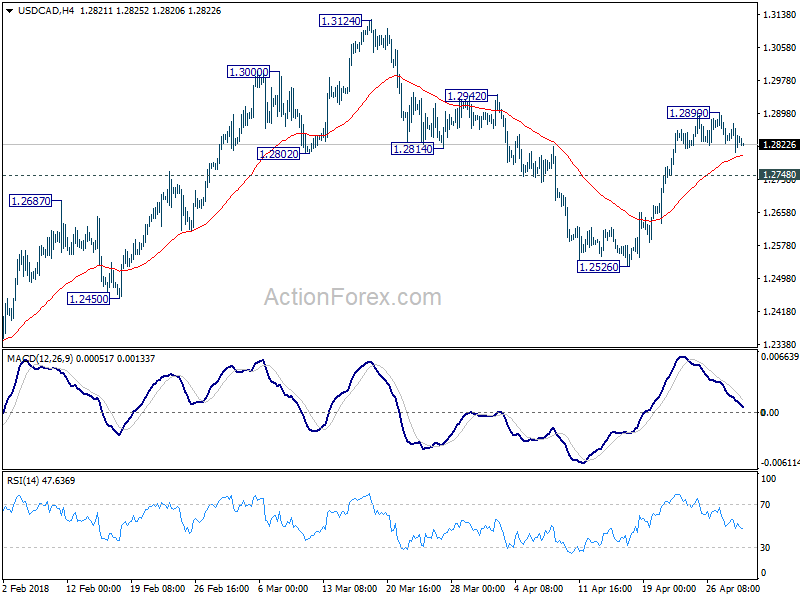
Daily Pivots: (S1) 1.2805; (P) 1.2839; (R1) 1.2875; More....
USD/CAD is staying in consolidation below 1.2899 temporary low and intraday bias remains neutral. Deeper retreat could be seen but downside should be by 1.2748 minor support to bring another rise. Above 1.2899 will target 1.3124 resistance next. On the downside, however, firm break of 1.2748 will turn focus back to 1.2526 support instead.
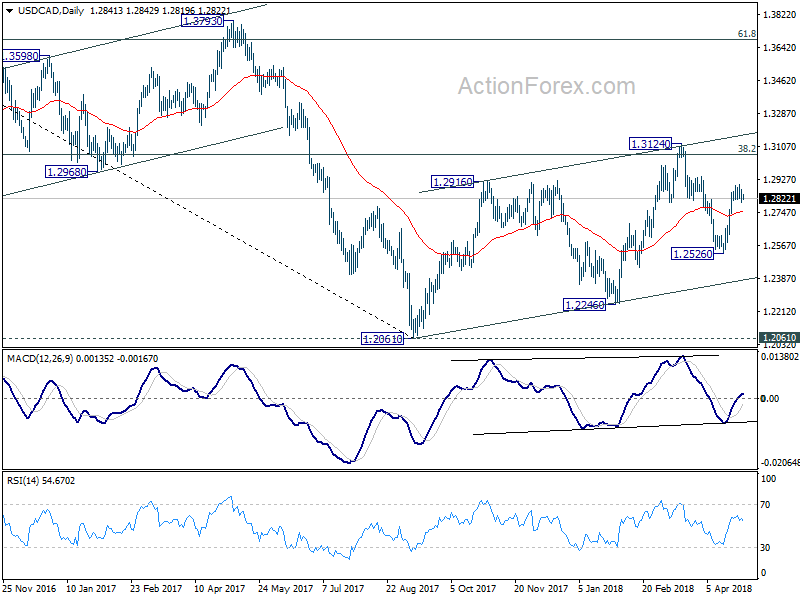
In the bigger picture, current development suggests that rebound from 1.2061 has not completed yet. Focus is back on 38.2% retracement of 1.4689 to 1.2061 at 1.3065. Sustained trading above there will confirm medium term bullish reversal. That is, down trend from 1.4689 has completed at 1.2061 already. In that case, next target will be 61.8% retracement at 1.3685.
AUD/USD Daily Outlook
Daily Pivots: (S1) 0.7508; (P) 0.7545; (R1) 0.7566; More...
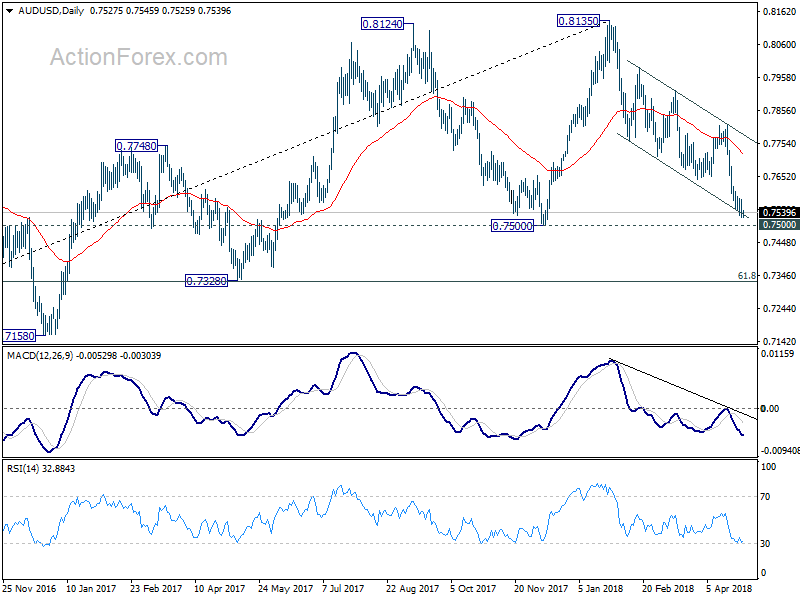
AUD/USD dips lower to 0.7524 as recent fall resumes. Intraday bias is back on the downside with focus on 0.7500 key support level. Decisive break there will indicate medium term reversal and target next support at 0.7328. On the upside, above 0.7583 minor resistance will suggest short term bottoming. In that case, stronger rebound would be seen back to 0.7642 support turned resistance.
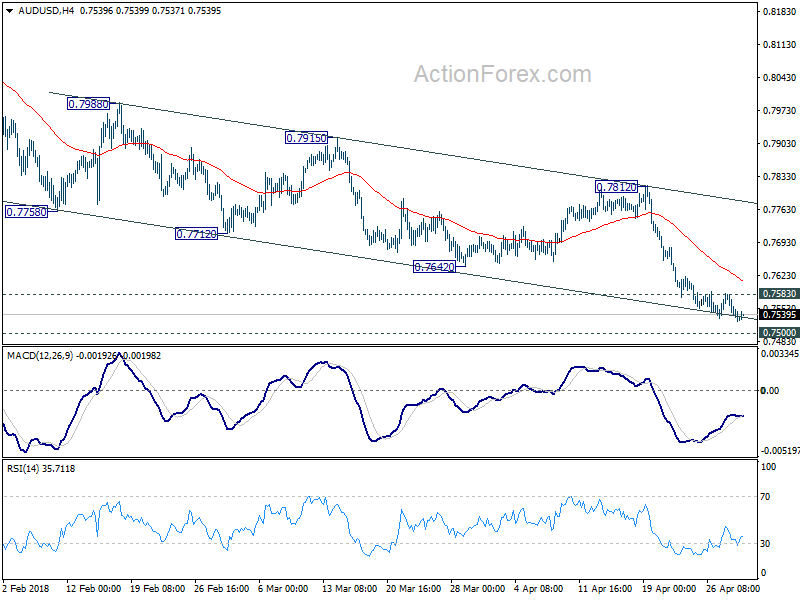
In the bigger picture, medium term rebound from 0.6826 is seen as a corrective move. Decisive break of 0.7500 key support will suggest that such correction is completed. In that case, deeper decline would be seen back to retest 0.6826 low. In case of another rise, we'd expect strong resistance from 38.2% retracement of 1.1079 to 0.6826 at 0.8451 to limit upside to bring long term down trend resumption eventually.
Australian Dollar Steady after RBA Stands Pat, UK PMI Manufacturing to Watch
Australian dollar is steady after RBA left cash rate unchanged at 1.50% as widely expected. Governor Philip Lowe continued to be confident on the economy. He noted in the accompanying statement that "the bank's central forecast for the Australian economy remains for growth to pick up, to average a bit above 3 percent in 2018 and 2019." RBA forecasts growth to be "a bit above 3%" in both 2018 and 2019.
Nonetheless, growth in employment "has slowed over recent months". Unemployment rate steadied at around 5.5% as participation rate rose with employment. While the job market will have "solid growth" ahead, low wage growth is "likely to continue for a while". Inflation data were "in line" with RBA's expectations and is expected to be "a bit above 2%" in 2018.
Overall, the statement suggested that RBA is in no rush to raise interest rates even though the economic outlook remains upbeat.
AiG Australia performance of manufacturing: Slower but still buoyant expansion
The Australian Industry Group Australian Performance of Manufacturing Index dropped -4.8 pts to 58.3 in April. AiG noted in the release that it indicated a "slower - but still buoyant - rate of expansion", after reaching a record high in march. April was also the nineteenth month of expanding or stable conditions, the longest run of continuous expansion since 2005.
Looking at the sub-indexes, sales dropped -1.4 to 62.5. Production dropped -0.1 to 62.1. new orders dropped -5 to 61.6. Employment dropped -3.9 to 56.1. Deliveries dropped sharply by -12.8 to 53.8.
Stocks dropped -6.2 to 49.8. Exports dropped -10.9 to 48.0, first contraction since October 2017. AiG noted that "Exports weakened in the food and beverages and the petroleum, coal, chemicals and rubber products sub-sectors."
New Zealand FM Robertson: We will stick to Budget Responsibility Rules and deliver surplus
New Zealand's Finance Minister Grant Robertson emphasized is his pre-budget speech today that the center-left coalition government will stick to the "Budget Responsibility Rules". He added that means Budget 2018 will deliver a surplus, and surpluses in subsequent years."
Robertson added that "we will reduce the level of net core Crown debt to 20 per cent of GDP within five years of taking office.: And, "we owe it to future generations to be fiscally responsible, given the risks New Zealand faces in terms of natural disasters and global economic shock."
The budget will be announced on May 17.
US extends temporary steel tariffs exemptions for EU, Mexico and Canada
Just before the temporary exemptions on the steel and aluminum tariffs expire today, Trump announced to a 30-day extension on European Union, Mexico and Canada, allowing for further negotiation. Meanwhile, the US has reached trade agreements-in-principle with Argentina, Australia and Brazil and details with be finalized "shortly".
The White House said in a statement that "in all of these negotiations, the administration is focused on quotas that will restrain imports, prevent transshipment, and protect the national security." And it added that "these agreements underscore the Trump administration's successful strategy to reach fair outcomes with allies to protect our national security and address global challenges to the steel and aluminum industries."
Looking ahead
UK data is the major focus in European session with Germany, France and Italy on bank holiday. PMI manufacturing is expected to dropped to 54.8 in April, down from 55.1. After a string of weak economic data, including last week's Q1 GDP, the expectation of a May BoE rate hike is rather low. The PMI data to be released this week will give some hint on how the UK economy is rebounding in Q2. That's still important in gauging the chance of BoE hike this year, maybe in November. UK will also release mortgage approvals and M4 money supply.
Later in the data, Canada GDP will be one major focus as BoC could still raise interest rate one more time in first half, given that NAFTA negotiations could be closed satisfactorily. US will release ISM manufacturing and construction spending.
AUD/USD Daily Outlook
Daily Pivots: (S1) 0.7508; (P) 0.7545; (R1) 0.7566; More...
AUD/USD dips lower to 0.7524 as recent fall resumes. Intraday bias is back on the downside with focus on 0.7500 key support level. Decisive break there will indicate medium term reversal and target next support at 0.7328. On the upside, above 0.7583 minor resistance will suggest short term bottoming. In that case, stronger rebound would be seen back to 0.7642 support turned resistance.
In the bigger picture, medium term rebound from 0.6826 is seen as a corrective move. Decisive break of 0.7500 key support will suggest that such correction is completed. In that case, deeper decline would be seen back to retest 0.6826 low. In case of another rise, we'd expect strong resistance from 38.2% retracement of 1.1079 to 0.6826 at 0.8451 to limit upside to bring long term down trend resumption eventually.
Economic Indicators Update
| GMT | Ccy | Events | Actual | Forecast | Previous | Revised |
|---|---|---|---|---|---|---|
| 22:45 | NZD | Building Permits M/M Mar | 14.70% | 5.70% | 6.40% | |
| 0:30 | JPY | PMI Manufacturing Apr F | 53.8 | 53.3 | 53.3 | |
| 4:30 | AUD | RBA Rate Decision | 1.50% | 1.50% | 1.50% | |
| 8:30 | GBP | Mortgage Approvals Mar | 63.0K | 63.9K | ||
| 8:30 | GBP | Money Supply M4 M/M Mar | 0.20% | -0.30% | ||
| 8:30 | GBP | PMI Manufacturing Apr | 54.8 | 55.1 | ||
| 12:30 | CAD | GDP M/M Feb | 0.30% | -0.10% | ||
| 13:30 | CAD | RBC Manufacturing PMI Apr | 55.7 | |||
| 13:45 | USD | Manufacturing PMI Apr F | 56.5 | 56.5 | ||
| 14:00 | USD | Construction Spending M/M Mar | 0.50% | 0.10% | ||
| 14:00 | USD | ISM Manufacturing Apr | 58.5 | 59.3 | ||
| 14:00 | USD | ISM Prices Paid Apr | 76.8 | 78.1 |
RBA Keeps Key Interest Rate Steady At 1.50%
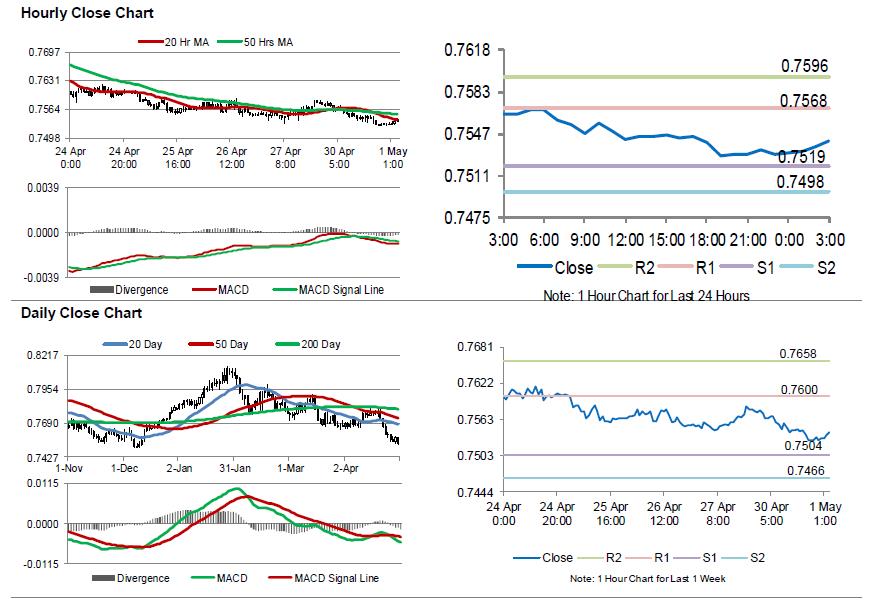
For the 24 hours to 23:00 GMT, the AUD declined 0.58% against the USD and closed at 0.7529.
LME Copper prices declined 0.21% or $14.0/MT to $6783.0/MT. Aluminium prices declined 1.11% or $25.0/MT to $2224.0/MT.
In the Asian session, at GMT0300, the pair is trading at 0.7541, with the AUD trading 0.16% higher against the USD from yesterday’s close.
Earlier today, the Reserve Bank of Australia (RBA), at its May monetary policy meeting, opted to keep the benchmark interest rate steady at 1.50%, meeting market expectations.
Separately, overnight data indicated that Australia’s AiG performance of manufacturing index dropped to a level of 58.3 in April, compared to a reading of 63.1 in the previous month.
The pair is expected to find support at 0.7519, and a fall through could take it to the next support level of 0.7498. The pair is expected to find its first resistance at 0.7568, and a rise through could take it to the next resistance level of 0.7596.
Going ahead, traders would closely monitor a speech by the RBA Governor, Philip Lowe, due in a few hours.
The currency pair is showing convergence with its 20 Hr moving average and trading below its 50 Hr moving average.
German Annual Inflation Advanced Above Expectations In April
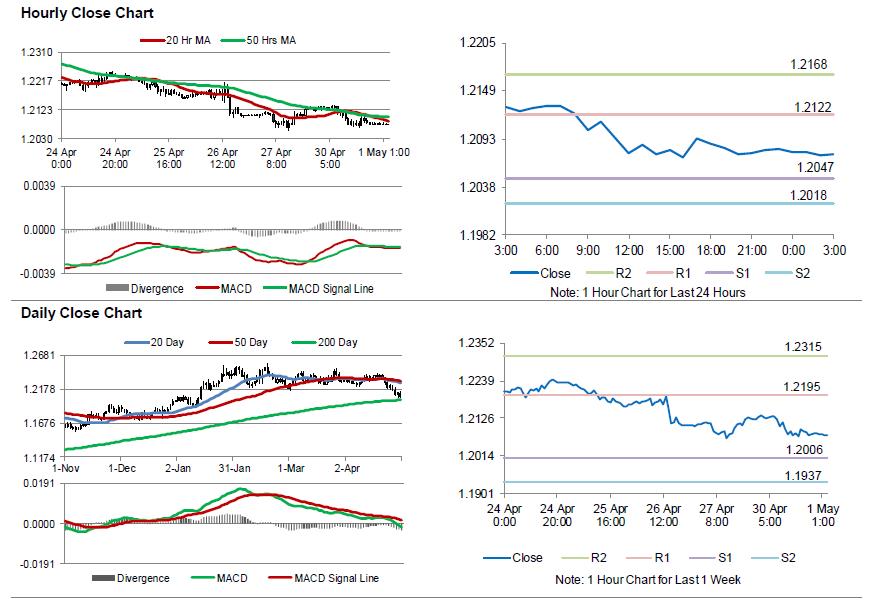
For the 24 hours to 23:00 GMT, the EUR declined 0.44% against the USD and closed at 1.2081, following an unexpected drop in German retail sales data.
On the economic front, Germany’s flash consumer price index (CPI) advanced more-than-anticipated by 1.6% on an annual basis in April, compared to market expectations for a rise of 1.5%. In the prior month, the CPI had registered a similar rise.
On the other hand, the nation’s retail sales unexpectedly fell 0.6% on a monthly basis in March, declining for the fourth consecutive month and confounding market consensus for a gain of 0.8%. In the prior month, retail sales had recorded a revised drop of 0.2%.
In the US, data indicated that personal spending grew 0.4% on a monthly basis in March, meeting market expectations and following a revised flat reading in the prior month. Meanwhile, the nation’s personal income climbed 0.3% on a monthly basis in March, compared to a revised similar rise in the prior month, while investors had anticipated for an increase of 0.4%.
In other economic news, pending home sales in the US advanced 0.4% on a monthly basis in March, undershooting market expectations for a rise of 0.7%. In the prior month, pending home sales had registered a revised gain of 2.8%. Moreover, the nation’s Chicago Fed purchasing managers index climbed to a level of 57.6 in April, compared to a level of 57.4 in the prior month, while markets were anticipating for an increase to a level of 58.0.
In the Asian session, at GMT0300, the pair is trading at 1.2076, with the EUR trading slightly lower against the USD from yesterday’s close.
The pair is expected to find support at 1.2047, and a fall through could take it to the next support level of 1.2018. The pair is expected to find its first resistance at 1.2122, and a rise through could take it to the next resistance level of 1.2168.
Amid no macroeconomic releases in the Euro-zone today, investors would focus on the US ISM manufacturing and the final Markit manufacturing PMIs, both for April followed by construction spending data for March, all scheduled to release later today.
The currency pair is trading below its 20 Hr and 50 Hr moving averages.
Pound Trading Lower, Ahead Of UK’s Markit Manufacturing PMI Data
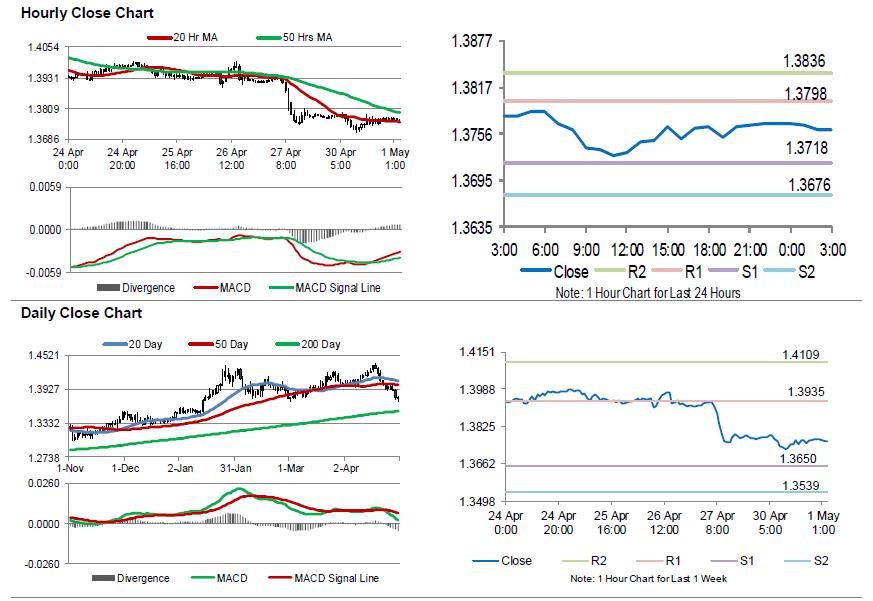
For the 24 hours to 23:00 GMT, the GBP declined 0.08% against the USD and closed at 1.3769.
In the Asian session, at GMT0300, the pair is trading at 1.3761, with the GBP trading 0.06% lower against the USD from yesterday's close.
The pair is expected to find support at 1.3718, and a fall through could take it to the next support level of 1.3676. The pair is expected to find its first resistance at 1.3798, and a rise through could take it to the next resistance level of 1.3836.
Trading trend in the Pound today is expected to be determined by the release of UK's Markit manufacturing PMI for April, due to release in a few hours. Additionally, the nation's net consumer credit and mortgage approvals data, both for March, will also be eyed by market participants.
The currency pair is showing convergence with its 20 Hr moving average and trading below its 50 Hr moving average.