

Sample Category Title
Gold: Yellow Metal Trading On A Weaker Footing This Morning
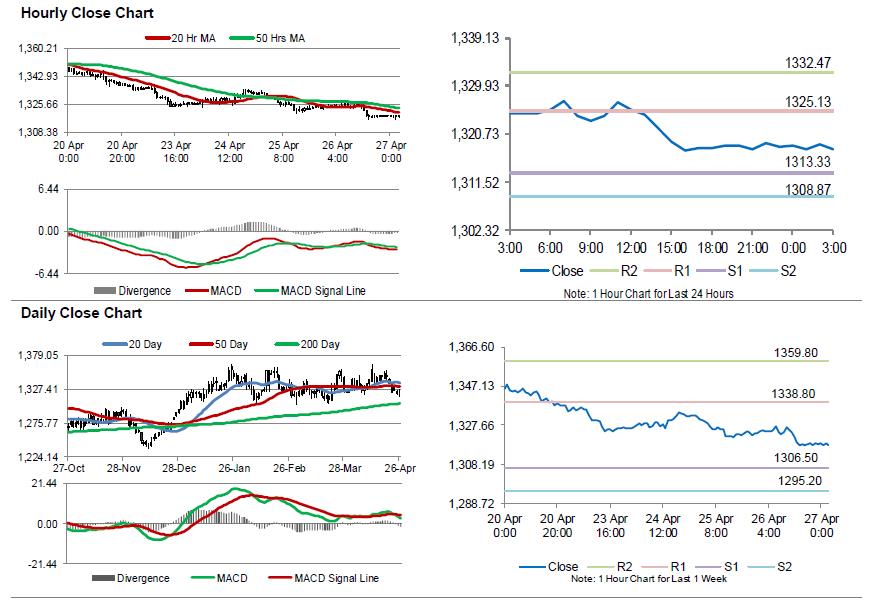
For the 24 hours to 23:00 GMT, Gold declined 0.37% against the USD and closed at USD1318.90 per ounce, amid strength in the US Dollar and easing geopolitical tensions.
In the Asian session, at GMT0300, the pair is trading at 1317.80, with gold trading 0.08% lower against the USD from yesterday’s close.
The pair is expected to find support at 1313.33, and a fall through could take it to the next support level of 1308.87. The pair is expected to find its first resistance at 1325.13, and a rise through could take it to the next resistance level of 1332.47.
The yellow metal is trading below its 20 Hr and 50 Hr moving averages.
Silver: White Metal Trading On A Weaker Footing This Morning
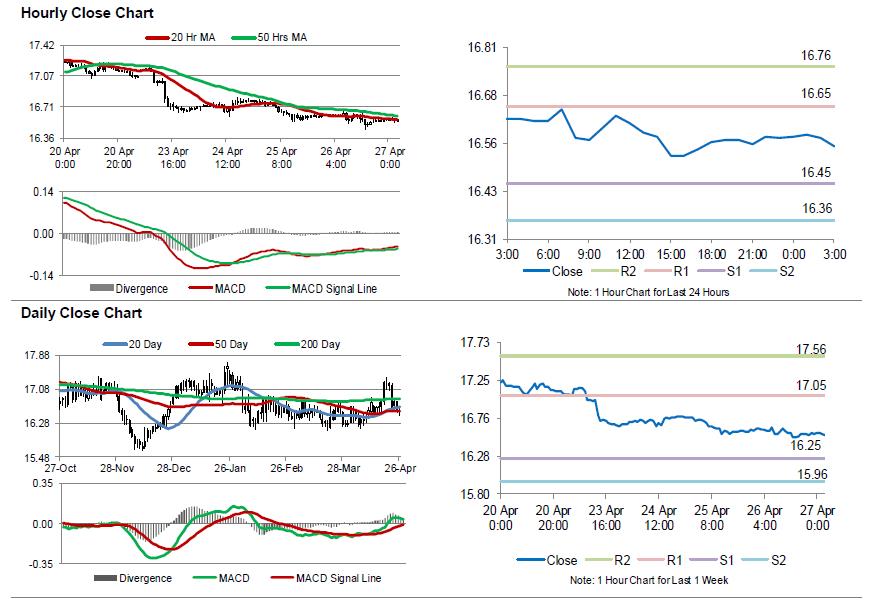
For the 24 hours to 23:00 GMT, Silver declined 0.30% against the USD and closed at USD16.57 per ounce, tracking losses in gold prices.
In the Asian session, at GMT0300, the pair is trading at 16.55, with silver trading 0.12% lower against the USD from yesterday’s close.
The pair is expected to find support at 16.45, and a fall through could take it to the next support level of 16.36. The pair is expected to find its first resistance at 16.65, and a rise through could take it to the next resistance level of 16.76.
The white metal is showing convergence with its 20 Hr moving average and trading below its 50 Hr moving average.
Crude Oil: Oil Extends Its Losses In The Asian Session, Ahead Of Baker Hughes Weekly Rig Count Data
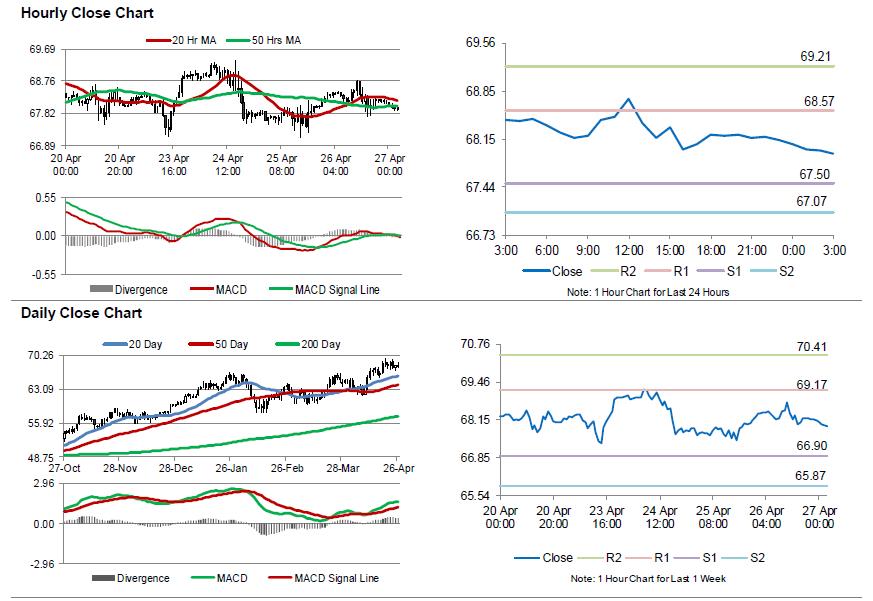
For the 24 hours to 23:00 GMT, Crude Oil slightly declined against the USD and closed at USD68.13 per barrel.
In the Asian session, at GMT0300, the pair is trading at 67.93, with oil trading 0.29% lower against the USD from yesterday’s close.
The pair is expected to find support at 67.50, and a fall through could take it to the next support level of 67.07. The pair is expected to find its first resistance at 68.57, and a rise through could take it to the next resistance level of 69.21.
Crude oil is trading below its 20 Hr moving average and showing convergence with its 50 Hr moving average.
GBP/USD Daily Outlook
Daily Pivots: (S1) 1.3872; (P) 1.3934; (R1) 1.3975; More...
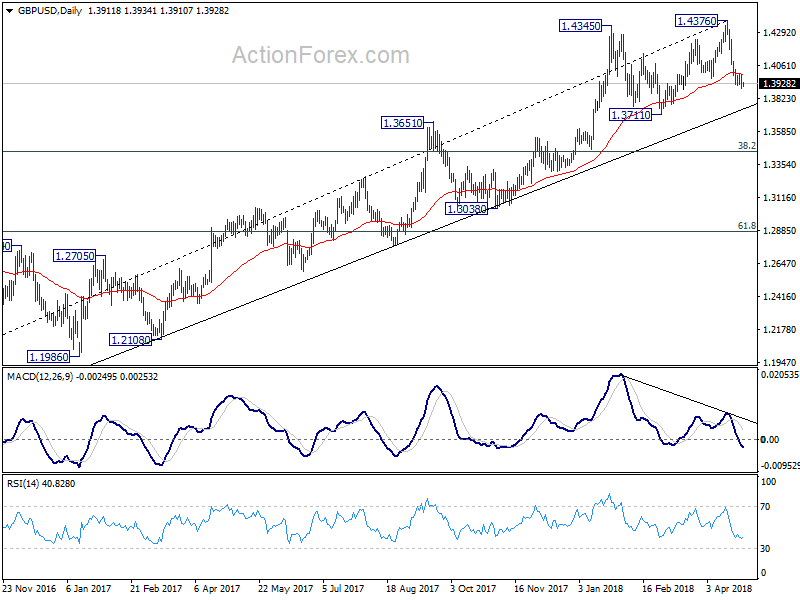
Intraday bias in GBP/USD remains neutral for consolidation above 1.3894 temporary low. Another recovery cannot be ruled out. But upside should be limited by 1.4089 minor resistance to bring fall resumption. Below 1.3894 will extend the fall from 1.4376 and target 1.3711 key support next. However, firm break of 1.4089 will turn focus back to 1.4376 high instead.
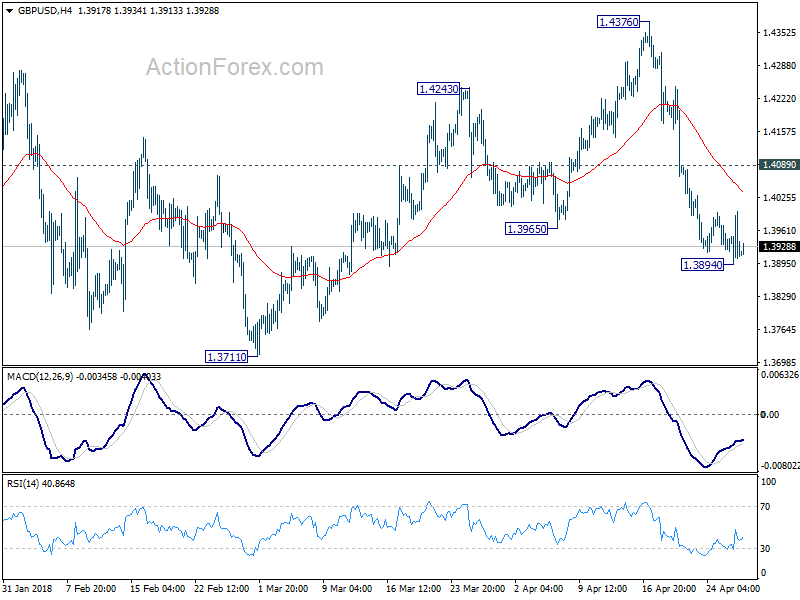
In the bigger picture, bearish divergence condition in daily MACD is raising the chance of medium term reversal. Also, note that GBP/USD has just failed to sustain above 55 month EMA (now at 1.4257) again. Focus is back on 1.3711 support. Firm break there will confirm medium term reversal and target 38.2% retracement of 1.1936 (2016 low) to 1.4376 at 1.3448 first. Break will target 61.8% retracement at 1.2874 and below. For now, sustained break of 55 month EMA is needed to confirm medium term upside momentum. Otherwise, we won't turn bullish even in case of strong rebound.
US and UK GDP to Take Center Stage, BoJ Stands Pat
Dollar is trading mildly lower today but remains the overwhelmingly strongest one for the week. The greenback was, on the one hand, pushed higher overnight thanks to the steep post ECB selloff in Euro. Dollar index hit as high as 91.63 and continued to build up the case of medium term trend reversal. But gain was capped as 10 year yield dipped back below 3% level to close at 2.990. The greenback will now turn to US Q1 GDP for more guidance.
Elsewhere in the currency markets, Sterling is broadly higher today and is trading as the second strongest for the week. Q1 GDP data from UK will catch most attention in European session. Euro, despite yesterday's selloff, is actually just mixed for the week, trading in black against Yen, Swiss Franc, Aussie and Kiwi. Yen showed little reaction to the expected BoJ rate decision, and the batch of mixed economic data. While the meeting between South Korean leader Moon Jae-in and North Korean leader Kim Jong-un is historical, it has little impact in the markets today.
BoJ stands pat, raised growth forecast, lowered inflation projection
BoJ announced to keep monetary policy unchanged by 8-1 vote as widely expected. Short term interest rate is held at -0.1%. The central bank will also continue with JGB purchases to keep 10 year yield at around 0%. The current pace of JPY 80T annual purchase is also maintained. BoJ also maintained the pledge to continue with the "Quantitative and Qualitative Monetary Easing (QQE) with Yield Curve Control" until year-on-year core CPI stay above 2% target in a "stable manner".
Goushi Kataoka dissented again. It's noted in the statement that "taking account of risk factors through fiscal 2020 such as the consumption tax hike and a possible economic downturn in the United States", Kataoka believed it's desirable to "further strengthen monetary easing".
In the outlook for economic activity and prices report, BoJ noted that the economy is "likely to continue growing at a pace above its potential in fiscal 2018." For 2019 and 2020, "the economy is expected to continue on a expanding trend supported by external demand. Ex-fresh food CPI continued to show "relatively weak developments" when excluding the effects of energy prices.
Below are the updated economic forecasts of BoJ:
- Forecast of fiscal 2018 real GDP was raised to 1.6%, up from January's estimate of 1.4%.
- Forecast of fiscal 2019 real GDP was raised to 0.8%, up from 0.7%.
- Forecast of fiscal 2020 real GDP was at 0.8%
- Forecast of fiscal 2018 core CPI was lowered to 1.3%, down from 1.4%.
- Forecast of fiscal 2019 core CPI (ex sales tax hike) was unchanged at 1.8%
- Forecast of fiscal 2020 core CPI was at 1.8%.
BoJ also highlighted four major risks to the outlook. First is overseas developments including US economic policies and Brexit. Secondly is the impacts of the planned consumption tax hike in October 2019. Third is change in firms and households medium- to long-term growth expectations. Fourth is fiscal sustainability in the medium term to long term.
There are also three main risks identified to price developments. First is change in firms and households medium- to long-term inflation expectations. Second is items's prices that are not response to output gap. Third is the developments in exchange rates and commodity prices.
A batch of data is released from Japan today. Tokyo CPI slowed to 0.6% yoy in April, down from 0.8% yoy and missed expected of 0.8% yoy. Industrial production rose 1.2% mom in March, well above expectation of 0.5% mom. Retail sales rose 1.0% yoy in March, below expectation of 1.5% yoy. Unemployment rate was unchanged at 2.5%.
Euro broke down as ECB needs more time to assess the Q1 slowdown
Euro rebounded initially yesterday after ECB President Mario Draghi's introductory statement talked about the "solid and broad-based expansion" despite weaker than expected data. However, there was a long of cautious tones in the Q&A section of the press conference. Draghi said the Governing Council didn't even discuss monetary policy "per se" during the meeting. And that's because more time is needed to assess whether the slowdown in Q1 was "temporary or permanent". And Draghi also cautioned that understanding the factors behind the moderation in growth is "essential for informing our next decisions."
The message showed that ECB policy makers are rather uncertain about the outlook. Eurozone Q1 GDP to be released next week on May 2 will give a clearer idea on how deep the moderation was. Then on May 3 there will be April CPI flash, which will show how well inflation is picking up again. Given that ECB's next meeting on June 14 is less than two months away, there may not be enough data for policymakers to full assess the situation. And there is a chance that Draghi will stay noncommittal on the asset purchase program even after the June meeting.
Euro was deeply sold off after markets took a bit of time to digest the messages.
New Zealand recorded first March trade deficit in 10 years
New Zealand trade balance unexpectedly show NZD -86m deficit in April, versus expectation of NZD 200m surplus. That was also the first March deficit 10 years since 2008. Goods exports rose 5.8%, or NZD 265m while imports rose 14%, or NZD 612m.
From Australia, PPI rose 0.5% qoq, 1.7% Yoy in Q1 versus expectation of 0.4% qoq, 1.2% yoy.
Looking ahead
UK Q1 GDP will be the main focus in European session today. Growth is expected to slow from 0.4% qoq in Q4 to 0.3% qoq. Germany will release import price and unemployment, France will release Q1 GDP. Eurozone will release confidence indicators.
Later in the day, US Q1 GDP will take center stage. Growth is expected to slow to 2.0% annualized, down from Q4's 2.9%. GDP price is expected is expected to rise 2.2%. Employment cost is expected to rise 0.7%.
GBP/USD Daily Outlook
Daily Pivots: (S1) 1.3872; (P) 1.3934; (R1) 1.3975; More...
Intraday bias in GBP/USD remains neutral for consolidation above 1.3894 temporary low. Another recovery cannot be ruled out. But upside should be limited by 1.4089 minor resistance to bring fall resumption. Below 1.3894 will extend the fall from 1.4376 and target 1.3711 key support next. However, firm break of 1.4089 will turn focus back to 1.4376 high instead.
In the bigger picture, bearish divergence condition in daily MACD is raising the chance of medium term reversal. Also, note that GBP/USD has just failed to sustain above 55 month EMA (now at 1.4257) again. Focus is back on 1.3711 support. Firm break there will confirm medium term reversal and target 38.2% retracement of 1.1936 (2016 low) to 1.4376 at 1.3448 first. Break will target 61.8% retracement at 1.2874 and below. For now, sustained break of 55 month EMA is needed to confirm medium term upside momentum. Otherwise, we won't turn bullish even in case of strong rebound.
Economic Indicators Update
| GMT | Ccy | Events | Actual | Forecast | Previous | Revised |
|---|---|---|---|---|---|---|
| 22:45 | NZD | Trade Balance Mar | -86M | 200M | 217M | 172M |
| 23:01 | GBP | GfK Consumer Confidence Apr | -9 | -7 | -7 | |
| 23:30 | JPY | Jobless Rate Mar | 2.50% | 2.50% | 2.50% | |
| 23:30 | JPY | Tokyo CPI Core Y/Y Apr | 0.60% | 0.80% | 0.80% | |
| 23:50 | JPY | Retail Trade Y/Y Mar | 1.00% | 1.50% | 1.60% | 1.70% |
| 23:50 | JPY | Industrial Production M/M Mar P | 1.20% | 0.50% | 2.00% | |
| 1:30 | AUD | PPI Q/Q Q1 | 0.50% | 0.40% | 0.60% | |
| 1:30 | AUD | PPI Y/Y Q1 | 1.70% | 1.20% | 1.70% | |
| 3:05 | JPY | BoJ Rate Decision | -0.10% | -0.10% | -0.10% | |
| 5:00 | JPY | Housing Starts Y/Y Mar | -4.80% | -2.60% | ||
| 5:30 | EUR | French GDP Q/Q Q1 A | 0.40% | 0.70% | ||
| 6:00 | EUR | German Import Price Index M/M Mar | 0.10% | -0.60% | ||
| 7:55 | EUR | German Unemployment Change Apr | -15K | -19K | ||
| 7:55 | EUR | German Unemployment Claims Rate Apr | 5.30% | 5.30% | ||
| 8:30 | GBP | Index of Services 3M/3M Feb | 0.60% | 0.60% | ||
| 8:30 | GBP | GDP Q/Q Q1 A | 0.30% | 0.40% | ||
| 9:00 | EUR | Eurozone Economic Confidence Apr | 112 | 112.6 | ||
| 9:00 | EUR | Eurozone Business Climate Indicator Apr | 1.28 | 1.34 | ||
| 9:00 | EUR | Eurozone Industrial Confidence Apr | 5.8 | 6.4 | ||
| 9:00 | EUR | Eurozone Services Confidence Apr | 15.9 | 16.3 | ||
| 9:00 | EUR | Eurozone Consumer Confidence Apr F | 0.4 | 0.4 | ||
| 12:30 | USD | GDP Annualized Q/Q Q1 A | 2.00% | 2.90% | ||
| 12:30 | USD | GDP Price Index Q1 A | 2.20% | 2.30% | ||
| 12:30 | USD | Employment Cost Index Q1 | 0.70% | 0.60% | ||
| 14:00 | USD | U. of Mich. Sentiment Apr F | 98 | 97.8 |
ECB Refrained from Hinting on Policy Outlook
In line with our expectations, ECB largely judged the recent slowdown in economic data as driven by temporary factors and moderation after periods of strong growth. The members maintained the view that risks to growth were “broadly balanced” and remained confident that inflation would converge towards the +2% target. Neither did the accompanying statement nor President Draghi reveal hints about the future path after QE’s end in September. The more reasonable timing of such announcement is still June, or July. At the April meeting, ECB decided to leave the main refi rate, the marginal lending rate and the deposit rate unchanged at 0%, 0.25% and -0.40% respectively. The central bank also kept the net asset purchases at a monthly pace of 30B euro until the end of September 2018, or beyond.
In the Introductory Statement, the members acknowledged “some moderation in the pace of growth since the start of the year”. They attributed the situation to “a pull-back from the high pace of growth observed at the end of last year” as well as “temporary factors” including cold weather, strikes, and Easter. They continued to expect growth to “remain solid and broad-based”. On inflation, the members admitted that it has “yet to show more convincing signs of a sustained upward trend“. Core inflation remained “subdued” but should “rise gradually over the medium term, supported by our monetary policy measures“. As such “an ample degree of monetary stimulus remains necessary for underlying inflation pressures to continue to build up“.
At the press conference, Draghi noted that “the interesting thing is that we didn’t discuss monetary policy per se”. It appears that the focus of the discussion was on recent economic developments, of which the conclusion is unchanged outlook. Likely in either June or July, the ECB would announce that plan after QE ends in September. We believe a three-month tapering from September to December is prudent to keep some monetary accommodation in place for convergence of inflation to the target.
Market Morning Briefing: Pound Did Move Lower Towards 1.3895
STOCKS
Dow (24322.34, +0.99%) and Dax (12500.47, +0.63%) have both risen from previous levels. 23500-23550 is crucial levels for Dow and a sharp rise from here is necessary to push the index to much higher levels in the medium term. Else the index is likely to trade within 23550-25000 region in the near term.
Dax on the other hand, tried to rise a bit from 12300 but 12600-12700 continues to remain an important resistance for the medium term. Unless a sustained break above 12700 is seen, the index may again come off towards 12300-12200 in the next week.
Nikkei (22413.85, +0.42%) moved up to almost test resistance near 22600. A break on the upside, if seen could be a signal of further strength coming up in the near term. Note that the Dollar Yen (109.25) has been moving up sharply and if it continues to move up towards 110, Nikkei could get stronger next week.
Shanghai (3064.48, -0.34%) is weak and is trading just above support at 3050. Watch price action near current levels. A break below 3050 could make it vulnerable to a fall towards 2900 or lower. Else a bounce back towards 3100-3150 could be seen.
Nifty (10617.80, +0.45%) continued to close at higher levels despite weakness in the Indian Rupee. A close above 10600 yesterday was quite a surprise and does not indicate any weakness in the bulls. Some dip could be seen today if the USDINR rises to levels past 67. Keep an eye at levels near 10600-10650.
COMMODITIES
Brent (74.46) and Nymex WTI (67.95) are stable just now. While WTI has some scope of rising towards 69-70 in the near term, Brent could trade in the 72-76 region in the medium term.
Gold (1317.60) is on its way down towards our mentioned 1310-1300 levels. Near term looks weak just now. A bounce from 1310-1300 could be expected in the medium term.
Copper (3.1335) is stable with no major movement just now. Near term likely to be ranged in the 3.10-3.18 region.
FOREX
The ECB struck a slightly dovish tone yesterday while maintaining status quo on all policy decisions. Draghi did acknowledge the slight moderation in growth of the past 4 months but also re-asserted confidence in the longer term growth prospects for the Euro region. The absence of any hint of hawkishness in the ECB stance has led to the Euro (1.2111) breaking below 1.215 and testing a low near 1.2096 yesterday. In our Apr ’18 Euro report, we had expected a decline towards 1.20-1.17 to begin later after June – however, the downtrend seems to have started already. Euro could now possibly move lower towards downside target of 1.195 (daily line chart) in the next couple of weeks. The chances of a rise back from these levels seem bleak now.
Dollar index (91.535), like the Euro, has breached crucial levels in the past week and could now target 92.5 in the weeks ahead (daily line chart) as the Euro tries to move towards 1.195. As US yields also rise, the traditionally positive correlation between Dollar strength and US Yields could start surfacing again in the months ahead (the correlation had not been working out since the beginning of 2018).
Dollar Yen (109.16) : Dollar Yen is forming an upward channel on the 3 day candles and tested resistance in the channel near 109.5 yesterday. It could now move down towards support in the channel near 108.5 and rise again from there. This uptrend could be capped till 110.0-110.5, after which Dollar Yen could dip. As mentioned yesterday, the current rise has been in line with our Apr ’18 Yen report.
Euro Yen (132.19) has broken support on daily candles and could move down towards support near 131 on weekly candles next week. A target of 108.5 on Dollar Yen and 1.2075 on the Euro also yields a target of 131 for the Euro Yen.
Pound (1.3924) did move lower towards 1.3895 yesterday and could test crucial long term support level near 1.385 on weekly line chart in the coming week. We are expecting the Pound to bounce soon from this strong support level. In the medium term, we expect it to target long term resistance level near 1.46. However, if the current support breaks, Pound could turn very bearish in the medium term.
Dollar Rupee (66.755): Upside might be limited to 67.20 for next week. Immediate Support at 66.70.
INTEREST RATES
Draghi’s dovishness has led to a dip in US yields with the 10 Year moving back below 3%. Our Apr ’18 US Treasury (available on demand) report predicts a medium target of 3.2%-3.3% (10 Year), 3.4%-3.5% (30 Year), 3.15% (5 Year) and 2.75% (2 Year). We also expect some more yield curve flattening in the next month followed by steepening after that, as yields bounce from long term supports.
We repeat that the recent upmove in US yields has happened on back of positive sentiment around the US economy’s growth and due to the rise in Crude towards 74-75.
US 10 Yr Yield (2.97%), 30 Yr (3.16%), 5 Yr (2.81%), 2 Yr (2.48%):
The US 2 year yield (2.48) continues to stay near levels seen yesterday and could see a short term correction towards 2.45% (earlier mentioned as 2.40%).
The 10 Year yield (2.97%) has dipped below 3% but could again rise back above it soon. Our preference is for it to stay within 3.0%-3.2% (max 3.3%) till June. Let’s wait and watch.
The 30 yr yield has dipped below crucial resistance near 3.2% again. Our preference is for it to stay within 3.2%-3.4% (max 3.5%) till June.
BoJ raised 2018, 2019 GDP growth forecasts, lowered 2018 inflation forecast
In the outlook for economic activity and prices report, BoJ noted that the economy is "likely to continue growing at a pace above its potential in fiscal 2018." For 2019 and 2020, "the economy is expected to continue on a expanding trend supported by external demand. Ex-fresh food CPI continued to show "relatively weak developments" when excluding the effects of energy prices.
Below are the updated economic forecasts of BoJ:
- Forecast of fiscal 2018 real GDP was raised to 1.6%, up from January's estimate of 1.4%.
- Forecast of fiscal 2019 real GDP was raised to 0.8%, up from 0.7%.
- Forecast of fiscal 2020 real GDP was at 0.8%
- Forecast of fiscal 2018 core CPI was lowered to 1.3%, down from 1.4%.
- Forecast of fiscal 2019 core CPI (ex sales tax hike) was unchanged at 1.8%
- Forecast of fiscal 2020 core CPI was at 1.8%.
BoJ also highlighted four major risks to the outlook. First is overseas developments including US economic policies and Brexit. Secondly is the impacts of the planned consumption tax hike in October 2019. Third is change in firms and households medium- to long-term growth expectations. Fourth is fiscal sustainability in the medium term to long term.
There re also three main risks identified to price developments. First is change in firms and households medium- to long-term inflation expectations. Second is items's prices that are not response to output gap. Third is the developments in exchange rates and commodity prices.
BoJ stands pat, Kataoka dissented again, calling for further easing
BoJ announced to keep monetary policy unchanged by 8-1 vote. Short term interest rate is held at -0.1%. The central bank will also continue with JGB purchases to keep 10 year yield at around 0%. The current pace of JPY 80T annual purchase is also maintained
BoJ also maintained the pledge to continue with the "Quantitative and Qualitative Monetary Easing (QQE) with Yield Curve Control" until year-on-year core CPI stay above 2% target in a "stable manner".
Goushi Kataoka dissented again. It's noted in the statement that "taking account of risk factors through fiscal 2020 such as the consumption tax hike and a possible economic downturn in the United States", Kataoka believed it's desirable to "further strengthen monetary easing".
USD/JPY Back In Uptrend Above 108.00
Key Highlights
- The US Dollar traded higher recently and broke a key resistance at 107.80 against the Japanese Yen.
- There is a major bullish trend line formed with support at 108.70 on the 4-hours chart of USD/JPY.
- The US Initial Jobless Claims in the week ending April 21, 2018 declined from 233K (revised) to 209K.
- Tokyo CPI in April 2018 posted a 0.5% rise (YoY), compared with the +0.8% forecast.
USDJPY Technical Analysis
The US Dollar started a nice upside move from the 105.00 support against the Japanese Yen. The USD/JPY traded in a solid bullish path and moved above a crucial resistance at 107.80.
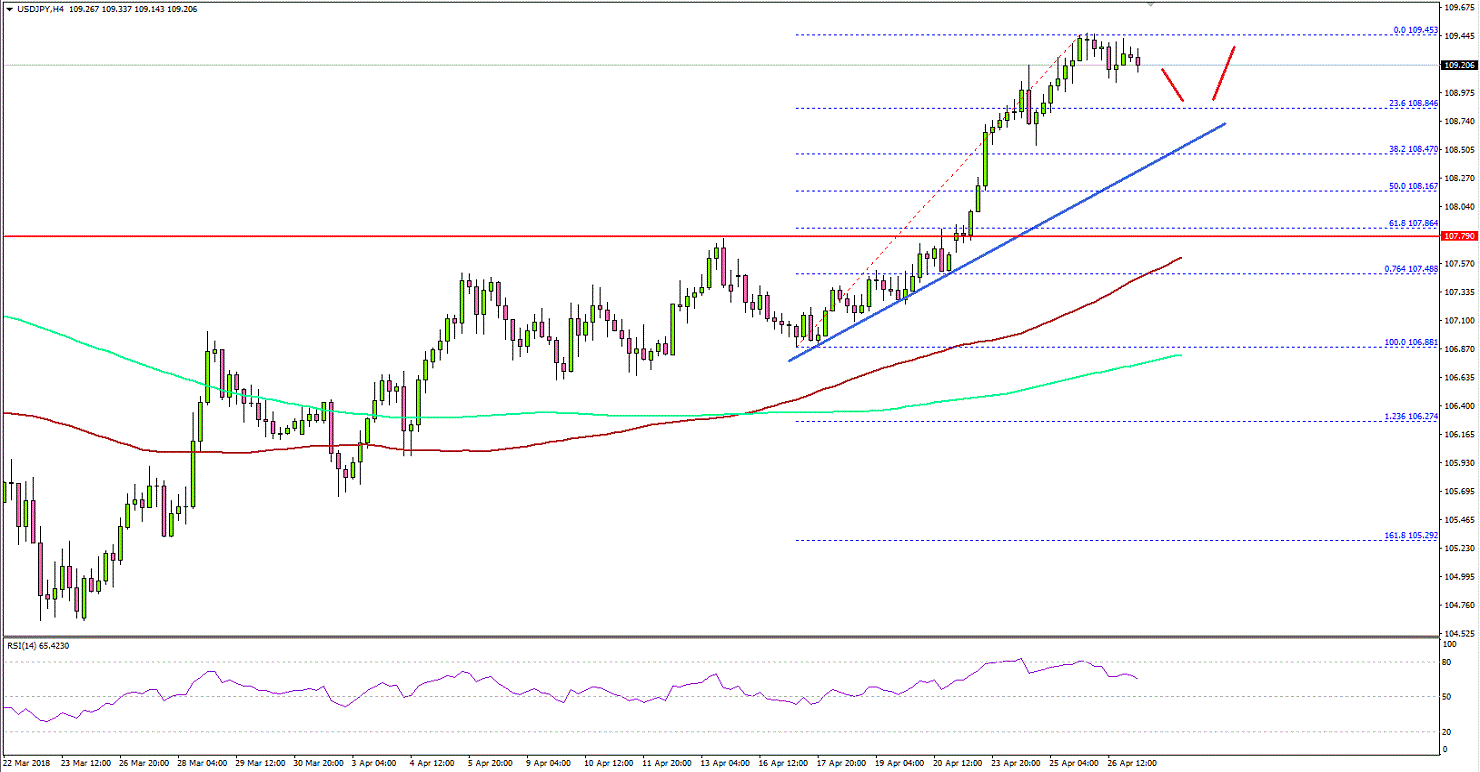
During the upside move, the pair broke many hurdles such as 106.50 and 107.00 to move into a bullish zone. More importantly, the pair settled above the 100 (red) and 200 (green) simple moving averages (4-hour).
The upside move was strong and the pair traded close to the 110.00 level. A high was formed at 109.45 before the pair started a downside correction. An initial support is near the 23.6% Fib retracement level of the last wave from the 106.86 low to 109.45 high.
There is also a major bullish trend line formed with support at 108.70 on the 4-hours chart of USD/JPY. The same trend line coincides with the 38.2% Fib retracement level of the last wave from the 106.86 low to 109.45 high.
Therefore, if the pair corrects lower, it will most likely find support above 108.50. On the upside, the pair might make an attempt to break 109.50 to test the 110.00 resistance in the near term.
Recently, the US Initial Jobless Claims figure for the week ending April 21, 2018 was released by the US Department of Labor. The market was looking for a decline from the last reading of 232K to 230K.
However, the actual result was much better as there was a sharp decline in claims to 209K. The last reading was revised up to 233K from 232K. Therefore, the net decline was 24K. The report added that:
The 4-week moving average was 229,250, a decrease of 2,250 from the previous week's revised average. The previous week's average was revised up by 250 from 231,250 to 231,500.
Overall, the US Dollar remains supported, which could continue to support more gains in USD/JPY.
Economic Releases to Watch Today
- Germany's Unemployment Change for April 2018 – Forecast -15K, versus -19K previous.
- Germany's Unemployment Rate for April 2018 – Forecast 5.3%, versus 5.3% previous.
- UK GDP for Q1 2018 (Preliminary) – Forecast +0.3% (QoQ) versus +0.4% previous.
- US Gross Domestic Product Q1 2018 (Preliminary) – Forecast 2.0% versus previous 2.9%.