

Sample Category Title
Draghi & Poloz Spin it Again
ECB president Draghi and BoC governor Poloz showdd their usual rhetorcial creativity on Thursday, prompting the euro to lose some ground and the loonie to regain momentum following last week's rate announcement. Yen pushes higher after the Tankan manufacturing survey hit 11-year high. USD is down cross the board after on fresh roadblocks to US tax reform, this time from Senator Rubio. Up next is US industrial production and further chatter on the tax bills.
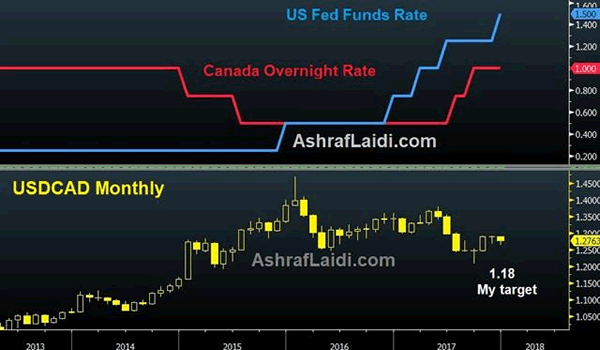
Draghi left the ECB's forward guidance unchanged along with interest rates at this month's rate decision. The staff boosted growth up to 2.3% next year from 1.8% while bumping 2019 to 1.9% from 1.7%. In spite of that, inflation forecasts were only nudged up to 1.4% next year from 1.2% and unchanged at 1.5% in 2019.
One of the major risks Draghi cited was the FX rate, keeping a lid on the currency. In the aftermath of the press conference, EURUSD remarkably slid to 1.1780 from 1.1850 in the face of rising sentiment and improving data.
On the flipside is BOC Governor Stephen Poloz continued to confound markets. 8 days after the CAD began a sharp descent following the central bank's keeping of the term "caution" in its policy statement, Poloz entered into a discussion on what caution means, indicating it does not mean they will not hike again. He also added that the 50-bp rate hikes of the last 6 months were not expected to have a large effect on the ecomomy.
USD/CAD fell by 1205 pips to 1.2850 only to rebound to 1.2800 around the US close. It is now trading at 1.2750, sending the USDCAD short of the Premium Insights back into the green. Markets are now pricing a 62% chance of a hike in March but we struggle to see how either side could have any confidence at this point. Also note that Canadian oil is now trading at a $28 discount to WTI in a story that is underappreciated.
EURGBP Holds in Bearish Sloping Channel; Risk of More Losses
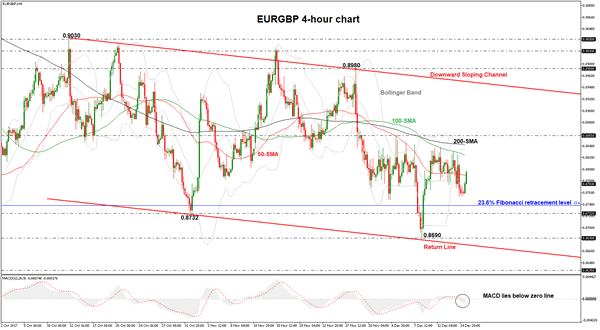
EURGBP posted losses for two negative weeks in a row and over the last nine weeks, the pair has been trading within a downward sloping channel, starting at a peak of 0.9030 resistance level and touching a low at 0.8690. The latter barrier is a new seven-month low.
Looking at the 4-hour chart, in the short-term timeframe, the price is holding below the 0.8865 strong obstacle, which is slightly above the 200-simple moving average (SMA) and is approaching the 23.6% Fibonacci retracement level of the last big upward movement with low at 0.6939 and high at 0.9305. The fibo level stands near the 0.8745 barrier, and the 0.8732 – 0.8745 zone has been acting as a critical support for the bulls.
However, a penetration below 0.8732 could open the door for the 0.8690 key level or could extend the losses towards the return line of the sloping channel, near 0.8670. On the reverse side, if the euro/pound pair posts an upward run above 0.8865, that would shift the bias to a more bullish one and it could pave the way for a test of the 0.8980 resistance.
Short-term momentum is weak and the MACD oscillator is endorsing the scenario for further bearish movement as it lies below the zero line. It is worth mentioning that the price paused its downward tendency as it rebounded on the lower band of the Bollinger band, but the descending movement in the medium-term still holds.
Brexit Clock Ticks Down but Pound Steady; H&M Drags Stocks
Here are the latest developments in global markets:
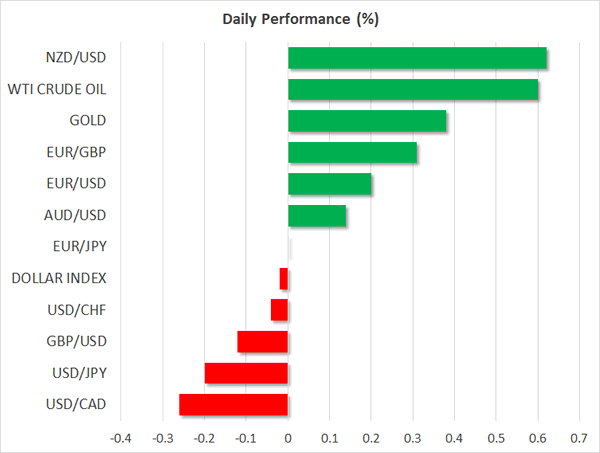
FOREX: The dollar continued to trade near yesterday's lows versus its major peers as tax risks kept weighing on the currency after another US Senate Republican warned to give a "no-vote" on the promised tax cuts. Dollar/yen was weaker at 112.18 (-0.18%). Euro/dollar posted moderate gains, rising marginally above the 1.1800 key-level (+0.20%) as yesterday's dovish ECB signals on eurozone's inflation restricted larger gains. The pound was steady at $1.3418, while the kiwi remained the best performer, jumping to a fresh two-month high of $0.7032 (+0.64%) after New Zealand's finance minister expressed his confidence on the currency's trend. Dollar/loonie stood at 1.2751 (-0.34%).
STOCKS: An unexpected drop in H&M sales – one of the world's biggest fast-fashion retailers – drove the European stocks lower despite a rise in utilities, while losses in tech shares continued to weigh on European indices as well. The benchmark STOXX 600 and the blue-chip STOXX 50 was down by 0.33% at 1030 GMT. The German DAX 30 fell by 0.38% and the French CAC 40 retreated by 0.33%. The British FTSE 100 was flat.
COMMODITIES: Oil prices inched up during early European trading hours, supported by the ongoing supply restrictions in the North Sea but fears over rising US output remained a drag in the market. WTI crude was last up by 0.75% on the day at $57.47 per barrel and Brent strengthened by 0.24% to $63.46. Gold rose by 0.40% to $1,257.70 per ounce.
Day ahead: EU leaders meet to discuss Brexit; US & Canada release industrial figures
EU leaders are said to officially approve the UK PM May's divorce proposals today at the end of the two-day EU summit in Brussels and therefore move negotiations to the next stage of future relations. Still, the media stated that May accepted on Thursday the EU offer to postpone the long-desired trade talks until March, giving room for discussions on the transition period, as the UK still has to clarify the sort of trade deal it wants to achieve. Note that May, whose hand is weaker now as she suffered a defeat over her Brexit plans in the British Parliament on Wednesday, will not attend Friday's meeting.
Meanwhile in the US, the cloud around the future of tax legislation becomes darker as Republicans who reached a joint agreement on tax plans with their House counterparts on Wednesday, continue to lack support from their inner cycle. With Florida's Senator Republican, Marco Rubio, threatening on Thursday to oppose the proposed tax cuts, the bill could face a cliff-edge as Republicans cannot afford to lose more than two-votes without Democrats' support. Today, Republicans are anticipated to unveil the final bill before the crucial vote early next week.
Looking at today's economic calendar, the US and Canada will report figures on industrial trends.
The New York Fed will publish readings on New York's manufacturing conditions for the month of December at 1330 GMT. Forecasts suggest the index to decline by 0.8 points to 18.60.
At 1415 GMT growth in industrial production reported by the Fed is forecasted to slow down to 0.3% m/m in December after reaching a six-month high of 0.9% in the previous month.
In Canada, manufacturing sales will be available at 1330 GMT with analysts projecting the measure to increase by 0.3 percentage points to 0.8% m/m in October.
In energy markets, investors will keep a close eye on the US oil rig count issued by the Baker Hughes company at 1800 GMT. Potential increases in active drilling rigs would add further losses to oil prices which recently have been under pressure as concerns over rising output in the US weighed on the market.

EURUSD Buyers Now In Control Above 1.1790
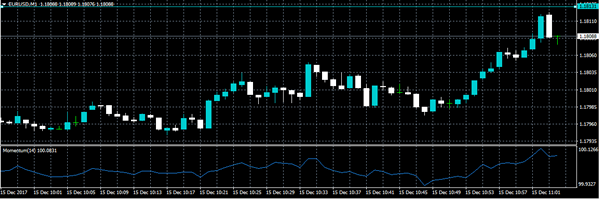
The euro has now turned higher against the U.S dollar, following a lack of overall selling interest below the key 1.1770 level during the European trading session. The EURUSD now trades above the 1.1800 handle, with the 1.1813 level the next strong technical resistance barrier ahead. Traders will now watch the pairs 100-day moving average, located at the 1.1799 level, ahead of the U.S open. The U.S economy will release Industrial production and Manufacturing figures for the month of November, with analysts expecting both data points to come in weaker than October.
The EURUSD pair has now turned bullish while price-action trades above the 1.1790 level. Upside resistance is found at the 1.1813 and 1.1840 technical levels.
If the EURUSD pair declines below the 1.1790 level again, sellers will likely target the 1.1770 and 1.1750 support regions.
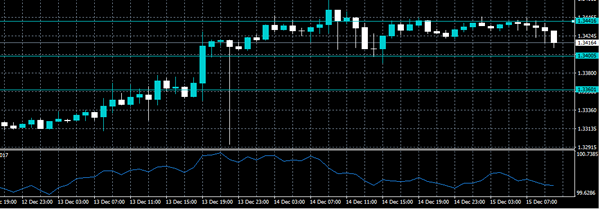
GBPUSD Buyers Still In Control ABove 1.3400
The British pound continues to hold firm against the U.S dollar, with political optimism over EU Brexit negotiations underpinning sterling’s recent strength. After a brief drop towards the 1.3400 level yesterday, the GBPUSD quickly recovered, and currently holds price-action around the 1.3420 region. Going forward, the pair is likely to remain volatile heading into the weekend, with UK and U.S politics now taking center stage after the conclusion of the Federal Reserve and Bank of England policy meetings.
GBPUSD buyers retain control of the pair while price-action holds above the key 1.3400 technical level. Upside targets remain the 1.3470 and 1.3520 levels.
If price-action declines below the 1.3400 technical level for a sustained period, further downside pressure towards the 1.3380 and 1.3340 support levels remains likely for the GBPUSD pair.
Technical Outlook: SPOT GOLD – Weaker Dollar Inflates Gold Price, Plethora Of Barriers Comes In Focus
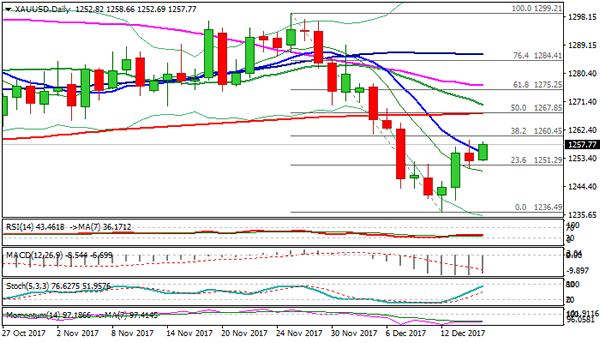
Gold regains traction and pressures Thursday's one-week high at $1259 after shallow correction was contained at $1250.
The dollar eased on Friday on fresh concerns over US tax reform, boosting gold's price.
Recovery leg from $1236 (12 Dec low) looks for break of pivotal barrier at $1260 (Fibo 38.2% of $1299/$1236 descend), to generate stronger bullish signal for extension towards next strong barrier at $1267 (200SMA / 50% retracement).
Initial bullish signal that was generated on today's break above falling 10SMA (currently at $1255) supports the notion.
However, overall bearish structure requires caution as recovery rally is seen limited before bears regain full control.
Failure to clear $1260 will be initial signal of early rejection while extended recovery leg should remain capped by $1267/70 barriers (converging 200/20 SMA's) to keep bearish scenario intact. Conversely, sustained break higher would sideline bears for stronger correction of $1299/$1236 bear-leg.
Res: 1260, 1264, 1267, 1270
Sup: 1252, 1250, 1247, 1240
US 30 Index Bullish In The Short- And Medium-Term, RSI Though Overbought
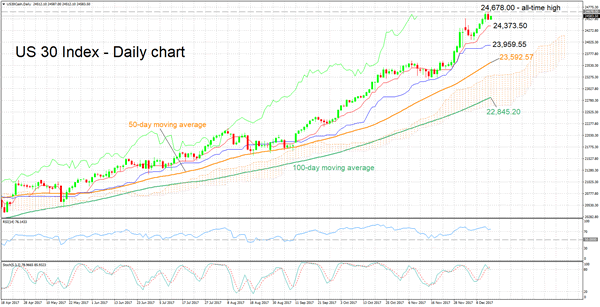
The US 30 index has been advancing for the most part in recent days, reaching an all-time high of 24,678.00 during yesterday's trading.
The Tenkan-sen line being above the Kijun-sen line is a positive alignment pointing to a bullish short-term picture for the index. The RSI, which has been moving higher in recent weeks, supports a positive view in the short-term, though it has crossed into overbought territory above the 70 level, rendering a short-term pullback a possibility. Turning to the stochastics, the %K line moving below the slow %D line also suggests that a pullback might take place in the very short-term.
Should the index continue advancing, resistance could be met around yesterday's all-time high of 24,678. Stronger bullish movement might find a barrier at 25,000, this being a potential psychological mark.
On the downside, support might be found around the current level of Tenkan-sen at 23,373.50 and further below – and given sharper declines – the Kijun-sen at 23,959.55.
The medium-term picture is clearly bullish with the index recording higher highs and higher lows over the last number of months. Price action is also taking place above the Ichimoku cloud as well as above the 50- and 100-day moving average lines, with both lines maintaining a positive slope.
Overall, the index is projecting a positive picture in the short- and medium-term with some caveats – such as RSI being in overbought territory – currently being in place in the short-term.
CRUDE OIL: Builds Up On Recovery Higher
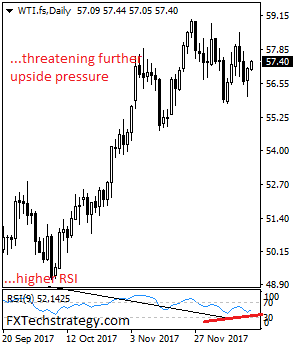
CRUDE OIL - The commodity followed through higher on Friday leaving risk of a move higher towards the 58.53 zone. On the downside, support resides at the 57.00 level where a break will expose the 56.50 level. A cut through here will set the stage for a run at the 56.00 level. Further down, support resides at the 54.50 level. On the upside, resistance resides at the 57.50 level. Further out, resistance comes in at the 58.00 level. A break above here will aim at the 58.50 level and then the 59.00 level followed by the 59.50 level. Its daily RSI is bullish and pointing higher suggesting further upside pressure. All in all, CRUDE OIL remains biased to the upside nearer term.
DAX Under Pressure As US Tax Reform Hits Snag
It's been a disappointing week for the DAX, as the index has declined 1.2 percent. The DAX continues to point down on Friday, as the index is at 13,038.00, down 0.23% on the day. On the release front, there is just one eurozone indicator. The eurozone trade surplus fell to EUR 19.0 billion, well off the estimate of EUR 24.4 billion. This marked a 3-month low.
There were no surprises from the ECB on Thursday, as policymakers held interest rates at a flat 0.00%. Investors were more interested in follow-up comments from ECB President Mario Draghi. In his press conference, Draghi sounded optimistic about economic conditions in the eurozone, noting that that ECB projections were “going in the right direction”. Still, there was a caveat, as Draghi added that “an ample degree of monetary stimulus remains necessary”. The ECB raised its forecasts for growth and inflation, but this clearly wasn't enough to coax the cautious Draghi to signal another taper of the Bank's ultra-loose stimulus program. Some policy makers favored signalling a change in policy if inflation continues to move higher, but the majority favored staying the course, which means the ECB will continue buying bonds till September 2018 (or later) and will keep interest rates at record lows even lower.
German indicators sparkled on Thursday, although this wasn't enough to stem the DAX losing ground. Manufacturing PMI hit a new record, climbing to 63.3 points. The PMI Composite Output Index, which measures business activity, improved to 58.7, its highest level since 2011. A robust German economy has been the locomotive for the eurozone, which has rebounded in 2017 with stronger growth and lower unemployment.
Euro Slips As ECB Says Stimulus To Stay
The euro has steadied in the Friday session, after losing ground on Thursday following the ECB rate announcement. Currently, EUR/USD is trading at 1.1796, up 0.15% on the day. After a busy week with rate announcements from the Federal and the ECB, Friday is a light day. The sole eurozone event, Trade Balance, looked weak as the trade surplus fell to EUR 19.0 billion, well off the estimate of EUR 24.4 billion. This marked a 3-month low. In the US, the key event of the day is the Empire State Manufacturing Index, which is expected to dip to 18.8 points.
With the markets expecting the ECB to maintain rates at a flat 0.00%, investors were more interested in follow-up comments from ECB President Mario Draghi. In his press conference, Draghi sounded optimistic about economic conditions in the eurozone, noting that that ECB projections were “going in the right direction”. Still, there was a caveat, as Draghi added that “an ample degree of monetary stimulus remains necessary”. The ECB raised its forecasts for growth and inflation, but this clearly wasn’t enough to coax the cautious Draghi to signal another taper of the Bank’s ultra-loose stimulus program. Some policy makers favored signaling a change in policy if inflation continues to move higher, but the majority favored staying the course, which means the ECB will continue buying bonds till September 2018 (or later) and will keep interest rates at record lows even lower.
On Wednesday, the Federal Reserve raised rates a quarter-point, the third such move in 2017. This raised the benchmark rate to a range between 1.25% and 1.50%. The Fed statement was optimistic about the economy, noting that the labor market “remained strong”. It also lowered its unemployment forecast in 2018 from 4.1% to 3.9%, and revised growth for 2018 from 2.1% to 2.5%. Despite this rosy prognosis, the dollar was broadly down after the announcement. Why? One reason is the sore point in the economy – inflation. The Fed has not changed its September forecast for rate hikes next year, with the Fed dot plot indicating that three rate hikes are projected for 2018. This disappointed some investors who would like to see four increases next year. As well, the rate statement said that the Fed did not expect the tax reform legislation to have any long-term effect on the economy, contradicting White House claims that the legislation would trigger substantial growth in the economy.