Sample Category Title
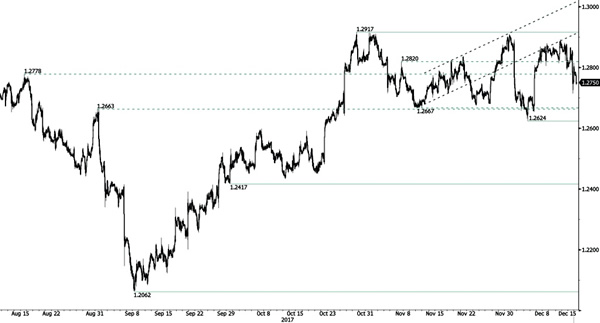
USD/CAD Dips Before Another Leg Higher
USD/CAD has bounced back lower after testing hourly resistance at 1.2917 (27/10/2017 high). Expected to show renewed buying pressures.
In the longer term, the pair has broken longterm support that can be found at 1.2461 (16/03/2015 low). Strong resistance is given at 1.4690 (22/01/2016 high). The pair is likely to head further lower.
USD/CHF Decline
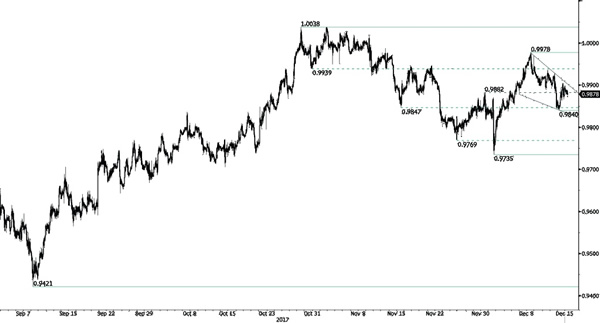
USD/CHF is trading lower. Yet, the technical structure indicates further downside risks. The pair has failed to hold consistently above the parity. Expected to go even lower.
In the long-term, the pair is still trading in range since 2011 despite some turmoil when the SNB unpegged the CHF. Key support can be found 0.8986 (30/01/2015 low). The technical structure favours nonetheless a long term bullish bias since the unpeg in January 2015.
USD/JPY Continued Decline
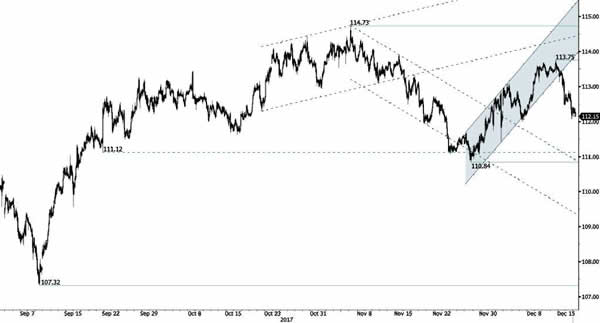
USD/JPY is pushing lower. Strong resistance is given at 114.73 (06/11/2017 high) while hourly support is given at 111.99 (06/12/2017 low). The technical structure suggests further weakness.
We favor a long-term bearish bias. Support is now given at 99.02 (10/08/2013 low). A gradual rise towards the major resistance at 125.86 (05/06/2015 high) seems unlikely. Expected to decline further support at 93.79 (13/06/2013 low).
GBP/USD Riding Short-Term Downtrend Channel
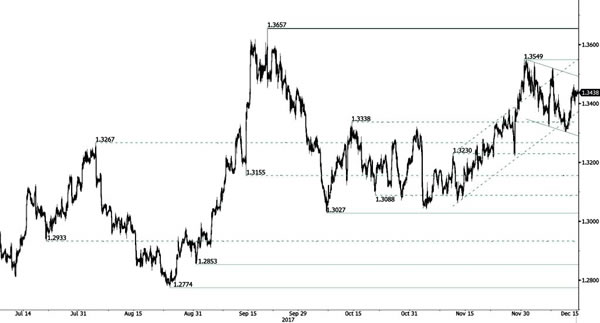
GBP/USD continues to move lower within downtrend short-term channel. The technical structure indicates further weakness. Support is given at a distance at 1.3304 (12/12/2017 low).
The long-term technical pattern is reversing. The Brexit vote had paved the way for further decline. Long-term support can be found at 1.1841 (07/10/2017 low). Long-term resistance given around 1.35 is at stake and indicates a long-term reversal in the negative trend. Yet, it is very unlikely at the moment.
EUR/USD Selling Pressures Are Still There
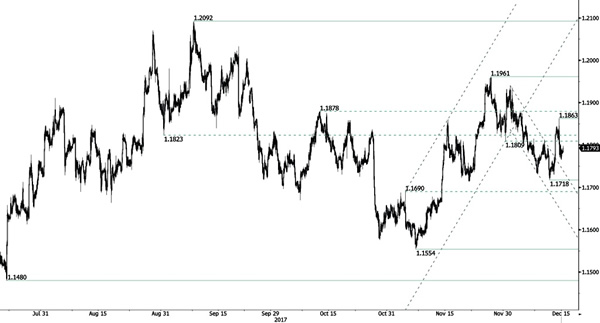
EUR/USD's short-term bearish momentum has abruptly ended. Hourly resistance is given at 1.1961 (27/11/2017 high). Hourly support given at 1.1718 (12/12/2017 low). Expected to show renewed decline.
In the longer term, the momentum is now turning largely positive. We favour a continued bullish bias. Key resistance is holding at 1.2252 (25/12/2014 high) while strong support lies at 1.0341 (03/01/2017 low).
AUD On The Rise Amid Solid Jobs Report, ECB On The Sidelines
AUD on a winning strike amid solid job report
The Australian dollar extended gains for the fifth consecutive days after the Australian Bureau of Statistics (ABS) released a better-than-expected November job report. Although the unemployment rate held steady at 5.4%, employment increased by 61,600 (seasonally adjusted), beating widely median forecast of 19,000. Moreover, the good news is that most of those news jobs are full time jobs (+41,900). Part time jobs increased by 19,700. Finally, the unemployment rate held steady for the simple reason that the participation jumped to 65.5% from 65.2% in the previous month.
This is definitely a good news for the Aussie economy, as it would translate, over time, into firmer price pressures, which could only please the RBA and help in its mission to lift inflation within 2%-3% target range.
Since the beginning of the week, the Aussie has gained more 2.50% against the greenback. AUD/USD is currently testing the $0.77 resistance area (high from 7th November and psychological threshold). Beside the positive push from rising commodity prices, the interest differential between US 2y yield and Australia ones has started to widen slightly since the beginning of the month increases incentives to go long Aussie.
ECB meeting: Draghi is buying time
The ECB meeting did not bring anything new on the table. The European Central Bank has held its rates unchanged and increased its forecast for growth for the next years. In addition, officials believe that the inflation won’t reach the target by 2020. This is what we call “Buying Time” to actually let inflation run.
It is without surprise that ECB members renewed their commitment regarding the asset purchase program that should run until next September. The amount added on the overall money supply each month is clearly massive and growth is exponential. Mario Draghi was very happy of “the strong pace of economic expansion” as well as the usual “improvement in the growth outlook”. Unfortunately we did not have a word concerning the cost of the growth. The truth is that one euro of growth costs way more than what it brings.
As for the Fed, the key for the ECB is to let inflation run without raising rates in order to kill the massive debt accumulated. By stating that the inflation is too low, the ECB is selling a dovish message that markets are too happy to buy as assets never stops to increase. And then the ECB is getting time hoping that inflation goes higher.
Dollar Close To Week’s Lows, EU Leaders Decide On Brexit
Here are the latest developments in global markets:
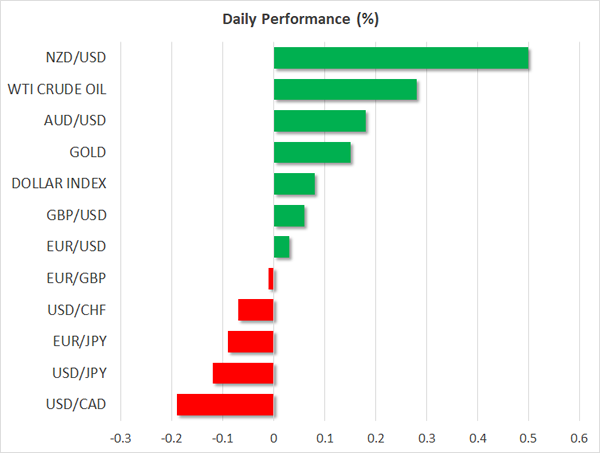
FOREX: The dollar was not much changed after hitting an eight-day low against a basket of currencies yesterday on uncertainty over the passage of tax reforms. Kiwi/dollar advanced after New Zealand's finance minister expressed no concerns about a rising currency.
STOCKS: The Nikkei 225 lost 0.6% and the Hang Seng was down by 1.1%, with Asian markets mostly on the decline . Euro Stoxx 50 futures were 0.25% lower at 0723 GMT, with futures on the Dow being up by 0.25% and S&P 500 as well as Nasdaq 100 contracts both trading higher by 0.2%.
COMMODITIES: WTI and Brent crude were both up by 0.3%, at $57.21 and $63.50 a barrel respectively. Gold traded higher by 0.2% at $1,255.83 per ounce, further distancing itself from $1,235.92, its lowest since late July hit earlier in the week.
Major movers: Dollar near week's low; kiwi gains as finance minister avoids talking down the currency
Two Republican senators seeking changes to the proposed tax legislation had investors casting doubts about its eventual passage and pushed the dollar lower during yesterday's US session. The dollar index was at 93.56, slightly up on the day but still near the week's lows. Dollar/yen was losing ground after finishing the three previous trading days lower. The pair was down by 0.1% at 112.20.
Euro/dollar traded at 1.1785, little changed after recording losses the previous day on the back of perceived dovishness by the ECB. Pound/dollar was up by 0.1% at 1.3441. After the completion of its meeting on monetary policy yesterday, the Bank of England maintained its position that interest rates were likely to increase only gradually despite inflation moving well above the bank's target of 2%.
The New Zealand dollar was a major gainer after the country's finance minister said he was comfortable with the trend in the currency, abstaining from talking down the currency. Kiwi/dollar was up by 0.5% at 0.7022 and not far below a two-month high recorded earlier in the day. The aussie maintained positive momentum following yesterday's employment figures which came in above expectations. Aussie/dollar was up by 0.2% at 0.7684, hovering around one-month high levels.

Day ahead: EU summit to unlock Brexit talks; US & Canada manufacturing data awaited
Friday would be a relatively quiet day in terms of economic releases, with the US and Canada being the ones to submit reports giving clues on industrial trends.
The New York Fed will publish readings on New York's manufacturing conditions for the month of December at 1330 GMT. Forecasts suggest the index would decline by 0.8 points to 18.60.
At 1415 GMT, growth in industrial production reported by the Fed is forecasted to slow down to 0.3% m/m in November after reaching a six-month high of 0.9% in the previous month.
In Canada, manufacturing sales will be available at 1330 GMT with analysts projecting the measure to increase by 0.3 percentage points to 0.8% m/m in October.
In energy markets, investors will keep a close eye on the US oil rig counts issued by the Baker Hughes company at 1800 GMT. Potential increases in active drilling rigs are likely to add pressure to oil prices.
However, the focus will turn to the EU summit in Brussels as the EU heads of state conclude their two-day meeting today. EU leaders, who recently welcomed UK PM May's Brexit proposals, are expected to officially announce that sufficient progress has been made in negotiations and move talks to the next stage of the future relationship which would include discussions on trade ties. Note that on Thursday, May agreed to give priority to talks on the transition period rather than on trade deals, with trade negotiations starting only in March. It is also worthy to note that May will not accompany her EU counterparts at Friday's meeting.
Technical Analysis: EURGBP trapped in a range; risk tilted to the downside
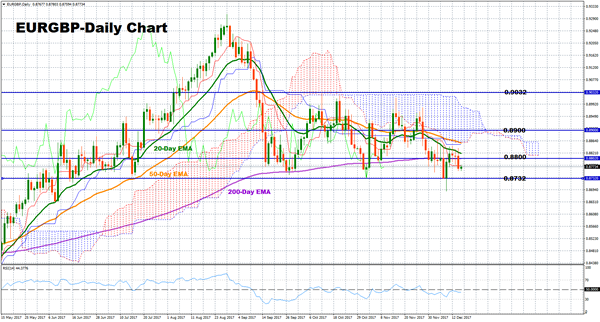
EURGBP holds a neutral bias in the short-term as evidenced by the RSI moving sideway in recent days. The risk, however, is titled to the downside as the pair fluctuates below the exponential moving average lines.
The pair has been mostly moving within a range between 0.8732 and 0.9032 in recent months. A confirmation of Brexit talks moving to the next stage could push prices down to meet the bottom of the range at 0.8732, while steeper decreases could also drive the market towards the three-month low of 0.8688.
In case of a move to the upside, the pair would target resistance at 0.8802 (200-day EMA). Breaking above this level, the focus would shift to the 0.89 key level and the upper bound of the range at 0.9032.
EUR/USD Analysis: Falls Below 200-Hour SMA
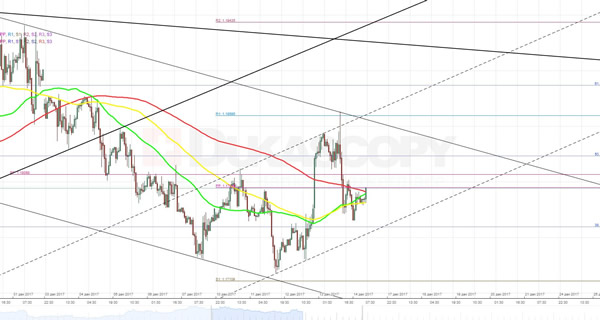
Due to dovish comments made by the ECB as well as publication of better than expected result on the American Core Retail Sales, the currency rate managed to break combined support level formed by the weekly and monthly PP as well as three other moving averages. In result of this plunge, the pair has formed two junior ascending channels, which presuppose continuation of an upward movement towards the upper boundary of a dominant descending channel. However, today an absence of any important fundamental events as well pressure from the above technical indicators suggest that the rate is likely to continue moving towards the 38.2% Fibonacci retracement level at 1.1760. In support of this assumption, 55% of pending orders in 100-pip range are set to sell.
GBP/USD Analysis: Struggles To Bypass 1.3450
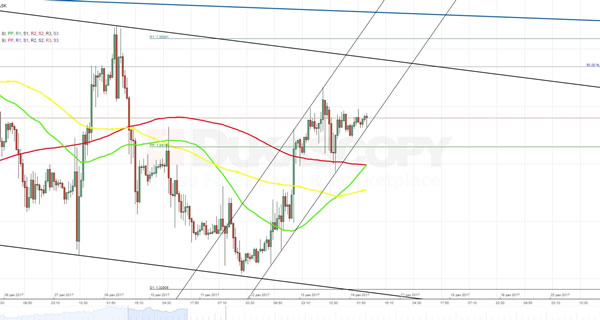
In result of the previous trading session the currency exchange rate made a breakout from the rising wedge formation. However, as the southern side was covered by the weekly PP and the 200-hour SMA the pair could not fall below the 1.3400 mark. In a similar manner, a resistance zone located between the 1.3440 and 1.3448 levels did not allow the pair to climb higher as well. Allocation of pending orders as well as recent progress made on tax reform suggests that there is not much interest to acquire the Pound. On the other hand, the rising 55-, 100- and 200-hour SMAs as well as existence of a junior ascending channel are likely to continue elevating the currency rate towards the upper trend-line of a senior descending channel
USD/JPY Analysis: Moves To South In Descending Channel
Because of release of better than anticipated information on the American Core Retail Sales as well as the pressure from 55-, 100- and 200-hour SMAs, the currency rate broke through support zone located between the 112.70 and 112.62 marks. During trading session the pair is expected to continue moving to the bottom due to absence of any barriers on its way up until the 112.00 mark. Generally, a new rebound might happen only at the 38.2% Fibonacci retracement level located just at the 111.65 mark. This assumption is supported by the fact that rate is fluctuating in a junior descending channel. On the other hand, an empty economic calendar as well as very intense previous three trading days suggest that fall of the rate might will be stopped already near the above support at 112.00.