Sample Category Title
USDJPY Intraday Analysis
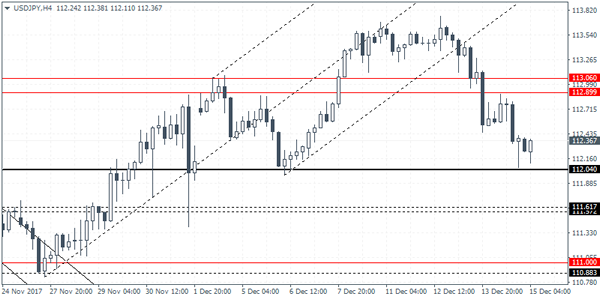
USDJPY (112.36): The USDJPY extended declines for the second day as price action is seen now trading close to the support level at 112.04 region. In the short term, establishing support at this level could signal a bounce to the upside. USDJPY is expected to maintain the range within 113.00 and 112.04 levels of resistance and support. A breakout from either of these levels is expected to show further gains or declines. To the downside, the next support below 112.04 comes in at 111.61 - 111.57 region.
EURUSD Intraday Analysis
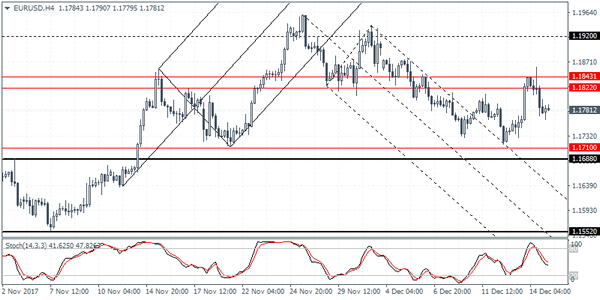
EURUSD (1.1781): The EURUSD posted declines yesterday as the ECB left the monetary policy unchanged. The long term inflation forecasts showed that consumer prices in the Eurozone could remain below the ECB's inflation target rate. This hit the sentiment in the euro which extended losses. However, as price action remains supported above the 1.1710 level of support, the bias remains to the upside. On the intraday basis, the reversal near the resistance level of 1.1822 signals a continuation to the downside. The intraday support at 1.1710 could be tested in the near term as the currency pair can be seen maintaining a sideways range within the levels mentioned.
ECB, BoE And SNB Hold The Line
The markets were busy yesterday as central bank monetary policy meetings continued. After the Fed's rate hike decision on Wednesday, Thursday was all about the central banks in Europe.
The ECB's monetary policy meeting saw the central bank leaving monetary policy unchanged. The ECB gave its economic projections which saw an upbeat forecast. However inflation was expected to still remain below the ECB's 2% inflation target rate by 2020.
The SNB's meeting was largely a non-event. Focus was mostly on the BoE's meeting. The central bank sounded optimistic that inflation was nearing its peak at 3.1%. It however said that GDP growth could slow in the coming quarters. The BoE expects a weaker Q4 GDP growth.
Looking ahead, the economic calendar today is quiet for the most part. The trade balance figures from the Eurozone are expected to be released earlier in the day while BoE Chief Economist Andy Haldane is expected to speak.
In the NY Trading session, the Canadian manufacturing sales report will be coming out and the NY Fed will be releasing the Empire State Manufacturing index report. Economists forecast the index will slightly dip to 18.8 for December.
EURO Intraday Bearish Below 1.1790 Level
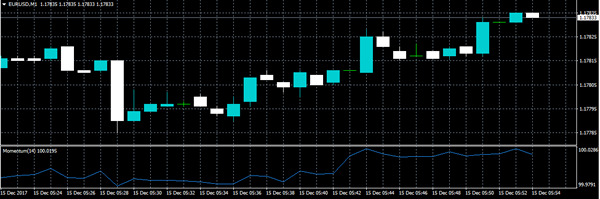
The euro has moved lower against the U.S dollar, following strong U.S macroeconomic data and a cautious monetary policy speech from ECB President Mario Draghi. The EURUSD pair currently trades below the key 1.1790 technical level, following the euro making a complete reversal from the 1.1860 level on Thursday. ECB President Mario Draghi talked down medium-term inflation expectations in the eurozone during 2018, which helped push the euro lower. Traders now look to Trade Balance data from the eurozone and Manufacturing data coming out from the United States economy.
The EURUSD pair remains intraday bearish while price-action trades below the 1.1790 level, price-action may find support from the 1.1770 and the 1.1750 technical levels.
Should the EURUSD pair start to move above the 1.1790 level, buyers may again start to target the 1.1813 and 1.1840 resistance levels.
EUR/JPY Candlesticks and Ichimoku Analysis
Weekly
• Last Candlesticks pattern: Window
• Time of formation: 24 April 2017
• Trend bias: Up
Daily
• Last Candlesticks pattern: Hammer
• Time of formation: 18 May 2017
• Trend bias: Up
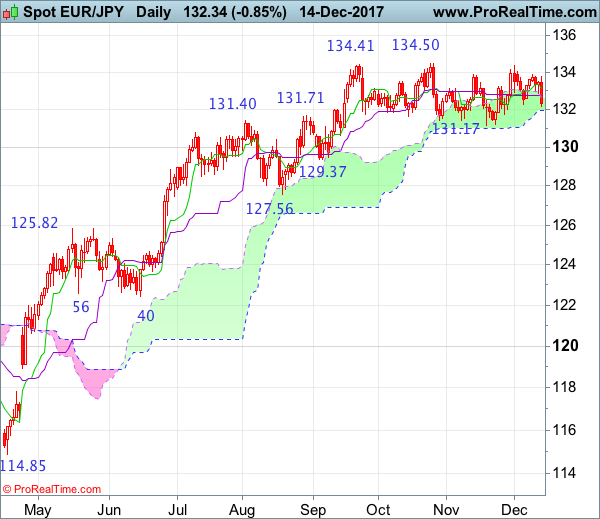
EUR/JPY – 132.22
Despite rebounding to 133.89 earlier this week, euro met renewed selling interest there and has dropped quite sharply yesterday, dampening our bullishness and downside risk remains for weakness to 131.99 support, break there would signal top has been formed at 134.38 earlier this month, bring test of support 131.72. Looking ahead, a drop below 131.72 would signal the rebound from 131.17 has ended, bring weakness to 131.40, then retest of this level but still reckon downside would be limited to 130.40-50 and psychological level at 130.00 should hold from here.
On the upside, whilst recovery to the Kijun-Sen (now at 132.78) cannot be ruled out, reckon the Tenkan-Sen (now at 133.03) would limit upside and yesterday’s high at 133.76 should remain intact, bring another decline. Only break of this week’s high at 133.89 would revive bullishness, bring test of 134.38 first. Having said that, a break of indicated resistance at 134.50 is needed to confirm recent upmove has resumed and extend gain to 135.00.
Recommendation: Stand aside for this week
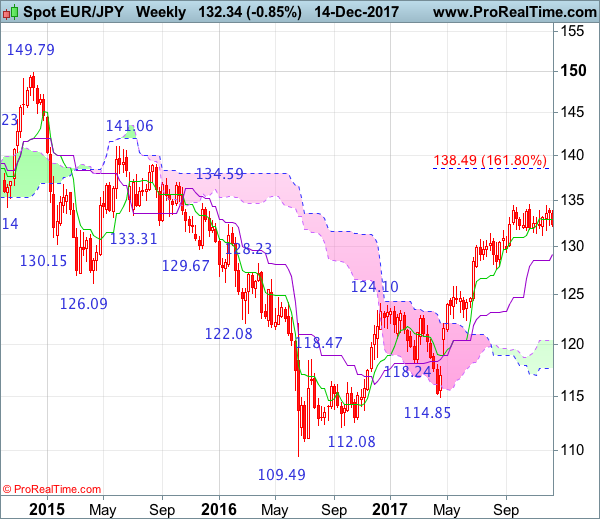
On the weekly chart, as the single currency faltered below last week’s high at 134.05 and has slipped this week, a black candlestick looks set to be formed, suggesting further consolidation below resistance at 134.38 would be seen and test of previous support at 131.72 is likely, however, only break of indicated strong support at 131.17 would shift risk to downside and suggest a temporary top has been formed earlier at 134.50, bring retracement of recent rise to support at 130.90-00, then 130.20-25 but reckon downside would be limited to 129.37 support and previous support at 127.56 should remain intact.
On the upside, expect recovery to be limited to 133.00-05 and bring another decline. above 133.89 would bring another test of 134.38 but only break of indicated recent high at 134.50 would confirm recent upmove from 109.49 (2016 low) has resumed and extend gain to 135.00, then 136.00-10 but reckon upside would be limited and 136.95-00 should hold, price should fatter below 138.45-50 (1.618 times extension of 109.49-124.10 measuring from 114.85), bring retreat later.
USDJPY Intraday Bearish Below 112.30 Level
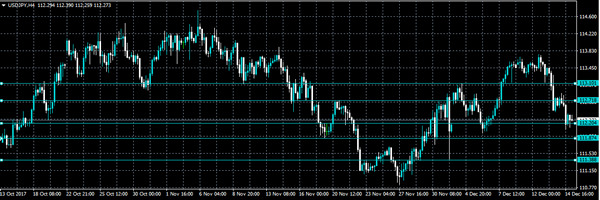
The U.S dollar continues to drift lower against the Japanese yen, hitting 112.09 during the early Asian trading. Renewed selling occurred in the pair, after two Republican senators were reported to have sought changes to the proposed legislation to overhaul the US tax code. The USDJPY pair currently trades around the 112.20 levels, as stocks and perceived riskier assets classes remain pressured. Traders now look to manufacturing and industrial production figures from the U.S economy, and any updates coming from U.S Congress on the tax reform bill.
The USDJPY pair remains strongly bearish while trading below the 112.20 technical level, sellers may now push price-action towards the 111.87 and 111.38 support levels.
Should price-action on the USDJPY pair hold above the 112.20 technical level, buyers may push price-action towards the 112.70 and 113.10 resistance levels.
US Dollar Strengthened On Strong Data
Yesterday's US retail sales data showed a boost in sales for the month of November which helped the US dollar post some gains during the US trading session. Data showed that Americans are spending more in this holiday season than expected. On the negative side, initial jobless claims for the week ended on 9 December decreased by 11,000 to an adjusted 225,000 as compared to the expected 235,000. Today is relatively a calm day in respect to data releases.
This morning at 10:00 GMT, the Eurozone trade balance will be released which is expected to hit 24.4 billion as compared to 25.0 billion in the previous month.
Canadian manufacturing sales for the month of November is due out at 13:15 GMT which is expected to increase by 0.9% as compared to 0.5% in the previous month.
The US has a busier schedule compared to other economies as three different data are due to be released today. At 14:15 GMT data for the Empire state manufacturing index is due with a forecast of 18.8 in November, it was 19.4 in the prior month. Industrial production data is expected to decrease to 0.3% from 0.9% in October and Capacity Utilization rate is forecasted to reach 77.2%, from a previous reading of 77%.
EUR/USD
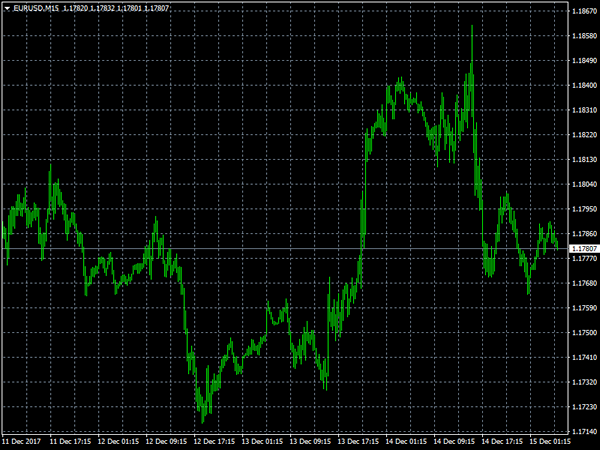
EUR/USD keeps trading on the downside while proceeding towards the immediate support at 1.1764 (today's Asian session low so far) and also capped by the descending 20-period moving average, which crossed below the 50-period moving average hence restricting the upside movement. As far as price remains below 1.18619 (yesterday’s high) it is most likely to sink below 1.17640 and 1.7294 (last week’s low).
USD/CAD
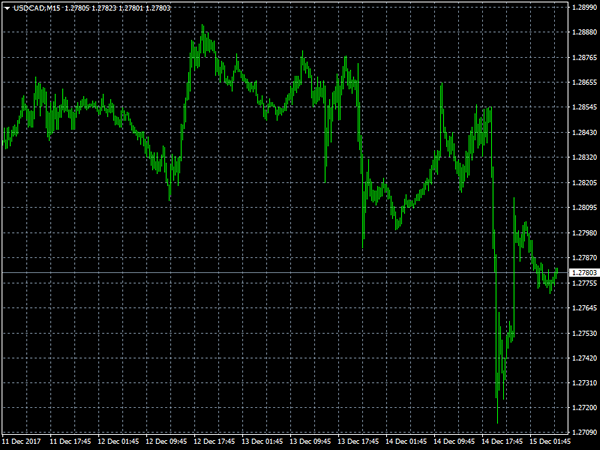
USD/CAD is under pressure and expected to extend its downside movement. In the Asian session, the pair encountered a steep downward movement which is expected to extend in upcoming sessions as well. Both 50-period and 20-period moving averages are declining and the relative strength index is heading towards the bearish zone. So, as long as price remains below 1.28789 (last week’s high), look for new downward target at 1.2712 (yesterday’s low) and 1.2665 (last month’s low).
GBP/USD
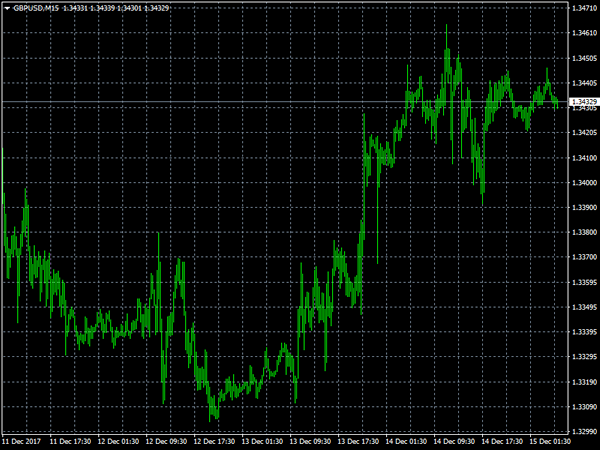
GBP/USD is expected to trade with bullish outlook above 1.33671. The pair posted a rebound from the support and still above this key point. The relative strength index is above its neutrality area at 50. Continuation of consolidation cannot be ruled out though its extent should be limited. As long as 1.3367 (yesterday's low) is not surpassed look for targets at 1.13644 (yesterday's high) and 1.3537 (last week’s high).
USDCAD Remains Neutral In Medium-Term, Near-Term Risk Is To The Downside
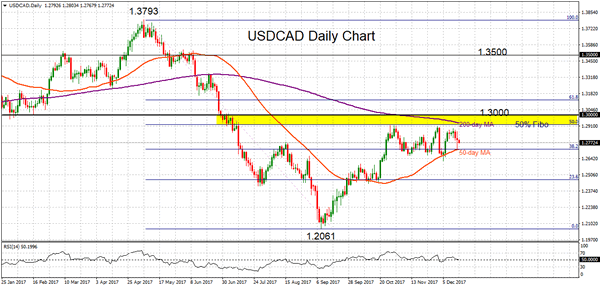
USDCAD remains neutral as it continues to trade in a range from late October. Near-term risk is tilted to the downside. The retracement of the longer-term downtrend from 1.3793 to 1.2061 has not reversed yet. However, the market is capped at the 200-day moving average.
The bounce off the more than a 2-year low from 1.2061 in September to October has moved into a consolidation phase between two key Fibonacci retracement levels of the 1.3793 to 1.2061 downleg. The 38.2% and 50% Fibonacci levels now act as support and resistance at 1.2717 and 1.2922.
USDCAD may find it challenging to break above the zone between the 50% Fibonacci and the key 1.3000 level. But a sustained break would shift the bias to a more bullish one and improve the odds for a move towards 1.3500 and then to the peak at 1.3793.
Near-term momentum is weak and RSI is falling, keeping risk to the downside but strong support is expected at the lower range between 1.2717 (38.2% Fibonacci) and 1.2623 (December 5 low). A break below this area would increase downside pressure and send prices towards the 1.2500 handle and possibly the 1.2061 low.
Overall, USDCAD has changed very little since trading in its well-established more than 2-month old range. The odds are not strong for a change in the broader trend yet as long as the pair trades below the 200-day MA and below 1.3000.
Currencies: USD Trading To Shift Into Year-End Modus
Sunrise Market Commentary
- Rates: Trading expected to shift in lower gear
Today's eco calendar is thin with only US empire manufacturing and industrial production. We don't expect them to influence trading. With the final key events of the year behind us, volumes will probably slow to a trickle. That could cause some erratic moves in coming days. - Currencies: USD trading to shift into year-end modus
Strong EMU/US eco data and a mixed ECB message failed to give clear guidance for EUR/USD trading yesterday. In the end, the topside in EUR/USD still looks rather well protected given divergent guidance from the ECB and the Fed. The fate of the US tax bill remains a wildcard for USD trading going into the end of the year.
The Sunrise Headlines
- US stock markets corrected up to 0.4% lower yesterday. Most Asian indices record losses as well this morning with China underperforming (-1%).
- President Trump's drive to win passage of a sweeping Republican tax bill in the US Congress hit potential obstacles as two more Republican senators insisted on changes, joining a list of lawmakers whose support is uncertain.
- EU leaders applauded British PM May for her work so far on Brexit, assuring her at a summit in Brussels that sufficient progress has been made to allow Britain to move on to the next stage of leaving the union.
- The Canadian dollar recovered its vim on Thursday after Bank of Canada governor Poloz said the central bank is growing 'increasingly confident' that the economy will need less stimulus over time.
- Business conditions in Japan improved still further in the fourth quarter as the Bank of Japan's Tankan index registered the best quarter for the country's big manufacturers in eleven years.
- A new dissenter on the Bank of Japan board calling for more stimulus has prompted the BOJ to adjust its communications to flag risks of additional easing, according to people familiar with the central bank's discussions.
- Today's eco calendar contains US industrial production data and empire manufacturing. ECB Nowotny and Rimsevics are scheduled to speak.
Currencies: USD Trading To Shift Into Year-End Modus
USD/JPY and EUR/USD show mixed picture
There was plenty of eco and central bank news yesterday. Initially, no theme was able to give USD trading a clear direction. Eco data were strong both in the US and in EMU. The ECB brought a mixed signal with a sharp upward revision for its growth forecast but with inflation still expected to rise only very gradually. Finally EUR/USD drifted back south below the 1.18 barrier as EMU yields declined more than US ones. The pair closed the session at 1.1778, reversing part of the post-Fed rise. At the same time, USD/JPY traded with a negative bias (cautious risk-off, lower core yields). The pair finished at 112.39.
Major Asian equities indices mostly trade in negative territory showing losses between 0.5% and 1.0%. The closely watched large manufacturing index in the Q3 Japan Tankan report rose from 22 to 25, the highest level in 11 years. Other sub-indices also suggest an improvement in the broader economic performance including a tightening labour market and tentative signs of price rises. For now this is not enough for markets to expect that the BOJ will change its ultra-easy monetary policy in the foreseeable future. USD/JPY trades in the 112.15 area, near the post-Fed low. Uncertainty on the fate of the US tax bill might play a role. EUR/USD trades sideways in the 1.1785 area.
There are no important data Europe today. The US Empire manufacturing survey and November production data will be published. NY manufacturing confidence is expected to ease slightly further off very high levels reached over the previous months. US production growth is expected to ease to 0.3% after strong October data. These data are usually only of intraday significance for trading.
With most key eco data and key central bank meetings out of the way, FX markets will gradually shift to year-end modus. Declining market liquidity will result in more erratic trading. Markets will keep a close eye on the final outcome of the US tax debate. An agreement, even if ‘imperfect', might still be slightly positive for the dollar. The combined position of the Fed (ongoing policy normalisation) and the ECB (ongoing soft inflation assessment) in theory should cap any sustained EUR/USD gains for now. We maintain the working hypothesis that a break beyond the 1.1961 resistance will be difficult except in case of negative (political) news from the US.
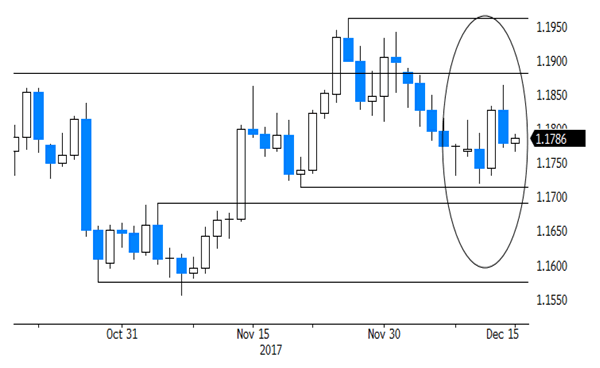
Technical picture. EUR/USD set a post-ECB low mid-November, but the USD's momentum wasn't strong enough. EUR/USD settled in a directionless consolidation pattern in the 1.17/19 area.
The outcome of the ECB and Fed meetings were not able to push EUR/USD out of the recent tight consolidation pattern. A return below 1.1713 would signal an improvement in the ST USD momentum. Next support comes in at 1.1554 (November low). USD/JPY's momentum deteriorated early November, dropping below the 111.65 neckline. No aggressive follow-through selling occurred though. Over the previous two weeks, the pair rebounded, calling off the downside alert and returning to the 110.84/114.73 range. We amended our ST bias from negative to neutral. We maintain the view that a sustained break north of 115 will remain difficult.
EUR/USD: Fed nor ECB were able to unlock recent stalemate
EUR/GBP
Sterling gains, but within established ranges
Yesterday, UK November retail sales beat the consensus by a wide margin, but had only a temporary positive impact on sterling. The BoE as expected left is policy unchanged. The Bank saw last week's Brexit deal as reducing the chances of disorderly UK departure. However, the BoE also saw tentative signs that the economy might be slowing into the yearend. There were no specific indications that the BoE considers a next rate hike in the near/foreseeable future. Sterling developed a directionless trading pattern for most of the day. Sterling finally captured a better bid later in the session. The EU supporting PM May's efforts to make progress on Brexit might have been an sterling positive. A cautious EUR/USD decline also weighed on EUR/GBP¨. EUR/GBP finished the day at 0.8770. Cable closed at 1.3431.
Today, there are no important eco data in the UK. The EU will formally approve that the second phase of the Brexit negotiations can start as enough progress has been made in the separation topics. The approval might support a temporary positive sterling momentum, but we don't expect any sterling rebound to go far. The next phase of the Brexit negotiations will remain very tough, UK PM May faces political hurdles at home and there is no indication that the BoE will take additional action anytime soon. In this context we see little room for a protracted sterling rebound.
Recent developments pushed EUR/GBP lower in the 0.8690/0.9033 consolidation pattern. EUR/GBP tested 0.8693 support (62% retracement), but the test was rejected. Next support comes in at 0.8653. We assume that the 0.8653/90 area won't be easy to break short-term. We hold a neutral bias on EUR/GBP short-term. We consider a return to the bottom of this range as an opportunity to reduce sterling long exposure against the euro.
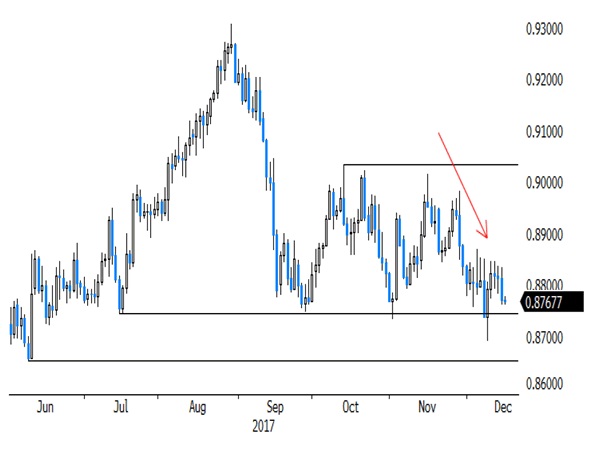
EUR/GBP: sterling momentum improves slightly, but within established range
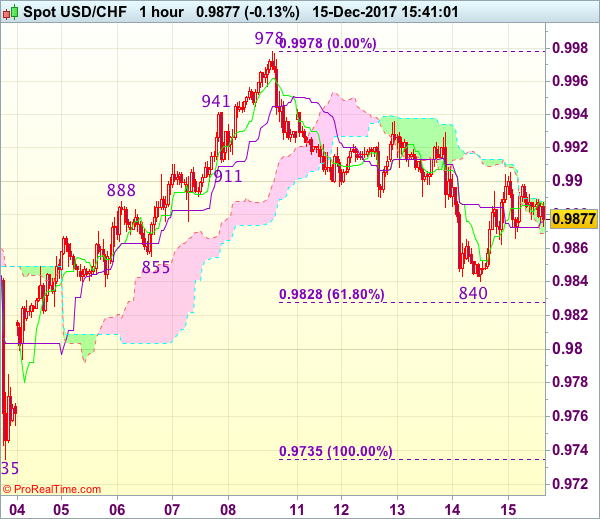
Trade Idea : USD/CHF – Hold long entered at 0.9870
USD/CHF - 0.9880
Most recent candlesticks pattern : N/A
Trend : Near term up
Tenkan-Sen level : 0.9886
Kijun-Sen level : 0.9888
Ichimoku cloud top : 0.9976
Ichimoku cloud bottom : 0.9869
Original strategy :
Bought at 0.9870, Target: 0.9970, Stop: 0.9835
Position : - Long at 0.9870
Target : - 0.9970
Stop : - 0.9835
New strategy :
Hold long entered at 0.9870, Target: 0.9970, Stop: 0.9835
Position : - Long at 0.9870
Target : - 0.9970
Stop : - 0.9835
Although the greenback retreated after meeting resistance at 0.9905 yesterday and consolidation would be seen, as long as yesterday’s low at 0.9840 holds, mild upside bias remains for another rebound, above 0.9905 would extend gain to 0.9935-40 but break there is needed to retain bullishness and signal low is formed, bring further rise towards resistance at 0.9978, however, only break there is confirm recent upmove has resumed and extend headway to psychological resistance at 1.0000.
In view of this, we are holding on to our long position entered at 0.9870. Below said support at 0.9840 would extend the fall from 0.9978 top for retracement of recent rise to 0.9820, then towards 0.9790-95, having said that, near term oversold condition should limit downside and price should stay above 0.9755-60, bring rebound later.