

Sample Category Title
Trade Idea Wrap-up: EUR/USD – Buy at 1.1785
EUR/USD - 1.1815
Most recent candlesticks pattern : N/A
Trend : Sideways
Tenkan-Sen level : 1.1786
Kijun-Sen level : 1.1785
Ichimoku cloud top : 1.1773
Ichimoku cloud bottom : 1.1752
New strategy :
Buy at 1.1785, Target: 1.1885, Stop: 1.1750
Position : -
Target : -
Stop : -
As euro’s intra-day rise has gathered momentum, suggesting low has been formed at 1.1725 and the rebound from there may extend further gain to resistance at 1.1858, break there would signal the fall from 1.1880 has ended and another leg of corrective rise from 1.1669 low is underway for retest of this level, then towards 1.1900 but reckon 1.1930-35 (61.8% Fibonacci retracement of 1.2093-1.1669) would hold, bring retreat later.
In view of this, we are looking to buy euro on pullback as 1.1780-85 should limit downside. Below 1.1750 would risk another test of said support at 1.1725 but only break there would revive bearishness for weakness to 1.1700, however, still reckon said recent low at 1.1669 would hold from here.

BoC: Poloz Hits Pause and Takes Stock
As widely expected, the Bank of Canada held its key monetary policy interest rate at 1.00% this morning.
In the accompanying Monetary Policy Report, the outlook for growth was upgraded somewhat. The Bank now expects growth of 3.1% this year, reflecting the robust growth seen over the first half of the year. Growth of 2.1% is anticipated for 2018 (July: 2.0%), and 1.5% in 2019 (July: 1.6%).
Of note, despite hints at a possible upgrade to estimated economic potential, the Bank left this unchanged overall, bumping up the level by about 0.1 percentage points. As a result, the output gap is seen as being effectively zero, meaning that the economy is running at capacity.
Despite the closure of the output gap, the Bank sees signs of remaining slack in labour markets, suggesting that there may be "room for more economic growth than the Bank is projecting without inflation rising materially above target"
The Bank views recent inflation numbers as in line with its expectations. A number of factors continue to hold back inflation in the near term, offset somewhat by hurricane impacts on gas prices. With core measures drifting higher, consistent with the absorption of economic slack, the Bank see inflation hitting its target in late 2018, and remaining at that pace thereafter.
The Monetary Policy Report again provided an assessment of the risks to the outlook. Front and center was the potential for protectionist trade policies, germane in light of recent weak trade numbers and the heating up of the NAFTA renegotiation process. Second on the list was weaker inflation, revised somewhat to focus on the risk of structural factors in holding back price growth. It was not all downside risks however, as stronger U.S. growth remains a potential positive risk for the Canadian economy.
Key Implications
After the excitement of the summer, Governor Poloz engaged in something of a stock-taking exercise, with today's Monetary Policy Report providing important insight into his thinking in the wake of this summer's back to back rate hikes. As things stand today, it appears that the urgency to increase rates has faded. Indeed, consistent with recent communication, today's statement has a somewhat dovish tilt to it.
A few examples of this tilt are likely worth exploring. High debt levels were again seen as an important factor, implying a higher sensitivity to rates relative to the past. As well, the discussion of the output gap, where closure would normally be taken as an inflationary development, was joined by discussion of perceived labour market softness, suggesting some wiggle room around future price pressures should growth come in stronger than expected. Finally, monetary conditions have become less stimulative as the Canadian dollar has risen, and recent changes to mortgage underwriting guidelines are seen as moderating growth in coming years.
Indeed, it appears that for the Bank of Canada, the economy is in something of a sweet spot: with the output gap closed and growth expected to remain near its longer-term trend, inflationary pressures are likely to remain modest. As a result, there does not appear to be any immediate urgency to further increase interest rates, although this 'sweet spot' also clearly implies that the current low level of rates will become increasingly unneeded.
Note that the Bank of Canada Governor and Senior Deputy Governor will speak at a press conference at 11:15AM EST.
Trade Idea Wrap-up: USD/JPY – Hold long entered at 113.80
USD/JPY - 113.72
Most recent candlesticks pattern : N/A
Trend : Near term up
Tenkan-Sen level : 113.94
Kijun-Sen level : 113.89
Ichimoku cloud top : 113.62
Ichimoku cloud bottom : 113.59
Original strategy :
Bought at 113.80, Target: 114.80, Stop: 113.45
Position : - Long at 113.80
Target : - 114.80
Stop : - 113.45
New strategy :
Hold long entered at 113.80, Target: 114.80, Stop: 113.50
Position : - Long at 113.80
Target : - 114.80
Stop : - 113.50
As dollar has retreated after rising to 114.24 earlier today, suggesting consolidation below this level would be seen, however, as long as support at 113.54 holds, prospect of another rise remains, above said resistance at 114.24 would extend recent upmove from 107.32 low to 114.45-50 (50% projection of 111.65-114.10 measuring from 113.24), then towards 114.75-80 (61.8% projection) but loss of momentum should prevent sharp move beyond latter level and reckon 115.00 would hold from here.
In view of this, we are holding on to our long position entered at 113.80. Below support at 113.54 would abort and suggest an intra-day top is formed, bring test of 113.24 support, however, break there is needed to provide confirmation, bring retracement of recent rise to 113.00 later.

GDP Growth in the United Kingdom Moves Sideways in Q3
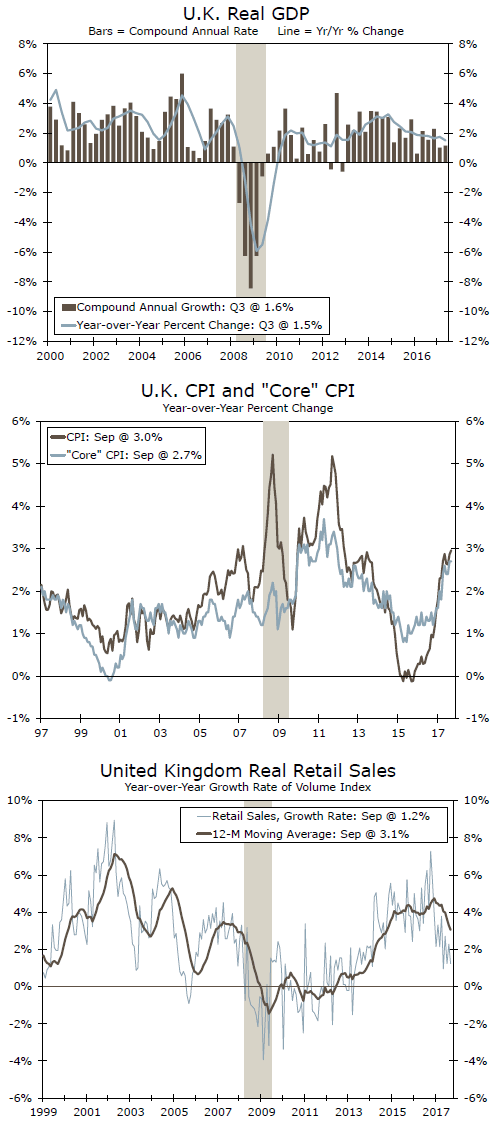
Real GDP growth in the U.K. was steady in Q3, holding firm at 1.5 percent year-over-year. Sluggish GDP growth, tepid wage growth and above-target inflation put the Bank of England in a tight quandary.
U.K. GDP Growth Remains Sluggish in Q3
Data released this morning showed GDP in the U.K. expanding 0.4 percent (not annualized) in Q3. The print was 0.1 percentage points higher than consensus expectations. On a year-over-year basis, real economic growth held steady at 1.5 percent (top chart).
Although a breakdown of GDP into its underlying demand components is not available at this time, examining growth data by sector reveals mixed results. Output in the service sector moved in-line with total output, rising 0.4 percent over the quarter and 1.5 percent over the year. The finance and distribution, hotels & restaurants sectors were the top performers in the quarter. On the production side of the economy, output rose a solid 1.0 percent, the fastest pace of 2017. Gains in manufacturing and mining & quarrying, however, were offset by the second consecutive quarterly decline in construction output, which fell 0.7 percent over the quarter.
Above-target inflation and stagnant wage growth in the U.K. likely continued to weigh on economic growth in Q3. The consumer price index rose 0.3 percent in September and 3 percent over the year, while the core index held steady at 2.7 percent, year over year (middle chart). Both of these measures are in excess of the Bank of England's 2 percent inflation target, which has been exceeded largely due to the depreciation in the pound in the wake of last year's Brexit vote.
Despite the faster inflation, wages have failed to accelerate in tandem. Average weekly earnings data for August showed a steady reading of 2.2 percent year-over-year growth. Real wage growth, or nominal wage growth minus the inflation rate, has turned negative amid this acceleration in prices and stagnant wage growth, and the loss of purchasing power has weighed on consumers. Real retail sales excluding auto fuel in the U.K. fell 0.7 percent in September. Some of this decline was likely payback from August's large increase, but year-over-year real retail sales are up just 1.2 percent (bottom chart).
From a monetary policy perspective, this morning's print likely represents a mixed bag for policymakers at the Bank of England (BoE). Financial markets appear convinced that the BoE will hike rates at the conclusion of the Monetary Policy Committee's meeting on November 2. We are maintaining our call for the next rate hike to occur in February 2018. Even with the above-target inflation, real economic growth of 1.5 percent is sluggish, and wages have shown few signs of accelerating. That said, we recognize that the risks of a rate hike by the BoE next week have clearly moved higher. Regardless of when the first move occurs, the pace of tightening through 2018 will likely remain gradual as inflation begins to recede and economic growth remains modest.
Strength in Core Capital Goods Orders Proves Durable
September durable goods orders rose 2.2 percent on the heels of a 2.0 percent gain in August. Core capital goods orders and shipments are both rising at the fastest three-month average annualized pace in years.
Core Orders, Shipments Show More Steady Growth
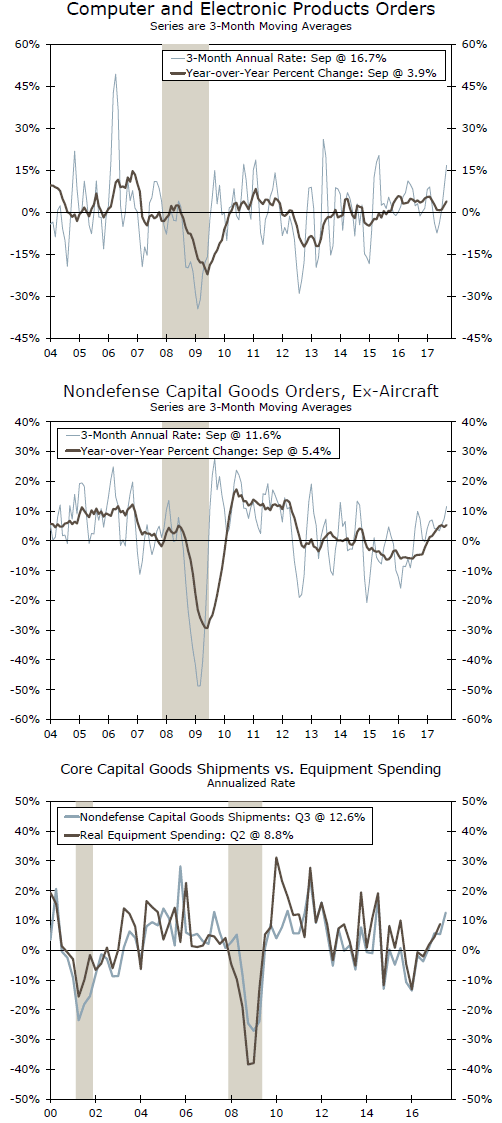
Preliminary data on durable goods orders in the United States showed a continued firming in factory sector data to end the third quarter. Durable goods orders rose 2.2 percent in September, boosted by another doubledigit jump in the volatile civilian aircraft component. Communications equipment also posted a suspiciously large gain, so there may have been some additional noise generated by the recent release of the new iPhone (top chart).
Economic data for August and September have been impacted to varying degrees by the dual-impact from hurricanes Harvey and Irma. In the durable goods series, one area where we were watching for a hurricane impact was the vehicle orders component. New orders for vehicles & parts rose a scant 0.1 percent in September. Although this data is still fairly preliminary, this early signal suggests that storm replacement demand may not be enough to reignite autos production given the high levels of inventories and slower trend in the pace of sales.
Non-defense capital goods orders ex-aircraft, our preferred gauge of future business investment, rose 1.3 percent in September, the third consecutive monthly gain of that size. This string of strong prints puts the three-month average annualized rate at 11.6 percent, the fastest pace of growth since the eve of the steep decline in the price of oil in September 2014 (middle chart). Earlier this month, the ISM manufacturing index touched a cycle-high, and a chunk of this gain was clearly attributable to hurricane-related quirks. Given today's strong print for core capital goods orders, however, the improvement in the survey-data likely also reflect stronger underlying fundamentals in addition to the hurricane-related noise.
Non-defense capital goods shipments ex-aircraft, which offers a snapshot of current conditions, also posted a strong reading of 0.7 percent in September. The string of gains brings the three-month average annualized gain for core capital goods shipments to 10.6 percent, the fastest pace since October 2014. Taken together, the core capital goods orders/shipments data bode well for a possible upside surprise to equipment spending in Q3 and continued momentum in Q4 (bottom chart).
With three-quarters of the year in the books, the recovery in the factory sector that has taken place in 2017 has built momentum in the second half of the year. The strong dollar/weak global growth/falling commodity price story that characterized the past two years has reversed in 2017, turning these headwinds into tailwinds for the sector. Manufacturers have responded by increasing payrolls by 104,000 jobs this year. Given the possible noise in the data from hurricanes and other factors, however, we will be watching future releases particularly closely.
US 30 Stock Index Strongly Bullish; Looking Overbought
The US 30 stock index reached another all-time high of 23485.10 yesterday as the index extended its second longest bull run in its history. Prices broke above the 23000 level for the first time on October 17 and are trading above their moving averages. The bullish picture in the medium term is further supported by the MACD, which is rising and above its red signal line.
Short-term momentum indicators are also pointing to a continuation of the bullish bias. However, the RSI is well above the 70-overbought level at 85, suggesting that the latest upswing may be running out of steam and that the risk of a near-term correction is high.
Should prices reverse lower, immediate support should come at 23120, which is the 261.8% Fibonacci retracement level of the downleg from 22180.10 to 21598.10. Below that, the 161.8% Fibonacci is another major support around 22540. A drop below this area would take the index closer to the 50-day moving average (currently 22377) and significantly weaken the bullish medium-term structure. Further losses would open the way towards the 100-day moving average near the 61.8% Fibonacci level at 21960. A breach of this level would shift the outlook from positive to neutral.
To the upside, there is immediate resistance just below the 23500 area, while above that, the next major resistance to watch is just above the 24000 mark at 24060 (the 432.6% Fibonacci level).

Trade Idea: EUR/GBP – Stand aside
EUR/GBP - 0.8918
New strategy :
Stand aside
Position : -
Target : -
Stop : -
Despite intra-day selloff to 0.8880, lack of follow through selling on break of previous support at 0.8886 and current rebound suggest further choppy trading would be seen and recovery to 0.8940-45 cannot be ruled out, however, reckon upside would be limited to 0.8970-75 and price should falter well below resistance at 0.9033, bring another retreat later.
As near term outlook is still mixed, would be prudent to stand aside for now. Below said support at 0.8880 would bring test of indicated previous support at 0.8856, break there would signal top has been formed at 0.9033 and bring further fall to 0.8820-25, then towards 0.8800.
Our preferred count is that, after forming a major top at 0.9805 (wave V), (A)-(B)-(C) correction is unfolding with (A) leg ended at 0.8400 (A: 0.8637, B: 0.9491 and 5-waver C ended at 0.8400. Wave (B) has ended at 0.9413 and impulsive wave (C) has either ended at 0.8067 or may extend one more fall to 0.8000 before prospect of another rally. Current breach of indicated resistance at 0.9043 confirms our view that the (C) leg has ended and bring stronger rebound towards 0.9150/54, then towards 0.9240/50.

Trade Idea: USD/CAD – Buy at 1.2670
USD/CAD - 1.2762
Trend: Down
Original strategy :
Buy at 1.2570, Target: 1.2770, Stop: 1.2510
Position: -
Target: -
Stop: -
New strategy :
Buy at 1.2670, Target: 1.2870, Stop: 1.2610
Position: -
Target: -
Stop:-
As the greenback has surged again after brief retreat to 1.2636, adding credence to our bullish view that the rise from 1.2061 low is still in progress and upside bias remains for this move from there (wave iii trough) to extend further gain towards previous resistance at 1.2778, break there would encourage for headway to 1.2800, then towards 1.2860-70. We are keeping our count that wave v as well as wave (C) ended at 1.3794 and impulsive wave (i ii, i ii) is now unfolding with minor wave iii ended at 1.2414, followed by wave iv correction ended at 1.2778, wave v has reached our indicated downside target at 1.2100 and may extend to 1.2000.
In view of this, we are looking to reinstate long on pullback but at a higher level as 1.2670-75 should limit downside and bring another rise. Below 1.2610-15 would defer and suggest top is possibly formed, bring correction to 1.2560-70, however, still reckon previous resistance at 1.2520 would turn into support and bring another rise later.
To recap, wave B from 1.3066 is unfolding as an a-b-c and is sub-divided as a: 1.2192, b: 1.2716 and wave c is a 5-waver with i: 1.1983, ii: 1.2506, extended wave iii with minor iii at 1.0206, wave iv ended at 1.0781 and wave v as well as wave iii has ended at 0.9931, hence the subsequent choppy trading is the wave iv which is unfolding as (a)-(b)-(c) with (a) leg of iv ended at 1.0854, followed by (b) leg at 1.0108 and (c) leg as well as the wave iv ended at 1.0674. The wave v is sub-divided by minor wave (i): 0.9980, (ii): 1.0374, (iii): 0.9446, (iv): 0.9913 and (v) as well as v has possibly ended at 0.9407, therefore, consolidation with upside bias is seen for major correction, indicated target at 1.3700 and 1.4000 had been met and further gain to 1.4700 would be seen later.

Sterling Shines as GDP Beat Expectations, Dollar and Euro Supported by Data
Quick update: Canadian Dollar dives as BoC sounds cautious in its statement. It notes that "projected export growth is slightly slower than before, in part because of a stronger Canadian dollar than assumed in July. Housing and consumption are forecast to slow in light of policy changes affecting housing markets and higher interest rates". Also, "wage and other data indicate that there is still slack in the labour market. This suggests that there could be room for more economic growth than the Bank is projecting without inflation rising materially above target." More improtantly, "governing Council will be cautious in making future adjustments to the policy rate."
Sterling is the star performer today as stronger than expected GDP data boosts the chance of November BoE rate hike. Euro and Dollar are not too far behind though. The common currency is supported as German Ifo business climate hit record high. That clears another hurdle for ECB to announce tapering of asset purchase tomorrow. Meanwhile, Dollar also remains firm on tax plan hope and expectation of December Fed hike. Data from US are also Dollar supportive. Headline durable goods orders rose 2.2% in September versus expectation of 1.0%. Ex-transport orders rose 0.7% versus expectation of 0.5%. Meanwhile, Aussie remains the weakest one as selloff accelerates after CPI data. Canadian Dollar is also soft ahead of BoC rate decision.
Sterling surges as GDP beats expectations
Sterling powers higher today after stronger than expected GDP data. Q3 GDP growth accelerated to 0.4% qoq, up from prior quarter's 1.3% qoq and beat expectation of 0.3% qoq. The acceleration in growth is certainly welcomed by BoE, which is widely expected to hike interest rate by 25bps in November. The data should also clear some concerns of BoE Deputy Governor Jon Cunliffe, who warned that the economy has "clearly slowed" this year. But then for Sterling traders, it should be noted again that the rise could be short lived. After a November hike, BoE Banks Rate is merely back at pre-Brexit referendum level. The central bank will still more likely hold their hands afterwards, until the Brexit picture becomes clear.
UK Brexit Secretary David Davis told a parliamentary committee today that he aimed to get the outlines of trade agreements agreed in the first quarter of 2018. And, UK would be able to seal the deal by March 2019, the Brexit date. While trade negotiation might start, it's technically impossible for UK, still as an EU member, to signal a trade agreement with EU. But Davis said that it could be signed a "nano second" after the exit.
German Ifo business climate hits all time high
German Ifo business climate rose to 116.7 in October, up from 115.3 and beat expectation at 115.1. That's also the highest level on record. Expectations gauge rose to 109.1, up from 107.5, beat expectation of 107.3. Current assessment gauge also rose to 124.8, up from 123.7 and beat expectation of 123.5. Ifo chief Clemens Fuest said in the statement that "companies are very optimistic about the months ahead. They also upwardly revised their very favorable assessments of the current business situation." Also, "Germany's economy is powering ahead."
ECB is widely expected to announce "recalibration" of the asset purchase program tomorrow. And policymakers have hinted the smaller for longer style of stimulus. That is, ECB would likely cut the monthly asset purchase from current EUR 60B a month. An option is to half the purchase to EUR 30B and extend till September 2018, or lower to EUR 20B and extend till the end of next year. While there are many possibilities for tuning the size and length, the direction is unchanged and the announcement will likely be Euro supportive.
Also released from Europe, Swiss UBS consumption indicator rose to 1.56 in September.
Aussie CPI miss suggests no RBA hike soon
Consumer inflation data from Australia surprised to the downside. Headline CPI rose 0.6% qoq in Q3, below expectation of 0.8% qoq. Annual rate slowed to 1.8% yoy, down from 1.9% yoy and missed expectation of 2.0% yoy. RBA trimmed mean CPI was unchanged at 1.8% yoy, missed expectation of 2.0% yoy. RBA weighted median CPI was unchanged at 1.9% yoy, below expectation of 2.0% yoy. The data suggested that it will be hard for RBA to considering raising interest rate any time soon.
Update on the 19th National Congress of CCP
In China, the 19th National Congress of the Chinese Communist Party culminated with the announcement of the new Politburo Standing Committee (PSC) - the group of officials leading the country in the coming five year. Five out of seven members of the previous PSC were replaced, with only President Xi Jinping and Premier Li Keqiang staying in power. The five new members are Li Zhanshu, Wang Yang, Wang Huning, Zhao Leji and Han Zheng. As we mentioned in the previous report, Li Zhanshu, Zhao Leji, Wang Huning and Chen Min'er have very strong link with President Xi. We are surprised that Chen is not chosen to be the core team. Derailing from the usual practice that has been in place since 1990s, Xi refrained from revealing who his successor is. This suggests that he refuses to step down after the coming 5-year term. More in Chinese Leadership Reshuffle: Xi Tightly Grips Power as He Refuses to Identify Successor
GBP/JPY Mid-Day Outlook
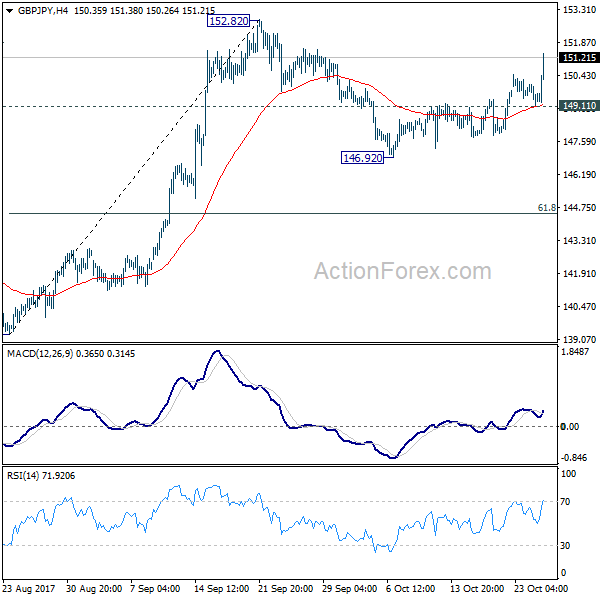
Daily Pivots: (S1) 149.11; (P) 149.60; (R1) 150.06; More
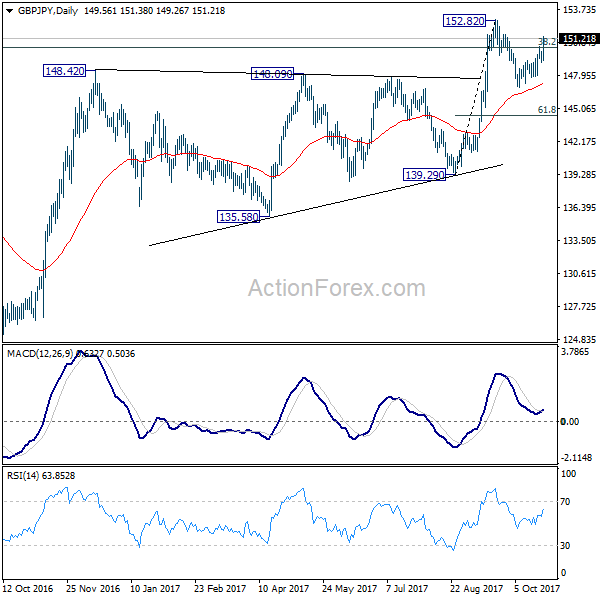
GBP/JPY's rebound from 146.92 resumes after brief consolidation and reaches as high as 151.38 so far. Intraday bias remains on the upside for 152.82 high. Firm break there will confirm resumption of medium term rise from 122.36 and target 163.87 resistance next. On the downside, break of 149.11 minor support will turn bias to the downside and extend the correction from 152.82. In that case, we'd expect strong support from 61.8% retracement of 139.29 to 152.82 at 144.45 to bring rebound.
In the bigger picture, medium term rebound from 122.36 is still expected to resume after corrective pull back from 152.82 completes. Firm break of 38.2% retracement of 196.85 to 122.36 at 150.43 will carry long term bullish implications. In that case, GBP/JPY could target 61.8% retracement at 167.78. However, break of 139.29 will indicate rejection from 150.43 key fibonacci level. And the three wave corrective structure of rebound from 122.36 will argue that larger down trend is resuming for a new low below 122.26.
Economic Indicators Update
| GMT | Ccy | Events | Actual | Forecast | Previous | Revised |
|---|---|---|---|---|---|---|
| 00:30 | AUD | CPI Q/Q Q3 | 0.60% | 0.80% | 0.20% | |
| 00:30 | AUD | CPI Y/Y Q3 | 1.80% | 2.00% | 1.90% | |
| 00:30 | AUD | CPI RBA Trimmed Mean Q/Q Q3 | 0.40% | 0.50% | 0.50% | |
| 00:30 | AUD | CPI RBA Trimmed Mean Y/Y Q3 | 1.80% | 2.00% | 1.80% | |
| 00:30 | AUD | CPI RBA Weighted Median Q/Q Q3 | 0.30% | 0.50% | 0.50% | |
| 00:30 | AUD | CPI RBA Weighted Median Y/Y Q3 | 1.90% | 2.00% | 1.80% | 1.90% |
| 06:00 | CHF | UBS Consumption Indicator Sep | 1.56 | 1.53 | ||
| 08:00 | EUR | German IFO - Business Climate Oct | 116.7 | 115.1 | 115.2 | 115.3 |
| 08:00 | EUR | German IFO - Expectations Oct | 109.1 | 107.3 | 107.4 | 107.5 |
| 08:00 | EUR | German IFO - Current Assessment Oct | 124.8 | 123.5 | 123.6 | 123.7 |
| 08:30 | GBP | GDP Q/Q Q3 A | 0.40% | 0.30% | 0.30% | |
| 08:30 | GBP | GDP Y/Y Q3 A | 1.50% | 1.50% | 1.50% | |
| 08:30 | GBP | Index of Services 3M/3M Aug | 0.40% | 0.40% | 0.50% | |
| 12:30 | USD | Durable Goods Orders Sep P | 2.20% | 1.00% | 2.00% | |
| 12:30 | USD | Durables Ex Transportation Sep P | 0.70% | 0.50% | 0.50% | |
| 13:00 | USD | House Price Index M/M Aug | 0.70% | 0.40% | 0.20% | 0.40% |
| 14:00 | CAD | BoC Rate Decision | 1.00% | 1.00% | 1.00% | |
| 14:00 | USD | New Home Sales Sep | 667K | 556K | 560K | 561K |
| 14:30 | USD | Crude Oil Inventories | -2.6M | -5.7M |
Rise in Core Yields Has Mixed Impact on the Dollar
- European stock markets couldn't profit from upbeat eco data and traded narrowly mixed in a sideways range. US stock markets opened with small losses.
- A euphoric mood among German constructors and manufacturers drove business confidence to an all-time high in October (116.7), according to the German IFO, reflecting optimism that an upswing in Europe's largest economy has further to run. The forward looking expectations component also beat forecasts and rose to 109.1.
- US orders for business equipment increased more than forecast in September (+2.2% M/M vs 1% M/M), indicating solid investment momentum as the third quarter drew to a close. Shipments of capital goods orders excluding aircraft, which are used to calculate GDP, rose more than expected as well (+0.7% M/M vs 0.1% M/M).
- The UK economy's surprise acceleration in Q3 (0.4% Q/Q vs 0.3% Q/Q expected) has paved the way for the Bank of England to raise interest rates for the first time in a decade next week. The ONS pointed out that service sector growth remained 0.4%, while manufacturing grew by 1%. Construction contracted for the second quarter in a row.
- Britain wants an outline agreement with the EU by the first quarter of 2018 on the transitional arrangements that will apply temporarily after it leaves the bloc, Brexit minister David Davis said. Davis also angered some lawmakers by suggesting that they might not get to vote on a Brexit deal until Britain has already left the EU.
- Catalan separatist leader Carles Puigdemont is likely to go to Madrid tomorrow to explain his position on independence from Spain and try to stop the national government imposing direct control on the region.
- Czech interest rates should head higher, central bank Vice-Governor Hampl said, adding he would prefer standard hikes of 25 bps each rather than a big jump. Yesterday, board member Nidetzky said the central bank may consider a 50 bps hike when it next meets. Another board member, Benda, has also said the economy would benefit from a 50-75 bps increase before the end of this year.
Rates
Core bond sell off continues
Core bonds remained under downward pressure today. Various factors conspired to the selling spree. Strong Q3 UK GDP, German IFO and US durable orders, nervousness before the ECB meeting and signs that the hawkish John Taylor is gaining ground in the battle to succeed Yellen as Fed chair. Technically, the US 10-yr yield finally broke above 2.42% yield resistance (the T-Note future fell below 124-14), triggering more selling. We would like to see the technical levels broken at the end of the week before drawing firm conclusions. US Treasuries underperformed German Bunds. At the time of writing, the German yield curve steepens with yields 0.6 bps (2-yr) to 2.1 bps (30-yr) higher. US yields increased between 2.6 bps (2-yr) and 3.5 bps (10-yr).
Intraday, the Bund lingered sideways till the releases of strong German IFO and UK GDP figures. The selling started in the gilt market, but it dragged also Bunds and US Treasuries lower. A second down-leg started on the strong US durable orders which pushed the US 10-yr yield above 2.42% resistance and triggered technically-inspired selling.
Currencies
Rise in core yields has mixed impact on the dollar
Trading in most major FX cross rates developed more or less along the same lines as was the case of late. Core (EMU and US) yields extended their rise supported by strong eco data (German IFO and US durable orders). This trend in core bond yields was again fairly neutral for EUR/USD as investors await tomorrow's ECB decision. The pair held a relatively tight range in the upper half of the 1.17 big figure. USD/JPY and EUR/JPY were again the outright winners.
Overnight, Asian equity indices mostly traded with moderate to decent gains. Japan underperformed. Risk sentiment initially had little impact on the dollar. EUR/USD traded in well-known territory in the 1.1760 area. USD/JPY also held near yesterday's level (high 113 area).
The rise in core (US & European) bond yields continued in Europe. The move was driven both by eco data and by technical considerations, but had a mixed impact on the dollar. The Germany IFO business confidence was very strong. The headline and current conditions indices printed at record highs. The initial rise of German/EMU yields was modest, but the move accelerated after a better-than-expected UK Q3 GDP. The subsequent rise in core yields was broad-based (UK, EMU but also US yields). Interest rate differentials even widened slightly in favour of the dollar. Still EUR/USD gained a few ticks and returned to the 1.1775 area. USD/JPY and EUR/JPY were again the main beneficiaries.
The rise in core yields accelerated further early in US dealings as the US 10-yr yield broke beyond the key 2.40% resistance area. A bit later, US durable orders were also stronger than expected. However, the rise in US yields nor the strong durable orders were able to support further US gains. EUR/USD tried a shy attempted to turn south, but the move was almost immediately blocked. EUR/USD trades currently just below the 1.18 handle. Investors apparently still don't want to find themselves positioned short euro going into tomorrow's ECB meeting. The durables this time also brought no further support for USD/JPY. The 114.45 range top is a too high hurdle. The pair tries to sustain north of the 114 big figure. EUR/JPY (134.45 area) is testing the September highs.
Sterling profits from decent UK Q3 growth
The focus for sterling trading turned from Brexit to the eco data today. UK Q3 GDP growth printed at 0.4% Q/Q and 1.5% Y/Y. The consensus only expected a rise of 0.3% Q/Q. Growth was again primarily driven by the services sector, but manufacturing production also added to growth supported by a rise in car production. The stronger Q3 GDP removed most market doubts on a BoE rate hike next week and kick-started quite an impressive sterling rebound. EUR/GBP traded in the 0.8965 area at the time of the publication but returned (temporary?) below the 0.89 big figure soon. The pair trades currently around 0.89. The rise in cable was even more impressive. The pair jumped from the 1.3120 area and trades currently in the mid 1.32 area. In comments before Parliament, UK Brexit Secretary Davis indicated that the Parliament may not be able to vote on the Brexit deal until after the UK has left the union. UK PM May dismissed this idea. This time, the Brexit divergence had only limited impact on trading. We understand the positive reaction of sterling on the stronger GDP but find it a bit exaggerated as it doesn't raise the case for more than one rate hike.