

Sample Category Title
Canadian Dollar Under Pressure as US Tariffs Drive USD/CAD to a 22-Year High
The USD/CAD pair surged above 1.4760 on Monday, reaching its highest level since April 2003. This sharp rise came in response to the US government's decision to impose 25% tariffs on Canadian imports, significantly impacting the Loonie.
Key factors driving USD/CAD
The White House framed the tariffs as part of a broader policy to combat illegal immigration and illicit trade. However, the economic repercussions are immediate, particularly for Canada's commodity-driven economy.
A separate 10% tariff has been applied to Canadian energy exports, a somewhat lower rate than initially expected. Similar tariffs were also introduced for Mexico, while Chinese goods now face a 10% import duty. In response, all affected countries have signalled plans for retaliatory measures.
For Canada, the new trade barriers pose a significant threat. With the economy heavily reliant on exports, reduced foreign demand could lower foreign currency inflows and further weaken the CAD.
Investors are now turning their attention to upcoming Canadian GDP data. December's figures are expected to show 0.2% growth, translating to an annual expansion of 1.4%, aligning with the Bank of Canada's (BoC) projections.
The BoC recently cut its benchmark interest rate by 25 basis points to 3.0% per annum and announced an end to its quantitative easing programme. Additionally, the central bank has indicated plans to resume asset purchases in March, further weighing on the Canadian dollar.
USD/CAD technical analysis
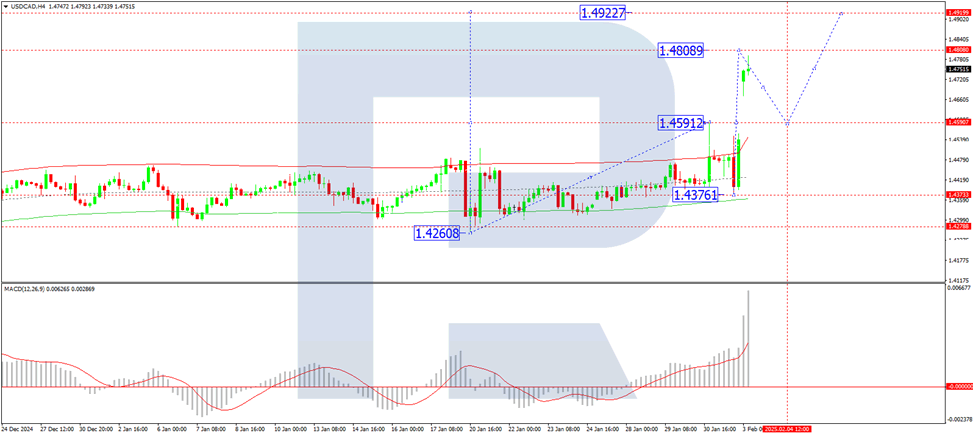
On the H4 chart, USD/CAD broke through 1.4591 and continues its upward wave. With this breakout, the path towards 1.4808 is now open, making it the next local target. After reaching this level, a correction towards 1.4591 is possible before a renewed growth wave targets 1.4919. The MACD indicator supports this outlook, with its signal line above zero and pointing sharply upwards, confirming bullish momentum.
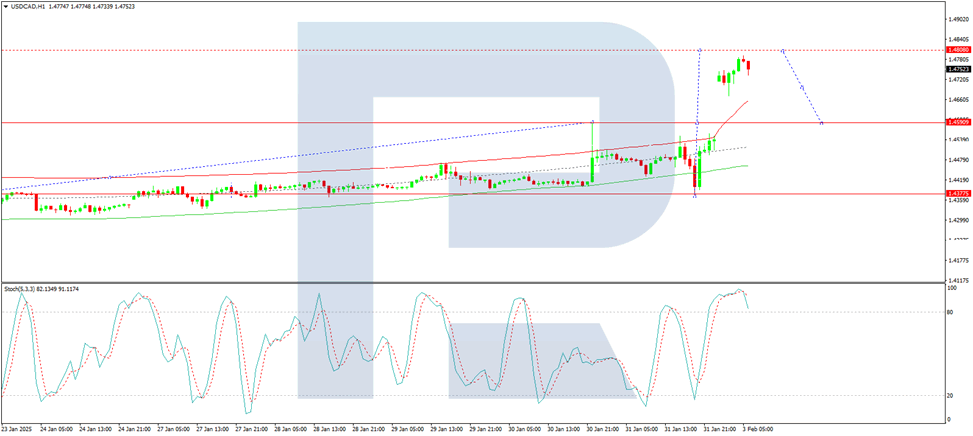
On the H1 chart, the pair has extended its upward structure to 1.4742 and is now consolidating around this level. A breakout from the consolidation range to the upside would signal a move towards 1.4808. However, if the pair breaks downwards, a correction to 1.4591 is possible before another attempt at the 1.4808 level. The Stochastic oscillator indicates a potential short-term pullback, with its signal line above 80 and preparing to decline towards 20.
Conclusion
The Canadian dollar remains under significant pressure as US trade tariffs drive uncertainty over future export demand. While technical indicators suggest further upside for USD/CAD towards 1.4808, a corrective move towards 1.4591 is also possible before another wave of growth. The market's next key focus will be Canadian GDP data and any further developments on trade retaliation from affected countries, both of which could impact the pair's trajectory.
In Pre-Tariff January, Manufacturing Expanded for 1st Time Since 2022
Summary
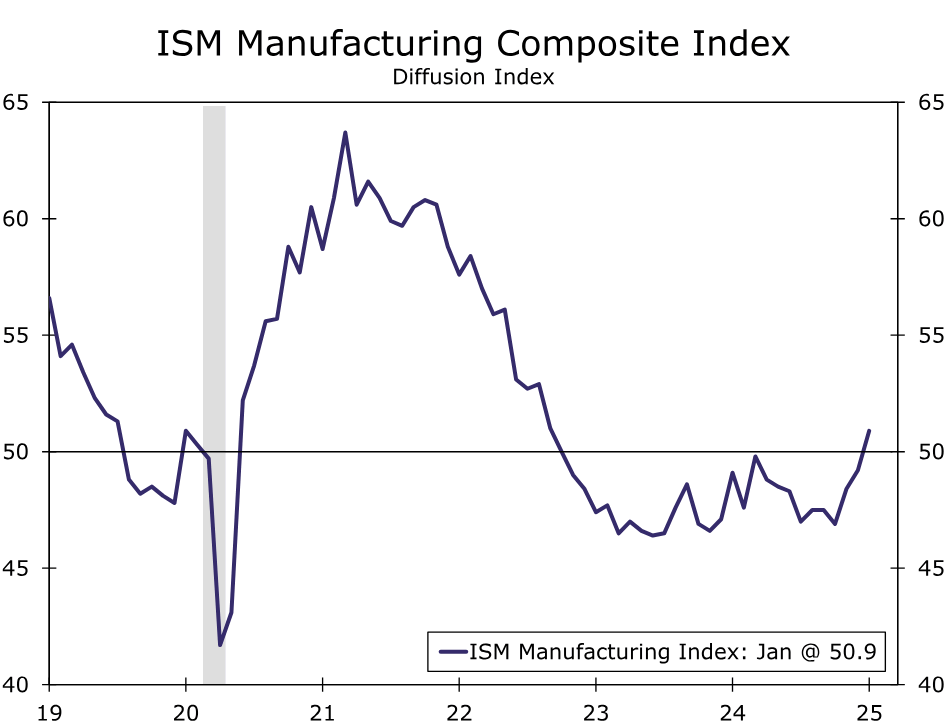
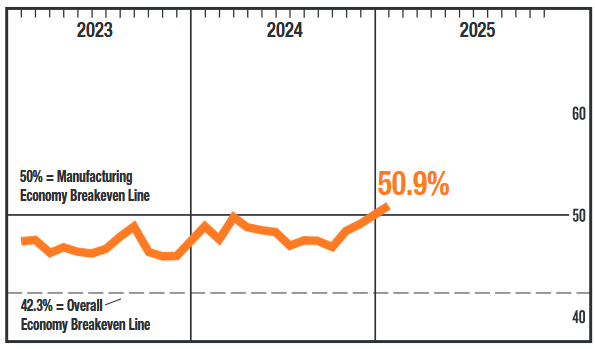
Buoyed by gains across various sub-components, the ISM Manufacturing Index broke above 50 for the first time since 2022. Prices, production, employment and new orders all rose in a long-awaited rebound for a sector that has felt the pain of higher interest rates more acutely than others.
Everything Was Going So Smoothly
On a day when financial markets are in a tailspin over the start of a trade war, the ISM Manufacturing Index crested above the 50 line into expansion for the first time since 2022 (chart). News that manufacturing activity is once again in expansion mode will not be salve to worried investors as it reflects a pre-tariff assessment.
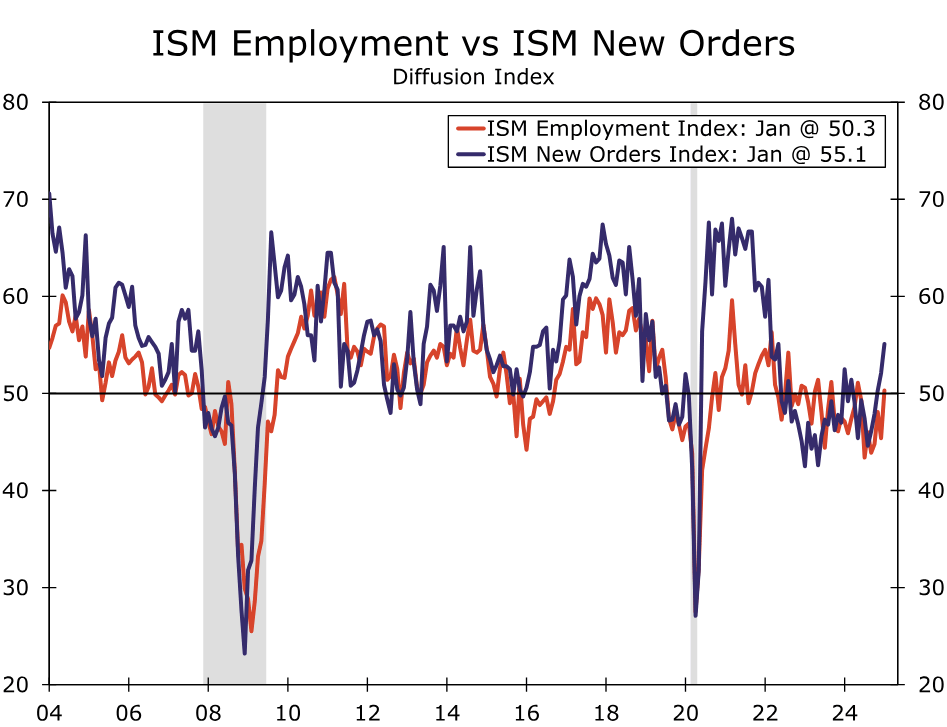
There was broad based strength in the ISM with four of the five components that make up the headline index higher at the start of the year. Specifically, new orders leaped three points to 55.1, which marks the fifth-consecutive monthly move higher suggesting more of a trend-step up rather than one-off bump (chart). The measure of current production was also in expansion for the first time in nine months signaling stronger activity.
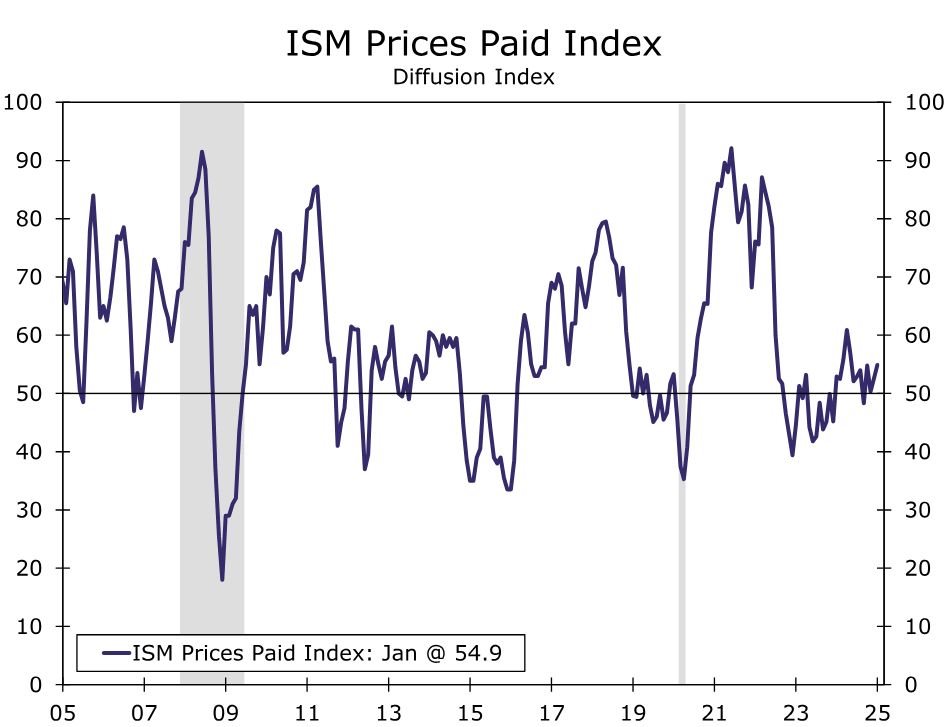
The one caveat in this report is that stronger activity comes with stronger price pressure. The prices paid index rose to 54.9, consistent with the broadest expansion in manufacturing input prices since May (chart). Eleven industries reported paying higher prices for materials last month. This could prove problematic for the Fed to the extent goods disinflation subsides as services inflation remains elevated, making the road to 2% all the more challenging. This is particularly true in the wake of recent tariff announcements.
President Trump said he would levy a 25% tariff on all imports from Mexico and Canada (10% on Canadian energy) and an additional 10% on goods coming from China by February 4. We estimate this would bring the average tariff rate in the United States up to 8.8% from 2.2% currently. As we note in a recent report, Mexico and Canada account for a large portion of our auto, food and industrial imports specifically, which could drive prices higher and disrupt the supply of key inputs for manufacturers. The select industry comments strike a tone of optimism among purchasing managers with some mention of tariff and supply chain concern.
Factories Hiring Again?
Factories have laid off workers in four out of the past five months, but that may be poised to change. Manufacturing hiring looks to have at least stabilized according to purchasing managers. The employment component rose 4.9 points, which was more than any other sub-component, to crest modestly above 50 in January. That said, the underlying details in terms of number of industries hiring was not overly positive. The ISM services release on Wednesday provides more detail of the broader hiring landscape. When the full employment report is released Friday, we expect to see employers continued to hire at a decent clip of around 185K workers.
Trump Fires First Salvo in Multifront Trade War
Trump fired the first shot in a multifront trade war on Saturday when tariffs on Mexico, Canada and China became a reality.
The tariffs are linked to border security and thus could be removed or reduced following negotiations. However, there is also a risk we see a tit-for-tat escalation in the short term. We also expect to see more tariffs on China later this year and that EU and possibly other countries will be hit as well before long.
S growth may take a moderate short-term hit but fiscal easing keeps the medium term outlook broadly unchanged for now. Inflation will see a modest one-off impulse.
The biggest impact for now may be the uncertainty the global economy is faced with, and supply chain planning for businesses have only become more tricky.
Sunset Market Commentary
Markets
President Trump’s tariffs on Canadian, Mexican and Chinese goods took markets off guard. Even though he said multiple times he would install them February 1st investors clearly assumed he would use them as leverage first in trade talks before actually imposing them should negotiations have failed. The EU in particular has been warned. Trump accompanied the 25% (10% for China) levies over the weekend with comments that the European continent “pretty soon” faces a similar fate. With countries much better prepared than in 2016 and countermeasures having already been announced, things could escalate quickly. Trump is meeting outgoing Canadian PM Trudeau later today ahead of the tariffs going into effect tomorrow (6 PM our time). There’s only an outside chance of things being averted after all, so risk aversion rolls over every corner of the market. Stocks slip 1.6% in Europe and are down 2% on Wall Street (Nasdaq). Bunds outperform Treasuries in the bond market. German yields drop between 8-9 bps across the curve. Markets assume the ECB will come to the rescue with growth supporting monetary policy. Kneejerk rate cut bets soar with the terminal rate seen around 1.75% from 2.75% currently. But as it happens, European inflation numbers printed today showcase the limited wiggle room Frankfurt has. Both headline and core CPI surprised to the upside, coming in at 2.5% and 2.7% respectively. Services inflation remains at an elevated 3.9%. US Treasury yields rise about 5 bps at the front as markets try to gauge what import levies mean for inflation and Fed policy. The long end of the curve eases 4 bps on safe haven flows. Trading in all segments of the curve is very volatile though. Canadian yields fall off a cliff with losses ranging between 9.5 and 16.5 bps. These add to the double digit losses seen in the days ahead of the weekend. Canadian money markets up their expectations for lower policy rates through 2025: from less than two additional cuts after last week’s one (to 3%) to a comfortable three.
The US dollar stands out on currency markets. While off the highs seen in (less liquid) Asian trading, the greenback scores gains against all G10 peers except the Japanese yen. The euro trembles, pushing EUR/USD to 1.026 compared to Friday’s 1.036 close. The Canadian dollar obviously trails with USD/CAD testing the 2015 and 2020 highs around 1.47. These serve as resistance levels ahead of 22-yr highs. The Mexican peso drops to USD/MXN 21, the weakest MXN level in two years time. A trade-weighted USD index jumped towards its previous January/2-yr high at 110 early in the session before paring gains to 109.23 currently. On the benefiting side (ex. USD) we find JPY, the Swiss franc and currently even GBP, be it against the euro. Trump’s beef with the UK appears a small one compared to others and that’s keeping sterling headwinds down to a minimum for the time being.
News & Views
The decline in Czech manufacturing conditions eased at the start of 2025 according to the January manufacturing PMI (46.6 from 44.8 vs 45.7 expected) which nevertheless remains in recessionary territory (<50) since June 2022. Challenges continued to come from key industry and export markets, with interest from domestic construction and machinery sectors, alongside demand from Germany, reportedly waning again. Output and new orders continued to fall amid subdued demand conditions, though at a slower pace, with a sharp decrease in backlog of work as well. The pace of job shedding slowed to the weakest in 10 months as business confidence in the year ahead improved. That doesn’t show up yet with input buying and inventories being reduced in January. On the price front, manufacturers recorded a faster but historically subdued rise in input costs. Companies continued to cut their selling prices (4th consecutive month) amid efforts to remain competitive and drive new orders. CE currencies underperform in today’s risk-off market setting. EUR/CZK rises from 25.10 from 25.25 but remains within existing (sideways) technical boundaries.
OPEC+ sources told Reuters that the Joint Ministerial Monitoring Committee, which meets today, is unlikely to recommend a production increase beyond what has already planned (starting in April). They won’t give into US President Trump’s demand at OPEC’s address to “cut the price of oil”. Brent crude prices surge from a close at $75.67/b at the end of last week to $76.85/b currently after Trump imposed a 10% tariff on energy and energy resources coming from Canada.
US-Canada Talks Offer Hope, But Risk Aversion Keeps Yen in Demand
After a burst of volatility earlier in the session, currency markets are taking a breather as traders reassess the evolving US tariff situation. Comments from White House National Economic Council Director Kevin Hassett helped cool tensions when he clarified that, "This is not a trade war, this is a drug war," directing the focus toward fentanyl imports rather than a sweeping escalation of protectionist policies. His remarks have provided a temporary sense of relief, as markets take a step back to evaluate whether tariff measures could be adjusted or reversed if progress is made on fentanyl control.
President Donald Trump’s updates on discussions with Canadian Prime Minister Justin Trudeau have also offered a glimmer of hope that a negotiated outcome could avert more severe tariff measures. Market sentiment hangs on the possibility that resolving fentanyl-related disputes could defuse tensions, but the risks for a breakdown in talks still looms. A failure to find common ground would likely re-energize the recent selloff and send safe-haven flows back into assets like the Japanese Yen, Swiss Franc and Dollar.
Speaking of currencies, the Yen stands out as the day’s strongest performer so far, benefiting from sliding US Treasury yields and ongoing risk aversion. Dollar remains firm in second place. Sterling is surprising the third strongest, drawing relative support since it appears less threatened by new US tariffs than the European Union. Meanwhile, Swiss Franc has also gained ground on renewed risk-off sentiment. Kiwi, Euro, and Loonie lag behind while Aussie remains under pressure, despite taking a brief pause from its recent downward spiral.
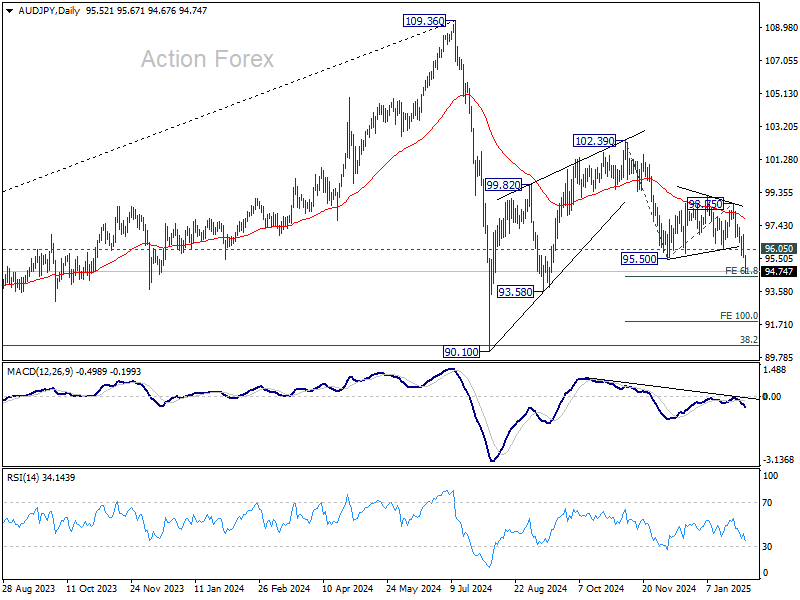
Technically, AUD/JPY's fall from 102.39 resumed today by powering through 95.50 support. Immediate focus is now on 61.8% projection of 102.39 to 95.50 from 98.75 at 94.49. Decisive break there could prompt downside acceleration to 100% projection at 91.86. For now, risk will stay on the downside as long as 96.05 support turned resistance holds, in case of recovery.
In Europe, at the time of writing, FTSE is down -1.57%. DAX is down -2.00%. CAC is down -1.76%. UK 10-year yield is down -0.0996 at 4.440. Germany 10-year yield is down -0.091 at 2.370. Earlier in Asia, Nikkei fell -2.66%. Hong Kong HSI fell -0.04%. China was on holiday. Singapore Strait Times fell -0.76%. Japan 10-year JGB yield rose 0.0075 to 1.249.
US ISM manufacturing rises to 50.9, ending 26-month contraction
The US manufacturing sector returned to expansion in January, with ISM Manufacturing PMI rising to 50.9 from 49.2, breaking a 26-month streak of contraction, above expectation of 49.3.
The improvement was broad-based, signaling stronger demand and increased production capacity. Notably, new orders climbed to 55.1 from 52.1, reflecting growing demand, while production rose to 52.5 from 49.9, indicating that manufacturers are ramping up output in response.
The employment index also showed a meaningful recovery, rebounding to 50.3 from 45.4, suggesting that firms are hiring again after months of labor market weakness. Meanwhile, input costs rose, with the prices index increasing to 54.9 from 52.5, signaling that inflationary pressures may be creeping back into the supply chain.
Timothy Fiore, Chair of the ISM Manufacturing Business Survey Committee, highlighted that the January PMI reading aligns with a projected 2.4% annualized GDP growth rate.
Eurozone CPI rises to 2.5% in Jan, core unchanged at 2.7%
Eurozone CPI rose from 2.4% yoy to 2.5% yoy in January, above expectation of 2.4% yoy. CPI core (ex-energy, food, alcohol & tobacco) was unchanged at 2.7% yoy, above expectation of 2.6% yoy.
Looking at the main components, services is expected to have the highest annual rate in January (3.9%, compared with 4.0% in December), followed by food, alcohol & tobacco (2.3%, compared with 2.6% in December), energy (1.8%, compared with 0.1% in December) and non-energy industrial goods (0.5%, stable compared with December).
Eurozone PMI manufacturing finalized at 46.6, still too early to talk about greenshoots
Eurozone PMI Manufacturing was finalized at 46.6, up from December’s 45.1, marking an eight-month high. While still in contraction, the data suggests a slowdown in the sector’s decline. Germany’s PMI rose to 45.0, while France rose to 45.0. Austria (45.7) and Italy (46.3) also saw multi-month highs. Greece (52.8) and Spain (50.9) remained in expansion.
According to Cyrus de la Rubia, Chief Economist at Hamburg Commercial Bank, despite the improvement, manufacturing remains under pressure. It is "too early" to signal a full recovery. Rising input costs, driven by nearly 7% increase in oil prices, pose risks for firms already facing weak demand. ECB’s easing path could also be complicated if inflationary pressures persist.
The US is expected to impose tariffs on European exports. However, business confidence has improved, with future output expectations rising four points above the long-term average, partly driven by optimism surrounding upcoming elections in Germany and possibly France.
While Germany and France remain the weakest performers, the pace of contraction has slowed across multiple sectors. De la Rubia noted that over 90% of Eurozone exports go to markets outside the US, limiting the immediate impact of potential tariffs.
UK PMI manufacturing finalized at 48.3, outlook remains weak
UK manufacturing sector remained in contraction at the start of 2025, with January’s final PMI rising slightly to 48.3 from December’s 11-month low of 47.0. Despite the modest improvement, four of the five key components—output, new orders, employment, and stocks of purchases—declined. The only positive indicator was longer average vendor lead times, which typically reflect supply chain constraints rather than stronger demand.
Rob Dobson, Director at S&P Global Market Intelligence noted that Weak domestic and international demand remains a key drag on the sector, with no clear signs of recovery in sight. Rising cost pressures are also adding to the strain, with input price inflation reaching a two-year high.
The effects of last year’s Budget changes, particularly increases in the minimum wage and employer National Insurance contributions, are expected to feed further into rising costs. These factors could keep pressure on profit margins and limit any near-term rebound in manufacturing activity. Business confidence remains low, hovering near December’s two-year low, reflecting ongoing uncertainty in both economic conditions and policy direction.
BoJ opinions signal more rate hikes as inflation risks tilt higher
BoJ's Summary of Opinions from the January 23-24 meeting indicates a growing shift toward policy normalization, as multiple board members highlighted mounting inflationary pressures.
Rising import costs driven by the weak yen have led more businesses to raise prices, prompting concerns that inflation could overshoot expectations.
One member noted that with economic activity and prices remaining stable, "risks to prices have become more skewed to the upside," emphasizing that rate hikes should be "timely and gradual."
Some policymakers warned that continued Yen depreciation and excessive risk-taking could lead to an overheating of financial activities. To counter this, one board member argued for additional rate hikes to stabilize the currency and prevent further distortions in market expectations regarding BoJ policy.
At the January meeting, the BoJ raised its short-term policy rate from 0.25% to 0.50%, marking another step away from ultra-loose monetary policy. The central bank also revised its price forecasts higher, reinforcing its confidence that rising wages will sustain inflation near the 2% target.
Japan’s PMI manufacturing finalized at 48.7, deepest contraction in 10 Months
Japan's PMI Manufacturing was finalized at 48.7 in January, down from December's 49.6. This marks the sharpest decline in output since March 2024, as firms faced a steeper drop in new orders. Weak demand conditions forced manufacturers to scale back production, reflecting ongoing headwinds for the sector.
According to S&P Global, businesses reacted to falling demand by cutting both inventories and raw material holdings, while also reducing input purchases at the fastest pace in nearly a year. Employment growth also slowed, highlighting a cautious approach to hiring amid economic uncertainty.
Despite the downturn, manufacturers maintained a positive outlook for future output, though confidence fell to its lowest level since December 2022. While firms expect a recovery in demand, concerns persist over when such an improvement will materialize. The slowdown in input price inflation to a nine-month low provides some relief, but overall, sentiment remains fragile.
Australia’s retail sales dip -0.1% mom in Dec, less than expected
Australia’s retail sales turnover edged down by -0.1% mom in December, a smaller decline than the expected -0.7% mom. While the contraction marks a pullback from the strong growth seen in previous months—0.7% mom in November and 0.5% in October mom—it suggests that consumer spending remains relatively resilient.
According to Robert Ewing, head of business statistics at the Australian Bureau of Statistics, retail activity was supported by extended promotional events, helping to smooth spending patterns over the quarter. He noted that Cyber Monday, which fell in early December, boosted demand for discretionary items, particularly furniture, homewares, electronics, and electrical goods.
China’s Caixin PMI manufacturing slips to 50.1, growth momentum weakens
China’s Caixin Manufacturing PMI edged down to 50.1 in January from 50.5 in December.
According to Caixin Insight Group, manufacturers saw improved logistics and a slight pickup in supply and demand. However, employment levels deteriorated notably, and new export orders remained weak, reflecting sluggish global demand.
External risks also remain a key concern, with rising geopolitical uncertainty adding pressure to China’s export environment. Disruptions in global trade policies could further dampen overseas demand, making it difficult for manufacturers to sustain current production levels.
Domestically, consumer spending remains sluggish, highlighting the need for policy measures aimed at boosting disposable income and restoring confidence.
EUR/USD Mid-Day Outlook
Daily Pivots: (S1) 1.0328; (P) 1.0381; (R1) 1.0412; More...
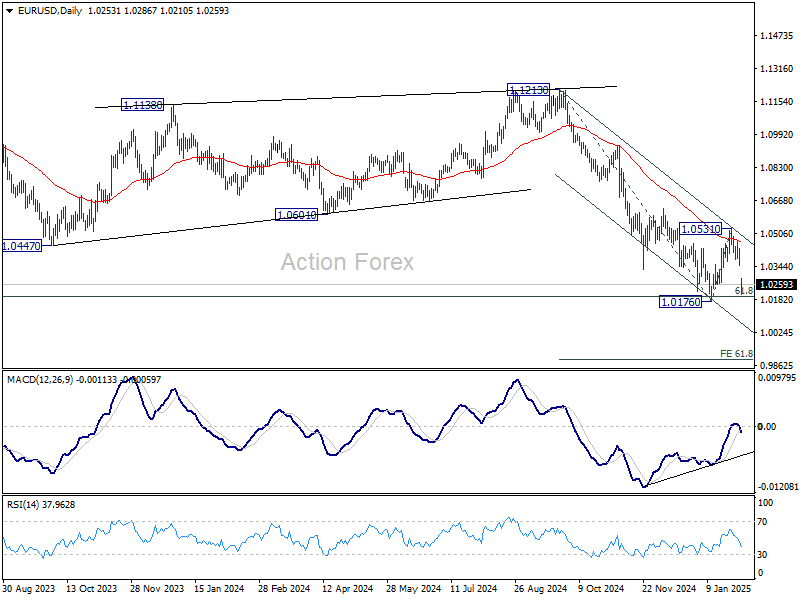
Intraday bias in EUR/USD remains on the downside for the moment. Decisive break of 1.0176 will resume whole fall from 1.1213. Next target will be 61.8% projection of 1.1213 to 1.0176 from 1.0531 at 0.9890. On the upside, above 1.0349 resistance will turn intraday bias neutral again first. But outlook will stay bearish as long as 1.0531 resistance holds, in case of strong recovery.
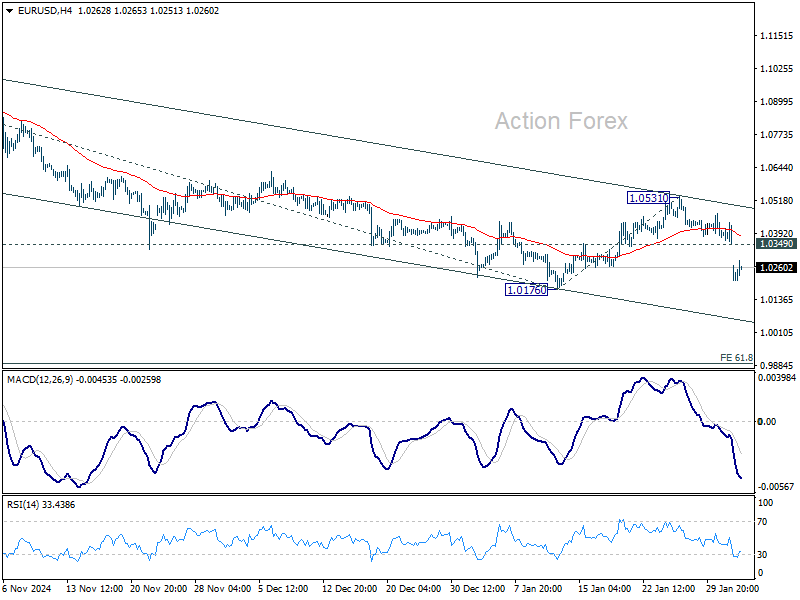
In the bigger picture, immediate focus is back on 61.8 retracement of 0.9534 (2022 low) to 1.1274 (2024 high) at 1.0199. Sustained break there will solidify the case of medium term bearish trend reversal, and pave the way back to 0.9534. For now, risk will stay on the downside as long as 1.0531 resistance holds, in case of rebound.
US ISM manufacturing rises to 50.9, ending 26-month contraction
The US manufacturing sector returned to expansion in January, with ISM Manufacturing PMI rising to 50.9 from 49.2, breaking a 26-month streak of contraction, above expectation of 49.3.
The improvement was broad-based, signaling stronger demand and increased production capacity. Notably, new orders climbed to 55.1 from 52.1, reflecting growing demand, while production rose to 52.5 from 49.9, indicating that manufacturers are ramping up output in response.
The employment index also showed a meaningful recovery, rebounding to 50.3 from 45.4, suggesting that firms are hiring again after months of labor market weakness. Meanwhile, input costs rose, with the prices index increasing to 54.9 from 52.5, signaling that inflationary pressures may be creeping back into the supply chain.
Timothy Fiore, Chair of the ISM Manufacturing Business Survey Committee, highlighted that the January PMI reading aligns with a projected 2.4% annualized GDP growth rate.
USD/JPY Mid-Day Outlook
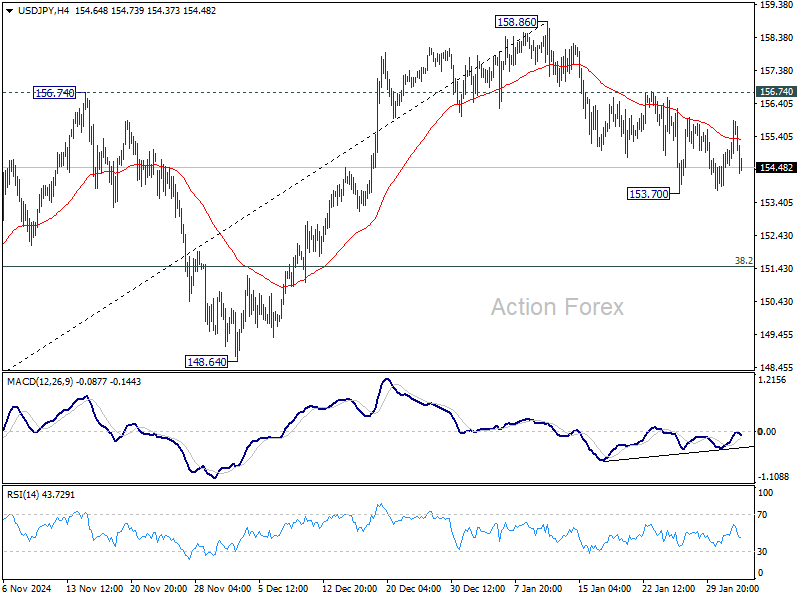
Daily Pivots: (S1) 154.34; (P) 154.78; (R1) 155.64; More...
Intraday bias in USD/JPY remains neutral as range trading continues above 153.70. Deeper fall is mildly in favor as long as 156.74 resistance holds. Break of 153.70 will resume the fall from 158.86 to 38.2% retracement of 139.57 to 158.86 at 151.49. Nevertheless, break of 156.74 resistance will indicate that fall from 158.86 has completed as a correction. Intraday bias will be back on the upside for 158.86 and above to resume the whole rally from 138.57.
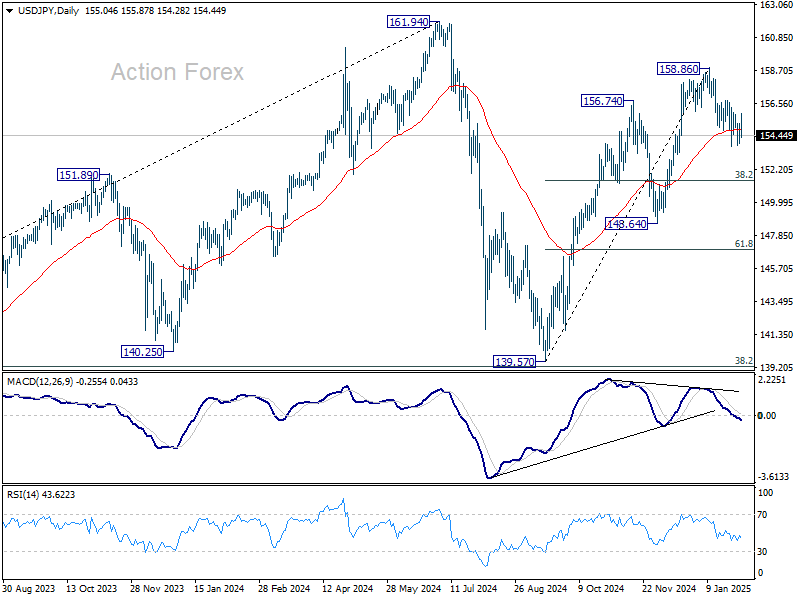
In the bigger picture, price actions from 161.94 are seen as a corrective pattern to rise from 102.58 (2021 low). The range of medium term consolidation should be set between 38.2% retracement of 102.58 to 161.94 at 139.26 and 161.94. Nevertheless, sustained break of 139.26 would open up deeper medium term decline to 61.8% retracement at 125.25.
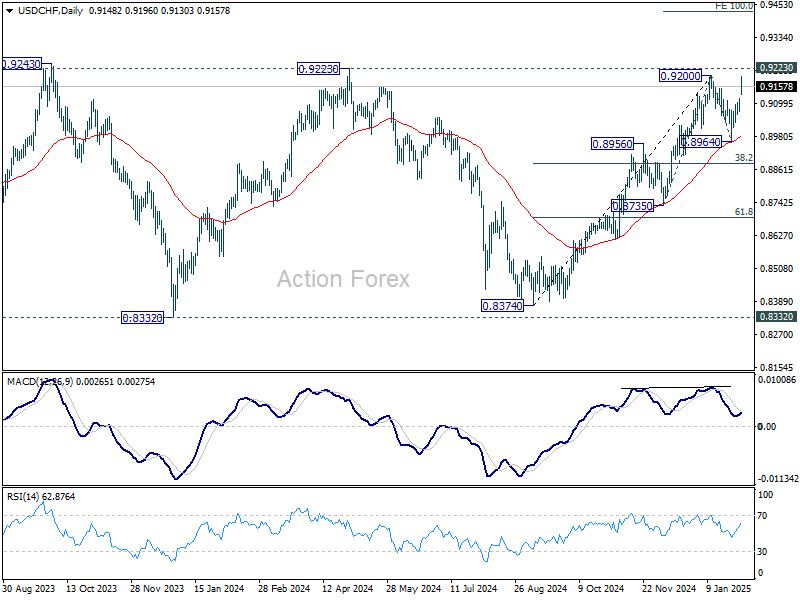
USD/CHF Mid-Day Outlook
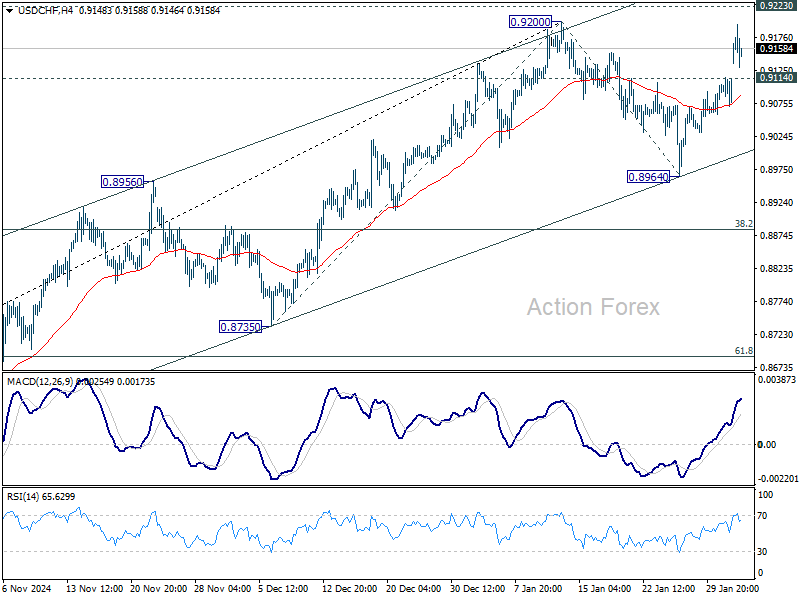
Daily Pivots: (S1) 0.9083; (P) 0.9099; (R1) 0.9129; More…
Intraday bias in USD/CHF remains on the upside for 0.9200/9223 resistance zone. Decisive break there will carry larger bullish implication. Next near term target will be 100% projection of 0.8735 to 0.9200 from 0.8964 at 0.9429. On the downside, below 0.9114 minor support will turn intraday bias neutral again first. But outlook will stay bullish as long as 0.8964 support holds, in case of retreat.
In the bigger picture, decisive break of 0.9223 resistance will argue that whole down trend from 1.0342 (2017 high) has completed with three waves down to 0.8332 (2023 low). Outlook will be turned bullish for 1.0146 resistance next. Nevertheless, rejection by 0.9223 will retain medium term bearishness for another decline through 0.8332 at a later stage.
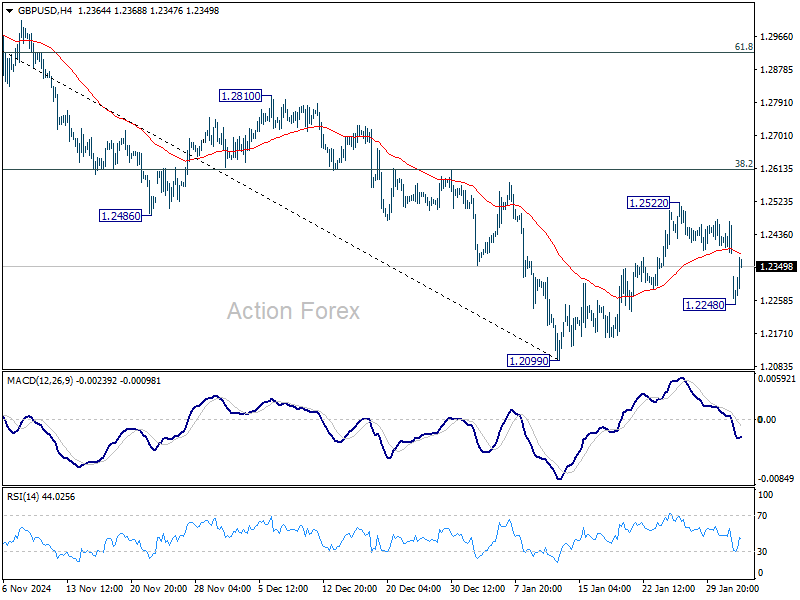
GBP/USD Mid-Day Outlook
Daily Pivots: (S1) 1.2361; (P) 1.2416; (R1) 1.2447; More...
Intraday bias in GBP/USD Is turned neutral first with current recovery. While corrective rebound from 1.2099 might extend with another rise, strong resistance should be seen from 38.2% retracement of 1.3433 to 1.2099 at 1.2609 to limit upside. Below 1.2248 will bring retest of 1.2099 low first. Firm break there will resume whole decline from 1.3433.
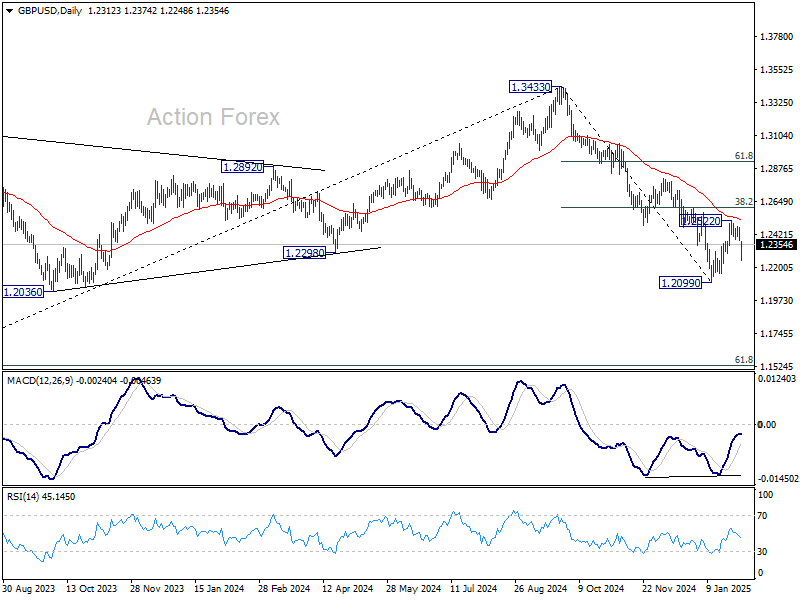
In the bigger picture, rise from 1.0351 (2022 low) should have already completed at 1.3433 (2024 high), and the trend has reversed. Further fall is now expected as long as 1.2810 resistance holds. Deeper decline should be seen to 61.8% retracement of 1.0351 to 1.3433 at 1.1528, even as a corrective move. However, firm break of 1.2810 will dampen this bearish view and bring retest of 1.3433 high instead.
EUR/USD Mid-Day Outlook
Daily Pivots: (S1) 1.0328; (P) 1.0381; (R1) 1.0412; More...
Intraday bias in EUR/USD remains on the downside for the moment. Decisive break of 1.0176 will resume whole fall from 1.1213. Next target will be 61.8% projection of 1.1213 to 1.0176 from 1.0531 at 0.9890. On the upside, above 1.0349 resistance will turn intraday bias neutral again first. But outlook will stay bearish as long as 1.0531 resistance holds, in case of strong recovery.
In the bigger picture, immediate focus is back on 61.8 retracement of 0.9534 (2022 low) to 1.1274 (2024 high) at 1.0199. Sustained break there will solidify the case of medium term bearish trend reversal, and pave the way back to 0.9534. For now, risk will stay on the downside as long as 1.0531 resistance holds, in case of rebound.