Sample Category Title
EUR/CHF Weekly Outlook
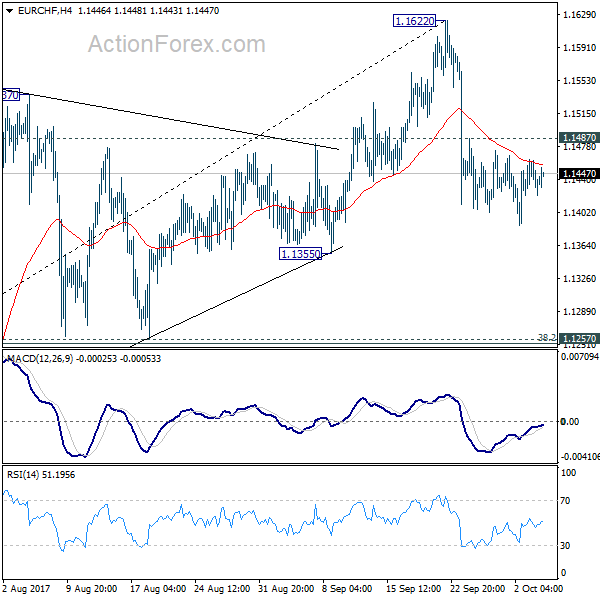
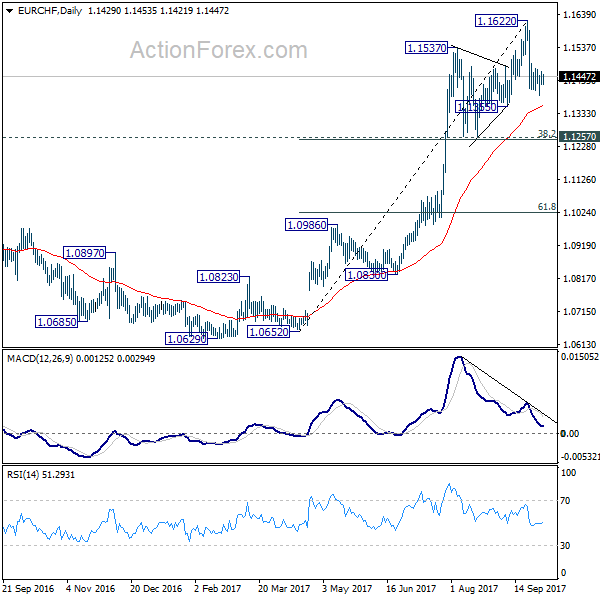
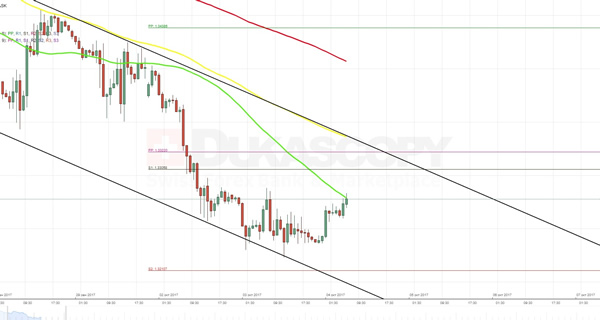
EUR/CHF edged higher again last week but failed to take out 1.1537 resistance. Outlook is unchanged that consolidation from 1.1537 is still in progress. Initial bias remains neutral this week first. In case of another fall, downside should be contained by 38.2% retracement of 1.0830 to 1.1537 at 1.1267 to bring rebound. On the upside, break of 1.1537 resistance will confirm resumption of larger rally from 1.0629. In that case, EUR/CHF should target 1.2 key resistance level next.
In the bigger picture, long term rise from SNB spike low back in 2015 is still in progress. EUR/CHF should now be heading back to prior SNB imposed floor at 1.2000. For now, this will be the favored case as long as 1.1087 resistance turned support holds.


Sterling Surged on Speculations of November Hike, Dollar Rebound Unconvincing, Yen Free Fall
British Pound ended as the strongest major currency last week as boosted by hawkish BoE announcement. A November rate hike by BoE is now a real possibility. Kiwi ended as the second strongest in spite of some volatility ahead of generally election. Dollar followed on revived speculations of a December Fed hike. Meanwhile, Yen ended as the weakest as markets on return of risk appetite. US equity indices made records highs while strong rebounds were seen in DAX and CAC. FTSE was the exception due to BoE rate expectation. Yen is also additionally pressured as markets are back looking at diverging global interest rates.
There are a number of focuses in the coming week. Fed is widely expected to announce the plan to unwind the balance sheet. Fed Chair Janet Yellen's post meeting press conference will be scrutinized for chance of December hike. There could be more news from US regarding tax reform as Republicans are preparing to publish the framework on the weeks of September 25. UK Prime Minister Theresa May will deliver a Brexit speech on Friday in Italy. There could be more Brexit news before negotiation starts again in the week of September 25. Germany and New Zealand will hold general elections in the weekend on September 24 and 23 respectively. BoJ will also meet but it's likely a non-event. And of course, North Korea will be watched for any more provocations.
Sterling surged on revived expectation of near term hike
Sterling's rally started last week after release of stronger than expected inflation data. Headline CPI re-accelerated to one year high at 2.9% yoy in August. That's followed by data showing unemployment rate dropped to 42 year low at 4.3% in three months to July. BoE rate decision was the trend defining event for the Pound. BoE kept bank rate unchanged at 0.25% and asset purchase target at GBP 435b. Two usual hawks voted for a rate hike including Michael Saunders and Ian McCafferty. These were not surprising to the markets. However, BoE did step up it's rhetoric and noted in the minutes that some withdrawal of stimulus should be appropriate in coming months. More in Eyebrows Raised as BOE signaled to Hike Rates in Coming Months. And that triggered speculations that BoE would hike as soon as in November. The British Pound was boosted further higher after BoE MPC member, Gertjan Vlieghe, a known dove, also turned his stance. Vlieghe said in a speech in London that "the evolution of the data is increasingly suggesting that we are approaching the moment when bank rate may need to rise."
The focus will now firstly turn to BoE Governor Mark Carney's speech at IMF in Washington, US on Monday. UK Prime Minister Theresa May will deliver a Brexit speech in Florence, Italy on Friday. And there could be more news regarding Brexit coming out this week, ahead of the postponed fourth round of negotiation in the week of September 25. Then attention will turn to CPI data to be released on October 17. By then, it should be quite clear whether November is a good time for BoE to finally raise interest rates.
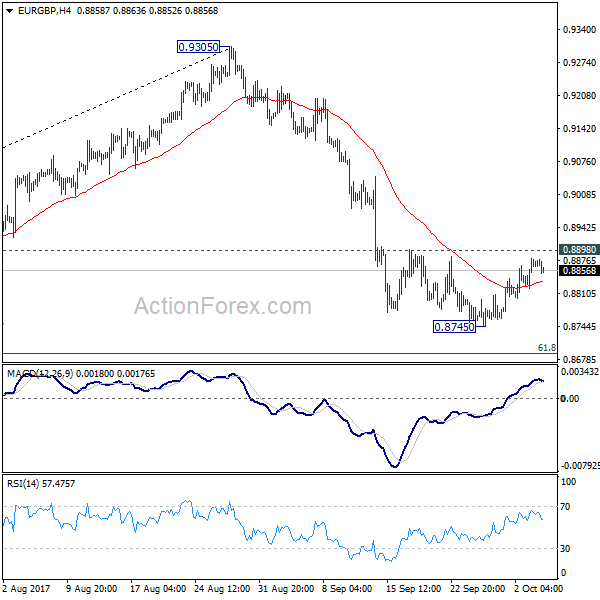
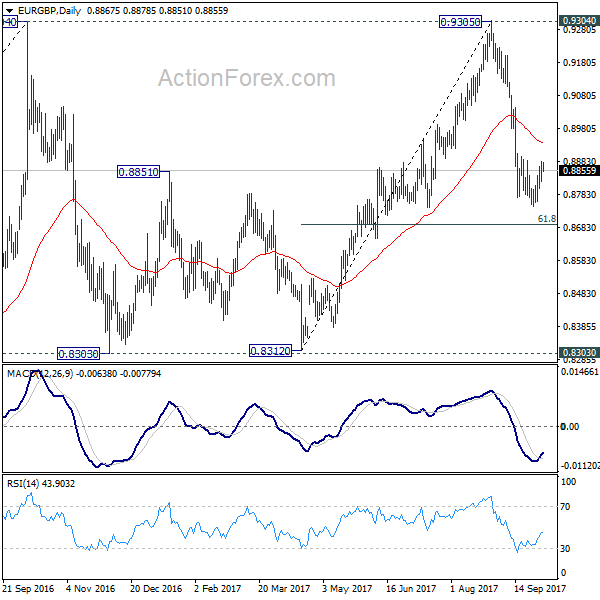
Technically, developments in Sterling were significant. GBP/USD took out 1.3444 resistance decisively and that suggests long term trend reversal. GBP/JPY also finally broke out from medium term range from 148.42 (started last December) and is resuming larger rebound from 2016 low at 122.36. EUR/GBP's sharp fall also confirmed rejection from 0.9304 key resistance and it's heading back to 0.8303 support. The sharp fall in FTSE should also confirm medium term topping at 7598.99. This is supported by rejection from long term channel resistance and bearish divergence condition in weekly MACD. FTSE should now head back to 38.2% retracement of 54.99.50 to 7598.99 at 6796.98 next. These developments is consistent with the expectations of a BoE hike.

Dollar rebound much less convincing, clouded by uncertainties
Dollar ended the week as the third strongest, next to Sterling and Kiwi. But strength in the greenback is mush less convincing than that of the Pound. Dollar was lifted by news that the Americans will finally get the details of US President Donald Trump's tax reforms in the upcoming weeks. Kevin Brady, The chief house tax writer, said the tax overhaul framework will be released in the week of September 25. And there was consensus among the so called Big Six tax writers including Speaker Paul D. Ryan, Senate Majority Leader Mitch McConnell, Senate Finance Committee Chairman Orrin G. Hatch, Treasury Secretary Steven Mnuchin, and White House economic adviser Gary Cohn. There was also optimism that Trump was changing his strategy to having more engagement with Democrats, and that could make it easier for tax reforms to go through Congress. Stronger than expected CPI readings also gave the greenback some support.
However, the picture is still far from being certain for the US. Firstly, markets seem to be still skeptical on what level of details would be released regarding the tax overhaul, not to mention the reactions from businesses and others. There are so many questions to answer before something concrete is on the table. Secondly, it looks like it's only wishful thinking of the neutrals that Trump is having more friendly engagements with Democrats. Democrat leaders of the House and Senate, Nancy Pelosi and Chuck Schumer said after a dinner with Trump that a deal was made in principle regarding the so called Dreamers program, the DACA (Deferred Action for Childhood Arrivals ). But Trump denied it a day after. Time is needed to see whether Trump is really willing to work with the Democrats for so called "bipartisan solutions" for the good of Americans. Thirdly, geopolitical tensions with North Korea is not solved yet. Markets reacted little after North Korea fired another missile over Japan on Friday. But it should be noted that the missile traveled 3700 km before landing in Pacific Ocean. It is now proven that North Korea is able to strike Guam.
But after all, markets are starting to price in more chance of a December rate hike by Fed. According to Fed fund futures, there is now 57.8% chance of a hike in December. That compares to just 31% chance a week ago. FOMC will meet this week and without a doubt, it will announce the plan to unwind the USD 4.5T balance sheet. Fed chair Janet Yellen will also deliver a post meeting press conference. The question of whether Fed will hike in December is definitely a focus there.

Receding risk aversion and repricing of Fed hike are also reflected in the sharp rebound in treasury yield. 10 year yield TNX hit as high as 2.225 and the development suggests that correction from 2.621 is already completed at 2.034. Immediately focus will be on 55 day EMA (now at 2.204). Firm break there will affirm this bullish case and target 2.396 resistance next. A break there will raise the chance of up trend resumption through 2.621 high.

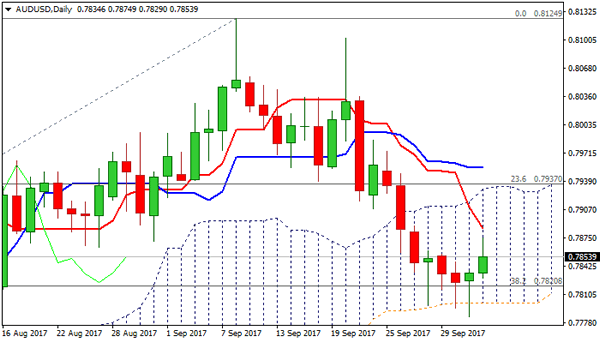
While Dollar rebounded last week, there is no clear sign of trend reversal yet. EUR/USD is held above 1.1822 near term support, USD/CHF is kept well below 0.9772 resistance. USD/CAD is clearly in consolidation and is kept below 1.2412 resistance. AUD/USD also stays well above 0.7807 near term support. Similarly, Dollar index closed just mildly higher at 91.87 and stays well below 94.14 near term resistance. The medium term fall from 103.82 is still in progress for 50% retracement of 72.69 to 130.82 at 88.25.

Yen dives as focus turned back to diverging rates
The weakness in the Japanese Yen last week is very clear. Returning of risk appetite provided the initial fuel for the selloff. The real trigger should be the return of theme of global monetary stimulus exit. Fed has been in that path for some time. BoC played catch up quickly in the past few months and is on track for further tightening. BoE now looks as close as ever to a rate hike finally. ECB didn't fall too much behind neither. ECB President Mario Draghi already indicated earlier this month that the "bulk of decision on recalibration of stimulus will be made in October meeting. Furthermore, a number of ECB officials have called for cutting bond purchase last week. The news gave EUR/USD a lifted ahead of 1.1822 near term support too. With diverging global interest rates in sight, Yen and, to a lesser extent, Swiss Franc could suffer deeper selling ahead.
The weakness in Yen is clearly seen even against New Zealand Dollar. Kiwi suffered much volatility as September 23 general election approaches. The election is described as the closest contest in more than a decade. Kiwi rode a roller coaster ride last week as polls came out with no decisive prediction. Still, NZD/JPY managed to take out 80.59 resistance firmly, suggesting completion of fall from 83.90. Rise from 78.17 is now expected to extend to upper side of medium term range at 83.90.

Trading strategy
With global monetary stimulus exit back as the theme in the markets, we'd expect the Japanese Yen to stay under much selling pressure. The biggest question to this is North Korea tensions. However, the muted reaction to Friday's missile launch argues that the markets are getting more indifferent to it. But that's of course subject to no drastic escalation of the situation. That is, North Korea could fire any missiles to the Pacific Ocean but not really at Guam, or Japan. Therefore, we'll look for Yen short opportunities this week.
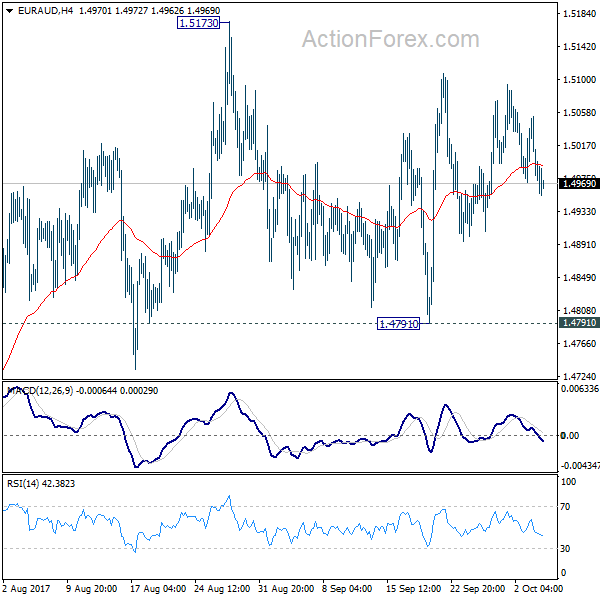
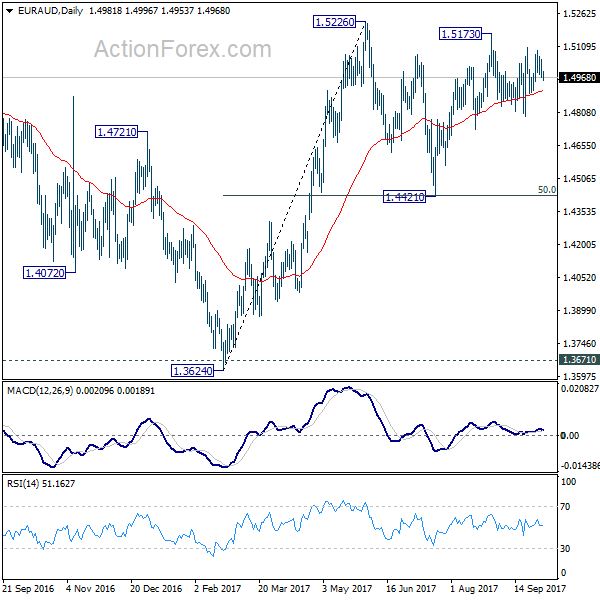
Dollar is avoided for the moment, as firstly, there is no convincing sign of trend reversal yet. Secondly, if North Korean leader Kim Jong-Un really does something unexpected, Dollar will likely be most hurt. Sterling is avoided first as it has already run away. Euro, Aussie and Canadian can all be considered. Canadian Dollar is having a slightly upper hand against the other two as seen in both EUR/CAD and AUD/CAD. Also, WTI crude oil's breach of 50.43 resistance last week suggests that rebound from June's low at 42.25 might be resuming for 55.24 key resistance.

Hence, we'll try to buy CAD/JPY at 89.90, below Friday's low. Stop is placed at 88.50, below last week's low. First target is 61.8% retracement of 106.48 to 74.80 at 94.37. There is prospect of hitting 106.48 high in medium term.

GBP/USD Weekly Outlook
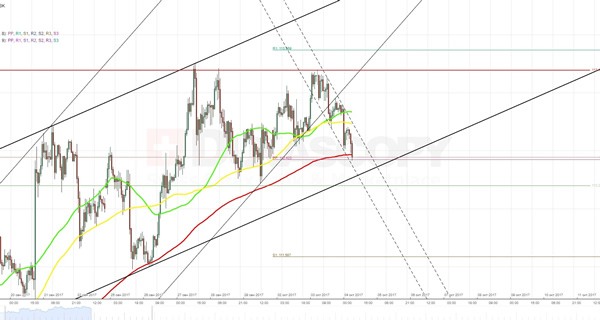
GBP/USD's strong rally last week and firm break of 1.3444 resistance is taken as a sign of larger trend reversal. Initial bias remains on the upside this week for medium term 1.3835 support turned resistance next. On the downside, below 1.3522 minor support will turn intraday bias neutral and bring consolidations, before staging another rally.
In the bigger picture, the strong break of 1.3444 key resistance now argues that the long term trend in GBP/USD has reversed. That is a key bottom was formed back in 1.1946 on bullish convergence condition in monthly MACD. Current rise from 1.1946 will target 38.2% retracement of 2.1161 (2007 high) to 1.1946 (2016 low) at 1.5466 next. In any case, medium term outlook will now stay bullish as long as 1.2773 support holds.
In the longer term picture, current development argues that whole down trend form 2.1161 (2007 high) is completed at 1.1946 already (2016 low). It's too early to tell is GBP/USD is staying a long term up trend. But in any case, further rise is in favor to 38.2% retracement of 2.1161 to 1.1946 at 1.5466 next. We'll monitor the structure of the current rally from 1.1946 to decide if it's an impulsive move.


Eco Data 9/22/17
[php_everywhere] [/php_everywhere]
Eco Data 9/20/17
[php_everywhere] [/php_everywhere]
Eco Data 9/19/17
[php_everywhere] [/php_everywhere]
Eco Data 9/18/17
[php_everywhere] [/php_everywhere]
Eco Data 9/21/17
[php_everywhere] [/php_everywhere]
Summary 9/18 – 9/22
Monday, Sep 18, 2017
[php_everywhere] [/php_everywhere]
Tuesday, Sep 19, 2017
[php_everywhere] [/php_everywhere]
Wednesday, Sep 20, 2017
[php_everywhere] [/php_everywhere]
Thursday, Sep 21, 2017
[php_everywhere] [/php_everywhere]
Friday, Sep 22, 2017
[php_everywhere] [/php_everywhere].
Weekly Economic and Financial Commentary: Economic Data under Close Watch by the Fed
U.S. Review
Slight Firming in Inflation Ahead of FOMC Meeting
- After three months of lower-than-expected inflation readings, the CPI came in higher than expectations. Despite inflation's relatively tepid trend, FOMC members have continued to signal that they are set to announce the start of balance sheet normalization at next week's meeting.
- Hurricane damage is beginning to show up in the monthly data. August retail sales contracted from the previous month, with notable weakness in auto sales.
- Industrial production surprised to the downside with manufacturing production contracting 0.3 percent in August.
Economic Data under Close Watch by the Fed
Consumer prices rose 0.4 percent in August, the largest monthly jump since January. Leading the index was a 2.8 percent rise in energy costs. Prices for gasoline had already been inching higher ahead of the Harvey-related surge late in the month. To what will likely be a relief to Fed officials, core inflation rose 0.2 percent in August, which was the largest monthly gain since February. On a year-over-year basis, core inflation continues to undershoot the Fed's 2 percent inflation target. Ex-food and energy, prices were up just 1.7 percent over the past 12 months. Following the firming in August, however, the recent trend looks stronger; over the past three months, the core index has risen at a 1.9 percent annualized pace.
August's gain should help alleviate concerns among Fed members that the slowdown in inflation that began in the spring might prove more lasting. FOMC members have continued to telegraph that they are set to announce the start of balance sheet normalization at next week's meeting. We do not expect the inflation data to get in the way of that plan. What is likely to be affected, however, is the Fed's Summary of Economic Projections. There will be three more readings on CPI and PCE inflation before the FOMC's December meeting, but the soft patch hit in prior months is likely to lead to lower estimates of year-end core inflation, which may push out the members' projections for the timing of the next rate hike.
Retail Sales and Industrial Production Disappoint
While August's CPI print may have lessened concerns about the recent slowdown in inflation among Fed members, notable weakness in the retail sales and industrial production reports may make the members reassess the general strength of the economy. The pronounced weakness in these two reports may be related to Hurricane Harvey.
Headline retail sales dropped 0.2 percent, with auto sales trimming 0.3 percentage points from topline growth. The decline in auto sales more than offset the boost from the 2.5 percent rise at gas stations. The surge in gasoline sales was largely expected, due to stocking up in storm affected areas. Moreover, the 0.5 percent decline in building material sales on the month, suggests most of that spending took place in September – this category will likely see a boost in September as Houston and the state of Florida rebuild and recover from the storm.
Industrial production data was also off sharply in August, declining 0.9 percent. Manufacturing production, which includes petroleum refining and petrochemical production in and around Houston, declined 0.3 percent in August, following a flat reading in July. Utilities posted the steepest drop, contracting 5.5 percent. Mild temperatures across the U.S. led to lower usage of air conditioning. The weaker than expected data appears to be largely accounted for Harvey-related effects which are likely transitory in nature. The Empire State Manufacturing index for September, a regional purchasing managers' index, suggests that beyond the recent weather-related industrial disruptions, factory activity remains strong.


U.S. Outlook
Housing Starts • Tuesday
Housing starts had a disappointing month of July, falling 4.8 percent on the month and down 5.6 on a year-ago basis. The weakness in July was concentrated in the multifamily component of the index, which fell 15.3 percent. Given the late-cycle fundamentals in that market, the drop is not surprising. Shortages in both lots and labor are holding back starts. Houston has been a key driver of housing construction this year, and Hurricane Harvey will almost certainly cause delays in planned housing starts.
Looking ahead, we expect August starts at a 1.174 million unit pace, an increase of 1.6 percent. We estimate that starts will be around 1.220 million units for 2017, down slightly from our prior forecast due to implications from both Hurricane Harvey and Irma, as single-family building will be held back in parts of Texas and Florida due to delays tied to those storms.
Previous: 1,155K Wells Fargo: 1,174K Consensus: 1,175K

Import Prices • Tuesday
In July, import prices rose a paltry 0.1 percent due to a 0.7 percent increase in imported petroleum prices, matching expectations. Import prices ex-fuel declined last month, however, the first drop since January. Last month, autos & parts prices fell, while capital goods and food & beverages prices increased. The greenback is down around 7 percent year-to-date, and is expected to take on further declines. This should boost prices on imported goods through the end of the year.
Next week, we expect to see import prices gain 0.5 percent monthto- month due to the dollar slide. However, we also expect the effect of elevated import prices will be limited on consumers, as prices on goods and services that are domestically produced should not be pushed upward by global exchange rates.
Previous: 0.1% Wells Fargo: 0.5% Consensus: 0.4% (Month-over-Month)

Existing Home Sales • Wednesday
The low inventory of existing homes for sale capped sales in July, with sales slipping to a 5.44 million unit pace, compared to a 5.51 million unit pace in June. Demand for housing remains strong thanks to low mortgage rates, job growth and rising income. Competition among buyers is stiff. Supply remains low and prices are rising as a result. First-time homebuyers are being priced out of the market with the high prices of homes, and home sales at the lower-end of the price spectrum have declined in every region of the nation over the year.
We expect existing home sales in the month of August to slightly fall to a 5.43 million unit pace. Texas and Florida account for 18.8 percent of existing home sales year-to-date, so we could see a stall in existing home sales in these markets throughout the end of the year, but this will likely be seen more in September compared to August.
Previous: 5.44M Wells Fargo: 5.43M Consensus: 5.46M

Global Review
Chinese Economy Cools at Summer's End
- Economic data out of China disappointed across the board this week. Retail sales and industrial production growth both came in below consensus.
- In the United Kingdom, the Bank of England's Monetary Policy Committee voted 7-2 in favor of keeping its policy rate and balance sheet unchanged. The pound and U.K. government bond yields jumped on hawkish language.
- The Brazilian economy continued its long climb back from a severe recession. The economic activity index for July topped expectations, rising 0.4 percent over the month in addition to a small upward revision to the previous month.
Chinese Economy Cools at Summer's End
Economic data out of China disappointed across the board this week. Retail sales growth on a year-over-year basis was 10.1 percent in August, 0.4 percentage points below the consensus. Industrial production growth also missed the mark, slowing to 6.0 percent year-over-year despite expectations for a 6.6 percent gain. Both readings were the slowest pace so far in 2017.
Leverage in the non-financial corporate (NFC) sector in China has become a growing concern. Chinese authorities are well aware of the leverage that has been built up in the NFC sector in recent years, and they are trying to rebalance the economy away from its over-reliance on investment spending toward more consumer spending before a debt crisis causes the economy to implode. As a result, authorities have eased up on the policy pedal in recent months, and it appears the economy has begun to feel the effects.
High debt levels and less free flowing credit, coupled with longerterm challenges such as an aging population, support our view for a continued but gradual deceleration in the Chinese economy next year. For more on NFC leverage in China, see our report released Thursday "Should We Worry about Chinese SOEs?"
In the United Kingdom, the Bank of England's (BoE) Monetary Policy Committee (MPC) voted 7-2 in favor of keeping its main policy rate and balance sheet unchanged. The language in the policy statement noted that "monetary policy could need to be tightened by a somewhat greater extent over the forecast period than current market expectations." This hawkish tact led the pound and U.K. government bond yields to jump.
Above-target inflation is the key to the Bank of England's bias towards tightening policy next year. The sharp depreciation of the currency in the wake of Brexit last year has driven consumer price inflation to nearly 3 percent, almost a full point above the central bank's target (middle chart). An above-consensus print for the August consumer price index released this past Tuesday only reinforced that point. Sluggish wage growth has kept the MPC in check; despite the acceleration in prices and an unemployment rate at a 42-year low, wages have decelerated in 2017 relative to H2-2016. We look for the Bank of England to next hike rates in Q2-2018.
Across the channel, industrial production growth continued to firm in the Eurozone, rising 3.2 percent year-over-year in July from an upwardly revised 2.8 percent in June. Industrial production has accelerated, helping corroborate the marked improvement in sentiment demonstrated by manufacturing purchasing manager indices.
Elsewhere, the Brazilian economy continued its long climb back from a severe recession. The economic activity index for July topped expectations, rising 0.4 percent over the month in addition to a small upward revision to the previous month. Although the Brazilian political corruption crisis has continued on, it appears that a more firm environment for commodities and global economic growth more generally have helped the Brazilian economy turn the corner after several years of contraction.


Global Outlook
United Kingdom Retail Sales • Wednesday
The U.K. is scheduled to release August retail sales data this upcoming Wednesday. Real retail sales have been decelerating recently as rising inflation and stagnant wage growth have taken a bite out of household purchasing power. The consensus estimate expects that retail sales grew 0.1 percent in August, month over month, and 1.2 percent on a year-ago basis. Both these estimates represent a slowdown from July in which retail sales grew 0.3 percent month over month and 1.5 percent year over year. On a year-over-year basis, real retail spending was up only 2.6 percent in Q2, which clearly represents a slowdown relative to the breakneck pace of the past few years.
Looking ahead, we forecast that real GDP growth will strengthen modestly in 2018 as some of the forces that have led to a slowdown this year reverse, although uncertainty related to Brexit continues to lurk in the background as a major downside risk to the economy. Previous: 0.3%
Consensus: 0.1% (Month-over-Month)

Canada CPI • Friday
Canadian consumer price inflation data are scheduled to be released next Friday. Last week, the Bank of Canada (BoC) raised rates in a move that was somewhat anticipated by markets, but generally not expected by most economists. Economic data coming out of our northern neighbor have been stronger than expected, leading the BoC to judge that the faster rate of growth to be "more broadly based and self-sustaining." The September rate hike likely takes another hike in October off the table.
The headline rate of CPI inflation in Canada is just 1.2 percent at present, near the low end of the target range. We expect CPI to have grown 0.1 percent month over month in August and 1.4 percent year over year. Also on the docket for next week is Canadian retail sales data for July. Retail sales were up 7.3 percent on a year-ago basis in June.
Previous: 1.2% Wells Fargo: 1.4% Consensus: 1.5% (Year-over-Year)

Eurozone PMIs • Friday
Preliminary Eurozone manufacturing and service PMI data for September will be released next Friday. The PMI for manufacturing in August was well in expansion territory at 57.4, tying the series' high. The service sector PMI dropped to 54.7 in August from 55.4 in July, and has slowly come off its April series' high, but remains firmly in expansionary territory. Real GDP in the Eurozone accelerated in Q2, as economic growth has become increasingly broad based in recent quarters amid steady employment gains and improving business sentiment. This marks the 17th consecutive quarter in which real GDP has risen on a sequential basis.
Looking forward, we expect that the increasingly self-sustaining economic expansion will remain intact. Our current forecast looks for real GDP in the Eurozone to grow 2.1 percent in 2017 and 2.0 percent in 2018.
Previous: Manufacturing: 57.4; Services: 54.7 Consensus: Manufacturing: 57.2; Services: 54.8

Point of View
Interest Rate Watch
Student Loan Breakout
Details of the student credit experience provide a number of insights into the strength of consumer spending and the outlook going forward.
Origination By Credit Quality
As the economic expansion has matured, the share of deep-subprime and subprime loans originated has declined compared to 2010-2012 (top graph). This is expected since individual credit quality improves as job growth strengthens and many individuals reduce their outstanding debt. Over the same past four years, the share of prime and super-prime loans has risen.
Another Signal of Improvement
Over the past four years for which data is available, cohort default rates have declined after a peak in FY2010 (middle graph). This improvement has coincided with a rise in the average award since the 2008-2009 recession.
Default Rates by Borrowing Amounts
What remains a surprise to many casual observers is that the details signal that the five-year default rates by borrowing amount actually decline with the size of the borrowing amount (bottom graph).
The smaller borrowing amounts may reflect drop-outs. These are students that took one or two semesters, borrowed the money but never completed their degree. They have the liability (the student loan) but not the asset (diploma).
Not shown, but also critical, is that five-year default rates decline by the average income of the borrower's zip code. This again signals that a higher income may be associated with a better ability to pay off the debt even during what may be perceived as a weak job market.
Interest Rates on Student Loans
Interest rates on new student loans track the 10-year Treasury note rates set at the May auction, and then remain fixed for the life of the loan. For students starting college this academic year, interest rates are 0.69 percentage points higher than a year ago, due to a spike in the 10-year yield. Along with future increases as the Fed normalizes policy, this could negatively impact default rates going forward.


Credit Market Insights
Safety Hammers Convenience
As roughly 143 million Americans were affected by the expansive data breach disclosed last week, consumer fears may weigh on the convenience of accessing credit. In an attempt to combat the lost sense of security, there has been a surge in freezing credit. As freezes were traditionally utilized by individuals who have experienced identity theft, or repetitive fraudulent activity, this recent rise could have implications on the financial industry.
A credit freeze prevents a lender from freely accessing a potential borrower's credit, affixing a password authentication as a road block prior to accessibility. Although this extra step of safety appears enticing, it lessens the convenient nature of openness to a consumer's creditworthiness. This lack of accessibility has implications on the lender, increasing the timeframe between a request for credit, and the actual installment. The rise may limit credit volume and could cause a decline in the quantity of loans.
The Federal Reserve Bank of Philadelphia published a report in 2014 on credit fraud, linking the 2012 data breach at the South Carolina Department of Revenue with a rise in credit freezes. But with scarce government data on credit freezes, it remains difficult to truly assess any future implications of such a rise. Although a rise in the freezing of credit appears to be an effect of the recent data breach, we must remain cautious of any implications on the future of the credit markets.
Topic of the Week
Legislative Hurricane Blows Through DC
Last week Congress unexpectedly passed a combined funding bill, debt limit suspension and Hurricane Harvey aid package. The package uses a continuing resolution to fund the government and suspends the debt limit through December 8. The bill also allocates $15.3 billion toward Hurricane Harvey relief, $7.4 billion towards FEMA's Disaster Relief Fund and extends the National Flood Insurance Program through December 8.
Importantly, the provision suspending the debt ceiling does not set December 8 as a "hard" deadline. After exhausting all of its extraordinary measures over the past six months, lifting the debt ceiling will allow the Treasury to refresh these maneuvers in the coming months. We are skeptical that the extraordinary measures will be able to last far beyond the December 8 reestablishment of the debt ceiling due to the timing of tax filing season. February and March usually see large outflows due to individuals who file their taxes early in anticipation of a tax refund, resulting in large monthly deficits. That said, the take away is that there will be some time between when the government's authority to borrow ends on December 8 and when the Treasury actually runs out of the ability to issue new debt.
The short-term deal sets up a fight in December over how to 1) fund the government beyond December 8, 2) whether to include funding for a wall on the southern U.S. border as requested by the White House and 3) find a permanent fix for DACA that Democrats are likely to demand. With the debt ceiling likely out of the picture in December, we see a high probability that December's fiscal fights are not going to end quickly. We are assigning a higher probability of a partial government shutdown in December relative to September given the inclusion of contentious immigration provisions into the debate. We do, however, expect a "clean" longer-term debt ceiling suspension to be passed in advance of the Treasury's extraordinary measures expiring, which will likely occur in Q1 of next year.


The Weekly Bottom Line: The Data Giveth and the Data Taketh Away
U.S. Highlights
- Investors and analysts reading the economic tea leaves were given mixed messages this week. On the one hand, inflation ticked up, but on the other, consumer spending softened.
- Consumer prices rose 0.4% (m/m) in August, pushing inflation to 1.9% (y/y) from 1.7%. A sharp rise in gasoline prices on the back of refinery shutdowns contributed to the gain. Core prices accelerated to 0.2% (m/m).
- Retail sales, on the other hand, fell 0.2% in August. With downward revisions to June and July, momentum in consumer spending has slowed heading into the third quarter relative to its blistering pace in Q2.
Canadian Highlights
- Housing data for August was fairly positive, with starts trending higher and resale activity recovering slightly.
- Canadians continued to pile on debt in the second quarter, sending the household debt-to-disposable income ratio to a new high of 167.8%. Despite a slight uptick, household leverage ratios remain well below post-crisis highs, reflecting strong asset value gains over this time.
- Census data provides an interesting insight into the post-crisis evolution of Canadian incomes. Commodity-oriented provinces saw marked gains in median incomes, while much more modest growth was recorded elsewhere, reflecting the uneven impact of macroeconomic drivers over the 2010-2015 period.

U.S. - The Data Giveth and the Data Taketh Away
Investors and analysts reading the economic tea leaves for signals on future Federal Reserve policy were given mixed messages this week. On the one hand, inflation ticked up, but on the other, consumer spending softened. Further muddying the water, both the CPI and retail sales reports were affected by Hurricane Harvey, a phenomenon that will continue in the months ahead.
One of the chief concerns of the Federal Reserve recently has been the persistent weakness in inflation. Despite ongoing improvement in the job market and an unemployment rate comfortably below target, price growth been slowing for much of this year. Inflation according to both the overall CPI and the core measure peaked in February. Energy prices contributed to inflation early in the year, but the impact was fleeting. Moreover, the weakness in inflation cannot be attributed entirely to idiosyncratic factors. Measures that strip them out, such as median and trimmed-mean inflation, have also decelerated noticeably.
One month does not a trend make, but August may be an early sign of a reversal in this downward trend. Headline consumer prices rose 0.4% on the month, pushing year-on-year inflation to 1.9% from 1.7%. A sharp rise in gasoline prices (6.3% month-over-month) on the back of refinery shutdowns due to Hurricane Harvey contributed to the gain in the headline.
More convincing was the gain in core prices and in the aforementioned median and trimmed mean measures. Core prices rose 0.2% on the month (0.249% to be precise), the strongest gain since January. While Harvey may have had some impact on core prices, the acceleration was broad-based with both median and trimmed-mean prices accelerating noticeably (both up 0.2%).
For the Federal Reserve, evidence that inflation may finally be heading higher should provide confidence that the economy is ready for higher interest rates. However, it will also want to see signs that the economic recovery remains on track. In that regard the pullback in retail sales (down 0.2% in August) provided a cautionary note As with the CPI data, Hurricane Harvey was likely an influence, especially for auto sales, which fell 1.6% in dollar terms (units fell 4%). Nonetheless, downward revisions to both June and July suggest less momentum in consumer spending even prior to Harvey. While spending is likely to rebound as the recovery efforts from Harvey and Irma take shape, a broader-based slowdown will not go unnoticed at the Fed.
All of this comes as the FOMC is due to meet to deliberate policy early next week. The Fed appears unlikely to hike its key lending rate at this meeting, but it is likely to announce plans to gradually begin unwinding its balance sheet. These have been well telegraphed to markets with most of the impact on bond yields already priced in. More important will be how much the statement recognizes the recent moves in inflation and how this comes through in the expectations of FOMC members for future policy rates, which will be released in the Survey of Economic Projections along with the policy statement. Stay tuned until Wednesday afternoon for more details.


Canada - A Decent August for Housing
It was a mixed week in the markets, with the Canadian dollar back roughly near where it started the week as of writing, reflecting the offsetting impacts of rising oil prices (which touched $50/barrel on Thursday) and a more positive outlook for U.S. rates. Improved oil prices supported Canadian equities, which were up slightly as of mid-morning Friday.
Data this week was focused on housing and borrowing. To begin with, the resale housing market might have softened in Ontario, but housing starts rebounded in August, helping push the national trend higher (Chart 1). Once again, multi-family homebuilding led the way, likely driven by the pre-sale of projects in the year prior. Because of the prevalence of multi-unit projects (about 60% of total starts), housing starts provide more of a backwards-looking view of how the market is evolving. As such, we remain of the view that starts are likely to trend lower as the year progresses, consistent with the evolution of the Toronto market earlier this year. It is important to remember that despite all the attention Toronto receives, most other major markets are expected to see steady activity, keeping overall starts around 200k on a medium-term basis.
Indeed, the Toronto market is already showing signs of turning the corner, with data for August showing a 14.3% month-on-month increase in sales activity (although it remains well below earlier peaks), and a roughly balanced sales-to-listing ratio. It is clearly early days and there are many moving parts (not least of which are rising borrowing costs and potential changes to mortgage qualification rules for uninsured borrowers), but there is at least some scope for cautious optimism regarding the Greater Toronto Area housing market.
The rise in rates comes against a backdrop of further indebted Canadian households. Data for the second quarter showed a 1.2%-point increase in the ratio of debt-to-income, as household borrowing outpaced income growth. The debt service ratio remained flat as interest costs hit a record low 6.0% of income (covering the second quarter of the year, this data does not include the effects of the Bank of Canada's back-to-back interest rate hikes). Although the debt-to-asset ratio ticked up slightly, indicating rising household leverage, it nevertheless remains well below post-crisis highs as the value of household assets grew more quickly than borrowing over this time.
Dialing the focus back a bit from the high frequency data, Census data released this week provides an interesting insight into the relative performance of the provinces over the post crisis period, in terms of median household income (Chart 2). The impact of the resource boom is clear, despite the Census data capturing the first year of the oil price downturn. Income growth was strongest in the commodity producing provinces of Saskatchewan, Newfoundland and Labrador, and Alberta. Conversely, its high starting point resulted in Ontario remaining near the top of the ranks, but Ontario saw the weakest income growth, likely a reflection of the challenges facing its industrial base over this period. If this data tells us anything, it serves as a clear reminder that beneath the aggregate data often lurk divergent outcomes among groups and regions.


Canada: Upcoming Key Economic Releases
Canadian Manufacturing Sales - July
Release Date: September 19, 2017
Previous Result: -1.8% m/m
TD Forecast: -1.5% m/m
Consensus: -0.7% m/m
Canadian manufacturers' summer doldrums are expected to continue into July with nominal sales forecast to decline a further 1.5% m/m. Much of this reflects the unruly appreciation in the Canadian dollar, which was the driving force behind a sharp decline in factory prices, though we do anticipate some pullback in real activity as well. Transportation shipments are expected to exert a sizeable drag after international trade data showed a significant pullback in exports of both motor vehicles and aircraft. We see scope for a pullback in machinery shipments, which are up over 20% on the year, after a sharp decline in export activity. We also see downside risks to forestry product shipments after a series of wildfires shuttered BC lumber mills for part of the month.
While the decline in real manufacturing sales should prove to be more modest than the nominal print, they are coming off a 1.0% decline in June so another negative print will be to the detriment of Q3. While our current tracking points towards GDP growth in the mid-2% range, this is due largely to the resilience of consumer spending and the outlook for exports is less upbeat.

Canadian Retail Sales - July
Release Date: September 22, 2017
Previous Result: 0.1% m/m, ex-auto 0.7% m/m
TD Forecast: 0.1% m/m, ex-auto 0.3% m/m
Consensus: 0.3% m/m, ex-auto 0.5% m/m
Retail sales are forecast to rise by 0.1% m/m in July while weaker motor vehicle spending should leave the ex-autos measure up 0.3% on the month. Last month's report showed that the slowdown in the Toronto housing market has weighed on big ticket purchases by local residents, and we expect this regional underperformance to continue into July. Outside of the Toronto region, labour market gains and elevated consumer confidence should continue to drive spending and sesquicentennial Canada Day celebrations could add to general merchandise and food and beverage sales. Meanwhile, the increase in consumer prices should see real retail sales underperform the nominal print. Given the solid handoff from June and a stabilization in the Toronto housing market, we think that household spending will remain one of the prominent drivers of growth in Q3 but expect PCE to moderate from the 4.6% advance in Q2.

Canadian Consumer Price Index - August
Release Date: September 22, 2017
Previous Result: 0.0% m/m, 1.2% y/y
TD Forecast: 0.2% m/m, 1.5% y/y
Consensus: 0.2% m/m, 1.5% y/y
TD expects headline inflation to firm to 1.5% in August from 1.2%, reflecting a 0.2% monthly increase in consumer prices and favourable base effects. Gasoline prices should serve as a key source of inflationary pressure though some of this can be faded due Hurricane Harvey's impact on refineries. Shelter prices should also provide a tailwind as new home prices have yet to adjust to the slowdown in the housing market. However, food prices are likely to offset the strength elsewhere due to the combination of falling agricultural prices and FX passthrough. We expect measures of core inflation to remain stable but the risks lean towards another modest improvement.