Sample Category Title
Week Ahead – Dollar Mixed Awaiting Fed Policy Meeting
Mixed Data and North Korea did not keep USD down
The US dollar managed to end the week in a positive note despite a lower than expected retail sales reading on Friday and flat US inflation data on Thursday. Economic data has begun to reflect the impact of Hurricane Harvey and later in the month the effects of storm Irma will be taken into account. The pound was one of the few currencies that gained against the dollar after the Bank of England (BoE) left rates unchanged on Thursday, but said rate hike could home sooner than expected boosting the currency against the USD. Central banks will remain in the spotlight with the Fed and the Bank of Japan set to publish their September monetary policies in the week of September 18-22.
The U.S. Federal Reserve will publish its rate statement on Wednesday, September 20 at 2:00 pm EDT. The US central bank will also release its updated economic projections and will host a press conference at 2:30 pm with Fed Chair Janet Yellen. Last month the Fed added that "relatively soon" it would start shrinking its massive balance sheet accumulated during its QE program. On the topic of a change to the benchmark Fed funds rate the CME FedWatch tool rates the probability of a September rate hike at 0 percent, with December a 50 percent chance.
The Bank of Japan (BOJ) will publish its monetary policy statement on Wednesday, September 20 at 11:50 pm EDT with a press conference to follow on Thursday, September 21 at 2:30 am EDT. The Japanese central is not expected to make a change to its monetary policy as inflation remains stubbornly low despite unprecedented stimulus by the BOJ. Growth has continued its upward trend but with little help from inflationary pressures no reduction in stimulus is in the horizon.

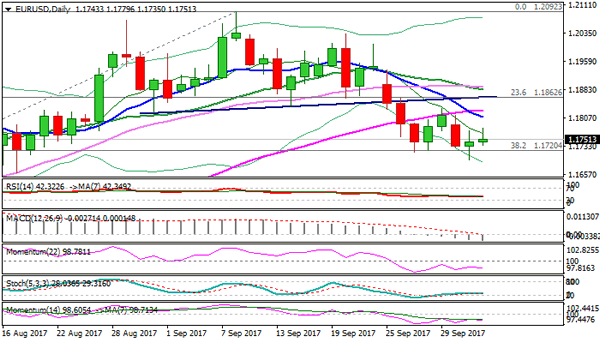
The EUR/USD lost 0.812 percent in the last five trading days. The single currency is trading at 1.1932 after US tax reform got closer to reality this week. The euro had advanced at the start of the week as more USD weakness was anticipated, but a turnaround in market expectations on a December rate hike and a show of momentum on tax reforms started a dollar rally putting the pair below 1.20. Political uncertainty has been a big factor of USD trading and a Trump administration ready to embrace dialogue with Democrats is seen as a productive development.
Next up will be the September Federal Open Market Committee (FOMC) meeting. The market is expecting the Fed to formally announce the start of the reduction of its balance sheet. Since the move is expected to be gradual the Fed could push the announcement back, specially if there is some uncertainty about a December rate hike but the dollar would suffer if that is the case. The White House has remained tight lipped about who will be the Fed Chair next year. Yellen's term ends in February, and with the falling out to favour of Gary Cohn, she could even remain in the job. While Janet Yellen was not the first choice of the Obama administration she got the nod, after a scandal took the front runner Larry Summers out of contention.

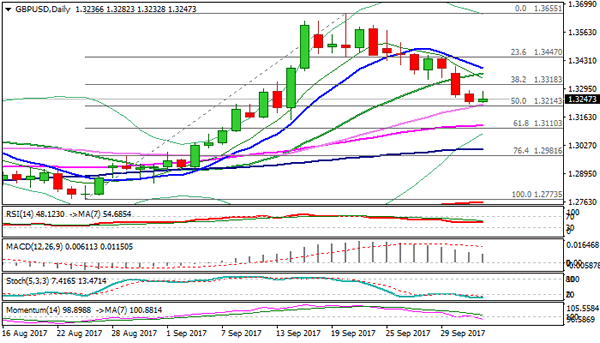
The GBP/USD gained 2.867 percent during the week. The currency pair is trading at 1.3567 near weekly highs of 1.3617. The hawkish policy by the Bank of England (BoE) drove the pound to its highest post Brexit referendum. Even the doves within the central bank have endorsed a rate hike in the near future. Rising inflation and a tighter job market have convinced uber dove Gertjan Vlieghe to back a higher interest rate.
The Office for National Statistics will release UK retail sales on Wednesday September 20 at 4:30 am EDT. The forecast calls for a rise of 1.1 percent, but taking the volatile items out of the equation will show a 0.1 percent gain. Rising inflation in the UK is a concern because despite a tighter job market wages remain flat putting more pressure on households to cope with higher prices.

US oil prices surged 4.016 percent in the last five days. The West Texas Intermediate is trading at $49.63 after briefly touching $50 per barrel. Oil prices recorded near two month highs as demand expectations picked up after the Organization of the Petroleum Exporting Countries (OPEC) released higher demand in 2018. US refineries getting back online also boosted energy prices. Higher demand with limited production due to Hurricanes Harvey and Irma boosted prices.
The International Energy Agency (IEA) also published a report this week that forecasts strong demand keeping the price of Brent above $55 and WTI near $50.
Market events to watch this week:
Monday, September 18
- 9:30pm AUD Monetary Policy Meeting Minutes
Tuesday, September 19
- 8:30am USD Building Permits
Wednesday, September 20
- 4:30am GBP Retail Sales m/m
- 10:30am USD Crude Oil Inventories
- 2:00pm USD FOMC Economic Projections
- 2:00pm USD FOMC Statement
- 2:00pm USD Federal Funds Rate
- 2:30pm USD FOMC Press Conference
- 6:45pm NZD GDP q/q
- 11:50pm JPY Monetary Policy Statement
Thursday, September 21
- Tentative JPY BOJ Policy Rate
- 2:30am JPY BOJ Press Conference
- 8:30am USD Unemployment Claims
Friday, September 22
- 8:30am CAD CPI m/m
- 8:30am CAD Core Retail Sales m/m
- 8:30am All Day NZD Parliamentary Elections
*All times EDT
Week Ahead – FOMC: Balance Sheet Announcement and Rate Projections Eyed; BoJ to Stand Pat
The Federal Reserve is expected to make its long-awaited announcement on its balance sheet reduction plan next week, though investors will probably be more interested in the FOMC's latest dot plot chart. The Bank of Japan also holds a monetary policy meeting but it will likely be a less exciting event than the Fed's. On the data front, Eurozone flash PMIs, UK retail sales, Canadian inflation and New Zealand GDP will be the highlights.
Eurozone data unlikely to shift euro out of consolidative phase
As the European Central Bank works on the details of its stimulus withdrawal plan, the euro rally has taken a pause. Data releases next week should provide some support for the euro but are not seen to drive the single currency to fresh highs, especially amid a stronger dollar and pound. First on the calendar is Monday's final inflation readings for the block. The annual rate of change in Eurozone CPI is expected to be confirmed at 1.5% in August, but core CPI is forecast to be revised down to 1.2% from the flash estimate of 1.2%. Germany's ZEW business survey will be watched on Tuesday. The ZEW economic sentiment and current conditions indices are both expected to improve in September. Eurozone producer prices for August will follow on Wednesday, but all eyes will be on Friday's flash PMI readings. Economic activity in the euro area is expected to remain steady with the IHS Markit composite PMI falling marginally to 55.6 in September's flash reading. The services PMI is forecast to stay unchanged at 54.7, while the manufacturing PMI is expected to decline by 0.2 to 57.2.
Bank of Japan meeting to be a non-event?
The Bank of Japan's policy meetings are known just as much for being non-events as for surprising markets with unconventional stimulus measures. The meeting on September 20-21 is looking like it will be the former as the Bank is not likely to make any changes to its forecasts before the October meeting when it will publish its quarterly outlook report. It's possible that next month the Bank could once again delay the timing of when its expects to hit its 2% inflation target. This would reinforce expectations that the BoJ will be the last of the major central banks to start tightening monetary policy. Before the BoJ meeting, trade data will come in focus on Tuesday. Exports from Japan are forecast to rise by 14.7% year-on-year in August as a weaker yen and improving global demand continue to boost Japanese manufacturing output. Another positive figure in August would make it the ninth consecutive month of annual gains in exports.
New Zealand GDP eyed ahead of elections
GDP figures out of New Zealand next week may provide a welcome distraction away from the September 23 election campaign that is proving to be a much tighter race than anyone anticipated. An unexpected strong showing for the Labour party has made the New Zealand dollar highly volatile in recent weeks as the prospect of the ruling National party losing power has unnerved investors. Solid GDP data on Wednesday could remind markets that the country's economic fundamentals remain strong and possibly provide some indication to the timing of a rate hike by the Reserve Bank of New Zealand. After growing at a relatively modest pace in the previous two quarters, New Zealand's economy is forecast to pick up speed in the June quarter, with growth accelerating to close to 1% over the quarter.
Canadian inflation and retail sales data to be watched after surprise rate hike
The Bank of Canada had to defend itself this week after receiving criticism for not clearly communicating that a rate hike at its September 6 meeting was on the cards. Market participants will therefore be watching next week's inflation and retail sales numbers more carefully for clues about a possible third rate hike in as many months. Canadian CPI, due on Friday, is forecast to rise from 1.2% to 1.5% y/y in August, suggesting that inflation is moving back towards the BoC's target as expected. Retail sales, also out the same day, are forecast to grow by 0.2% month-on-month. An upside surprise could add fresh impetus to the loonie's rally, which is currently trading near two-year highs against the greenback.
UK retail sales growth to moderate further
An IT problem at the Office for National Statistics caused a delay to the retail sales data, which are normally published in the same week as the inflation and employment reports. The delayed release may act in cooling the pound's 3% surge this week as retail sales are forecast to ease in August. Annual growth in retail sales is expected to moderate for the second month in a row to just 1.1% in August, while the month-on-month rate is forecast at 0.2%. A worse-than-anticipated reading may feed doubt into the expectations that the Bank of England will begin raising rates in the coming months.
Fed to start balance sheet normalization
The Fed will move into the limelight next week as it holds its two-day monetary policy meeting on September 19-20. However, second-tier data releases should also attract some attention, starting with a batch of August housing data on Tuesday. Building permits and housing starts are both released on Tuesday, followed by existing home sales on Wednesday. The Philly Fed's diffusion index of manufacturing activity for September is out on Thursday, and the IHS Markit flash manufacturing and services PMIs (also for September) will round up the week on Friday.
An announcement on reducing its $4.5 trillion balance sheet is widely expected by the Fed on Wednesday given that such a decision has been well telegraphed by FOMC members over the past few months. Market reaction, in particular for US treasury yields, will likely be muted as the Fed has said it will proceed with scaling back its reinvestments in maturing treasuries and mortgage-backed securities very gradually.
The bigger surprise at Wednesday's announcement and press conference by Chair Janet Yellen might come from the FOMC's revised economic projections. After this week's stronger-than-expected inflation data, a December rate hike is back in play. Therefore, any indication that Yellen is becoming more confident that inflation is heading back up again could fuel the dollar's gains from this week. More importantly, the Fed's latest dot plot chart should reveal whether or not FOMC members still expect to see a third rate hike this year and if there's been any change to their rate path prediction for 2018.
Weekly Market Outlook: FOMC, BoJ, & Norges Bank Policy Meetings
Next week's market movers
- The main event will probably be the FOMC policy meeting. Markets may focus on any potential changes to the "dot plot", as well as the timing of balance sheet normalization.
- In Japan, the BoJ is likely to keep its ultra-loose framework unchanged once again. That said, we expect a more upbeat tone from policymakers, amid encouraging economic developments.
- The Norges Bank is likely to stand pat as well. We suspect officials could appear a bit more concerned, given the latest slowdown in inflation, and could push slightly back the timing of their first planned rate hike.
- We also get key economic data from the Eurozone, the UK and Canada.
On Monday and Tuesday, the economic calendar is relatively light, with no major events or indicators coming out..
On Wednesday, the main event will be the FOMC policy announcement. This is one of the "bigger" meetings, meaning that besides the rate decision we will also get fresh economic forecasts for the US economy, an updated "dot plot", as well as a press conference by Chair Yellen. According to the Fed funds futures, the financial community is almost certain that policymakers will keep interest rates unchanged, and we agree with that given that inflation remained subdued in the aftermath of the latest meeting. Although August's data showed that both the headline and core CPI rates rebounded, we doubt that just a single data set will be enough to ease the concerns of those policymakers who believe that the latest softness in inflation is not due to idiosyncratic factors.
We believe that the market will place most of its emphasis on any signals regarding the beginning of the balance sheet normalization. Market chatter suggests that this process may start at this meeting or the next one, in October. As for our view, we don't expect the Bank to start the process now, but it could provide clear signals that this may happen in October. The risk to that view is officials leaving the language around that subject unchanged. Specifically, they could keep the part saying that the reduction will begin "relatively soon" in order to leave themselves some room for maneuvering if economic data continue to disappoint.
As for the forecasts, we will mainly focus on the "dot plot" to see whether the Committee as a whole continues to anticipate another rate increase this year. We expect the plot to still signal another hike this year. Although we got increasingly dovish comments last week, these remarks came mostly from members we suspect that they have already indicated they won't support additional hikes in 2017. As for the pace of future hikes, we believe that they may keep it untouched as well and wait to see whether the latest rebound in inflation will continue. If not, they may revise down the "dot plot" in December.

On Thursday, during the Asian day, the BoJ policy decision will be in the spotlight. With no forecast available, we see the case for the Bank to keep its QQE with yield-curve control framework intact once again, and to appear slightly more optimistic than previously. Economic developments since the latest BoJ meeting have been positive on every front. With regards to inflation, both the national and the BoJ's core CPI rates rose further in July, while the forward-looking Tokyo core CPI rate for August rose as well, suggesting that this recovery in inflation is likely to continue. Meanwhile, the unemployment rate declined further, while economic growth accelerated.
Given this cocktail of encouraging developments, we think the BoJ is likely to upgrade its language around the Japanese economy, and perhaps even revise up its economic forecasts. That said though, we still think it's too early for speculation regarding a potential reduction in stimulus in the near-term. Under its current framework, the Bank has explicitly committed not only to achieve its 2% inflation target, but to actually overshoot it. Thus, although the CPI rates rose somewhat, as long as they remain so far away from the target, we doubt any change in policy is looming.

During the European day, the Norges Bank will announce its own rate decision. When it last met, the Bank revised up its GDP forecasts for 2017, and even though it marked down its expectations for near-term inflation, it upgraded them for the long term. Perhaps the most notable change was that the Bank removed its easing bias and now expects the key policy rate to remain at the current level in the period ahead, while it revised slightly higher its expected rate path for 2017 and 2018.
Since then economic data have been mixed. The nation's GDP accelerated notably in Q2, which is in line with the Bank's forecast, while the unemployment rate slid further in August. On the other hand, inflation slowed in August, confounding expectations of rising. We don't expect the Bank to take any action at this meeting, neither to change its language. However, due to declining inflation, officials could push further back the timing of when they expect to start raising interest rates.

Finally on Friday, the economic indicators likely to attract market attention are Eurozone's preliminary PMIs for September, and Canada's CPI data for August.
Weekly Market Outlook: Low Key BoJ Meeting
- Low Key BoJ Meeting - Peter Rosenstreich
- BoE Hawkish Shift Changes The Game - Arnaud Masset
- Gold Consolidates And Bitcoin Takes A Serious Hit - Yann Quelenn
- Global High Dividends
FX Market - Low Key BoJ Meeting
The BoJ meeting should be an uneventful event. Despite the one-year anniversary of yield curve control (YCC), growing question of stability and political pressure, now is not the time for the BoJ to act. Governor Kuroda will likely keep the BoJs primary policy framework unchanged. In July, the BoJ decreased its inflation forecast, which in turns changed the time for reaching the banks well published 2% inflation target. The new date is a distant 2019 as inflation trajectory is far from their stated goal. July core CPI, which excludes only fresh foods, increased to 0.5% y/y, core CPI, a strong view of underlying inflation pressures, remained around 0%. Initially, YCC policy likely help to an acceleration of yen weakening in Q4 2016, but much more depreciation would be required to achieve the 2% goal and effect is now limited. Growth on the other hand has picked up with solid activity in 2Q as real GDP growth was 2.5% but spillover into prices have not materialized. So from a stated objective standpoint there is not rush to shift policy position. Recent communications from Kuroda indicates its too early to discuss exits strategies.
Markets will be focused on vote composition after the board members changes (Mr. Kataoka and Mr. Suzuki first meeting) and communication guidelines regarding JGB purchase operation (BoJ have decelerated JGB purchases per operation since mid-August). In addition, timing of the meeting will provide Kuroda a platform to discuss the FOMC. The JPY is now at the crossroads. YCC no longer pro-actively weakens the yen but does setup up environment allowing hawkish foreign central banks (ECB, BoE, Fed, BoC) shift toward normalization to drive JPY downwards. Events around N. Korea has created a safe haven buying rationale, yet in reality real yield differentials remains the primary driver of USDJPY pricing. However, political pressure on Abe could spill over into BoJ policy. Although the board is made up of policy doves a political changes could threaten the BoJ policy path. Without extraordinary measure, the JPY will likely appreciate.


Economics - BoE Hawkish Shift Changes The Game
It has climbed to multi-month amid volatile week as investors anticipate the Bank of England is about to reduce its support to the economy. However, prior to the BoE hawkish shift, the week was punctuated by the release of several key economic indicators. On the inflation side, an upside surprise in August CPI readings gave a first booster to the pound. It was followed by
The headline gauge printed at 2.9y/y versus 2.8% median forecast and 2.6% in the previous month. The core measure, which excludes the most volatile components, came in at 2.7%y/y versus 2.5% expected and 2.4% in July, suggesting that the tick up in fuel price is not the sole explanation. Indeed, the sharp depreciation of the pound sterling over the last few months impacted positively the cost of imported goods. Clothing and footwear component rose 4.6% over the last 12 months, contributing to 0.26 points to the CPIH rate (compared to -0.07 a year ago), while the surge in restaurant and hotels prices contributed to 0.35 points (compared 0.23 a year ago).
On the unemployment front, the July's jobs report added more impetus to the GBP bulls. The ILO unemployment rate fell to 4.3% July from 4.4% a month ago as employment change rose to 181,000 versus 150,000 median forecast and 125,000 in June. However, average weekly earnings stayed stable at 2.1%y/y versus 2.2% expected. The lack upside pressure in basic wage growth suggest that households' stalling disposable income won't accelerate the pick-up in inflation. In addition, the pound sterling has stabilised since the beginning of the year, if not recovered, and this would somehow eases the upside pressure in inflation stemming from the exchange rate.
Finally, the BoE took a more hawkish stance on Thursday and appeared ready to hike borrowing rates against the backdrop of an improving economic picture and most importantly stronger inflation. Prior to the BoE decision, we thought the central bank would take a more dovish stance and would rather emphasized the downside risk created by the Brexit situation. Nevertheless, it is clear now that the BoE believe the economy is strong enough to take a 25bps hike, regardless the potential negative effect a hard Brexit. In addition, it seems that the Brexit negotiations will take longer than expected and that UK lawmakers are finally to take a conciliatory tone and abandon the harsh rhetoric.

Economics - Gold Consolidates And Bitcoin Takes A Serious Hit
Gold has largely increased since the start of the year going from $1150 to $1350. The sharpest increase was during the summer. The decline of the dollar was largely followed by an increase in the precious metal. Now that central banks needs to deliver within the short-term (balance sheet normalization for the Fed, reduction of the asset purchase program for the ECB), we believe that there are more upside for the yellow metal as we consider that global economic conditions are clearly not good enough to support a change in the monetary policy.
Technically, gold is in a clear uptrend channel and as inflation is back in the US, this is another strong point regarding the potential appreciation of the commodity. Yet competition appears and gold, which is one great asset for storage of value is now competing against Bitcoin.
This year has been a great year for the first cryptocurrency so far. Debates are strong regarding the question if Bitcoin will become a safe haven. Jamie Dimon, JP Morgan Chase CEO, has declared that "Bitcoin is a fraud". Cryptocurrencies are a new asset class and the war between fiat money and cryptocurrencies will be on regulatory issues. Recently the People's Bank of China has triggered a sell-off in the whole cryptocurrency market by forbidding exchanges. Yet, rumours are stating that exchanges will be able to buy licenses in order to be allowed.
Needless to say that the power of money is not a power central banks are willing to let decentralize. Bitcoin took a hit since this comment. Other would also say that China and its ICO ban are weighing on the most famous cryptocurrency. Further downsides are happening but Bitcoin still has a lot of potential. Only less than 0.01% of the global population has a bitcoin wallet.
If this would reach 1%, the demand for Bitcoin would skyrocket, knowing that there are only 18 million coins available at the moment.

Themes Trading - Global High Dividends
Dividends are set to become increasingly important to global investors. Over the past century, dividends have accounted for approximately 50% of total returns earned by investors. Should stock returns flatten, it will be expected dividends that will likely drive growth for investors. This means that in today's low-yield and low-volatility environment, the stability of dividend-paying stocks with historical total return characteristics has been in high demand.
Companies selected for this theme provide investors with geographical and industry perspective diversification, while offering the potential for capital appreciation and reliable income. This theme attempts to avoid the `dividend trap' by focusing on companies that have delivered consistent dividend growth with limited share price volatility.
IMPORTANT
The subscription period opens on September 12 and will run until September 25, 2017. This means the price will not move until September 25, the date on which the initial allocation will be made. Do not hesitate to contact us if you have any questions.

Weekly Focus: Riksbank May be Next to Join ‘Exit Camp’
Market Movers ahead
We look for the FOMC to announce "quantitative tightening" and signal one more rate hike this year when it meets on Wednesday.
We expect EUR manufacturing PMI to show a slight drop from the current strong level as the stronger euro is likely to weigh a bit on euro exports. We also look for a small decline in the German ZEW index.
Chinese house price inflation for August is likely to show a further moderation as tightening measures are starting to dampen home sales and prices.
Bank of Japan: we expect it to keep its policy stance unchanged.
In Scandinavia, the Riksbank's minutes should give more insight into how close the bank is to joining the 'exit' camp. We don't expect any rate change or change to the rate path from Norges Bank at its meeting on Thursday.
Global macro and market themes
Central bankers look increasingly divided into those in the 'exit' camp (Fed, BoE, ECB), those in the 'no exit camp' (BoJ, SNB), and those in between (Riksbank, Norges Bank).
While the Fed looks determined to hike in December, it is unlikely to drive a major selloff in EUR/USD.
Dollar Extends Losses; BOE Vlieghe Pushes Pound Above $1.36
The dollar could not find support on the closely watched US retail sales figures released during the European session as the numbers came in lower than forecast, while risk-off sentiment continued weighing on the currency. Among major currencies, though, the pound was the best performer as it managed to reach post-Brexit levels after BOE's Gertjan Vlieghe signalled that a rate hike might emerge in next months.
While investors anticipated US retail sales to grow by 0.1% m/m in August, the actual change was negative at -0.2% affected mainly by the impact of Hurricane Harvey on motor vehicle purchases. This was the biggest decline recorded in six months, pointing that consumption would likely moderate in the third quarter. The previous post of a growth of 0.6% was also revised downwards to 0.3%. Excluding automobiles, core retail sales increased by 0.2%, falling short of the 0.5% expected and 0.4% (revised downwardly from 0.5%) observed in July.
US industrial production also missed forecasts, falling by 0.9% m/m and reaching the biggest drop since April 2016. Projections were for industrial output to climb by 0.1%, below the 0.4 posted in July (upwardly revised from 0.2%).
The index pertaining to the University of Michigan's preliminary survey on consumer sentiment for the month of September, released during afternoon European trading hours, surprised to the upside. Specifically, the reading came in at 95.3. Expectations were for it to stand at 95.1, while the final reading for August stood at 96.8.
Next up, markets will look forward to the FOMC meeting on Wednesday, where Fed voting members would have to decide whether to raise interest rates given better than expected inflation numbers, a low unemployment rate but a sluggish wage growth. Moreover, Fed policymakers would keep in mind the financial impact of the two tropical storms Harvey and Irma as the New York President William Dudley said a week ago that the damage caused by those storms might influence the timing of the next rate hike.
The dollar index was under pressure during the European session, touching an intra-day low of 91.54 after today's data out of the US reduced optimism about the strength of the economy. Moreover, North Korea's latest missile test earlier today made investors look for less risky assets.
The safe-haven yen was up by 0.54% on the day with dollar/yen touching an intra-day low of 110.60 before it jumps to 110.82. Recall that the Bank of Japan will launch its policy meeting on Thursday with markets projecting the bank to maintain its ultra-easy monetary strategy.
A day after the Bank of England (BOE) held interest rates steady at record low of 0.25% and hinted through its statement a potential rate hike in the coming months, BOE Monetary Policy Committee (MPC) member, Gertjan Vlieghe, added more weight on the latter, clarifying that the central bank should raise rates "as early as in the coming months". Vlieghe, considered as one of the dovish MPC members, said that with the unemployment rate receding and wage growth expected to rise, pushing inflation further above the BOE's target rate, monetary policy should be tightened. This convinced markets that the BOE might deliver a rate hike for the first time in a decade as soon as November.
In other news out of the UK, several people were injured after an explosion in Parsons Green Underground Station in west London. This is currently suspected as a terrorist action. Despite this incident, the pound peaked at a post-Brexithigh of $1.3615 before slipping to 1.3577, up by 1.36% on the day and by 3.30% during this week, gaining by the hawkish message of Vlieghe.
In the Eurozone, wage growth (not seasonally adjusted) came in higher in the second quarter, rising by 2.0% y/y compared to the 1.3% seen in the first quarter, increasing the odds that the ECB will announce an outline of its stimulus reduction in October. However, on Monday, the central bank will analyze the block's CPI readings for the month of August to see whether higher wages drove prices towards the bank's 2% target.
In another report, the euro area's trade surplus came in at 23.2bn euros, better than the 21.4bn euros that was expected but below the previous mark of 26.6bn euros.
The euro hit an intra-day high of $1.1986 following the disappointing US retail sales figures, before later falling to $1.1977, reversing the losses made over the last two days relative to the US currency. Against the pound, the euro ticked up to 0.8812 after reaching a two-month low of 0.8773 earlier in the session. Euro/pound was still significantly down on the day.
Regarding commodities, oil prices recovered during European trading, while gold continued its downtrend. WTI crude edged up to $49.91 per barrel while Brent jumped to $55.74. Gold was trading lower at $1,321.7 per ounce.
Dollar Losing Ground Amid Weak Retail Sales
The greenback is losing positions on the background of profit taking by traders after its recent appreciation. Other events that put the USD under pressure were comments by European politicians regarding monetary tightening in the UK and cutting of the asset purchasing program in the Eurozone in 2018. The possibility of a quarter percent interest rate hike in the UK, to bring the rate to 0.50% in November, is just shy of 50% after a hawkish statement by the Bank of England. At the same time, inflation in the Eurozone, according to ECB's officials is likely to approach the target level of 2.0% and plans to cut quantitative easing in the euro area are likely to be announced at the end of October after the ECB meeting.
The US dollar also took a hit today from weak retail sales that fell 0.2% in August against forecasted growth of 0.1%. The Empire State manufacturing index in September, which declined to 24.4 against the forecasted fall to 18.2, could not change traders' mood. By the end of the trading session today we may see the typical fixing of positions ahead of the weekend.
The New Zealand dollar demonstrates positive dynamics that was caused by a number of factors, including the growth of Business NZ manufacturing index to 57.9 in August against 55.5 in July and the growth of new loans amount in China to 1090 billion against the expected increase to only 933 billion in August. Keep in mind that China is the key trade partner for New Zealand.
EUR/USD
The EUR/USD accelerated the upward dynamics after it was able to overcome resistance at 1.1925. Now the price is close to 1.2000 and its breaking may open the way for continued increases up to 1.2070 and 1.2200. The RSI on the 15-minute chart is in the overbought zone that may be judged as a reason for a descending correction soon.

GBP/USD
The GBP/USD is soaring after it left the limits of the rising channel. Currently the quotes are consolidating under the important 1.3600 mark, and breaking through that may become a trigger for a continued increase to 1.3800. In case of a rollback, quotes may return to SMA100 on the 15-minute chart or the support lines at 1.3500 and 1.3400.

NZD/USD
Within the rising impulse, the quotes of NZD/USD reached the inclined resistance line and horizontal obstacle at 0.7300. Approaching this level, and the RSI on the 15-minute chart being near the overbought area, increases the chances of a pullback of NZD/USD happening soon with the first goals at 0.7250 and 0.7200.

Trade Idea Wrap-up: USD/CHF – Stand aside
USD/CHF - 0.9603
Most recent candlesticks pattern : N/A
Trend : Near term up
Tenkan-Sen level : 0.9607
Kijun-Sen level : 0.9621
Ichimoku cloud top : 0.9653
Ichimoku cloud bottom : 0.9635
New strategy :
Stand aside
Position : -
Target : -
Stop : -
As the greenback slipped again after meeting renewed selling interest at 0.9648 earlier today, justifying out view that top has been formed at 0.9705 yesterday and our short position entered at 0.9680 just met our downside target at 0.9580 (with 100 points profit) in NY morning, this anticipated decline signals the rise from 0.9421 low has ended at 0.9705 yesterday and mild downside bias remains for weakness to 0.9560-63 (50% Fibonacci retracement of 0.9421-0.9705) but reckon 0.9525-30 (61.8% Fibonacci retracement) would hold.
As we have taken profit on our short position entered at 0.9680, would not chase this fall here and would be prudent to stand aside in the meantime. Above the Kijun-Sen (now at 0.9621) would bring another bounce to 0.9648 but break there is needed to signal an intra-day low is formed, bring test of 0.9670-75 later.

Trade Idea Wrap-up: GBP/USD – Buy at 1.3490
GBP/USD - 1.3588
Most recent candlesticks pattern : N/A
Trend : Near term up
Tenkan-Sen level : 1.3507
Kijun-Sen level : 1.3481
Ichimoku cloud top : 1.3263
Ichimoku cloud bottom : 1.3263
Original strategy :
Buy at 1.3490, Target: 1.3600, Stop: 1.3455
Position : -
Target : -
Stop : -
New strategy :
Buy at 1.3490, Target: 1.3600, Stop: 1.3455
Position : -
Target : -
Stop : -
Although cable has eased after intra-day rally to 1.3617 and minor consolidation below this level would be seen and pullback to 1.3510-20 is likely, reckon 1.3490 would limit downside and bring another rise later, above said resistance at 1.3617 would extend recent upmove to 1.3650 and possibly towards 1.3675 but upside should be limited to 1.3700-10, bring retreat later.
In view of this, would not chase this rise here and would be prudent to buy cable on pullback as the Kijun-Sen (now at 1.3481) should limit downside. Below 1.3450-60 would defer and suggest an intra-day top is formed instead, risk correction to 1.3420, then 1.3400.

Trade Idea Wrap-up: EUR/USD – Stand aside
EUR/USD - 1.1969
Most recent candlesticks pattern : N/A
Trend : Near term down
Tenkan-Sen level : 1.1947
Kijun-Sen level : 1.1928
Ichimoku cloud top : 1.1917
Ichimoku cloud bottom : 1.1894
New strategy :
Stand aside
Position : -
Target : -
Stop : -
As the single currency found support at 1.1838 yesterday and has staged the anticipated rebound, our long position entered at 1.1855 met target at 1.1955 (with 100 points profit) and mild upside bias remains for gain to 1.1995-00 (previous resistance and 61.8% Fibonacci retracement of 1.2093-1.1838), however, break there is needed to signal the fall from 1.2093 has ended, bring subsequent rise to 1.2030-35 but overbought condition should cap price below 1.2050.
As we have taken profit on our long position entered at 1.1855, would not chase this rise here and would be prudent to stand aside for now. Below 1.1920-25 would signal an intra-day top is formed instead, bring weakness to 1.1900 but break there is needed to confirm, then fall to 1.1870-75 would follow.