

Sample Category Title
EUR/AUD Daily Outlook
Daily Pivots: (S1) 1.6565; (P) 1.6610; (R1) 1.6685; More...
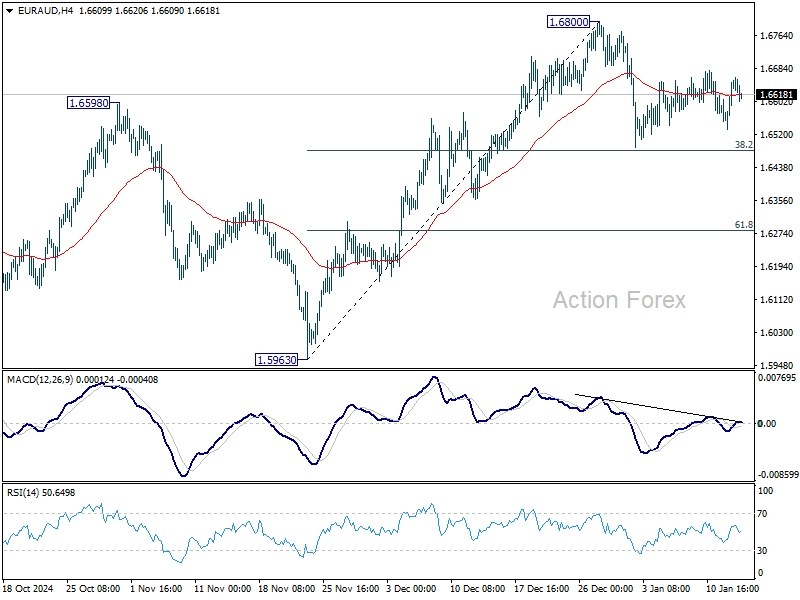
EUR/AUD is still bounded in consolidation from 1.6800 and intraday bias stays neutral. Downside should be contained by 38.2% retracement of 1.5963 to 1.6800 at 1.6480 in case of another fall. Firm break of 1.6800 will resume the rally from 1.5963. However, firm break of 1.6480 will bring deeper correction 61.8% retracement at 1.6283.
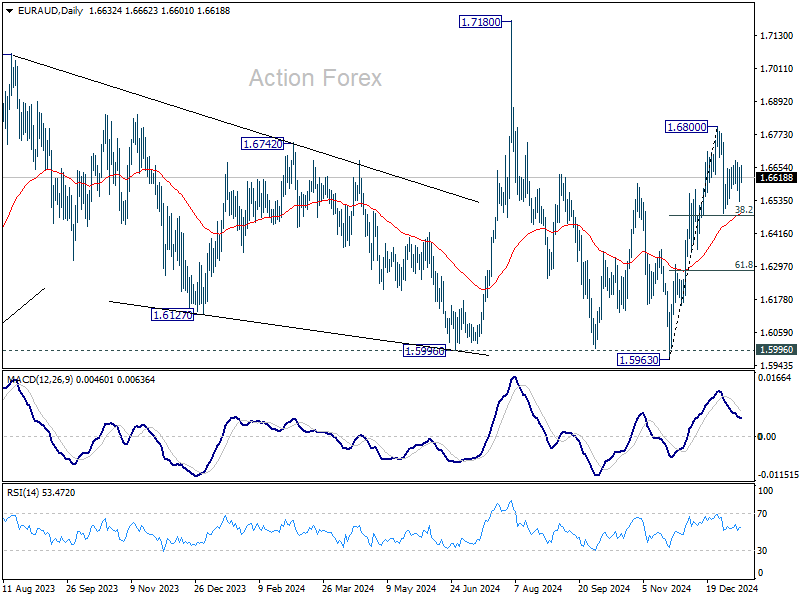
In the bigger picture, EUR/AUD is holding on to 1.5996 key support despite brief breach. Larger up trend from 1.4281 (2022 low) is still in favor to resume through 1.7180 at a later stage. Nevertheless, sustained break of 1.5995 will indicate that such up trend has completed and deeper decline would be seen.
EUR/CHF Daily Outlook
Daily Pivots: (S1) 0.9383; (P) 0.9399; (R1) 0.9422; More....
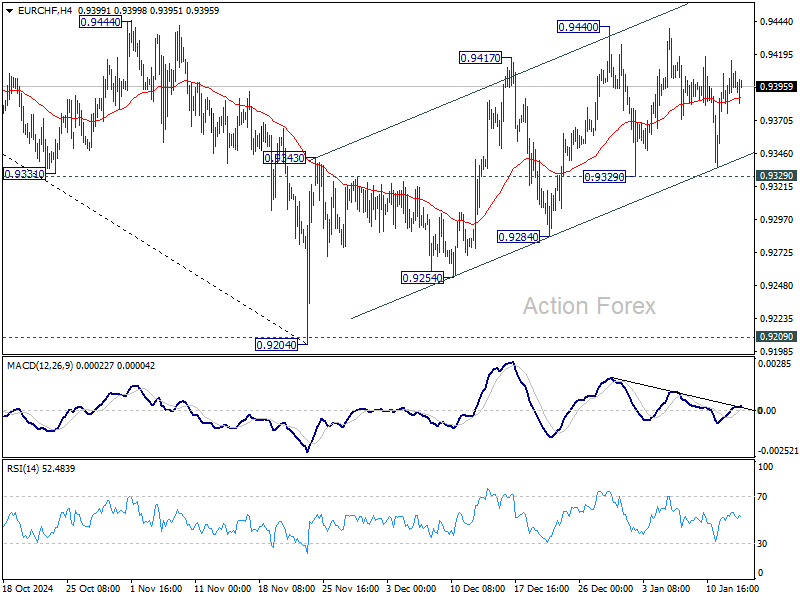
No change in EUR/CHF's outlook as consolidation continues and intraday bias remains neutral. Corrective rebound from 0.9204 could still extend higher. But upside should be limited by 0.9481 fibonacci resistance. On the downside, firm break of 0.9329 support will argue that the correction has completed, and turn bias back to the downside for 0.9284 support first.
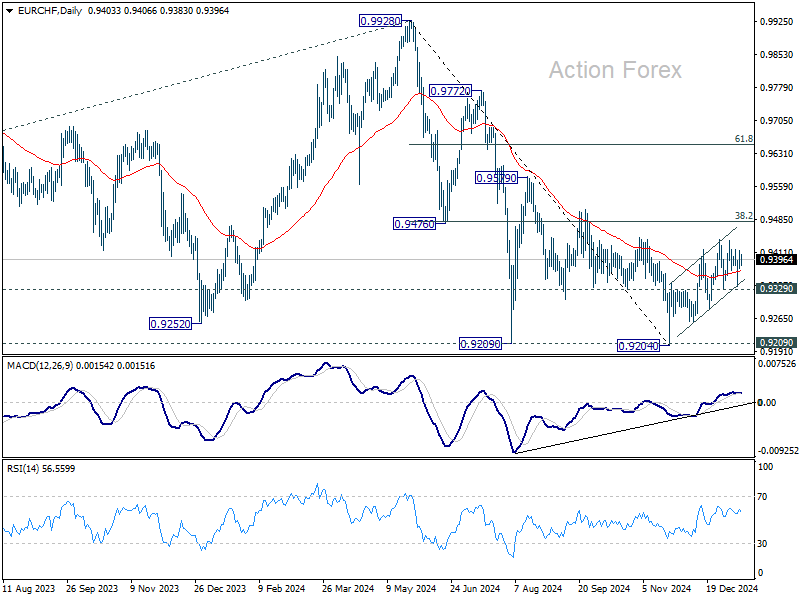
In the bigger picture, while corrective rebound from 0.9204 might extend higher, strong resistance could be seen from 38.2% retracement of 0.9928 to 0.9204 at 0.9481 to limit upside. Down trend from 0.9928 (2024 high) is still in favor to resume through 0.9204/9 support zone at a later stage.
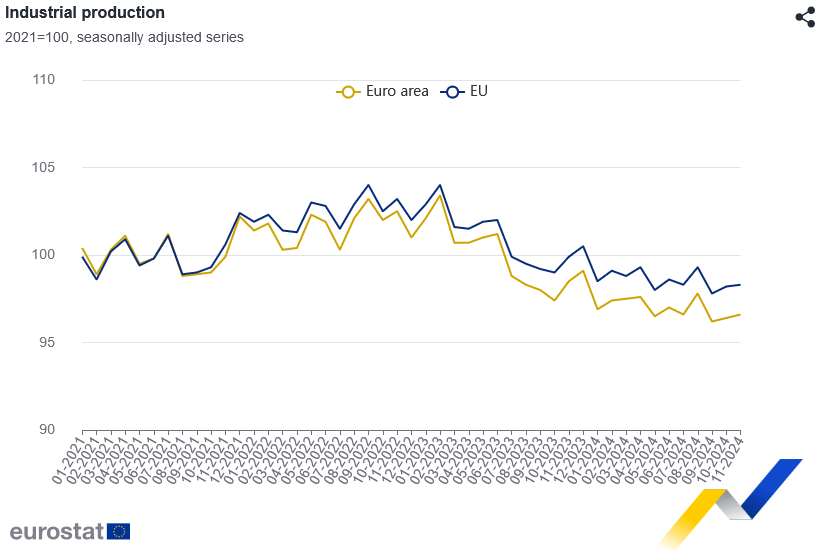
Eurozone industrial production rises 0.2% mom in Nov, EU up 0.1% mom
Eurozone industrial production edged up by 0.2% mom in November, falling short of 0.3% mom consensus forecast. While the overall increase suggests resilience in the industrial sector, the performance was uneven across categories. Production rose by 1.5% for durable consumer goods and 1.1% for energy, highlighting strong demand in these areas. Intermediate and capital goods also posted gains of 0.5% each, while non-durable consumer goods saw a marginal uptick of 0.1%.
Across the broader EU, industrial production grew by just 0.1% on the month. The highest monthly increases were recorded in Belgium (+8.7%), Malta (+7.1%) and Lithuania (+4.3%). The largest decreases were observed in Ireland (-5.8%), Luxembourg (-3.9%) and Portugal (-3.4%).
ECB’s Guindos and Villeroy affirm progress on disinflation
ECB Vice President Luis de Guindos highlighted today that disinflation in the Eurozone is “well on track,” reinforcing optimism about the region's progress toward price stability. While December’s inflation rose to 2.4%, Guindos noted that this increase was anticipated and aligned with ECB’s projections. Domestic inflation remains elevated, but recent easing signals have provided some relief.
Guindos cautioned, however, that risks remain high. “The high level of uncertainty calls for prudence,” he said, referencing global trade frictions that could fragment the global economy further. He also warned about the fiscal policy challenges to weigh on borrowing costs and renewed geopolitical tensions to destabilize energy markets.
Despite weak near-term economic outlook, Guindos expressed cautious optimism, stating, “The conditions are in place for growth to strengthen over the projection horizon, although less than was forecast in previous rounds.”
Meanwhile, French ECB Governing Council member François Villeroy de Galhau echoed a positive sentiment, emphasizing progress against inflation.
“We have practically won the battle against inflation,” he said, projecting that it “makes sense for interest rates to reach 2% by the summer.” However, Villeroy also highlighted risks to France’s 2025 growth forecast of 0.9%, acknowledging that while downside risks persist, a recession remains unlikely.
USD/CAD Daily Outlook
Daily Pivots: (S1) 1.4325; (P) 1.4367; (R1) 1.4392; More...
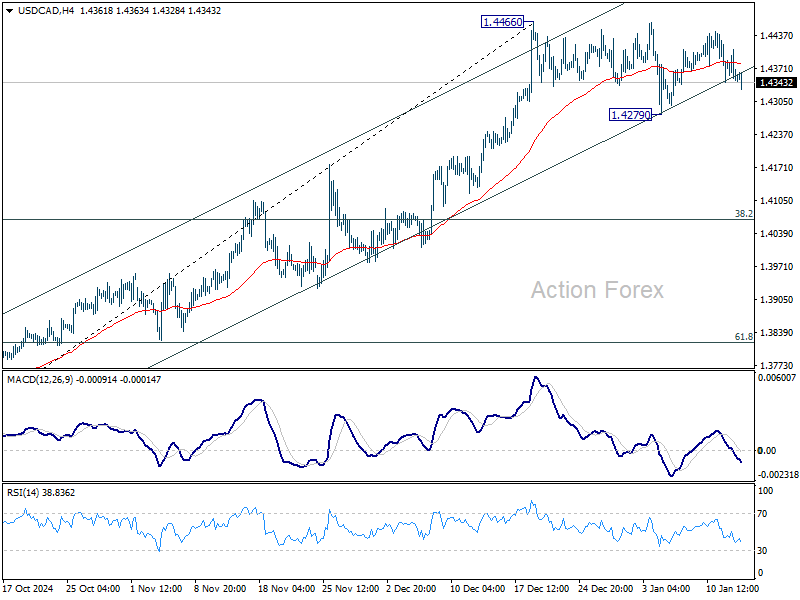
Intraday bias in USD/CAD stays neutral as range trading continues. Break of 1.4279 support will bring deeper correction. But downside should be contained by 55 D EMA (now at 1.4172) to bring rebound. On the upside, break of 1.4466 will resume larger up trend to 1.4667/89 long term resistance zone.
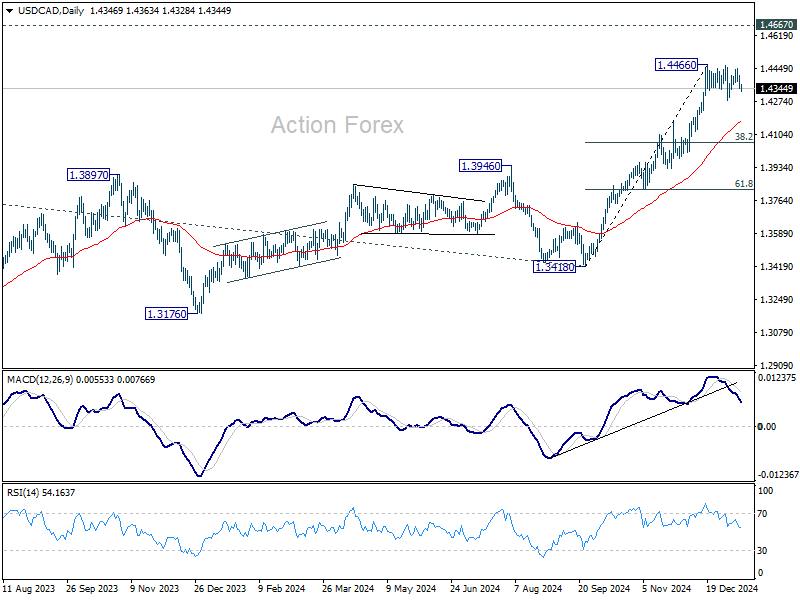
In the bigger picture, up trend from 1.2005 (2021) is in progress for retesting 1.4667/89 key resistance zone (2020/2015 highs). Medium term outlook will remain bullish as long as 1.3976 resistance turned holds (2022 high), even in case of deep pullback.
AUD/USD Daily Report
Daily Pivots: (S1) 0.6171; (P) 0.6189; (R1) 0.6213; More...
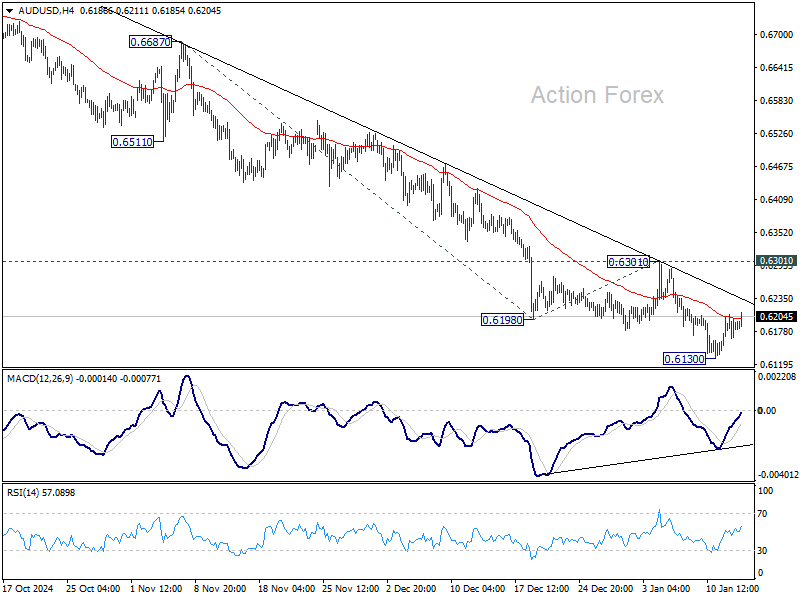
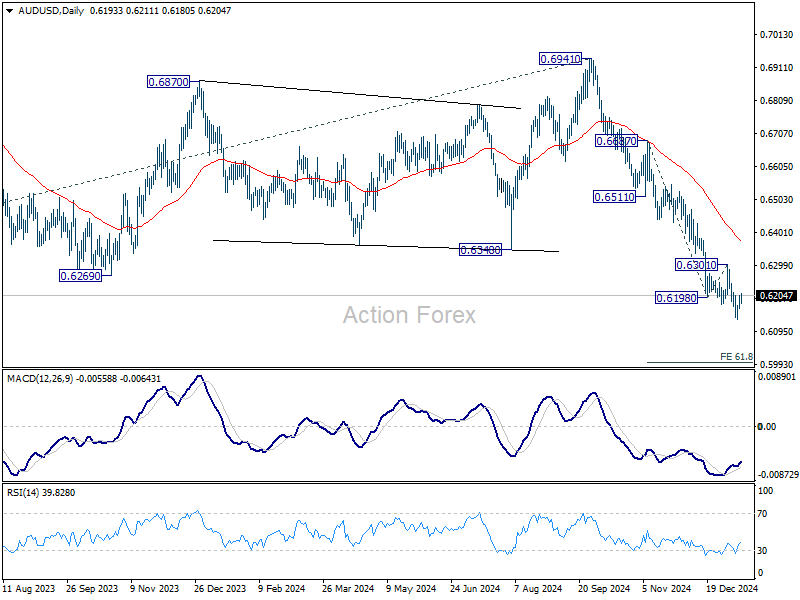
Intraday bias in AUD/USD remains neutral as consolidations continue above 0.6130. Further decline is expected as long as 0.6310 resistance holds. Break of 0.6130 will resume the fall from 0.6941 to 61.8% projection of 0.6687 to 0.6198 from 0.6301 at 0.5999. However, considering bullish convergence condition in 4H MACD, break of 0.6310 will indicate short term bottoming, and turn bias back to the upside for stronger rebound.
In the bigger picture, down trend from 0.8006 (2021 high) is resuming with break of 0.6169 (2022 low). Next medium term target is 61.8% projection of 0.8006 to 0.6169 from 0.6941 at 0.5806, In any case, outlook will stay bearish as long as 55 W EMA (now at 0.6587) holds.
EUR/USD Daily Outlook
Daily Pivots: (S1) 1.0261; (P) 1.0286; (R1) 1.0333; More...
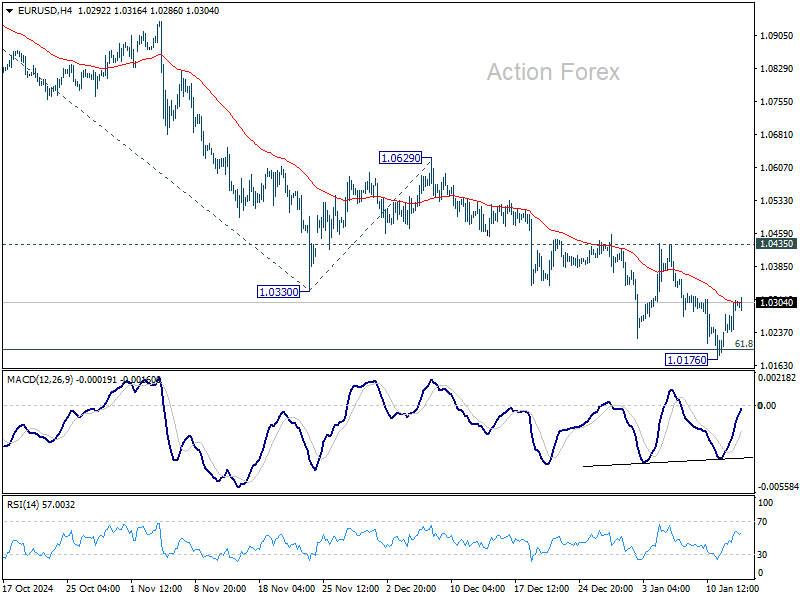
Intraday bias in EUR/USD remains neutral as consolidations continue above 1.0176. While stronger recovery cannot be ruled out, outlook will stay bearish as long as 1.0435 resistance holds. On the downside, break of 1.0176 will resume the fall from 1.1213 and target 61.8% projection of 1.1213 to 1.0330 from 1.0629 at 1.0083.
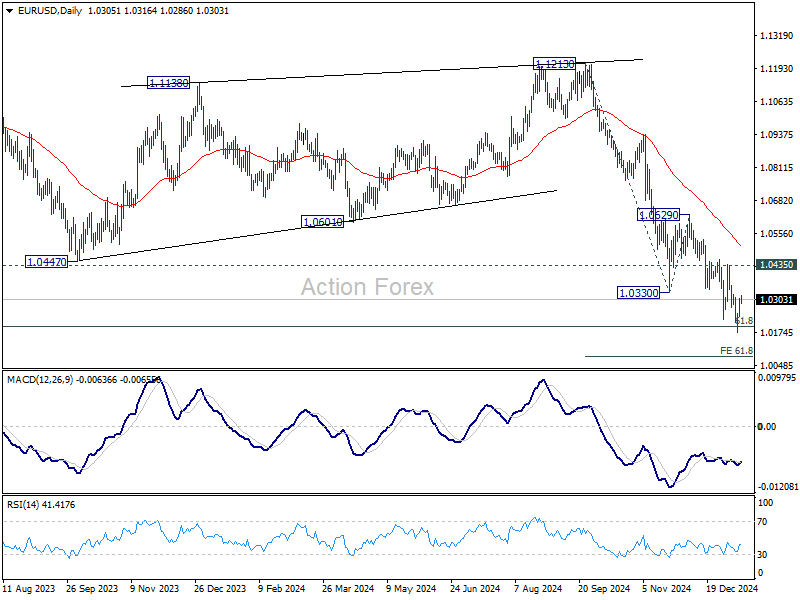
In the bigger picture, fall from 1.1274 (2023 high) should either be the second leg of the corrective pattern from 0.9534 (2022 low), or another down leg of the long term down trend. In both cases, sustained break of 61.8 retracement of 0.9534 to 1.1274 at 1.0199 will pave the way back to 0.9534. For now, outlook will stay bearish as long as 1.0629 resistance holds, even in case of strong rebound.
GBP/USD Daily Outlook
Daily Pivots: (S1) 1.2154; (P) 1.2202; (R1) 1.2264; More...
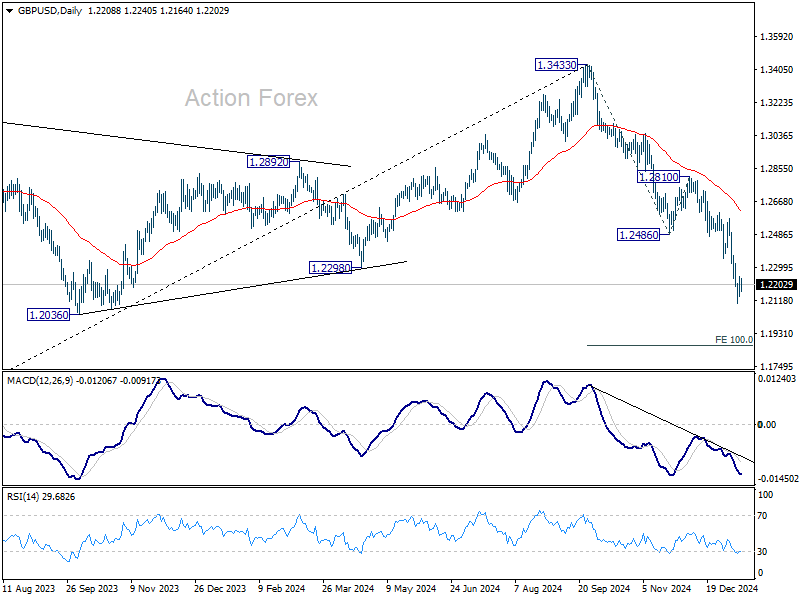
GBP/USD is staying in consolidation above 1.2099 and intraday bias remains neutral. While stronger recovery cannot be ruled out, outlook will stay bearish as long as 1.2486 support turned resistance holds. Break of 1.2099 will resume the decline from 1.3433 to 100% projection of 1.3433 to 1.2486 from 1.2810 at 1.1863.
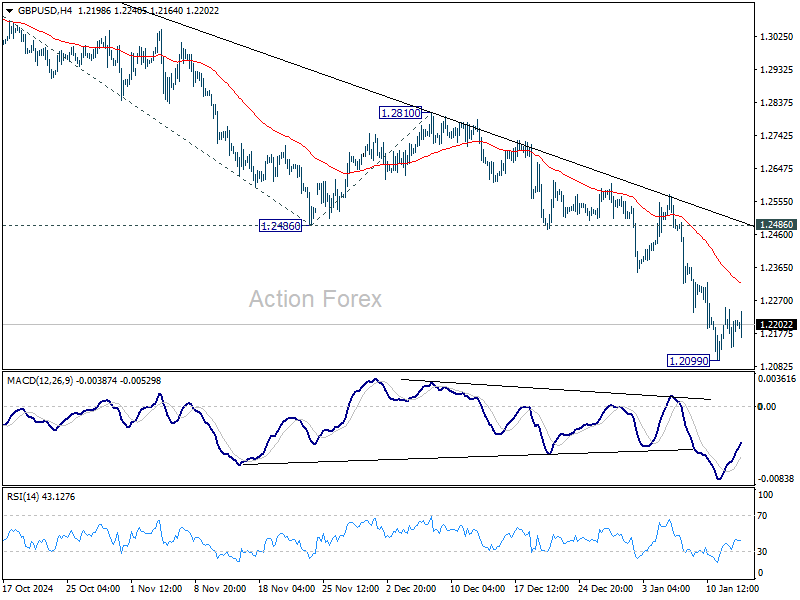
In the bigger picture, rise from 1.0351 (2022 low) should have already completed at 1.3433, and the trend has reversed. Further fall is now expected as long as 1.2810 resistance holds. Deeper decline should be seen to 61.8% retracement of 1.0351 to 1.3433 at 1.1528, even as a corrective move.
USD/CHF Daily Outlook
Daily Pivots: (S1) 0.9105; (P) 0.9141; (R1) 0.9159; More…
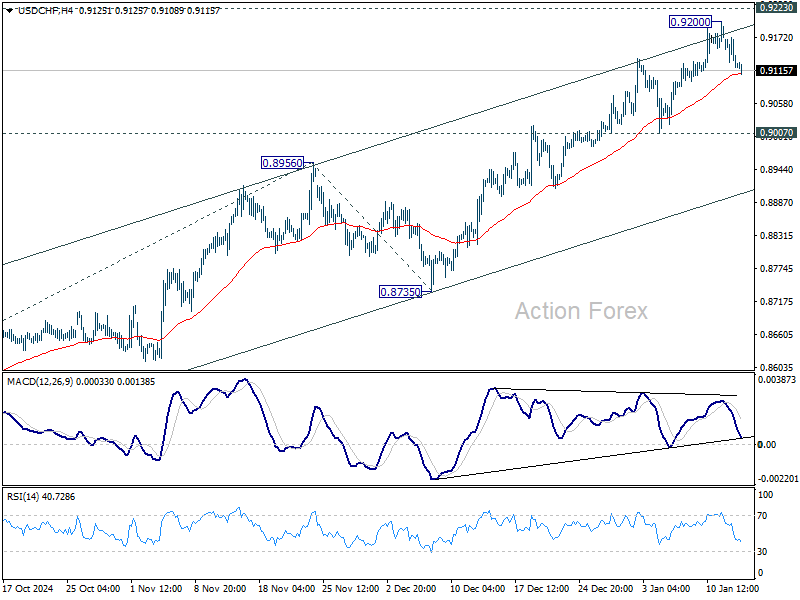
Intraday bias in USD/CHF stays neutral and outlook is unchanged. More consolidations could be seen and deeper pullback cannot be ruled out. But near term outlook will stay bullish as long as 0.9007 support holds, in case of deep retreat. On the upside, decisive break of 0.9223 will carry larger bullish implications.
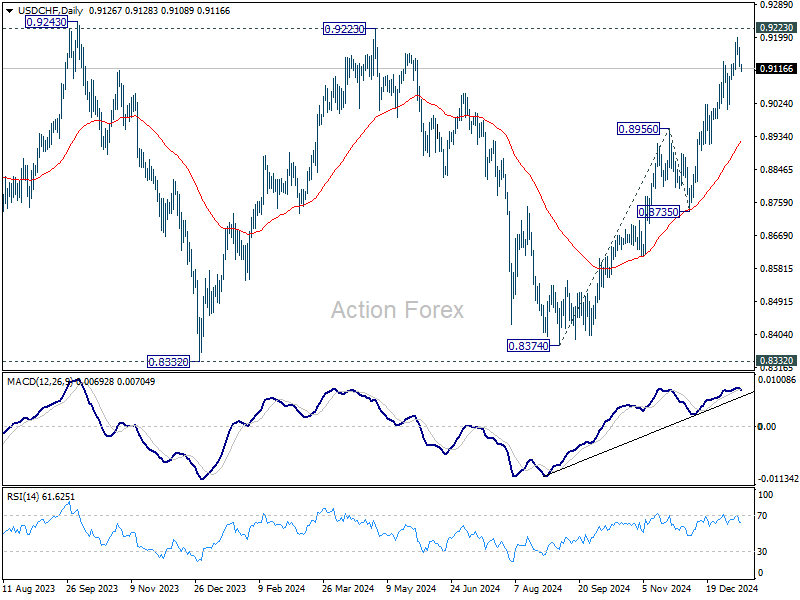
In the bigger picture, price actions from 0.8332 (2023 low) are currently seen as a medium term corrective pattern, with rise from 0.8374 as the third leg. Overall outlook will continue to stay bearish as long as 0.9223 resistance holds. Break of 0.8332 low is in favor at a later stage when the consolidation completes. However, decisive break of 0.9223 will be an important sign of bullish trend reversal.
Australian Dollar Gains, but Rate Uncertainty Limits Potential
The AUD/USD pair climbed to 0.6192 midweek, reflecting cautious optimism in the market. Traders remain vigilant ahead of key December inflation data from the US, which could influence expectations regarding the Federal Reserve’s potential interest rate cuts in 2025. Earlier, the Australian dollar recovered some of its losses as the US dollar reacted to Producer Price Index statistics.
Key upcoming events for the AUD
Australia will release its employment report on Thursday, a critical data point for assessing the state of the labour market. These figures are crucial for adjusting forecasts concerning the Reserve Bank of Australia’s (RBA) interest rate trajectory.
Fresh Q4 2024 inflation data for Australia will also be published at the end of the month. These data will be pivotal in shaping expectations for the RBA’s upcoming meeting and its decisions on borrowing costs.
Investors currently assign a 70% probability of a rate cut at the RBA’s February meeting. If realised, the rate could decrease by 25 basis points from the current 4.35% per annum. Market prices have already factored in this potential decision.
However, lingering uncertainty about the RBA’s future policy direction and the terminal rate target for the year keeps investors cautious, limiting the AUD’s upside potential.
Technical analysis of AUD/USD
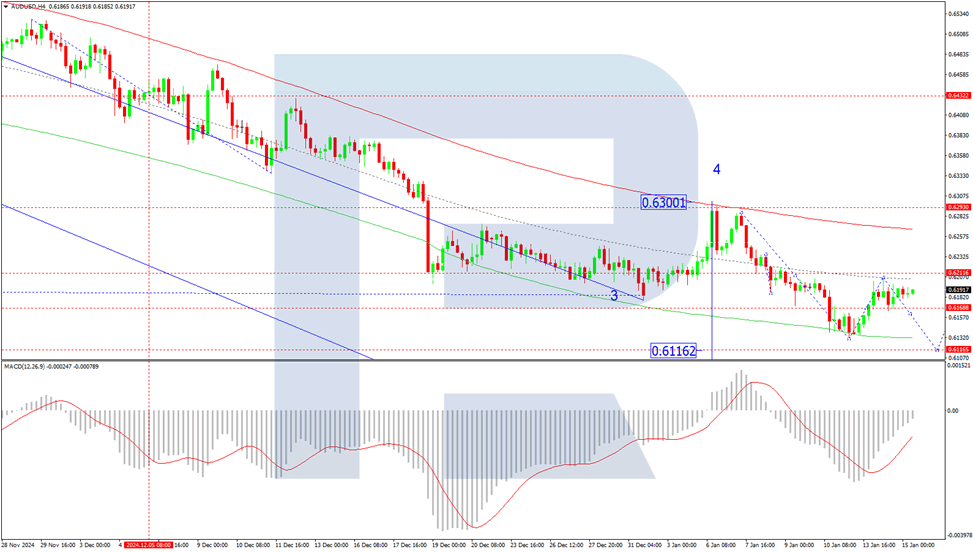
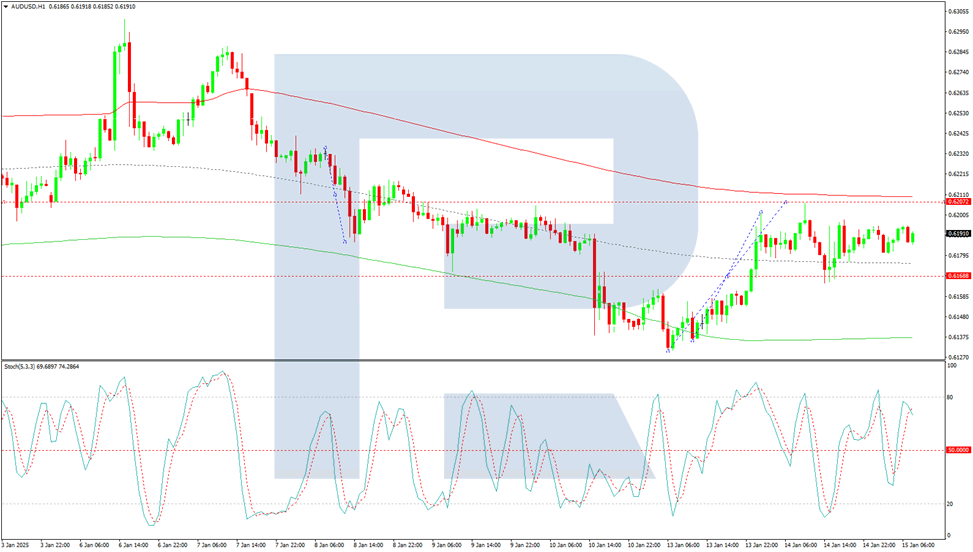
On the H4 chart, AUD/USD is developing an upward wave targeting 0.6211. This level is expected to be tested today, followed by a potential decline towards 0.6161. A consolidation range is likely to form around 0.6161. If the pair breaks upwards from this range, a correction to 0.6290 could materialise. Conversely, a downward breakout could trigger a new wave targeting 0.6116. The MACD indicator supports this scenario, with its signal line below the zero mark but pointing sharply upwards.
On the H1 chart, the pair is building a growth wave towards 0.6211, which is expected to be reached today. Following this, a corrective move to 0.6161 may occur. The Stochastic oscillator confirms this scenario, with its signal line above the 50 mark and trending upwards towards 80.
Conclusion
The Australian dollar’s recent recovery is tempered by uncertainty surrounding the RBA’s future policy decisions. Key domestic data, including employment figures and Q4 inflation, heavily influence market expectations. While technical indicators suggest short-term growth potential for AUD/USD, further gains will depend on clarity regarding the RBA’s policy trajectory and broader economic conditions.