Sample Category Title
EUR/CHF Daily Outlook
Daily Pivots: (S1) 0.9385; (P) 0.9394; (R1) 0.9405; More....
No change in EUR/CHF's outlook and intraday bias stays neutral. Corrective rebound from 0.9204 could still extend higher through 0.9440. But upside should be limited by 0.9481 fibonacci resistance. On the downside, firm break of 0.9329 support will argue that the correction has completed, and bring retest of 0.9204 low.
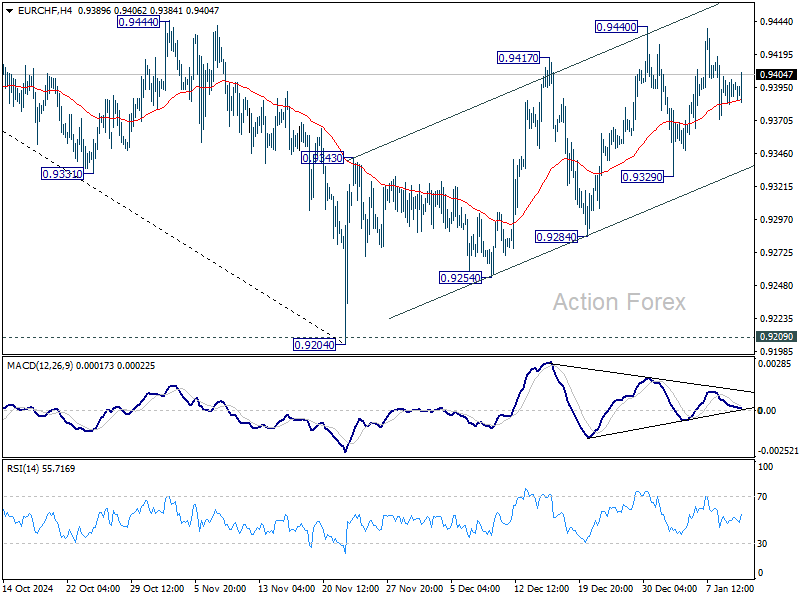
In the bigger picture, while rebound from 0.9204 might extend higher, strong resistance could be seen from 38.2% retracement of 0.9928 to 0.9204 at 0.9481 to limit upside. Down trend from 0.9928 (2024 high) is still in favor to resume through 0.9204/9 support zone at a later stage.
USD/CAD Daily Outlook
Daily Pivots: (S1) 1.4372; (P) 1.4388; (R1) 1.4411; More...
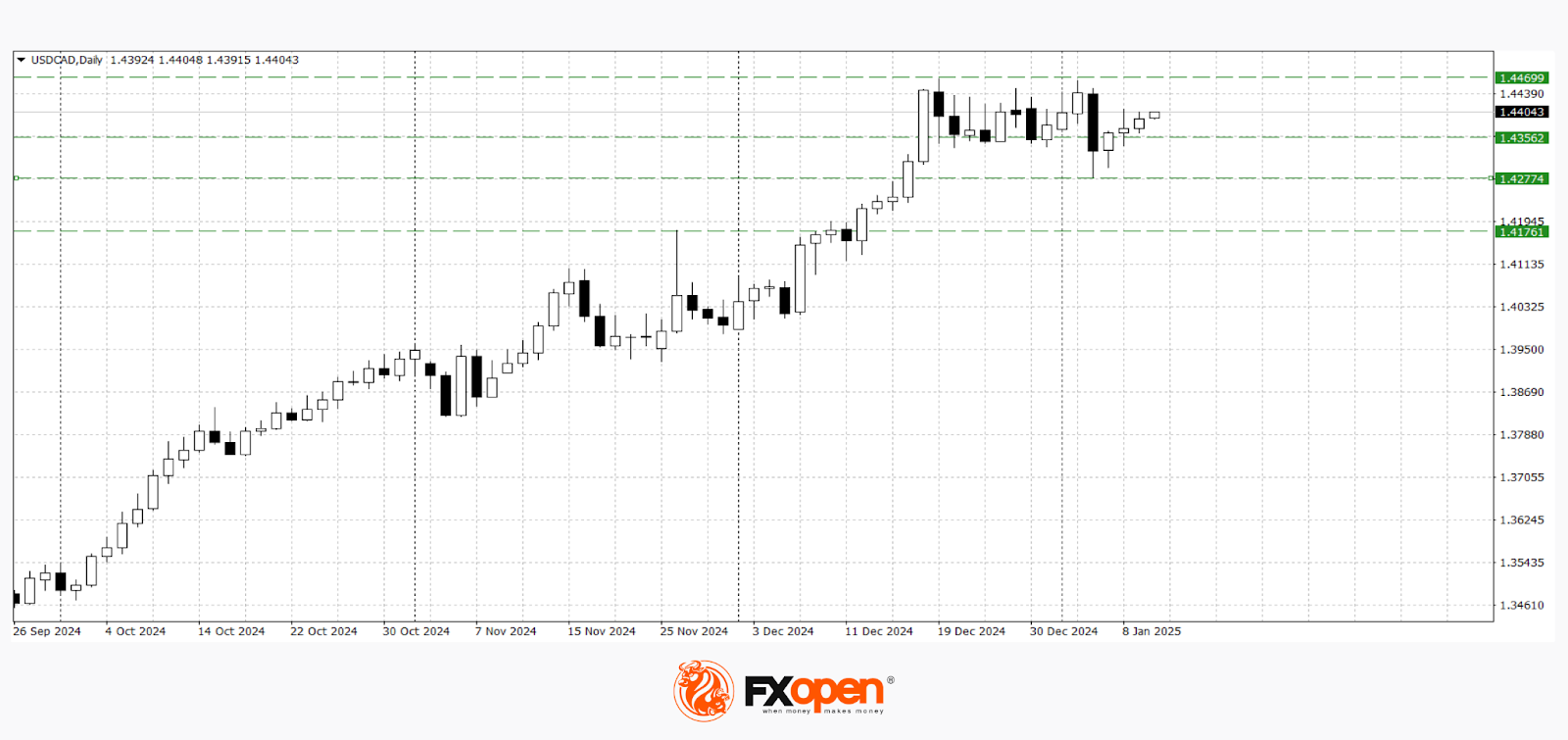
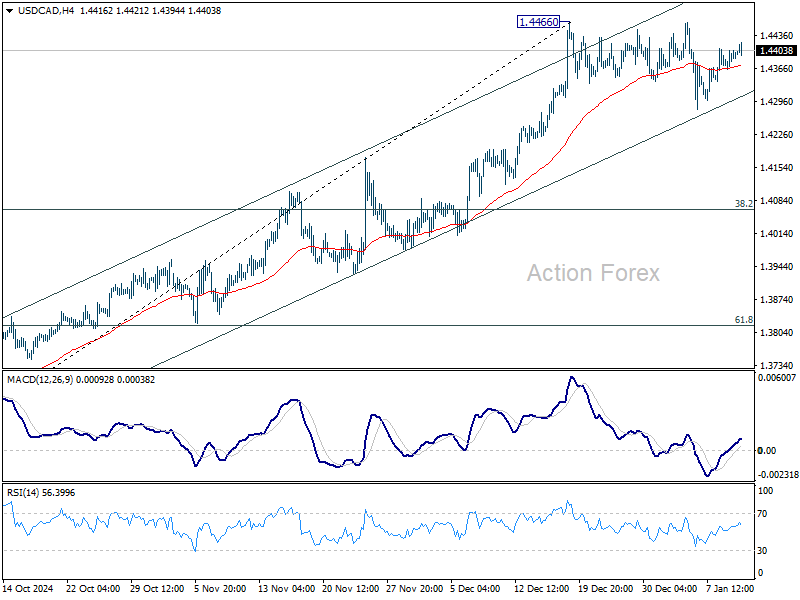
Intraday bias USD/CAD remains neutral for the moment, and consolidations from 1.466 could extend, probably with another fall. But downside should be contained above 38.2% retracement of 1.3418 to 1.4466 at 1.4066 to bring rebound. On the upside, break of 1.4466 will resume larger up trend to 1.4667/89 key resistance zone.
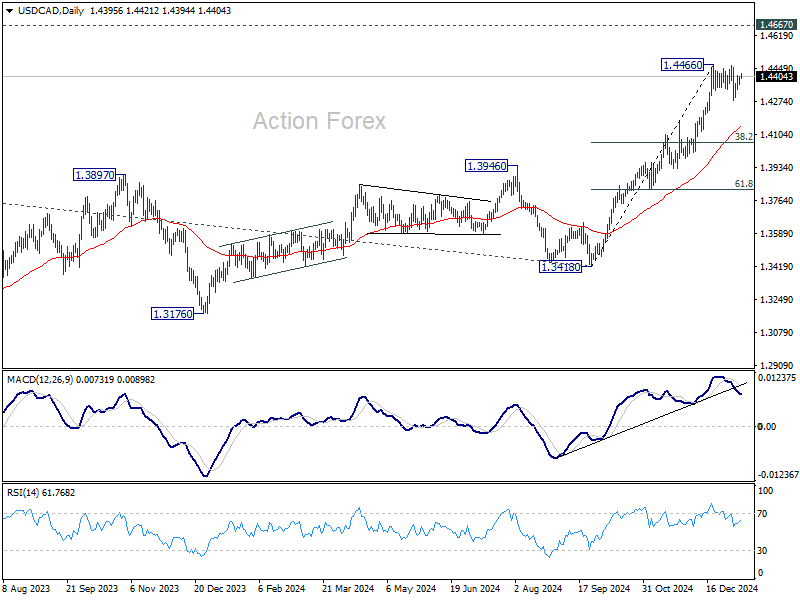
In the bigger picture, up trend from 1.2005 (2021) is in progress for retesting 1.4667/89 key resistance zone (2020/2015 highs). Medium term outlook will remain bullish as long as 1.3976 resistance turned holds (2022 high), even in case of deep pullback.
AUD/USD Daily Report
Daily Pivots: (S1) 0.6172; (P) 0.6196; (R1) 0.6219; More...
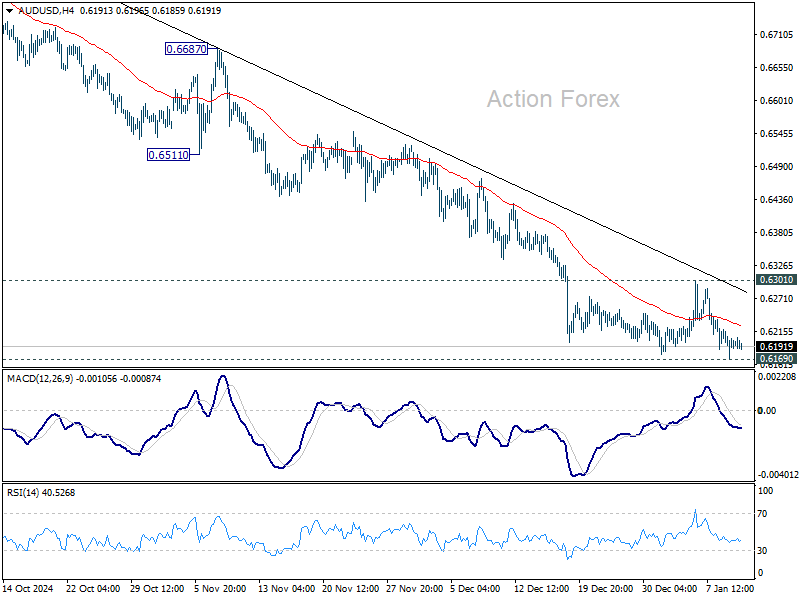
Intraday bias in AUD/USD remains neutral at this point, and further decline is expected as long as 0.6301 resistance holds. Firm break of 0.6169 key support will confirm larger down trend resumption. Nevertheless, break of 0.6301 resistance will turn bias back to the upside for stronger rebound to 55 D EMA (now at 0.6394).
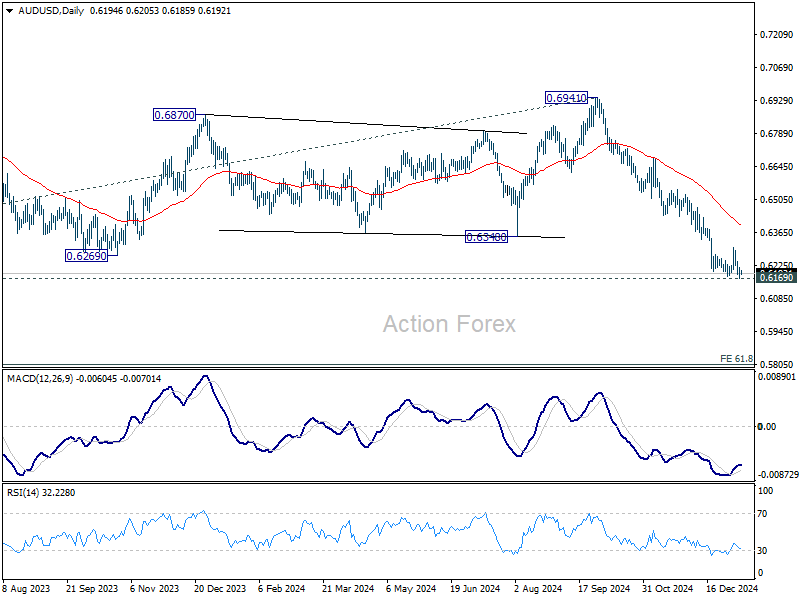
In the bigger picture, price actions from 0.6169 (2022 low) are seen as a medium term consolidation to the down trend from 0.8006, and could have completed at 0.6941 already. Firm break of 0.6169 support will confirm down trend resumption for 61.8% projection of 0.8006 to 0.6169 from 0.6941 at 0.5806 next. In any case, outlook will stay bearish as long as 55 W EMA (now at 0.6587) holds.
USD/JPY Daily Outlook
Daily Pivots: (S1) 157.69; (P) 158.04; (R1) 158.51; More...
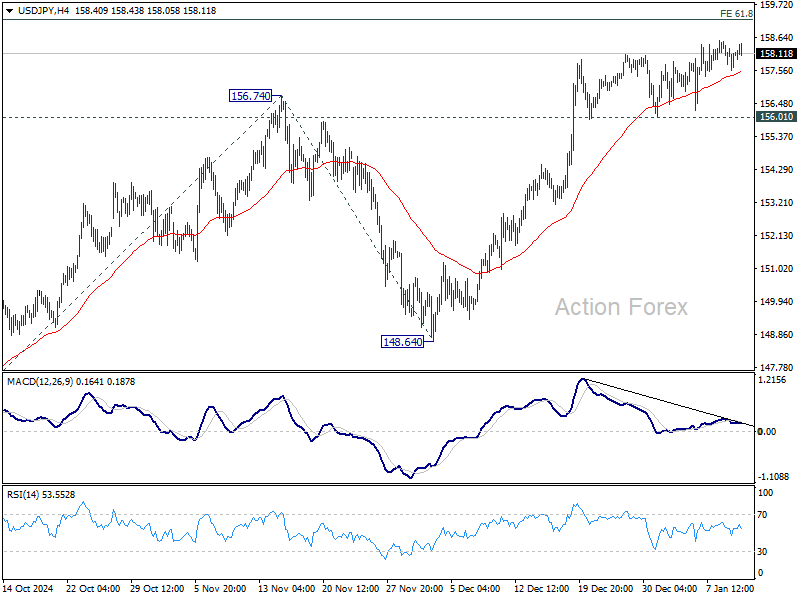
Intraday bias in USD/JPY remains neutral for the moment, and further rally is in favor with 156.01 support intact. On the upside, firm break of 61.8% projection of 139.57 to 156.74 from 148.64 at 159.25 will extend the rally from 139.57 to retest 161.94 high. However, considering bearish divergence condition in 4H MACD, firm break of 156.01 support will indicate short term topping. Intraday bias will then be back on the downside for 55 D EMA (now at 154.13) instead.
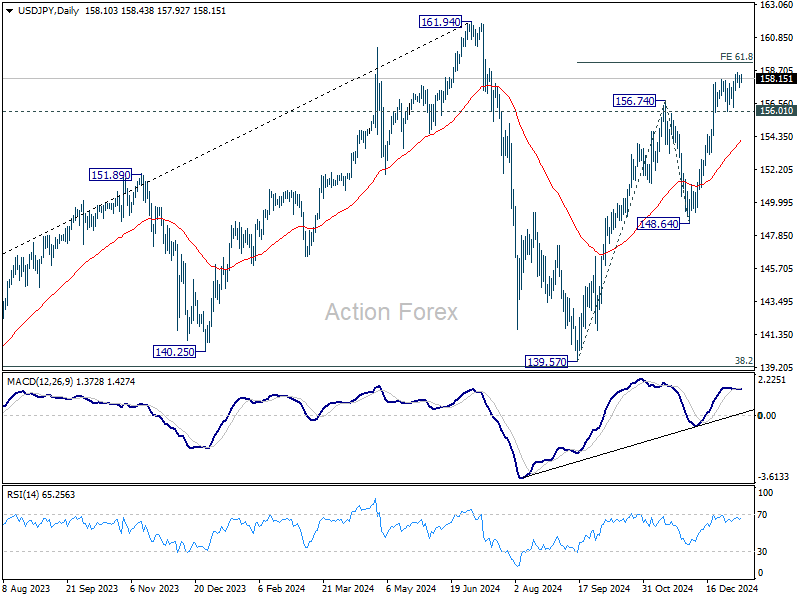
In the bigger picture, price actions from 161.94 are seen as a corrective pattern to rise from 102.58 (2021 low). The range of medium term consolidation should be set between 38.2% retracement of 102.58 to 161.94 at 139.26 and 161.94. Nevertheless, sustained break of 139.26 would open up deeper medium term decline to 61.8% retracement at 125.25.
USD/CHF Daily Outlook
Daily Pivots: (S1) 0.9101; (P) 0.9117; (R1) 0.9137; More…
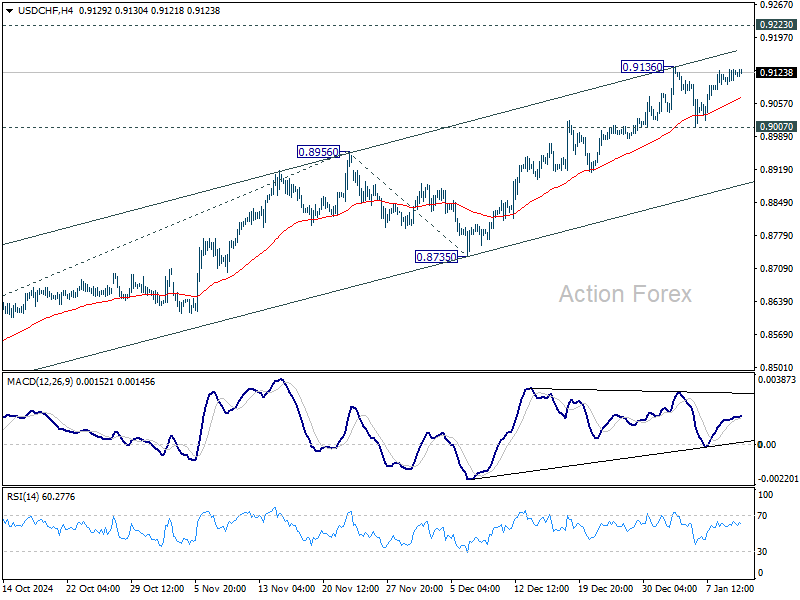
USD/CHF is still bounded in range below 0.9136 and intraday bias remains neutral. With 0.9007 support intact, further rally is expected. On the upside, break of 0.9136 will resume the rally from 0.8374 to 0.9223 key resistance next. However, firm break of 0.8956 will turn bias back to the downside for 55 D EMA (now at 0.8896).
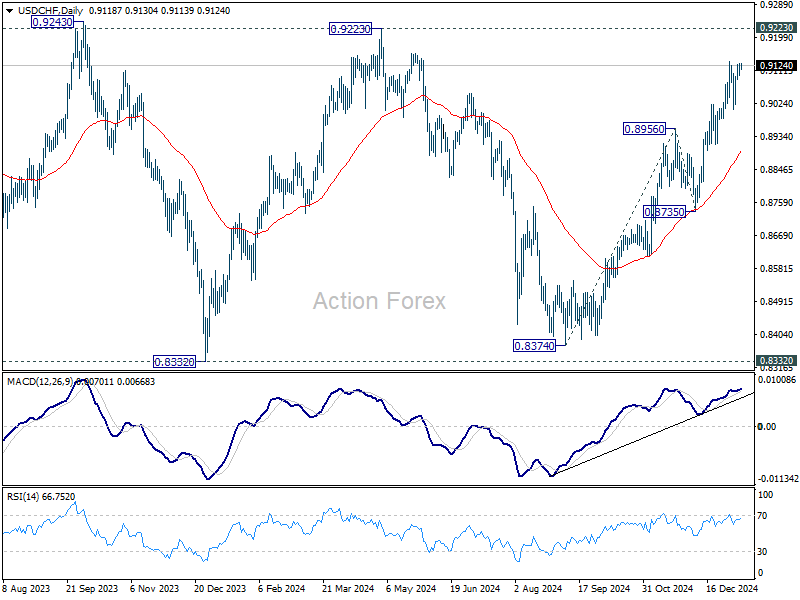
In the bigger picture, price actions from 0.8332 (2023 low) are currently seen as a medium term corrective pattern, with rise from 0.8374 as the third leg. Overall outlook will continue to stay bearish as long as 0.9223 resistance holds. Break of 0.8332 low is in favor at a later stage when the consolidation completes. However, decisive break of 0.9223 will be an important sign of bullish trend reversal.
EUR/USD Daily Outlook
Daily Pivots: (S1) 1.0281; (P) 1.0302; (R1) 1.0321; More...
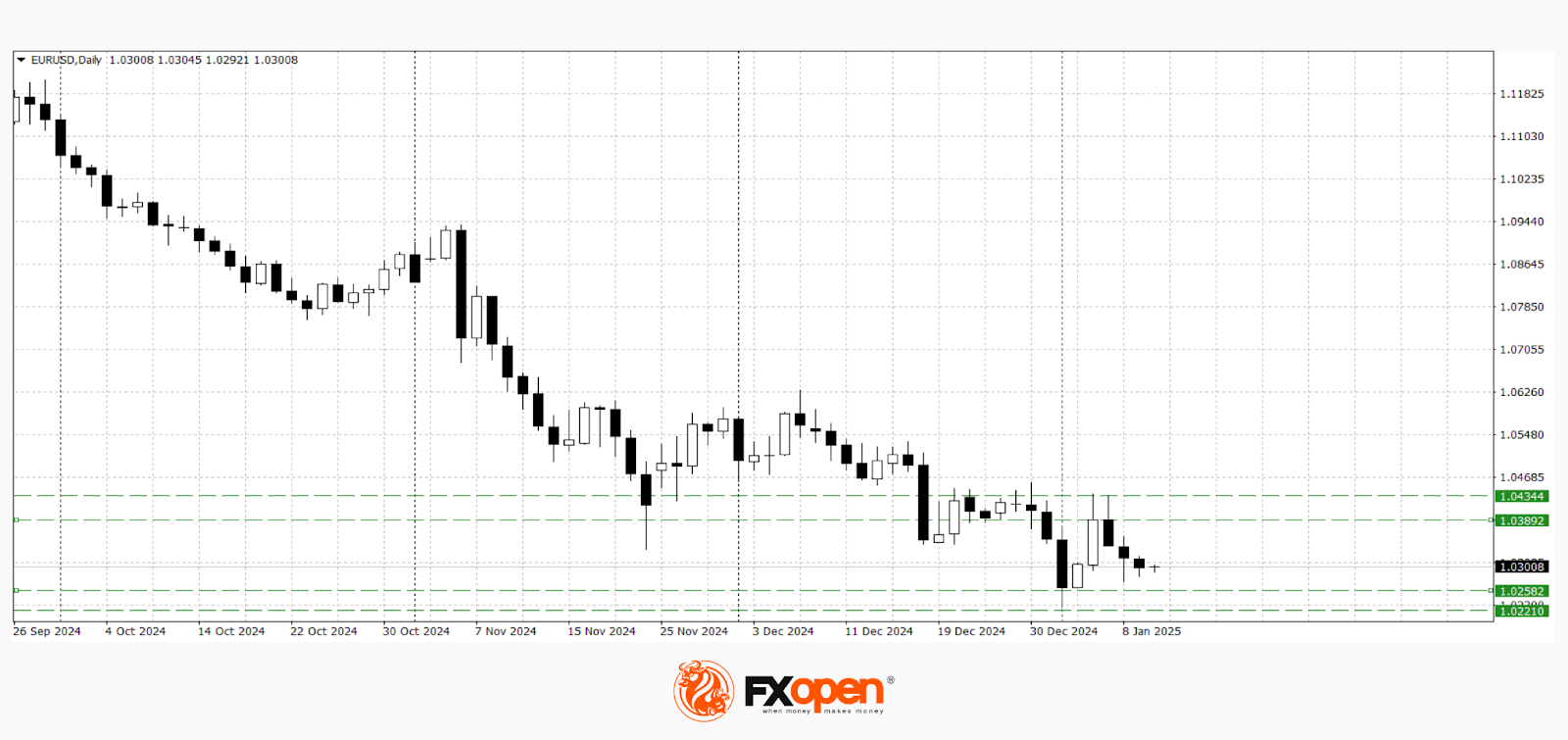
EUR/USD is still bounded in range of 1.0223/0457 and intraday bias stays neutral for the moment. With 1.0457 resistance intact, outlook stay bearish. On the downside, firm break of 1.0223 will resume the fall from 1.1213. However, sustained break of 1.0457 will confirm short term bottoming, and turn bias to the upside for 55 D EMA (now at 1.0533).
In the bigger picture, fall from 1.1274 (2023 high) should either be the second leg of the corrective pattern from 0.9534 (2022 low), or another down leg of the long term down trend. In both cases, sustained break of 61.8 retracement of 0.9534 to 1.1274 at 1.0199 will pave the way back to 0.9534. For now, outlook will stay bearish as long as 1.0629 resistance holds, even in case of strong rebound.
GBP/USD Daily Outlook
Daily Pivots: (S1) 1.2240; (P) 1.2306; (R1) 1.2375; More...
There is no clear sign of bottoming yet in GBP/USD and intraday bias remains on the downside. Sustained trading below 1.2256 fibonacci level will carry larger bearish implications. On the upside, break of 1.2376 will turn intraday bias neutral first. Further break of 1.2486 support turned resistance should confirm short term bottoming.
In the bigger picture, price actions from 1.3433 medium term are seen as correcting whole up trend from 1.0351 (2022 low). Strong support is still expected from 38.2% retracement of 1.0351 to 1.3433 at 1.2256 to bring rebound to extend the corrective pattern. However, firm break of 1.2256 will argue that the trend has reversed and target 61.8% retracement at 1.1528.
NFP Set to Boost Dollar, But Trump Inauguration Risks May Limit Sustained Gains
Dollar holds onto its leadership position as markets await the US non-farm payroll report. Investors expect the data to reinforce Fed’s decision to pause rate cuts this month, particularly if the report confirms continued labor market strength. In such a scenario, rising US Treasury yields could further bolster the greenback.
However, any post-NFP rally might be short-lived, given the looming inauguration of President-elect Donald Trump on January 20. Trade policy rumors have already spurred market volatility, with conflicting reports about sector-specific tariffs and the possible use of emergency powers. Traders may be quick to take profits after NFP-driven moves, wary of sudden developments in Washington.
For the week, Canadian Dollar remains the top performer, consolidating gains against the second-ranked Dollar. Euro occupies third place, while Sterling languishes at the bottom, pressured by concerns over UK fiscal stability. Swiss Franc and Yen are next weakest, as Euro and Australian Dollar sit at middle positions.
Technically, USD/JPY has seen its rally slow just shy of 61.8% projection of 139.57 to 156.74 from 148.64 at 159.25. Caution is rising as the pair approaches 160 psychological level, where intervention risk from Japan looms. Nonetheless, further upside is favored as long as 156.01 support holds, pointing to a test of the 161.94 high once 159.25 is cleared. That zone represents significant resistance and could cap any near-term gains.
NFP to anchor Fed pause, 10-year yield eyes higher level
US non-farm payroll report is taking center stage today as markets look for confirmation of Fed’s anticipated decision to pause rate cuts this month. Recent comments from multiple Fed officials have highlighted a cautious approach to further monetary easing, with a consensus forming that the central bank is nearing a pause in its rate-cutting cycle.
Fed fund futures currently price 93% likelihood of a hold at the meeting, and an in-line or stronger-than-expected jobs report could push this probability closer to certainty.
The broader debate now shifts to two key questions: how long the Fed’s pause might last and how much more easing, if any, will occur this year. Current market pricing indicates a 60% chance of another hold in March, followed by a 53% probability of a rate cut in May. For the rest of 2025, markets see over an 85% chance that rates will remain steady at 4.00%-4.25%.
Following today’s data, the immediate focus is whether the odds of a March hold increase, reflecting an extended pause.
Regarding expectations on the data, for December, headline job growth is forecasted to slow to 150k, with the unemployment rate expected to hold steady at 4.2%. Average hourly earnings are anticipated to rise by 0.3% month-over-month.
While some signals, such as the ISM Manufacturing PMI Employment component falling to 45.3 and ADP private employment growth decelerating to 122k, point to a cooling labor market, others remain robust. ISM Services PMI Employment component held steady at 51.4, and the 4-week moving average of initial jobless claims fell to a historically strong 213k, suggesting resilience and leaving room for an upside surprise in today’s report.
In terms of market reactions, a major focus is on treasury yields. Technically, 10-year yield breached 61.8% projection of 3.603 to 4.505 from 4.126 at 4.683 this week, as rally from 3.603 resumed.
Strong NFP number could push TNX higher, and sustained trading above 4.683 should pave the way towards 100% projection at 5.028, which is close to 4.997 high, and 5% psychological level. Any upside acceleration could realize this target at around the end of Q1.
In any case, outlook in TNX will stay bullish as long as 4.517 support holds, in case of retreat.
Japan’s household spending falls for fourth month, minister flags critical economic transition
Japan’s household spending declined for the fourth consecutive month in November, falling -0.4% yoy. While this was an improvement from October's -1.3% drop and surpassed expectations of -0.8%, it still reflects ongoing consumer caution.
The decline was driven by significant cuts in expenditures on home appliances and food, highlighting weak domestic demand.
Spending on furniture and electric appliances plummeted by -13.8%, marking the third straight month of decline, while clothing and footwear saw a similar drop -of 13.7%, down for the second consecutive month. Food purchases also contracted slightly, falling by-0.6%.
Separately, Economy Minister Ryosei Akazawa acknowledged the challenges, stating that Japan's economy is at a "critical stage" in shifting public sentiment away from deflation and toward sustainable growth driven by higher wages and investment.
GBP/USD Daily Outlook
Daily Pivots: (S1) 1.2240; (P) 1.2306; (R1) 1.2375; More...
There is no clear sign of bottoming yet in GBP/USD and intraday bias remains on the downside. Sustained trading below 1.2256 fibonacci level will carry larger bearish implications. On the upside, break of 1.2376 will turn intraday bias neutral first. Further break of 1.2486 support turned resistance should confirm short term bottoming.
In the bigger picture, price actions from 1.3433 medium term are seen as correcting whole up trend from 1.0351 (2022 low). Strong support is still expected from 38.2% retracement of 1.0351 to 1.3433 at 1.2256 to bring rebound to extend the corrective pattern. However, firm break of 1.2256 will argue that the trend has reversed and target 61.8% retracement at 1.1528.
Asian-Pacific Dealings Lacking Much Other News Revolve Mostly Around PBOC
Markets
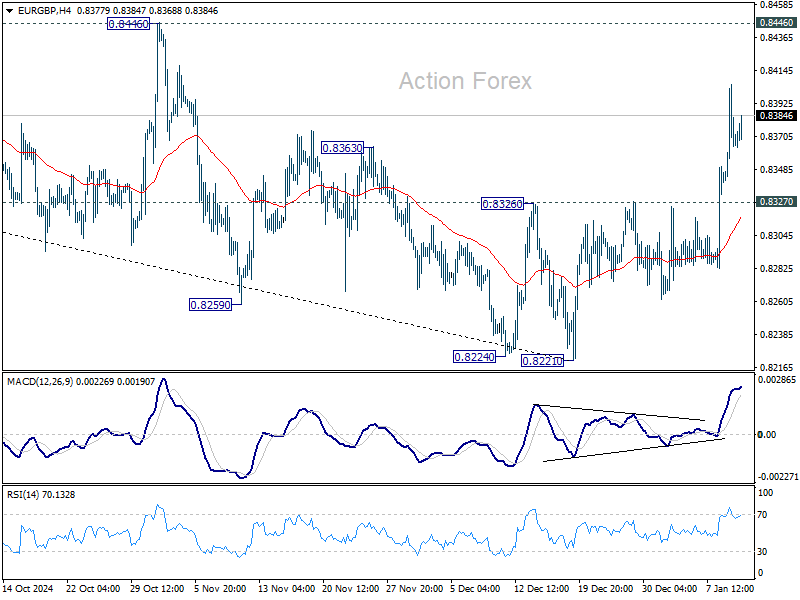
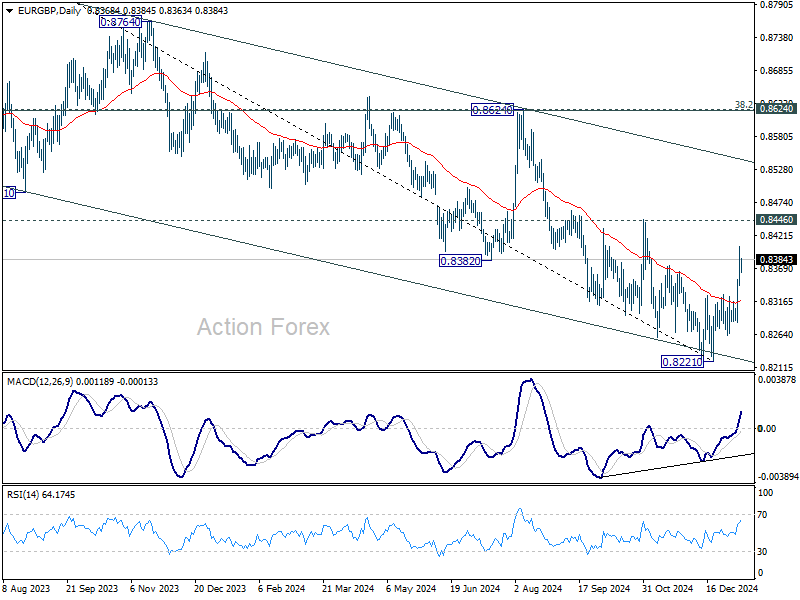
The partial absence of US investors due to a national day of mourning for ex-president Carter and the empty economic calendar kept markets squarely focused on the UK. Gilt yields gapped another 12 bps higher at the open before paring most of those gains into the close. The earlier surge nevertheless means multi-year or even -decade highs. Breeden from the Bank of England was the first to comment but wouldn’t go much further than saying they are monitoring what is happening and that the moves reflect a lot of “global factors”. The genie appears to be out of the bottle for sterling. EUR/GBP tested the 0.84 big figure. The pound has the easing of the gilt sell-off to thank for avoiding the technical break (EUR/GBP 0.8368). Cable’s picture looks much more dire. The 2024 GBP/USD low of 1.23 was cracking and succumbs in Asian trading this morning. GBP/USD 1.228 trades at the weakest level since November 2023 and marches closer to an important support area around 1.225 (38.2% retracement on the 2022-2024 ascent). Rates in Europe added a few basis points in a bear flattening move (up to 3 bps in Germany) compared to a liquidity-thinned bull steepening in the US with moves from -2 bps to flat. Currency markets ex GBP were a sea of calm.
Asian-Pacific dealings lacking much other news revolve mostly around the PBOC announcement (see News & Views) to suspend bond buying. All eyes are on US economic agenda for today. The University of Michigan’s consumer confidence indicator (January) is scheduled but it’s the December payrolls report that’ll get most of the market attention. We think risks to the 165k consensus are skewed to the upside. The front end of the US curve is at a stalemate with markets already positioned more hawkish than the Fed (40 bps of cuts priced in compared to 50 bps in the dot plot). Similarly we do not think that a downside surprise would suddenly prompt a material dovish rebalancing. Recent Fed speak was clearly in favour of a prolonged pause at the current level of rates. The long end is most vulnerable for further losses in case of a topside surprise. Important resistance in the 10-yr yield is located at 4.73%. A break implies a return towards the 2023 high of 5.02%. Dollar strength remains our base case. With the euro not yet ripe for a rebound from its own making, south is the past of least resistance in EUR/USD. 1.0226 is the reference to watch.
News & Views
The People’s Bank of China (PBOC) this morning announced that it suspends its Treasury Bond purchases. In explaining the move, the PBOC said that supply of bonds has fallen compared to demand, triggering a shortage in the market. Bond purchases since last year gained in significance as a tool to manage market liquidity as the central bank tried to ease monetary conditions to support the ailing economy. However, the subsequent sharp decline in yields is seen as a factor putting additional pressure on the currency. The run on (long-dated) bonds can also be seen as a sign of investor doubts on the ability of authorities to address current deflationary trends. Chinese authorities showed unease with the financial stability risks related to a stretched bond positioning in the market (risk for a crash). The central bank left the timing open of a resumption of its program which. It will take place at a proper time depending on supply and demand in the government bond market. In a first reaction, the 10-y Chinese government bond yield jumped 4 bps to 1.68%, but the gain dwindled as trading continued. The yuan trades little changed near recent lows at USD/CNY 7.332.
Inflation in Mexico declined eased further in December printing at 0.38% M/M and 4.21% Y/Y. The latter marked the lowest level since February 2021. Core inflation reaccelerated to 0.51% M/M and 3.65% Y/Y. The central bank of Mexico aims to keep inflation at 3.0% with a 1.0% tolerance band. The data most likely will allow the bank to continue its easing cycle. The central bank cut its policy rate in December by 25 bps to 10%. It started its easing cycle in March of last year at 11.25%. The Minutes of the December policy meeting yesterday showed that a majority of the board members leaned to considering larger rate cuts. "In view of the progress on disinflation, larger downward adjustments could be considered in some meetings, albeit maintaining a restrictive stance," the minutes said. The Mexican peso, which suffered from overall USD strength in the second half of last year, remains in the defensive. At USD/MXN, the local currency holds within reach of the weakest levels since mid-2022 reached at the end of last year.
Jobs Day
In the absence of the US, the UK sat on the headlines yesterday, with its debt drama. Everyone threw in what he or she thought about what today’s situation reminded them. The discussions went from the latest aggressive selloff triggered by Liz Truss to 1976 debt crisis when the UK had to ask IMF help to get its head above water. I don’t think that the UK is there just yet, and yesterday’s retreat in yields (after reaching fresh highs) *without the Bank of England’s (BoE) intervention* was more than welcome. But the fact is, Rachel Reeves is losing her fiscal headroom and her manoeuvre margin with every basis point rise in borrowing costs, and that muddies the UK’s growth outlook. In numbers, the 10-year gilt yield has risen around 60bp since Rachel Reeves announced her latest budget. Note that the yields didn’t rise as spectacularly and immediately as in reaction to Liz Truss’ mini budget disaster, but the yields are now above Liz levels – and that leaves the UK government with three choices: either they will announce more tax rises, or lower spending, or both. According to people who are familiar with the matter, it would be the second option: lowering spending plans in the first instance. Maybe that’s what brings some relief to investors. But in all cases, the UK’s drama in not over. Cable has now slipped below the 1.23 mark and is set for a deeper selloff. Price rebounds could be interesting opportunities to strengthen short positions and target the 1.20 support. On the euro front, we should see consolidation and extension of the latest gains in favour of the euro.
Fun fact before we move on. The UK – which has a huge debt, dismal productivity and growth and a thick layer of unnecessary regulation like continental Europe – still has a debt-to-GDP level lower than other developed economies like France, Italy, Spain and Japan! But the country faces relatively tougher market reaction to its political decisions. I have the feeling that investors somehow continue to blame the UK for its decision to quit the EU. But anyway, the selloff in gilts and the pound may have cooled down yesterday, but cost of boosting growth has become significantly more expensive for the UK government, meaning that we may not see the UK perform as well as it did last year. And that sets the pound outlook negative at the early weeks of the new year.
Moving on, the EURUSD continued to be sold in the absence of Americans yesterday and is trading below the 1.03 mark this morning. The selling pressure is backed by strong dovish expectations from the European Central Bank (ECB) that were – in return – backed by the French central bank head Francois Villeroy’s view that the ECB should cut its rates at every policy meeting into summer to reach a neutral rate. I doubt that his German equivalent shares the same opinion after inflation in Germany jumped to 2.9% last month...
In all cases, the EURUSD’s – and other major pairs’ – short-term direction will likely be set by the US dollar. The US will release its latest jobs data today, and the numbers could help slowing the fast progress of the Federal Reserve (Fed) hawks that resulted – along with US debt worries – in rapidly rising yields.
Before the announcement of the US official jobs data, activity on Fed funds futures suggests that the Fed’s next rate cut should arrive in May – with around a 53% chance. A set of stronger-than-expected data could flip this expectation to the ‘no cut until June’ side very rapidly and enhance the selloff in the US dollar and support a further appreciation of the US dollar, while a set of softer-than-expected jobs data could strengthen the hope of a May cut. Given how quickly the Fed hawks have gained ground in recent weeks—and how much more investors are excited by dovish signals—the market’s reaction to soft data could outweigh its response to strong figures. The expectation is that the US economy may have added 164K new nonfarm jobs in December – well below the 227K added a month ago, but that number was boosted by the strikes and hurricanes of the month before (so the fall won’t be as bad as it first looks). Then, the average earnings is expected to remain highly sticky near the 4% on an annual basis – which is a problem for the Fed because people who earn more tend to spend more. And finally, the unemployment rate is seen steady near 4.2%. Again, strong NFP and wages growth would be supportive of the dollar, while soft NFP and wages growth should lead to a pullback in both. But if we see mixed figures, wages data could overweigh – unless we see an alarmingly high or low NFP figure.
Meanwhile in China
On the flip side of the world, the Chinese struggle with a completely different problem. Despite the announcement of multitude stimulus measures, yields there continue to dive, and the gap between the US and Chinese yields are widening *alarmingly*. We hear the phrase ‘Japanification of China’ pronounced very often since last year - the Japanification referring to inability to boost spending and investment despite lower rates. This – formally the liquidity trap – is probably the worse disease for an economy and takes very longtime to heal. The CSI 300 experienced its worst start to a year since 2016 and is finding difficult to rebound on low rates. The yuan is weak and the Chinese are expected to let it weaken further as an additional tool in the trade war against Trump. But low yields and prospects of a weaker yuan make it harder to convince foreign investors to bring on money, as the economic growth remains lacklustre. China will release its latest inflation report this weekend, and everyone prays for deflation to slow.