Sample Category Title
USD/CAD Daily Outlook
Daily Pivots: (S1) 1.3397; (P) 1.3418; (R1) 1.3459; More....
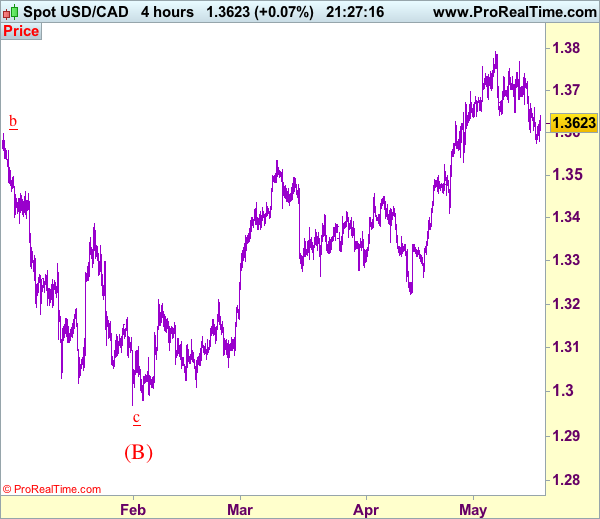
With 1.3373 minor support intact, intraday bias in USD/CAD remains on the upside for 1.3534 resistance. Break will extend whole rise from 1.2698 to 1.3598 resistance. On the downside, below 1.3373 minor support will turn bias back to the downside and could extend the correction from 1.3534 with another fall. But we'd expect strong support from 1.3211 cluster level (61.8% retracement of 1.3008 to 1.3534 at 1.3209) to contain downside and bring rebound. Overall, medium term rebound form 1.2460 is still expected to extend through 1.3598.
In the bigger picture, price actions from 1.4689 medium term top are seen as a correction pattern. The first leg has completed at 1.2460. The second leg from 1.2460 is likely still in progress and could target 61.8% retracement of 1.4689 to 1.2460 at 1.3838. We'd look for reversal signal there to start the third leg. Break of 1.2968 will argue that the third leg has already started and should at least bring at retest of 1.2460 low. However, sustained trading above 1.3838 would pave the way to retest 1.4689 high.


AUD/USD Daily Outlook
Daily Pivots: (S1) 0.7554; (P) 0.7570; (R1) 0.7584; More...
AUD/USD's fall from 0.7748 continues today and reaches as low as 0.7532 so far. Intraday bias remains on downside for 0.7490 support. Decisive break of 0.7490 will confirm completion of rise from 0.7158. In such case, near term outlook will be turned bearish for 0.7158 support. On the upside, above 0.7586 minor resistance will turn bias neutral first. And, break of 0.7678 minor resistance will turn bias back to the upside and could extend the rise fro 0.7158 through 0.7748 resistance.
In the bigger picture, we're still treating price actions from 0.6826 low as a correction. And, as long as 38.2% retracement of 0.9504 to 0.6826 at 0.7849 holds, long term down trend from 1.1079 is expected to resume sooner or later. Break of 0.6826 low will target 0.6008 key support level. However, firm break of 0.7849 will indicate that rise from 0.6826 is developing into a medium term rebound, rather than a sideway pattern. In such case, stronger rise should be seen to 55 month EMA (now at 0.8165) and above.


Dow Reversed as Markets Lose Confidence on Trump’s Tax Reform, Japanese Yen Picks Up Strength
The tones in the financial markets remain unchanged for the week. US equities attempted for a rally overnight. DJIA surged initially on strong US ADP employment and reached as high as 20887.50. But the index then reversed to close down -0.20%, or -41.09 pts, at 20648.15. The hawkish FOMC minutes are seen as a factor weighing on sentiments. But more importantly, House speaker Paul Ryan's comments on tax reform further reduced market confidence on US President Donald Trump's ability to implement what he promised. 10 year yield closed mildly higher by -0.007 at 2.357 but it's kept in tight range well below 55 day EMA. In the currency markets, Japanese yen strengthens again on risk aversion is remains the strongest major currency for the week. Commodity currencies are suffering renewed selling in Asian session. Dollar and Euro are trading mixed.
FOMC Minutes: Shrinking of balance sheet to start later this year
The minutes of the March FOMC meeting was overall hawkish. They outlined the steps to shrink the USD 4.5T balance sheet. The minutes noted that the reduction has to be "gradual and predictable", accomplished by "phasing out" or reinvestment and such process could start "later this year". No detail is provided yet but the minutes said Fed will "its deliberations on reinvestment policy during upcoming meetings and would release additional information as it becomes available." Meanwhile, some officials are concerned that if unemployment falls further, it could pose "significant upside risk" of inflation. The minutes also showed "some participants viewed equity prices as quite high relative to standard valuation measures."
More on FOMC Minutes:
- FOMC Might Begin Shrinking Balance Sheet In Late-2017
- FOMC Mintues: Beginning the Long Process of Fed Balance Sheet Normalization Later This Year
- FOMC Minutes Go Against Dovish Interpretation of March's Meeting
House Speaker Ryan: Tax reforms takes longer than health care
The two day meeting of US President Donald Trump and China President Xi Jinping will start today. It's a closely watched event but we're not anticipating anything substantial to the markets coming out of the meeting. Again, we'd like to emphasize that direction stocks, yields, and Dollar will be heavily dependent on the confidence on Trump to deliver his election promises on fiscal policies. Such confidence was hurt much after the health care act flop. Now that hope is turned to tax reforms, House speaker Paul Ryan said yesterday that tax reform will take longer to accomplish than the health care act. He noted that "the House has a (tax reform) plan but the Senate doesn't quite have one yet. They're working on one. The White House hasn't nailed it down." And, "so even the three entities aren't on the same page yet on tax reform."
BoE Vliegh: Better late than premature
BoE policy maker Gertjan Vliegh warned that "a rate hike that turns out to be premature is a more serious mistake than one that turns out to be somewhat late." He explained that if "inflationary pressures are spreading beyond just exchange-rate pass-through", or there is "re-acceleration of indicators related to household spending and credit", then higher interest rate is warranted. But for now, "caution is warranted." Sterling has been resilient since Kristin Forbes voted for a rate hike last month. And it remains supported in spite of Brexit news since then.
EU Parliament: No parallel approach in Brexit negotiation
Talking about Brexit, the European Parliament voted 516-133, with 50 abstentions, for the phased approach of Brexit negotiation, rather than parallel. European Union chief negotiator Michel Barnier said yesterday that "parallel talks" on Brexit terms and future trade relationship is "a very risky approach". And, he emphasized that to succeed, "we need on the contrary to devote the first phase of negotiations exclusively to reaching an agreement on the principles of the exit."
BoJ Kuroda favorite to get second term
In Japan, it's reported that BoJ Governor Haruhiko Kuroda is Prime Minister Shinzo Abe's favorite for the job. And Kuroda will likely renew for another five year term next year. Reuters quoted unnamed source saying that Abe trusts Kuroda and believed he did a "very good job". Also, the it's believed that Abe's administration is happy with impact of BoJ's QQE program that keep government borrowing costs very low. The selection process for the next BoJ Governor will start in the second half of this year.
Separately, a former BoJ official Kazuo Momma said that the central bank will likely revise down inflation forecast soon, possibly as early as during the quarterly review this month. Momma noted that the BoJ's price forecasts are "too optimistic". Meanwhile, it's "hard to raise interest rates when you're cutting your inflation forecasts." Momma expects core inflation hover around 0.5% in the current fiscal year, and jump to 1.0% next. That's sharply lower than BoJ's expectation of core inflation hitting 1.5% by the end of fiscal 2017 and 1.7% by the end of fiscal 2018.
On the data front...
China Caixin PMI services dropped 0.4 to 52.2 in March. Japan will release consumer confidence today. Germany factory orders, Eurozone retail PMI and Swiss CPI will be featured in European session. In US session, US Challenger job cuts, jobless claims and Canada building permits will be featured.
AUD/USD Daily Outlook
Daily Pivots: (S1) 0.7554; (P) 0.7570; (R1) 0.7584; More...
AUD/USD's fall from 0.7748 continues today and reaches as low as 0.7532 so far. Intraday bias remains on downside for 0.7490 support. Decisive break of 0.7490 will confirm completion of rise from 0.7158. In such case, near term outlook will be turned bearish for 0.7158 support. On the upside, above 0.7586 minor resistance will turn bias neutral first. And, break of 0.7678 minor resistance will turn bias back to the upside and could extend the rise fro 0.7158 through 0.7748 resistance.
In the bigger picture, we're still treating price actions from 0.6826 low as a correction. And, as long as 38.2% retracement of 0.9504 to 0.6826 at 0.7849 holds, long term down trend from 1.1079 is expected to resume sooner or later. Break of 0.6826 low will target 0.6008 key support level. However, firm break of 0.7849 will indicate that rise from 0.6826 is developing into a medium term rebound, rather than a sideway pattern. In such case, stronger rise should be seen to 55 month EMA (now at 0.8165) and above.


Economic Indicators Update
| GMT | Ccy | Events | Actual | Forecast | Previous | Revised |
|---|---|---|---|---|---|---|
| 1:45 | CNY | Caixin PMI Services Mar | 52.2 | 53.2 | 52.6 | |
| 5:00 | JPY | Consumer Confidence Index Mar | 43.4 | 43.1 | ||
| 6:00 | EUR | German Factory Orders M/M Feb | 3.50% | -7.40% | ||
| 7:15 | CHF | CPI M/M Mar | 0.20% | 0.50% | ||
| 7:15 | CHF | CPI Y/Y Mar | 0.50% | 0.60% | ||
| 8:10 | EUR | Eurozone Retail PMI Mar | 49.9 | |||
| 11:30 | EUR | ECB Monetary Policy Meeting Accounts | ||||
| 11:30 | USD | Challenger Job Cuts Y/Y Mar | -40.00% | |||
| 12:30 | CAD | Building Permits M/M Feb | 5.40% | |||
| 12:30 | USD | Initial Jobless Claims (APR 01) | 250k | 258k | ||
| 14:30 | USD | Natural Gas Storage | -43B |
GBP/USD Wedge
We turn our attention back to the majors today with another look at GBP/USD.
The majors haven't been doing a whole lot for a while now, highlighted by the Cable charts in this post, clearly stuck in higher time frame ranges.
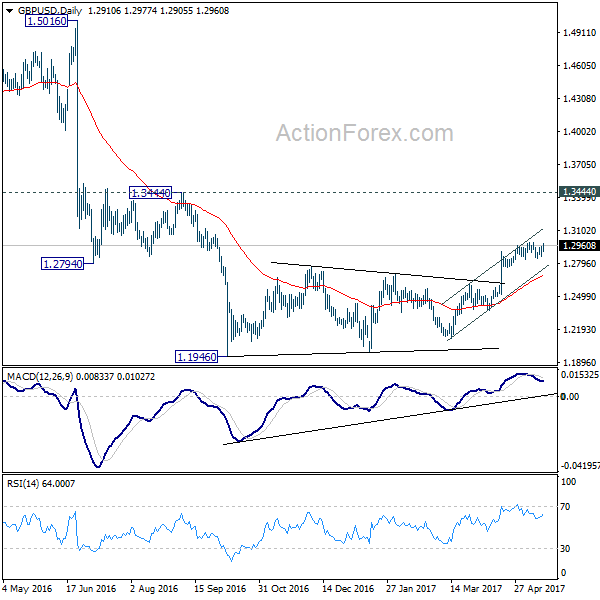
You can see the daily range on GBP/USD in the chart below:
GBP/USD Daily:

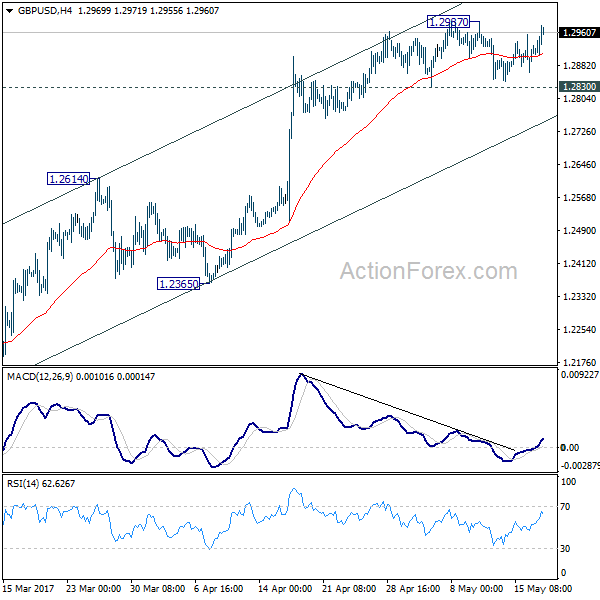
Zooming into any of the intraday charts, you can see that price is coiling into a wedge pattern:
GBP/USD 4 Hourly:

Seeing as though price is right smack bang in the middle of the daily range, the direction on which to trade this pattern isn't clear. Do you view it as a continuation pattern because price has rallied off support and this is merely a pause before a further push higher, or do you take the view that it is simply a turn as we get closer to the top of the range?
Price is very much in an area of indecision at the moment. Keep that in mind if you're taking a Cable position to end the week.
FOMC Might Begin Shrinking Balance Sheet In Late-2017
The FOMC members had quite extensive discussions on the balance sheet policies, the minutes revealed. US Treasury yields declined as the market interpreted Fed's phasing out of the reinvestment policy might be a de facto tightening measure, reducing the urgency to hike interest rates. We expect the Fed might begin balance reduction in as soon as December 2017. The minutes also unveiled that the rationale behind the March rate hike was the solid economic growth developments. The members acknowledged that the labor market strengthened further in January and February and that real GDP was continuing to expand in the first quarter. The moderation in growth from the fourth quarter was mainly driven by 'transitory factors'.
Regarding the balance sheet policy, the members reaffirmed the approach to balance sheet normalization articulated in the Committee's Policy Normalization Principles and Plans announced in September 2014. They agreed that any reduction in securities holdings should be 'gradual and predictable' and accomplished primarily by phasing out reinvestments of principal received from those holdings. The minutes also noted that nearly all participants preferred that the timing of a change in reinvestment policy depend on an assessment of economic and financial conditions, as opposed to a quantitative target on the level of the federal funds rate or a qualitative assessment of economic conditions and risks. Finally, most participants anticipated that a change to the Committee's reinvestment policy would likely be appropriate later this year if the Fed's outlook was realized.
There were also discussion over the usages of the balance sheet policy and interest rate policy, Most members agreed that the interest rate policy 'should be the primary means for adjusting the stance of monetary policy when the federal funds rate was above its effective lower bound'. 'A number of' participants noted that the asset purchases should be used 'if substantially adverse economic circumstances warranted greater monetary policy accommodation than could be provided by lowering the federal funds rate to the effective lower bound'. Meanwhile, 'some participants' believed it is appropriate to 'restart reinvestments' if the economy 'encountered significant adverse shocks that required a reduction in the target range for the federal funds rate'.
The members remained uncertain over the inflation outlook. As noted in the minutes, 'several' participants noticed that inflation had not picked up despite a strengthening in the labor market, while 'some other participants' were concerned that 'a substantial undershooting of the longer-run normal rate of unemployment, if it was to occur, posed a significant upside risk to inflation'. Regarding how the monetary policy should react to the uncertainty, 'a few members expressed the view that the Committee should avoid policy actions or communications that might be interpreted as suggesting that the Committee's 2% objective was actually a ceiling'.
FOMC Mintues: Beginning the Long Process of Fed Balance Sheet Normalization Later This Year
Fed Minutes from Mid-March Meeting Point to the End of Reinvestments Later This Year, Beginning the Long Process of Fed Balance Sheet Normalization
In the March 14-15 meeting round, the participants discussed at length the approach by which they may begin unwinding the Fed's $4.5tn balance sheet. On the whole, they generally agreed that continuing reinvestments in past years allowed a "smooth and effective" conduct of monetary policy. They also reiterated the principles outlined in their September 2014 plan of ending reinvestments which consisted of: gradual and predictable approach while primarily relying on passive phasing out of reinvestments, while highlighting that the target for the federal funds rate should remain their key policy tool.
The FOMC also discussed conditions under which the Fed could adopt another bond buying program. Any such circumstances would have to be substantially adverse as far as economic terms, in that they warranted greater monetary accommodation than could be afforded by the fed funds target given its lower bound.
Triggering the end of reinvestments, and therefore the beginning of normalization of the balance sheet, was viewed by several participants as being tied to a quantitative trigger, such as the level of the fed funds rate target, while others argued for a more qualitative approach which would consider the outlook and risks also.
Having said that, most members viewed that should the economy performed as expected, the change in reinvestment policy should come about this year, with passive and predictable decline in the size of the balance sheet. On the other hand, should the economy falter, and require a lower fed funds rate target, reinvestments could once again be utilized to provide support.
The Committee appears to prefer to end reinvestments in both Treasuries and agency MBS just the same. A phase out of reinvestments could be beneficial in reducing financial volatility, while an all-at-once ending of reinvestments was seen as easier to communicate and allowing for quicker normalization.
The Committee was unanimous in ensuring that any policy change was well telegraphed to the public, with information about the Committee's expected future size and make-up of the Fed's portfolio also seen as helpful.
As far as the target for the federal funds rate, the Committee continued to expect that with gradual adjustments in the rate, the economy would expand and labor conditions tighten further, pushing the Fed's inflation rate target towards the 2% goal. While uncertainty was a theme across the discussion, near-term risks were viewed as balanced given the plethora of domestic and foreign risks which could both support or drag economic activity relative to baseline.
Key Implications
Given the lack of substantive changes as far as outlook, the minutes from the mid-March meeting were largely scoured for clues about balance sheet normalization - something we're heard many Fed officials talk about louder in recent months.
Overall, the discussion didn't really alter our views as far as how the Fed will proceed. It appears that both Treasuries and MBS will cease to be reinvested, with some pressure on yields across those markets when as reinvestment timelines are announced. Still, while there is debate amongst the committee, we expect a taper of reinvestments is likely to be employed instead of the one-and-done approach advocated by some. This view is based on the notion that any potential costs of unnerving markets outweigh the any benefits of cutting it off abruptly - still this isn't yet decided and we look forward to more communication in the coming months.
Overall, we expect the Fed to hike twice more this year, with 25 basis point hikes likely coming in June and September. Subsequently, the Fed will lay out and implement the beginning of the end of reinvestments. Instead of reinvesting 100%, as it does now, the Fed could reinvest 80%, then 60%, etc. until reinvestments were no more. At that point, the balance sheet would passively begin to shrink, all the more so relative to the growing American economy.
FOMC Minutes Go Against Dovish Interpretation of March’s Meeting
Highlights:
- Nominal The apparent slowdown in Q1/17 growth was seen as primarily reflecting temporary factors.
- Several participants now expect meaningful fiscal stimulus won't begin until 2018; only half of participants incorporated assumptions about fiscal policy in their projections.
- Participants saw growing anecdotal evidence of tightening labour market conditions and nearly all judged that the US economy is at or close to maximum employment.
- Some participants see the Committee has having essentially met its inflation objective or expect it to be met this year. Even among those who thought otherwise, several see a gradual pace of tightening as consistent with inflation stabilizing around 2%.
- Most participants think a change in the Committee's reinvestment policy will likely be appropriate later this year. Tapering of reinvestment is generally preferred to ending reinvestment all at once.
Our Take:
The Fed raised rates for the second time in just three months in March but nonetheless disappointed those hoping the Committee would double down on the more hawkish rhetoric that boosted rate expectations ahead of the meeting. Today's minutes seem to indicate the market reaction was a bit unfair - the Committee's discussion can hardly be characterized as dovish. The economic outlook was broadly positive and participants seem willing to look through a slightly slower start to the year (we are currently monitoring GDP growth close to 1½% in Q1/17). Risks were once again seen as balanced, but if anything, tilted a bit more to the upside than previously. Expansionary fiscal stimulus is still viewed as an upside risk to most participants' outlooks. As well, a growing number now see the Committee as having met or soon to meet both employment and inflation objectives. There is clearly a consensus that gradual removal of accommodation is needed this year - at least two more hikes in 2017, according to the dot plot, with risk again tilted to the upside. We look for the next move to come in June.
(FED) Minutes of the Federal Open Market Committee March 14-15, 2017
A joint meeting of the Federal Open Market Committee and the Board of Governors was held in the offices of the Board of Governors of the Federal Reserve System in Washington, D.C., on Tuesday, March 14, 2017, at 10:00 a.m. and continued on Wednesday, March 15, 2017, at 9:00 a.m.
PRESENT:
Janet L. Yellen, Chair
William C. Dudley, Vice Chairman
Lael Brainard
Charles L. Evans
Stanley Fischer
Patrick Harker
Robert S. Kaplan
Neel Kashkari
Jerome H. Powell
Daniel K. Tarullo
Marie Gooding, Jeffrey M. Lacker, Loretta J. Mester, and John C. Williams, Alternate Members of the Federal Open Market Committee
James Bullard, Esther L. George, and Eric Rosengren, Presidents of the Federal Reserve Banks of St. Louis, Kansas City, and Boston, respectively
Brian F. Madigan, Secretary
Matthew M. Luecke, Deputy Secretary
David W. Skidmore, Assistant Secretary
Michelle A. Smith, Assistant Secretary
Scott G. Alvarez, General Counsel
Michael Held, Deputy General Counsel
Steven B. Kamin, Economist
Thomas Laubach, Economist
David W. Wilcox, Economist
James A. Clouse, Michael Dotsey, Evan F. Koenig, Daniel G. Sullivan, and William Wascher, Associate Economists
Simon Potter, Manager, System Open Market Account
Lorie K. Logan, Deputy Manager, System Open Market Account
Robert deV. Frierson, Secretary, Office of the Secretary, Board of Governors
Matthew J. Eichner, Director, Division of Reserve Bank Operations and Payment Systems, Board of Governors; Michael S. Gibson, Director, Division of Supervision and Regulation, Board of Governors; Andreas Lehnert, Director, Division of Financial Stability, Board of Governors
Daniel M. Covitz, Deputy Director, Division of Research and Statistics, Board of Governors; Michael T. Kiley, Deputy Director, Division of Financial Stability, Board of Governors; Stephen A. Meyer, Deputy Director, Division of Monetary Affairs, Board of Governors
Trevor A. Reeve, Senior Special Adviser to the Chair, Office of Board Members, Board of Governors
David Bowman, Andrew Figura, Joseph W. Gruber, and David Reifschneider, Special Advisers to the Board, Office of Board Members, Board of Governors
Linda Robertson, Assistant to the Board, Office of Board Members, Board of Governors
David E. Lebow and Michael G. Palumbo, Senior Associate Directors, Division of Research and Statistics, Board of Governors
Antulio N. Bomfim and Ellen E. Meade, Senior Advisers, Division of Monetary Affairs, Board of Governors
Brian M. Doyle, Associate Director, Division of International Finance, Board of Governors; Jane E. Ihrig and David López-Salido, Associate Directors, Division of Monetary Affairs, Board of Governors; Stacey Tevlin, Associate Director, Division of Research and Statistics, Board of Governors
Min Wei, Deputy Associate Director, Division of Monetary Affairs, Board of Governors
Christopher J. Gust and Jason Wu, Assistant Directors, Division of Monetary Affairs, Board of Governors; Paul R. Wood, Assistant Director, Division of International Finance, Board of Governors
Penelope A. Beattie,3 Assistant to the Secretary, Office of the Secretary, Board of Governors
Michele Cavallo and Jeffrey Huther, Section Chiefs, Division of Monetary Affairs, Board of Governors
David H. Small, Project Manager, Division of Monetary Affairs, Board of Governors
Andrea Ajello, Principal Economist, Division of Monetary Affairs, Board of Governors
Randall A. Williams, Information Manager, Division of Monetary Affairs, Board of Governors
James M. Lyon and Mark L. Mullinix, First Vice Presidents, Federal Reserve Banks of Minneapolis and Richmond, respectively
David Altig, Jeff Fuhrer, and Glenn D. Rudebusch, Executive Vice Presidents, Federal Reserve Banks of Atlanta, Boston, and San Francisco, respectively
Paolo A. Pesenti, Julie Ann Remache, and Ellis W. Tallman, Senior Vice Presidents, Federal Reserve Banks of New York, New York, and Cleveland, respectively
George A. Kahn, Vice President, Federal Reserve Bank of Kansas City
William Dupor, Assistant Vice President, Federal Reserve Bank of St. Louis
Roy H. Webb, Senior Economist, Federal Reserve Bank of Richmond
Developments in Financial Markets and Open Market Operations
The manager of the System Open Market Account (SOMA) reported on developments in U.S. and global financial markets during the period since the Committee met on January 31 and February 1, 2017. Global equity prices generally increased further, credit spreads on corporate debt and emerging market bonds narrowed, and yields on Treasury securities rose somewhat. In survey responses, market participants again reported elevated uncertainty about the outlook for U.S. economic policies and about financial asset prices, but various measures of implied volatility nonetheless declined further. The monetary policies of other advanced-economy central banks remained quite accommodative, and some signs of progress on central banks' inflation mandates were evident. Late in the intermeeting period, market participants came to interpret U.S. monetary policy communications as implying high odds of a firming of monetary policy at this meeting, and changes in market prices suggested a slightly steeper path for the federal funds rate over the next few years than was previously anticipated. Survey results indicated that market participants saw a change in the FOMC's policy of reinvesting principal payments on its securities holdings as most likely to be announced in late 2017 or the first half of 2018. Most market participants anticipated that, once a change to reinvestment policy was announced, reinvestments would most likely be phased out rather than stopped all at once.
The deputy manager followed with a briefing on developments in money markets and open market operations. Over the intermeeting period, federal funds continued to trade near the center of the Committee's 1/2 to 3/4 percent target range except on month-ends. Spreads of rates on market repurchase agreements (repos) over the rate at the System's overnight reverse repurchase agreement (ON RRP) facility remained relatively low. Market participants attributed some of the recent decline in market repo rates to a reduction in the supply of Treasury bills in advance of the reinstatement of the statutory debt limit on March 16. The lower market repo rates had led to moderately higher take-up at the ON RRP facility in recent weeks.
By unanimous vote, the Committee ratified the Open Market Desk's domestic transactions over the intermeeting period. There were no intervention operations in foreign currencies for the System's account during the intermeeting period.
System Open Market Account Reinvestment Policy
The staff provided several briefings that summarized issues related to potential changes to the Committee's policy of reinvesting principal payments from securities held in the SOMA. These briefings discussed the macroeconomic implications of alternative strategies the Committee could employ with respect to reinvestments, including making the timing of an end to reinvestments either date dependent or dependent on economic conditions. The briefings also considered the advantages and disadvantages of phasing out reinvestments or ending them all at once as well as whether using the same approach would be appropriate for both Treasury securities and agency mortgage-backed securities (MBS).
In their discussion, policymakers reaffirmed the approach to balance sheet normalization articulated in the Committee's Policy Normalization Principles and Plans announced in September 2014. In particular, participants agreed that reductions in the Federal Reserve's securities holdings should be gradual and predictable, and accomplished primarily by phasing out reinvestments of principal received from those holdings. Most participants expressed the view that changes in the target range for the federal funds rate should be the primary means for adjusting the stance of monetary policy when the federal funds rate was above its effective lower bound. A number of participants indicated that the Committee should resume asset purchases only if substantially adverse economic circumstances warranted greater monetary policy accommodation than could be provided by lowering the federal funds rate to the effective lower bound. Moreover, it was noted that the Committee's policy of maintaining reinvestments until normalization of the level of the federal funds rate was well under way had supported the smooth and effective conduct of monetary policy and had helped maintain accommodative financial conditions.
Consistent with the Policy Normalization Principles and Plans, nearly all participants preferred that the timing of a change in reinvestment policy depend on an assessment of economic and financial conditions. Several participants indicated that the timing should be based on a quantitative threshold or trigger tied to the target range for the federal funds rate. Some other participants expressed the view that the timing should depend on a qualitative judgment about economic and financial conditions. Such a judgment would importantly encompass an assessment by the Committee of the risks to the outlook, including the degree of confidence that evolving circumstances would not soon require a reversal in the direction of policy. Taking these considerations into account, policymakers discussed the likely level of the federal funds rate when a change in the Committee's reinvestment policy would be appropriate. Provided that the economy continued to perform about as expected, most participants anticipated that gradual increases in the federal funds rate would continue and judged that a change to the Committee's reinvestment policy would likely be appropriate later this year. Many participants emphasized that reducing the size of the balance sheet should be conducted in a passive and predictable manner. Some participants expressed the view that it might be appropriate for the Committee to restart reinvestments if the economy encountered significant adverse shocks that required a reduction in the target range for the federal funds rate.
When the time comes to implement a change to reinvestment policy, participants generally preferred to phase out or cease reinvestments of both Treasury securities and agency MBS. Policymakers also discussed the potential benefits and costs of approaches that would either phase out or cease all at once reinvestments of principal from these securities. An approach that phased out reinvestments was seen as reducing the risks of triggering financial market volatility or of potentially sending misleading signals about the Committee's policy intentions while only modestly slowing reductions in the Committee's securities holdings. An approach that ended reinvestments all at once, however, was generally viewed as easier to communicate while allowing for somewhat swifter normalization of the size of the balance sheet. To promote rapid normalization of the size and composition of the balance sheet, one participant preferred to set a minimum pace for reductions in MBS holdings and, if and when necessary, to sell MBS to maintain such a pace.
Nearly all participants agreed that the Committee's intentions regarding reinvestment policy should be communicated to the public well in advance of an actual change. It was noted that the Committee would continue its deliberations on reinvestment policy during upcoming meetings and would release additional information as it becomes available. In that context, several participants indicated that, when the Committee announces its plans for a change to its reinvestment policy, it would be desirable to also provide more information to the public about the Committee's expectations for the size and composition of the Federal Reserve's assets and liabilities in the longer run.
Staff Review of the Economic Situation
The information reviewed for the March 14-15 meeting suggested that the labor market strengthened further in January and February and that real gross domestic product (GDP) was continuing to expand in the first quarter, albeit at a slower pace than in the fourth quarter, with some of the slowing likely reflecting transitory factors. The 12-month change in consumer prices moved up in recent months and was close to the Committee's longer-run objective of 2 percent; excluding food and energy prices, inflation was little changed and continued to run somewhat below 2 percent.
Total nonfarm payroll employment increased at a brisk pace in January and February. The unemployment rate edged back down to 4.7 percent in February, and the labor force participation rate rose over the first two months of the year. The share of workers employed part time for economic reasons was little changed on net. The rate of private-sector job openings was unchanged at a high level in December, while the rate of hiring edged up and the rate of quits edged down. The four-week moving average of initial claims for unemployment insurance benefits was at a very low level in early March. Measures of labor compensation continued to rise at a moderate rate. Compensation per hour in the nonfarm business sector increased 3-1/4 percent over the four quarters of 2016, and average hourly earnings for all employees increased 2-3/4 percent over the 12 months ending in February. The unemployment rates for African Americans, for Hispanics, and for whites were close to the levels seen just before the most recent recession, but the unemployment rates for African Americans and for Hispanics remained above the rate for whites. Over the past year or so, the jobless rate for African Americans moved lower, while the rates for Hispanics and for whites moved roughly sideways.
Total industrial production declined in January, as unseasonably warm weather reduced the demand for heating, which held down the output of utilities. Mining output expanded further following a large gain in the fourth quarter, and manufacturing production continued to rise at a modest pace. Automakers' assembly schedules suggested that motor vehicle production would remain near its January pace, on average, over the next few months, while broader indicators of manufacturing production, such as the new orders indexes from national and regional manufacturing surveys, pointed to further modest gains in factory output over the near term.
Real personal consumption expenditures (PCE) appeared to be rising at a slower pace in the first quarter than in the fourth quarter. Motor vehicle sales stepped down in January and February from their brisk year-end pace, and unseasonably warm weather prompted a further decline in consumer spending for energy services. Taken together, the components of the nominal retail sales data used by the Bureau of Economic Analysis to construct its estimate of PCE were unchanged in February after a robust gain in January. Recent readings on some key factors that influence consumer spending--including further gains in employment, real disposable personal income, and households' net worth--were consistent with moderate increases in real PCE in early 2017. In addition, consumer sentiment, as measured by the University of Michigan Surveys of Consumers, remained at an elevated level in February.
Recent information on housing activity suggested that residential investment increased at a solid pace early in the year. Starts for both new single-family homes and multifamily units strengthened in the fourth quarter and remained near those levels in January. Issuance of building permits for new single-family homes--which tends to be a reliable indicator of the underlying trend in construction--also moved up in the fourth quarter and remained near that level in January. Sales of existing homes rose in January, while new home sales maintained their fourth-quarter pace.
Real private expenditures for business equipment and intellectual property appeared to be rising in the first quarter after a moderate gain in the fourth quarter. Nominal new orders of nondefense capital goods excluding aircraft recorded a solid net gain over the three months ending in January, and indicators of business sentiment were upbeat. Firms' nominal spending for nonresidential structures excluding drilling and mining was fairly flat in recent months, but the number of crude oil and natural gas rigs in operation, an indicator of spending for structures in the drilling and mining sector, continued to increase through early March. The limited available data suggested that inventory investment was likely to make a smaller contribution to real GDP growth in the early part of the year than it did in the fourth quarter.
Total real government purchases appeared to be moving sideways in the first quarter after having been little changed in the fourth quarter. Nominal outlays for defense in January and February pointed to an increase in real federal purchases. Although state and local government payrolls expanded in January and February, nominal construction spending by these governments fell sharply in January.
Net exports exerted a significant drag on real GDP growth in the fourth quarter of 2016, and the January trade data suggested that net exports would continue to weigh on growth in the first quarter of this year. The U.S. international trade deficit widened in January in nominal terms, with imports--led by consumer goods--rising more than exports. Over the past six months, nominal imports grew at a much faster pace than nominal exports.
Total U.S. consumer prices, as measured by the PCE price index, increased a little less than 2 percent over the 12 months ending in January. Core PCE price inflation, which excludes changes in food and energy prices, was 1-3/4 percent over those same 12 months, held down in part by decreases in the prices of nonenergy imports over part of this period. Over the 12 months ending in February, total consumer prices as measured by the consumer price index (CPI) rose 2-3/4 percent, while core CPI inflation was 2-1/4 percent. The medians of survey-based measures of longer-run inflation expectations--such as those from the Michigan survey, the Survey of Professional Forecasters, and the Desk's Survey of Primary Dealers and Survey of Market Participants--were little changed, on balance, in recent months.
Foreign real GDP growth slowed a bit in the fourth quarter from a relatively strong rate in the third quarter, but it was still somewhat higher than its average pace over the past two years. In much of the world, including Europe, Japan, and most of emerging Asia, economic activity continued to grow at a moderate pace. In Canada and Mexico--two important trading partners of the United States--growth stepped down from unusually strong third-quarter rates to a still-solid pace in the fourth quarter, and Brazil's recession deepened. Recently released purchasing managers indexes and confidence indicators from abroad were generally upbeat and pointed to continued moderate foreign growth in early 2017, although indicators from Mexico suggested a further slowing. Inflation in the advanced foreign economies (AFEs) continued to rise, largely reflecting increases in retail energy prices and currency depreciation. Among the emerging market economies (EMEs), inflation rose in Mexico, in part reflecting a substantial hike in fuel prices, but fell in China and parts of South America.
Staff Review of the Financial Situation
Financial markets were generally quiet over the intermeeting period. The Committee's decision to keep the target range for the federal funds rate unchanged at the January-February FOMC meeting was well anticipated. Broad equity price indexes rose further, leaving some standard measures of valuations above historical norms. Treasury yields rose late in the intermeeting period, following monetary policy communications by several Federal Reserve officials. The broad dollar index was about unchanged. Financing conditions for nonfinancial businesses, households, and state and local governments remained generally accommodative in recent months.
Federal Reserve communications over the intermeeting period contributed to increased expectations of a decision to raise the target range for the federal funds rate at the March meeting. The Chair's semiannual monetary policy testimony reportedly led market participants to price in a slightly higher probability of a monetary policy firming in the near term. Subsequently, investors took note of the mention in the minutes of the January-February FOMC meeting that many participants expressed the view that it might be appropriate to raise the federal funds rate again fairly soon if incoming information on the labor market and inflation was in line with or stronger than their current expectations or if the risks of overshooting the Committee's maximum-
employment and inflation objectives increased. Late in the period, communications from several Federal Reserve officials led to an increase in market-based measures of the probability that the target range for the federal funds rate would rise at the March meeting.
Nominal Treasury yields increased over the intermeeting period, particularly for shorter maturities. Treasury yields reacted only modestly over most of the period to domestic economic data releases that were reportedly seen as a little stronger than expected on balance. Yields on longer-dated Treasury securities rose late in the period following comments by Federal Reserve officials. Measures of inflation compensation based on Treasury Inflation-Protected Securities were little changed, on net, since the February FOMC meeting.
Broad U.S. equity price indexes increased over the intermeeting period, and some measures of valuations, such as price-to-earnings ratios, rose further above historical norms. A standard measure of the equity risk premium edged lower, declining into the lower quartile of its historical distribution of the previous three decades. Stock prices rose across most industries, and equity prices for financial firms outperformed broader indexes. Meanwhile, spreads of yields on bonds issued by nonfinancial corporations over those on comparable-maturity Treasury securities were little changed.
Since the previous FOMC meeting, better-than-expected economic data and earnings releases abroad also supported risk sentiment: Foreign equity prices increased, flows to emerging market mutual funds picked up, and emerging market bond spreads narrowed. Consistent with improved sentiment toward the EMEs, the dollar depreciated against EME currencies. The Mexican peso appreciated substantially against the dollar, although it remained weaker than just before the U.S. elections. In contrast, the dollar appreciated against the AFE currencies, reflecting continued divergence in monetary policy expectations for the United States and AFEs as well as political uncertainty in Europe. The broad dollar index was little changed over the period. Sovereign yields in AFEs generally increased slightly. In the United Kingdom, however, gilt yields declined and the pound weakened against the dollar in response to weaker-than-expected inflation data and to an upward revision by the Bank of England, at its early February policy meeting, of its assessment of the degree of slack in the labor market. As expected by market participants, the European Central Bank, at its meeting in early March, kept its policy rate and the pace of its asset purchases unchanged.
In U.S. financial markets, credit flows to large firms remained solid in recent months, with strong bond issuance by investment-grade corporations and brisk originations of leveraged loans. Bank loans continued to be largely available for small businesses, although small business credit demand reportedly remained subdued.
In the municipal bond market, issuance was strong in January but decreased somewhat in February. Yields increased a little, about in line with the rise in Treasury yields. The number of ratings upgrades notably outpaced the number of downgrades in January and February.
Commercial real estate loans on banks' books continued to grow in January and February. Spreads on highly rated commercial mortgage-backed securities (CMBS) over Treasury securities were little changed. However, the volumes of CMBS issuance and of deals in the pipeline were lower in the first two months of the year than in each of the previous two years. Market commentators attributed some of the slowdown to the response of issuers to risk retention rules that took effect in late 2016. The delinquency rate on loans in CMBS pools had risen since the spring of 2016, reflecting increased delinquencies on loans originated before the financial crisis.
Mortgage credit continued to be readily available for households with strong credit scores and documented incomes. Despite the increase in Treasury yields, the interest rate on 30-year fixed-rate mortgages was little changed over the intermeeting period. Closed-end residential mortgage loans on banks' books were about flat in January and February, while banks' holdings of home equity lines of credit continued their long contraction. Financing conditions in the market for asset-backed securities remained favorable. Consumer credit continued to increase at a steady pace, with similar growth rates across credit card, automobile, and student loans. The growth of consumer lending at banks continued in January and February, albeit at a slower pace than in the fourth quarter of 2016. Financing conditions for consumers remained accommodative except in the market for subprime credit card loans.
Staff Economic Outlook
In the U.S. economic projection prepared by the staff for the March FOMC meeting, the near-term forecast for real GDP growth was a little weaker, on net, than in the previous projection. Real GDP was expected to expand at a slower rate in the first quarter than in the fourth quarter, reflecting some data for January that were judged to be transitorily weak, but growth was projected to move back up in the second quarter. The staff maintained its assumption--provisionally included starting with the December 2016 forecast--of a more expansionary fiscal policy in the coming years, but it pushed back the timing of when those policy changes were anticipated to take effect. The negative effect of this timing change on projected real GDP growth through 2019 was offset by a higher assumed path for equity prices and by a lower assumed path for the exchange value of the dollar. All told, the staff's forecast for the level of real GDP at the end of 2019 was essentially unrevised from the previous forecast, and the staff continued to project that real GDP would expand at a modestly faster pace than potential output in 2017 through 2019. The unemployment rate was forecast to edge down gradually through the end of 2019 and to run below the staff's estimate of its longer-run natural rate; the path for the unemployment rate was little changed from the previous projection.
The staff's forecast for consumer price inflation, as measured by changes in the PCE price index, was unchanged for 2017 as a whole and over the next couple of years. The staff continued to project that inflation would increase gradually over this period, as food and energy prices, along with the prices of non-energy imports, were expected to begin steadily rising this year. However, inflation was projected to be slightly below the Committee's longer-run objective of 2 percent in 2019.
The staff viewed the uncertainty around its projections for real GDP growth, the unemployment rate, and inflation as similar to the average of the past 20 years. The risks to the forecast for real GDP were seen as tilted to the downside, primarily reflecting the staff's assessment that monetary policy appeared to be better positioned to respond to large positive shocks to the economic outlook than substantial adverse ones. However, the staff viewed the risks to the forecast as less pronounced than in the recent past, reflecting both somewhat diminished risks to the foreign outlook and an increase in U.S. consumer and business confidence over recent months. Consistent with the downside risks to aggregate demand, the staff viewed the risks to its outlook for the unemployment rate as tilted to the upside. The risks to the projection for inflation were seen as roughly balanced. The downside risks from the possibility that longer-term inflation expectations may have edged down or that the dollar could appreciate substantially further were seen as roughly counterbalanced by the upside risk that inflation could increase more than expected in an economy that was projected to continue operating above its longer-run potential.
Participants' Views on Current Conditions and the Economic Outlook
In conjunction with this FOMC meeting, members of the Board of Governors and Federal Reserve Bank presidents submitted their projections of the most likely outcomes for real output growth, the unemployment rate, and inflation for each year from 2017 through 2019 and over the longer run, based on their individual assessments of the appropriate path for the federal funds rate. The longer-run projections represented each participant's assessment of the rate to which each variable would be expected to converge, over time, under appropriate monetary policy and in the absence of further shocks to the economy. These projections and policy assessments are described in the Summary of Economic Projections (SEP), which is an addendum to these minutes.
In their discussion of the economic situation and the outlook, meeting participants agreed that information received over the intermeeting period indicated that the labor market had continued to strengthen and that economic activity had continued to expand at a moderate pace. Job gains had remained solid and the unemployment rate was little changed in recent months. Household spending had continued to rise moderately while business fixed investment appeared to have firmed somewhat. Inflation had increased in recent quarters and moved close to the Committee's 2 percent longer-run objective; excluding energy and food prices, inflation was little changed and had continued to run somewhat below 2 percent. Market-based measures of inflation compensation had remained low; survey-based measures of inflation compensation were little changed on balance.
Participants generally saw the incoming economic information as consistent, overall, with their expectations and indicated that their views about the economic outlook had changed little since the January-February FOMC meeting. Although GDP appeared to be expanding relatively slowly in the current quarter, that development seemed primarily to reflect temporary factors, possibly including residual seasonality. Participants continued to anticipate that, with gradual adjustments in the stance of monetary policy, economic activity would expand at a moderate pace, labor market conditions would strengthen somewhat further, and inflation would stabilize around 2 percent over the medium term.
Participants generally judged that risks to the economic outlook remained roughly balanced overall, although they saw some of the considerations underlying that assessment as having changed modestly. Participants continued to underscore the considerable uncertainty about the timing and nature of potential changes to fiscal policies as well as the size of the effects of such changes on economic activity. However, several participants now anticipated that meaningful fiscal stimulus would likely not begin until 2018. In view of the substantial uncertainty, about half of the participants did not incorporate explicit assumptions about fiscal policy in their projections. Nonetheless, most participants continued to view the prospect of more expansionary fiscal policies as an upside risk to their economic forecasts. At the same time, some participants and their business contacts saw downside risks to labor force and economic growth from possible changes to other government policies, such as those affecting immigration and trade. Participants generally viewed the downside risks associated with the global economic outlook, particularly those related to the economic situation in China and Europe, as having diminished over recent months. At the same time, several participants cautioned that upcoming elections in EU countries posed both near-term and longer-term risks.
Regarding the outlook for inflation, several participants noted that the apparently modest response of inflation to measures of resource slack in recent years, along with inflation expectations that appeared to have remained well anchored, limited the risk of a marked pickup in inflation as the labor market tightened further. In contrast, some other participants continued to express concern that a substantial undershooting of the longer-run normal rate of unemployment, if it was to occur, posed a significant upside risk to inflation, in part because of the possibility that the behavior of inflation could differ from that in recent decades. Participants generally agreed that it would be appropriate to continue to closely monitor inflation indicators and global economic and financial developments.
In their discussion of developments in the household sector, participants agreed that consumer spending was likely to contribute significantly to economic growth this year. Although motor vehicle sales had fallen early in the year and some other components of PCE had also declined, many participants suggested that the slowdown in consumer spending in January would likely be temporary. The slowing appeared to mainly reflect transitory factors like lower energy consumption induced by warm weather or delays in processing income tax refunds. In addition, conditions conducive to growth in consumer spending, such as a strong labor market or higher levels of household wealth, were expected to persist. A number of participants also cited buoyant consumer confidence as potentially supporting household expenditures, although some also mentioned that improved sentiment did not appear to have appreciably altered the trajectory of consumer spending so far. In the housing market, access to mortgage credit that was still restricted for some borrowers, constraints on buildable land in some regions, and rising interest rates were cited as having continued to restrain the recovery in housing.
Participants generally agreed that recent momentum in the business sector had been sustained over the intermeeting period. Many reported that manufacturing activity in their Districts had strengthened further, and reports from the service sector were positive. Business optimism remained elevated in a number of Districts. A few participants reported increased capital expenditures by businesses in their Districts, but business contacts in several other Districts said they were waiting for more clarity about government policy initiatives before implementing capital expansion plans. Investment in oil drilling, and particularly extraction from shale, was described as increasing in a couple of Districts, and demand for related production inputs was also said to be expanding. Nonetheless, slower economic growth, ample existing capacity, and modest returns in the energy sector were noted as factors that were continuing to restrain overall capital spending.
Labor market conditions had continued to improve. Monthly increases in nonfarm payroll employment averaged nearly 210,000 over the three months ending in February, the unemployment rate edged down, and the labor force participation rate ticked up. Some participants cited anecdotal evidence of a tightening of labor markets. Business contacts in many Districts reported difficulty recruiting qualified workers and indicated that they had to either offer higher wages or hire workers with lower qualifications than desired. A couple of participants reported that the ongoing mismatch between the skill requirements of available jobs and the qualifications of job applicants was a factor boosting the number of unfilled positions. Tight labor markets were said to increasingly be a factor in businesses' planning. More employers reportedly were addressing the scarcity of labor by expanding vocational programs, but contacts emphasized that, to be effective, such efforts needed to be complemented by other programs such as assistance with child care and transportation. Shortages of production crews were said to have restricted oil drilling in a couple of Districts. In contrast, several other participants cited evidence that some slack remained in the labor market, such as still-modest aggregate wage growth and the unevenness of wage gains across industries, an elevated share of employees working part time for economic reasons, or other broad measures of labor underutilization. Participants noted the continued stability of the labor force participation rate in the face of its demographically driven downward trend. A few participants interpreted that development as suggesting that slack in the labor market was minimal. A few others saw it as an indication that labor force participation could increase a bit more relative to trend and thus that some further reduction in labor market slack could occur. Most participants still expected that if economic growth stayed moderate, as they projected, the unemployment rate would remain only modestly below their estimates of the longer-run normal rate of unemployment over the next few years. Some other participants, however, anticipated a more substantial undershoot.
Participants generally viewed the information received over the intermeeting period as reinforcing their expectation that inflation would stabilize around the Committee's 2 percent objective over the medium term. The 12-month change in headline PCE prices increased from 1.7 percent in December to 1.9 percent in January, as the effects of firmer consumer energy prices were registered. Core PCE prices rose at a relatively quick pace of 0.3 percent for the month of January, although it was noted that residual seasonality might have exaggerated the increase. The Federal Reserve Bank of Dallas's 12-month trimmed mean PCE inflation rate had gradually increased over the past couple of years, reaching 1.9 percent in January. Although market-based measures of inflation compensation had remained low, they were somewhat above the levels seen last year. In addition, longer-term inflation expectations in the Michigan survey had been relatively stable since the beginning of the year, while other survey measures of inflation expectations, such as the three-year-ahead measure from the Federal Reserve Bank of New York's Survey of Consumer Expectations, had increased in recent months. Notwithstanding these developments, some participants cautioned that progress toward the Committee's inflation objective should not be overstated; they noted that inflation had been persistently below 2 percent during the current economic expansion and that core inflation on a 12-month basis was little changed in recent months at a level below 2 percent. In contrast, a few other participants commented that recent inflation data were stronger than they had expected and that they anticipated that inflation would reach the Committee's objective of 2 percent this year.
In their discussion of recent developments in financial markets, participants noted that financial conditions remained accommodative despite the rise in longer-term interest rates in recent months and continued to support the expansion of economic activity. Many participants discussed the implications of the rise in equity prices over the past few months, with several of them citing it as contributing to an easing of financial conditions. A few participants attributed the recent equity price appreciation to expectations for corporate tax cuts or to increased risk tolerance among investors rather than to expectations of stronger economic growth. Some participants viewed equity prices as quite high relative to standard valuation measures. It was observed that prices of other risk assets, such as emerging market stocks, high-yield corporate bonds, and commercial real estate, had also risen significantly in recent months. In contrast, prices of farmland reportedly had edged lower, in part because low commodity prices continued to weigh on farm income. Still, farmland valuations were said to remain quite high as gauged by standard benchmarks such as rent-to-price ratios.
In their consideration of monetary policy, participants generally agreed that the data over the intermeeting period were broadly in line with their expectations, providing evidence of further strengthening of labor market conditions and ongoing progress toward the Committee's objective of 2 percent inflation. Participants noted that their views of the economic outlook were essentially unchanged from those of the past couple of meetings. Almost all participants saw the incoming data as consistent with an increase of 25 basis points in the target range for the federal funds rate at this meeting. They judged that, even after an increase in the target range, the stance of monetary policy would remain accommodative, supporting some additional strengthening in labor market conditions and a sustained return to 2 percent inflation.
With their views of the outlook for the economy little changed, participants generally continued to judge that a gradual pace of rate increases was likely to be appropriate to promote the Committee's objectives of maximum employment and 2 percent inflation. Participants pointed to several reasons for their assessment that a gradual removal of policy accommodation likely would be appropriate. A few noted that it could take some time for inflation to rise to 2 percent on a sustained basis, and thus monetary policy would likely need to remain accommodative for a while longer in order to support the economic conditions that would foster such an increase. Several participants remarked that risk-management considerations still argued for a gradual removal of accommodation because the proximity of the federal funds rate to the effective lower bound placed constraints on the ability of monetary policy to respond to adverse shocks. Moreover, the neutral real rate--defined as the real interest rate that is neither expansionary nor contractionary when the economy is operating at or near its potential--still appeared to be low by historical standards. Furthermore, uncertainty about current and prospective values of the neutral real rate reinforced the argument for a gradual approach to removing monetary policy accommodation over the next few years.
Participants emphasized that they stood ready to change their assessments of, and communications about, the appropriate path for the federal funds rate in response to unanticipated developments. They pointed to several risks that, if realized, could lead them to reassess their views of the appropriate policy path. These risks included the possibility of stronger spending by businesses and households as a result of improved sentiment, appreciably more expansionary fiscal policy, or a more rapid buildup of inflationary pressures than anticipated. In addition, a number of participants remarked that recent and prospective changes in financial conditions posed upside risks to their economic projections, to the extent that financial developments provided greater stimulus to spending than currently anticipated, as well as downside risks to their economic projections if, for example, financial markets were to experience a significant correction. Participants also mentioned potential developments abroad that could have adverse implications for the U.S. economy.
Nearly all participants judged that the U.S. economy was operating at or near maximum employment. In contrast, participants held different views regarding prospects for the attainment of the Committee's inflation goal. A number of participants noted that core inflation was a useful indicator of future headline inflation, and the latest reading on 12-month core inflation suggested that it could still be some time before headline inflation reached 2 percent on a sustained basis. Moreover, several participants remarked that even though inflation was currently not that far below the Committee's 2 percent objective, it was important for the Committee to remove accommodation gradually to help ensure that inflation would stabilize around that objective over the medium term. These participants emphasized that a sustained return to 2 percent inflation was particularly important in light of the persistent shortfall of inflation from its objective over the past several years. However, several other participants judged that--with the headline PCE price index rising nearly 2 percent and the core PCE index increasing close to 1-3/4 percent over the 12-month period ending in January--the Committee essentially had met its inflation goal or was poised to meet it later this year. In the view of these participants, such circumstances could warrant a faster pace of scaling back accommodation than implied by the medians of participants' assessments in the SEP.
Committee Policy Action
In their discussion of monetary policy for the period ahead, members judged that the information received since the Committee's previous meeting indicated that the labor market had continued to strengthen and that economic activity had continued to expand at a moderate pace. Job gains had remained solid, and the unemployment rate had changed little in recent months. Household spending had continued to rise moderately, while business fixed investment appeared to have firmed somewhat.
Inflation had increased in recent quarters, with the 12-month change in the headline PCE price index rising to nearly 2 percent in January, close to the Committee's longer-run objective. However, nearly all members judged that the Committee had not yet achieved its objective for headline inflation on a sustained basis. Members generally viewed it as important to highlight that core inflation--which excludes volatile energy and food prices and historically has tended to be a good indicator of future headline inflation--was little changed and continued to run somewhat below 2 percent. Moreover, market-based measures of inflation compensation had remained low.
With respect to the economic outlook and its implications for monetary policy, members continued to expect that, with gradual adjustments in the stance of monetary policy, economic activity would expand at a moderate pace and labor market conditions would strengthen somewhat further. It was noted that recent increases in consumer energy prices could cause inflation to temporarily reach or even rise a bit above 2 percent in the near term. Members anticipated that inflation would stabilize around 2 percent over the medium term and commented that transitory deviations above and below 2 percent were to be expected. Members continued to judge that there was significant uncertainty about the effects of possible changes in fiscal and other government policies but that near-term risks to the economic outlook appeared roughly balanced. A few members noted that domestic upside risks may have increased somewhat in recent months, partly reflecting potential changes in fiscal policy, while some downside risks from abroad appeared to have diminished. Members agreed that they would continue to closely monitor inflation indicators and global economic and financial developments.
After assessing current conditions and the outlook for economic activity, the labor market, and inflation, all but one member agreed to raise the target range for the federal funds rate to 3/4 to 1 percent. This increase was viewed as appropriate in light of the further progress that had been made toward the Committee's objectives of maximum employment and 2 percent inflation. Members generally noted that the increase in the target range did not reflect changes in their assessments of the economic outlook or the appropriate path of the federal funds rate, adding that the increase was consistent with the gradual pace of removal of accommodation that was anticipated in December, when the Committee last raised the target range.
In the view of one member, it was premature to raise the target range for the federal funds rate at this meeting. That member preferred to await additional information on the amount of slack remaining in the labor market and increased evidence that inflation would stabilize at the Committee's objective before taking another step to remove monetary policy accommodation.
Members agreed that, in determining the timing and size of future adjustments to the target range for the federal funds rate, the Committee would assess realized and expected economic conditions relative to its objectives of maximum employment and 2 percent inflation. This assessment would take into account a wide range of information, including measures of labor market conditions, indicators of inflation pressures and inflation expectations, and readings on financial and international developments. Partly in light of the likelihood that the recent higher readings on headline inflation had mostly reflected the temporary effect of increases in consumer energy prices, members agreed that the Committee would continue to carefully monitor actual and expected inflation developments relative to its inflation goal. A few members expressed the view that the Committee should avoid policy actions or communications that might be interpreted as suggesting that the Committee's 2 percent inflation objective was actually a ceiling. Several members observed that an explicit recognition in the statement that the Committee's inflation goal was symmetric could help support inflation expectations at a level consistent with that goal, and it was noted that a symmetric inflation objective implied that the Committee would adjust the stance of monetary policy in response to inflation that was either persistently above or persistently below 2 percent. Members also reiterated that they expected that economic conditions would evolve in a manner that would warrant gradual increases in the federal funds rate. They agreed that the federal funds rate was likely to remain, for some time, below levels expected to prevail in the longer run. However, they noted that the actual path of the federal funds rate would depend on the economic outlook as informed by incoming data.
The Committee decided to maintain its existing policy of reinvesting principal payments from its holdings of agency debt and agency mortgage-backed securities in agency mortgage-backed securities and of rolling over maturing Treasury securities at auction. Members anticipated doing so until normalization of the level of the federal funds rate was well under way. They noted that this policy, by keeping the Committee's holdings of longer-term securities at sizable levels, should help maintain accommodative financial conditions.
At the conclusion of the discussion, the Committee voted to authorize and direct the Federal Reserve Bank of New York, until it was instructed otherwise, to execute transactions in the SOMA in accordance with the following domestic policy directive, to be released at 2:00 p.m.:
"Effective March 16, 2017, the Federal Open Market Committee directs the Desk to undertake open market operations as necessary to maintain the federal funds rate in a target range of 3/4 to 1 percent, including overnight reverse repurchase operations (and reverse repurchase operations with maturities of more than one day when necessary to accommodate weekend, holiday, or similar trading conventions) at an offering rate of 0.75 percent, in amounts limited only by the value of Treasury securities held outright in the System Open Market Account that are available for such operations and by a per-counterparty limit of $30 billion per day.
The Committee directs the Desk to continue rolling over maturing Treasury securities at auction and to continue reinvesting principal payments on all agency debt and agency mortgage-backed securities in agency mortgage-backed securities. The Committee also directs the Desk to engage in dollar roll and coupon swap transactions as necessary to facilitate settlement of the Federal Reserve's agency mortgage-backed securities transactions."
The vote also encompassed approval of the statement below to be released at 2:00 p.m.:
"Information received since the Federal Open Market Committee met in February indicates that the labor market has continued to strengthen and that economic activity has continued to expand at a moderate pace. Job gains remained solid and the unemployment rate was little changed in recent months. Household spending has continued to rise moderately while business fixed investment appears to have firmed somewhat. Inflation has increased in recent quarters, moving close to the Committee's 2 percent longer-run objective; excluding energy and food prices, inflation was little changed and continued to run somewhat below 2 percent. Market-based measures of inflation compensation remain low; survey-based measures of longer-term inflation expectations are little changed, on balance.
Consistent with its statutory mandate, the Committee seeks to foster maximum employment and price stability. The Committee expects that, with gradual adjustments in the stance of monetary policy, economic activity will expand at a moderate pace, labor market conditions will strengthen somewhat further, and inflation will stabilize around 2 percent over the medium term. Near-term risks to the economic outlook appear roughly balanced. The Committee continues to closely monitor inflation indicators and global economic and financial developments.
In view of realized and expected labor market conditions and inflation, the Committee decided to raise the target range for the federal funds rate to 3/4 to 1 percent. The stance of monetary policy remains accommodative, thereby supporting some further strengthening in labor market conditions and a sustained return to 2 percent inflation.
In determining the timing and size of future adjustments to the target range for the federal funds rate, the Committee will assess realized and expected economic conditions relative to its objectives of maximum employment and 2 percent inflation. This assessment will take into account a wide range of information, including measures of labor market conditions, indicators of inflation pressures and inflation expectations, and readings on financial and international developments. The Committee will carefully monitor actual and expected inflation developments relative to its symmetric inflation goal. The Committee expects that economic conditions will evolve in a manner that will warrant gradual increases in the federal funds rate; the federal funds rate is likely to remain, for some time, below levels that are expected to prevail in the longer run. However, the actual path of the federal funds rate will depend on the economic outlook as informed by incoming data.
The Committee is maintaining its existing policy of reinvesting principal payments from its holdings of agency debt and agency mortgage-backed securities in agency mortgage-backed securities and of rolling over maturing Treasury securities at auction, and it anticipates doing so until normalization of the level of the federal funds rate is well under way. This policy, by keeping the Committee's holdings of longer-term securities at sizable levels, should help maintain accommodative financial conditions."
Voting for this action: Janet L. Yellen, William C. Dudley, Lael Brainard, Charles L. Evans, Stanley Fischer, Patrick Harker, Robert S. Kaplan, Jerome H. Powell, and Daniel K. Tarullo.
Voting against this action: Neel Kashkari.
Mr. Kashkari dissented because he preferred to maintain the existing target range for the federal funds rate at this meeting. In his view, recent data had not pointed to further progress on the Committee's dual objectives and thus had not provided a compelling case to firm monetary policy at this meeting. He preferred to await additional information on the amount of slack remaining in the labor market and increased evidence that inflation would stabilize at the Committee's symmetric 2 percent inflation objective before taking another step to remove monetary policy accommodation. Mr. Kashkari also preferred that when data do support a removal of monetary policy accommodation, the FOMC first publish a detailed plan to normalize its balance sheet before proceeding with further increases in the federal funds rate.
To support the Committee's decision to raise the target range for the federal funds rate, the Board of Governors voted unanimously to raise the interest rates on required and excess reserve balances 1/4 percentage point, to 1 percent, effective March 16, 2017. The Board of Governors also voted unanimously to approve a 1/4 percentage point increase in the primary credit rate (discount rate) to 1-1/2 percent, effective March 16, 2017.
It was agreed that the next meeting of the Committee would be held on Tuesday-Wednesday, May 2-3, 2017. The meeting adjourned at 10:40 a.m. on March 15, 2017.
Notation Vote
By notation vote completed on February 21, 2017, the Committee unanimously approved the minutes of the Committee meeting held on January 31-February 1, 2017.
Sterling Rises on Strong UK Services PMI
GBP/USD has posted gains in the Wednesday session, erasing the losses from Tuesday. In North American trade, GBP/USD is trading at 1.2470. On the release front, British Services PMI improved to 55.0, above the forecast of 53.5 points. In the US, ISM Non-Manufacturing PMI dropped to 55.2, short of the forecast of 57.0 points. Later in the day, the Federal Reserve will release the minutes of its March policy meeting. On Thursday, the US releases the weekly unemployment claims report.
Gertjan Vlieghe, a BoE policymaker, said on Wednesday that consumer spending in the UK was weakening and the situation was likely to worsen. Vlieghe weighed in on the discussion over monetary policy, as he cautioned the BoE against raising interest rates. The BoE, which has adapted a neutral stance towards a rate move, is not expected to raise rates before 2018, and the Brexit process could delay a rate hike even further. Although inflation levels have moved higher, wage growth and consumer spending remain soft, so there isn't much pressure on the BoE to raise rates in the near future.
All eyes are on the Federal Reserve, which will release the minutes of its March policy meeting. At the meeting, the Fed raised rates by a quarter-point, to a range of 0.75%-1.00%. The markets will be paying close attention to the minutes, looking hints about the timing of the next hike, as well as the tone of the minutes are factors which could move the currency markets on Wednesday. The markets considered the rate statement overly cautious, and this sentiment sent the US dollar broadly lower in March. If the reaction to the minutes is one of disappointment, the dollar could again experience broad losses.
With the US economy continuing to perform well, the discussions around the monetary policy tables are not whether the Fed will raise rates, but how many hikes we will see in 2017. There is speculation about whether the Fed will hike rates two more times or three more times, and Fed policymakers seemed divided on this question. Last week, FOMC member called for three more hikes, saying the Fed should raise rates in June, September and December. Rosengren said that employment and inflation levels were close to the Fed's targets, and that three additional hikes were needed in order to prevent the US economy from overheating. However, a majority of FOMC members are in favor of just two more hikes this year.
Trade Idea Wrap-up: USD/CHF – Buy at 0.9950
USD/CHF - 1.0054
Most recent candlesticks pattern : N/A
Trend : Near term up
Tenkan-Sen level : 1.0037
Kijun-Sen level : 1.0035
Ichimoku cloud top : 1.0025
Ichimoku cloud bottom : 1.0017
Original strategy :
Buy at 0.9950, Target: 1.0050, Stop: 0.9915
Position : -
Target : -
Stop : -
New strategy :
Buy at 0.9950, Target: 1.0050, Stop: 0.9915
Position : -
Target : -
Stop : -
As the greenback has continued trading with a firm undertone after last week’s rally above 1.0003 resistance, suggesting recent rise from last week’s low at 0.9813 is still in progress and bullishness remains for this move to extend gain to previous support at 1.0060 (now resistance), then 1.0080, however, loss of upward momentum should prevent sharp move beyond resistance at 1.0109 and reckon 1.0140-50 would hold, risk from there has increased for a retreat to take place later.
In view of this, would not chase this rise here and would be prudent to buy dollar on pullback as support at 0.9948 should limit downside. Below 0.9931 (50% Fibonacci retracement of 0.9831-1.0031) would abort and signal top is formed instead, bring correction to 0.9905-10 (61.8% Fibonacci retracement) but reckon previous resistance at 0.9869 would hold from here.