Sample Category Title
GBP/JPY Daily Outlook
Daily Pivots: (S1) 194.35; (P) 195.37; (R1) 197.16; More...
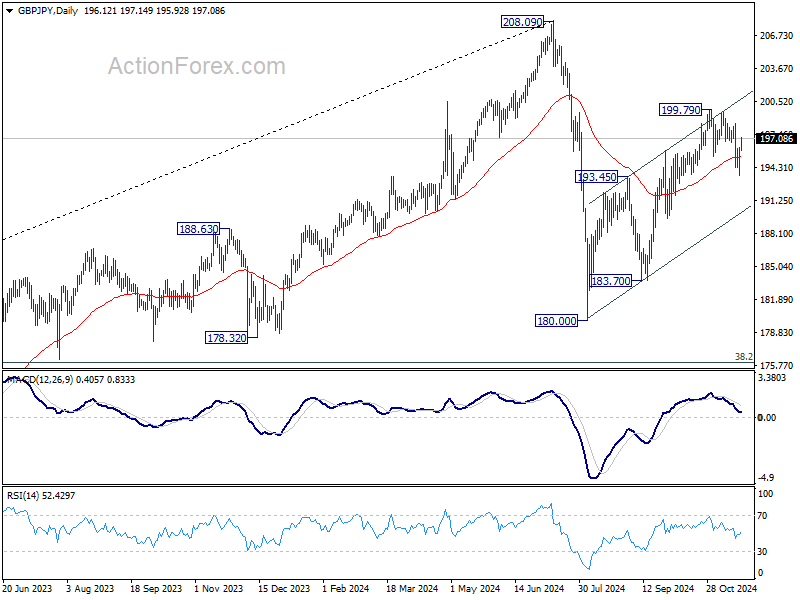
GBP/JPY's strong rebound an break of 196.13 minor resistance suggests that pull back from 199.79 has already completed. The development also revive near term bullishness. Intraday bias is back on the upside for retesting 199.79 resistance first. Firm break there will rebound whole rebound from 180.00.
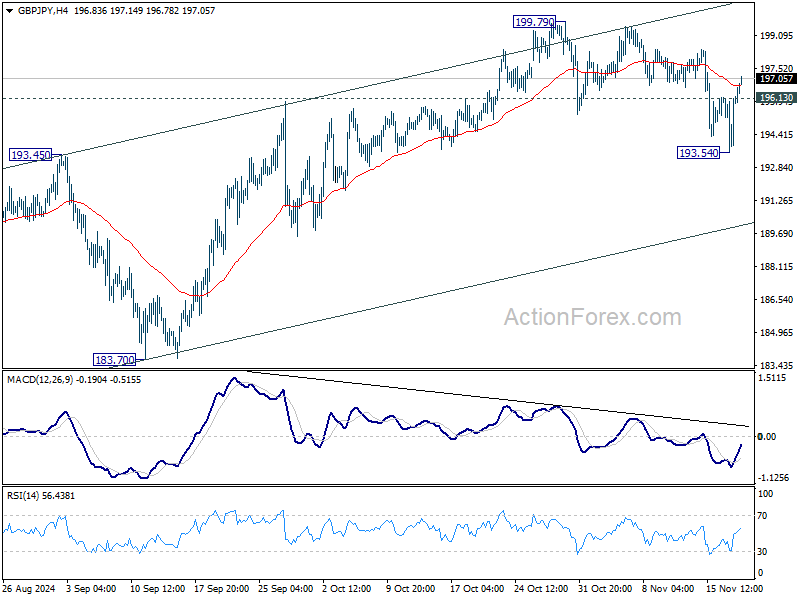
In the bigger picture, price actions from 208.09 are seen as a correction to whole rally from 123.94 (2020 low). The range of consolidation should be set between 38.2% retracement of 123.94 to 208.09 at 175.94 and 208.09. However, decisive break of 175.94 will argue that deeper correction is underway.
Sentiment Stabilization Reverses Yen Gains and Halts Gold’s Rebound
Yen fell broadly during Asian session today, reversing all of this week's earlier gains. Market sentiment has calmed somewhat despite the escalation in Russia's war in Ukraine, as there is no clear intensification toward a nuclear conflict. US Treasury yields have stabilized after yesterday's decline, and Gold's rebound has also stalled. Attention now turns to the upcoming UK CPI data.
UK inflation is expected to rebound from 1.7% to 2.2% in October, while core CPI is projected to slow slightly but remain elevated at 3.1%. The British Retail Consortium, along with over 80 retail companies, has requested a meeting with Finance Minister Rachel Reeves, warning that last month's budget would result in higher prices, job losses, and reduced investment.
BoE Governor Andrew Bailey has indicated that, given the uncertainty surrounding the impact of the Autumn budget, a gradual approach to monetary easing is needed. Persistent inflation is likely to keep BoE cautious about an inflation resurgence, leaning toward another pause at the December meeting.
Overall in the currency markets for the week so far, Aussie is the strongest one followed by Loonie and then Kiwi. Yen is the worst now, followed by Dollar and then Euro. Sterling and Swiss Franc are positioning in the middle. But almost all major pairs and crosses are still stuck inside last week's range, indicating that consolidations remain in progress.
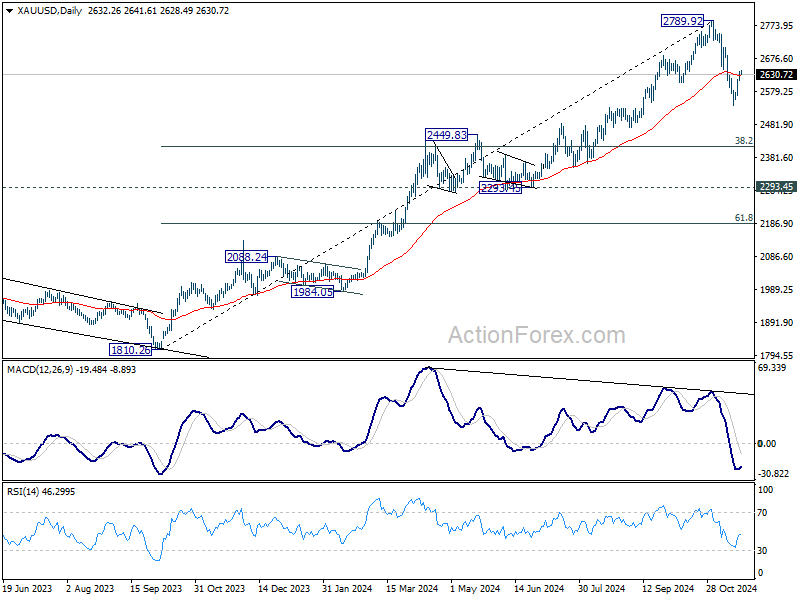
Technically, while Gold rebounded strongly this week, it's still struggling to break through 55 D EMA (now at 2627.547). Price actions from 2789.92 are seen as a correction to whole five-wave rally from 18102.6. Rejection by the 55 D EMA will extend the decline to 38.2% retracement of 1810.26 to 2789.92 at 2415.68. Nevertheless, sustained trading above 55 D EMA will bring retest of 2789.92 high first, before starting the third leg to finish the corrective pattern.
In Asia, at the time of writing, Nikkei is down -0.36%. Hong Kong HSI is down -0.17%. China Shanghai SSE is up 0.20%. Singapore Strait Times is down -0.14%. Japan 10-year JGB yield is up 0.0073 at 1.072. Overnight, DOW fell -0.28%. S&P 500 rose 0.40%. NASDAQ rose 1.04%. 10-year yield fell -0.035 to 4.379.
Fed’s Schmid: Path and destination of rate cut yet to be determined
Kansas City Fed President Jeffrey Schmid highlighted in a speech overnight the decision to lower rates this year as a reflection of the "growing confidence" in inflation’s moderation.
This optimism, he explained, stems from signs that "both labor and product markets have come into better balance in recent months."
While acknowledging this progress, Schmid cautioned, “It still remains to be seen how much further interest rates will decline or where they might eventually settle.”
Schmid also addressed concerns about the implications of large fiscal deficits on monetary policy. He emphasized that such deficits are not inherently inflationary, as long as Fed maintains its commitment to the 2% inflation target.
However, he warned that this approach could necessitate "persistently higher interest rates," creating tensions with political authorities. He noted, “History has shown that efforts to avoid higher interest rates by accommodating deficits often result in higher inflation.”
Japan's exports rebound by 3.1% yoy in Oct, but trade deficit persists
Japan's exports rose 3.1% yoy in October, reaching JPY 9,427B, a strong recovery from the -1.7% yoy decline in September, which marked a 43-month low.
This rebound was primarily driven by a 1.5% yoy increase in shipments to China, buoyed by strong demand for chipmaking equipment. However, exports to the US, Japan's largest trading partner, fell -6.2% yoy, reflecting weakness in auto shipments.
On the import side, growth remained modest at 0.4% yoy, totaling JPY 9,888B. This resulted in a trade deficit of JPY -461B for the month, the fourth straight month of shortfall.
Seasonally adjusted data showed exports declining -0.7% mom to JPY 8,882B, while imports ticked up 0.2% mom to JPY 9,239B, leading to a seasonally adjusted trade deficit of JPY -358B.
Australia Westpac leading index hits 0.26%, decisive breakaway from year-long sluggishness
Australia's Westpac Leading Index moved decisively into positive territory in October, rising from -0.20% in September to +0.26%.
This marks a significant shift, as the index had been hovering in slight negative territory, between -0.3% and flat, for most of the past year. The October reading is not only the first clear above-trend result since November 2023 (+0.16%) but also the strongest since July 2022 (+0.63%).
The improvement in the index provides a "constructive signal" for the economy’s future momentum. Westpac’s outlook aligns with this shift, forecasting an acceleration in economic growth from a nadir of 1.0% in mid-2024 to 1.5% by year-end and 2.4% by the end of 2025.
Looking ahead
UK CPI is the main focus in European session while PPI will also be featured. Germany will release PPI.
GBP/JPY Daily Outlook
Daily Pivots: (S1) 194.35; (P) 195.37; (R1) 197.16; More...
GBP/JPY's strong rebound an break of 196.13 minor resistance suggests that pull back from 199.79 has already completed. The development also revive near term bullishness. Intraday bias is back on the upside for retesting 199.79 resistance first. Firm break there will rebound whole rebound from 180.00.
In the bigger picture, price actions from 208.09 are seen as a correction to whole rally from 123.94 (2020 low). The range of consolidation should be set between 38.2% retracement of 123.94 to 208.09 at 175.94 and 208.09. However, decisive break of 175.94 will argue that deeper correction is underway.
Bitcoin Price Holds Steady as Bulls Set Sights on $100K
Key Highlights
- Bitcoin price started a consolidation phase near the $90,000 zone.
- BTC is following a key bullish trend line with support at $90,300 on the 4-hour chart.
- Gold prices started a recovery wave above the $2,600 zone.
- GBP/USD is showing bearish signs below the 1.2700 resistance.
Bitcoin Price Technical Analysis
Bitcoin price remained in a strong uptrend above the $88,000 resistance zone. BTC/USD is consolidating gains and the bulls could soon aim for a move toward $100,000.
Looking at the 4-hour chart, the price climbed higher steadily above the $80,000 and $85,000 resistance levels. The price even settled above the $85,000 zone, the 200 simple moving average (green, 4 hours), and the 100 simple moving average (red, 4 hours).
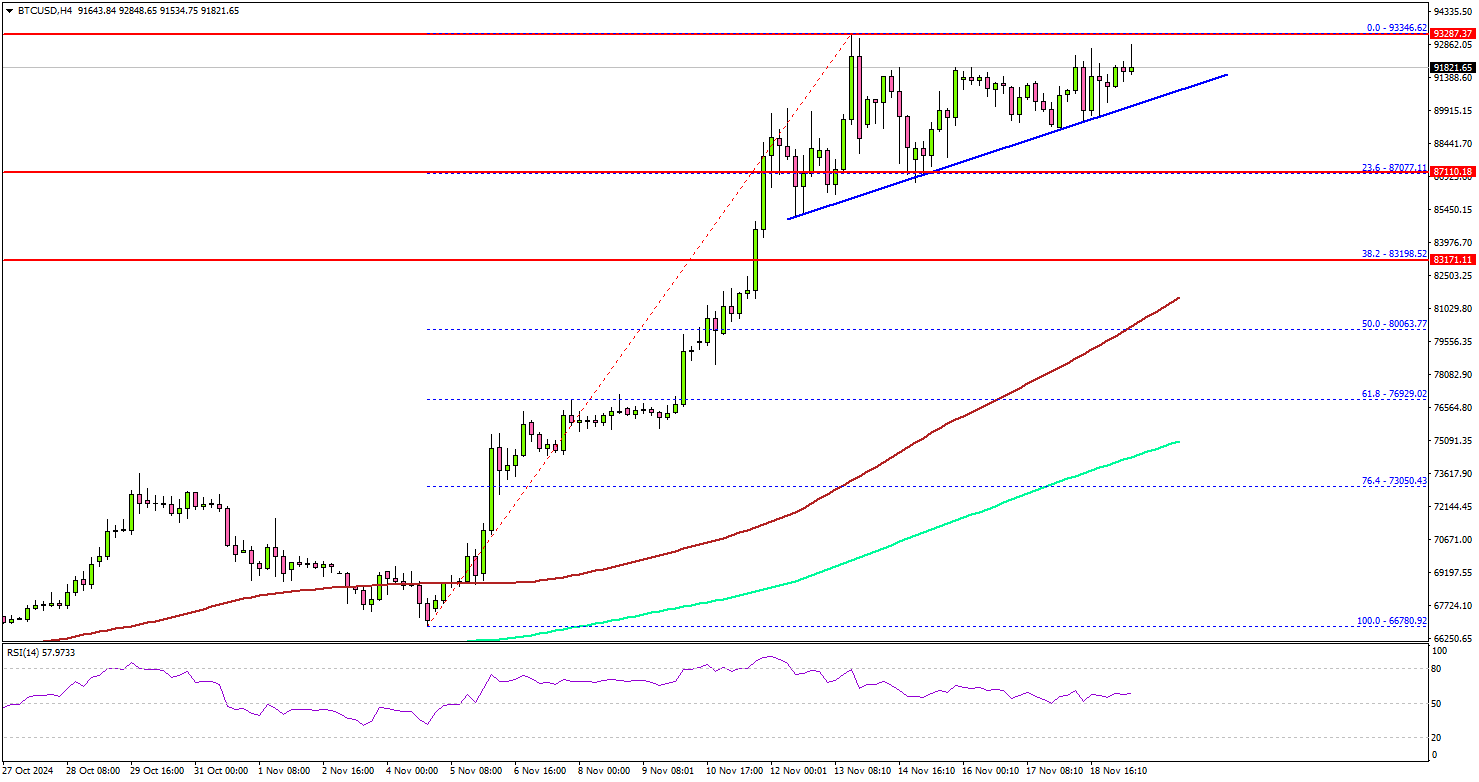
A new all-time high was formed at $93,346 and the price is now consolidating gains. There was a minor pullback, and the price tested the 23.6% Fib retracement level of the upward move from the $66,780 swing low to the $93,346 high.
However, the bulls are active above the $88,000 level. There is also a key bullish trend line forming with support at $90,300 on the same chart.
On the upside, the price could face resistance near the $93,500 level. The next key resistance is $95,000. A successful close above $95,000 might start another steady increase. In the stated case, the price may perhaps rise toward the $98,800 level or even $100,000.
If not, there might be another downside correction. Immediate support is near the $90,000 level and the trend line. The next key support sits at $88,000.
A downside break below $88,000 might send Bitcoin toward the $85,000 support. Any more losses might send the price toward the $80,000 support zone or the 50% Fib retracement level of the upward move from the $66,780 swing low to the $93,346 high.
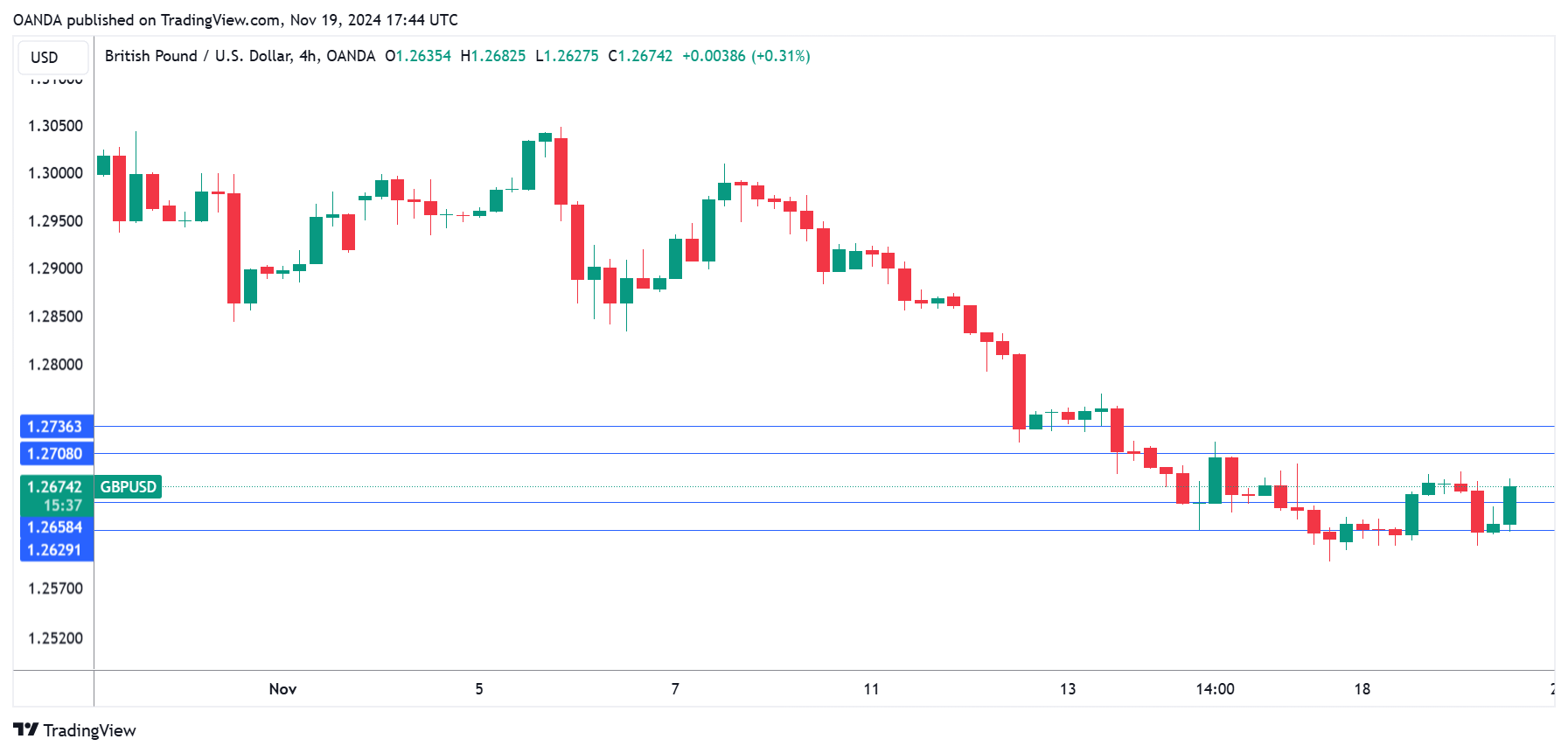
Looking at GBP/USD, the pair saw a lot of bearish moves and now struggles to recover above the 1.2700 resistance zone.
Today’s Economic Releases
- Fed's Cook speech.
- Fed's Bowman speech.
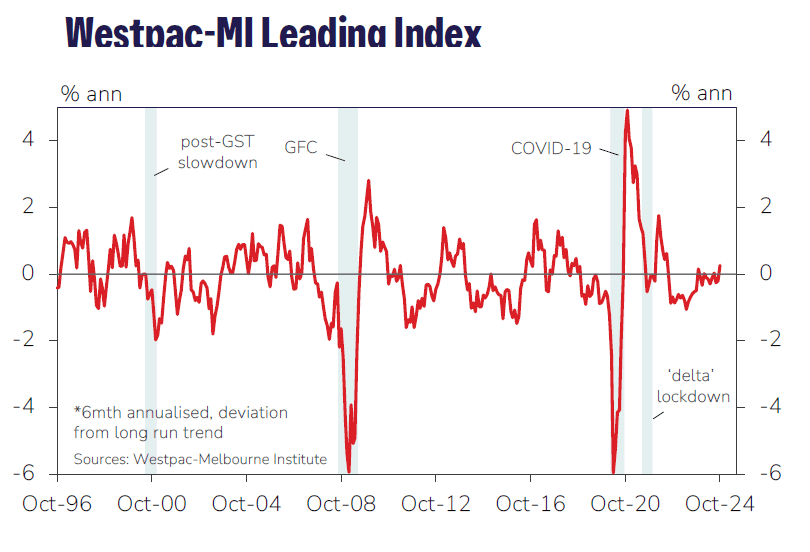
Australia Westpac leading index hits 0.26%, decisive breakaway from year-long sluggishness
Australia's Westpac Leading Index moved decisively into positive territory in October, rising from -0.20% in September to +0.26%.
This marks a significant shift, as the index had been hovering in slight negative territory, between -0.3% and flat, for most of the past year. The October reading is not only the first clear above-trend result since November 2023 (+0.16%) but also the strongest since July 2022 (+0.63%).
The improvement in the index provides a "constructive signal" for the economy’s future momentum. Westpac’s outlook aligns with this shift, forecasting an acceleration in economic growth from a nadir of 1.0% in mid-2024 to 1.5% by year-end and 2.4% by the end of 2025.
Japan’s exports rebound by 3.1% yoy in Oct, but trade deficit persists
Japan's exports rose 3.1% yoy in October, reaching JPY 9,427B, a strong recovery from the -1.7% yoy decline in September, which marked a 43-month low.
This rebound was primarily driven by a 1.5% yoy increase in shipments to China, buoyed by strong demand for chipmaking equipment. However, exports to the US, Japan's largest trading partner, fell -6.2% yoy, reflecting weakness in auto shipments.
On the import side, growth remained modest at 0.4% yoy, totaling JPY 9,888B. This resulted in a trade deficit of JPY -461B for the month, the fourth straight month of shortfall.
Seasonally adjusted data showed exports declining -0.7% mom to JPY 8,882B, while imports ticked up 0.2% mom to JPY 9,239B, leading to a seasonally adjusted trade deficit of JPY -358B.
Fed’s Schmid: Path and destination of rate cut yet to be determined
Kansas City Fed President Jeffrey Schmid highlighted in a speech overnight the decision to lower rates this year as a reflection of the "growing confidence" in inflation’s moderation.
This optimism, he explained, stems from signs that "both labor and product markets have come into better balance in recent months."
While acknowledging this progress, Schmid cautioned, “It still remains to be seen how much further interest rates will decline or where they might eventually settle.”
Schmid also addressed concerns about the implications of large fiscal deficits on monetary policy. He emphasized that such deficits are not inherently inflationary, as long as Fed maintains its commitment to the 2% inflation target.
However, he warned that this approach could necessitate "persistently higher interest rates," creating tensions with political authorities. He noted, “History has shown that efforts to avoid higher interest rates by accommodating deficits often result in higher inflation.”
S&P 500 index Wave Analysis
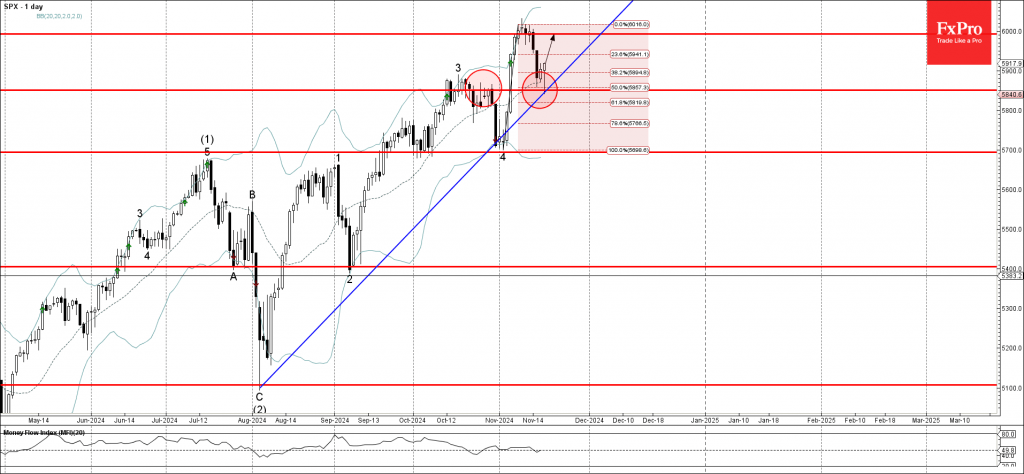
- S&P 500 index reversed from support zone
- Likely to rise to resistance level 6000.00
S&P 500 index recently reversed up from the pivotal support level 5850.00 (former multi-day resistance from October).
The support level 5850.00 was further strengthened by the lower daily Bollinger Band, support trendline from August and the 50% Fibonacci correction of the upward impulse from the start of November.
Given the clear daily uptrend, S&P 500 index can be expected to rise to the next round resistance level 6000.00.
EURCAD Wave Analysis
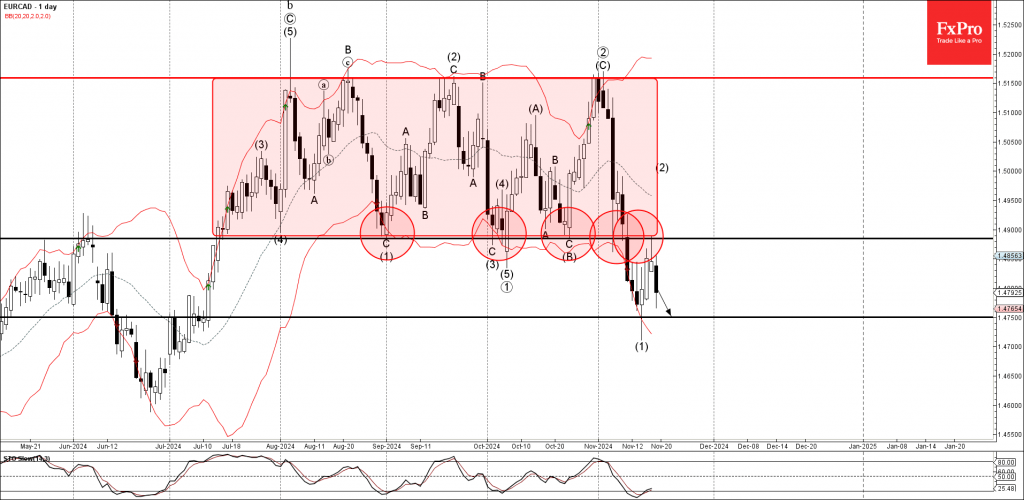
- EURCAD reversed from resistance level 1.4885
- Likely to fall to support level 1.4750
EURCAD currency pair recently reversed down from the resistance level 1.4885 (which is the lower border of the wide sideways price range inside which the pair has been trading from July, acting as the resistance after it was broken earlier).
The downward reversal from the resistance level 1.4885 stopped the previous intermediate ABC correction (2) from the end of last week.
Given the strongly bearish euro sentiment seen today, EURCAD currency pair can be expected to fall to the next support level 1.4750.
UK Inflation Expected to Jump to 2.2%
The British pound is steady on Tuesday. In the North American session, GBP is trading at 1.2678 at the time of writing, unchanged on the day. On Monday, the pound ended a six-day slide, during which the currency lost 2.8%.
Markets brace for higher UK inflation
The Bank of England has done an excellent job slashing inflation, which was in double digits for much of 2023. The September inflation report was a milestone as inflation eased to 1.7%, the first time it was below the BoE target of 2% since April 2021.
Still, the BoE is under no illusions that the tenacious battle against inflation is over. Services inflation has fallen significantly but is running at 4.9%, more than double the target. The Trump election win has raised deep concerns that Trump’s trade policy promises, with threats of tariffs on US trading partners, could lead to higher global inflation.
The BoE lower rates by 25 basis points on Nov. 7, marking the second rate cut in the current easing cycle. The September inflation report contributed to the decision to lower rates at that meeting and Wednesday’s inflation release will be closely monitored by the BoE, with the following inflation report coming out on Dec. 18, just one day before the BOE’s next rate announcement.
BoE Governor Bailey said in a report to the House of Commons Treasury select committee that the BoE needed to keep a close eye on services inflation, which remained above a level that was compatible with “on target inflation”.
Bailey also stated that he favored a gradual approach to cutting rates in order for the central bank to assess the effects of the government’s recent budget on growth and inflation. The BoE’s November forecasts indicate that the budget will result in higher growth and inflation in the near term, which could slow the pace of rate cuts.
GBP/USD Technical
- There is resistance at 1.2707 and 1.2736
- 1.2629 and 1.2658 are the next support levels