

Sample Category Title
AUDUSD Elliott Wave Analysis: Short Term Favors Downside From Bounces
Hello traders, welcome to a new Forex blog post. In this one, we will discuss AUDUSD short-term Elliott wave analysis. We believe the forex pair is still within a bearish corrective cycle from late September 2024. Thus, the current minor bounce should fail at some point, leading to a further intraday sell-off.
From the perspective of Elliott wave theory, price action evolves in a series of 5-waves and 3-waves that depict trend and correction, respectively. The theory also postulates that a trend develops in 5-waves. When a 5-wave sequence is completed, a 3-wave correction should occur against the direction of the trend. These 5-waves and 3-waves combine to form market cycles across all time frames.
A bullish sequence evolved in AUDUSD from the low of August 2024. This sequence completed a 5-wave impulse structure on September 30th. The expectation was that a 3-wave correction to the downside would follow. Meanwhile, corrections can take different forms. However, the most recognizable and tradable are what we call zigzags. Zigzags can either complete a 3, 7, or 11 swing structure, i.e., A-B-C, W-X-Y, or W-X-Y-XX-Z sequences, respectively. When the first sub-structure within the corrective phase is a 5-wave, we often anticipate an A-B-C structure. A-B-C structures are 5-3-5 wave sequences, which we refer to as zigzag patterns.
AUDUSD Elliott Wave Analysis – 10.17.2024 Update
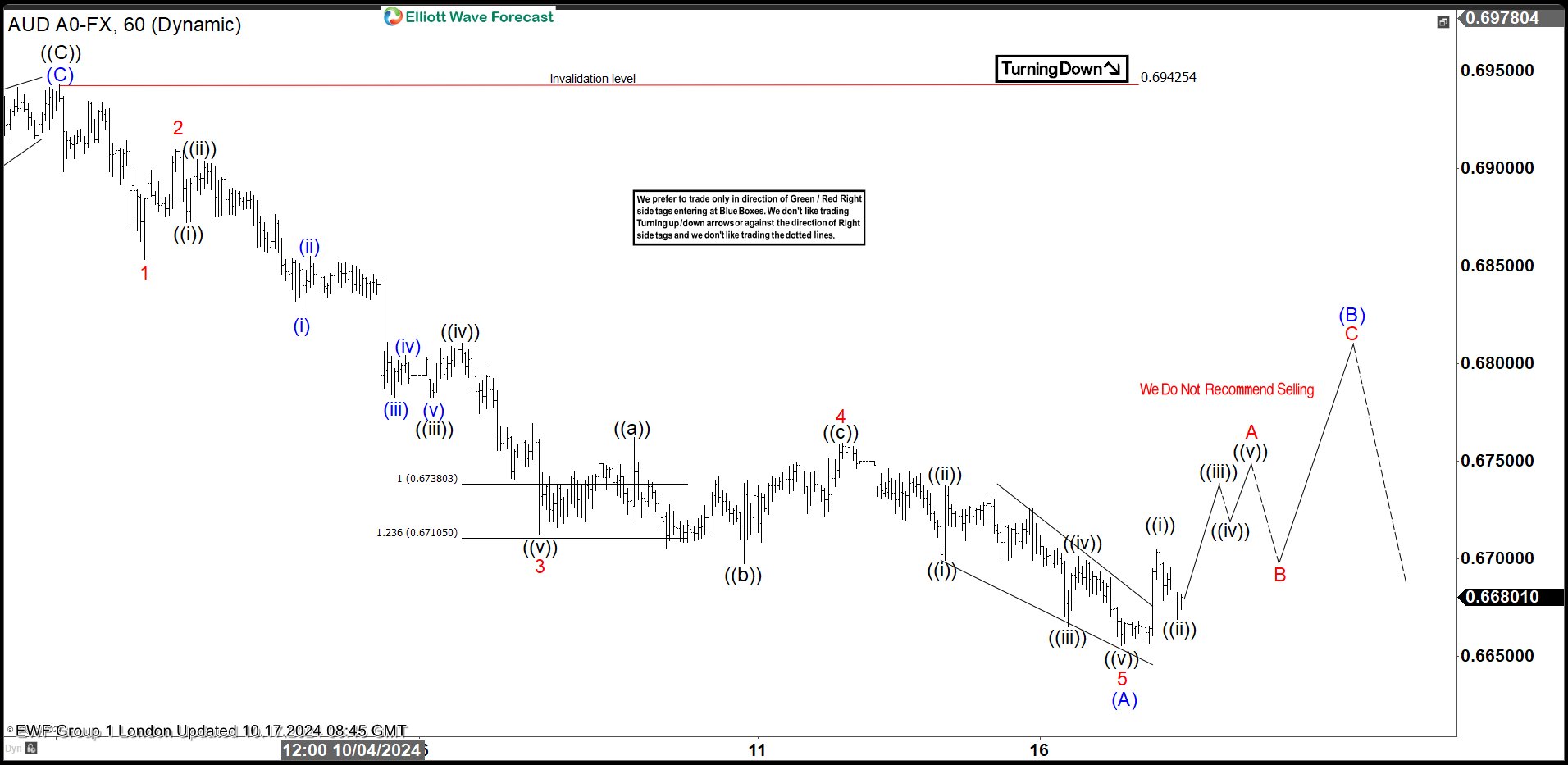
We shared the chart above on 10/17/2024 with Elliottwave-Forecast members, showing the path in the shorter cycles. The chart displays a bearish correction of the bullish sequence from the low of August. The first reaction was a 5-wave down, completing wave (A). With this structure, we can anticipate an A-B-C zigzag pattern involving a 5-3-5 wave sequence. Thus, the price is currently in wave (B) if it extends higher to at least the 23.6% retracement zone at 0.6725. However, if the current bounce ends below 0.6725, then it’s not sufficient for (B). In that case, we could consider it as a new wave 4 of (A) or wave ((ii)) of 5, leading to a further sell-off for wave (A).
On the other hand, if the bounce develops above 0.6725 to qualify for wave (B), we will expect a 3, 7, or 11 swing structure and anticipate where wave (B) should end. At the extreme of (B), we expect new attempts by sellers to push lower below (A) along the path of (C). However, to join the sellers, we would like to confirm the end of wave (B) by waiting for the price to breach the low of wave (A). Afterward, we would sell on bounces in 3, 7, or 11 swing structures, targeting 100% of wave (A) from (B). When it’s time to sell, our members will be alerted in the trading room and by the blue box on our charts. The blue box provides entry and exit prices. Additionally, in the trading room, our analysts share trade management tips for every setup.
USD/JPY Mid-Day Outlook
Daily Pivots: (S1) 149.08; (P) 149.44; (R1) 150.02; More...
Intraday bias in USD/JPY remains neutral and more consolidations could still be seen. Further rally is expected with 146.48 resistance turned support intact. Above 149.97 will resume the rise from 139.57 to 61.8% retracement of 161.94 to 139.57 at 153.39 next. However, firm break of 146.48 will argue that such rebound has completed, and turn bias back to the downside for retesting 139.57 low.
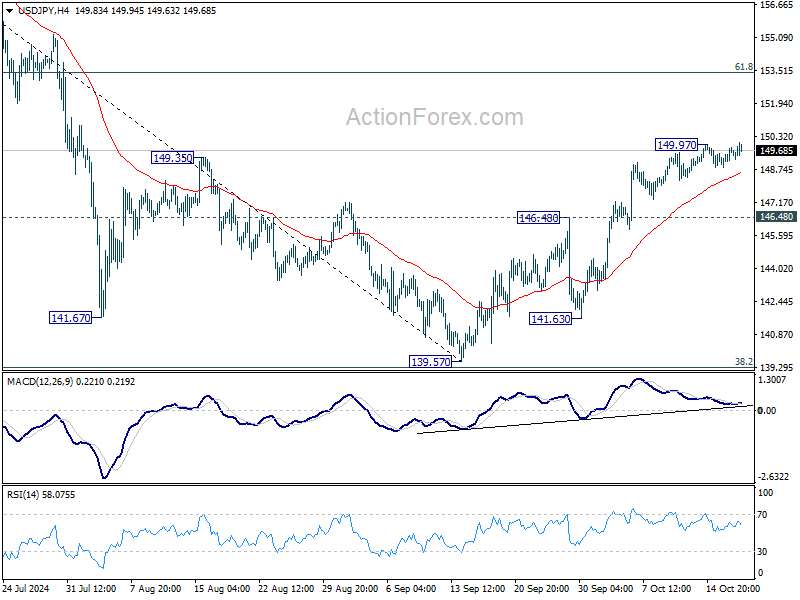
In the bigger picture, price actions from 161.94 are seen as a corrective pattern to rise from 102.58 (2021 low). The range of medium term consolidation should now be set between 38.2% retracement of 102.58 to 161.94 at 139.26 and 161.94. Nevertheless, sustained break of 139.26 would open up deeper medium term decline to 61.8% retracement at 125.25.
USD/CHF Mid-Day Outlook
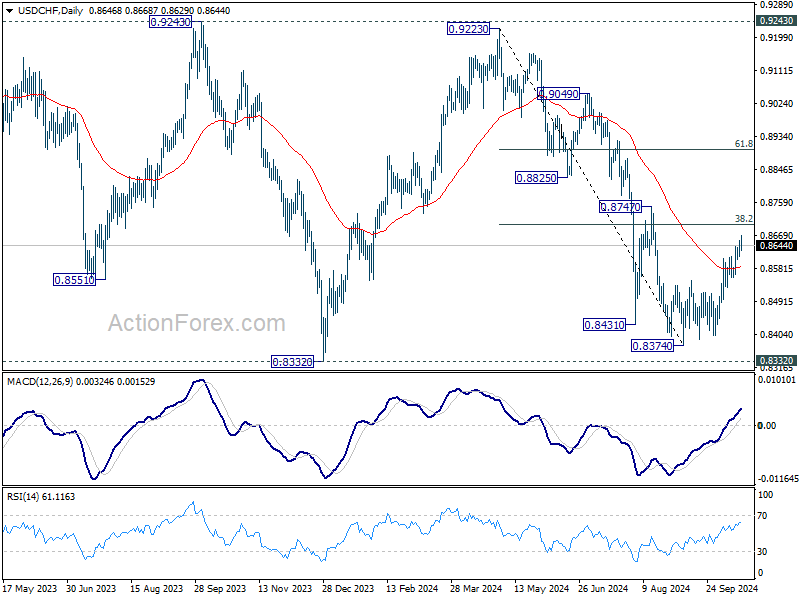
Daily Pivots: (S1) 0.8625; (P) 0.8641; (R1) 0.8672; More…
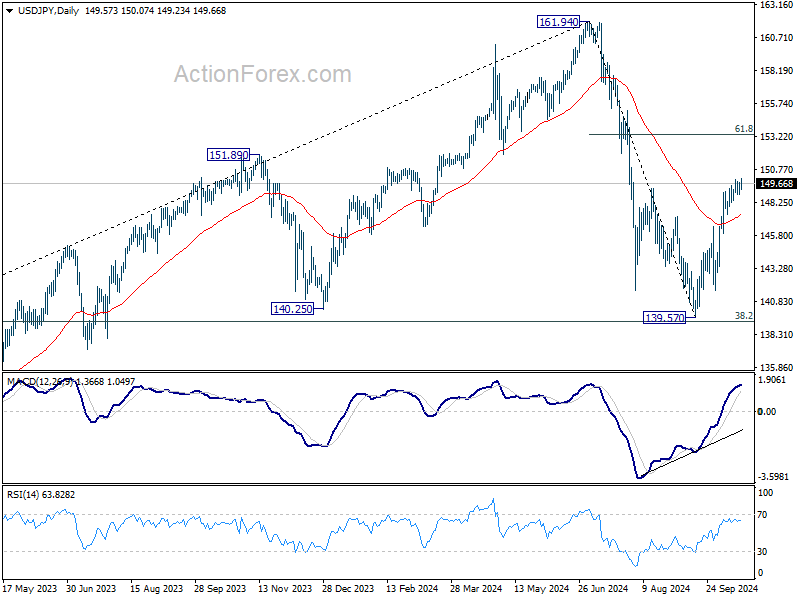
USD/CHF's rally from 0.8374 is in progress and intraday bias stays on the upside. Sustained break of 38.2% retracement of 0.9223 to 0.8374 at 0.8698 will argue that fall from 0.9223 has completed after defending 0.8332 low. Further rally should then be seen to 61.8% retracement at 0.8899 next. On the downside, below 0.8605 minor support will turn intraday bias neutral again first.
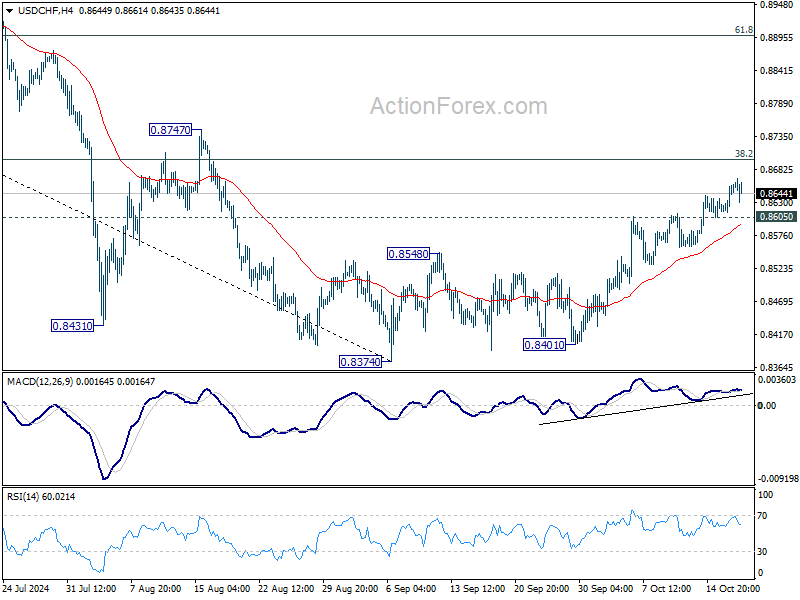
In the bigger picture, price actions from 0.8332 (2023 low) are currently seen as a medium term corrective pattern, with fall from 0.9223 as the second leg. Strong support could be seen from 0.8332 to bring rebound. Yet, overall outlook will continue to stay bearish as long as 0.9243 resistance holds. Firm break of 0.8332, however, will resume larger down trend from 1.0146 (2022 high).
GBP/USD Mid-Day Outlook
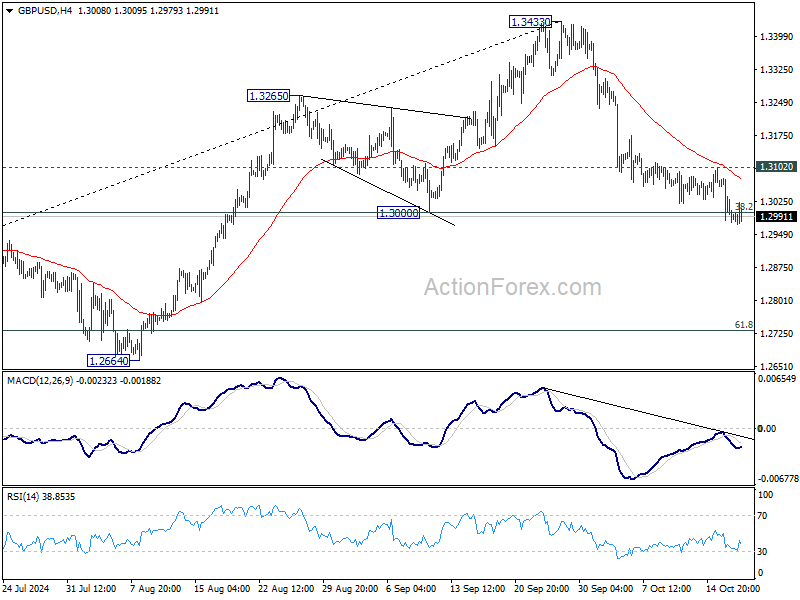
Daily Pivots: (S1) 1.2950; (P) 1.3018; (R1) 1.3060; More...
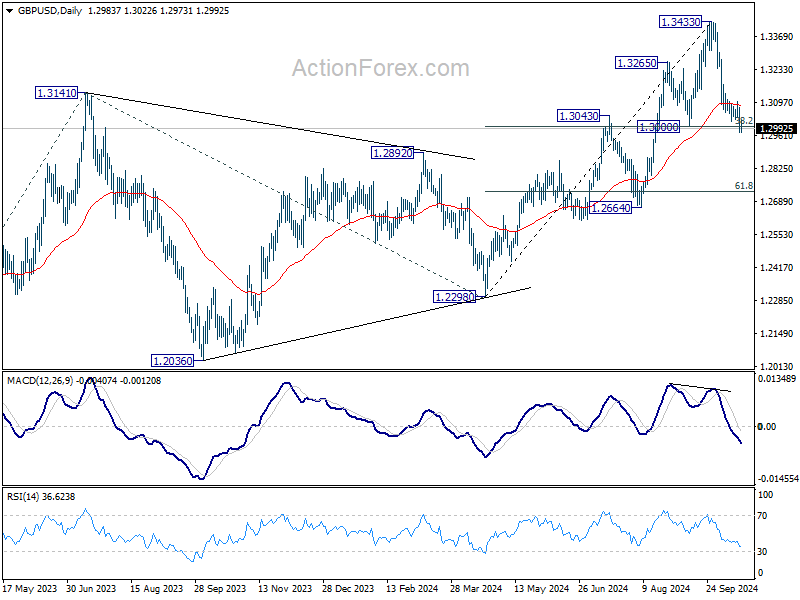
Intraday bias in GBP/USD remains on the downside and outlook is unchanged. Sustained trading below 1.3000 cluster support (38.2% retracement of 1.2298 to 1.3433 at 1.2999) will argue that whole rise from 1.2298 has completed and bring deeper fall to 61.8% retracement at 1.2732. Nevertheless, strong bounce from current level, followed by break of 1.3102 minor resistance, will turn bias back to the upside for stronger rebound towards 1.3433.
In the bigger picture, as long as 1.3000 support holds, the up trend from 1.0351 (2022 low) is still in progress. Next target is 61.8% projection of 1.0351 to 1.3141 from 1.2298 at 1.4022. However, considering mild bearish divergence condition in D MACD, decisive break of 1.3000 will argue that a medium term top is already in place, and bring deeper fall back to 1.2664 support next.
US: Retail Sales Came in Stronger Than Expected in September
Retail sales rose 0.4% month-on-month (m/m) in September, higher than August's 0.1% gain and ahead of consensus forecast calling for an increase of 0.3% m/m.
Trade in the auto sector was flat for the month, as the marginal increase at automotive parts and accessory stores (0.5%) was wholly offset by the slight decline at motor vehicle dealers (-0.01%).
Sales at gasoline stations dipped -1.6% m/m in September, though this was largely a price story, as prices at the pump fell 4.0% m/m last month. The building materials and equipment category rose by 0.2% m/m.
Sales in the "control group", which excludes the volatile components above (i.e., gasoline, autos and building supplies) and is used in the estimate of personal consumption expenditures (PCE), rose 0.7% m/m, a sizeable acceleration from the 0.3% monthly gain in August.
- Gains were concentrated across miscellaneous store retailers (4.0% m/m), clothing & accessories stores (1.5% m/m) and health & personal care stores (1.1% m/m).
- The largest decline was at furniture and electronics stores (-2.2% m/m).
Food services & drinking places – the only services category in the retail sales report – rose 1.0% m/m. August's data was also revised up to 0.5% (reported as flat previously).
Key Implications
The U.S. consumer continues to display notable resilience, despite the headwinds that have blown their way. Monthly sales rose at a relatively fast pace adding to previous gains earlier in the quarter. Sales in the key control group were also notable, remaining in positive territory for the fifth consecutive month. All said, with today's numbers, growth in sales for the third quarter was strong at 5.3% annualized – notably above the 1.8% annualized gain recorded in Q2 and significantly higher than the decline in Q1 (-0.8%).
After a brief stumble at the beginning of the year, consumers seem to have found their footing again. Recent revisions to income and spending data suggests that they may have even more room to run than we previously believed. While we no longer expect growth in consumer spending to dip below 2% annualized, a deceleration from our current tracking of above-3.0% in Q3 is still in the cards over the coming quarters.
EUR/USD Mid-Day Outlook
Daily Pivots: (S1) 1.0843; (P) 1.0872; (R1) 1.0891; More....
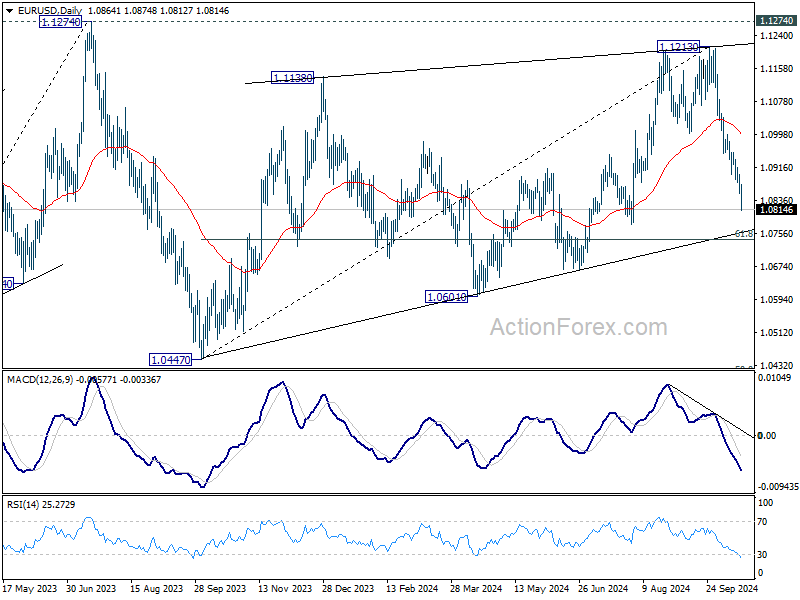
EUR/USD's fall from 1.1213 extends lower today and intraday bias remains on the downside. This decline is seen as the third leg of the corrective pattern from 1.1274. Deeper fall would be seen to 61.8% retracement of 1.0447 to 1.1213 at 1.0740 next. Firm break there will target 1.0601 support next. On the upside, above 1.0900 minor resistance will turn intraday bias neutral and bring consolidations first, before staging another decline.
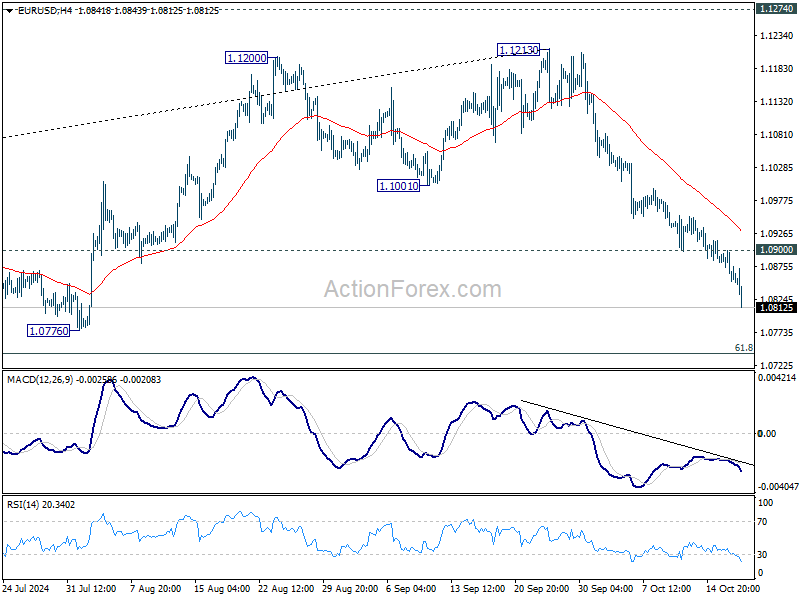
In the bigger picture, rejection by 1.1274 resistance suggests that corrective pattern from 1.1274 (2023 high) is not completed yet. Instead, decline from 1.1213 might be another falling leg. Sustained break of 55 W EMA (now at 1.0877) will validate this case, and bring deeper fall towards 1.0447 support again. But downside should be contained by 50% retracement of 0.9534 (2022 low) to 1.1274 at 1.0404.
Dovish ECB Rate Cut Pressures Euro, Gold Breaks to Fresh Record
Euro tumbled broadly after ECB’s decision to cut its deposit rate by 25bps, as widely expected. During the post-meeting press conference, President Christine Lagarde maintained a cautious tone, stressing that ECB is "not pre-committing to a particular rate path." However, her overall stance leaned dovish, with a clear acknowledgment that "economic activity has been somewhat weaker than expected."
Lagarde further highlighted that risks to growth remain "tilted to the downside." Lower confidence could slow the recovery in consumption and investment. Reduced demand for Eurozone exports could potentially adding pressure to economic growth. Additionally, inflation risks could shift to the downside if weak confidence and concerns over geopolitical events continue to curb spending and investment, or if the global economic environment deteriorates unexpectedly.
Overall in the currency markets, Canadian Dollar has emerged as the day’s worst performer, struggling to maintain its brief recovery. Euro follows as the second weakest, with Yen also underperforming. On the other side, Australian Dollar leads the gains, supported by strong employment data, though its upward momentum remains capped. Sterling and Kiwi are also performing well, while Dollar and Swiss Franc occupy middle ground.
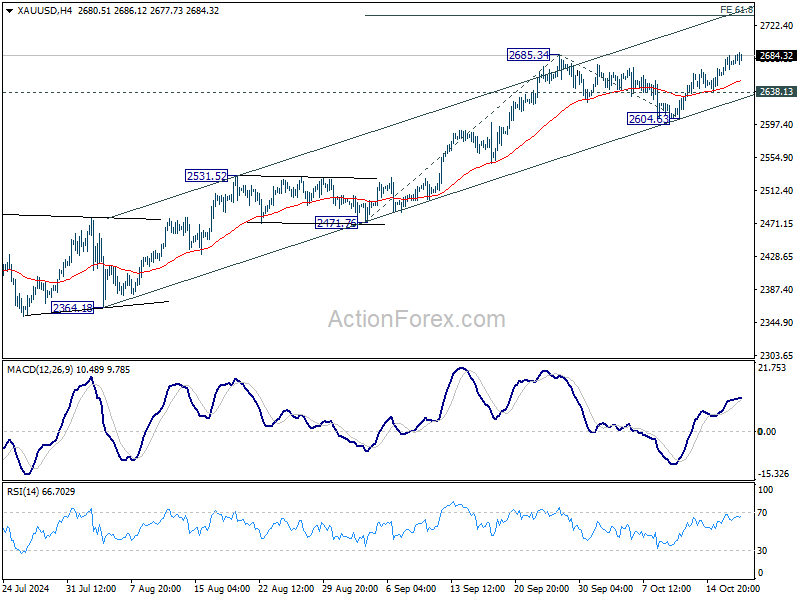
Technically, Gold is maintaining steady momentum as it breaches to new record high today. For now, further rally is expected as long as 2638.13 support holds. Next target is 61.8% projection of 2471.76 to 2685.34 from 2604.53 at 2736.62.
In Europe, at the time of writing, FTSE is up 0.47%. DAX is up 0.92%. CAC is up 1.50%. UK 10-year yield is up 0.0228 at 4.091. Germany 10-year yield is up 0.015 at 2.204. Earlier in Asia, Nikkei fell -0.69%. Hong Kong HSI fell -1.02%. China Shanghai SSE fell -1.05%. Singapore Strait Times rose 0.96%. Japan 10-year JGB yield rose 0.0102 to 0.965.
US retail sales rise 0.4% mom in Sep, ex-auto sales jump 0.5% mom
US retail sales rose 0.4% mom to USD 714.4B in September, above expectation of 0.3% mom. Ex-auto sales jumped 0.5% mom to 580.5B, well above expectation of 0.1% mom. Ex-gasoline sales rose 0.6% mom to 633.2B. Ex-auto, gasoline sales rose 0.7% mom to 529.5B.
Total sales for the July through September period were up 2.3% over the sale period a year ago.
US initial jobless claims fall to 241k, match expectations
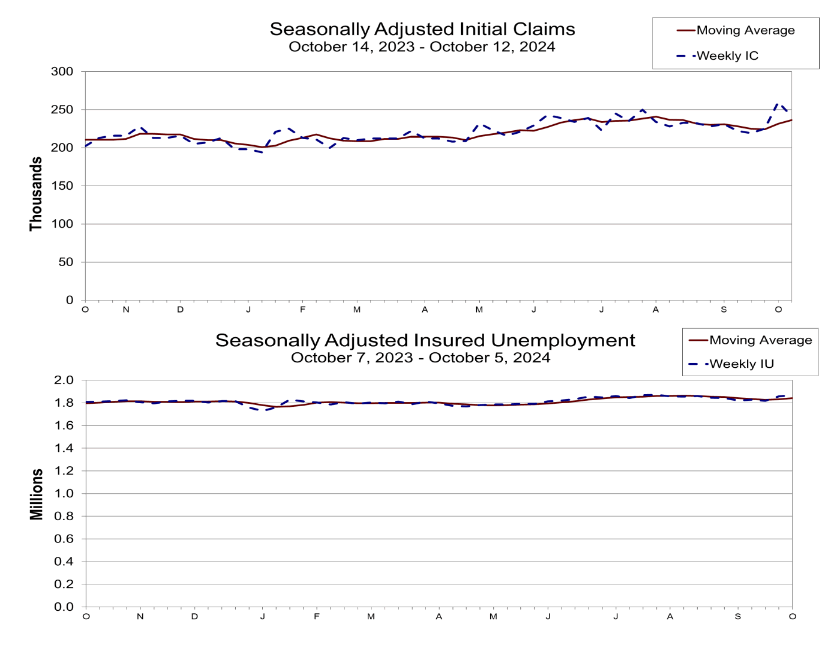
US initial jobless claims fell -19k to 241k in the week ending October 12, matched expectations. Four-week moving average of initial claims rose 5k to 236k.
Continuing claims rose 9k to 1867k in the week ending October 5. Four-week moving average of continuing claims rose 11.5k to 1843k.
ECB lowers rates by 25bps, cites economic downside surprises impacting inflation outlook
ECB cut its deposit rate by 25 basis points to 3.25% today, as widely anticipated. In its accompanying statement, ECB highlighted that the disinflationary process is "well on track," with inflation expected to decline to target levels by next year. Recent "downside surprises" in economic activity have also impacted the inflation outlook.
Despite the improvement, domestic inflation remains elevated, driven by persistent wage growth. However, ECB expects labor cost pressures to ease gradually, with profits buffering their inflationary impact.
The central bank reaffirmed its commitment to maintaining rates at restrictive levels for as long as necessary, emphasizing a "data-dependent", "meeting-by-meeting" approach to future policy decisions, without pre-committing to any specific rate path.
Eurozone CPI finalized at 1.7% in Sep, CPI core at 2.7%
Eurozone CPI in September was finalized at 1.7% yoy, down from August’s 2.2% yoy. Core CPI, which excludes volatile components like energy, food, alcohol, and tobacco, was finalized at 2.7% yoy, slightly lower than August’s 2.8% yoy.
The largest contributor to Eurozone CPI was the services sector, adding +1.76 percentage points to the annual rate, followed by food, alcohol, and tobacco (+0.47 pp). Non-energy industrial goods added +0.12 pp, while energy dragged inflation down by -0.60 pp as prices continued to ease.
On a broader level, EU inflation was also finalized lower at 2.1%, down from 2.4% in August. Inflation rates across member states varied significantly, with the lowest annual rates recorded in Ireland (0.0%), Lithuania (0.4%), and Slovenia and Italy (both at 0.7%).
In contrast, Romania (4.8%), Belgium (4.3%), and Poland (4.2%) registered the highest inflation rates. Compared to August, annual inflation fell in twenty Member States, remained stable in two, and rose in five.
Eurozone goods exports fall -2.4% yoy in Aug, imports down -2.3% yoy
Eurozone goods exports fell -2.4% yoy to EUR 216.7B in August. Goods imports fell -2.3% yoy to EUR 212.1B. Trade balance was a EUR 4.6B surplus. Intra- Eurozone trade fell -4.3% yoy to EUR 183.5B.
In seasonally adjusted term, goods exports fell -0.1% mom to EUR 237.9B. Goods imports rose 1.0% mom to EUR 226.8B. Trade balance reported EUR 11.0B surplus. Intra-Eurozone trade fell -0.5% mom to EUR 215.1B.
Australia's employment grows 64.1k in Sep, unemployment rate unchanged at 4.1%
Australia's employment figures for September showed stronger-than-expected growth, with 64.1k jobs added, significantly exceeding forecast of 25.2k. Full-time employment led the gains, rising by 51.6k, while part-time jobs increased by 12.5k.
Unemployment rate remained steady at 4.1%, slightly better than the expected 4.2%. Participation also increased by 0.1% to 67.2%, indicating higher workforce engagement. Monthly hours worked saw a modest rise of 0.3% mom.
Over the past year, employment has grown by 3.1%, outpacing the civilian population growth of 2.5%. This pushed the employment-to-population ratio to a historical high of 64.4%, reflecting robust labor market conditions.
Australia's NAB business confidence drops to -6 in Q3, inflation pressures ease slightly as margins squeezed
Australia’s NAB quarterly Business Confidence declined from -2 to -6 in Q3. Business conditions also dropped from 5 to 2, with trade conditions falling from 9 to 5, profitability slipping from 2 to 0, and employment conditions down from 5 to 3, signaling softer economic momentum.
Leading indicators weakened, with expected business conditions for the next 3 months falling from 11 to 10, and for the next 12 months from 15 to 12. Forward orders remained negative at -4, and capacity utilization eased from 83.6% to 83.0%. Capital expenditure plans also declined from 24 to 19, indicating reduced investment expectations.
Cost pressures remained persistent. Labor costs grew 1.2%, up from 1.1%, and purchase costs increased to 1.0%, up from 0.9%. Final product price growth, however, slowed from 0.6% to 0.4%, and retail price growth remained steady at 0.7%, suggesting inflationary pressures are easing but at the expense of business margins.
NAB Head of Australian Economics Gareth Spence noted, “Labor cost growth remains elevated, and wage costs are the top issue affecting business confidence. While purchase cost growth persists, the marked drop in final product price growth suggests progress on inflation, though margins are under pressure.”
Japan's exports fall -1.7% yoy in Sep, first decline in 10 months
Japan's exports in September dropped by -1.7% yoy to JPY 9.038T, marking the first annual decline in 10 months. This slump was driven by weaker demand from key trading partners. Exports to China, Japan's largest market, fell by -7.3% yoy, while those to the US dropped by -2.4% yoy.
On the other hand, imports rose modestly by 2.1% yoy to JPY 9.333T, leading to a trade deficit of JPY -294B, the third consecutive monthly shortfall.
In seasonally adjusted terms, there was a small improvement. Exports grew by 2.0% mom to JPY 8.956T, while imports fell by -1.2% mom to JPY 9.144T. This led to a seasonally adjusted trade deficit of JPY -187B.
EUR/USD Mid-Day Outlook
Daily Pivots: (S1) 1.0843; (P) 1.0872; (R1) 1.0891; More....
EUR/USD's fall from 1.1213 extends lower today and intraday bias remains on the downside. This decline is seen as the third leg of the corrective pattern from 1.1274. Deeper fall would be seen to 61.8% retracement of 1.0447 to 1.1213 at 1.0740 next. Firm break there will target 1.0601 support next. On the upside, above 1.0900 minor resistance will turn intraday bias neutral and bring consolidations first, before staging another decline.
In the bigger picture, rejection by 1.1274 resistance suggests that corrective pattern from 1.1274 (2023 high) is not completed yet. Instead, decline from 1.1213 might be another falling leg. Sustained break of 55 W EMA (now at 1.0877) will validate this case, and bring deeper fall towards 1.0447 support again. But downside should be contained by 50% retracement of 0.9534 (2022 low) to 1.1274 at 1.0404.
US initial jobless claims fall to 241k, match expectations
US initial jobless claims fell -19k to 241k in the week ending October 12, matched expectations. Four-week moving average of initial claims rose 5k to 236k.
Continuing claims rose 9k to 1867k in the week ending October 5. Four-week moving average of continuing claims rose 11.5k to 1843k.
US retail sales rise 0.4% mom in Sep, ex-auto sales jump 0.5% mom
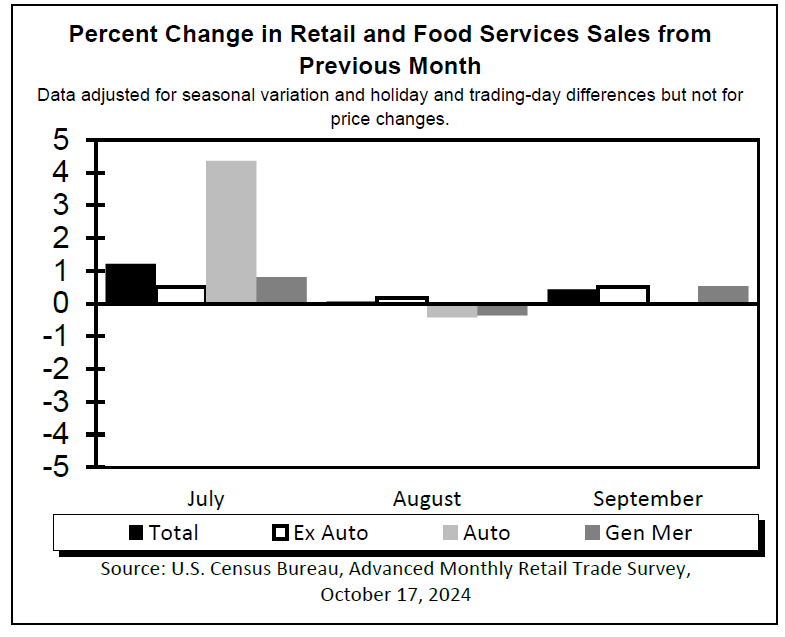
US retail sales rose 0.4% mom to USD 714.4B in September, above expectation of 0.3% mom. Ex-auto sales jumped 0.5% mom to 580.5B, well above expectation of 0.1% mom. Ex-gasoline sales rose 0.6% mom to 633.2B. Ex-auto, gasoline sales rose 0.7% mom to 529.5B.
Total sales for the July through September period were up 2.3% over the sale period a year ago.
ECB lowers rates by 25bps, cites economic downside surprises impacting inflation outlook
ECB cut its deposit rate by 25 basis points to 3.25% today, as widely anticipated. In its accompanying statement, ECB highlighted that the disinflationary process is "well on track," with inflation expected to decline to target levels by next year. Recent "downside surprises" in economic activity have also impacted the inflation outlook.
Despite the improvement, domestic inflation remains elevated, driven by persistent wage growth. However, ECB expects labor cost pressures to ease gradually, with profits buffering their inflationary impact.
The central bank reaffirmed its commitment to maintaining rates at restrictive levels for as long as necessary, emphasizing a "data-dependent", "meeting-by-meeting" approach to future policy decisions, without pre-committing to any specific rate path.