Sample Category Title
Fed’s Bostic justifies 50bps rate cut amid faster inflation progress, labor market weakness
In a speech today, Atlanta Fed President Raphael Bostic shed light on his support for last week's 50bps rate cut, citing faster-than-expected improvements in inflation and labor market cooling.
"Progress on inflation and the cooling of the labor market have emerged much more quickly than I imagined at the beginning of the summer," Bostic remarked. He now sees a path to normalizing monetary policy sooner than anticipated.
Bostic acknowledged that his "residual concern" about inflation could have led him to favor a smaller reduction. However, a 25bps cut "would belie growing uncertainty about the weakening of the labor market," he added.
Fed’s Kashkari backs 50bps cut, shifts focus to labor market weakness
In an essay, Minneapolis Fed President Neel Kashkari provided insight into his support for last week’s 50bps rate cut, despite not having a vote on the decision.
“We have made substantial progress bringing inflation back down toward our 2 percent target, and the labor market has softened," he said. Kashkari noted that the balance of risks has "shifted away from higher inflation" and toward risk of further weakening of the labor market, justifying the need for a lower federal funds rate.
He acknowledged that even after the substantial 50bps reduction, "the overall stance of monetary policy remains tight."
Kashkari further pointed out that the economy’s unexpected resilience despite high policy rates might indicate a temporary or even structural rise in the neutral rate. “The longer this economic resilience continues, the more signal I take that the temporary elevation of the neutral rate might in fact be more structural,” he explained.
Looking ahead, Kashkari highlighted that future policy decisions would depend on incoming data related to economic activity, labor markets, and inflation.
USD/JPY Technical: Mean Reversion Rebound in Progress Within a Medium-Term Downtrend
- USD/JPY failure to have a clear break below 140.25 coupled with BoJ Governor Ueda’s cautious rhetoric has increased the odds of a mean reversion rebound.
- A swift increase in large speculators’ net bullish open positioning in the JPY futures market to a 5-year high makes the USD/JPY vulnerable to a short squeeze.
- Watch the key medium-term resistance zone of 146.90/149.30 on the USD/JPY.
Before last Friday, 20 September Bank of Japan’s (BoJ) monetary policy decision, the USD/JPY weakened and hit the first medium-term support level of 140.25 on 16 September as highlighted in our prior report.
Hawkish BoJ monetary policy statement toned down by cautious rhetoric from Ueda
BoJ has left its overnight policy interest rate unchanged at 0.25% as expected and its monetary policy statement has been peppered with a lukewarm hawkish tone. It stated that inflationary expectations have heightened moderately, consumption is rising moderately, and economic growth in Japan is likely to achieve growth above potential.
These liners suggest that BoJ is on track to resume its normalization policy by likely another rate hike of 25 basis points in either October or December.
However, during the press conference, BoJ Governor Ueda offered a contrasting guidance where he surprisingly sounded less hawkish, stating that the upside risk to inflation from the recent Japanese yen’s weakness has eased, and BoJ is not in a stage to immediately hike rates immediately due to a lack of clarity in the economic growth conditions of the US.
The cautious rhetoric from Ueda has reduced the odds of another rate hike by BoJ in 2024, and pricing in the short-term interest rate swaps market has indicated only a 30% chance of a 25 bps increase in the December monetary policy meeting.
The USD/JPY has rallied by 1.95% from last Friday, 20 September Asian session intraday low of 141.74 to print a US session high of 144.50 on the same day.
Overstretched net bullish positioning in JPY futures
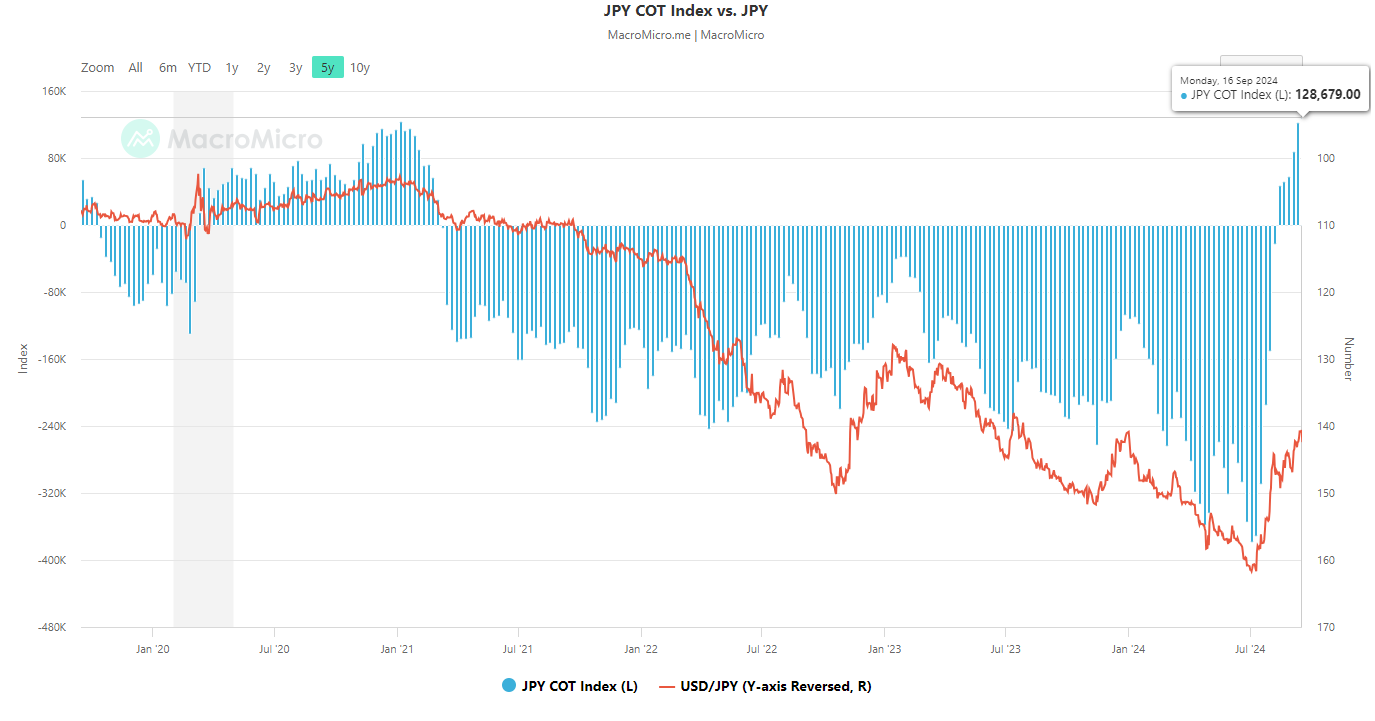
Fig 1: Commitments of Trader large speculators’ net positioning in JPY futures as of 16 Sep 2024 (Source: Macro Micro, click to enlarge chart)
Based on the latest data Commitments of Traders data as of 16 September 2024 (compiled by Macro Micro), the aggregate net bullish open positions of large speculators in the JPY futures market (after offsetting the aggregate positions of large commercial hedgers) have risen to +128,679 contracts (net long), a significant increase of 176% in the past six weeks to hit a 5-year high after being net bearish open positioning for almost three years (see Fig 1).
Given that net open large speculative positioning flows (primarily from hedge funds) are contrarian in nature which suggests that a relatively high level of net positioning may see an opposite reaction in price actions if related data or news flows disappoint.
In the context of USD/JPY price action movements, the risk of an adjustment (short-squeeze) to such high levels of yen bullish open positioning cannot be ruled out as large leveraged speculators have committed a relatively high amount of net bullish open positions.
Hence, the USD/JPY now faces an increased risk of a rebound after it declined by 13% from its July high of 161.95 in the past 11 weeks.
Technical analysis suggests a potential mean reversion rebound
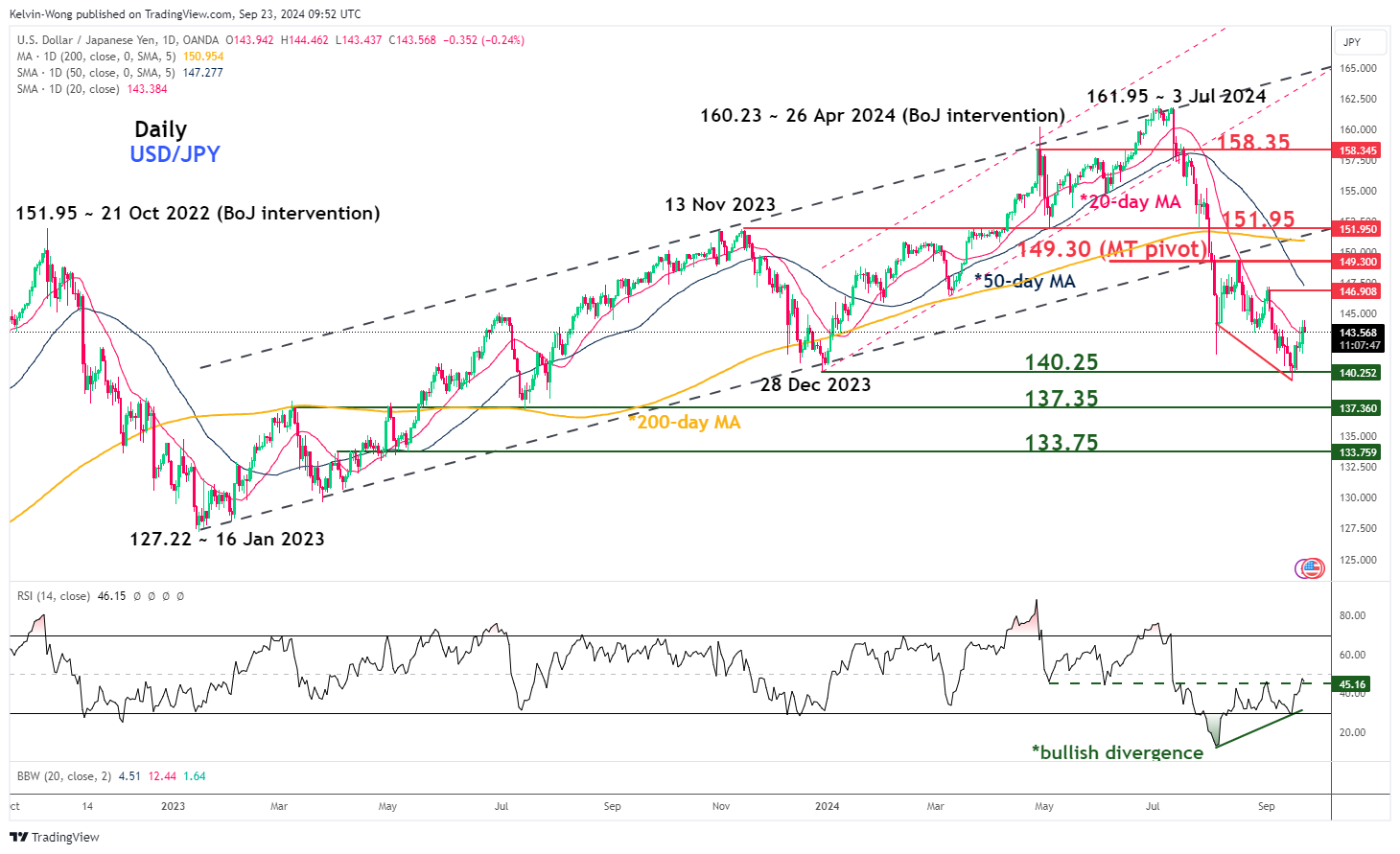
Fig 2: USD/JPY medium-term trend as of 23 Sep 2024 (Source: TradingView, click to enlarge chart)
Last week’s price actions of the USD/JPY have probed a significant key swing low of 140.25 formed on 28 December 2023. It failed to break below it on last Monday, 16 September, and staged a daily close above the 20-day moving average at 143.92 last Friday, 20 September (ex-post BoJ).
In addition, the daily RSI momentum indicator has flashed out a bullish divergence condition at its oversold region which suggests the prior medium-term downside momentum from 11 July to 16 August has eased (see Fig 2).
These observations suggest a possible mean reversion rebound at this juncture that may revisit the key medium-term resistance zone of 146.90/149.30 (also the downward-sloping 50-day moving average).
On the flip side, a breakdown with a daily close below 140.25 may resume the downward trajectory to expose the next medium-term supports at 137.35 and 133.75.
Euro Slips as Eurozone PMIs Dip, US PMIs Next
The euro has started the trading week with considerable losses. EUR/USD is trading at 1.1103 in the European session at the time of writing, down 0.50% on the day. Later today, we’ll get a look at US services and manufacturing PMIs.
Eurozone and German PMIs disappoint
The August PMIs for services and manufacturing were a disappointment, as they decelerated in September and missed the estimates.
The manufacturing sector remains mired in contraction. The eurozone manufacturing PMI fell to 44.8, below the August reading of 45.8 and the market estimate of 45.6 and was the sharpest decline this year. Germany, the largest economy in the bloc, saw manufacturing fall to 40.3, below the August reading of 42.4 and the market estimate of 42.3. This marked the weakest level in a year. The 50 line separates expansion from contraction.
The services sector is looking a bit better, but also eased in September. The eurozone services PMI fell to 50.5, down from 52.9 in August and shy of the market estimate of 52.1. This was the weakest reading since February and indicates marginal expansion. It was a similar story in Germany, as the PMI reading of 50.6 was below the August read of 51.2 and the market estimate of 51.0.
The weak data has sent the euro lower today and will support the case for lower interest rates. The European Central Bank has shifted gears and has embarked on rate-cutting cycle with a cut in June and a second cut earlier this month. Inflation is within striking distance of the ECB’s 2% inflation target and the current goal is to kick-start the weak economy and avert a recession.
EUR/USD Technical
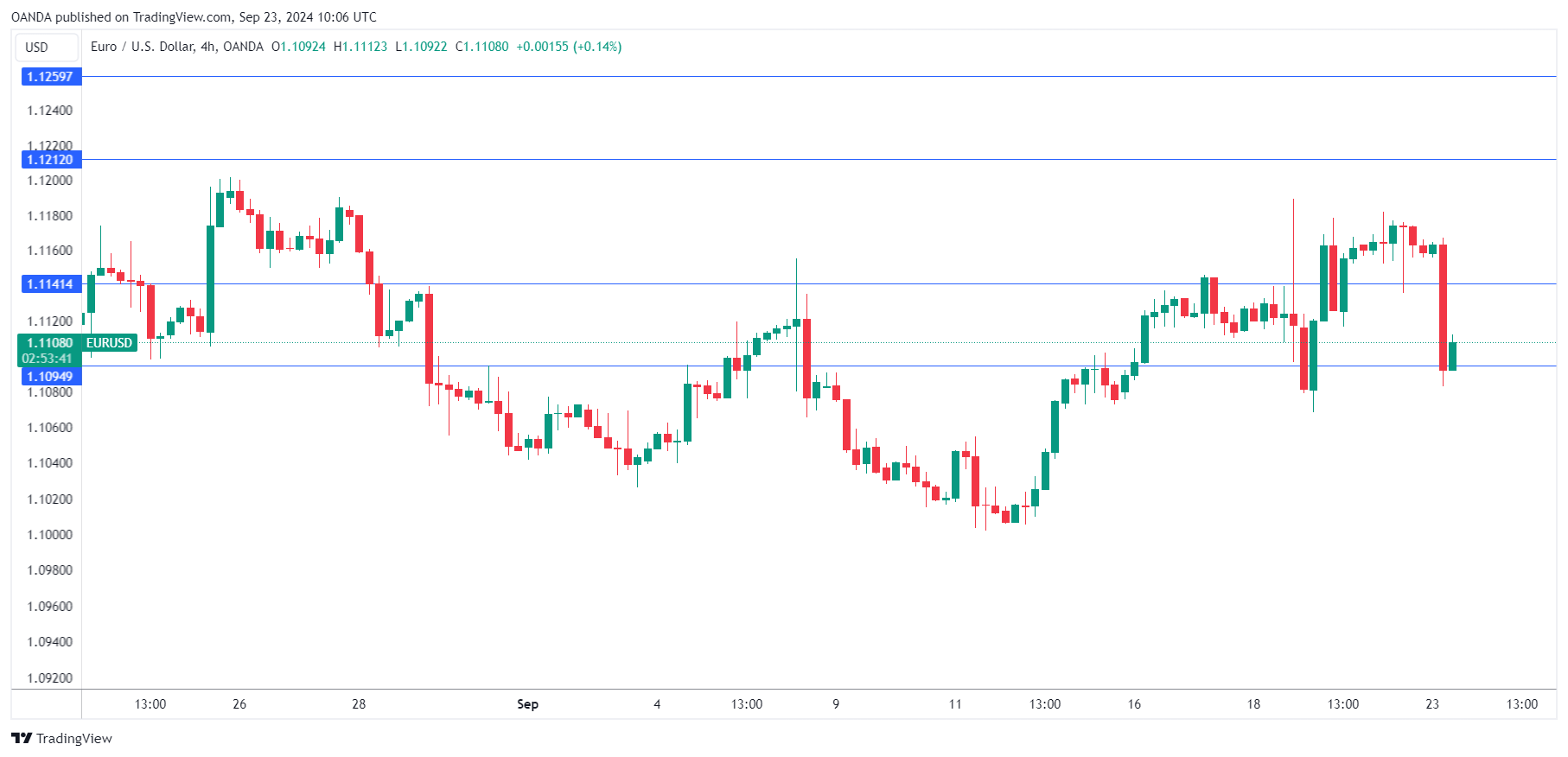
- EUR/USD has pushed below support at 1.1141 and tested support at 1.1094 earlier.
- There is resistance at 1.1212 and 1.1259
EUR/USD Outlook: Weak Data Deflate Euro But Larger Bulls Remain in Play
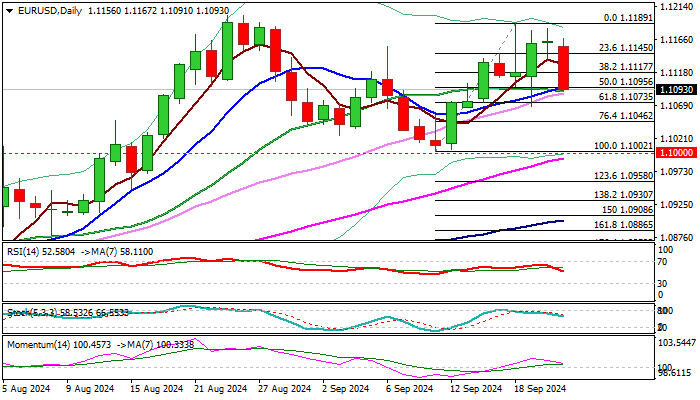
EURUSD was sharply down on Monday morning after weaker than expected German and French PMI’s (German manufacturing PMI at 40.3 warns of recession) soured sentiment.
Fresh weakness adds to reversal signals from recent repeated strong upside rejections on approach to pivotal 1.1200 barrier (Aug 26 high / round-figure).
Bears cracked lower pivots at 1.1100 zone (50% retracement of 1.1021/1.1189 upleg / rising 10 DMA) but need to register a clear break lower to signal continuation and expose next targets at 1.1073/46 (Fibo levels 61.8% and 76.4%).
However, larger picture is bullish and broader uptrend to remain in play as long as floor of recent consolidation range / psychological (1.1000) stays intact.
In such scenario the pair would hold in prolonged consolidation, before bulls regain strength for fresh attempt through 1.1200.
Res: 1.1117; 1.1145; 1.1167; 1.1189.
Sup: 1.1087; 1.1073; 1.1046; 1.1000.
The Crypto Market Bullish Pause
Market Picture
The cryptocurrency market paused growth early in the day on Monday after last week’s resounding close, stabilising at $2.23 trillion (+8.8% in 7 days), which is near the previous peak. This means that further gains will be an important second signal for breaking the multi-month trend of lower local highs. Prior to this, we have seen a breaking of the sequence of lower local lows, which was the first signal of a trend change.
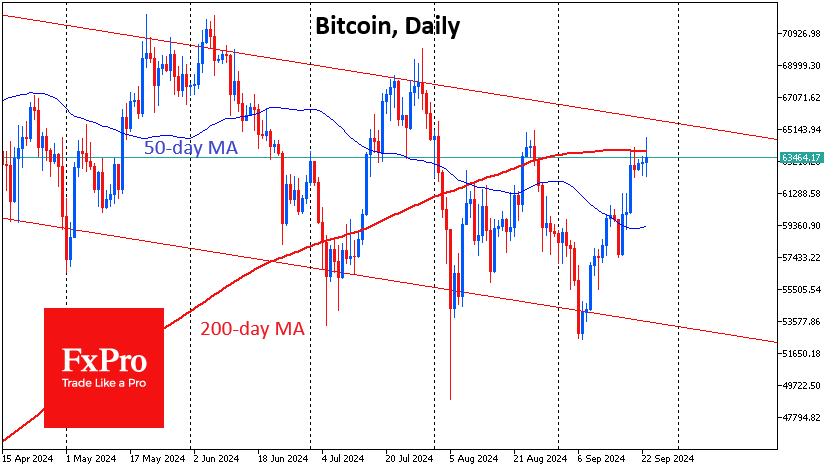
Bitcoin slipped to $64.4K on Monday morning, stabilising $1K lower at the time of writing. This tug-of-war near the 200-day simple moving average is in its fifth day. Monday saw the biggest move into territory above this curve. Still, traders should keep in mind last month’s moves when a strong seller attack came after two days of consolidation above this line, also at roughly the same height.
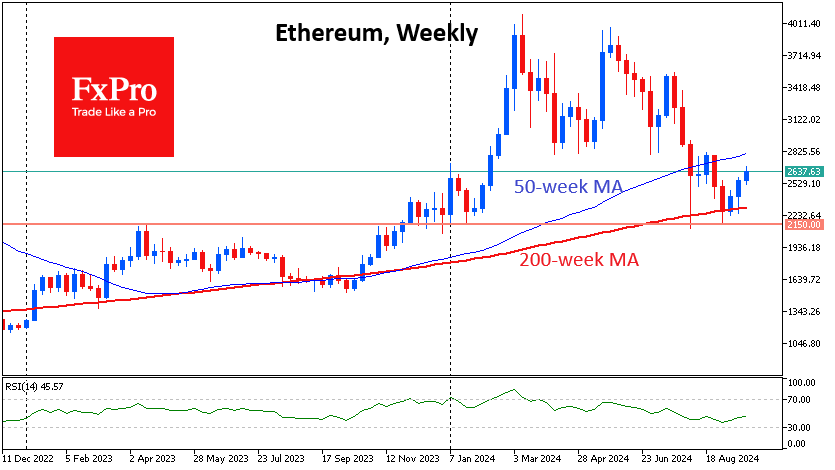
Ethereum has rebounded solidly from its 200-week moving average, which could attract additional long-term buyers. At current levels near $2650, the immediate upside target looks to be the $2800 area, where the 50-week average passes.
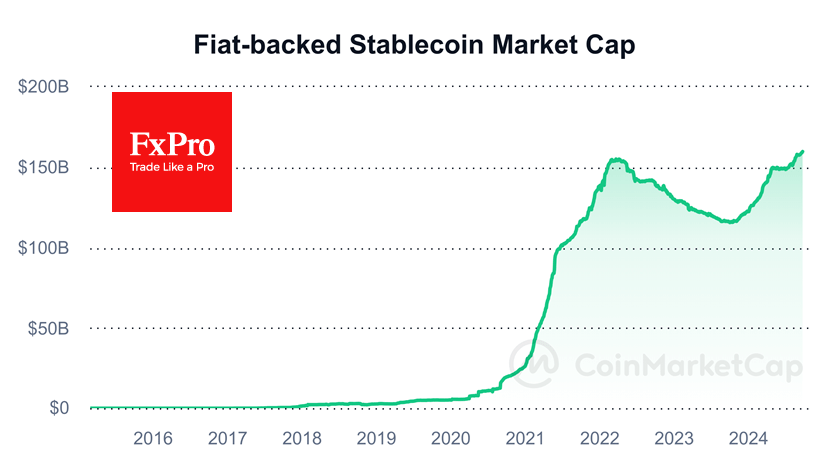
The generally positive mood of the crypto market is indicated by the growing capitalisation of the stablecoin market since August, approaching $160bn after three months of fluctuations around $150bn.
News Background
According to SoSoValue, inflows into spot bitcoin-ETFs in the US last week totalled $397m after $403.8m the week before, bringing the total to $17.69bn. Ethereum-ETFs saw net outflows for the sixth week in a row, totalling $26.3m after $12.9m, bringing the total to $607.5m since approval.
CryptoQuant pointed to the reduction of BTC supply at the disposal of speculators to the minimum of 2012. Such dynamics can be interpreted as a lack of ‘fresh demand’, which could make it difficult for bitcoin to break out of its current price range.
MicroStrategy reported purchasing an additional 7,420 BTC for $458.2 million (at a price of ~$61,750 per coin) after selling $1bn worth of bonds. The firm already holds 252,220 BTC on its balance sheet, purchased for $9.9bn at an average rate of ~$39,266 per coin.
The US SEC has given expedited approval for the listing and trading of options on BlackRock’s bitcoin-ETF. Next, OCC and CFTC approval will be required before the official listing. Bloomberg speculated that options for other companies’ products will also be approved soon.
Project founder Justin Sun said commissions on the TRON network have fallen by 50%, which will boost network activity and meme-coin trading.
Analysts Predict Bitcoin’s Price Will Rise to an All-Time High This Year
As reported by CNBC, Jeff Kendrick from Standard Chartered Bank forecasts that, against the backdrop of the Federal Reserve lowering interest rates, the BTC/USD exchange rate will reach an all-time high by the end of 2024:
→ up to $125,000 if Trump wins, who publicly expressed support for the cryptocurrency sector this summer.
→ up to approximately $75,000 if Harris wins. "A Harris victory would likely trigger an initial price decline, but we would expect dips to be bought as the market recognizes that progress on the regulatory front will still be forthcoming, and as other positive drivers take hold," wrote Jeff Kendrick.
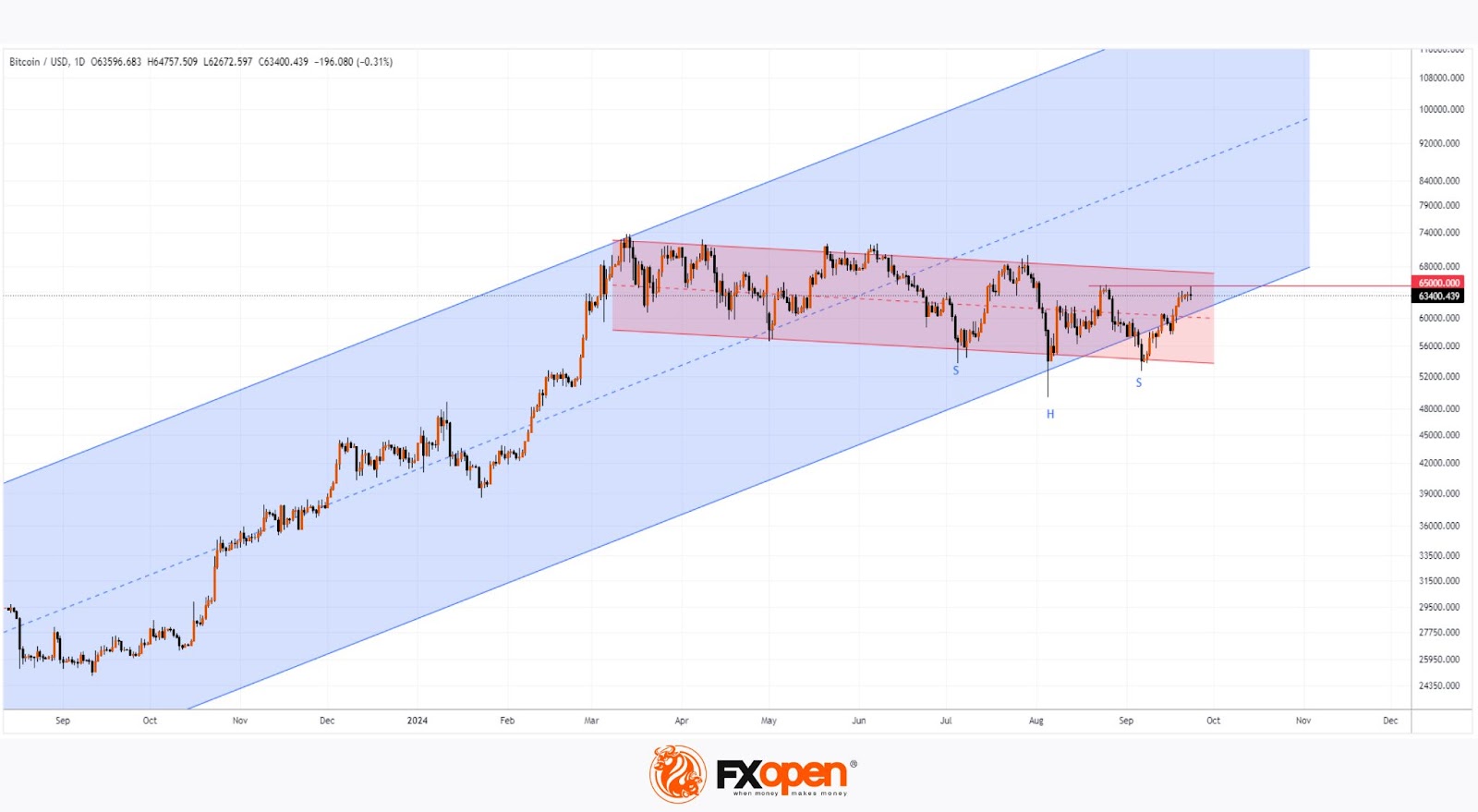
A technical analysis of Bitcoin’s chart today shows that, from a long-term perspective, the BTC/USD rate is developing within an upward channel, indicated in blue, with the following key points:
→ everything that has happened to the price since March can be interpreted as a correction (shown by the red channel) within the bullish trend, forming a bull flag pattern;
→ the last three lows around the lower boundary of the red channel form a bullish inverted “head and shoulders” pattern.
Given the above, it is reasonable to conclude that Jeff Kendrick anticipates a breakout of the bull flag and a continuation of Bitcoin’s price movement within the blue channel.
FXOpen offers the world's most popular cryptocurrency CFDs*, including Bitcoin and Ethereum. Floating spreads, 1:2 leverage — at your service. Open your trading account now or learn more about crypto CFD trading with FXOpen.
*At FXOpen UK and FXOpen AU, Cryptocurrency CFDs are only available for trading by those clients categorised as Professional clients under FCA Rules and Professional clients under ASIC Rules respectively. They are not available for trading by Retail clients.
This article represents the opinion of the Companies operating under the FXOpen brand only. It is not to be construed as an offer, solicitation, or recommendation with respect to products and services provided by the Companies operating under the FXOpen brand, nor is it to be considered financial advice.
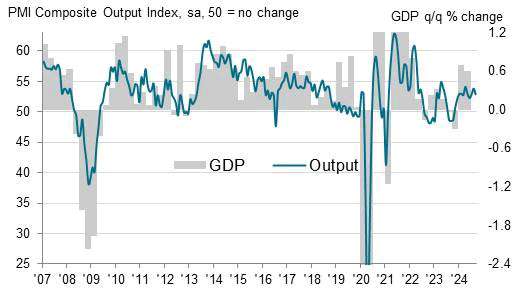
UK PMI composite falls slightly to 52.9, soft landing and further BoE cut in sight
UK's economic growth showed signs of moderation in September, with PMI Manufacturing slipping from 52.5 to 51.5, while PMI Services declined from 53.7 to 52.8. Consequently, PMI Composite also dropped to 52.9 from 53.8, indicating a slight deceleration in overall activity.
Chris Williamson, Chief Business Economist at S&P Global Market Intelligence, noted that the data brings "encouraging news," pointing to robust economic growth alongside a cooling in inflationary pressures. He highlighted that the UK economy appears to be heading for a "soft landing" as inflation seems to be easing without the need for further significant rate hikes by BoE.
While output growth slowed in both manufacturing and services, Williamson downplayed concerns, stating that the survey data is still consistent with GDP growth of around 0.3% in Q3, aligning with BoE forecasts. The cooling in services inflation, now at its lowest level since February 2021, is particularly notable. This progress brings the BoE’s 2% inflation target closer within reach and supports the possibility of further rate cuts before the end of 2024.
Gold Near a Peak, But Uptrend Might Stay Solid
- Gold charts a new record high after two-week rally
- Technical picture signals a temporary slowdown
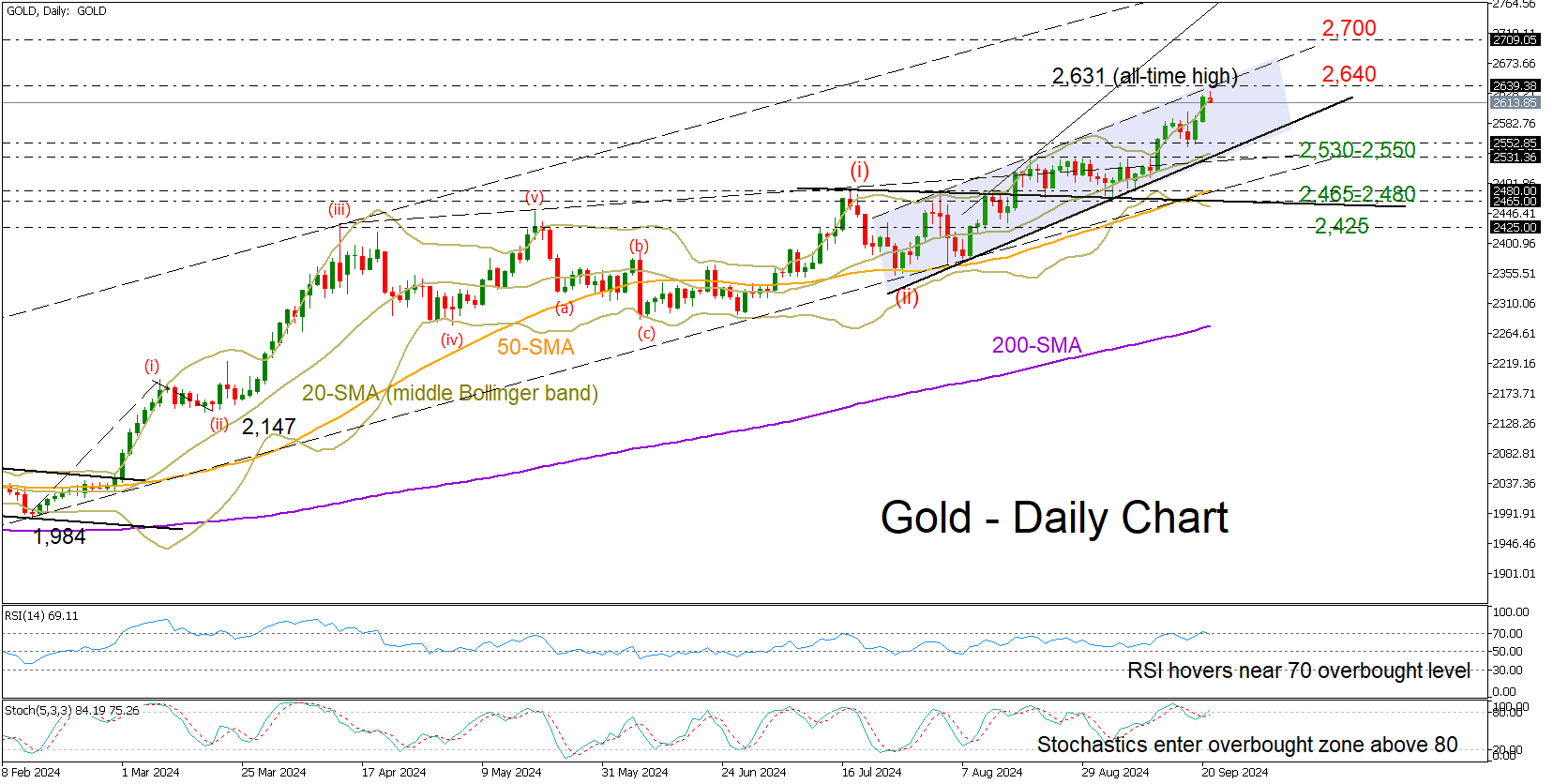
Gold hit a new milestone early on Monday, unlocking a fresh record high of 2,631 following two consecutive impressive weeks in uncharted territory, which boosted the price by 5%.
The precious metal is sailing in overbought waters according to the RSI and the stochastic oscillator, and with the price hanging around the upper Bollinger band and the upper band of an upward-sloping channel, the risk for a downside correction or some stability is increasing. An interesting observation from the Elliot wave in the chart suggests that the market might be approaching the end of wave 3 in the bullish pattern, indicating a potential pause before wave 4 initiates.
If the bulls stay trapped below the channel’s resistance line at 2,640, the spotlight will turn to the bottom of the channel and the 2,530-2,550 support region, which includes the 20-day simple moving average (SMA). A break lower could pause near the 50-day SMA and the almost flat constraining line which triggered September’s upturn at 2,480 and 2,465 respectively. Then, the bears could target the 2,425 region.
On the upside, if the rally continues above 2,640, the next obstacle could pop up near the 2,700 psychological mark. Even higher, the price may retest the tentative ascending line which connects the December 2023 and April 2024 highs at 2,800.
In a nutshell, the recent bullish trend in gold might lose momentum soon, but any drop in price could be temporary if it remains above 2,465.
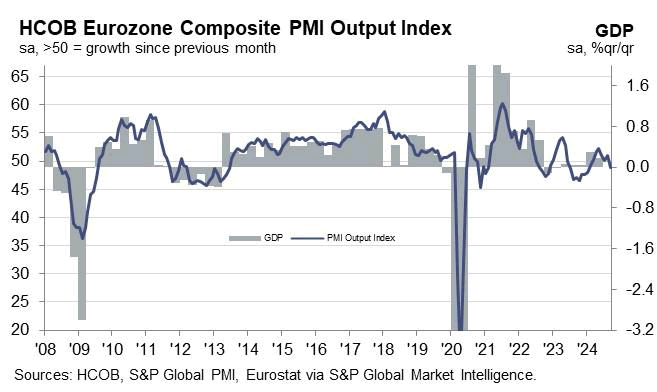
Eurozone PMI composite falls to 48.9, Oct ECB rate cut on the table
Eurozone economic activity showed further signs of weakness in September as both manufacturing and services sectors struggled. PMI Manufacturing Index dropped from 45.8 to 44.8, a nine-month low, while PMI Services fell from 52.9 to 50.5, a seven-month low. As a result, PMI Composite slid back into contraction, dropping farm 51.0 to 48.9—its lowest in eight months.
Cyrus de la Rubia, Chief Economist at HCOB expressed growing concerns that Eurozone is "heading towards stagnation." The decline in the Composite PMI in September marked the largest drop in 15 months. This weakening momentum is particularly worrying as both new orders and order backlogs are rapidly decreasing, signaling that further economic deterioration is likely.
The manufacturing sector, in particular, is in a prolonged slump, with the recession now stretching into its 27th consecutive month. Job cuts in the manufacturing sector have accelerated, with layoffs occurring at the fastest pace since August 2020. Even the services sector, which had been a bright spot for growth, is now showing signs of cooling, with employment growth nearly flat for the fourth straight month.
Input and output price inflation have eased, particularly in the services sector. With ongoing economic contraction, the possibility of a rate cut in October is ""very well be on the table", de la Rubia noted.