Sample Category Title
Eurozone retail sales falls -0.3% mom in June, EU down -0.1% mom
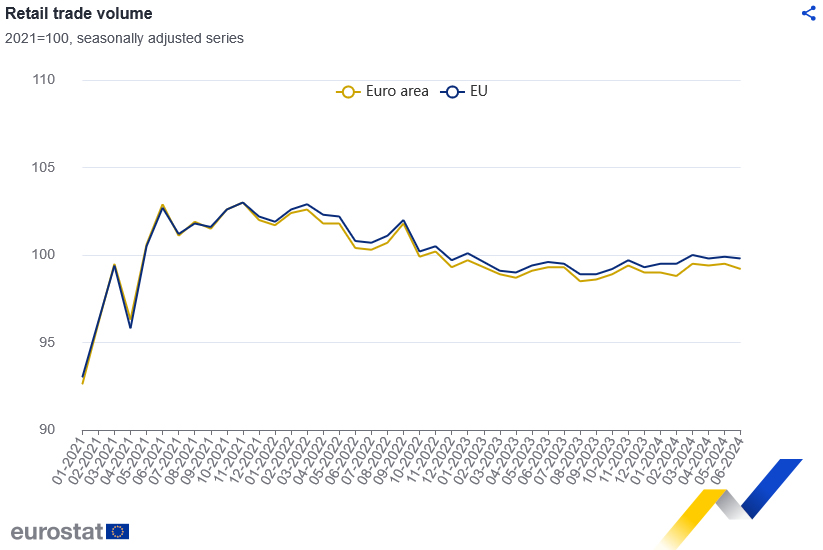
Eurozone retail sales volume fell -0.3% mom in June, worse than expectation of -0.2% mom. Retail trade decreased for food, drinks, tobacco by -0.7%, and for non-food products (except automotive fuel) by - 0.1%. Retail trade increased increased for automotive fuel in specialised stores by 0.5%.
EU retail sales volume fell -0.1% mom. Among Member States for which data are available, the largest monthly decreases in the total retail trade volume were recorded in Croatia (-2.7%), Austria (-2.3%), Latvia and Lithuania (both -1.7%). The highest increases were observed in Romania (+1.8%), Bulgaria (+1.4%) and Denmark (+1.0%).
UK PMI construction jumps to 55.3, paused projects released
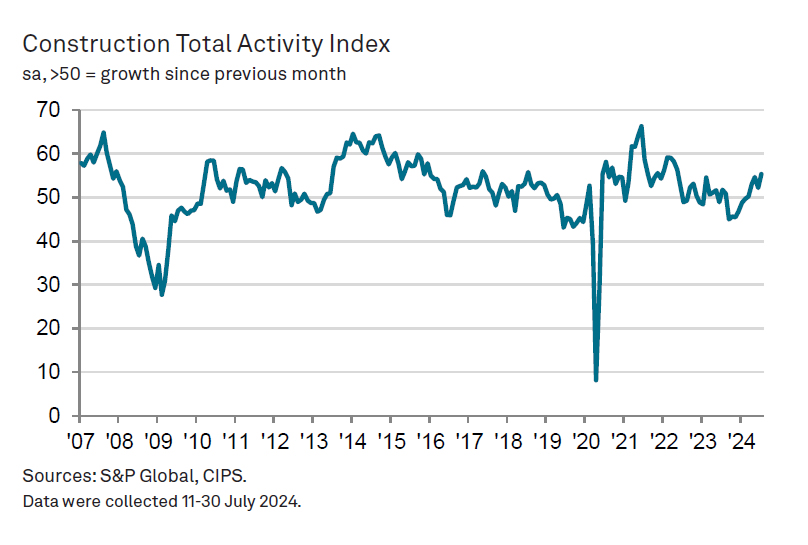
UK PMI Construction rose from 52.2 to 55.3 in June, highest reading since May 2022. S&P Global noted that activity rose amid much faster increase in new orders. Employment increased for the third month running. Emerging pressure on supply chains signaled.
Andrew Harker, Economics Director at S&P Global Market Intelligence, said: "The election-related slowdown in growth seen in June proved to be temporary, with the pace of expansion roaring ahead in July. Firms saw the strongest increases in new orders and activity since 2022 as paused projects were released amid reports of improved customer confidence."
RBA on Hold, But Hawkish Amongst Market Whiplash
The RBA left rates on hold in August as we expected, but their rhetoric and view of aggregate demand were surprisingly hawkish. Given the Board apparently does not see its way to cutting rates this year, our expectation of a November rate cut is unlikely to be achieved. Our rate forecasts are under review while we assess the basis for the RBA’s own economic outlook.
As widely expected, and recently completely priced in by financial markets, the RBA Board left rates unchanged today. This had been our expectation as well. Inflation still looks to be on track to return to the target range next year; the RBA’s forecasts for trimmed mean inflation are not materially different to our own, though its near-term headline inflation forecasts are a little higher. While in our view, this expected decline in inflation sets up the conditions for the RBA to start scaling back some of the current restrictiveness in the stance of monetary policy later this year, the Board does not expect that start to occur that soon.
The Board’s statement and the Statement on Monetary Policy (SMP) continued to highlight upside risks to inflation and to not rule anything in or out. The statement and forecasts were more hawkish than we expected, reflecting a surprisingly bullish view on domestic demand. In the media conference after the decision, the Governor went one step further, all but ruling out rate cuts this year by stating explicitly that: ‘A near-term reduction in the cash rate doesn't align with the Board's current thinking.’
Prominent in the Governor’s language in the media conference was the need to ‘stay the course’ to get inflation down. This and some other language reveal that the RBA Board is not yet thinking in a forward-looking manner, but it appears to want to see inflation almost back in the target range before cutting rates. Given the lags in transmission of policy, this implies that the risk of inflation undershooting the inflation target range in the years ahead have gone up.
Given the Board apparently does not see its way to cutting rates this year, our expectation of a November rate cut is unlikely to be achieved. Our rate forecasts are under review while we assess the basis for the RBA’s own economic outlook.
That the RBA would be on hold today did not look so obvious to market participants a week ago. In the lead-up to the June quarter CPI release, much of the focus was on upside risks to inflation. Market pricing implied a material chance that the RBA would lift rates at the August meeting. As it turned out, though, CPI inflation was in line with our sub-consensus call. The crucial trimmed mean measure of trend inflation was slightly below even our expectations; the RBA has characterised the result as broadly in line with their May forecasts.
And then at the end of the week, the US payrolls data were much weaker than the market expected. Risk appetite declined and so did equity markets and bond yields. The Federal Reserve is unlikely to respond to these shifts in the way that some of the more feverish speculation has suggested. It will, however, respond to the softening in the labour market, which has taken the unemployment rate above the Fed’s forecast for year-end. We continue to expect the Fed to start cutting the Fed funds rate at its next meeting in September, and we have revised our forecast for subsequent months to be a slightly steeper trajectory than previously expected.
Likewise, the RBA Board will not overreact to these latest market developments, and the Governor’s comments confirmed this. Indeed, they have remained more hawkish than recent market pricing would imply.
On the international front, the RBA has persisted with the view, expressed in the June minutes, that global growth has troughed. As we noted at the time, there are risks around this view. The SMP contained multiple mentions of upside risks to goods inflation due to stronger demand for Asian goods, trade and geopolitical tensions and an increase in shipping costs. That said, global progress on inflation had ‘surprised to the downside’, which ‘raised the prospect of a faster easing in inflation’.
Central to the Board’s hawkishness is its assessment that the level of demand continues to outstrip the level of supply, partly because the level of domestic supply capacity is smaller than previously thought. This levels-based analytical approach is a relatively new emphasis at the RBA; it is substantially based on past inflation outcomes and assumes a lot about the structure of the supply side. In the media conference, the Governor said she would not ‘hang her hat’ on the staff’s numerical estimates of supply. But these estimates have clearly had a bearing on the Board’s latest policy decision and language.
The RBA has also upgraded its view of the resilience of domestic demand. Other than some revisions to the past for consumption, which drop out of the growth rates for next year, most of this upgrade is coming from public demand. Also important has been a shifting out of the assumed decline in population growth. The RBA has now aligned with our own population assumptions, first articulated nearly a year ago by Westpac Economics Economist Ryan Wells: that population growth has peaked, but that it will take a couple of years to return to pre-pandemic trends. (A side note: 2023 turned out a touch higher than we originally thought, and we would now put growth in 2024 at 2% from 1.9% previously, similar to where the RBA has now got to.) As a result, the RBA’s view of employment growth and overall demand growth has been upgraded.
Also central to the RBA’s view on inflation is that it has revised down its view of the near-term outlook for productivity. This is largely because of a mechanical adjustment driven by average hours worked remaining a bit stronger than previously thought, but also because the RBA’s forecasts for business investment are not strong enough to result in much catch-up in the stock of capital per worker.
Some of the other forecast revisions go the other way, however. It is noteworthy that both unemployment and wages growth have been revised down, the latter quite noticeably. But the previously mentioned revision to productivity growth means that the RBA took no signal from this.
While the Board understandably wants to continue to be seen to be resolute on inflation and vigilant to the upside risks, its current view of the outlook hangs on a number of strong assumptions. It was always going to be the case that the RBA would be among the last of its peers to start cutting, given it did not raise rates as far. However, recent evolutions in its analytical framework and rhetoric increase the risk that it will now not pivot in time.
AUDUSD Stays in One Piece After Flash Crash
- AUDUSD bounces back from its lowest point in nine months
- Short-term risk skewed to the upside; close above 0.6500 needed
- RBA maintains steady policy; pushes back rate cut timing
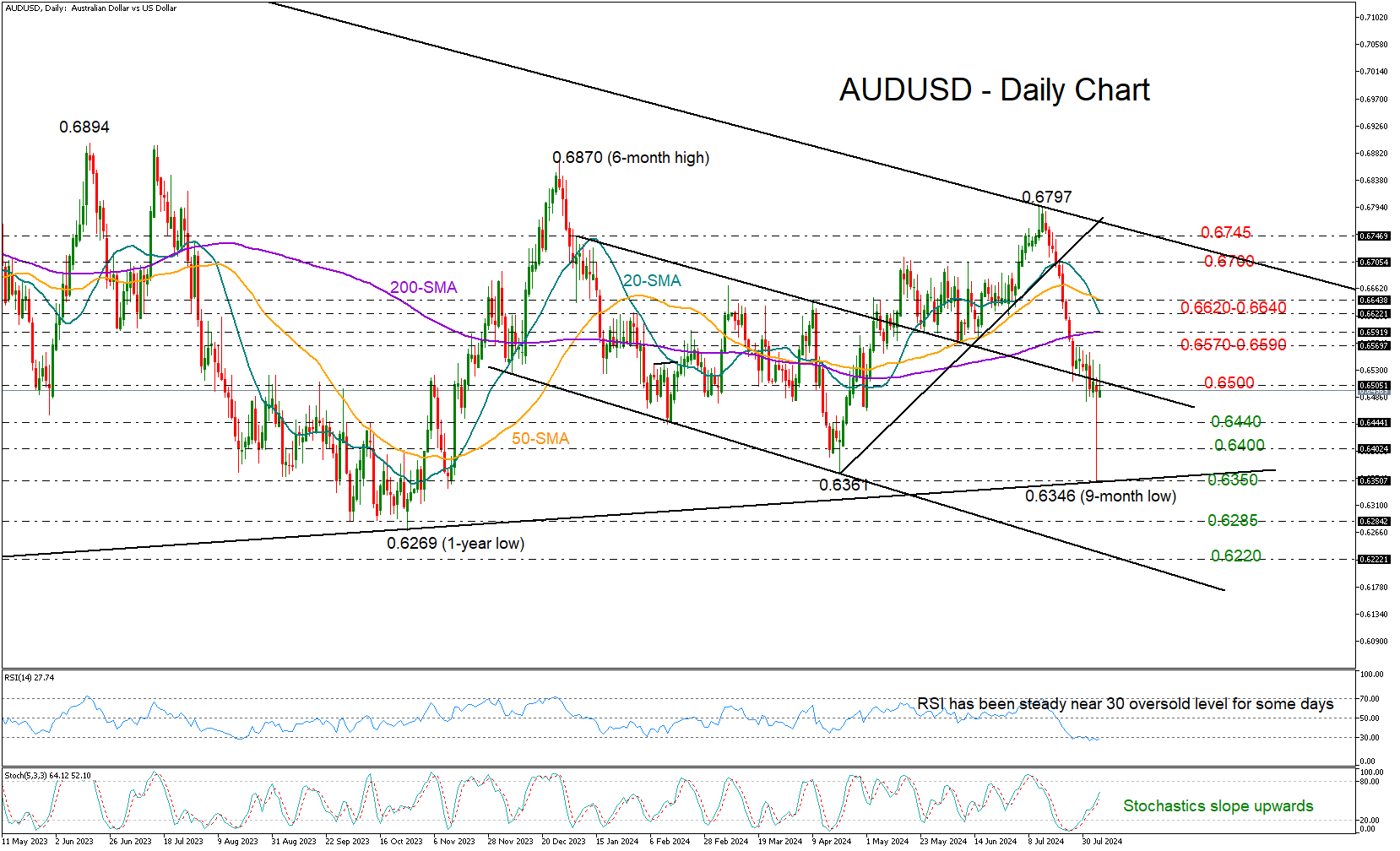
AUDUSD encountered a significant drop to a nine-month low of 0.6346 on Monday, marking its worst daily performance since the pandemic, but it quickly found fresh buying near the trendline, which connects the 2022 and 2023 lows, and managed to recover most of its losses by the end of the day.
The Reserve Bank of Australia (RBA) provided a helping hand to the pair on Tuesday after it played down any hopes for a rate cut soon, boosting the price as high as 0.6539. However, the pair could not sustain its gains, returning below the 0.6500 number again and beneath the falling constraining line from January which has been limiting upside movements over the past three trading days.
With the RSI remaining flat near the oversold level of 30 for a few days and the stochastic oscillator showing an upward trend, it seems like the bulls may have some luck in their favor in the upcoming sessions. A clear close above 0.6500 could last until the 0.6570-0.6590 zone, where the 200-day SMA is positioned. If the 20- and 50-day SMAs at 0.6620 and 0.6640 give way as well, the bullish wave could pick up pace towards the 0.6700 number and the broken ascending trendline seen near 0.6745.
In the opposite scenario, if the price holds below 0.6500, there could be stronger selling interest towards the range of 0.6400-0.6440. If the bears breach that base too, the 0.6285 floor from October 2023 could be the next destination.
To summarize, AUDUSD has laid the foundation for its next recovery phase, but buyers might not step in if the price fails to break above 0.6500.
Bitcoin’s Bear Rally?
Market picture
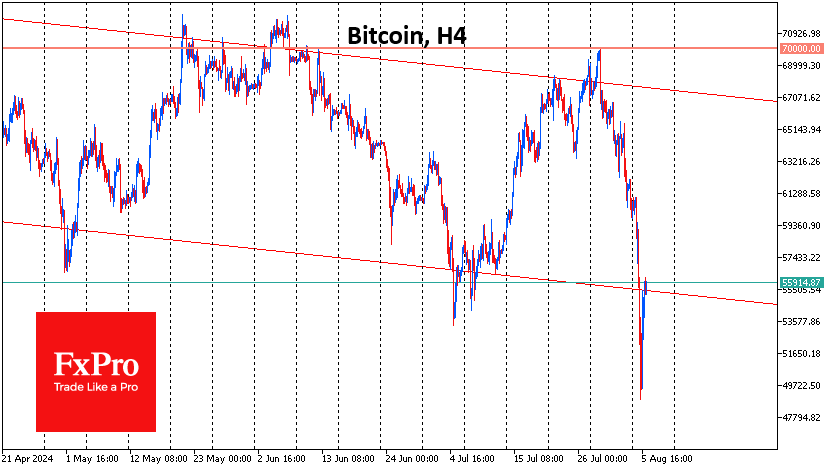
The cryptocurrency market has survived the peak of fear, finding the strength to consolidate during European trading and begin a recovery during active hours in the Americas. As a result, the crypto market capitalisation is up 11.3% in 24 hours to $1.98 trillion. That’s still -17% in seven days.
Bitcoin was trading at nearly $55.7K at the start of the European session, having recovered two-thirds of Monday’s loss when the price bottomed out at $49K. The price is now close to the earlier lows.
Optimists can note the RSI’s attempt to move out of the oversold zone and back into the familiar range. On Monday, there was also a tempting touch and bounce from the 50-week moving average, as if to prove that we are still in a bull market.
However, pessimists can easily point out that a similar spike in volatility has previously preceded long selloffs, with rebounds followed by periods of new dips.
Either way, Bitcoin’s momentum may remain a bellwether for global financial market sentiment, as it is the most sensitive to fluctuations in risk appetite.
News background
According to CoinShares, crypto fund investments fell by $528 million last week after four weeks of inflows. Bitcoin investments fell by $400 million, Ethereum by $146 million and Solana by $3 million. Outflows from the Grayscale crypto ETF rose sharply to $806 million for the week.
According to Coinglass data, liquidations reached $1.10 billion on 5 August, the highest since 5 March. Of this, $813 million came from long positions.
Michael van de Poppe, founder of MN Trading, said days like this “usually define the beginning of a major crisis. Either that, or there will be a V-shaped reversal and a move towards Bitcoin as a safe-haven, along with Gold and Ethereum”.
The network is also discussing the possible involvement of market maker Jump Crypto in the market dump. On 4 August, the company released 120,000 wETH on Lido and has since sold most of it, negatively affecting the second most-capitalised cryptocurrency.
According to US Republican presidential candidate Donald Trump, Bitcoin could be a key tool in tackling the growing US national debt, which has surpassed $35 trillion.
NZD/USD Sees Recovery After Hitting Nine-Month Low
The NZD/USD pair has shown signs of recovery, reaching 0.5941 after initially plunging to a nine-month low. This downturn was triggered by concerns over a potential US recession, driven by weak job sector data, which rattled global financial markets.
As risk aversion spiked, the New Zealand dollar and other currencies declined steeply. This market turmoil reflects growing fears that the Federal Reserve may run out of time to adjust monetary policy to avert economic troubles.
The Reserve Bank of New Zealand (RBNZ) will meet next week. Current market expectations lean towards a rate cut, possibly by 25 basis points, reducing the interest rate to 5.25% per annum on 14 August. This anticipated move is part of a broader global trend towards monetary easing.
Further rate reductions in New Zealand could follow, with projections suggesting a potential decrease to 4.75% per annum by the end of 2024.
Technical analysis of NZD/USD
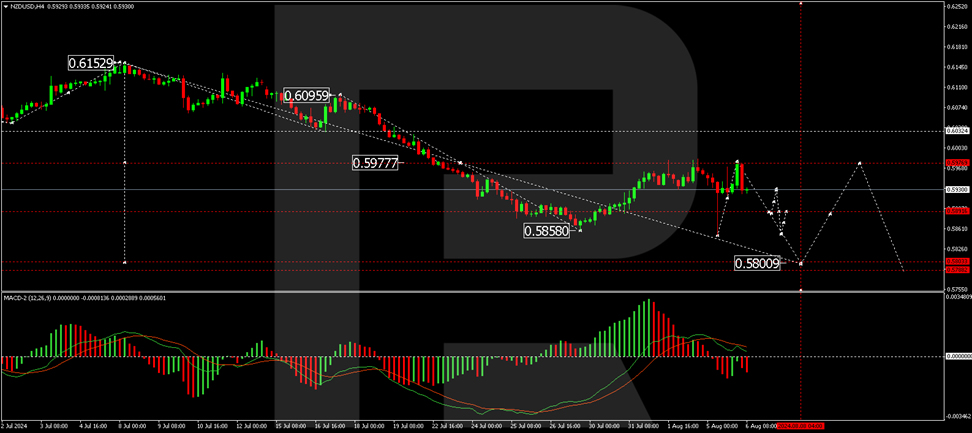
On the H4 chart, the NZD/USD pair executed a downside wave to 0.5850 and a correction to 0.5977. Today, the market is forming another wave of decline towards 0.5800, after which a correction to 0.5977 is likely (testing from below). On the technical analysis side, this scenario is confirmed by the MACD indicator with its signal line above the zero mark and pointing downwards.
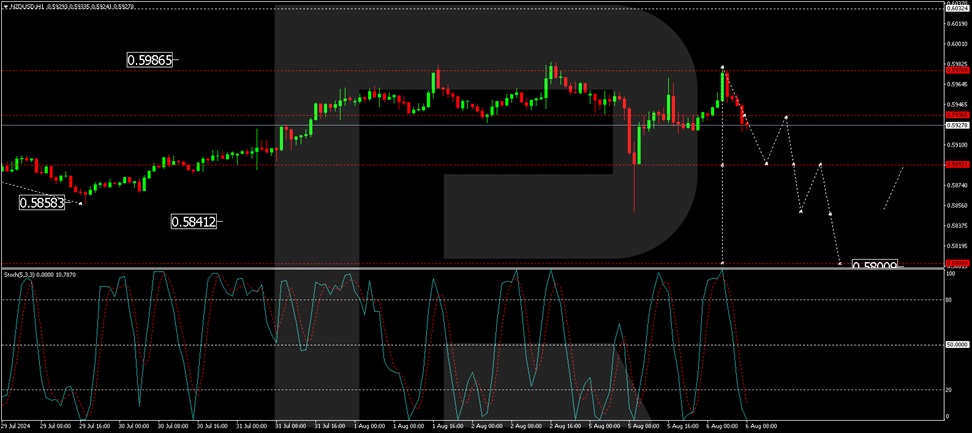
On the H1 chart, the NZD/USD pair forms downward waves to 0.5892. After working off this level, a correction to 0.5936 (testing from below) is likely, and the next wave of decline to 0.5850 is expected to develop with the prospect of trend continuation to 0.5800. This bearish NZD/USD forecast is corroborated by the Stochastic Oscillator, whose signal line is currently below 50 and showing a solid downward trend.
Investors and traders will closely monitor upcoming speeches and reports from central banks, especially the Federal Reserve and RBNZ, as these will significantly influence the currency pair's movements in the near term.
EUR/USD Daily Outlook
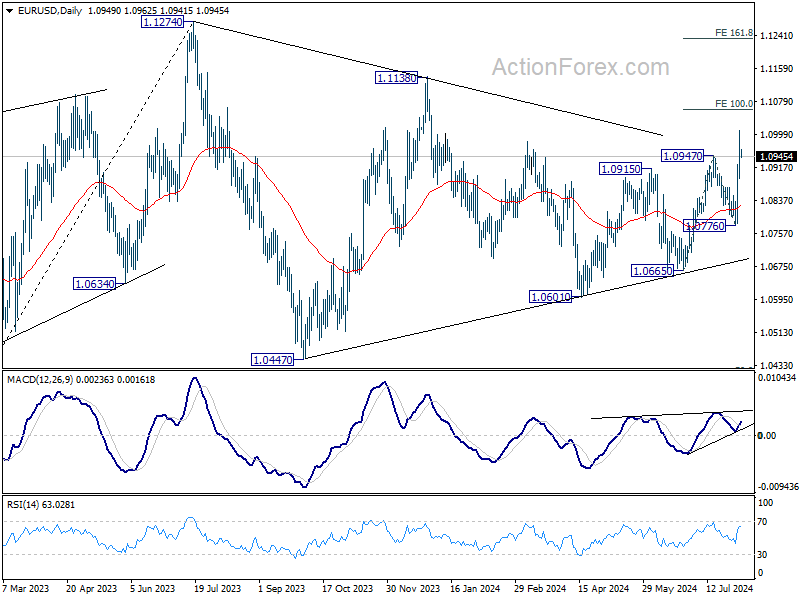
Daily Pivots: (S1) 1.0893; (P) 1.0951; (R1) 1.1009; More.....
Intraday bias in EUR/USD stays on the upside with 1.0932 minor support intact. Current rally is part of the whole rise from 1.0665 and should target 100% projection of 1.0665 to 1.0947 from 1.0776 at 1.1056 next. On the downside, below 1.0932 minor support will turn intraday bias neutral and bring consolidations, before staging another rally.
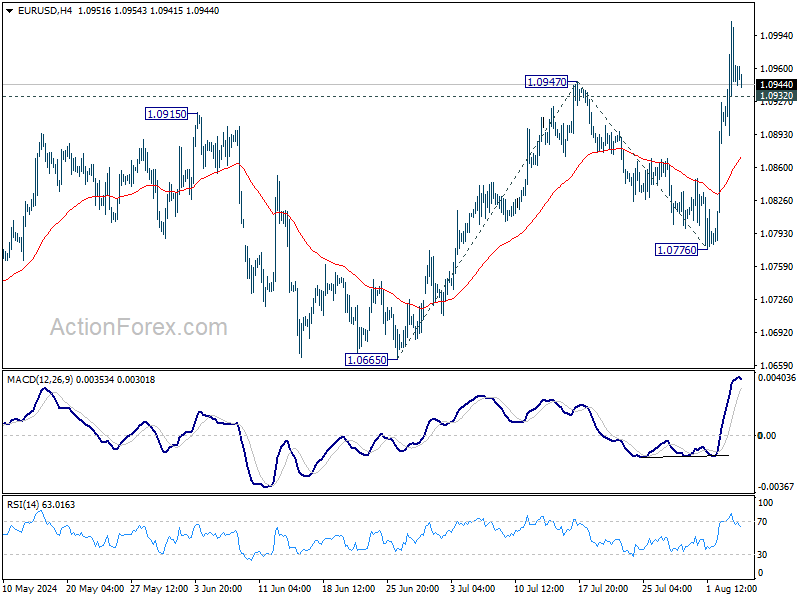
In the bigger picture, price actions from 1.1274 are viewed as a corrective pattern that's still be in progress. Break of 1.1138 resistance will be the first signal that rise from 0.9534 (2022 low) is ready to resume through 1.1274 (2023 high). However, break of 1.0776 support will extend the correction with another falling leg back towards 1.0447 support.
USD/JPY Daily Outlook
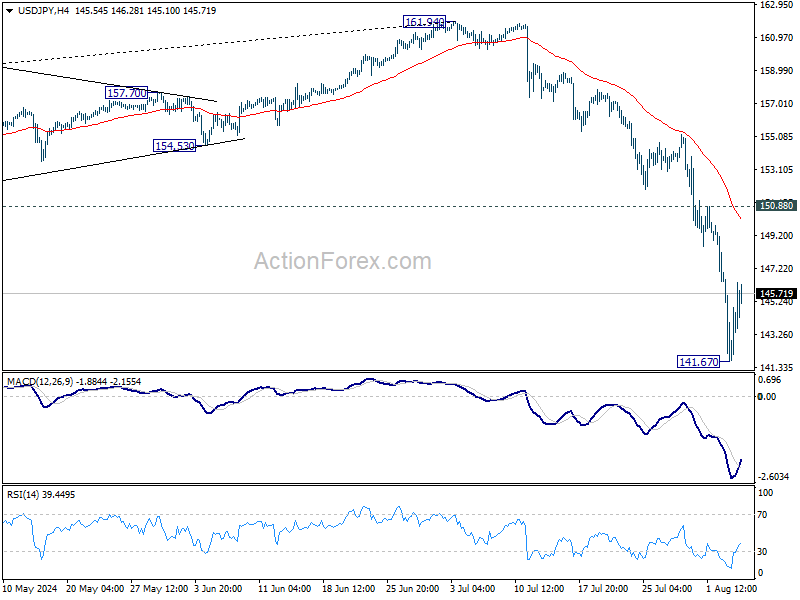
Daily Pivots: (S1) 141.68; (P) 144.17; (R1) 146.64; More...
USD/JPY recovered after diving to 141.67 and intraday bias is turned neutral first. Some consolidations would be seen but upside should be limited by 150.88 resistance to bring another fall. Break of 141.67 will resume the decline from 161.94 to 140.25 support next.
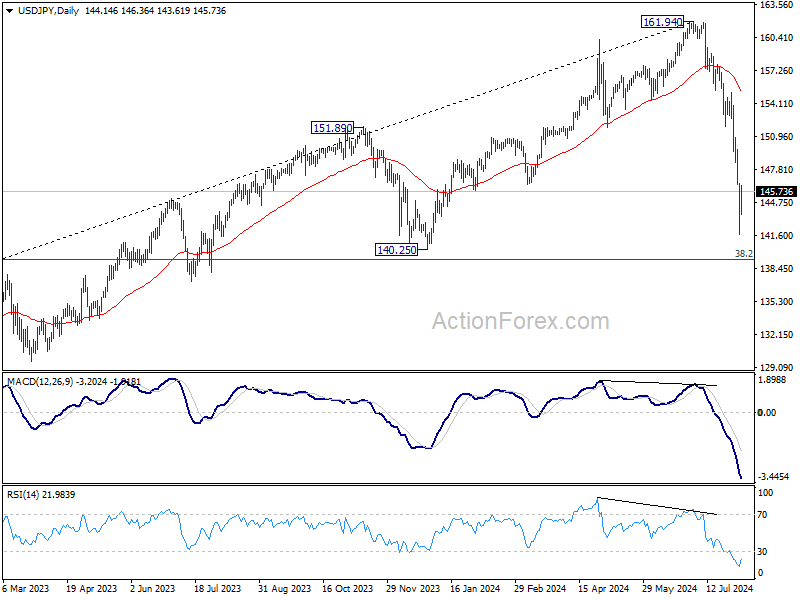
In the bigger picture, the strong break of 55 W EMA (now at 149.98) argue that fall from 161.94 medium term is correcting whole up trend from 102.58 (2021 low). Deeper decline could be seen to 38.2% retracement of 102.58 to 161.94 at 139.26, which is close to 140.25 support. In any case, risk will stay on the downside as long as 55 W EMA (now at 149.83) holds. Nevertheless, firm break of 55 W EMA will suggest that the range for medium term corrective pattern is already set.
GBP/USD Daily Outlook
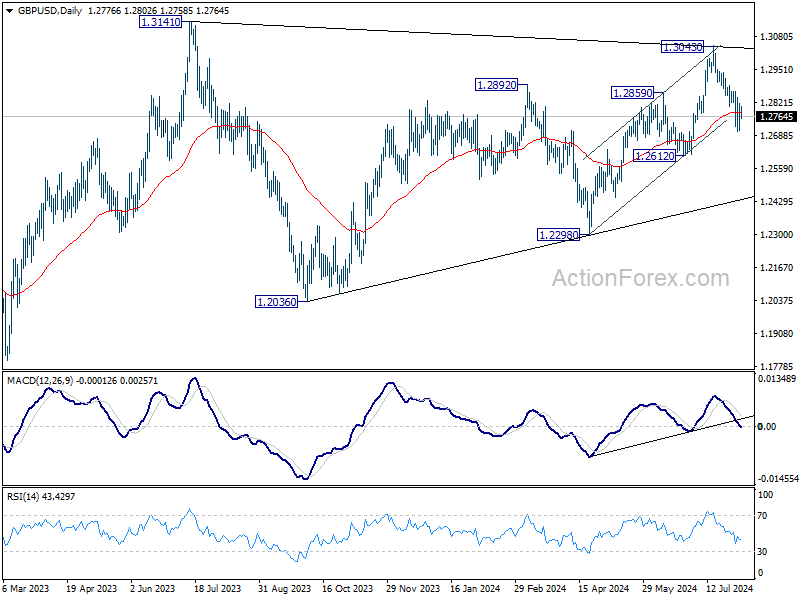
Daily Pivots: (S1) 1.2719; (P) 1.2769; (R1) 1.2829; More...
Intraday bias in GBP/USD stays neutral as range trading continues. Further decline is in favor with 1.2863 resistance intact. On the downside, below 1.2706 will target 1.2612 support first. Decisive break there should confirm that rise from 1.2298 has completed. However, break of 1.2863 will turn bias back to the upside for retesting 1.3043 resistance instead.
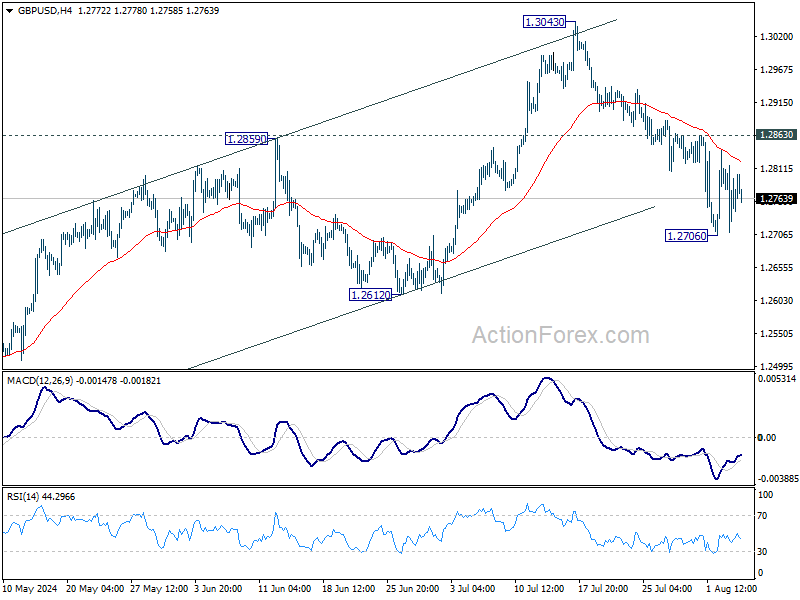
In the bigger picture, current development suggests that corrective pattern from 1.3141 is extending with fall from 1.3043 as another leg. Break of 1.2612 support would strengthen this case. But still, downside should be contained by 1.2036/2298 support zone even in case of deep decline. Rise from 1.0351 (2022 low) remains in favor to resume at a later stage.
USD/CHF Daily Outlook
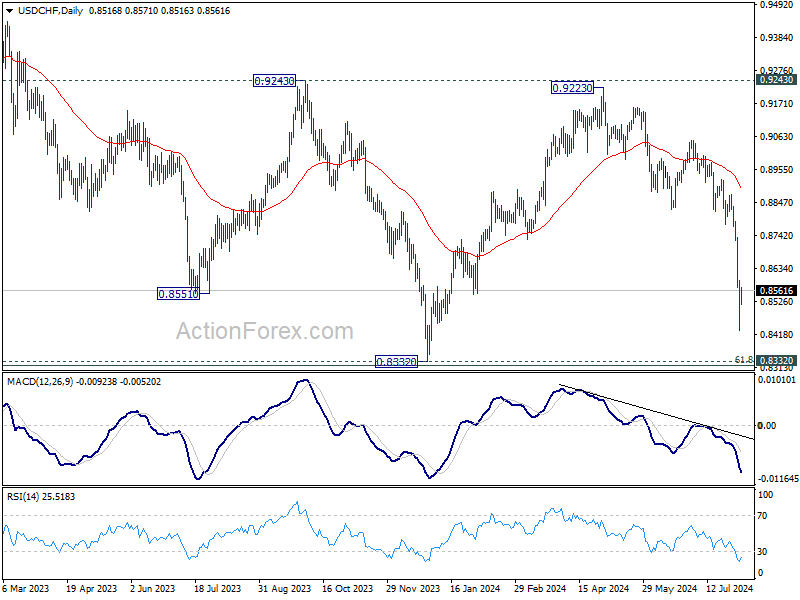
Daily Pivots: (S1) 0.8437; (P) 0.8520; (R1) 0.8606; More…
USD/CHF recovered after dipping to 0.8431 and intraday bias is turned neutral first. Some consolidations would be seen but upside should be limited by 0.8711 resistance. Below 0.8431 will resume the fall from 0.9223 to retest 0.8332 low.
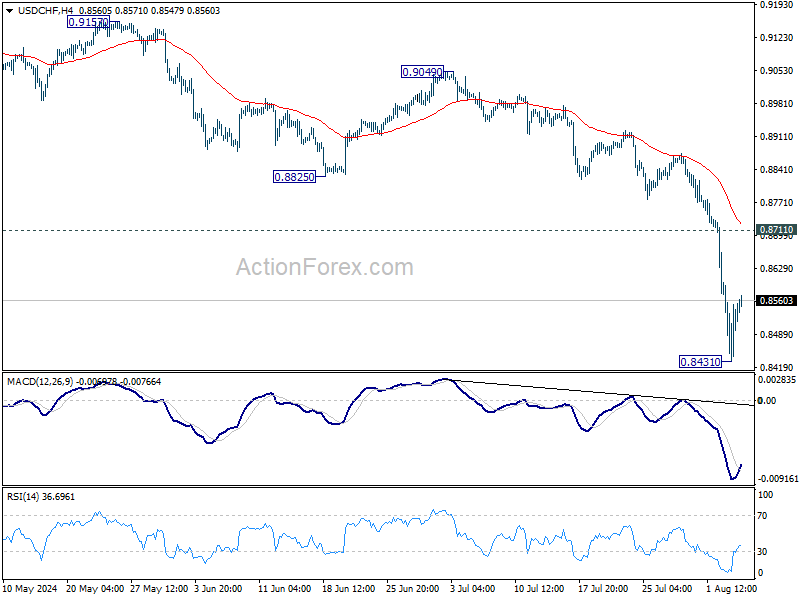
In the bigger picture, price actions from 0.8332 (2023 low) are currently seen as a medium term corrective pattern, with fall from 0.9223 as the second leg. Strong support could be seen from 0.8332 to bring rebound. Yet, overall outlook will continue to stay bearish as long as 0.9243 resistance holds. Firm break of 0.8332, however, will resume larger down trend from 1.0146 (2022 high).