Sample Category Title

BoC nears interest rate cuts as inflation eases, says Macklem

BoC Governor Tiff Macklem, at a Senate committee testimony, indicated that Canada is edging closer to conditions that would allow for easing monetary policy. "The short answer is we are getting closer," he affirmed.

Inflation in Canada has moderated effectively, remaining under 3% since January and aligning with the central bank's forecasts. This stabilization is expected to persist through the first half of 2024, with key core measures of consumer prices showing a consistent downward trend.

"We are seeing what we need to see, but we need to see it for longer to be confident that progress toward price stability will be sustained," Macklem explained.

Furthermore, Macklem addressed the impact of fiscal policy on the economic outlook, noting that recent governmental fiscal plans are unlikely to significantly alter the Bank's projections for the economy or inflation.

Gold Price Could Restart Increase Above This Resistance

Key Highlights

  • Gold started a downside correction and traded below $2,350.
  • A connecting bearish trend line is forming with resistance at $2,325 on the 4-hour chart.
  • Oil prices extended losses but remained stable above $80.00.
  • Bitcoin price traded to a new weekly low below $60,000.

Gold Price Technical Analysis

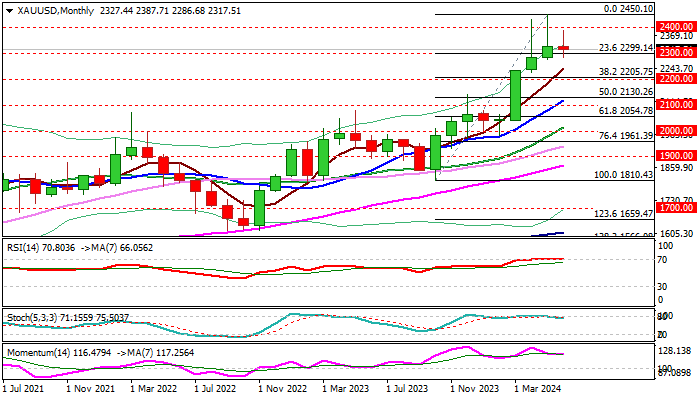
Gold prices started a downside correction from the $2,431 high against the US Dollar. It traded below the $2,400 and $2,365 support levels.

The 4-hour chart of XAU/USD indicates that the price even broke the $2,325 support and settled below the 100 Simple Moving Average (red, 4 hours). However, the bulls are now active above the $2,280 support and the 200 Simple Moving Average (green, 4 hours).

The price is now consolidating losses, with an immediate resistance at $2,318. The first major resistance is now forming near connecting bearish trend line at $2,325.

The main resistance is now forming near $2,350 and the 100 Simple Moving Average (red, 4 hours), above which the price could accelerate higher toward $2,395.

On the downside, the 200 Simple Moving Average (green, 4 hours) is the key at $2,280. A downside break below the $2,280 support might call for more downsides. The next major support is near the $2,250 level. Any more losses might send Gold prices toward $2,220.

Looking at Bitcoin, there was a strong decline, and the bears were able to push the price below the $60,000 and $58,500 support levels.

Economic Releases to Watch Today

  • Germany’s Manufacturing PMI for March 2024 - Forecast 42.2, versus 42.2 previous.
  • Euro Zone Manufacturing PMI March 2024 – Forecast 45.6, versus 45.6 previous.
  • US Initial Jobless Claims - Forecast 212K, versus 207K previous.

10-year yield dips as Fed Powell rules out rate hike

US markets expressed a sign of relief overnight followed as Fed Chair Jerome Powell's less hawkish than feared stance at the post-FOMC press conference. Major stock indexes closed mixed while treasury yields dipped with Dollar.

Most importantly, Powell characterized the current interest rate level as "sufficiently restrictive," and indicated that it is "unlikely that the next rate move will be a hike." Instead, Powell delineated the future monetary policy path as a decision between "cutting" and "not cutting" interest rates, depending on economic data.

This stance comes in the wake of stronger-than-expected inflation data since the beginning of the year, leading Powell to acknowledge that it would "take longer than previously expected" for Fed to be confident that inflation is on a steady decline toward the 2% target. policymakers to become comfortable that inflation will resume the decline towards 2%."

"If we did have a path where inflation proves more persistent than expected, and where the labor market remains strong but inflation is moving sideways and we're not gaining greater confidence, well, that would be a case in which it could be appropriate to hold off on rate cuts," Powell said. "There are paths to not cutting and there are paths to cutting. It's really going to depend on the data."

More on FOMC:

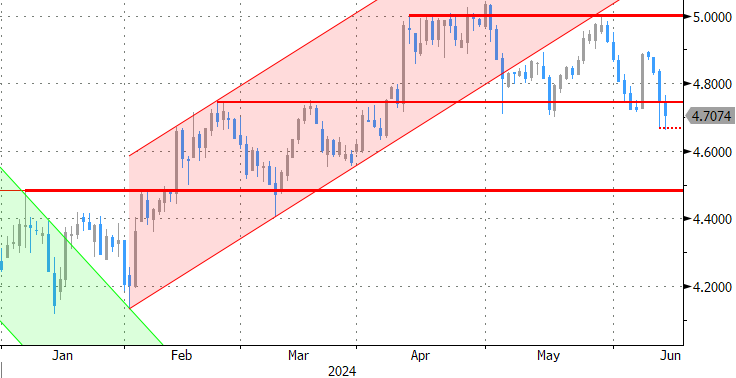
10-year yield closed down -0.0910 at 4.595 in reaction to FOMC. Technically, another rise could still be seen as long as 4.568 support holds. But even in this case, TNX should continue to lose upside momentum ahead of 4.997 high. Meanwhile, break of 4.568 will indicate that it's at least in a near term pullback towards 55 D EMA (now at 4.408).

First Cut by Fed is September at the Earliest

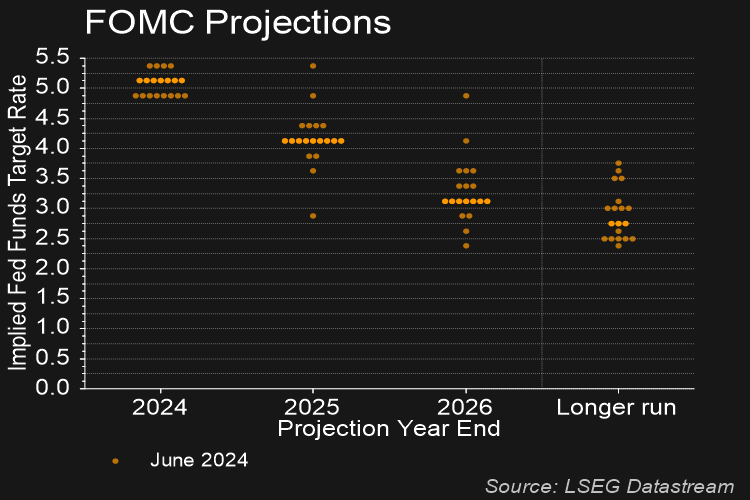
Current and expected risks warrant the FOMC holding off on the first cut until September and then carefully assessing lingering inflation risks as each subsequent step is taken. A low of 3.375% is expected for fed funds mid-2026, a modestly contractionary rate.

Following a run of data pointing to inflation being more persistent, the updated views of Chair Powell and the FOMC were eagerly awaited. In the event, the tone of their guidance was balanced, with the FOMC again emphasising they will decide meeting by meeting on the appropriate timing of rate cuts. Very clear in Chair Powell’s remarks though is that they need to see a number of months of good progress on inflation before considering a cut. Given recent momentum, the additional three months of data to come ahead of the July meeting are unlikely to be enough. We now see September as the most probable timing for the first cut, followed by one cut per quarter until June 2026, when we see the fed funds rate troughing at a modestly contractionary 3.375%.

The FOMC is not ignoring the recent momentum in inflation. In the statement, the Committee noted in “recent months, there has been a lack of further progress toward the Committee's 2 percent inflation objective” and that they do “not expect it will be appropriate to reduce the target range until [they have] gained greater confidence that inflation is moving sustainably toward 2 percent”. However, Chair Powell made clear in the press conference that they still expect inflation will move down over the year. The current stance of policy is deemed “sufficiently restrictive” and the labour market coming into balance. From this guidance and other comments in the press conference, it is evident the Committee is focused on when to cut, not whether.

In gauging the most likely timing of a first cut and the pace thereafter, the persistence of activity and labour market momentum will prove key. Our baseline view is that momentum holds up around trend for activity and above zero for job growth. Wages growth will remain solid with risks skewed upwards. Recall also that most US borrowers are insulated from rate hikes and household wealth is still rising. If our baseline view on the economy plays out, the FOMC are likely to take their time easing policy. The persistence of this economic resilience, and so pricing pressure, also favours our baseline view of a one cut per quarter profile over two years.

Conversely, if the labour market suddenly deteriorates, with employment contracting and the unemployment rate rising materially above 4.0%, then expectations for wages and demand will sour. This would justify an earlier and potentially more rapid policy easing. While this should be seen only as a risk scenario, it cannot be ruled out completely. Business surveys such as the ISMs have, on average, been pointing to net job losses for the past six months.

Jumping ahead and considering our forecast end point for this cycle of 3.375%, two points are worthy of note. First, we do expect FOMC policy to be effective in bringing inflation back around target and so see a material easing over the period, a cumulative 200bps. But second, Westpac continues to see need for restrictive policy into the medium-term, with 3.375% materially above the FOMC’s longer run end point of 2.6%. We expect modestly restrictive policy will be needed into the medium-term because supply-side inflationary pressures evident across the economy, most notably in rents and house construction costs, are likely to persist. Further, with the continuing support to demand from highly expansionary fiscal policy, regardless of which party wins, investment is also likely to be sustained across the economy and with it demand for resources and financial capital.

The latter point is important for both Treasury yields and the US dollar. Over the course of the next two years, we forecast the US 10-year yield will retreat to around 4.0% as inflation declines. But that level is expected, on average, to prove the low point. We see the 10-year yield edging higher during 2026. The result is a swing in the cash/10-year spread from around -80bps to +60bps at end-2025 and rising. Underlying this view is also a belief that, irrespective of which party wins in November’s elections, the US fiscal position is unlikely to improve in coming years and will instead remain at risk of deteriorating further.

For the US dollar, while the extraordinary support from actual and expected rate differentials has abated somewhat in 2024, with the ECB and Bank of England now expected to cut sooner than the FOMC and likely by a similar amount over two years, aid for the US dollar from this factor is expected to remain at or above-average over the period. Around the time of November’s elections, policy expectations should also be constructive for US growth. Consequently, we have flattened out our US dollar profile, seeing DXY only edge lower from the 105–107 range recently traded to 103.5 end-2024 and 99.0 end-2025. Some further weakening is likely in 2026, but it is more probable that the US dollar will remain above long-run average levels than break through.

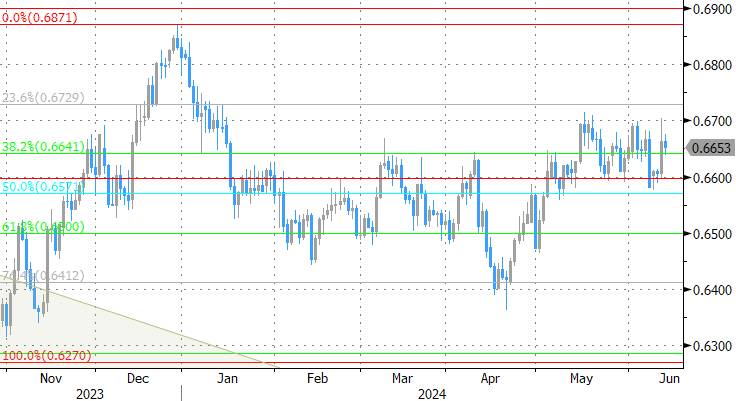
These developments have implications for Australian financial benchmarks as well. While our own fiscal situation is a stark contrast to the US, this means Australia’s 10-year is likely to trade in line with the US 10-year over the period and into the medium-term, rather than at a premium as in the past. We therefore regard the 4.0% level as a floor for yields in Australia as well, even as policy rates fall. We also continue to expect the Australian dollar to largely track the US dollar, averaging USD0.66 through June and September quarters before beginning to edge higher from December quarter (USD0.67). Through 2025, a 4 cent appreciation is expected to USD0.71 and in 2026 there is reason to believe further modest appreciation will be seen. To this profile, risk appetite and the persistence of inflation are set to remain downside risks. Most of this is a USD story, though; the outlook for Australia’s trade-weighted index remains a continuation of a broadly stable level, as it has been for the past decade.

May FOMC: Stalling in Inflation Leaves FOMC Stalling for Time

Summary

As was widely expected, the FOMC left the fed funds target range unchanged at 5.25%-5.50% at the conclusion of its May meeting. It was evident, however, that the Committee believes inflation's return to its 2% objective likely has a somewhat longer and uncertain journey ahead. In the post-meeting statement, the Committee noted that "in recent months, there has been a lack of further progress" toward its 2% inflation goal. This setback in obtaining confidence that inflation is on a sustainable path back to 2% reinforces our view that any reduction to the fed funds rate remains at least a couple of meetings away.

The Committee announced that it will slow the pace of quantitative tightening (QT) starting on June 1. The monthly cap for Treasury security redemptions was reduced from $60 billion to $25 billion, while the monthly redemption cap for mortgage-backed securities (MBS) was left unchanged at $35 billion. The slow-but-don't-stop approach to balance sheet runoff is an attempt to keep normalizing the size of the Fed's balance sheet without creating money market stresses like the ones that occurred in September 2019. The move to a slower pace of QT was well-telegraphed by the Committee, and the outlook for the federal funds rate will be far more critical to determining the level and shape of the yield curve in the months ahead, in our view.

Lack of Progress on Inflation Keeps FOMC on Hold

As universally expected, the Federal Open Market Committee (FOMC) voted unanimously at its meeting today to leave the target range for the federal funds rate unchanged at 5.25%-5.50%, where it has been maintained since last July (Figure 1). As is typical for the April/May FOMC meeting, the Committee did not release a Summary of Economic Projections, which contains the so-called "dot plot," at the conclusion of this meeting. Therefore, market participants need to infer the FOMC's intentions from its post-meeting statement and from the Q&A session in Chair Powell's press conference. In our view, these data points suggest the Committee is not in any rush to cut rates, a message that was delivered by numerous Fed officials in the weeks leading up to today's meeting (see our recent "Flashlight" report for further discussion.)

In that regard, the FOMC continues to have an upbeat assessment of the real economy. The post-meeting statement noted once again that "economic activity has continued to expand at a solid pace," that "job gains have remained strong" and that "the unemployment rate has remained low." Furthermore, the Committee continues to acknowledge that "inflation has eased over the past year," although the statement noted for the first time that "there has been a lack of further progress toward the Committee's 2 percent inflation objective." As shown in Figure 2, the year-over-year rate of core PCE inflation, which the FOMC considers to be the best measure of the underlying rate of consumer price inflation, has receded from more than 5% in 2022 to 2.8% in March. However, core PCE prices have shot up at an annualized rate of 4.4% over the past three months. To paraphrase recent Fed speakers, the FOMC will need greater "confidence" that inflation is returning to 2% on a sustained basis before it feels comfortable cutting its target range for the federal funds rate. In our view, the Committee will not have that confidence until the September 18 FOMC meeting, at the earliest.

In Chair Powell's post-meeting press conference, he noted that it likely will take longer than originally thought to get that confidence. Notably, he backed off any reference to the potential timing of a rate reduction in his prepared remarks, no longer stating that "it will likely be appropriate to begin dialing back policy restraint at some point this year" (emphasis ours). Yet he also noted that he believes it is "unlikely" that the FOMC will need to hike again and that policy remains restrictive. On balance, the recent data appear to have pushed the FOMC away from the precipice of rate cuts but still very comfortable with a wait and see approach.

Slow-But-Don't-Stop for QT

Although the Committee kept its primary policy tool, the federal funds rate, unchanged at today's meeting, the FOMC did announce some changes to its balance sheet runoff program. The Committee announced that it intends to slow the decline in its securities holdings by reducing the monthly redemption cap on Treasury securities from $60 billion to $25 billion. The monthly redemption cap for mortgage-backed securities (MBS) was left unchanged at $35 billion. The new caps will be effective starting June 1.

The logic for slowing runoff is fairly straightforward: the ultimate “equilibrium” size of the Fed's balance sheet is uncertain, and a prudent risk management policy calls for a slow-but-don't-stop approach as the Fed feels out the optimal size for its balance sheet. The minutes from the last FOMC meeting noted that “slower runoff would give the Committee more time to assess market conditions as the balance sheet continues to shrink.” Powell reiterated in his press conference that slowing the pace of runoff will help ensure a "smooth transition" and "reduce the possibility that money markets experience stress." We think the new pace of runoff will continue through at least year-end 2024.

Eco Data 5/2/24

GMT Ccy Events Actual Consensus Previous Revised
22:45 NZD Building Permits M/M Mar -0.20% 14.90% 15.90%
23:50 JPY Monetary Base Y/Y Apr 2.10% 1.70% 1.60%
23:50 JPY BoJ Meeting Minutes
01:30 AUD Building Permits M/M Mar 1.90% 3.20% -1.90% -0.90%
01:30 AUD Trade Balance (AUD) Apr 5.02B 7.37B 7.28B 6.59B
05:00 JPY Consumer Confidence Apr 38.3 39.5 39.5
06:30 CHF Real Retail Sales Y/Y Mar -0.10% 0.20% -0.20%
06:30 CHF CPI M/M Apr 0.30% 0.20% 0.00%
06:30 CHF CPI Y/Y Apr 1.40% 1.10% 1.00%
07:30 CHF Manufacturing PMI Apr 41.4 45.8 45.2
07:45 EUR Italy Manufacturing PMI Apr 47.3 49.8 50.4
07:50 EUR France Manufacturing PMI Apr F 45.3 44.9 44.9
07:55 EUR Germany Manufacturing PMI Apr F 42.5 42.2 42.2
08:00 EUR Eurozone Manufacturing PMI Apr F 45.7 45.6 45.6
11:30 USD Challenger Job Cuts Y/Y Apr -3.30% 0.70%
12:30 CAD Trade Balance (CAD) Mar -2.3B 1.0B 1.4B
12:30 USD Trade Balance (USD) Mar -69.4B -69.3B -68.9B
12:30 USD Initial Jobless Claims (Apr 26) 208K 212K 207K 208K
12:30 USD Nonfarm Productivity Q1 P 0.30% 0.80% 3.20%
12:30 USD Unit Labor Costs Q1 P 4.70% 3.20% 0.40%
14:00 USD Factory Orders M/M Mar 1.60% 1.60% 1.40% 1.20%
14:30 USD Natural Gas Storage 59B 68B 92B
GMT Ccy Events
22:45 NZD Building Permits M/M Mar
    Actual: -0.20% Forecast:
    Previous: 14.90% Revised: 15.90%
23:50 JPY Monetary Base Y/Y Apr
    Actual: 2.10% Forecast: 1.70%
    Previous: 1.60% Revised:
23:50 JPY BoJ Meeting Minutes
    Actual: Forecast:
    Previous: Revised:
01:30 AUD Building Permits M/M Mar
    Actual: 1.90% Forecast: 3.20%
    Previous: -1.90% Revised: -0.90%
01:30 AUD Trade Balance (AUD) Apr
    Actual: 5.02B Forecast: 7.37B
    Previous: 7.28B Revised: 6.59B
05:00 JPY Consumer Confidence Apr
    Actual: 38.3 Forecast: 39.5
    Previous: 39.5 Revised:
06:30 CHF Real Retail Sales Y/Y Mar
    Actual: -0.10% Forecast: 0.20%
    Previous: -0.20% Revised:
06:30 CHF CPI M/M Apr
    Actual: 0.30% Forecast: 0.20%
    Previous: 0.00% Revised:
06:30 CHF CPI Y/Y Apr
    Actual: 1.40% Forecast: 1.10%
    Previous: 1.00% Revised:
07:30 CHF Manufacturing PMI Apr
    Actual: 41.4 Forecast: 45.8
    Previous: 45.2 Revised:
07:45 EUR Italy Manufacturing PMI Apr
    Actual: 47.3 Forecast: 49.8
    Previous: 50.4 Revised:
07:50 EUR France Manufacturing PMI Apr F
    Actual: 45.3 Forecast: 44.9
    Previous: 44.9 Revised:
07:55 EUR Germany Manufacturing PMI Apr F
    Actual: 42.5 Forecast: 42.2
    Previous: 42.2 Revised:
08:00 EUR Eurozone Manufacturing PMI Apr F
    Actual: 45.7 Forecast: 45.6
    Previous: 45.6 Revised:
11:30 USD Challenger Job Cuts Y/Y Apr
    Actual: -3.30% Forecast:
    Previous: 0.70% Revised:
12:30 CAD Trade Balance (CAD) Mar
    Actual: -2.3B Forecast: 1.0B
    Previous: 1.4B Revised:
12:30 USD Trade Balance (USD) Mar
    Actual: -69.4B Forecast: -69.3B
    Previous: -68.9B Revised:
12:30 USD Initial Jobless Claims (Apr 26)
    Actual: 208K Forecast: 212K
    Previous: 207K Revised: 208K
12:30 USD Nonfarm Productivity Q1 P
    Actual: 0.30% Forecast: 0.80%
    Previous: 3.20% Revised:
12:30 USD Unit Labor Costs Q1 P
    Actual: 4.70% Forecast: 3.20%
    Previous: 0.40% Revised:
14:00 USD Factory Orders M/M Mar
    Actual: 1.60% Forecast: 1.60%
    Previous: 1.40% Revised: 1.20%
14:30 USD Natural Gas Storage
    Actual: 59B Forecast: 68B
    Previous: 92B Revised:

Fed stands pat, acknowledge lack of progress in disinflation

Fed keeps interest rate unchanged at 5.25-5.50% as widely expected.. In the accompanying statement. Fed noted that there has been a " lack of further progress" recently on lowering inflation towards target.

Meanwhile, FOMC emphasized that "The Committee does not expect it will be appropriate to reduce the target range until it has gained greater confidence that inflation is moving sustainably toward 2 percent."

Full statement below:

Recent indicators suggest that economic activity has continued to expand at a solid pace. Job gains have remained strong, and the unemployment rate has remained low. Inflation has eased over the past year but remains elevated. In recent months, there has been a lack of further progress toward the Committee's 2 percent inflation objective.

The Committee seeks to achieve maximum employment and inflation at the rate of 2 percent over the longer run. The Committee judges that the risks to achieving its employment and inflation goals have moved toward better balance over the past year. The economic outlook is uncertain, and the Committee remains highly attentive to inflation risks.

In support of its goals, the Committee decided to maintain the target range for the federal funds rate at 5-1/4 to 5-1/2 percent. In considering any adjustments to the target range for the federal funds rate, the Committee will carefully assess incoming data, the evolving outlook, and the balance of risks. The Committee does not expect it will be appropriate to reduce the target range until it has gained greater confidence that inflation is moving sustainably toward 2 percent. In addition, the Committee will continue reducing its holdings of Treasury securities and agency debt and agency mortgage‑backed securities. Beginning in June, the Committee will slow the pace of decline of its securities holdings by reducing the monthly redemption cap on Treasury securities from $60 billion to $25 billion. The Committee will maintain the monthly redemption cap on agency debt and agency mortgage‑backed securities at $35 billion and will reinvest any principal payments in excess of this cap into Treasury securities. The Committee is strongly committed to returning inflation to its 2 percent objective.

In assessing the appropriate stance of monetary policy, the Committee will continue to monitor the implications of incoming information for the economic outlook. The Committee would be prepared to adjust the stance of monetary policy as appropriate if risks emerge that could impede the attainment of the Committee's goals. The Committee's assessments will take into account a wide range of information, including readings on labor market conditions, inflation pressures and inflation expectations, and financial and international developments.

Voting for the monetary policy action were Jerome H. Powell, Chair; John C. Williams, Vice Chair; Thomas I. Barkin; Michael S. Barr; Raphael W. Bostic; Michelle W. Bowman; Lisa D. Cook; Mary C. Daly; Philip N. Jefferson; Adriana D. Kugler; Loretta J. Mester; and Christopher J. Waller.

(FED) Federal Reserve Issues FOMC Statement

Recent indicators suggest that economic activity has continued to expand at a solid pace. Job gains have remained strong, and the unemployment rate has remained low. Inflation has eased over the past year but remains elevated. In recent months, there has been a lack of further progress toward the Committee's 2 percent inflation objective.

The Committee seeks to achieve maximum employment and inflation at the rate of 2 percent over the longer run. The Committee judges that the risks to achieving its employment and inflation goals have moved toward better balance over the past year. The economic outlook is uncertain, and the Committee remains highly attentive to inflation risks.

In support of its goals, the Committee decided to maintain the target range for the federal funds rate at 5-1/4 to 5-1/2 percent. In considering any adjustments to the target range for the federal funds rate, the Committee will carefully assess incoming data, the evolving outlook, and the balance of risks. The Committee does not expect it will be appropriate to reduce the target range until it has gained greater confidence that inflation is moving sustainably toward 2 percent. In addition, the Committee will continue reducing its holdings of Treasury securities and agency debt and agency mortgage‑backed securities. Beginning in June, the Committee will slow the pace of decline of its securities holdings by reducing the monthly redemption cap on Treasury securities from $60 billion to $25 billion. The Committee will maintain the monthly redemption cap on agency debt and agency mortgage‑backed securities at $35 billion and will reinvest any principal payments in excess of this cap into Treasury securities. The Committee is strongly committed to returning inflation to its 2 percent objective.

In assessing the appropriate stance of monetary policy, the Committee will continue to monitor the implications of incoming information for the economic outlook. The Committee would be prepared to adjust the stance of monetary policy as appropriate if risks emerge that could impede the attainment of the Committee's goals. The Committee's assessments will take into account a wide range of information, including readings on labor market conditions, inflation pressures and inflation expectations, and financial and international developments.

Voting for the monetary policy action were Jerome H. Powell, Chair; John C. Williams, Vice Chair; Thomas I. Barkin; Michael S. Barr; Raphael W. Bostic; Michelle W. Bowman; Lisa D. Cook; Mary C. Daly; Philip N. Jefferson; Adriana D. Kugler; Loretta J. Mester; and Christopher J. Waller.

Worst of Both Worlds: Are the Risks of Stagflation Elevated? Part III

Part III: Where Is Stagflation Headed from Here?

Summary

  • In the first installment of this series, we presented a simple framework to characterize stagflation and identified 13 instances in the United States since 1950. We briefly summarized past episodes of stagflation in the second installment. In this final report, we consider the risk of stagflation in the coming years.
  • Inflation gained significant momentum in 2021 and has remained persistent since, though the drivers have shifted. Gummed up supply chains and limited labor availability in 2020 helped push selling prices higher in 2021 and 2022. By our framework, the CPI broke into "severe" territory in Q4-2022 after spending six straight quarters more than three deviations above 2.0% on an annual basis. In 2023, supply chain and labor dynamics improved, but strong consumer demand continued to pressure prices higher.
  • Economic output has been mostly strong, and ample fiscal stimulus has supported household liquidity and consumption in the face of elevated price growth. That said, real GDP growth slowed below its prior cycle's average in the first half of 2023 and in Q1-2024, pointing to a moderation in growth and a gradual loosening in demand.
  • Though the Federal Open Market Committee has hiked the target range of the federal funds rate by 525 bps in just under two years, output growth remains respectable and inflation remains sticky. Fiscal support has ramped up over the past few years, further boosting aggregate growth, and the federal debt has increased to levels not seen since WWII.
  • We suspect government purchases will moderate in coming quarters, which will dampen its contribution to real GDP growth. Though the unemployment rate is at a decades' low today, we expect the labor market to gradually loosen as restrictive monetary policy continues to filter through. Less marked job growth will weigh on real disposable income, further dampening real GDP growth and inflation by pressuring consumer spending.
  • Should our forecast come to fruition, our framework says the current bout of stagflation will end in the fourth quarter of this year. What was once a severe episode of stagflation in 2022 has downgraded to a mild case in the opening innings of 2024, but the path of inflation remains uncertain. We suspect the risk of stagflation remains elevated in coming years, especially if the labor market does not loosen as presently anticipated.

The Good, Bad and the Ugly

In the first installment of this series, we presented a simple framework to characterize stagflation using real GDP growth and CPI inflation. Using the framework, we identified 13 episodes of stagflation in the United States since 1950, with six of those episodes occurring in the 1970s. We then briefly summarized historical instances of stagflation in the second installment and left the latest episode to this final report.

Back in 2021, inflation gathered significant momentum. CPI inflation averaged 6.7% year-over-year in Q4-2021, up from an average of just 1.9% year-over-year in Q1-2021. Despite the moonshot in prices, real GDP growth remained well above its prior cycle's average throughout the year amid surging labor demand and falling unemployment. Yet when the calendar turned to 2022, real GDP growth downshifted to -2.0% in Q1 and -0.6% in Q2. At the same time, CPI inflation continued to tear higher, averaging 8.0% and 8.6% in Q1 and Q2, respectively, on a year-ago basis.

As discussed in the first report of this series, our framework deems inflation as "severe" when the year-over-year percent change in the CPI comes in more than three standard deviations above 2.0%—the Federal Reserve's inflation target—for at least six consecutive quarters. We use the standard deviation of CPI inflation in the prior business cycle as the benchmark; the CPI averaged 1.7% on a year-over-year basis with a standard deviation of 0.98 percentage points over the 2009-2019 economic expansion. By these measures, the CPI broke into "severe" territory in Q4-2022 after spending six straight quarters more than three standard deviations above 2.0% on an annual basis.

The drivers of inflation have shifted as the aftershocks from the pandemic have unwound. Immediately following the early lockdown days in 2020, businesses faced skyrocketing material and labor costs amid gummed up supply chains and limited labor availability. These cost dynamics helped push selling prices higher over the course of 2021 and into 2022. In 2023, strong consumer demand continued to pressure prices higher even as supply chain and labor dynamics improved, thereby shifting inflation toward the demand-pull variety.

While inflation has been persistent, economic output has been mostly strong. Real GDP expanded 5.8% in 2021, 1.9% in 2022 and 2.5% in 2023. Ample fiscal stimulus, in the form of relief checks and tax credits, has supported household liquidity and consumption in the face of elevated price growth. Despite the momentum in consumption, the framework designates this period as stagflation due to the two consecutive quarters of negative real GDP growth in the first half of 2022. We readily acknowledge that the drivers of real GDP's contraction in those quarters were primarily net exports and inventories, which suggests underlying demand remained intact. That said, real GDP growth slowed below its prior cycle's average of 2.5% in the first half of 2023 and in Q1-2024 (Figure 1). The moderation in growth, albeit teetering, points to a gradual loosening in demand.

A moderation in demand would come as welcome news to the Federal Reserve, if it helps to quell inflation. The Federal Open Market Committee has responded to the recent inflation bout by hiking the target range of the federal funds rate 525 bps in just under two years to 5.25-5.50% at present. The real fed funds rate (i.e., the upper bound target less CPI inflation) has been above 1% the past four quarters, suggesting that monetary policy settings are restrictive.

Yet the economy has seemingly defied the weight of higher interest rates, as output growth remains respectable and inflation remains sticky. Beyond stimulus checks to households, fiscal support in the form of federal aid to state and local governments, infrastructure funding and spending on other policy initiatives, such as veterans support and national defense, have ramped up over the past few years.1 These policies have boosted the federal government's output and contribution to real GDP growth in recent quarters, which has helped to prop up aggregate demand. While supportive of economic growth, the federal debt has increased to levels not seen since the Second World War when measured as a share of GDP.

Stimulative fiscal policy typically puts upward pressure on inflation, although the degree to which inflation becomes entrenched depends on the labor market's slack. Back in the late 1960s, President Johnson's Great Society programs and other spending initiatives led to a ballooning federal deficit. At the same time, the unemployment rate was hovering below 4%, implying the labor market was near maximum employment. The mixture of ample fiscal support and a tight labor market meant that the economy did not have much capacity to keep wage pressures in check. Consequently, the CPI ramped up from 1968 and into 1970. The pressure on prices led to profit margin squeeze; the unemployment rate turned higher in 1970 and led the economy into a moderate recession.

Today, the unemployment rate is near a decades' low, labor cost growth is solid and the fiscal deficit is swelling. Long-run fiscal challenges are likely to remain amid a rapidly aging population and elevated debt service costs. We suspect government purchases to moderate in the coming quarters, which will dampen its contribution to real GDP growth. As outlined in our latest monthly U.S. Economic Outlook, we expect the labor market to gradually loosen as restrictive monetary policy continues to filter through; we look for the FOMC to begin cutting its target range in September, which will keep policy tight in the coming months. Less marked job growth will weigh on real disposable income growth, which would pressure consumer spending. The ebbing in demand is poised to lead real GDP growth below the prior cycle's trend and help inflation continue to ease (Figure 2).

Should our forecast come to fruition, our framework says the current bout of stagflation will end in the fourth quarter of this year. CPI inflation is no longer in "severe" territory, but it remains more than one standard deviation above 2% on an annual basis and real GDP growth has slipped below its previous cycle's average. Thus, what was once a severe episode of stagflation back in 2022 has downgraded to a mild case in the opening innings of 2024. That said, the path of inflation is increasingly uncertain given heightened geopolitical risks across the globe, which have the potential to send oil prices higher and hamper supply chains anew.

Furthermore, the severity at the beginning of this stagflation episode has not been matched since the 1970s, when years of restrictive monetary policy were necessary to stamp out the "Great Inflation." Structural inflation pressures today, such as the tight labor supply amid an aging demographic and deglobalization amid geopolitical tensions, point to a higher neutral rate of interest. Many analysts expect the FOMC to start cutting by the end of this year, but the stickiness in inflation has continually delayed the start date of easing and led to an upward drift in the median projection for the long-run federal funds rate. Unless the economy has meaningfully edged up its potential capacity, we suspect the risk of stagflation remains elevated in the coming years, especially if the labor market does not loosen as presently anticipated.2

Endnotes

1 - For more detail, see our colleagues special report, The Fiscal Tailwinds Are Still Blowing, from December 2023.

2 – This series is based on a 2024 American Economic Association Annual Meeting paper by Azhar Iqbal and Nicole Cervi titled "Characterizing Stagflation into Mild, Moderate and Severe Episodes: A New Approach". Please contact the authors if interested in the full paper.

US: Manufacturing Slips Back into Contraction in April, But Price Pressures Pick Up

The ISM Manufacturing Index slipped back into contractionary territory in April, dipping to 49.2, from 50.3 in March. Even so, 9 of 16 industries reported growth in April – the same as in March.

Demand softness was reflected by the new orders and new export orders sub-indices both flipping back into contraction, after pointing to expansion in March. The backlog of orders index dropped slightly further into contractionary territory.

Output also moderated, but remained in positive territory. However, headcount reductions continued in April, but showed signs of easing.

Consistent with the resurgence in inflation seen in other measures, the prices paid sub-index rose 5.1 pp to 60.9, "as commodity-driven costs continue to climb". That is the highest level for this component since the summer of 2022.

Key Implications

The manufacturing sector's flirtation with expansionary territory in March proved brief. The ISM Institute characterizes demand as " at the early stages of recovery" and focused on the fact that production continued to expand.

The path towards recovery for the manufacturing sector has been bumpy, and April's dip may prove to be a blip on an continuing uptrend given overall strength in the U.S. economy. The index is often a market mover, but today investors are awaiting how the Fed will address hotter inflation readings in recent months.