Sample Category Title
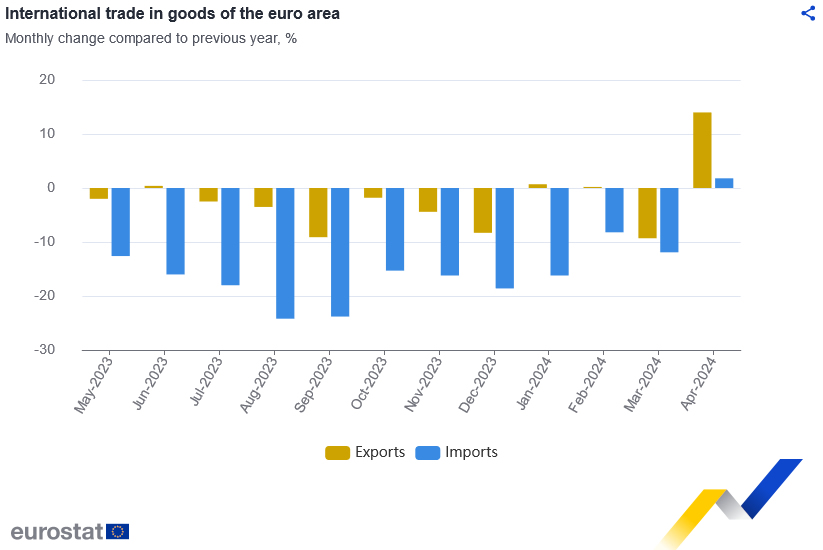
Eurozone PMI manufacturing finalized at 45.7, deepens recession despite bright spots in Spain and Netherlands
Eurozone's manufacturing sector remains entrenched in recession as April's PMI figures highlight ongoing challenges and disparities within the region. The overall Manufacturing PMI for the Eurozone was finalized at 45.7, a slight decrease from March's 46.1.
Among the member states, Greece led with a PMI of 55.2, though it marked a three-month low for the country. Spain and the Netherlands exhibited positive trends, with Spain reaching a 22-month high at 52.2 and the Netherlands achieving a 20-month high at 51.3. Conversely, major economies like Germany, France, and Italy continued to struggle. Germany's PMI slightly improved to a two-month high of 42.5, and France's was a three-month low at 45.3, despite a slight uptick from the flash estimate.
Cyrus de la Rubia, Chief Economist at Hamburg Commercial Bank, noted the manufacturing sector is prolonging its drawn-out recession into April." He highlighted the significant downturn in new orders, which he described as "a rapid decline unmatched in speed over the past four months and devoid of international support." De la Rubia also pointed out the concerning trends in the capital goods sector, which is usually a bellwether for broader industrial health but has been "hit particularly hard" in the current cycle.
Spain stands out as an anomaly within the Eurozone, continuing to demonstrate economic resilience with sustained growth in its manufacturing sector. This divergence is notable, especially against the backdrop of more subdued economic performances in other major Eurozone economies like Germany, France, and Italy, which have failed to gain similar momentum.
USD/JPY: US Dollar Weakens After Statements from Federal Reserve Chair
Last night, the Federal Reserve's decision regarding interest rates was published, which, as expected, remained unchanged at 5.5%. The subsequent press conference by Powell was of particular interest to market participants.
According to CNBC, during the conference, the Fed Chair almost ruled out a rate hike as the next step, emphasizing the monetary policy's independence from the upcoming presidential elections. Additionally, he stated that:
- Concerns regarding stagflation are exaggerated;
- The Fed intends to lower rates smoothly and gradually;
- The duration of maintaining high rates is increasing indefinitely.
The market's reaction to the Fed's news was a weakening of the dollar – apparently, concerns about another rate hike as the next step have diminished.
The dollar weakened significantly against the yen – the USD/JPY rate dropped from 157.50 to 153.10 yen per dollar yesterday evening (approximately -2.7%) in less than an hour, although the rate later recovered. The reason lies in the context, specifically the yen's strong strengthening on Monday, when the rate exceeded 160 yen per dollar, as we wrote on the morning of April 29. Perhaps there was another intervention yesterday?
However, official sources refuse to comment. Tokyo may be adhering to a tactic of keeping investors in the dark about its currency intervention strategy. Although, as reported by the Japan Times, fluctuations of 5 yen per dollar indicate interventions.
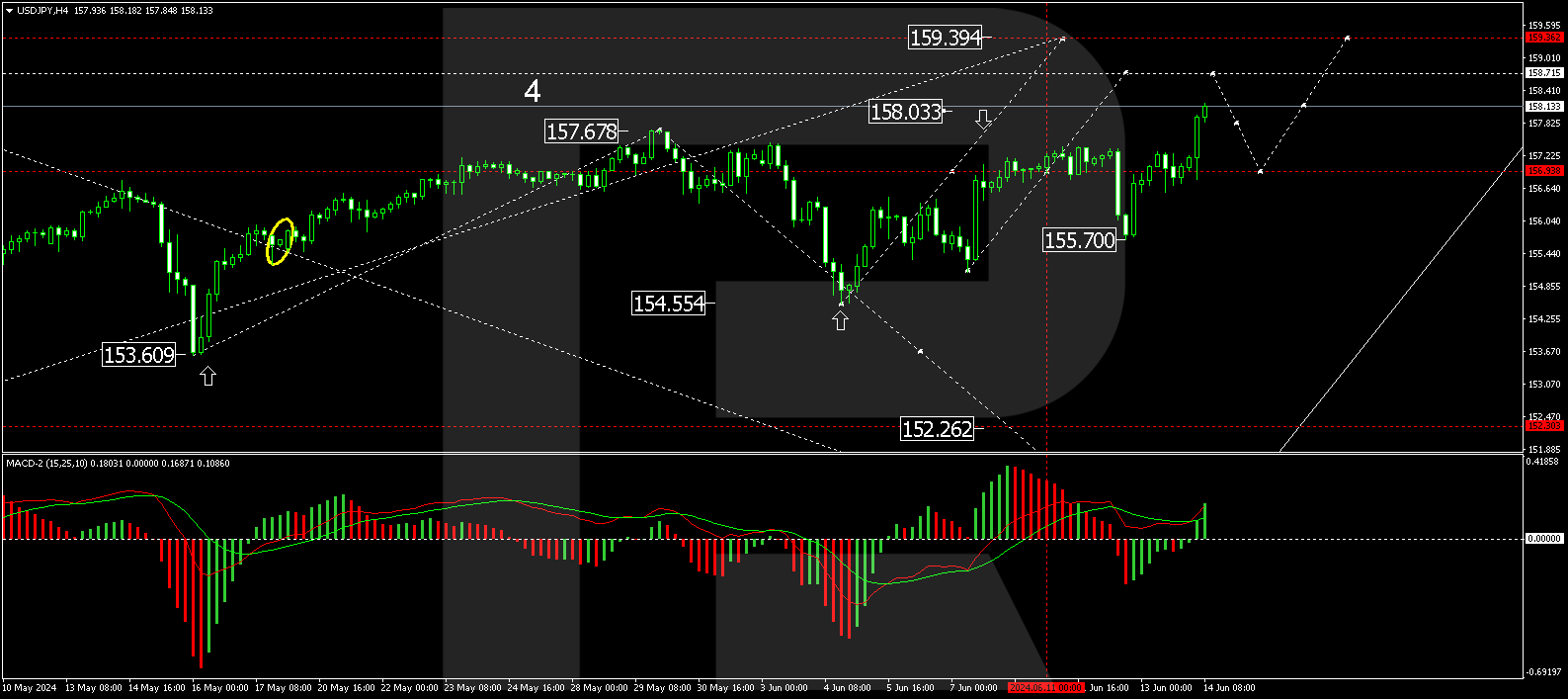
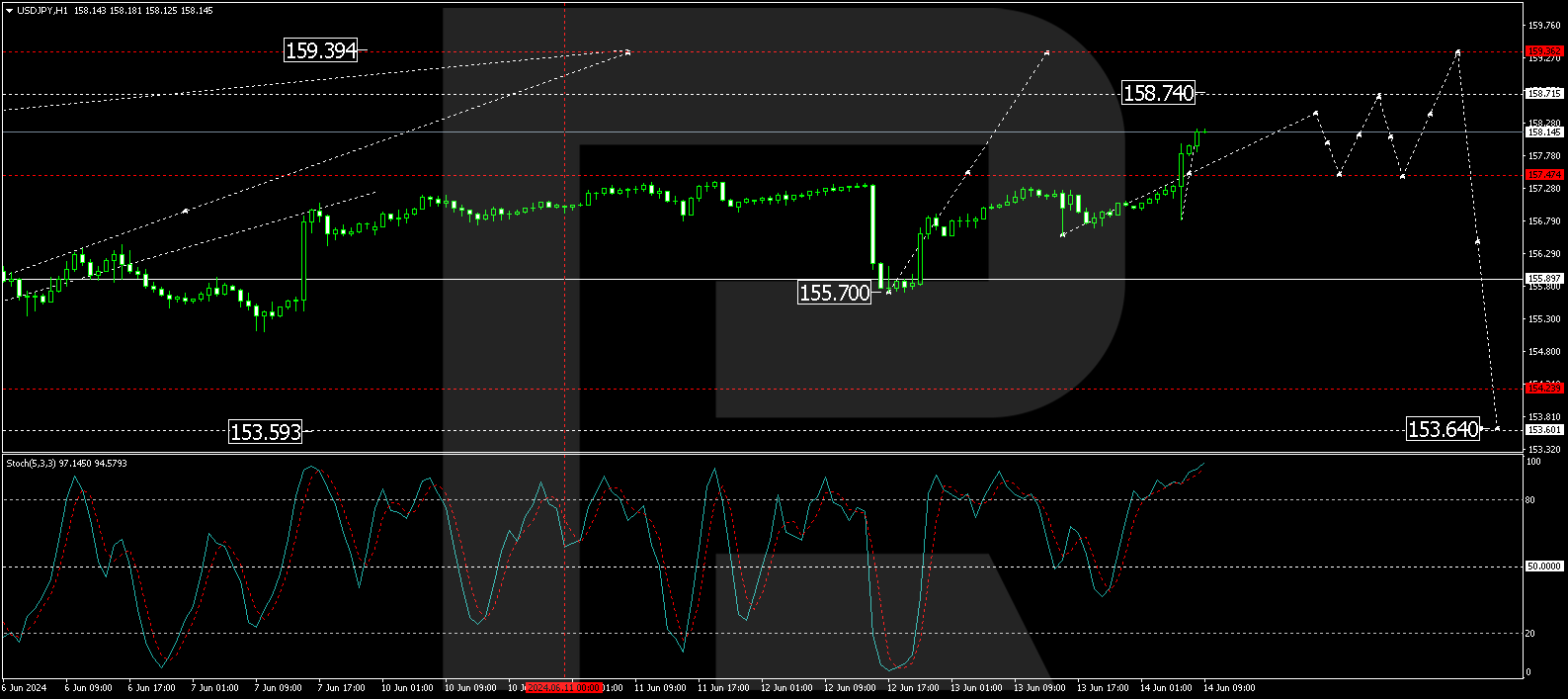
Today's technical analysis of the USD/JPY chart shows:
- Following Monday's intervention (assuming it occurred), the USD/JPY rate rebounded from the lower boundary of the ascending channel shown in black;
- At the rebound peak, the 158 yen per dollar level acted as resistance;
- After yesterday's weakening of the US dollar, the rate broke below the previous week's minimum, falling below the median line of the blue channel.
Although the EMA 50 is above the EMA 100, a change in market sentiment can be assumed. This would be evidenced by the price consolidating below the short-term (black) channel, which would open the path towards the long-term (blue) channel's lower boundary.
Trade over 50 forex markets 24 hours a day with FXOpen. Take advantage of low commissions, deep liquidity, and spreads from 0.0 pips. Open your FXOpen account now or learn more about trading forex with FXOpen.
This article represents the opinion of the Companies operating under the FXOpen brand only. It is not to be construed as an offer, solicitation, or recommendation with respect to products and services provided by the Companies operating under the FXOpen brand, nor is it to be considered financial advice.
Bullish Pressure in AUDUSD Lingers
- AUDUSD in the green again today, above the 50-day SMA
- The bullish tendency manifesting since the April low persists
- Momentum indicators mostly mixed; stochastics could send a bullish signal
AUDUSD is recording another green candle as the market appears to be relieved that Fed Chairman Powell did not mention rate hikes as a viable policy option at Wednesday's press conference. AUDUSD is currently battling with the 50-day simple moving average (SMA) and possibly on its way to break the recent series of lower highs and lower lows.
The bullish tendency since the April lows persists but it is not entirely reflected in the momentum indicators. In more detail, the Average Directional Movement Index (ADX) is hovering around its 25-threshold, signaling a trendless market, and the RSI is tentatively edging above its 50-midpoint. More interestingly, the stochastic oscillator is trying to stay above its moving average, setting a course for a higher high and possibly opening the door to a similar move in AUDUSD.
Should the bulls remain confident, they could try to complete their move above the 0.6516-0.6530 range and then test the resistance set by the 100-day SMA at 0.6576. If successful, they could then stage a move towards the July 14, 2022 low at 0.6681 with the 38.2% Fibonacci retracement level of the April 5, 2022 – October 13, 2022 downtrend at 0.6739 also being in the vicinity.
On the flip side, the bears are probably keen to put a stop to the current bullish move. They could try to push AUDUSD back below the 0.6516-0.6530 area, which is populated by the 23.6% Fibonacci retracement level and the 50- and 200-day SMAs, as well as the December 28, 2023 downward sloping trendline. They could then test the support set by May 31, 2023 low at 0.6458.
To sum up, AUDUSD bulls remain in control, but they probably need to rally above the recent 0.6586 high in order to confirm that a new bullish trend is in place.
GBP/JPY Daily Outlook
Daily Pivots: (S1) 191.01; (P) 194.22; (R1) 196.66; More..
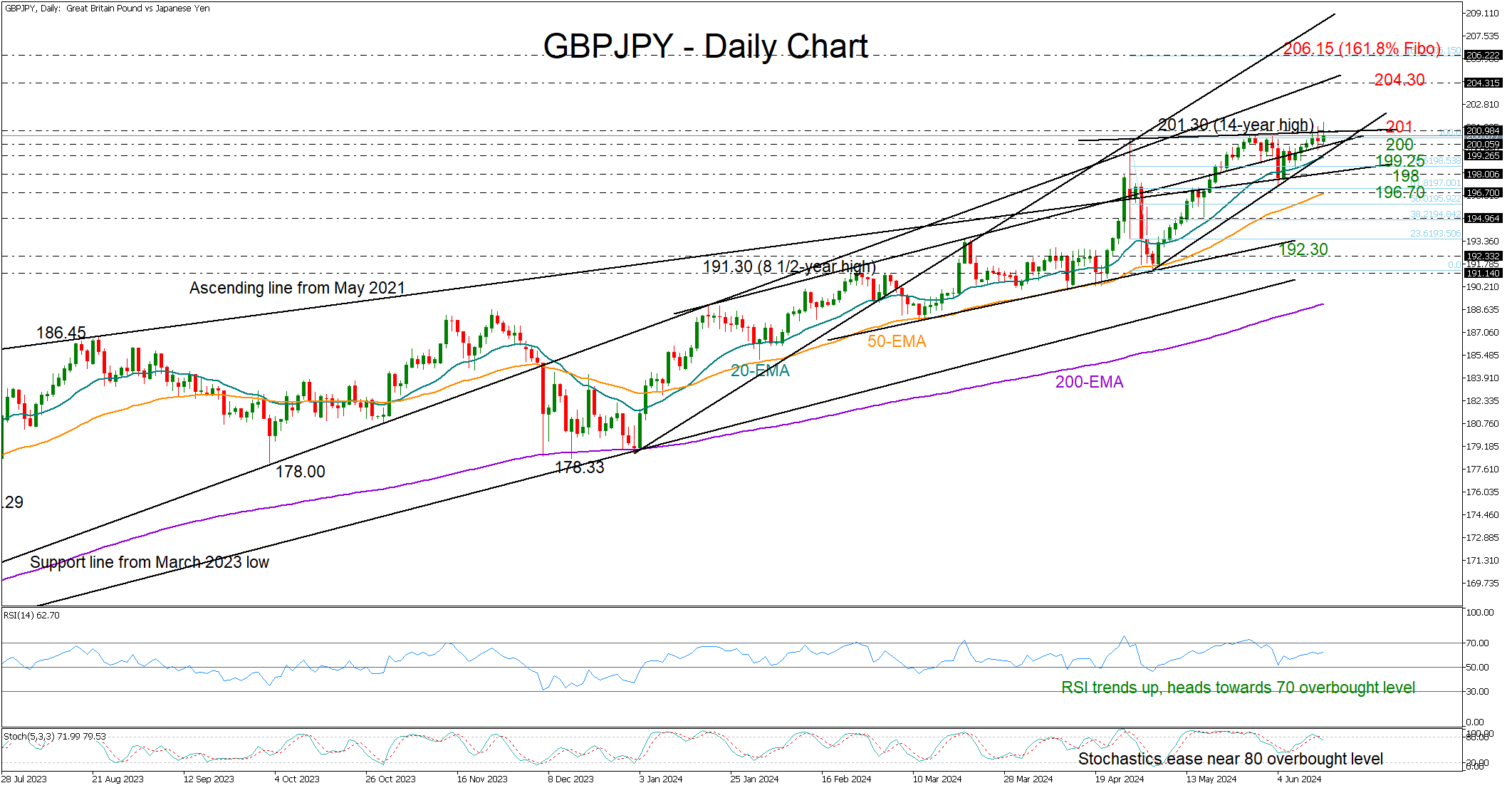
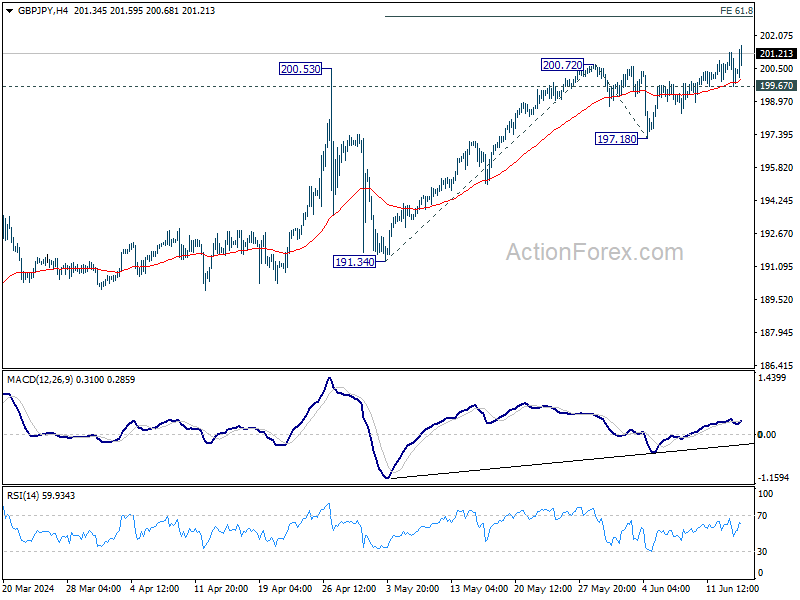
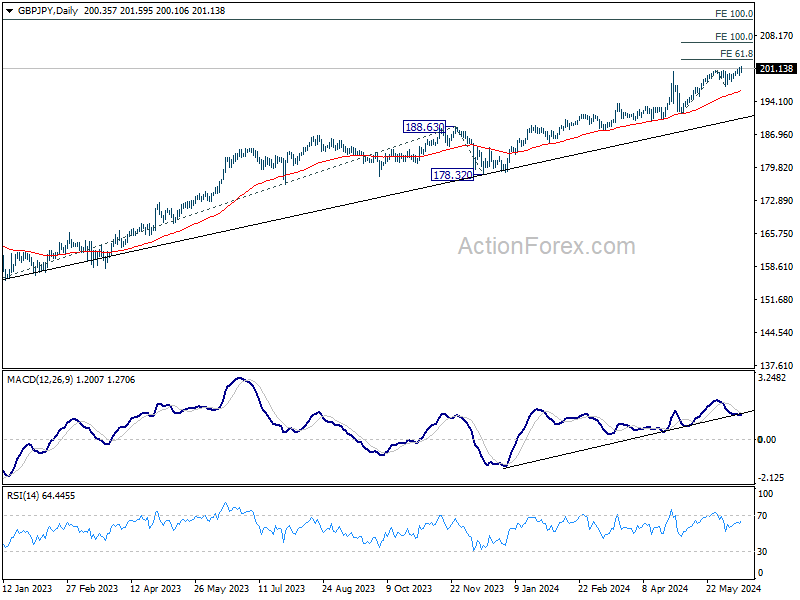
GBP/JPY's fall from 200.53 resumed and hit 191.77 before recovering. For now, further decline is in favor as long as 197.40 minor resistance holds, as correction to rise from 178.32. Sustained break of 55 D EMA (now at 191.42) will pave the way to 61.8% retracement of 178.32 to 200.53 at 186.80.
In the bigger picture, current rally is part of the up trend from 123.94 (2020 low). Sustained break of 61.8% projection of 155.33 to 188.63 from 178.32 at 198.89 will pave the way to 100% projection at 211.65. Break of 189.97 support is needed to be the first sign of medium term topping. Otherwise, outlook will remain bullish in case of retreat.
EUR/JPY Daily Outlook
Daily Pivots: (S1) 163.45; (P) 166.06; (R1) 168.06; More...
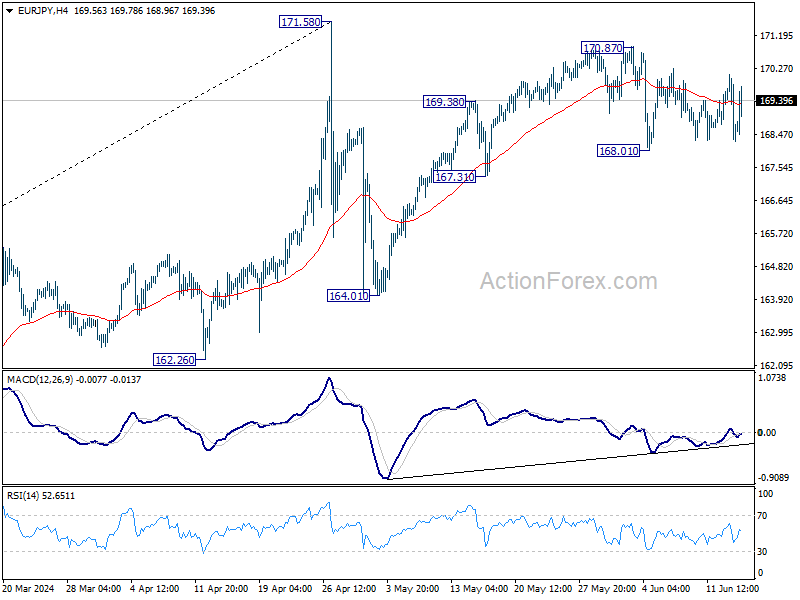
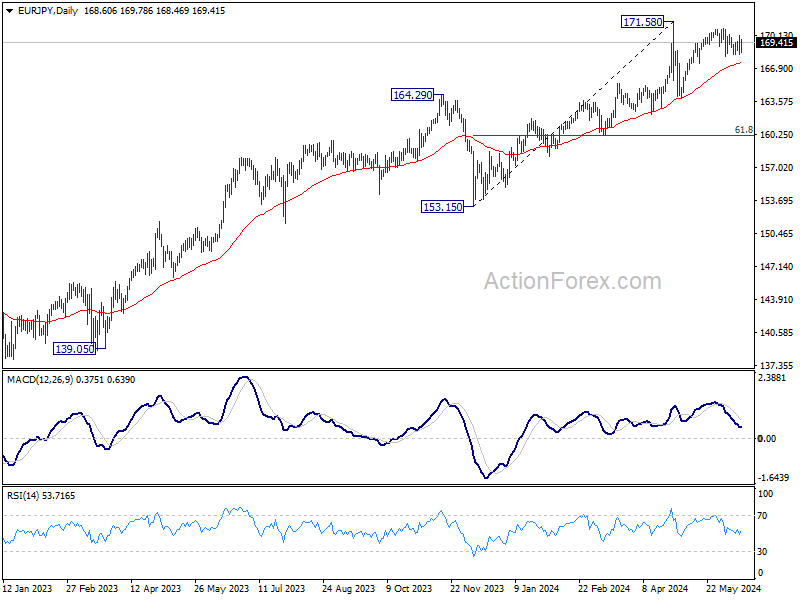
EUR/JPY's fall from 171.58 resumed and dipped to 164.04 but quickly recovered. Further fall is now in favor as long as 168.64 resistance holds, as a correction to rise from 153.15. Sustained break of 55 D EMA (now at 163.94) will target 61.8% retracement of 153.15 to 171.58 at 160.19.
In the bigger picture, current rally is part of the up trend from 114.42 (2020 low), which is still in progress. Decisive break of 169.96 (2008 high) will pave the way to 100% projection of 139.05 to 164.29 from 153.15 at 178.39. On the downside, break of 162.26 support is needed to be the first sign of medium term topping. Otherwise, outlook will stay bullish in case of retreat.
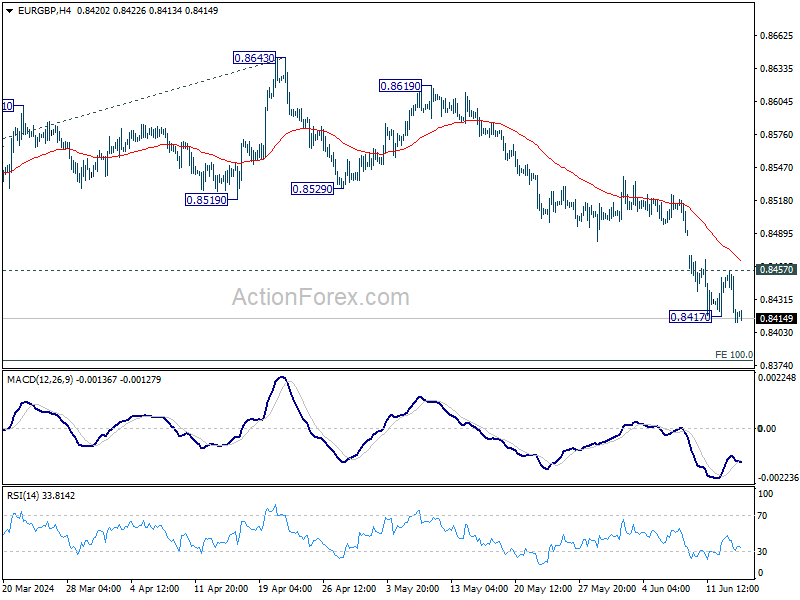
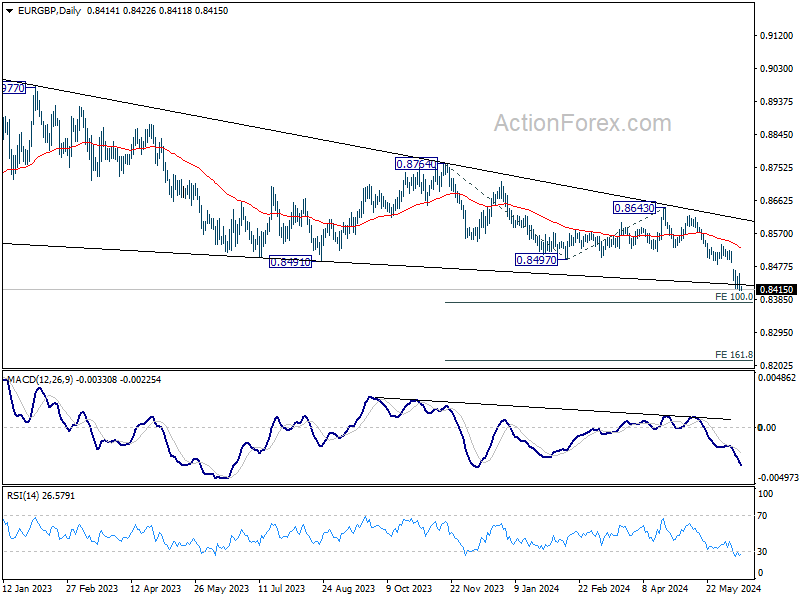
EUR/GBP Daily Outlook
Daily Pivots: (S1) 0.8539; (P) 0.8549; (R1) 0.8562; More...
Intraday bias in EUR/GBP remains neutral and some more consolidations would be seen above 0.8529 temporary low. But further decline is expected as long as 0.8582 resistance holds. Below 0.8529 will target 0.8491/7 support zone.
In the bigger picture, outlook remains bearish as EUR/GBP is capped below medium term falling trendline. That is, down trend from 0.9267 (2022 high) is still in progress. Firm break of 0.8491/7 will target 100% projection of 0.8764 to 0.8497 from 0.8643 at 0.8376.
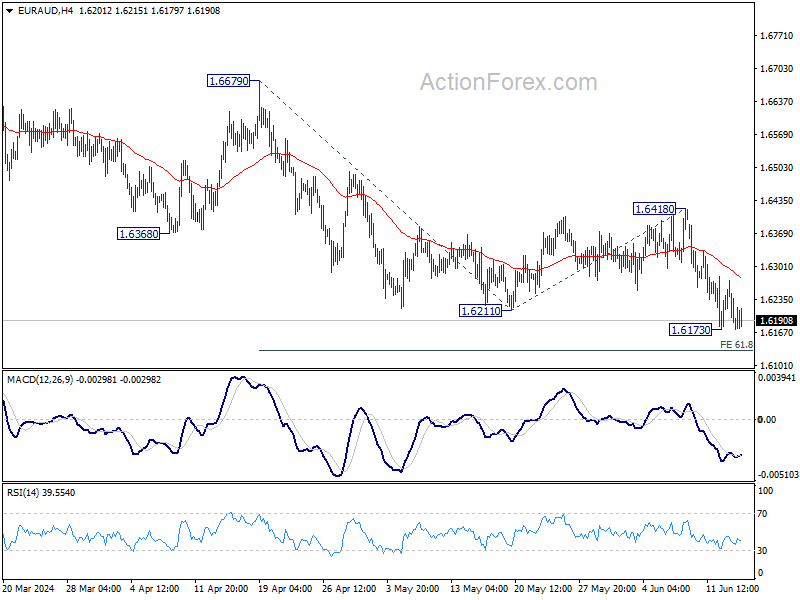
EUR/AUD Daily Outlook
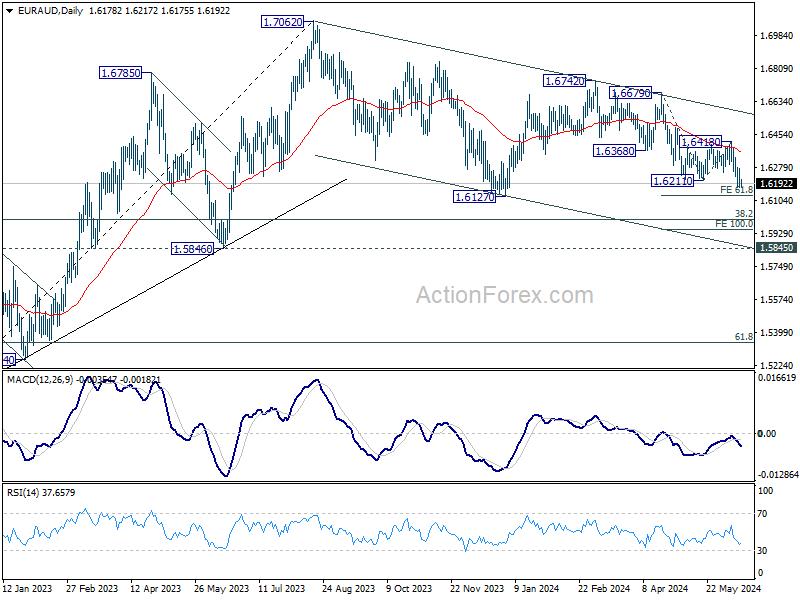
Daily Pivots: (S1) 1.6390; (P) 1.6442; (R1) 1.6477; More...
Intraday bias in EUR/AUD remains neutral and outlook is unchanged. Further decline is expected as long as 1.6484 resistance holds. Below 1.6288 will resume the fall from 1.6742 to 1.6127 support, or further to 100% projection of 1.7062 to 1.6127 from 1.6742 at 1.5807. However, break of 1.6484 will turn bias back to the upside for further rebound.
In the bigger picture, fall from 1.7062 medium term top is seen as a correction to the up trend from 1.4281 (2022 low). In case of another fall, strong support is expected around 1.5846 and 38.2% retracement of 1.4281 to 1.7062 at 1.6000 to bring rebound. Break of 1.7062 is in favor as a later stage.
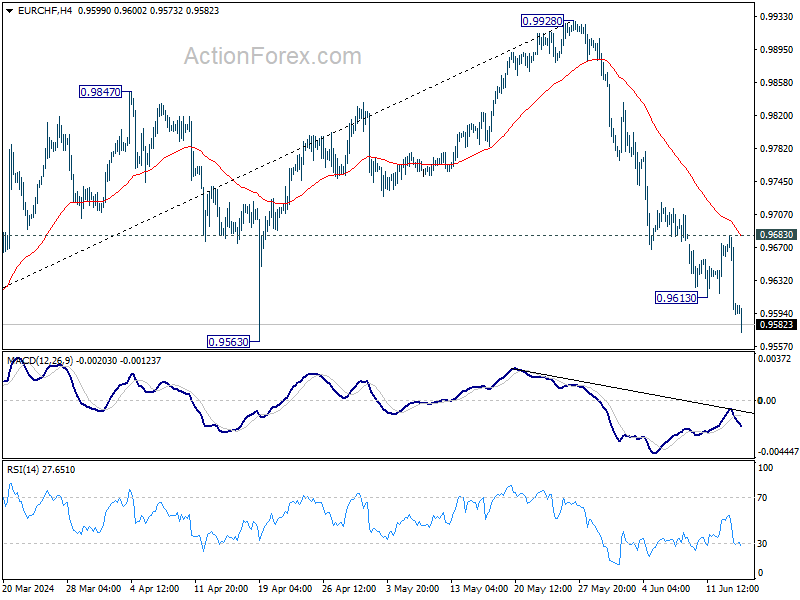
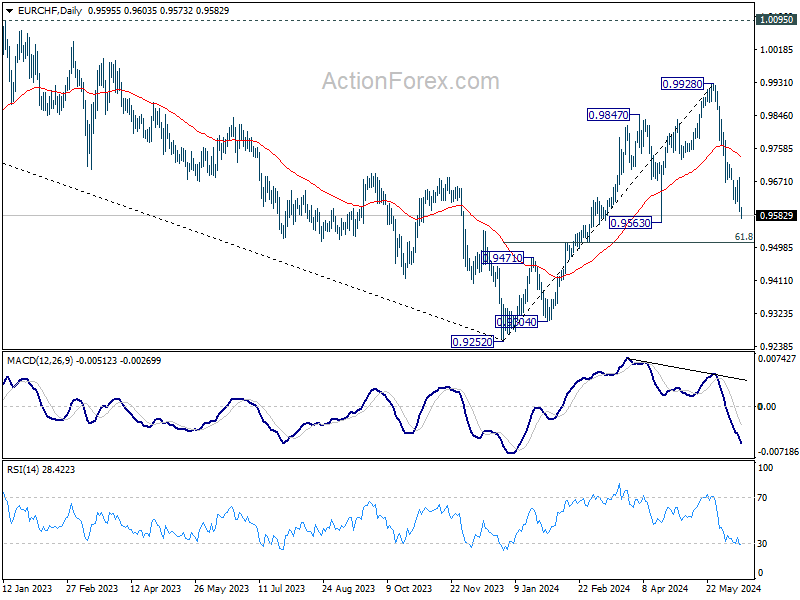
EUR/CHF Daily Outlook
Daily Pivots: (S1) 0.9787; (P) 0.9812; (R1) 0.9837; More...
Intraday bias in EUR/CHF is turned neutral again with current retreat. on the upside, firm break of 0.9847 resistance will resume larger rise from 0.9252 to 61.8% projection of 0.9252 to 0.9847 from 0.9563 at 0.9931 next. However, break of 0.9748 will extend the corrective pattern from 0.9847 with another falling leg instead.
In the bigger picture, while 55 D EMA (now at 0.9644) was breached, EUR/CHF rebounded strongly since then. Rise from 0.9252 medium term bottom should still be in progress. Break of 0.9847 will target 38.2% retracement of 1.2004 (2018 high) to 0.9252 (2023 low) at 1.0303, even as a correction to the down trend from 1.2004. However, sustained trading below 55 D EMA will argue that the rebound has completed.
FX Interventions Do Not Change a Currency’s Fundamental Course
Markets
The Fed kept the policy rate stable at the 5.25%-5.50% range yesterday. The statement did feature some changes, including that “In recent months, there has been a lack of further progress toward the Committee’s 2 percent inflation objective.” It also announced that the Fed will reduce the pace of QT in Treasuries from $60bn to $25bn while keeping the $35bn cap in MBS. The “lack of further progress” translated in chair Powell saying it’s going to take longer to gain the confidence that inflation is indeed back on track towards target. In terms of policy rates, it boils down in keeping them at the current level for a little while longer. That’s exactly what markets have been repricing for in recent months. Some in the outskirts of the market even began contemplating about rate hikes again. Powell noted it was unlikely that the next move would be an increase. Minutes later he did say that “In terms of peak rate, […] I think the data will have to answer that question for us.” Turning to those data, yesterday’s was a mixed bag. The April ADP job report (192k with an upward revision to March) was stronger than expected. But the manufacturing ISM unexpectedly dipped in contraction territory again (49.2) while price pressures in the sector intensified sharply. Yields finished the session lower in technically irrelevant trading. Daily changes varied between -3.5 bps (30y) to -7.5 bps (2y). The dollar lost ground against the euro (EUR/USD 1.0712) though we should add that this happened in holiday-thinned European trading (Labor Day). It was also partially a spillover from what is a presumed FX intervention by Japanese officials in late US dealings. USD/JPY dropped sharply from 158 to an intraday low of 153.04 before closing at 154.57. US stock markets swung from gains of up to 1.75% (Nasdaq) in volatile trading.
The Japanese yen is once again in the spotlights during Asian dealings, erasing about half of yesterday’s gains and confirming that FX interventions do not change a currency’s fundamental course. Stocks in the broad region trade mixed with few news stories to guide them. The dollar and euro trade balanced while yields in the US ease less than 2 bps. The economic calendar contains the (outdated) Q1 productivity numbers and unit labor costs. The jobless claims give us the usual weekly look on the labour market. All in all we don’t think it’ll trigger big swings ahead of tomorrow’s US services ISM and the payrolls report. We may see German bonds outperform in core markets as they catch up with the US yesterday but we wouldn’t draw any firm conclusions from that. Technical trading could keep EUR/USD oscillating around the 1.07 big figure as it has been doing for the last couple of sessions.
News & Views
The US Treasury released its quarterly refunding statement yesterday. Since August 2023, Treasury has significantly increased issuance sizes for nominal coupon and FRN securities. Based on current projected borrowing needs, Treasury does not anticipate needing to increase them further for at least the next several quarters. Actual auction sizes remain steady for the May-July period at their April (peak) level of $69bn, $58bn, $70bn and $44bn for 2-yr, 3-yr, 5-yr and 7-yr sales. The longer tenors follow the same rhythm as in the Fed-Apr period implying higher auction sizes in the first month (cumulative $83bn for 10-yr, 20-yr & 30-yr in May vs $74bn in June & July). Treasury expects to increase the 4-, 6-, and 8-week bill auction sizes in the coming days to ensure sufficient liquidity to meet one-week cash needs around the end of May. Over the course of July, auction sizes will reach the highs from February and March. Finally, Treasury announced the launch of a buyback program. They aim to end up with operation sizes of maximum $30bn per quarter across buckers for liquidity support.
Rating agency Moody’s raised the outlook on Brazil’s Ba2 rating from stable to positive. Improved growth prospects with upside potential over the medium and long term are one reason. Moody’s expects growth to average around 2% in coming years. Second, structural reforms over successive administrations support policy effectiveness with institutional guardrails reduce policy uncertainty. Finally, gradual fiscal consolidation may lead to a stabilization of the debt burden. A new fiscal framework limits the increase in real primary spending to 70% of the increase in real revenues in the previous year.
Graphs
GE 10y yield
ECB President Lagarde clearly hinted at a summer (June) rate cut and has broad backing. EMU disinflation will continue in April and bring headline CPI (temporarily) at/below the 2% target. Together with weak growth momentum, this gives backing to deliver a first 25 bps rate cut. A more bumpy inflation path in H2 2024 and the Fed’s higher for longer strategy make follow-up moves difficult. Markets come to terms with that, pushing yields up.
US 10y yield
The Fed in May acknowledged the lack of progress towards the 2% inflation objective. Upcoming CPI readings and a resilient economy/labour market will continue to prevent the Fed to cut rates fast nor deep. September at the earliest, but December is more likely. US yields, especially at the front end, could catch a breather after the recent sharp repricing, but their bottom is well protected.
EUR/USD
Economic divergence (US > EMU) and a likely desynchronized rate cut cycle with the ECB exceptionally taking the lead pulled EUR/USD towards the previous YTD low at 1.0695. Stronger-than-expected US March inflation figures forced a technical break. Last year’s low at 1.0494 looks vulnerable.
EUR/GBP
Debate at the Bank of England is focused at the timing of rate cuts. Most BoE members align with the ECB rather than with Fed view, suggesting that the disinflation process provides a window of opportunity to make policy less restrictive (in the near term). Sterling’s downside turned more vulnerable with the topside of the sideways EUR/GBP 0.8493 - 0.8768 trading range serving as the first real technical reference.
Powell Did Not Shake Markets
In focus today
Today offers a light schedule in terms of tier-1 data releases.
Most global markets that were off yesterday due to the International Labour Day are back today.
In the US, we will keep an eye out for the preliminary Q1 productivity data. Surprisingly strong productivity growth contributed to the US economy's stellar performance in 2023, but its persistence remains uncertain. We also receive the initial jobless claims figure.
Swedish PMIs for April are released at 9:30 CET. In the last release, Manufacturing PMI reached expansionary ground once again at 50.0 for the first time since June 2022. New orders increased to 50.9, thus adding up to an increase of 2.6 in the aggregated Manufacturing PMI for Q1 2024, mainly driven by new orders in the export sector. We anticipate that the positive trend continues in today's release.
Economic and market news
What happened overnight
In Japan, authorities appeared to have intervened in FX markets, as the yen took a sharp upwards turn against the dollar (USDJPY) from around 157 to 153 in less than 45 minutes. The suspected intervention came after the dollar had been weakening some on the back of the Fed's decision to leave rates unchanged and Fed chairman Powell's subsequent remarks (read more below). As of this morning the USDJPY is trading around 156.
Asian markets have reacted to yesterday's Fed decision by trading a bit mixed with Shanghai and South Korea slightly down, and Australia, Japan, and Hong Kong in the Green.
US futures for major indices are all trading up as of this morning with Nasdaq futures in front having gained around 0.6%. S&P500 and Dow Jones futures are not far behind trading about 0.5% and 0.4% up respectively.
What happened yesterday
In the US, the Fed left interest rates unchanged as was widely expected amongst market participants. In its press release, the FOMC announced that from June onwards it will reduce its monthly quantitative tightening (QT) programme for US Treasuries to USD25bn from the previous USD60bn a month. It left its cap on reducing its holdings of Mortgage-Backed Securities unchanged at USD35bn a month.
At the press conference, Powell provided few new clues on the policy outlook but emphasized that the Fed continues to see its policy having a restrictive effect on demand. As such he made it clear the Fed remains in a good place with its current policy. However, the Fed needs more confidence on inflation returning to target before deciding on a rate cut. Yet, he said it is unlikely that the next move would be a hike.
Markets initially reacted in a dovish manner sending both the dollar and long yields down. However, this reaction mostly faded later, and both the dollar and 10Y UST yields ended little changed from pre-meeting levels. Read more in Research US - Fed review - Maintaining easing bias, 2 May.
The ISM manufacturing figure for April fell more than expected coming in at 49.2 vs. consensus expectations of 50.0. The month prior it stood at 50.3, and the drop was driven especially by new orders which dropped to 49.1 from 51.4 the month prior.
The ADP jobs report showed slightly stronger jobs growth in the private sector than what was expected posting 192k additional jobs for April, and an upwards revision to the March figure of 24k. Tomorrow we will be looking out for the jobs report where we expect 200k additional non-farm jobs created in April.
The JOLTs job opening numbers pointed to fewer job openings than expected, as such lending support to the narrative of a cooling labour market. There was a total of 8.488mn job openings in March, and the ratio of job openings to unemployed jobseekers declined to 1.32, the lowest seen since the initial Covid-shock hit the economy in 2020. The February figure saw a very slight upward revision of around 50k.
In the Quarterly Refinancing Announcement (QRA) the US Treasury said issuance is going to be concentrated in the 2Y-5Y segment as well as in T-Bills. They also announced that auction sizes would remain unchanged "at least for the next several quarters". Guidance is thus overall unchanged from January, just as expected.
In Europe, most markets were out due to International Labour Day, however those that remained opened traded mostly in the red with for instance the FTSE100 dropping 0.28%. Market movements.