Sample Category Title
AUD/USD Daily Report
Daily Pivots: (S1) 0.6523; (P) 0.6546; (R1) 0.6590; More....
AUD/USD's strong break of 55 D EMA suggests that fail from 0.6666 has completed with three waves down to 0.6480. Rise from there is now seen as the third leg of the corrective pattern from 0.6442. Intraday bias is back on the upside for 0.6633 resistance first. Break there will target 0.6666 and above. On the downside, though, below 0.6559 minor support will turn intraday bias neutral first.
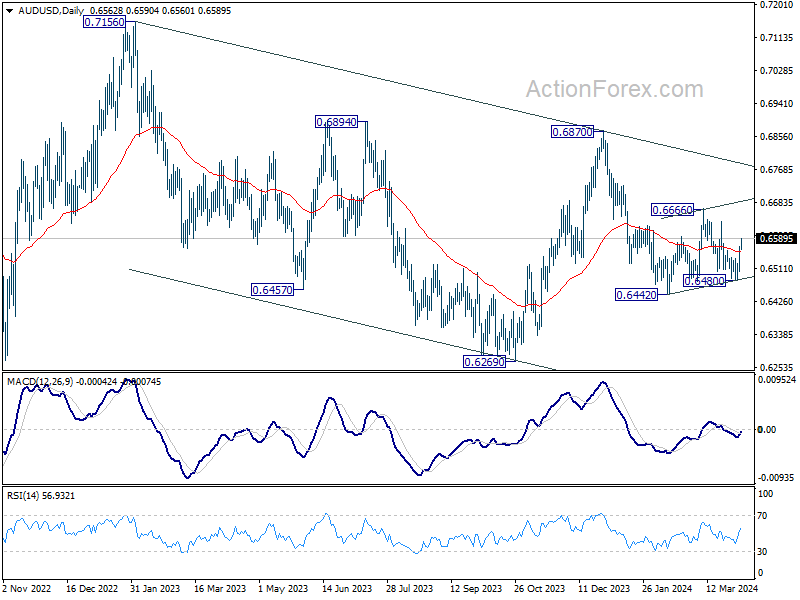
In the bigger picture, price actions from 0.6169 (2022 low) are seen as a medium term corrective pattern to the down trend from 0.8006 (2021 high). Fall from 0.7156 (2023 high) is seen as the second leg, which might still be in progress. Overall, sideway trading could continue in range of 0.6169/7156 for some more time. But as long as 0.7156 holds, an eventual downside breakout would be mildly in favor.
Fed Powell and Soft Data Dampen Dollar, While Commodity Boom Propels Aussie
Dollar was sold off overnight after weaker than expected ISM Services data, and the weakness persisted following comments from Fed Chair Jerome Powell. Powell downplayed the significance of recent robust labor and inflation figures, suggesting them as fluctuations in "bumpy road" of moderating demand and inflation. This narrative reinforces the market's anticipation that Fed is still leaning towards three rate cuts this year over just two. Though, the upcoming non-farm payroll data remains crucial for further adjustments in these expectations.
In the broader currency markets risk-on sentiment seems to prevail, more evident in the commodity markets than in equities. Australian dollar leads as the strongest currency for the week so far, fueled by significant rally in commodities like Copper. New Zealand dollar follows as the second strongest. Japanese Yen languishes as the weakest, with Swiss Franc and Dollar also underperforming.
Euro, Sterling, and Canadian Dollar occupy the middle ground in the currency spectrum, with Euro slightly edging out after surviving lower-than-expected Eurozone CPI data yesterday. Attention now shifts to release of ECB minutes today. But it is unlikely that they will offer any groundbreaking revelations given ECB officials' clear communication regarding the consensus for June first rate cut.
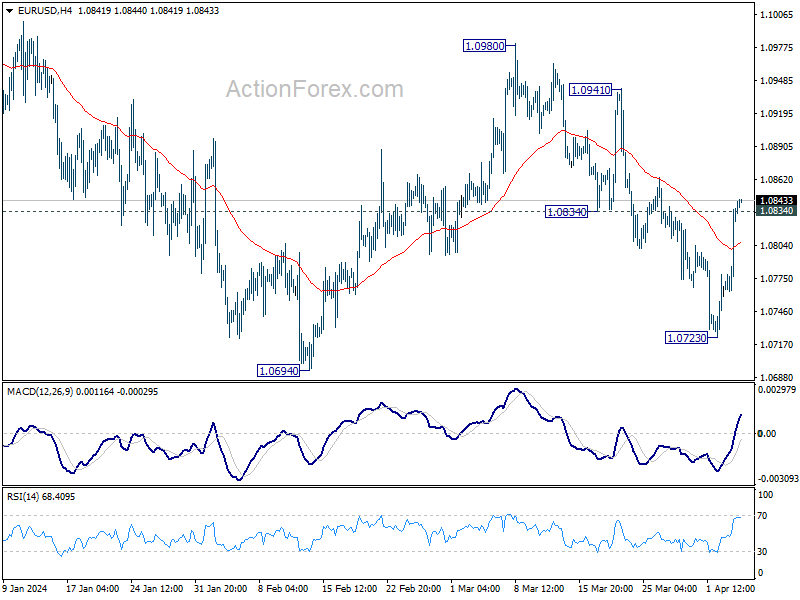
Technically, it now looks like EUR/USD's fall from 1.0980 has completed with three waves down to 1.0723, ahead of 1.0694 support. Further rally would be mildly in favor as long as 55 4H EMA (now at 1.0805) holds, for 1.0941/80 resistance zone. But sustained break of the EMA will argue that rise from 1.0723 is merely a brief recovery and bring retest of 1.0694/0723 support zone instead.
In Asia, at the time of writing, Nikkei is up 1.27%. Japan 10-year JGB yield is up 0.0114 at 0.778. Singapore Strait Times is up 0.61%. Hong Kong and China are on holiday. Overnight, DOW fell -0.11%. S&P 500 rose 0.11%. NASDAQ rose 0.23%. 10-year yield fell -0.010 to 4.355.
Fed Powell downplays significance of recent strong labor market and inflation data
Fed Chair Jerome Powell downplayed the significance of recent labor market and inflation data that surpassed expectations, he noted that these developments do not significantly alter the Fed's overall economic outlook.
"Recent readings on both job gains and inflation have come in higher than expected," Powell said at a forum at Stanford University overnight. However, he was quick to clarify that these developments do not fundamentally shift the broader economic narrative, which he described as "one of solid growth, a strong but rebalancing labor market, and inflation moving down toward 2 percent on a sometimes bumpy path."
In discussing the Federal Reserve's approach to monetary policy easing, Powell affirmed the "meeting by meeting" decision-making process and acknowledged that rate cuts are "likely to be appropriate at some point this year."
Yet, he stressed the prerequisite of having "greater confidence" in inflation's downward path towards 2% target before any interest rate red reduction would be considered.
"Given the strength of the economy and progress on inflation so far, we have time to let the incoming data guide our decisions on policy," he remarked.
Fed's Kugler expects rate cut this year amid cooling demand
Fed Governor Adriana Kugler said overnight that if the disinflation process and labor market conditions evolve in line with her current expectations, a policy rate reduction within the year could be warranted.
"With demand growth cooling, given the backdrop of solid supply, my baseline expectation is that further disinflation can be accomplished without a significant rise in unemployment," Kugler stated
"If disinflation and labor market conditions proceed as I am currently expecting, then some lowering of the policy rate this year would be appropriate," she remarked.
Copper hits yearly high on global growth optimism
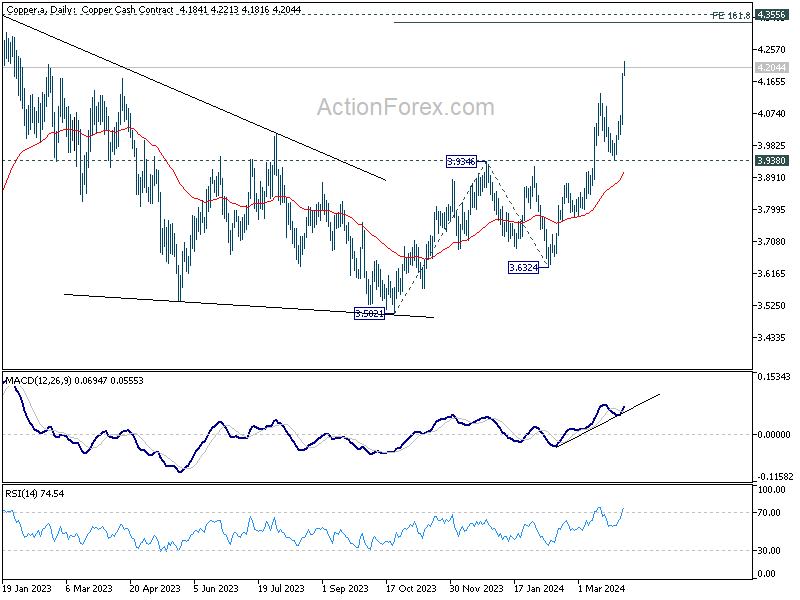
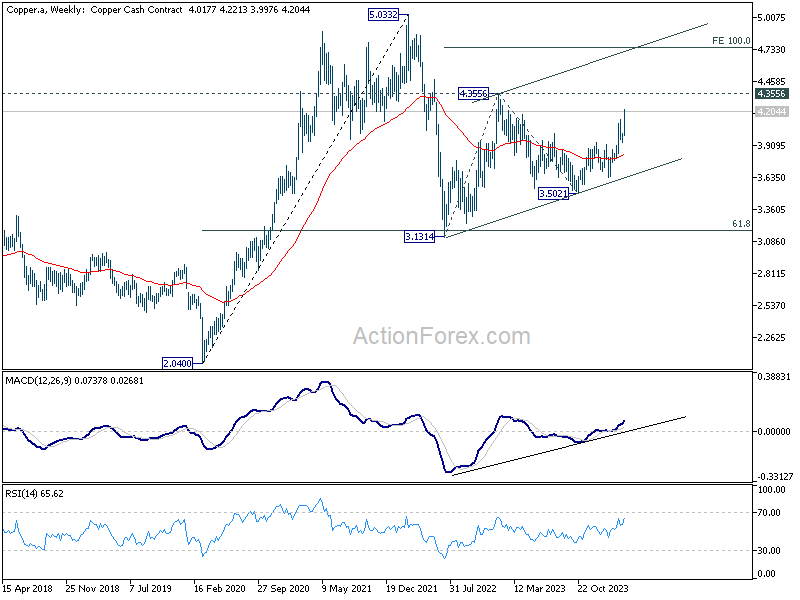
Copper soars to the highest levels in over a year this year, driven by renewed optimism regarding global economic growth and expectations of monetary easing from the world's major central banks. This surge reflects growing confidence among investors that the downturn in manufacturing, including even China, may have past its worst. The prospect of interest rate cuts this year further fuels this positive mood for commodities like copper.
Technically, Copper's rally from 3.5021 resumed this week and it's now on track to 161.8% projection of 3.5021 to 3.9346 from 3.6324 at 4.3322, which is close to 4.3556 (2023 high). In any case, outlook will stay bullish as long as 3.9380 support holds. The bigger question is whether Copper is indeed resuming the rise from 3.1314 (2022 low) too. Let's see.
Looking ahead
Swiss CPI, Eurozone PMI services final and PPI, UK PMI services final will be released in European session. But more focus would likely be on ECB minutes.
Later in the day, US and Canada will release trade balance while US will also publish jobless claims.
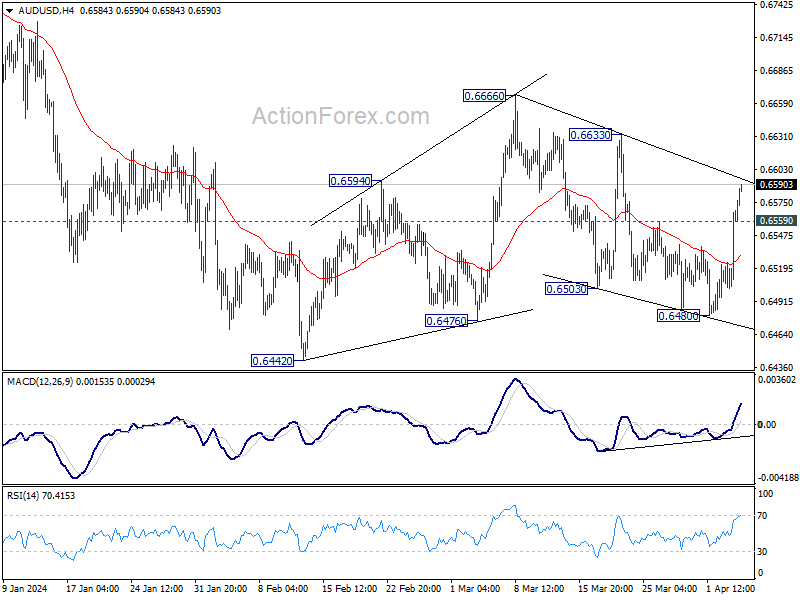
AUD/USD Daily Report
Daily Pivots: (S1) 0.6523; (P) 0.6546; (R1) 0.6590; More....
AUD/USD's strong break of 55 D EMA suggests that fail from 0.6666 has completed with three waves down to 0.6480. Rise from there is now seen as the third leg of the corrective pattern from 0.6442. Intraday bias is back on the upside for 0.6633 resistance first. Break there will target 0.6666 and above. On the downside, though, below 0.6559 minor support will turn intraday bias neutral first.
In the bigger picture, price actions from 0.6169 (2022 low) are seen as a medium term corrective pattern to the down trend from 0.8006 (2021 high). Fall from 0.7156 (2023 high) is seen as the second leg, which might still be in progress. Overall, sideway trading could continue in range of 0.6169/7156 for some more time. But as long as 0.7156 holds, an eventual downside breakout would be mildly in favor.
Economic Indicators Update
| GMT | Ccy | Events | Actual | Forecast | Previous | Revised |
|---|---|---|---|---|---|---|
| 21:45 | NZD | Building Permits M/M Feb | 14.90% | -8.80% | -8.60% | |
| 00:30 | AUD | Building Permits M/M Feb | -1.90% | 3.20% | -1.00% | -2.50% |
| 06:30 | CHF | CPI M/M Mar | 0.30% | 0.60% | ||
| 06:30 | CHF | CPI Y/Y Mar | 1.40% | 1.20% | ||
| 07:45 | EUR | Italy Services PMI Mar | 53.2 | 52.2 | ||
| 07:50 | EUR | France Services PMI Mar F | 47.8 | 47.8 | ||
| 07:55 | EUR | Germany Services PMI Mar F | 49.8 | 49.8 | ||
| 08:00 | EUR | Eurozone Services PMI Mar F | 51.1 | 51.1 | ||
| 08:30 | GBP | Services PMI Mar | 53.4 | 53.4 | ||
| 09:00 | EUR | Eurozone PPI M/M Feb | -0.70% | -0.90% | ||
| 09:00 | EUR | Eurozone PPI Y/Y Feb | -8.60% | -8.60% | ||
| 11:30 | USD | Challenger Job Cuts Y/Y Mar | 8.80% | |||
| 11:30 | EUR | ECB Meeting Accounts | ||||
| 12:30 | CAD | Trade Balance (CAD) Feb | 0.5B | 0.5B | ||
| 12:30 | USD | Trade Balance (USD) Feb | -66.0B | -67.4B | ||
| 12:30 | USD | Initial Jobless Claims (Mar 29) | 212K | 210K | ||
| 14:30 | USD | Natural Gas Storage | -42B | -36B |
Copper hits yearly high on global growth optimism
Copper soars to the highest levels in over a year this year, driven by renewed optimism regarding global economic growth and expectations of monetary easing from the world's major central banks. This surge reflects growing confidence among investors that the downturn in manufacturing, including even China, may have past its worst. The prospect of interest rate cuts this year further fuels this positive mood for commodities like copper.
Technically, Copper's rally from 3.5021 resumed this week and it's now on track to 161.8% projection of 3.5021 to 3.9346 from 3.6324 at 4.3322, which is close to 4.3556 (2023 high). In any case, outlook will stay bullish as long as 3.9380 support holds. The bigger question is whether Copper is indeed resuming the rise from 3.1314 (2022 low) too. Let's see.
Bitcoin Price At Risk of More Downsides Below $65K
Key Highlights
- Bitcoin price started a fresh decline below $69,000 and $68,000.
- BTC traded below a key bullish trend line with support at $68,350 on the 4-hour chart.
- Crude oil price rallied further above $85.00.
- Gold price also climbed higher toward the $2,300 level.
Bitcoin Price Technical Analysis
Bitcoin price failed to stay above $70,000 and started a fresh decline. BTC traded below the $69,000 and $68,000 support levels to move into a short-term bearish zone.
Looking at the 4-hour chart, the price traded below a key bullish trend line with support at $68,350. It even settled below the $67,500 level, and the 100 simple moving average (red, 4 hours), and the 200 simple moving average (green, 4 hours).
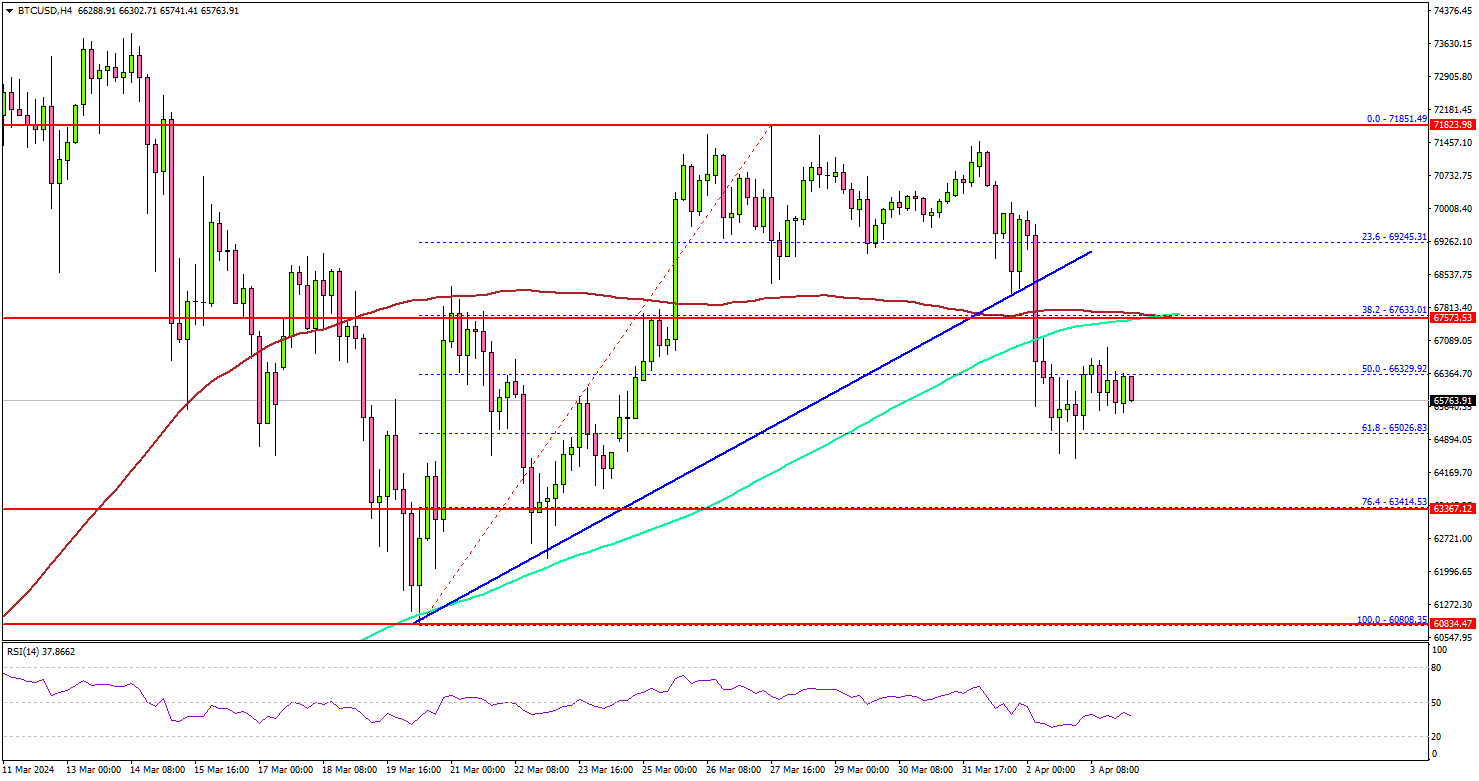
There was a spike toward the 61.8% Fib retracement level of the upward move from the $60,808 swing low to the $71,851 high. The price is now consolidating losses.
Immediate support is near the $65,000 level. The next major support is near the 76.4% Fib retracement level of the upward move from the $60,808 swing low to the $71,851 high at $63,400.
Any more losses might send the price toward the $62,000 support zone. Immediate resistance is near the $67,500 level and the 100 simple moving average (red, 4 hours). The next resistance is near $68,000. The main resistance could be $71,850.
A successful close above $71,850 might start another steady increase. In the stated case, the price may perhaps rise toward the $73,600 level.
Economic Releases
- US Initial Jobless Claims - Forecast 214K, versus 210K previous.
Fed’s Kugler expects rate cut this year amid cooling demand
Fed Governor Adriana Kugler said overnight that if the disinflation process and labor market conditions evolve in line with her current expectations, a policy rate reduction within the year could be warranted.
"With demand growth cooling, given the backdrop of solid supply, my baseline expectation is that further disinflation can be accomplished without a significant rise in unemployment," Kugler stated
"If disinflation and labor market conditions proceed as I am currently expecting, then some lowering of the policy rate this year would be appropriate," she remarked.
Fed Powell downplays significance of recent strong labor market and inflation data
Fed Chair Jerome Powell downplayed the significance of recent labor market and inflation data that surpassed expectations, he noted that these developments do not significantly alter the Fed's overall economic outlook.
"Recent readings on both job gains and inflation have come in higher than expected," Powell said at a forum at Stanford University overnight. However, he was quick to clarify that these developments do not fundamentally shift the broader economic narrative, which he described as "one of solid growth, a strong but rebalancing labor market, and inflation moving down toward 2 percent on a sometimes bumpy path."
In discussing the Federal Reserve's approach to monetary policy easing, Powell affirmed the "meeting by meeting" decision-making process and acknowledged that rate cuts are "likely to be appropriate at some point this year."
Yet, he stressed the prerequisite of having "greater confidence" in inflation's downward path towards 2% target before any interest rate red reduction would be considered.
"Given the strength of the economy and progress on inflation so far, we have time to let the incoming data guide our decisions on policy," he remarked.
A Trading Playbook on Japanese FX Intervention
- Yen falls 7% this year to hit lowest levels in three decades
- Japanese authorities threaten to intervene again to defend it
- How likely is intervention, and what are the steps to get there?
Yen tanks, again
The Japanese yen absorbed heavy damage this year, briefly falling to a 34-year low against the US dollar. Selling pressures persisted even after the Bank of Japan raised interest rates out of negative territory, leading authorities in Tokyo to threaten another round of FX intervention to defend the currency.
Several factors lie behind the yen's collapse. First and foremost is the wide interest rate gap between Japan and the United States. Despite the Bank of Japan's historic move, rate differentials are still extremely wide. As such, capital continues to flow out of Japan, searching for higher returns abroad.
Rising oil prices have been another thorn in the yen's side, hitting the energy-importing currency through the trade channel. The euphoria in stock markets has further suppressed demand for the safe-haven Japanese currency.
What is the roadmap for FX intervention?
With Tokyo warning it could take action, it's useful to examine the language officials have used in the past before intervening, and how those threats escalate before actual intervention takes place.
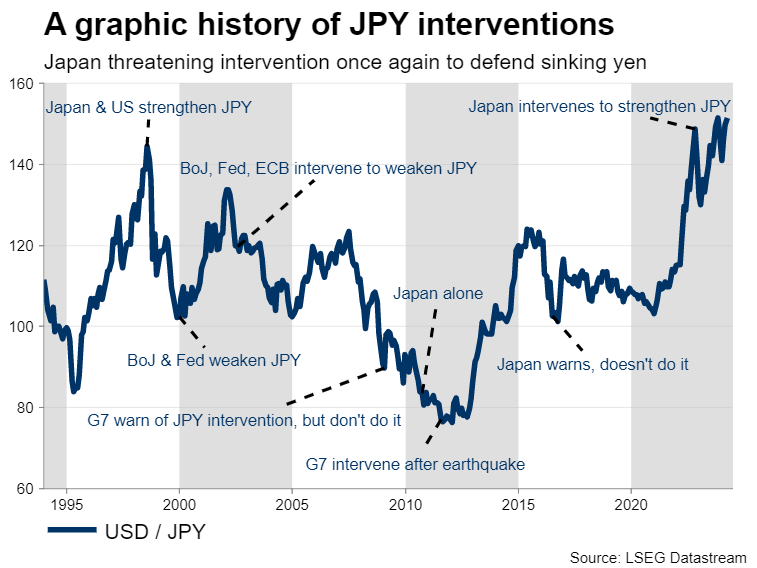
In Japan, the decision to intervene falls on the government, while the execution is done by the central bank. The speed of currency moves is extremely important in deciding whether to intervene. Authorities are more concerned about sharp and sudden FX moves, as those threaten economic stability.
So Japan is more likely to resort to intervention if the yen depreciates at a rapid clip, like it did back in 2022. If the currency is losing ground but at a very slow pace, the risk of intervention would be much lower.
Before actually intervening, Japanese officials will often escalate their verbal warnings in an attempt to scare away speculators that are shorting the currency. This 'verbal intervention' process has several unofficial stages.
Stage 1:
- We are monitoring developments in the currency market
- Desirable for FX rates to move in line with economic fundamentals
Stage 2:
- Rapid FX moves can have negative effects on the economy
- Excessive movements in exchange rates are undesirable
- Carefully monitoring FX markets with a sense of urgency
Stage 3:
- Recent moves are driven by speculation and don't reflect fundamentals
- Won't rule out any options to combat disorderly currency moves
- Yen losses have been "excessive" or "disorderly"
Stage 4:
- Prepared to take "decisive" or "bold" action against speculative moves
- Ready to act against "one-sided" and "excessive" currency moves
- "Bank of Japan calls FX dealers to check exchange rates"
The finance minister is the final authority in intervention matters, so when these warnings come from him directly, their importance is greater. We currently seem to be in Stage 4, as finance minister Suzuki recently stressed the government is willing to take "bold measures against excessive moves". This was his strongest warning so far.
Options market suggests intervention is not imminent
Language aside, the options market doesn't seem very concerned about an immediate intervention. Implied volatility in short-dated USDJPY options remains fairly low, which shows that big investment funds are not panic hedging against any massive yen moves.
Therefore, options traders seem to view FX intervention as a low-probability scenario for now, perhaps because the speed of depreciation has not been as dramatic as in 2022, when Tokyo intervened twice.
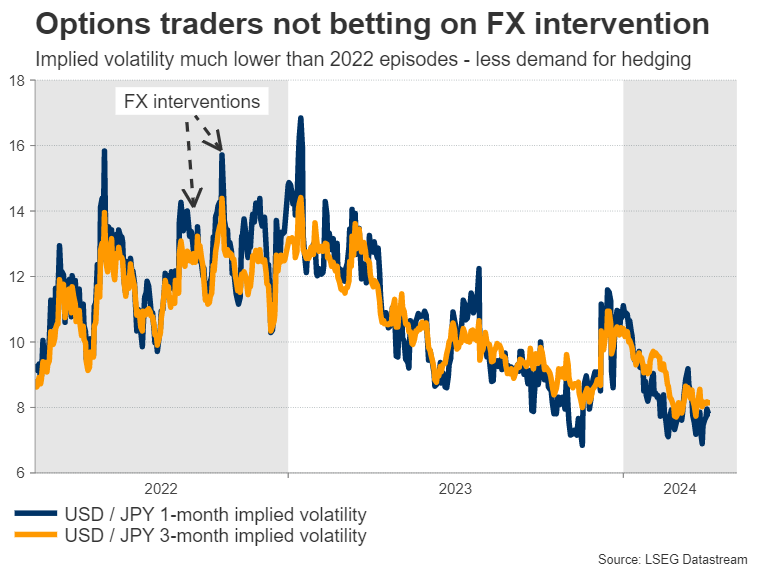
Similarly, the fact that the Bank of Japan hasn't "called FX dealers to check yen quotes" suggests authorities are not quite ready to take action yet. Of course, that could change if USDJPY slices through the 152.00 region and moves higher rapidly.
The risk of intervention would rise significantly in this case, although Tokyo might still refrain from pulling the trigger unless the pair goes all the way up to the 155.00 - 156.00 area. A lot will also depend on the rally's momentum. The faster the move, the more likely intervention becomes.
Even if Tokyo steps in, it's doubtful whether that would lead to a trend reversal in the yen as wide rate differentials would continue working against the currency. Hence, intervention might prevent deeper losses, but is unlikely to ignite a lasting rally in the yen.
Ultimately, the yen needs the global economy to weaken and foreign central banks to start slashing interest rates, before it can stage a sustainable recovery.
USD: Powell Speaks on Cutting Interest Rates
Jerome H. Powell, the Federal Reserve chair, stated that the central bank can afford to be patient in deciding when to cut interest rates, citing easing inflation and stable economic growth. Powell emphasized the Fed's independence from political influences, particularly relevant as the election season nears. The Fed had raised interest rates to 5.3 percent to address rapid inflation but may consider lowering them as price increases subside. However, the timing of rate cuts remains uncertain, with officials awaiting further evidence of sustained inflation moderation, likely delaying any action until June or July. Despite criticism, Powell reaffirmed the Fed's commitment to basing decisions on economic factors rather than political considerations.
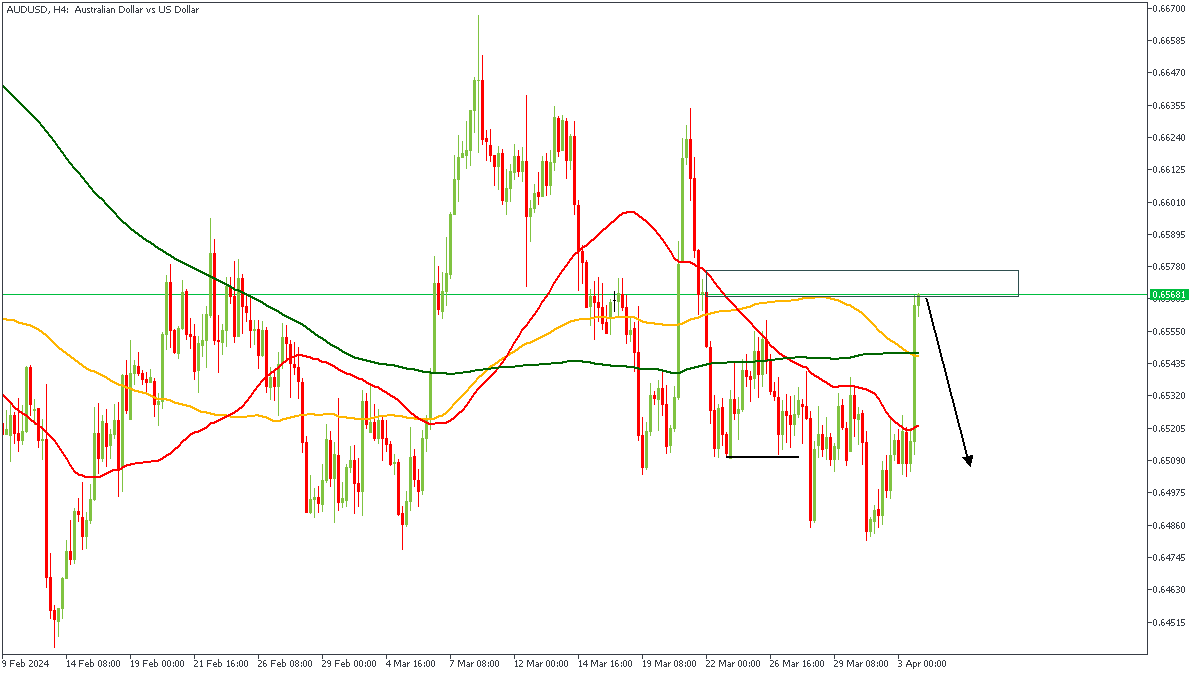
AUDUSD - H4 Timeframe
After the initial break of structure on the 4-hour timeframe of AUDUSD, we’ve seen price make a run for the previous area of supply. This region is crucial because it is a supply zone that is being tested right after a sweep of liquidity. Also, we see the bearish array of the moving averages, as well as the equal lows down below, which could serve as a good level for another run on liquidity. All in all, my sentiment here is bearish.
Analyst’s Expectations:
- Direction: Bearish
- Target: 0.65210
- Invalidation: 0.65781
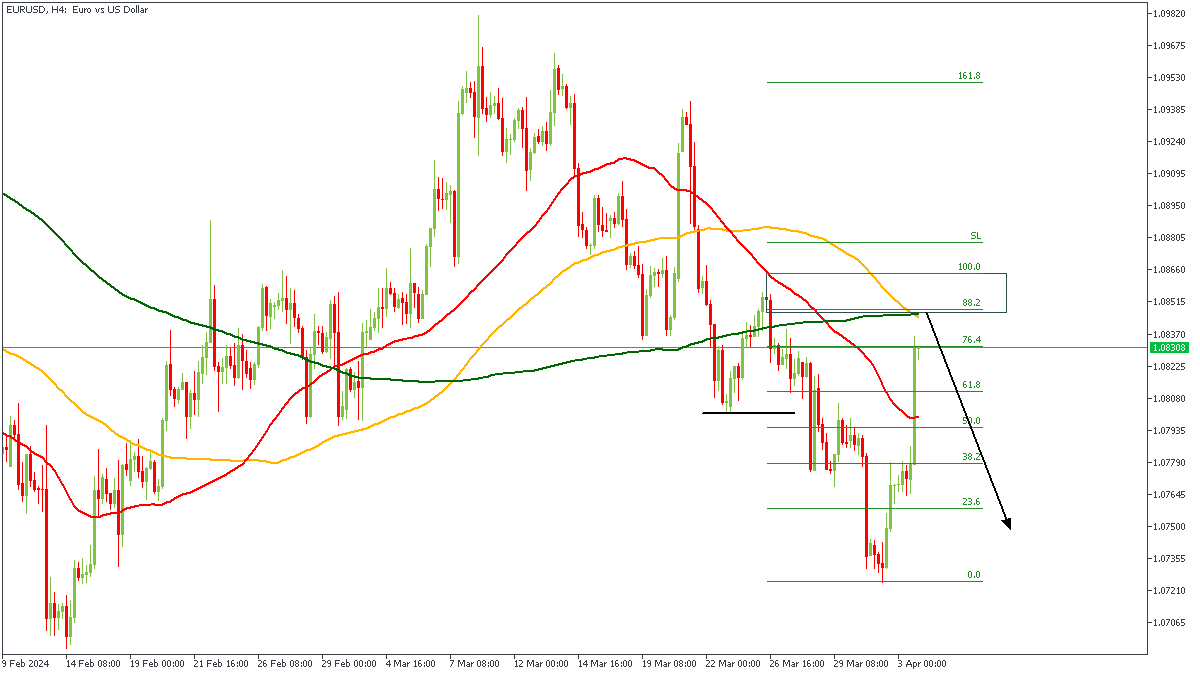
EURUSD - H4 Timeframe
EURUSD recently broke below the previous low, hence, I expect price to make a return to the supply zone that engineered the break of structure. Also, the confluence of the 100 and 200 period moving averages may be considered a viable area of resistance, especially since the moving averages are in a descending order. Finally, the 88% of the Fibonacci retracement, and the rally-base-drop supply zone are the final pieces of the puzzle towards my bearish sentiment.
Analyst’s Expectations:
- Direction: Bearish
- Target: 1.07797
- Invalidation: 1.08657
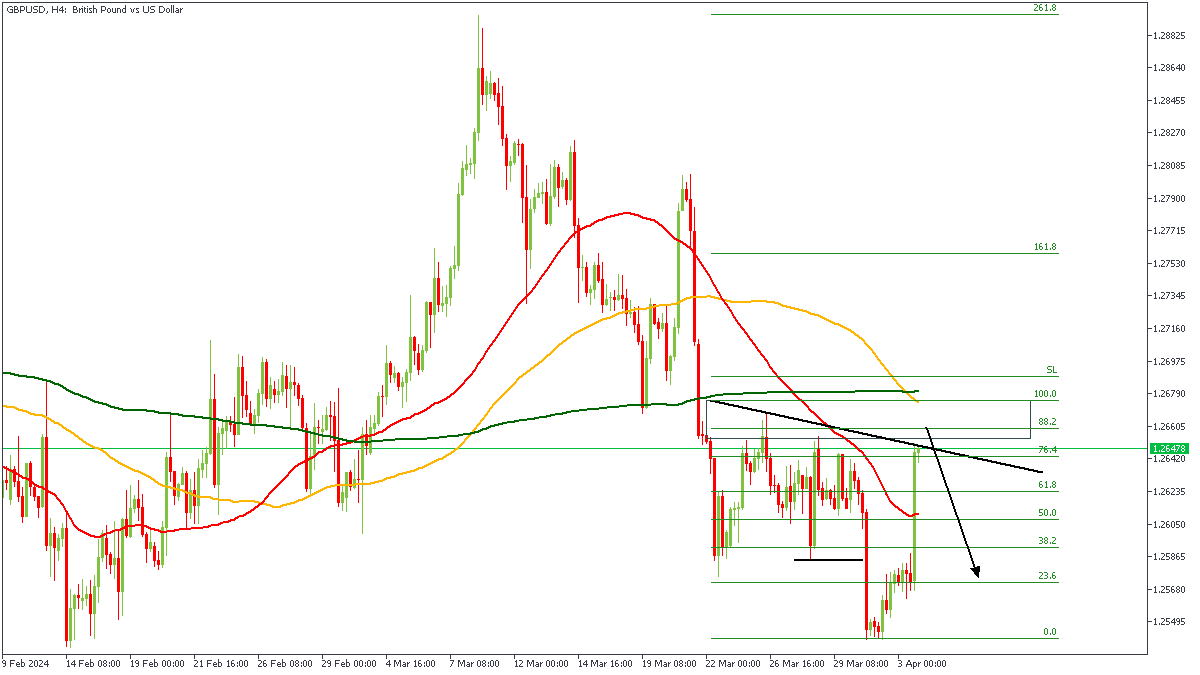
GBPUSD - H4 Timeframe
GBPUSD is currently reflecting the price action on EURUSD, albeit with some slight modification. Here on the 4-hour chart of GBPUSD, we see the initial break of structure, and the race to retest the supply zone that engineered that break. Also, we clearly see the bearish array of the moving averages, the 88% Fibonacci retracement level, trendline resistance, as well as the overlap of the 100 and 200 moving averages with the rally-base-drop supply zone. All these point to the likelihood of a bearish outcome.
Analyst’s Expectations:
- Direction: Bearish
- Target: 1.25897
- Invalidation: 1.26766
CONCLUSION
The trading of CFDs comes at a risk. Thus, to succeed, you have to manage risks properly. To avoid costly mistakes while you look to trade these opportunities, be sure to do your due diligence and manage your risk appropriately.
Silver Wave Analysis
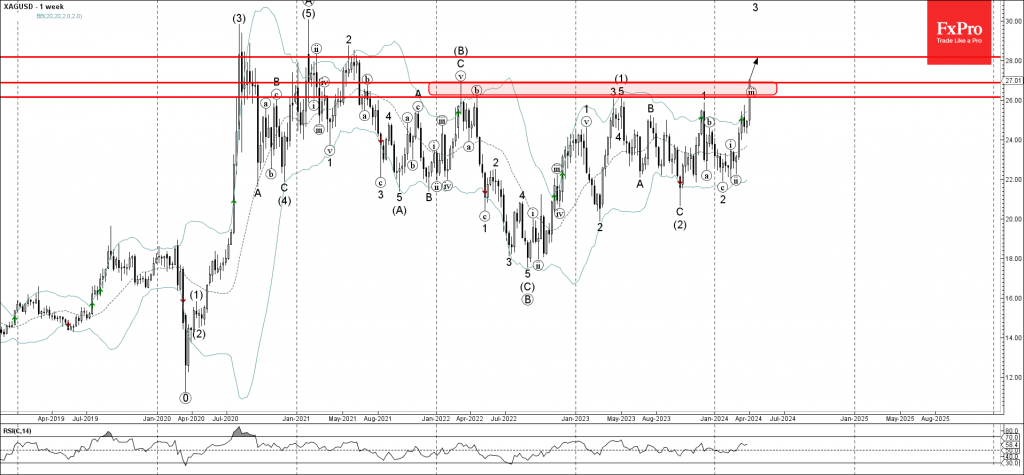
- Silver broke major resistance zone
- Likely to rise to resistance level 28.00
Silver under the bullish pressure after the recent breakout of the major resistance zone located between the resistance levels 26.15 and 26.90 (previous yearly highs from 2022 and 2023).
The breakout of the resistance levels 26.15 and 26.90 accelerated the active impulse waves 3 and (3).
Given the clear multiyear uptrend, Silver can be expected to rise further to the next resistance level 28.00 (former strong resistance from 2021).
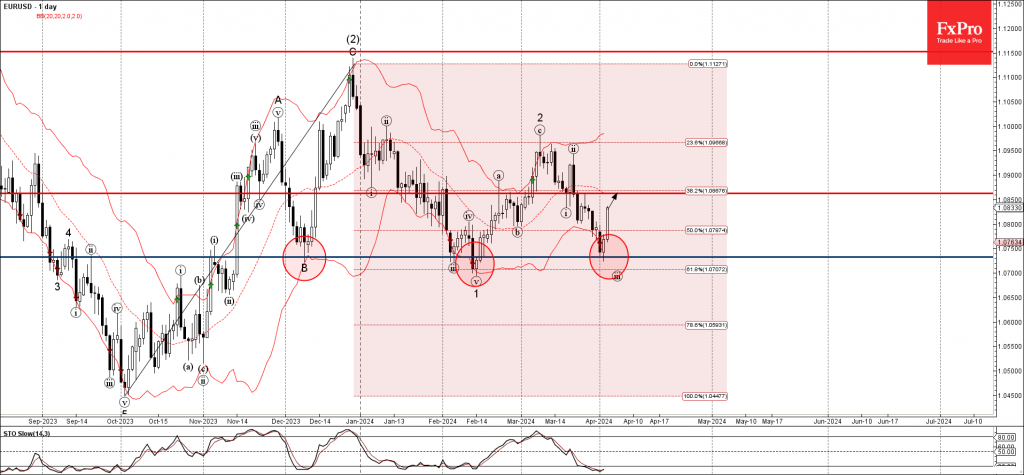
EURUSD Wave Analysis
- EURUSD reversed from key support level 1.0730
- Likely to rise to resistance level 1.0860
EURUSD currency pair recently reversed up from the key support level 1.0730, which has been reversing the pair from the start of December, standing near the lower daily Bollinger Band and the 61.8% Fibonacci correction of the upward impulse from October
The upward reversal from the support level 1.0730 created the daily Japanese candlesticks reversal pattern Piercing Line.
Given the oversold daily Stochastic, EURUSD currency pair can be expected to rise further to the next resistance level 1.0860.