Sample Category Title
Trade of The Week: AUDNZD Trade Breakdown
The Australian Dollar (AUD) rebounds on Monday, despite a slight dip in the US Dollar (USD) and higher US Treasury yields. Investors are eyeing Australian monthly Consumer Price Index (CPI) data for February and US Gross Domestic Product (GDP) for Q4 2023. The AUD gains momentum as the ASX 200 Index rises, especially in mining and energy sectors. Additionally, the Aussie Dollar gets support from a stronger Chinese Yuan (CNY) as the People's Bank of China (PBoC) sets the yuan's mid-rate higher than expected. Meanwhile, the US Dollar Index (DXY) corrects after hitting a five-week high, possibly due to expectations of the Federal Reserve (Fed) easing cycle starting in June. Fed Chair Jerome Powell has downplayed inflation concerns, indicating a cautious approach to policy adjustments.
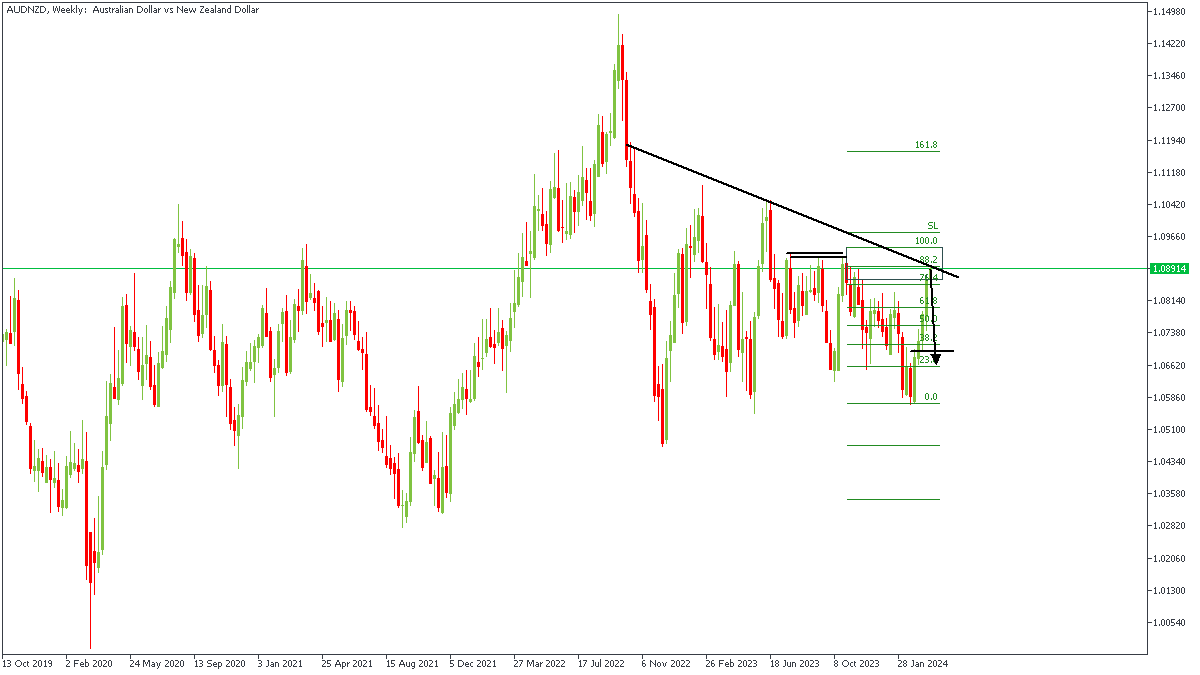
AUDNZD - W1 Timeframe
After breaking below the previous low on the weekly timeframe chart as shown above, we see price climb back up towards the 88% of the Fibonacci retracement; creating a QMR pattern - an even deeper confirmation for a price reversal.
AUDNZD - D1 Timeframe
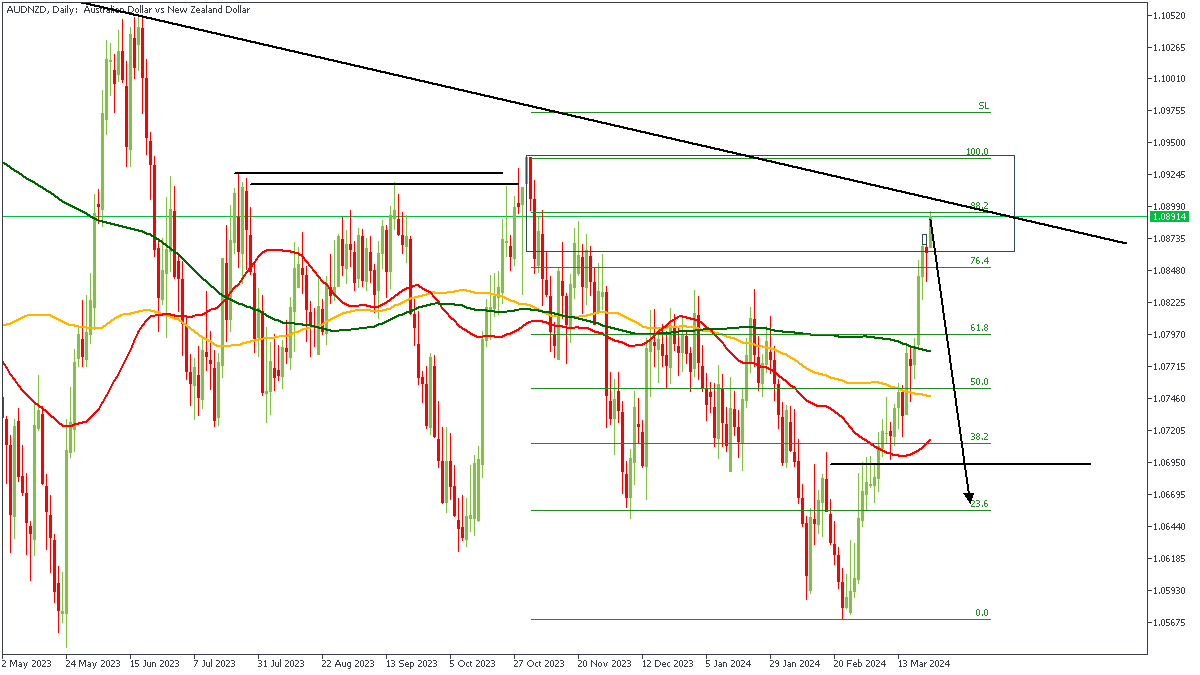
Taking a closer look at the AUDNZD price action from the daily timeframe point of view shows even more clearly the QMR pattern as mentioned earlier. The bearish array of the moving averages indicates the likelihood of price to reverse from the supply zone. The presence of the trendline resistance lends even further confirmation to the bearish sentiment; making it my favourite trade idea of the week.
Analyst’s Expectations:
- Direction: Bearish
- Target: 1.06953
- Invalidation: 1.09432
CONCLUSION
The trading of CFDs comes at a risk. Thus, to succeed, you have to manage risks properly. To avoid costly mistakes while you look to trade these opportunities, be sure to do your due diligence and manage your risk appropriately.
XAUUSD: Markets Slow Down Ahead of NFP
Gold prices rose on Monday as the US Dollar weakened amidst speculation about potential Federal Reserve rate cuts starting in June. This weakened Dollar was partly due to improved risk sentiment pushing US Treasury yields lower. Despite facing challenges from declining yields, gold prices recovered to nearly $2,170 per troy ounce, driven by the Dollar's weakness. Federal Reserve Chair Jerome Powell's remarks suggested that unexpected rises in unemployment could prompt interest rate cuts, reassuring markets concerned about inflation. Traders are closely monitoring upcoming US inflation readings, including GDP data for Q4 2023 and the PCE price index report, for insights into inflationary pressures and potential impacts on gold prices.
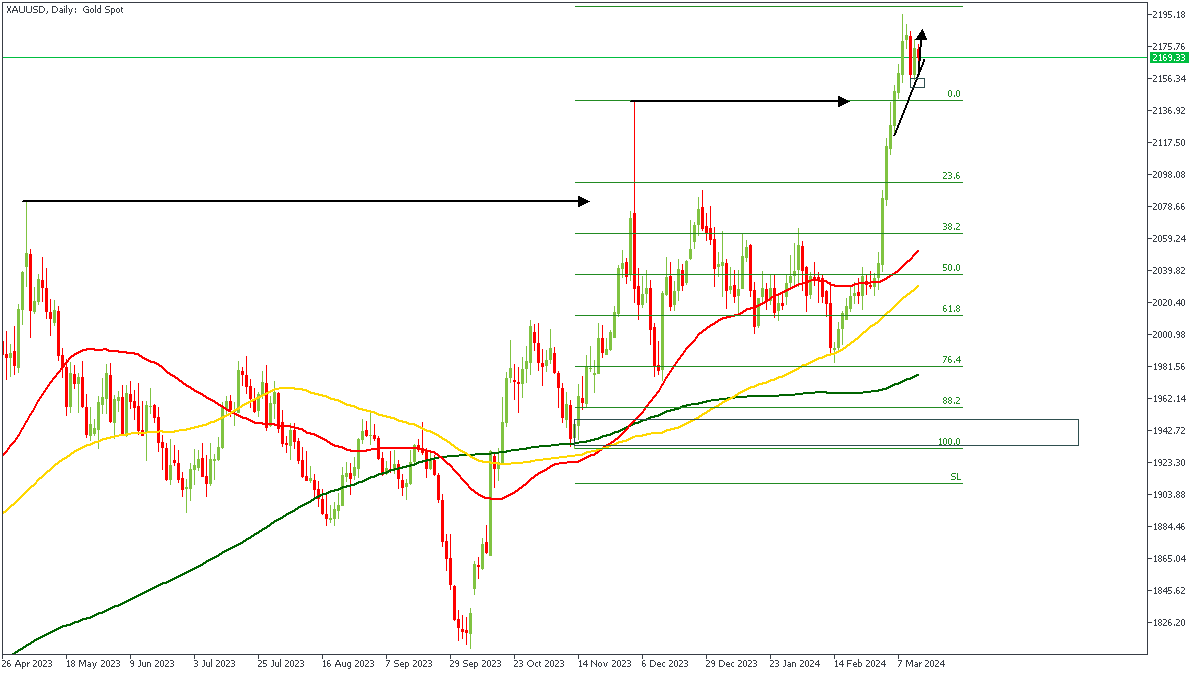
XAUUSD - D1 Timeframe
On the daily timeframe of XAUUSD, we can clearly see that the structure has been broken, with price shooting clear of the previous high. In spite of this, I believe the current price action is gradually slowing down in a search for a crucial pivot zone from which the bullish pressure can resume.
XAUUSD - H4 Timeframe
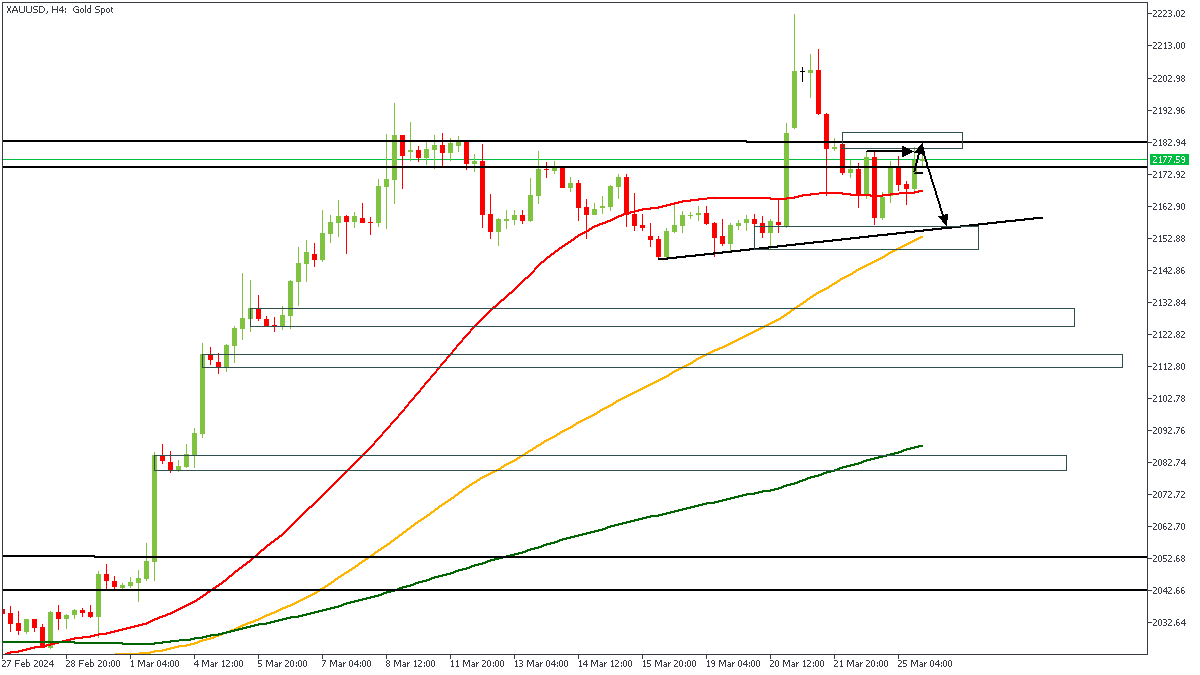
On the 4-hour timeframe, I believe price intends to make a run for the trendline support as well as the demand zone underneath it. The presence of the 100-period moving average also confirms the possibility of price to run towards the point-of-interest. I hope to see the imbalance (Fair Value Gap) get filled before the bullish price action resumes.
Analyst’s Expectations:
- Direction: Bearish
- Target: $2,158.77
- Invalidation: $2,181.53
CONCLUSION
The trading of CFDs comes at a risk. Thus, to succeed, you have to manage risks properly. To avoid costly mistakes while you look to trade these opportunities, be sure to do your due diligence and manage your risk appropriately.
Fed’s Cook: Risks of meeting dual manage more balanced
Fed Governor Lisa Cook pointed out in a speech that risks associated with meeting the dual mandate goals of inflation and employment are "moving into better balance".
She explained that prematurely easing monetary policy might "allow above-target inflation to become entrenched" and eventually require a tighter monetary stance, risking significant employment setbacks. Conversely, delaying policy easing could unnecessarily restrict economic expansion and curtail job opportunities.
Fed’s Goolsbee forecasts three rate cuts amid rising real interest rate restrictiveness
Chicago Fed President Austan Goolsbee told Yahoo Finance that he aligned with the "median" projections regarding the monetary easing path forward, as anticipates three rate cuts within the year.
In this "murky period" of economic recovery as Goolsbee described, Fed has to "strike a balance of the dual mandate". He noted that with inflation rates on a downward path, the real cost of borrowing has inadvertently risen, positioning Fed in "historically pretty restrictive territory."
"So I think with that level of restrictiveness, you will have to start paying attention to the other side of the mandate, too, if it goes for too long," he added.
USDJPY- Bulls Hold Grip for Further Gains after Consolidation
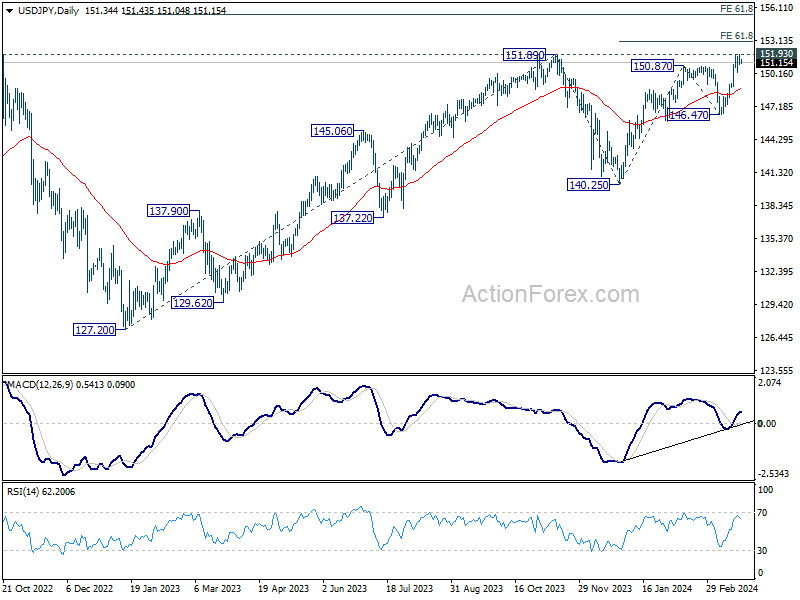
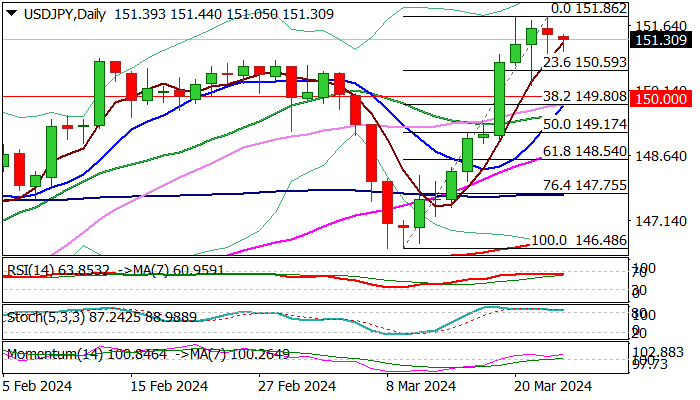
Bulls are taking a breather and consolidating just under key barriers at 150.90/94 (2023/22 tops) after strong rally in past two weeks.
USDJPY was inflated by a wide gap between US and Japan’s interest rates, with no positive impact from BoJ’s rate hike last week, as investors do not expect the central bank to be aggressive with policy tightening.
However, traders remain cautious regarding the latest warning from Japan’s officials that yen is too weak, which keeps possibility of intervention on the table.
Technical studies on daily chart are firmly bullish and supportive for fresh gains, with consolidation / correction on overbought conditions, to precede fresh push higher.
Initial support lays at 150.59 (Fibo 23.6% of 146.48/151.86 upleg, ahead of more significant 150.00/149.80 (psychological / Fibo 38.2%, reinforced by rising 10DMA) where extended dips should find firm ground to keep larger bulls in play and mark a healthy correction ahead of renewed attack at 151.90/94.
Res: 151.90; 151.94; 152.56; 153.00
Sup: 151.00; 150.59; 150.00; 149.80
Sunset Market Commentary
Markets
The yuan’s sharp rebound this morning triggered some attention, if only because other news was so limited today. USD/CNY shot up last Friday on signals that Chinese authorities loosened their grip on the 7.2 handle it defended for several months. Clearly they weren’t expecting nor hoping for such an abrupt move. Such large fluctuations could pose threats to financial stability, tarnishing CNY reputation. The authorities including the PBOC send a clear message through a significantly stronger fixing. USD/CNY declined back to 7.2 before paring losses in European/US dealings again to 7.21. Sticking to the region, Japan’s vice finance minister for international affairs Kanda told reporters that the “current weakening of the yen is not in line with fundamentals and clearly driven by speculation.” Regarding direct interventions, Kanda said they are always prepared. USD/JPY eases to 151.15, but remains just inches away from the multidecade yen-lows of 151.95. It is also as much JPY appreciation as it is USD depreciation. DXY loses a few ticks but remains north of the 104 barrier. EUR/USD rebounded from the low 1.08 towards 1.0836. Sterling tries to build on Friday’s momentum, when a technical leap beyond 0.86 by EUR/GBP failed and triggered some return action lower instead. The currency pair currently eases to 0.8568. GBP/USD bounces of the 1.26 level to 1.264. Central European currencies are generally well bid though they are off their intraday highs. The forint takes center stage this week with the Hungarian central bank (MNB) meeting tomorrow. The Hungarian currency slid ever since the central bank jacked up the cutting pace from 75 to 100 bps and the feud between the government and the MNB escalated. On the latter, it became official today that the government will delay the hotly contested supervision law until the autumn. But with EUR/HUF (396.5) nonetheless moving dangerously close to the 400 symbolical level, we wouldn’t be surprised to see the MNB already revert to 75 bps of rate cuts. Off-bets for a 50 bps move circulate as well.
Core bonds lose some ground at the start of the new week, returning some of Friday’s (outsized) gains. US yields add between 3.6 and 4.4 bps. Atlanta Fed Bostic in a speech today repeated he expects just one rate cut if the economy evolves as expected. Goolsbee from Chicago said he needed to see more progress in inflation coming down. According to him, the main puzzle is in housing. He added that the current dot plot’s suggestion of three cuts this year was in line with his thinking. German Bunds marginally underperform with yields strengthening 3 (30-y) to 5 bps (5-y).
News & Views
The Dutch government this morning announced that last year’s budget deficit was only 0.3% of GDP, in line with the 0.1% of GDP shortfall in 2022. That’s significantly below the 1.8% deficit estimated in November. The government debt ratio declined from 50.1% of GDP to 46.5% which is the lowest level of the past 30 years apart from 2006 (45.2%) and 2007 (43%). On both metrics, the Netherlands easily beat the Maastricht criteria (<3% and <60%), significantly outperforming other EMU countries and bucking the global trend of huge fiscal stimulus. Government spending and government income respectively increased by 8% (to €449.5bn) and 7% (to €445.9bn) in 2023.
The composite Czech consumer & business confidence indicator rose from 90.6 to 94.2 in March, its highest level since May of last year. Both consumer confidence (99.9 from 94; best since October 2021) and business confidence (93 from 89.9) improved. Amongst entrepreneurs, confidence only deteriorated in the construction sector. Consumers sounded less pessimistic on the economy in the next 12 months while the number fearing a deterioration in their financial situation over the same time period did increase significantly. The share of consumers who believe that the current time is not suitable for making major purchases has not changed compared to the previous month.
USD/JPY Drifting at Start of Week
The Japanese yen is showing limited movement on Monday. In the North American session, USD/JPY is trading at 151.25, down 0.13%.
Yen can’t find its footing
Last week’s Bank of Japan was dramatic as the central bank raised interest rates for the first time since 2007. The move did not catch the markets completely by surprise, as some media reports ahead of the meeting said the BoJ would raise rates and investors were looking at both the March and April meetings as strong possibilities for a rate hike.
The yen did not respond to the rate hike with gains, as might have been expected. There are several reasons for this. First, the actual tightening was limited, with rates rising from -0.10% to 0.10%. This means that although the BoJ rate is now in positive territory, the move had little impact on the wide USD/JPY rate differential. BoJ Governor Ueda said after the meeting that despite the hike, monetary policy would remain accommodative, saying that there was “some distance to go” until inflation climbs to the 2% target.
As well, many investors approached the BoJ meeting with a “buy the rumour, sell the fact” approach and this resulted in heavy selling of the yen after the rate announcement. The yen slipped 1.60% last week and dropped as low as 151.86, its lowest level since November 2023.
The Japanese yen has dropped to levels that could invite intervention – the Ministry of Finance intervened last September and October when the yen dropped to around the 152 line. If the yen continues to lose ground, the threat of intervention will become greater.
In the US, the markets have priced in three rate cuts this year, and the Fed also projected three cuts this year at last week’s meeting. However, Atlanta Federal Reserve President Raphael Bostic sounded hawkish on Friday when he said that he expects only one quarter-point cut this year.
Bostic said that he was “definitely less confident than I was in December” that inflation will continue to drop towards the 2% target, as he noted that inflation remains stubbornly high and the US economy has been more resilient than he expected.
USD/JPY Technical
- USD/JPY is putting pressure on resistance at 151.44. Above, there is resistance at 151.88
- 151.02 and 15058 are providing support
Gold’s Prospects Look Promising
Gold prices have stabilized around $2170.00 per troy ounce after two days of decline. Investors are taking a pause ahead of an important US inflation indicator report due this week, which could provide insights into the future direction of the Federal Reserve's monetary policy.
The Core PCE index data, an inflation measure closely watched by the Federal Reserve, will be released this Friday. This week, several Federal Reserve officials, including Chair Jerome Powell, will speak at various events, potentially influencing market reactions. Additionally, most markets in Catholic countries will be closed on Good Friday at the week's end, possibly delaying market reactions.
Strategically, gold has gained solid support after the Federal Reserve's March meeting outlined three interest rate cuts for the current year. Support also came from the Swiss National Bank, which unexpectedly reduced its lending rate, sparking discussions that other major central banks might ease monetary policy sooner than expected - even before the Fed. For gold, this is a positive signal: lower interest rates reduce the opportunity cost of holding bullion.
The probability of the Fed starting to cut rates in June is estimated at 74%.
COMEX data shows that net long positions in gold have decreased by 2,093 contracts to 157,467 contracts, which is not critical for the precious metal's trend.
Technical analysis of XAU/USD
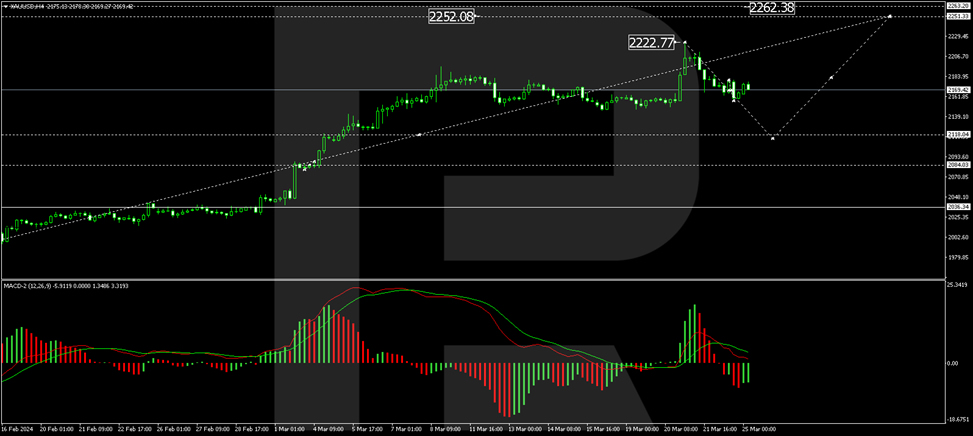
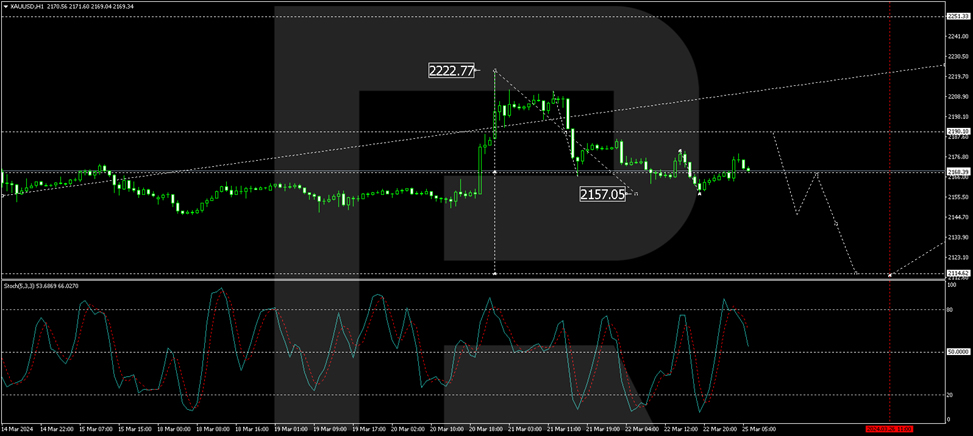
On the H4 chart, XAU/USD reached a local target of 2222.77. A correction to the level of 2157.05 has been executed today. Currently, the market is forming a consolidation range around 2168.40. A downward breakout is expected, followed by a continuation of the correction to 2114.60. After completing this correction, a growth wave to 2251.33 is anticipated. This scenario is supported by the MACD indicator, with its signal line above zero and sharply directed downwards.
On the H1 chart, XAU/USD has formed a consolidation range around 2168.40. An upward exit from this range could lead to a correction towards 2188.77. After reaching this level, a decline to 2146.66 will be considered, followed by the possibility of rising back to 2168.40 (testing from below) and then a decline to 2114.60. This scenario is confirmed by the Stochastic oscillator, with its signal line below 80 and heading straight down to 20.
USD/JPY Mid-Day Outlook
Daily Pivots: (S1) 151.02; (P) 151.44; (R1) 151.88; More...
USD/JPY is still extending the consolidation from 151.92 and intraday bias stays neutral. Further rally is expected as long as 150.25 support holds. On the upside, decisive break of 151.93 key resistance will confirm long term up trend resumption. Next near term target will be 61.8% projection of 140.25 to 150.87 from 146.47 at 153.03. However, firm break of 150.25 will turn bias back to the downside for deeper pullback.
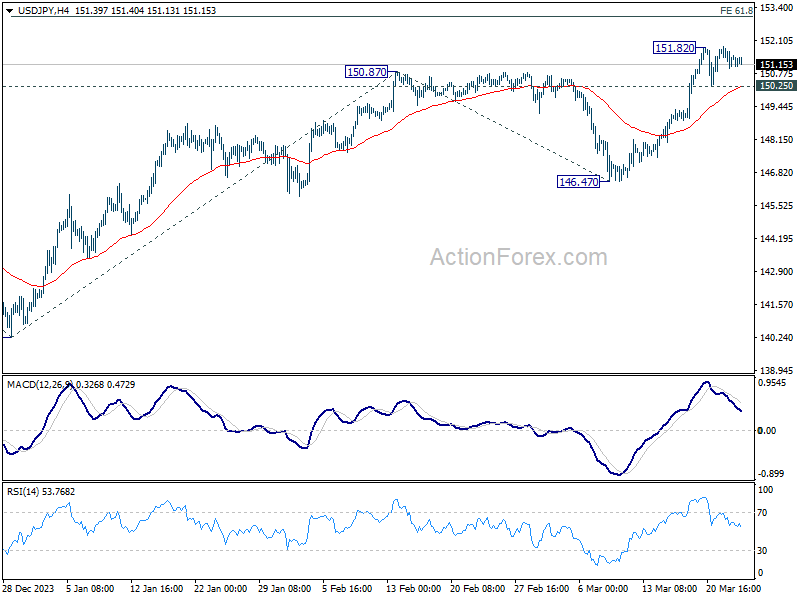
In the bigger picture, correction from 151.87 (2023) high could have completed at 140.25 already. Rise from 127.20 (2023 low), as part of the long term up trend, is probably ready to resume. Decisive break of 151.93 resistance (2022 high) will confirm this bullish case. Next medium term target will be 61.8% projection of 127.20 to 151.89 from 140.25 at 155.20. This will remain the favored case as long as 146.47 support holds, in case of another pullback.