

Sample Category Title
USD/CAD Daily Outlook
Daily Pivots: (S1) 1.3546; (P) 1.3580; (R1) 1.3640; More...
Focus stays on 1.612 resistance in USD/CAD. Decisive break there will resume whole rise from 1.3176 towards 1.3897 resistance. On the downside, firm break of 1.3419 support will argue that rebound from 1.3176 has completed. Near term outlook will be turned bearish for 1.3357 support first.
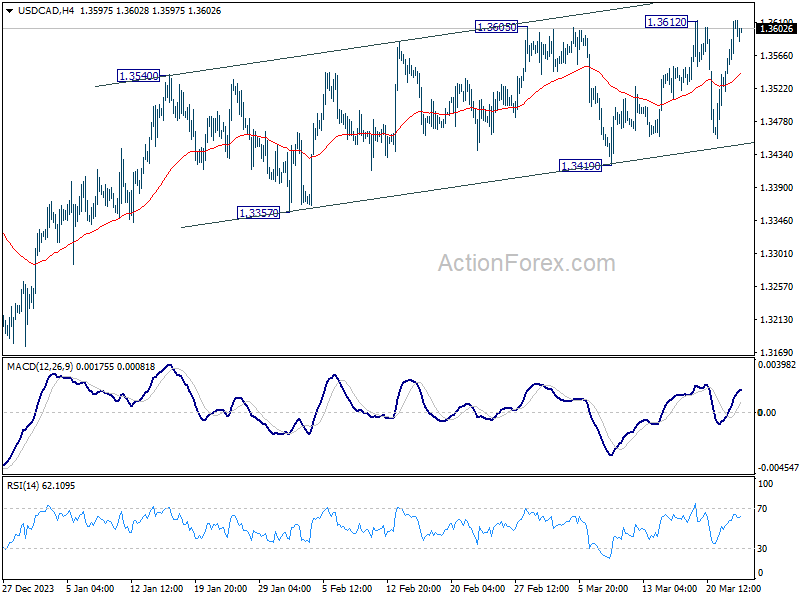
In the bigger picture, price actions from 1.3976 (2022 high) are viewed as a corrective pattern only. In case of another fall, strong support should emerge above 1.2947 resistance turned support to bring rebound. Overall, larger up trend from 1.2005 (2021 low) is still expected to resume through 1.3976 at a later stage.
AUD/USD Daily Report
Daily Pivots: (S1) 0.6490; (P) 0.6534; (R1) 0.6558; More....
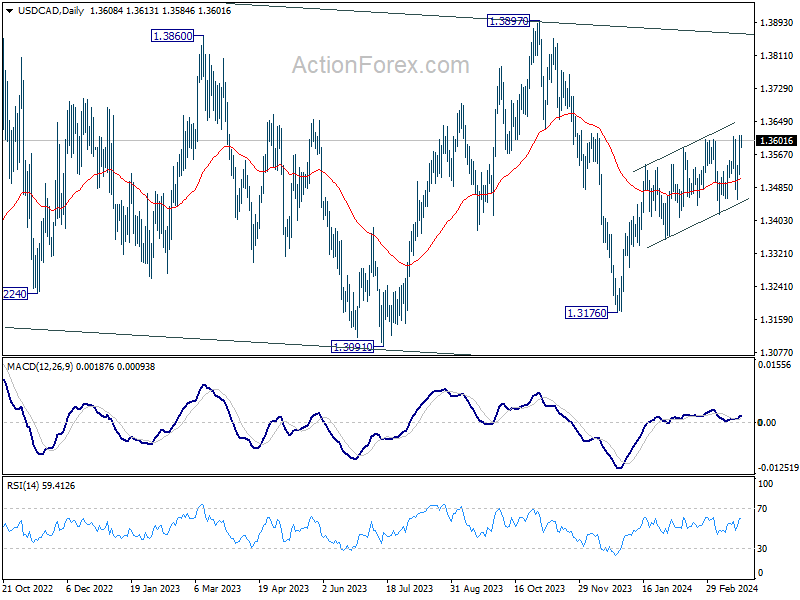
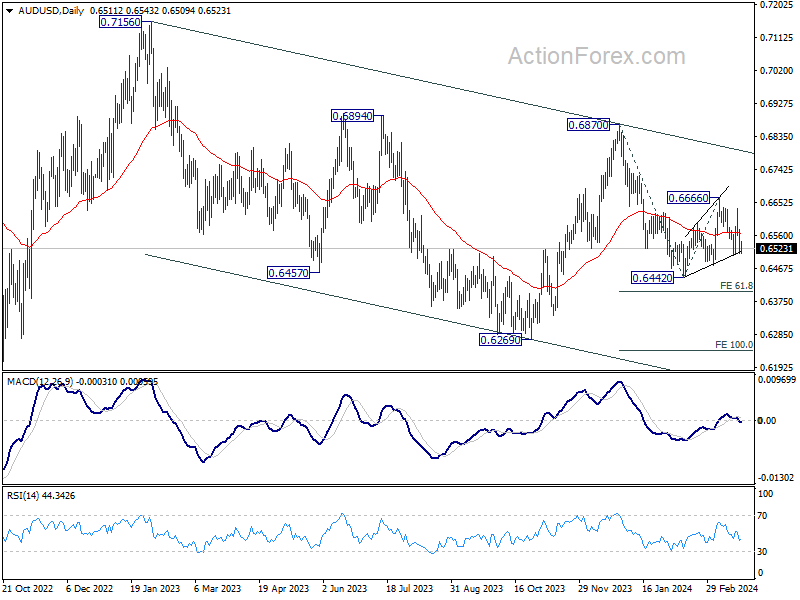
Focus stays on 0.6503 support in AUD/USD. Decisive break there will indicate that larger fall from 0.6870 is ready to resume, and turn bias to the downside for 0.6442 low. For now, risk will stay on the downside as long as 0.6633 resistance holds, in case of recovery.
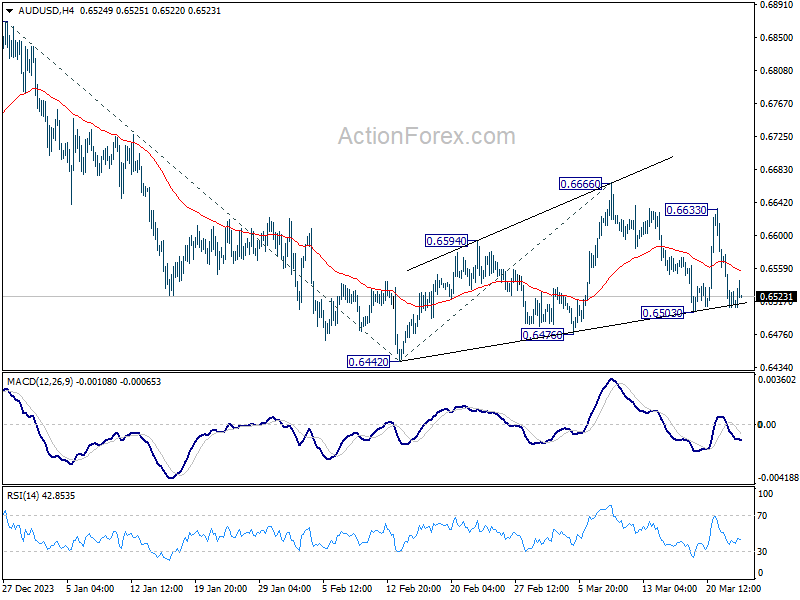
In the bigger picture, price actions from 0.6169 (2022 low) are seen as a medium term corrective pattern to the down trend from 0.8006 (2021 high). Fall from 0.7156 (2023 high) is seen as the second leg, which might still be in progress. Overall, sideway trading could continue in range of 0.6169/7156 for some more time. But as long as 0.7156 holds, an eventual downside breakout would be mildly in favor.
EUR/USD Daily Outlook
Daily Pivots: (S1) 1.0784; (P) 1.0826; (R1) 1.0850; More...
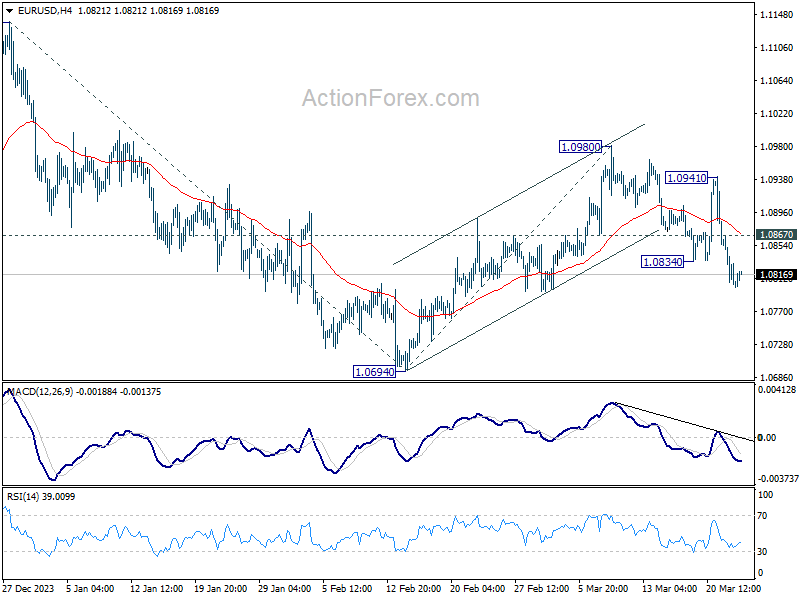
Intraday bias in EUR/USD stays on the downside at this point. Rebound from 1.0694 should have completed at 1.0980. Deeper fall would be seen to retest this low first. Break there will resume the decline from 1.1138 and target 100% projection of 1.1138 to 1.0694 from 1.0980 at 1.0536. On the upside, above 1.0867 minor resistance will turn intraday bias neutral first. But risk will stay on the downside as long as 1.0941 resistance holds.
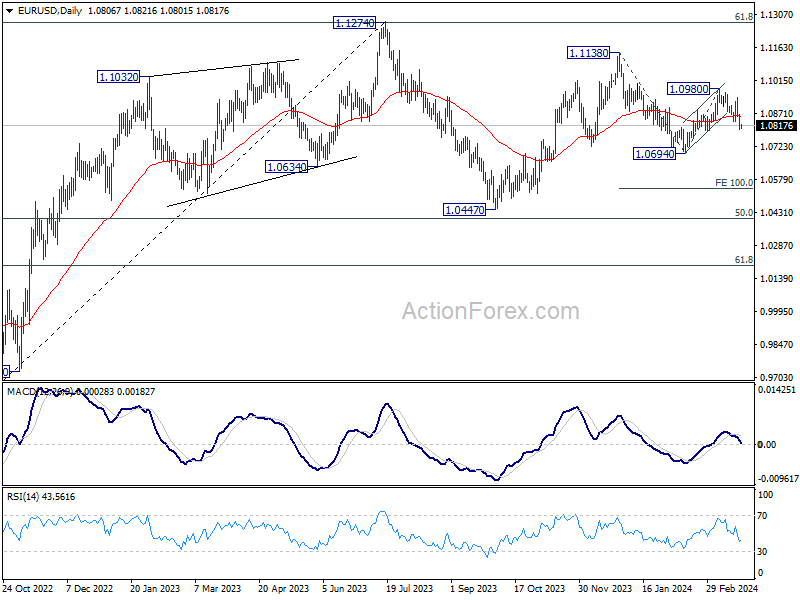
In the bigger picture, price actions from 1.1274 are viewed as a corrective pattern to rise from 0.9534 (2022 low). Rise from 1.0447 is seen as the second leg. While further rally could cannot be ruled out, upside should be limited by 1.1274 to bring the third leg of the pattern. Meanwhile, sustained break of 1.0694 support will argue that the third leg has already started for 1.0447 and possibly below.
GBP/USD Daily Outlook
Daily Pivots: (S1) 1.2558; (P) 1.2617; (R1) 1.2658; More...
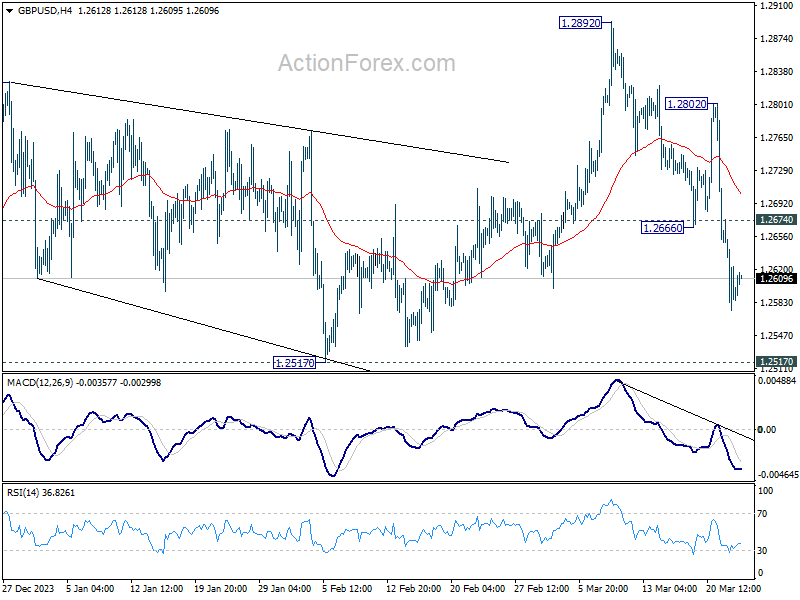
Intraday bias in GBP/USD remains on the downside for 1.2517 structural support. Decisive break there will suggest that rise from 1.2036 has completed at 1.2892 already, and turn near term outlook bearish. On the upside, above 1.2674 minor resistance will turn intraday bias neutral first.
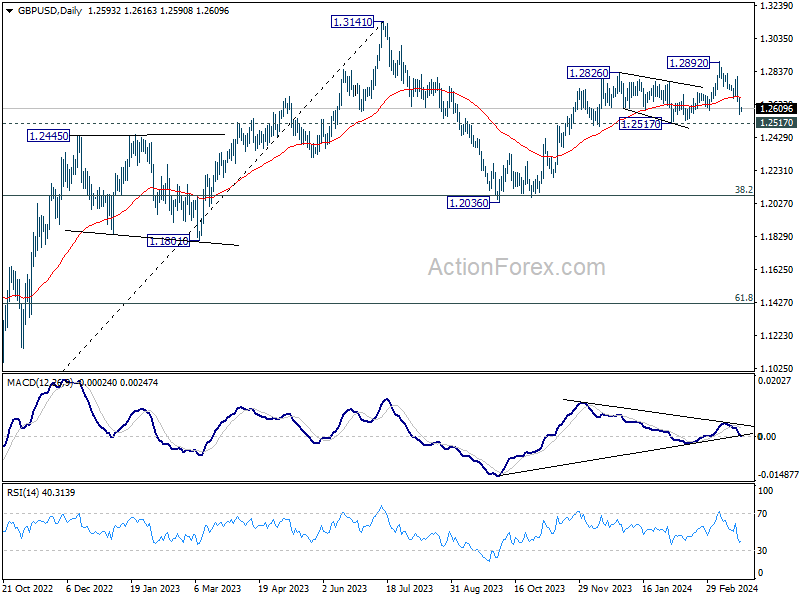
In the bigger picture, price actions from 1.3141 medium term top are seen as a corrective pattern to up trend from 1.0351 (2022 low). Rise from 1.2036 is seen as the second leg, which might still be in progress. But upside should be limited by 1.3141 to bring the third leg of the pattern. Meanwhile, break of 1.2517 support will argue that the third leg has already started for 38.2% retracement of 1.0351 (2022 low) to 1.3141 at 1.2075 again.
USD/JPY Daily Outlook
Daily Pivots: (S1) 151.02; (P) 151.44; (R1) 151.88; More...
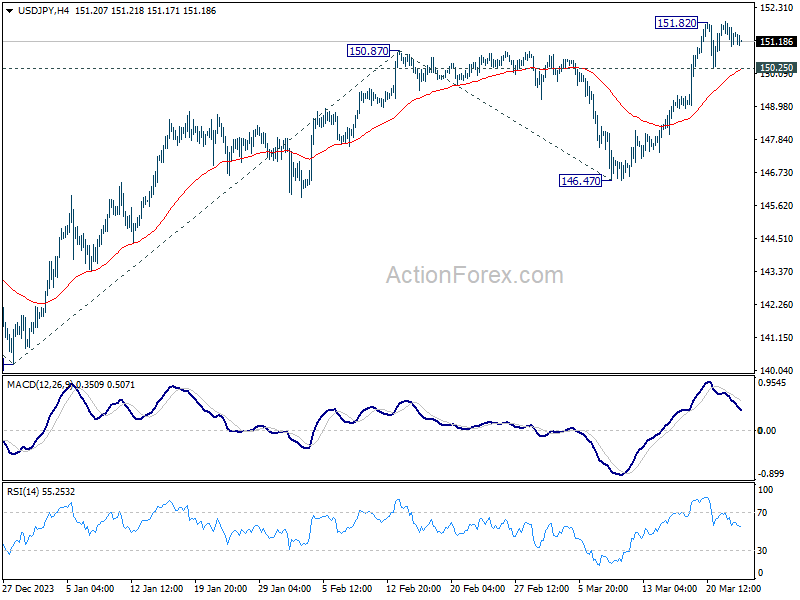
Intraday bias in USD/JPY remains neutral as consolidation from 151.92 is extending. Further rally is expected as long as 150.25 support holds. On the upside, decisive break of 151.93 key resistance will confirm long term up trend resumption. Next near term target will be 61.8% projection of 140.25 to 150.87 from 146.47 at 153.03. However, firm break of 150.25 will turn bias back to the downside for deeper pullback.
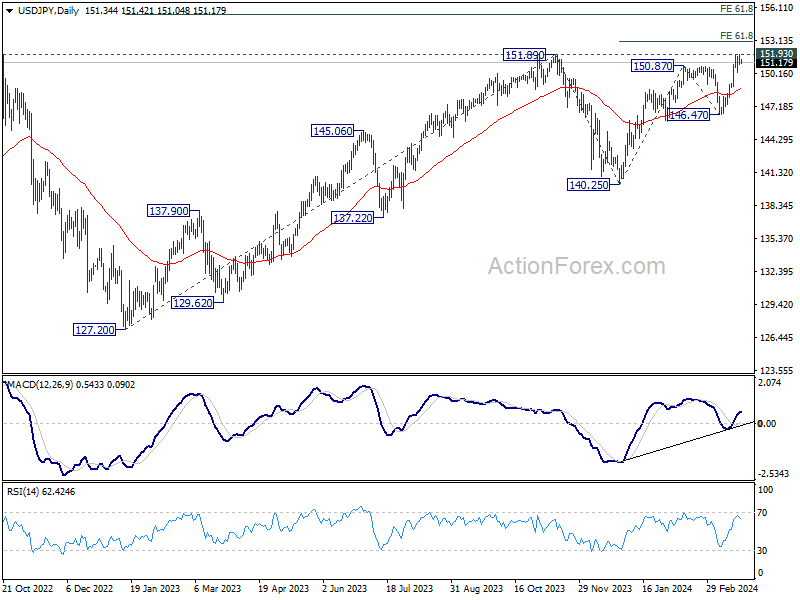
In the bigger picture, correction from 151.87 (2023) high could have completed at 140.25 already. Rise from 127.20 (2023 low), as part of the long term up trend, is probably ready to resume. Decisive break of 151.93 resistance (2022 high) will confirm this bullish case. Next medium term target will be 61.8% projection of 127.20 to 151.89 from 140.25 at 155.20. This will remain the favored case as long as 146.47 support holds, in case of another pullback.
USD/CHF Daily Outlook
Daily Pivots: (S1) 0.8953; (P) 0.8987; (R1) 0.9009; More....
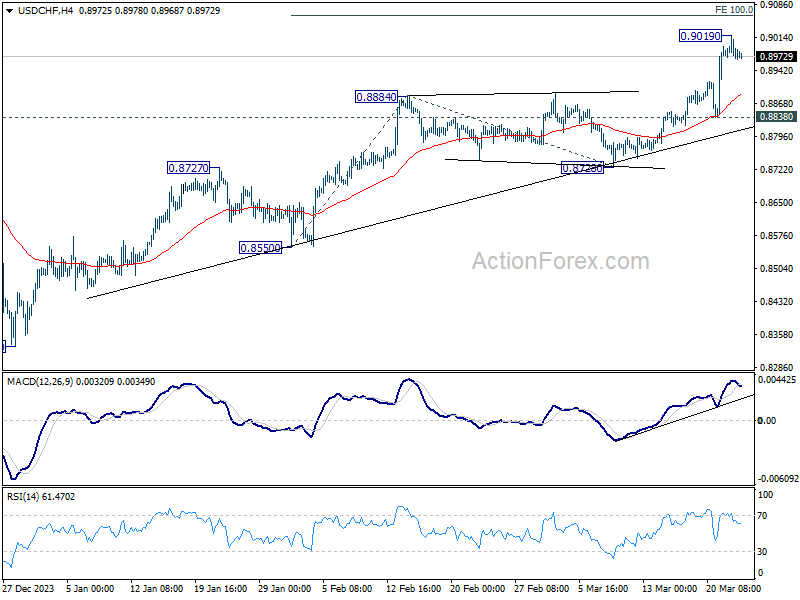
Intraday bias in USD/CHF is turned neutral with 4H MACD crossed below signal line. Some consolidations would be seen below 0.9019 temporary top first. But downside of retreat should be contained above 0.8838 support to bring rebound. Break of 0.9019 will resume larger rally from 0.8332. Next target is 100% projection projection of 0.8550 to 0.8884 from 0.8728 at 0.9062.
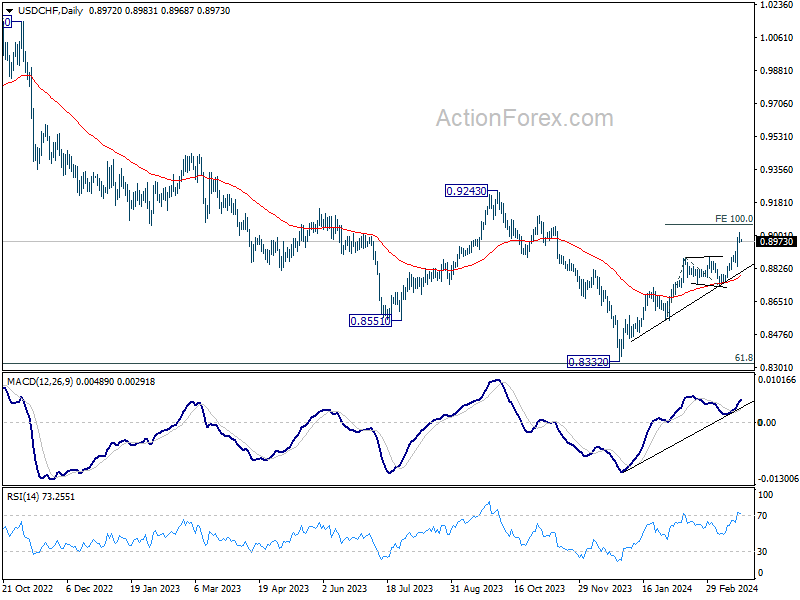
In the bigger picture, price actions from 0.8332 medium term bottom as tentatively seen as developing into a corrective pattern to the down trend from 1.0146 (2022 high). Further rise would be seen as long as 0.8728 support holds. But upside should be limited by 0.9243 resistance, at least on first attempt.
Light Week Ahead with Dollar Rally Awaiting PCE Inflation Insights
The forex markets display a calm demeanor in the Asian session, with most major pairs and crosses gyrating in very tight ranges. Australian Dollar finds modest support from the state orchestrated rebound in Chinese Yuan. However, this lift hasn't translated into clear momentum for an extended rally in Aussie.
Meanwhile, Yen continues to pare back its recent losses. The release of BoJ's minutes from its January meeting stirred little reaction among traders, as the market's focus is keenly set on the upcoming summary of opinions from last week's pivot meeting instead, expected to be released on Thursday.
Dollar's recent rally is on pause, awaiting US PCE inflation data as a potential volatility trigger. Surprises in this data could lead Fed policymakers to recalibrate their projections on the timing and number of rate cuts this year. Atlanta Fed President Raphael Bostic is an example of FOMC member that shifted stance. He revised his expectations to just one rate cut for the year, likely occurring later than initially anticipated.
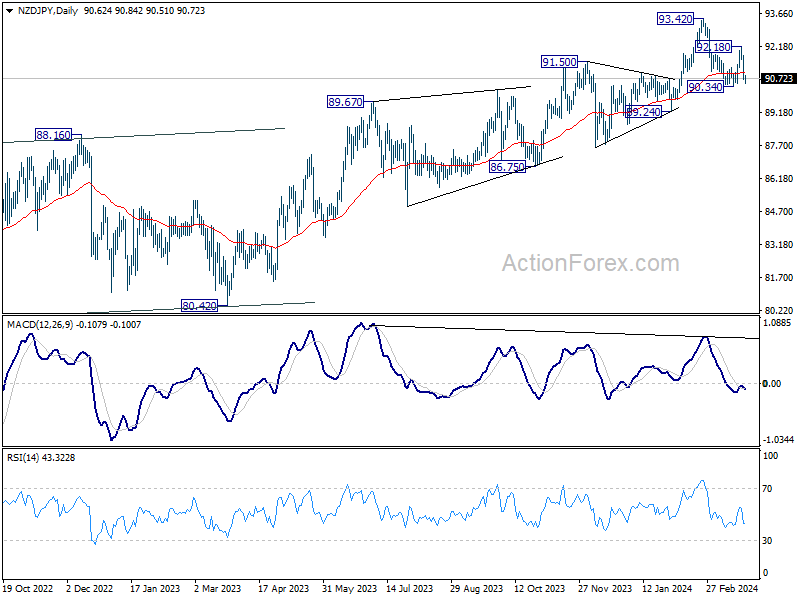
As March progresses, the competition to be labeled the month's worst performer is between Japanese Yen, Swiss Franc, and New Zealand Dollar. Technically, NZD/JPY's has now nearly reversed all of the rebound from 90.34 to 92.18. Break of 90.24 will resume the fall from 93.42 to 89.24 support. Firm break there will argue that it's already in a larger scale correction to up trend from 80.42.
In Asia, at the time of writing, Nikkei is down -0.62%. Hong Kong HSI is up 0.51%. China Shanghai SSE is up 0.48%. Singapore Strait Times is down -0.21%. Japan 10-year JGB yield is down -0.0115 at 0.732.
BoJ Jan minutes: No need for aggressive tightening like Western counterparts
BoJ's minutes from January meeting, ahead of the landmark March decision to end negative interest rates, reveal a cautious approach towards monetary policy adjustments. Members highlighted the Japan's economic conditions "differed significantly" to those of US and Europe when they initiated interest rate hikes a few years ago. The consensus was clear: it was "not required in Japan to conduct rapid monetary tightening" as seen in Western economies.
Further discussions underscored three primary risks to Japan's economic activity: shifts in global economic performance and financial markets, fluctuations in commodity and grain import prices, and future growth expectations of firms and households.
Members agreed these factors could significantly influence economic outcomes and emphasized the need for vigilance towards price-setting behaviors within the economy, as well as the impact of currency and commodity price movements on domestic inflation.
Yuan rebounds on PBoC's aggressive fixing and state-owned banks' support
Chinese Yuan rebounded significantly in Asian session, sparked by PBoC's unexpectedly strong daily fixing. The fixing was set at 7.0996, markedly stronger than the anticipated 7.2222 by analysts, marking the largest strengthening bias since November. Also, reports suggest that state-owned banks actively participated in selling Dollars onshore, further tightening offshore Yuan liquidity.
Economists interpret this orchestrated maneuver as a decisive message from PBoC, indicating a refusal to tolerate further weakening of Yuan. This action seems to correct what the authorities considered an overreaction by the market to last Friday's sharp decline. The market's speculation on Yuan depreciation appeared to be challenged by today's fixing, aimed at recalibrating market perceptions.
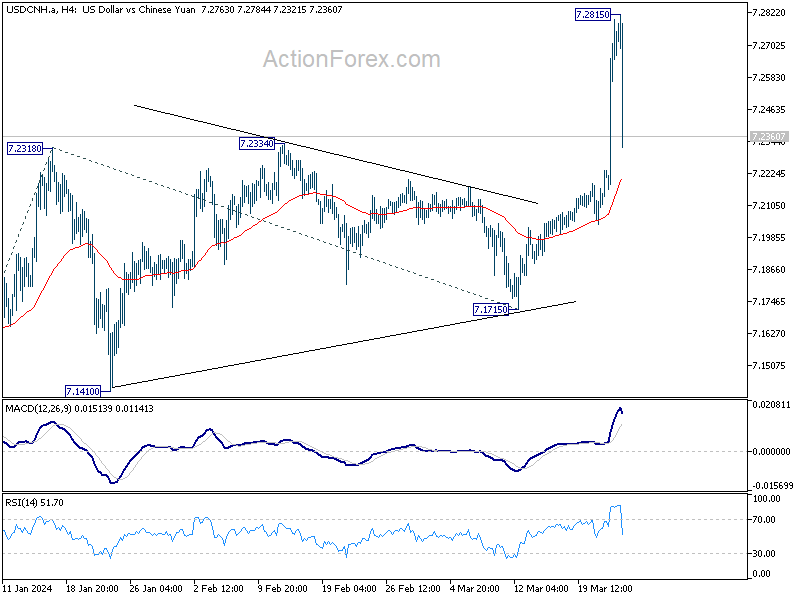
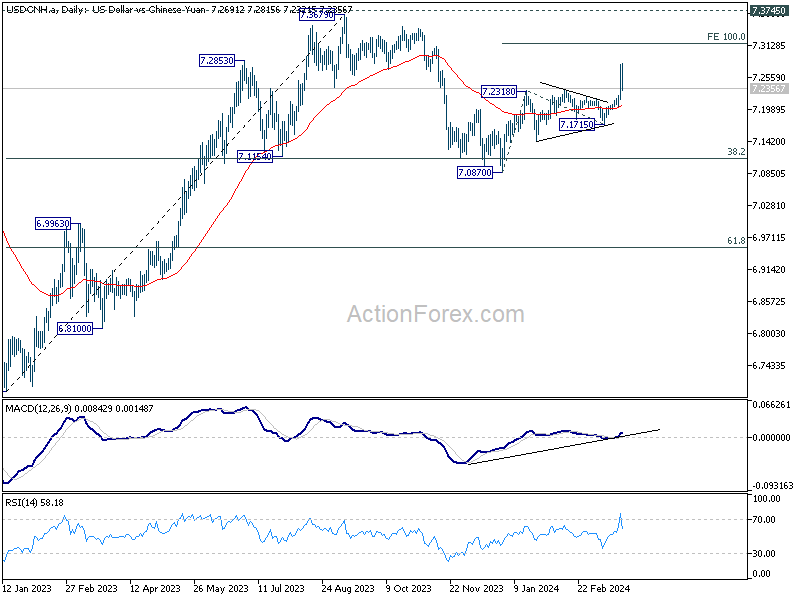
From a pure technical perspective, USD/CNH's rise from 0.7087 is seen as the second leg of the corrective pattern from 7.3679 for now, which is still in progress. FUrther rally is expected as long as 55 D EMA (now at 7.2056) holds. Next target is 100% projection of 7.0870 to 7.2318 from 7.1715 at 7.3163. But break of 7.3679 high is not envisaged.
However, these technical observations stand independent of the significant influence of PBoC's interventions in the currency market.
US PCE inflation and BoJ opinions to highlight a relatively light week
While economic calendar may seem less packed this week, certain events stand out with potential market-moving implications. Among the highlights, US PCE inflation data stands out as a key point of interest, especially in light of Fed's recent projections, which showed a nearly even split among members (9 vs 10) regarding the outlook for two versus three rate cuts this year. Hence, any data surpassing expectations could pivot the scale towards fewer cuts. Additional economic indicators to watch include consumer confidence and durable goods orders.
Internationally, summary of opinions from BoJ's recent groundbreaking meeting—where it raised interest rate to 0-0.10% and terminated Yield Curve Control—is eagerly awaited. This document is expected to offer a deeper understanding of the rationale and discussions behind the decision. It might also drop some hints on the likelihood of further tightening within the year. Tokyo Consumer Price Index (CPI) will also be under scrutiny, serving as a critical gauge for future BoJ actions.
Other significant data releases this week include the Swiss KOF economic barometer, Canada's monthly GDP figures, Australia's monthly CPI and retail sales reports, and New Zealand's ANZ business confidence index.
New Zealand ANZ business confidence
- Monday: BoJ minutes: US new home sales.
- Tuesday: Australia Westpac consumer sentiment; Japan corporate services price; Germany Gfk consumer sentiment; US durable goods orders, house price index, consumer confidence.
- Wednesday: Australia monthly CPI; Swiss Credit Suisse economic expectations.
- Thursday: BoJ summary of opinions; New Zealand ANZ business confidence; Australia retail sales; Germany retail sales; UK Q4 GDP final; Swiss KOF economic barometer; Canada GDP; US Q4 GDP final, jobless claims, Chicago PMI.
- Friday: Japan Tokyo CPI, unemployment rate, industrial production, retail sales; France consumer spending; US personal income and spending, PCE inflation, goods trade balance.
USD/CHF Daily Outlook
Daily Pivots: (S1) 0.8953; (P) 0.8987; (R1) 0.9009; More....
Intraday bias in USD/CHF is turned neutral with 4H MACD crossed below signal line. Some consolidations would be seen below 0.9019 temporary top first. But downside of retreat should be contained above 0.8838 support to bring rebound. Break of 0.9019 will resume larger rally from 0.8332. Next target is 100% projection projection of 0.8550 to 0.8884 from 0.8728 at 0.9062.
In the bigger picture, price actions from 0.8332 medium term bottom as tentatively seen as developing into a corrective pattern to the down trend from 1.0146 (2022 high). Further rise would be seen as long as 0.8728 support holds. But upside should be limited by 0.9243 resistance, at least on first attempt.
Economic Indicators Update
| GMT | Ccy | Events | Actual | Forecast | Previous | Revised |
|---|---|---|---|---|---|---|
| 23:50 | JPY | BoJ Minutes | ||||
| 14:00 | USD | New Home Sales Feb | 675K | 661K |
Yuan rebounds on PBoC’s aggressive fixing and state-owned banks’ support
Chinese Yuan rebounded significantly in Asian session, sparked by PBoC's unexpectedly strong daily fixing. The fixing was set at 7.0996, markedly stronger than the anticipated 7.2222 by analysts, marking the largest strengthening bias since November. Also, reports suggest that state-owned banks actively participated in selling Dollars onshore, further tightening offshore Yuan liquidity.
Economists interpret this orchestrated maneuver as a decisive message from PBoC, indicating a refusal to tolerate further weakening of Yuan. This action seems to correct what the authorities considered an overreaction by the market to last Friday's sharp decline. The market's speculation on Yuan depreciation appeared to be challenged by today's fixing, aimed at recalibrating market perceptions.
From a pure technical perspective, USD/CNH's rise from 0.7087 is seen as the second leg of the corrective pattern from 7.3679 for now, which is still in progress. FUrther rally is expected as long as 55 D EMA (now at 7.2056) holds. Next target is 100% projection of 7.0870 to 7.2318 from 7.1715 at 7.3163. But break of 7.3679 high is not envisaged.
However, these technical observations stand independent of the significant influence of PBoC's interventions in the currency market.
BoJ Jan minutes: No need for aggressive tightening like Western counterparts
BoJ's minutes from January meeting, ahead of the landmark March decision to end negative interest rates, reveal a cautious approach towards monetary policy adjustments. Members highlighted the Japan's economic conditions "differed significantly" to those of US and Europe when they initiated interest rate hikes a few years ago. The consensus was clear: it was "not required in Japan to conduct rapid monetary tightening" as seen in Western economies.
Further discussions underscored three primary risks to Japan's economic activity: shifts in global economic performance and financial markets, fluctuations in commodity and grain import prices, and future growth expectations of firms and households.
Members agreed these factors could significantly influence economic outcomes and emphasized the need for vigilance towards price-setting behaviors within the economy, as well as the impact of currency and commodity price movements on domestic inflation.
EUR/USD At Risk of Downside Break To 1.0650
Key Highlights
- EUR/USD started a fresh decline from the 1.0950 resistance zone.
- It traded below a key contracting triangle with support at 1.0840 on the 4-hour chart.
- GBP/USD declined heavily below the 1.2750 support.
- Gold prices are consolidating gains above the $2,120 level.
EUR/USD Technical Analysis
The Euro failed to continue higher above the 1.0950 resistance against the US Dollar. EUR/USD traded below the 1.0880 support to enter a bearish zone.
Looking at the 4-hour chart, the pair traded below a key contracting triangle with support at 1.0840. It settled below the 1.0850 level, the 100 simple moving average (red, 4-hour), and the 200 simple moving average (green, 4-hour).
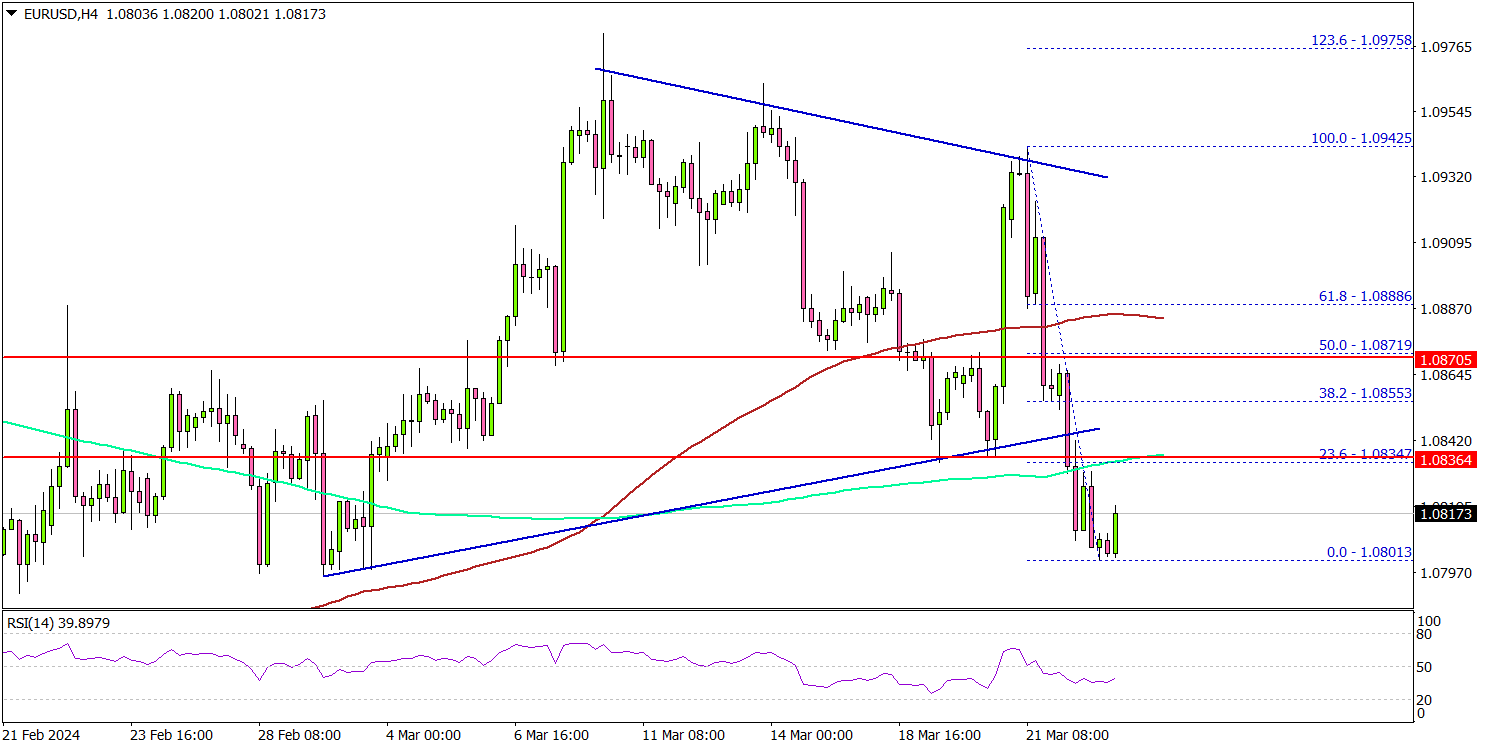
It tested the 1.0800 zone and remains at risk of more downsides in the near term. On the upside, the pair could face resistance near the 1.0835 level. The first major resistance is now forming near 1.0850.
A close above the 1.0850 zone could open the doors for more upsides. The next stop for the bulls might be 1.0920. If not, the pair might continue to decline. Immediate support is near the 1.0800 level.
The next major support is at 1.0780. If there is a downside break below the 1.0780 support, the pair could decline toward the 1.0750 support. Any more losses might send the pair toward the 1.0650 level in the near term.
Looking at Gold, the bulls pushed the price above the $2,200 zone before there was a downside correction and consolidation near $2,150.
Economic Releases
- US New Home Sales for Feb 2024 (YoY) - Forecast +0.3%, versus +1.5% previous.