Sample Category Title
Gold’s Retreat Not Yet a Reversal
The Fed’s comments led to a 3% rise in gold, but the dollar’s recovery in the second half of Thursday reduced this gain to just 0.5%. Technically, the outlook is unclear, but fundamentally, things are still on the side of the bulls.
In early trading on Thursday, gold slipped to $2222 on thin liquidity and the triggering of stop orders, which washed short positions out of the market. Throughout the day on Thursday, a stabilisation above $2200 looked attractive for many to take money off the table.
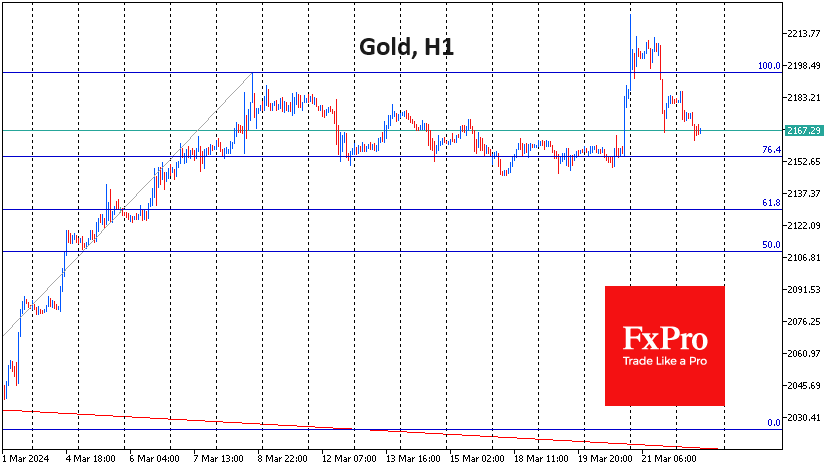
The technical analysis so far gives a mixed picture on the daily timeframes.
On the bullish side, gold’s ability to break above previous highs confirmed the Fibonacci extension scenario to 2300 (161.8% of the rally in the last days of February) after a corrective consolidation of 76.4%. The ability to make new highs after a pause is also a bullish signal.
On the bearish side, fatigue after the rise is temporarily evident: the price update of the highs has not been confirmed by the RSI. Moreover, the index left the overbought territory (>70) in the first half of Friday’s trading.
Cautious traders may want to wait for a break above the $2155-2190 area, as the chances of further movement in the direction of the break are higher.
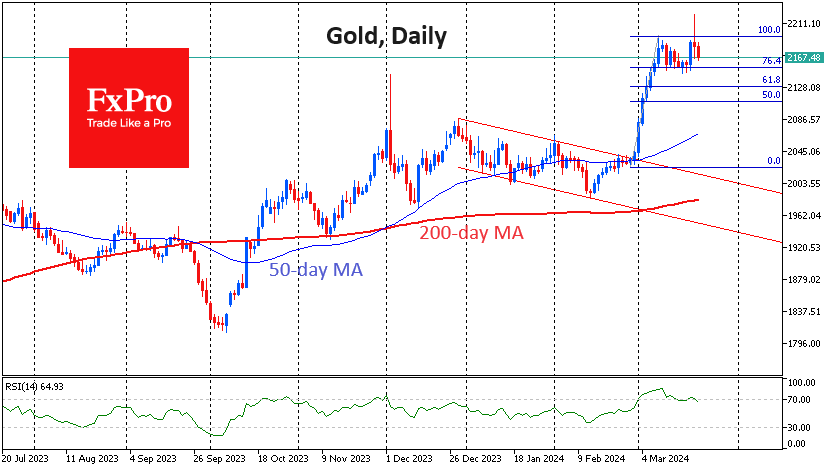
In our view, gold’s failure on Thursday and the first half of Friday does not look like a reversal, as the push into the dollar in recent hours is the result of speculation that other central banks will be even softer than the Fed. This is a supportive environment for risk assets, including gold. Still, the impressive rally in gold since the second half of February and the recent surge have left the market somewhat overheated and in need of a pause.
ECB’s Nagel: June cut increasingly likely, but no automatism afterwards
In a webcast today, ECB Governing Council member Joachim Nagel indicated that the chance is increasing for a first rate cut "before the summer break" in August. However, he cautioned that afterwards, ECB will maintain a data-dependent approach and policy loosening wouldn't be on autopilot.
"I do not see that there is a kind of automatism," he remarked. "It is data dependent and it is not a done deal that everything is going smoothly for the rest of the year or maybe for next year. So we have to be vigilant, we have to be cautious."
The ECB official flagged several "open issues" that warrant cautions, including the volatility in energy prices and the ongoing uncertainties surrounding wage growth and profit margins. "This meeting-to-meeting approach is the best way to address the current situation," he added.
XAU/USD: Gold Eases from New Record High
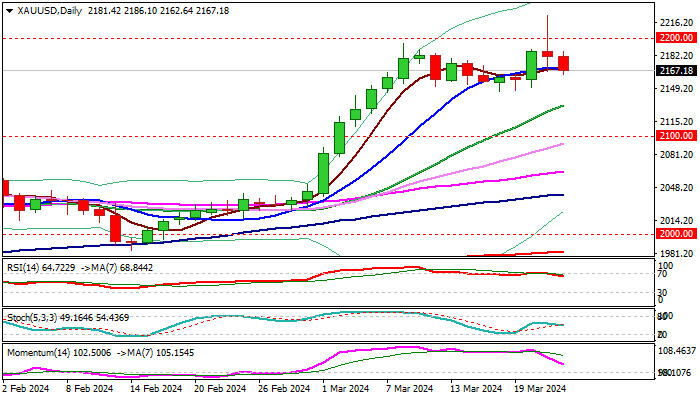
Gold price eases further on Friday, extending pullback from new record high $2222 (posted on Thursday) after a strong upside rejection on probe above psychological $2200 barrier.
The yellow metal came under increased pressure from stronger dollar after Fed kept the policy unchanged and signaled that high borrowing cost may stay elevated as the US economy is in good condition, which cooled talks about rate cuts from June.
However, the US central bank remains on track towards policy easing this year, which will continue to underpin gold price in the longer run.
Significant supports at $2146/41 (this week’s low / former record high of Dec 4) are exposed and should ideally contain and keep the price action within limited consolidation range, guarding lower pivot at $2131 (Fibo 38.2% of $1984/$2222, reinforced by rising 20DMA), where extended dips should find firm ground to mark a healthy correction of a larger rally from $1984).
Technical picture is mixed on daily chart as MA’s are in bullish setup, but momentum and RSI indicators are heading south after diverging from the price action in earlier sessions, which requires caution.
Res: 2186; 2200; 2222; 2250.
Sup: 2160; 2146; 2141; 2131.
Pound Drops to 1-Month Low After Flat Retail Sales
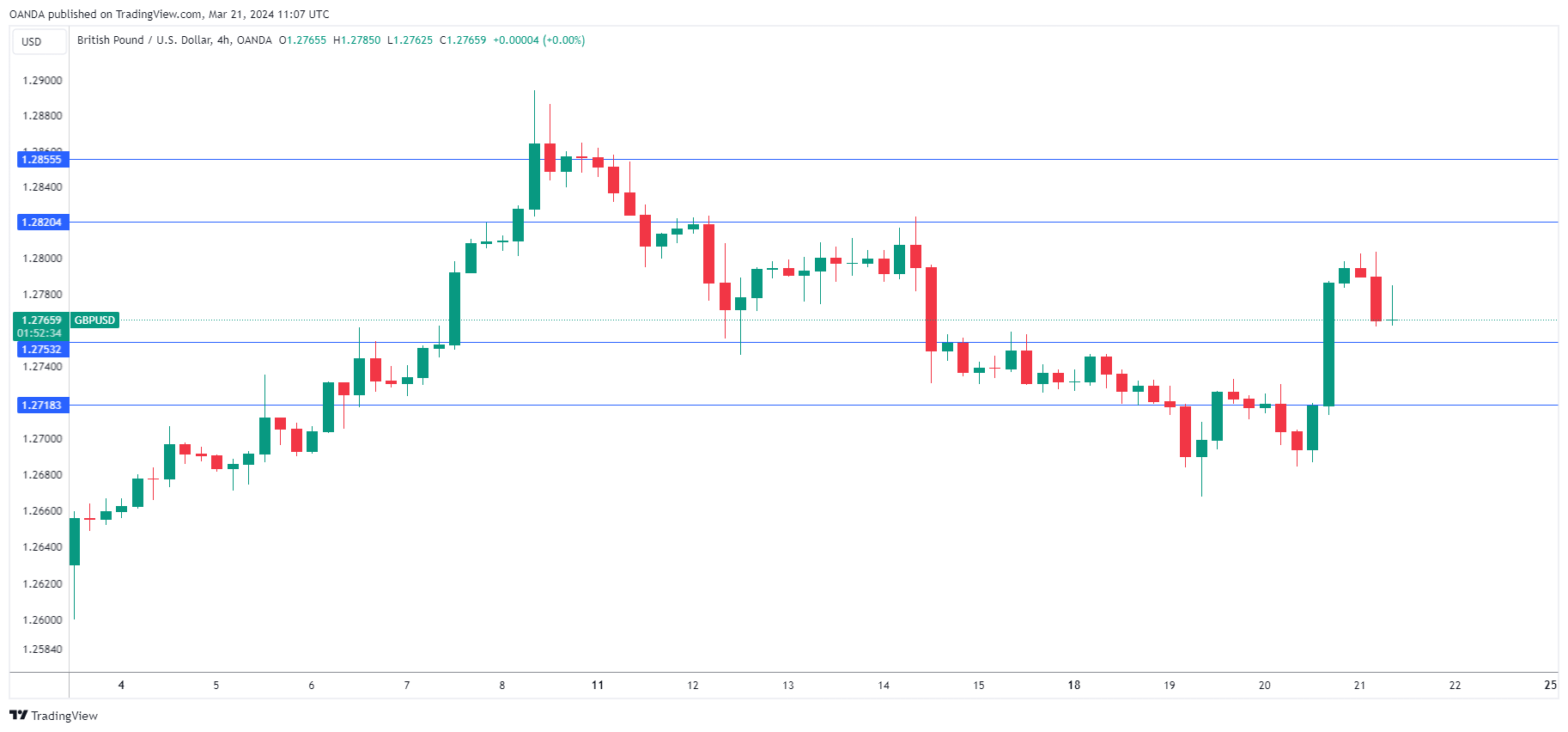
The British pound has extended its losses on Friday. In the European session, GBP/USD is trading at 1.2600, down 0.45%. Earlier, the pound fell as low as 1.2584, its lowest level since March 20.
UK retail sales unchanged in February
UK retail sales were flat in February, after a revised 3.6% gain (m/m) in January. This was better than the market estimate of -0.3%. On an annualized basis, retail sales fell by 0.4%, erasing most of the 0.5% gain in January. Britain’s weather was unusually wet in February which dampened retail trade.
Dovish BoE sends pound tumbling
The Bank of England maintained the cash rate at 5.25% at Wednesday’s meeting. The pause was widely expected and marked the sixth straight time that the BoE has kept rates unchanged.
Perhaps the most significant development at the meeting was the Monetary Policy Committee vote. The MPC voted 8-1 to keep rates unchanged, with one member voting for a quarter-point cut. This was the first time in the current tightening cycle that no members voted for a hike – at the previous meeting, two members voted to raise rates by a quarter-point.
The markets pounced on the vote as evidence of a dovish shift in the Bank’s stance and the British pound sank 1% on Wednesday, its worst one-day performance since October 2023.
It looks like rates have peaked, but when can we expect the BoE to start cutting rates? Governor Bailey said after the meeting that inflation is not “yet at the point where we can cut interest rates, but things are moving in the right direction”. The markets are looking at an initial cut in June, with an outside possibility in May.
GBP/USD Technical
- GBP/USD is testing support at 1.2605. Below, there is support at 1.2552
- There is resistance at 1.2704 and 1.2757
Rising Dollar Spooked Bitcoin, But Not the Entire Crypto Market
Market picture
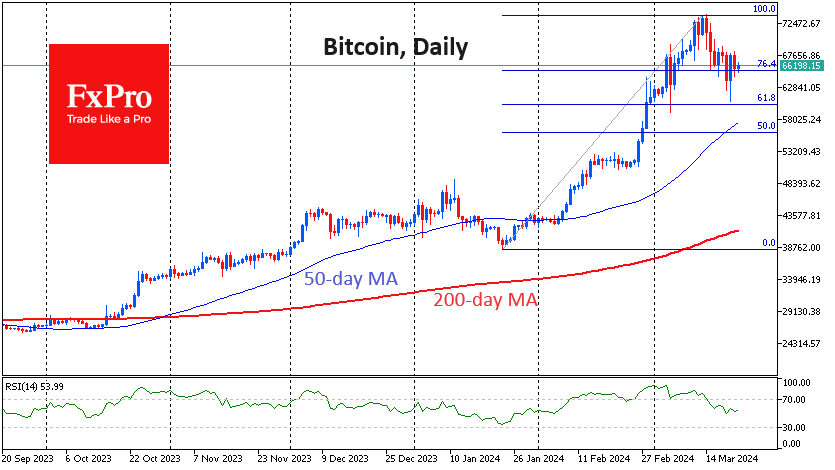
The cryptocurrency market closed lower on Thursday, but little changed from the $2.53 trillion market cap over 24 hours. However, the internal dynamics are mixed. Bitcoin loses 1.5% and retreats to $66K, while Ethereum hovers around $3500 (-0.25%), BNB and DOGE are up over 5%, and XRP is up around 4%.
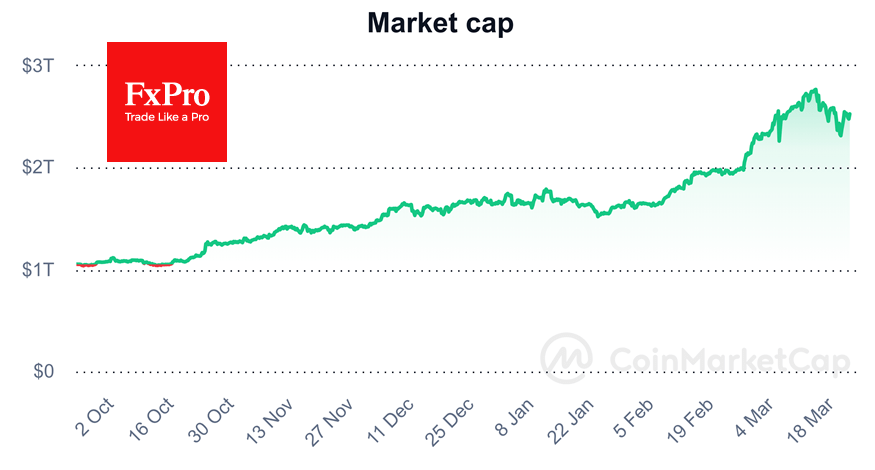
It’s as if the cryptocurrencies haven’t chosen their shepherd: should they follow negative from the strengthening dollar or positive after new heights of US indices? We lean towards the latter, believing that the dollar strengthens against even weaker peers whose central banks are more dovish.
Overall, G10 central banks’ dovishness eases a liquidity drain, which is positive for cryptocurrencies that are sensitive to it.
News background
Bitcoin’s current pullback is a temporary correction, according to CryptoQuant. Judging by the low level of inflows from new investors, BTC’s bull cycle is far from over.
BTC could fall to $52K in the coming weeks, warned 10xResearch. However, there will be a further rise to at least $106K due to the upcoming halving in April.
The SEC has no good reason to reject applications to launch an Ethereum ETF, said Coinbase General Counsel Paul Grewal. For years, the commission has treated the world’s second-largest cryptocurrency as an exchange-traded commodity rather than a security, he said.
Former US CFTC commissioner Brian Quintenz criticised the SEC’s stance on Ethereum, saying the agency was creating confusion in the law.
Solana is attracting the most investor interest. Solana accounts for 49.3% of global investor interest in blockchain ecosystems in 2024, CoinGecko calculated based on internet search data. The leadership is fuelled by SOL’s rise to highs from 2021, the development of ecosystem projects such as Pyth and the popularity of meme tokens such as dogwifhat.
Ethereum co-founder Vitalik Buterin said the main challenge for the network’s PoS mechanism was the centralisation involved in staking services. Lido, Coinbase and Binance have gained “excessive market share”, he said.
German Ifo business climate rises to 87.8, glimpses light on the horizon
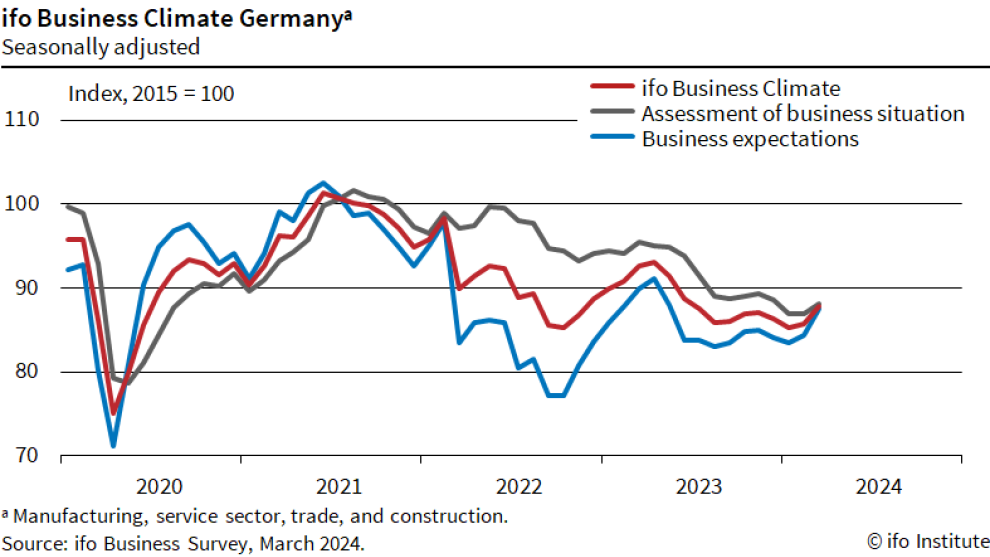
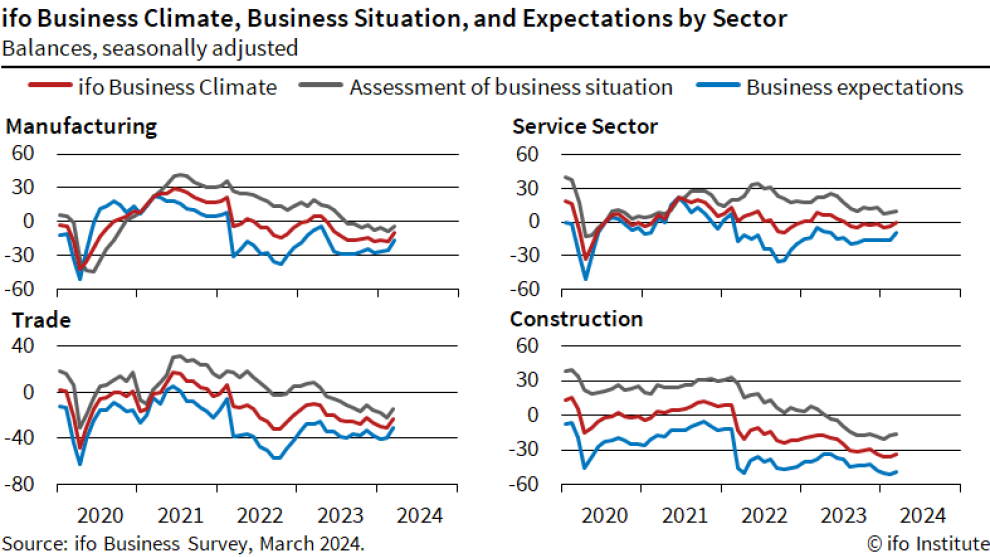
Germany's Ifo Business Climate Index rose to 87.8 in March, from the previous 85.7, surpassing anticipated 86.2. This uplift is mirrored in both Current Assessment Index, which advanced from 86.9 to 88.1 against expectations of 86.8. Expectations Index, which climbed from 84.1 to 87.5, outstripping the forecasted 84.7.
A closer look at sector-specific changes reveals significant variances: Manufacturing sector saw a substantial leap from -17.1 to -10.0. Services sector marked a positive turn, moving from -4.0 to 0.3. Meanwhile, the trade sector saw an improvement as its index rose from -30.8 to -22.9. However, the construction sector observed a slight decrease from -35.4 to -33.5,.
Ifo President Clemens Fuest encapsulated the sentiment by stating, "The German economy glimpses light on the horizon," highlighting a renewed sense of optimism among businesses.
Is There Stronger Bullish Trend for USDCAD?
- USDCAD switches back to gains, surpasses SMAs
- Technical signals cannot warrant a bullish channel breakout
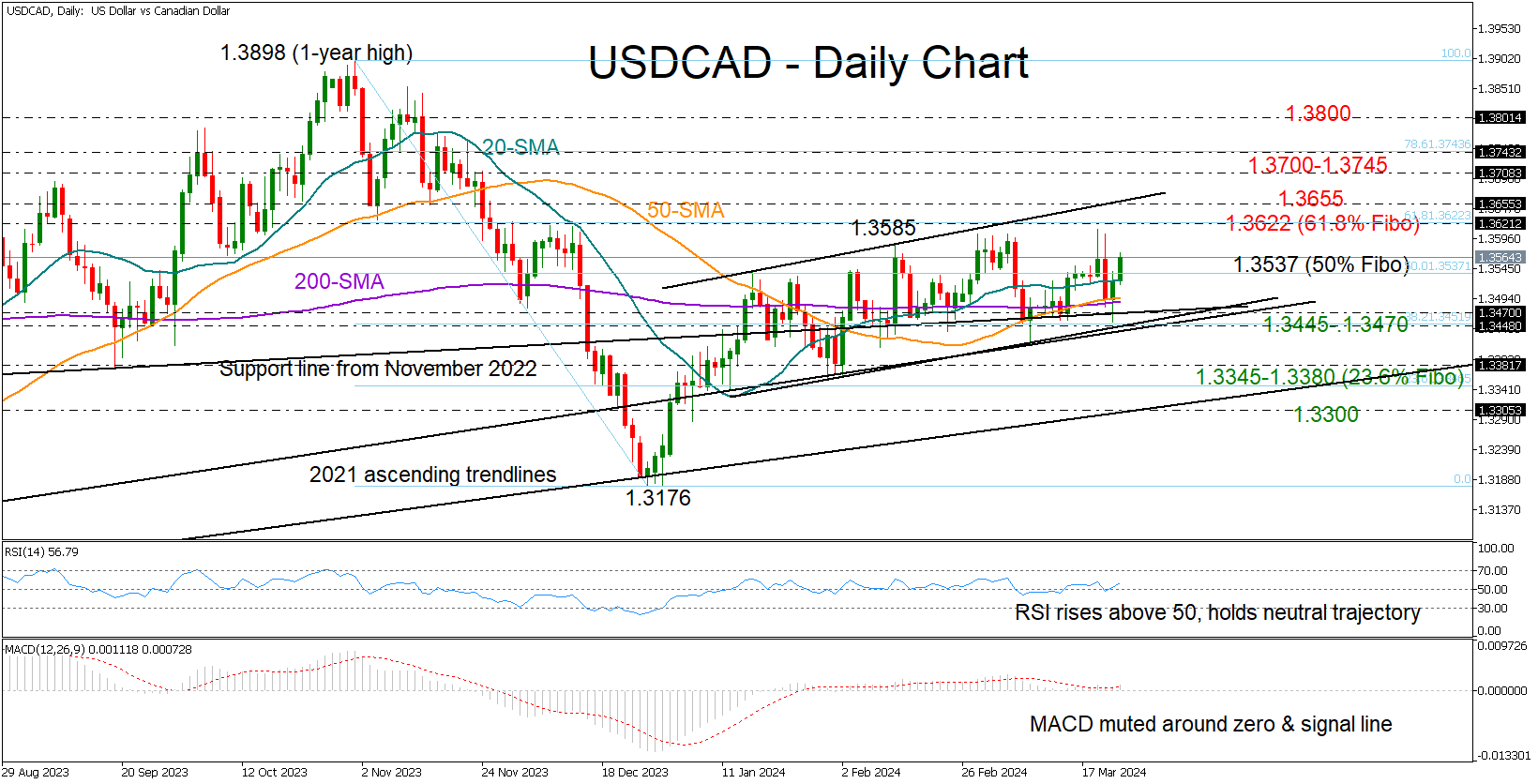
USDCAD successfully recovered from a flash drop to 1.3454 and closed Thursday’s session above the 50- and 200-day SMAs, maintaining its position within the short-term bullish channel. Consequently, the bulls piled in on Friday to drive the pair above the 20-day SMA and the 50% Fibonacci retracement of the November-December downtrend, which has been a key resistance zone since the start of the year.
The recent bullish accomplishments have raised expectations for further progress towards the upper boundary of the channel at 1.3655. However, the current neutral trend in the RSI and MACD does not inspire confidence. Prior to a channel breakout, the bulls will have to overcome the 61.8% Fibonacci mark of 1.3622. Should they exit the channel on the upside, resistance could initially develop somewhere within the 1.3700-1.3745 region, and then around 1.3800.
Conversely, if the pair sinks below the important 1.3445-1.3470 support area, it could seek shelter within the 1.3345-1.3380 territory, where the 23.6% Fibonacci number is placed. Even lower, the bears might push towards the ascending trendline, which connects the 2021 and 2022 lows at 1.3300.
Overall, the recent rise in USDCAD doesn’t provide enough technical evidence for an immediate extension towards the upper boundary of the channel.
GBPJPY Plummets from 8½-Year High
- GBPJPY may rest near 190.00 round number
- MACD and RSI confirm bearish retracement
- Broader outlook looks strongly bullish
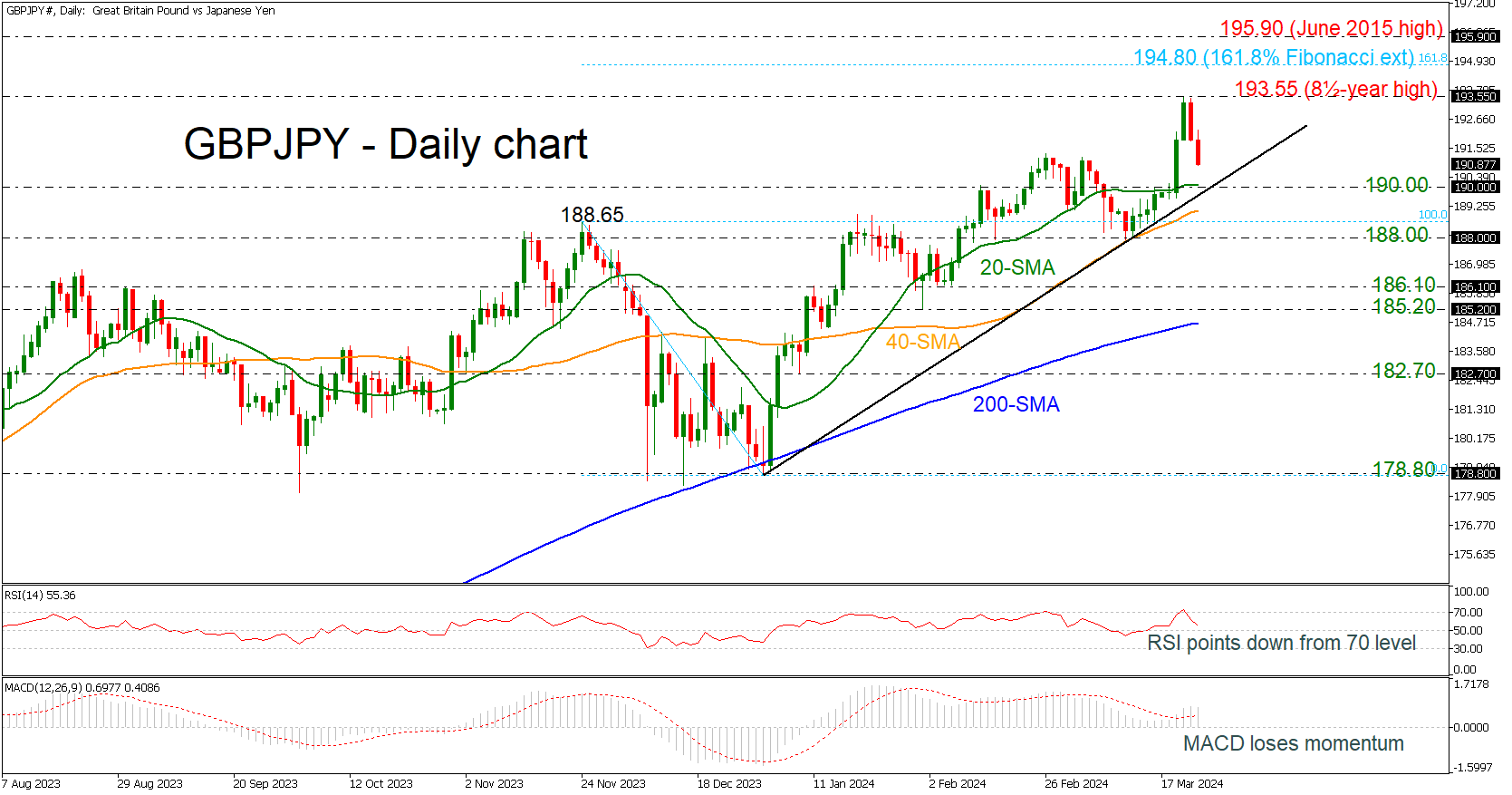
GBPJPY is retreating after the pullback off the eight-and-a-half-year high of 193.55 and is moving towards the short-term ascending trend line.
According to technical oscillators, the RSI is heading south following the strong rally until the 70 level, while the MACD is losing some steam above its trigger and zero lines, both confirming the recent bearish correction.
If the bears hold control, then the pair could touch the 190.00 critical level, which coincides with the 20-day simple moving average (SMA) and the uptrend line. A rebound is expected around these lines, but in the case of steeper decreases the price could see the market testing the 50-day SMA at 189.10 ahead of the 188.00 handle.
However, an upside recovery could take the market towards the previous multi-year peak of 193.55 before resting near the 161.8% Fibonacci extension level of the downward wave from 188.65 to 178.80 at 194.80. More upside pressures could see the bulls meeting the June 2015 high at 195.90.
To conclude, GBPJPY is looking bullish in all timeframes and caution should be taken if there is a plunge beneath the 200-day SMA at 184.70 that may switch the short-term outlook to a more neutral one.
GBP/USD Faces Sharp Decline Amid BoE’s Monetary Policy Stance
As of Friday, the GBP/USD pair hovered around 1.2642, following a substantial decline. The Bank of England (BoE) has yet to find reasons to lower the interest rate, indicating intentions to maintain high rates for an extended period to support the necessary inflation level in the country. The BoE's monetary policy remains restrictive.
In its latest meeting, the Bank of England kept the interest rate steady at 5.25% annually, unchanged from previous sessions.
The BoE's primary inflation target is 2%. Official forecasts suggest that the Consumer Price Index in the UK will likely reach this target by Q2 2024, with no immediate changes in monetary attitudes anticipated.
The market was "disappointed" that the BoE did not introduce any new policies, given that key central banks worldwide have started (at least verbally) to move towards tightening monetary conditions. The BoE remains an outlier, sticking to a conservative "wait-and-see" approach.
The BoE will likely continue with its current strategy. It will wait to see the outcomes of interest rate hikes by the US Federal Reserve and the European Central Bank (ECB) and observe currency reactions before considering any steps towards tightening based on the inflation trend.
Technical analysis of GBP/USD
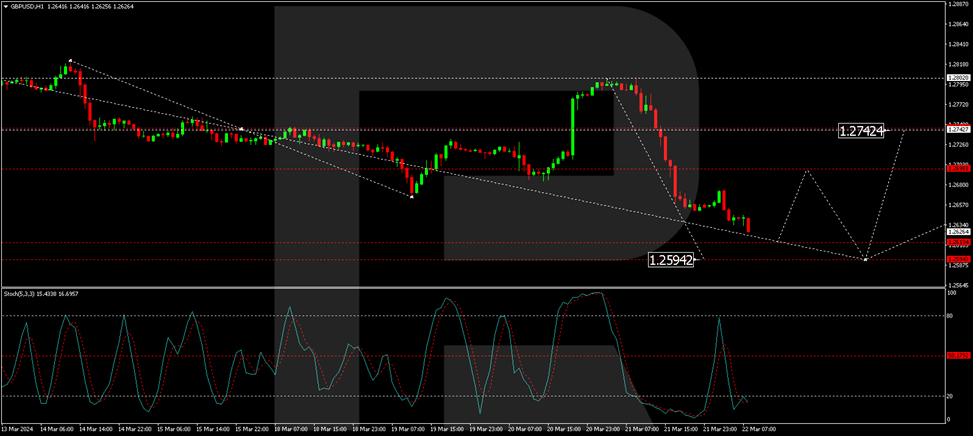
The H4 chart of GBP/USD is developing the fifth wave of decline towards the level of 1.2594. After that, a potential correction to 1.2742 is considered, with a continued downward trend expected. The MACD oscillator supports this scenario, with its signal line below zero and continuing downward towards new lows.
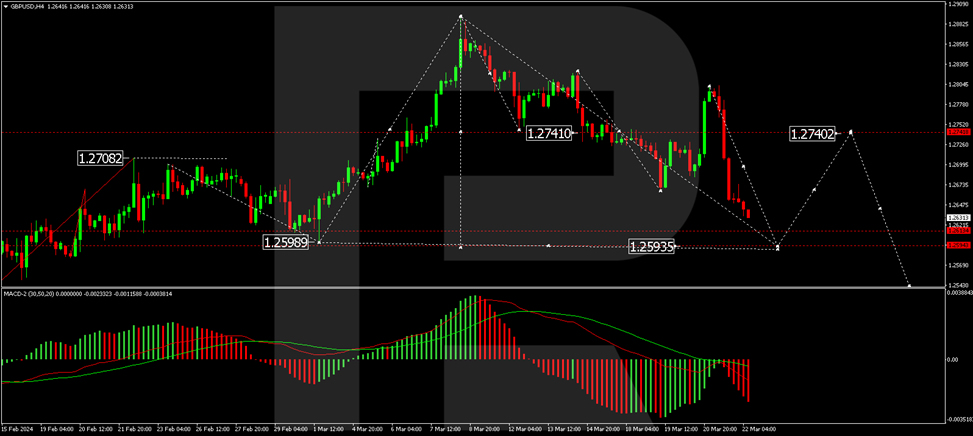
On the H1 chart, a declining wave structure towards 1.2615 is forming. After reaching this level, a potential rise to 1.2698 could occur, followed by a decline to 1.2594. The Stochastic oscillator confirms this scenario, with its signal line below 20 and sharply directed downwards.
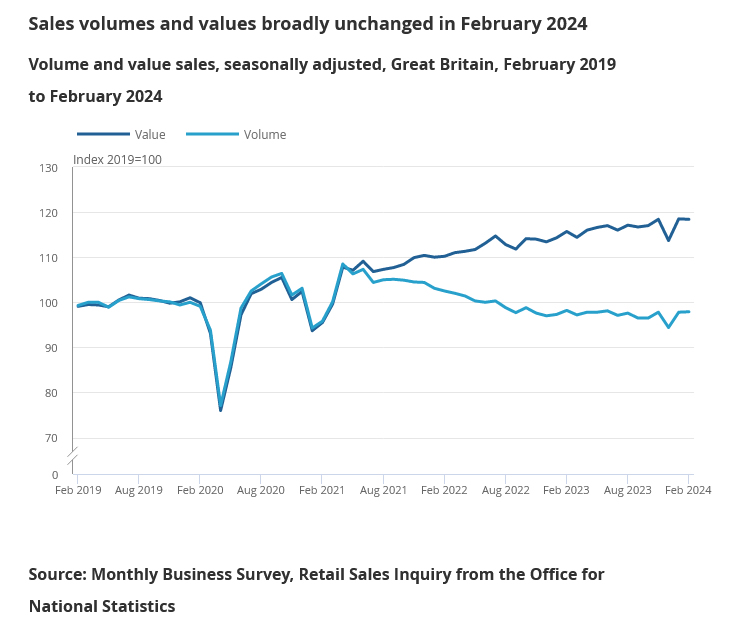
UK retail sales volumes flat in Feb, sales value down -0.1% mom
In February 2024, UK's retail sales volumes remained unchanged month-over-month, a performance that's better than expectation of -0.3% mom decline. Meanwhile, sales value slightly dipped by a -0.1% mom.
A broader examination reveals -0.4% decline in sales volumes over the three months leading up to February, compared to the preceding three-month period. Additionally, a year-over-year comparison with the three months to February 2023 shows -1.0% decrease.