

Sample Category Title
EUR/USD Daily Outlook
Daily Pivots: (S1) 1.0857; (P) 1.0881; (R1) 1.0897; More...
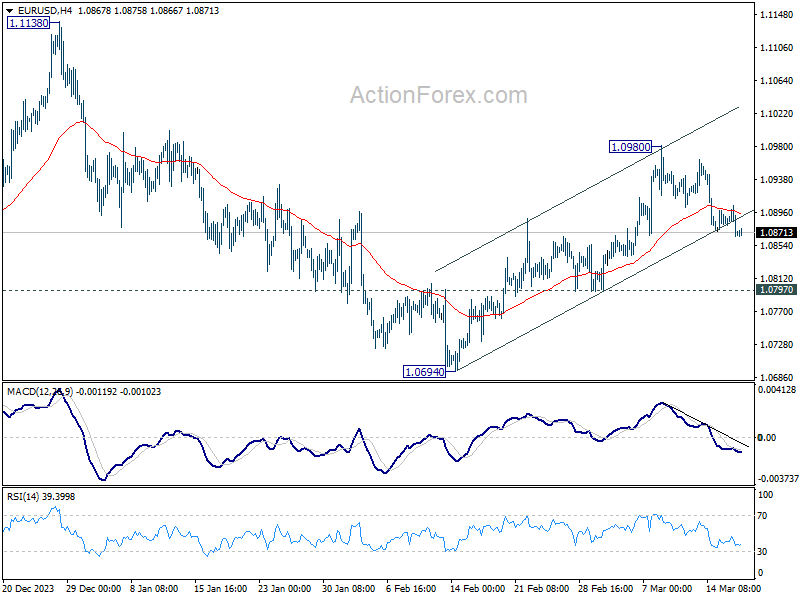
Intraday bias in EUR/USD remains on the downside, as fall from 1.0980 short term top is in progress for 55 D EMA (now at 1.0856). Sustained break there will argue that rebound from 1.0694 has completed and bring retest of this low. For now, risk will stay on the downside as long as 1.0980 resistance holds, in case of recovery.
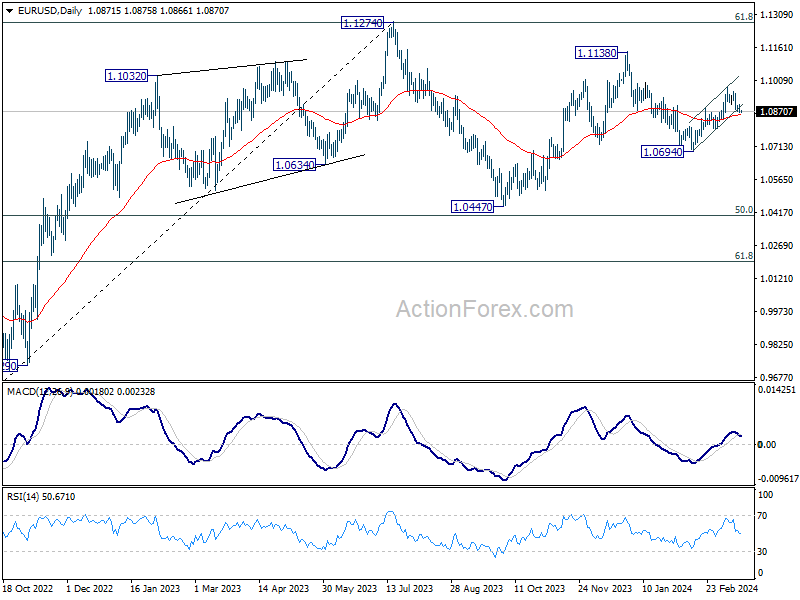
In the bigger picture, price actions from 1.1274 are viewed as a corrective pattern to rise from 0.9534 (2022 low). Rise from 1.0447 is seen as the second leg. While further rally could cannot be ruled out, upside should be limited by 1.1274 to bring the third leg of the pattern. Meanwhile, sustained break of 1.0694 support will argue that the third leg has already started for 1.0447 and possibly below.
GBP/USD Daily Outlook
Daily Pivots: (S1) 1.2716; (P) 1.2731; (R1) 1.2745; More...
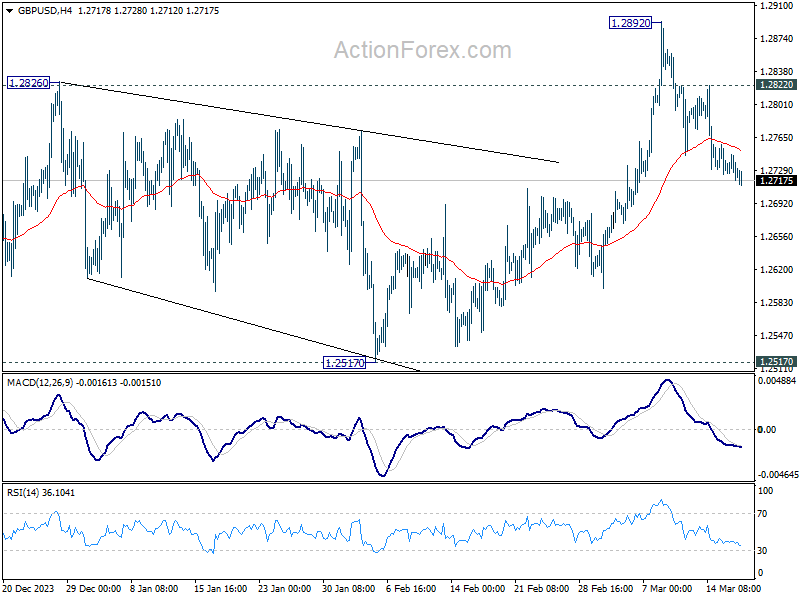
Intraday bias in GBP/USD remains on the downside at this point. Fall from 1.2892 is in progress for 55 D EMA (now at 1.2677). Firm break there will target 1.2517 structural support. For now, risk will stay mildly on the downside as long as 1.2822 minor resistance holds, in case of recovery.
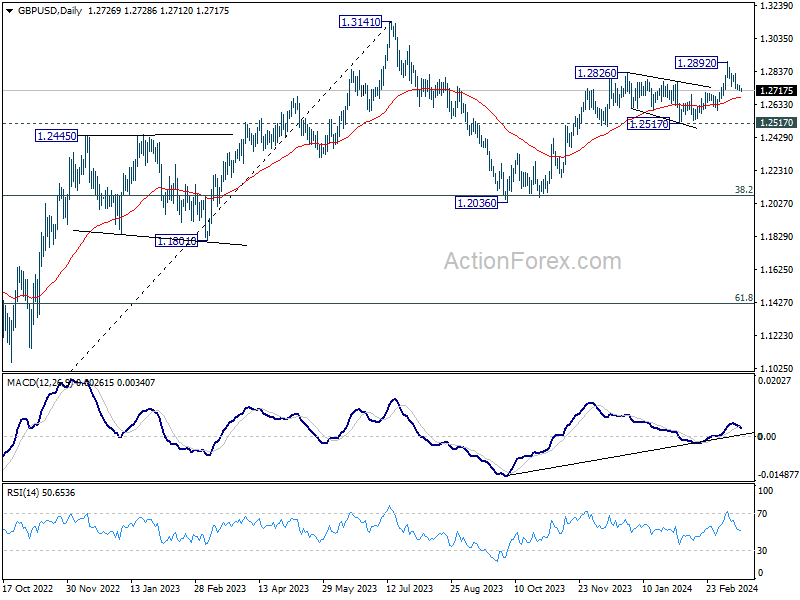
In the bigger picture, price actions from 1.3141 medium term top are seen as a corrective pattern to up trend from 1.0351 (2022 low). Rise from 1.2036 is seen as the second leg, which is still in progress. But upside should be limited by 1.3141 to bring the third leg of the pattern. Meanwhile, break of 1.2517 support will argue that the third leg has already started for 38.2% retracement of 1.0351 (2022 low) to 1.3141 at 1.2075 again.
USD/CHF Daily Outlook
Daily Pivots: (S1) 0.8838; (P) 0.8863; (R1) 0.8903; More....
Intraday bias in USD/CHF remains on the upside with focus on 0.8891 resistance. Decisive break there will confirm resumption of rally from 0.8332. Next target is 61.8% projection of 0.8550 to 0.8884 from 0.8728 at 0.8934. On the downside, below 0.8818 minor support will turn intraday bias neutral and bring consolidations. But outlook will stay bullish as long as as long as 0.8728 support holds, in case of retreat.
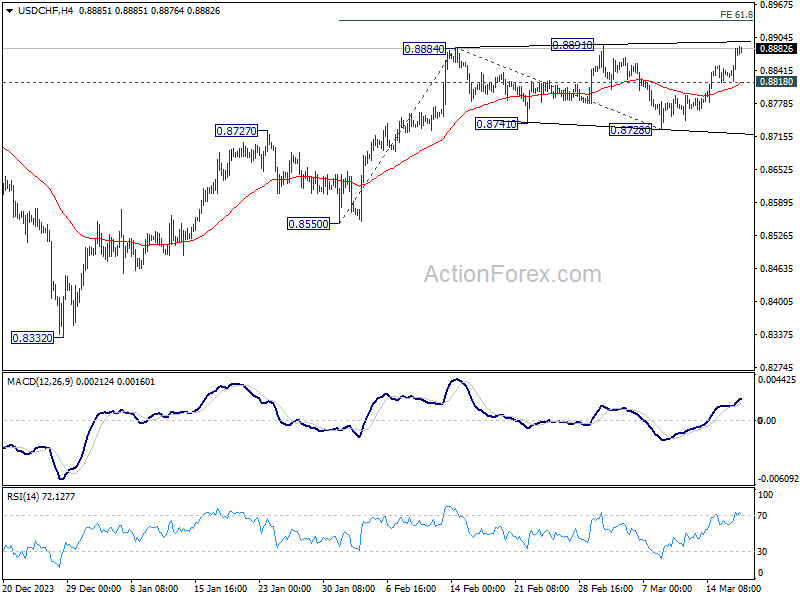
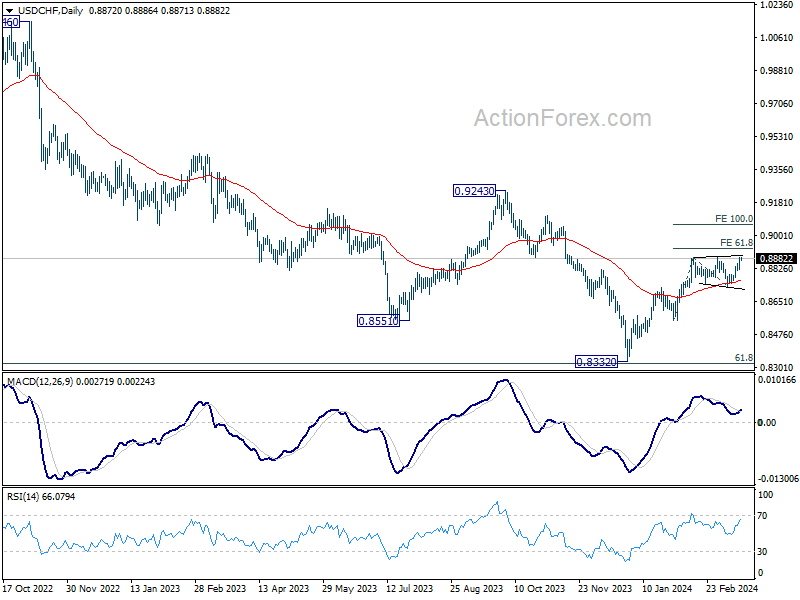
In the bigger picture, price actions from 0.8332 medium term bottom as seen as developing into a corrective pattern to the down trend from 1.0146 (2022 high). Further rise would be seen as long as 0.8555 support holds. But upside should be limited by 0.9243 resistance, at least on first attempt.
USD/JPY Daily Outlook
Daily Pivots: (S1) 148.93; (P) 149.13; (R1) 149.35; More...
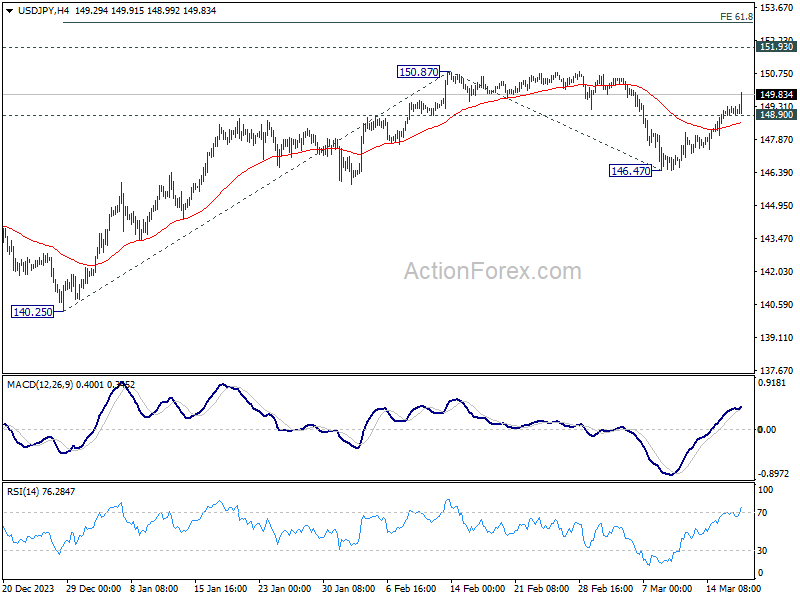
USD/JPY's rally from 146.47 continues today and intraday bias stays on the upside for retesting 150.87/89 key resistance. Decisive break there will confirm larger up trend resumption. Next near term target will be 61.8% projection of 140.25 to 150.87 from 146.47 at 153.03. On the downside, below 148.90 minor support will delay the bullish case and turn intraday bias neutral first. But outlook will now remain bullish as long as 146.47 support holds.
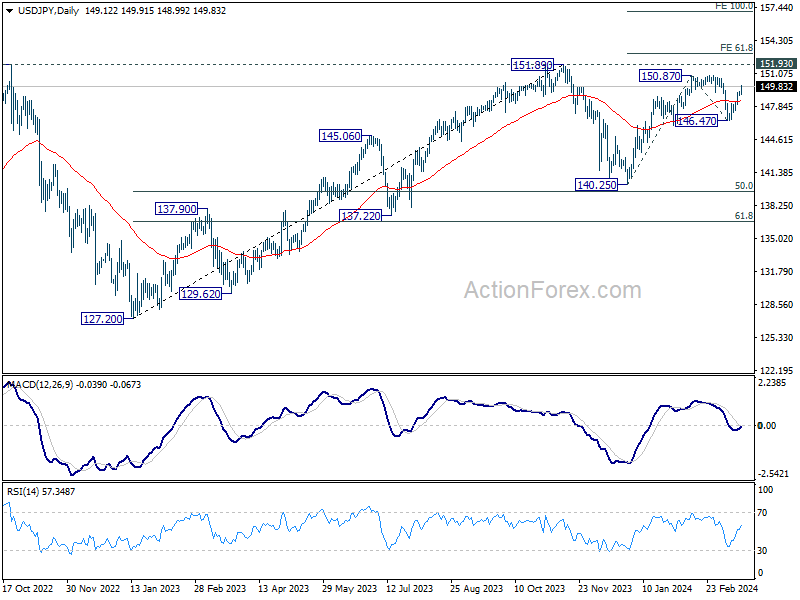
In the bigger picture, correction from 151.87 (2023) high could have completed at 140.25 already. Rise from 127.20 (2023 low), as part of the long term up trend, is probably ready to resume. Decisive break of 151.93 resistance (2022 high) will confirm this bullish case. Also, this will remain the favored case as long as 140.25 support holds, in case of another fall.
BoJ’s Historic Hike Fails to Lift Yen, RBA’s Cautious Stance Weighs on Aussie
Yen declines broadly in a classic "sell-on-news" reaction following BoJ's landmark decision to exit its eight-year negative interest rate policy and announce its first rate hike in 17 years. Although the immediate economic impact of this move is considered minimal, its psychological and symbolic significance cannot be understated. This policy shift was largely anticipated by investors, as evidenced by Nikkei's stability post-announcement, which saw only brief initial buying before stabilizing.
In parallel, Australian Dollar faces some downward pressure after RBA keeps interest rates on hold as widely expected. The statement left the possibility of further rate hikes open, yet some market participants interpreted the central bank's language as less hawkish than anticipated. The notion that RBA is "not ruling anything in or out" has led some to speculate that a rate cut could be the next course of action.
As of now, Euro is trading as the day's strongest currency, followed by Dollar and Swiss Franc. Yen finds itself at the bottom of the performance list, with Australian Dollar and New Zealand Dollar also weak. Sterling and Canadian Dollar occupy the middle ground.
The markets have just begun to unravel the day's volatility, with significant economic indicators such as German ZEW economic sentiment and Canadian CPI on the agenda. Furthermore, the week promises even more fluctuations with impending meetings from Fed, SNB, and BoE still to come.
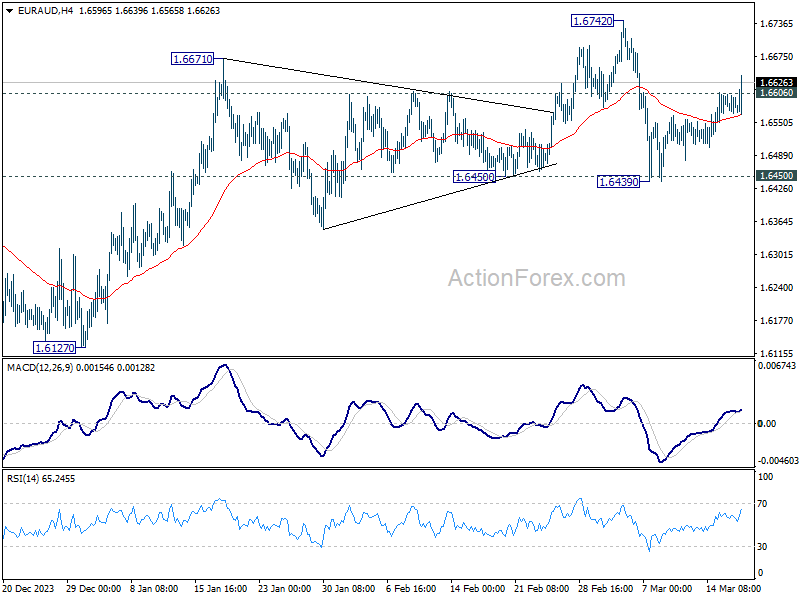
Technically, EUR/AUD's break of 1.6606 resistance indicates that corrective pullback from 1.6742 has completed at 1.6439, after drawing support from 1.6450. More importantly, rise from 1.1627 low is still in progress. Further rise is now in favor to retest 1.6742 resistance first. Decisive break there will confirm rally resumption.
In Asia, at the time of writing, Nikkei is up 0.03%. Hong Kong HSI is down -1.11%. China Shanghai SSE is down -0.39%. Singapore Strait Times is up 0.04%. Japan 10-year JGB yield is down -0.0323 at 0.731. Overnight, DOW rose 0.20%. S&P 500 rose 0.63%. NASDAQ rose 0.82%. 10-year yield rose 0.036 to 4.340.
BoJ ends YCC and negative rates as they have fulfilled their roles
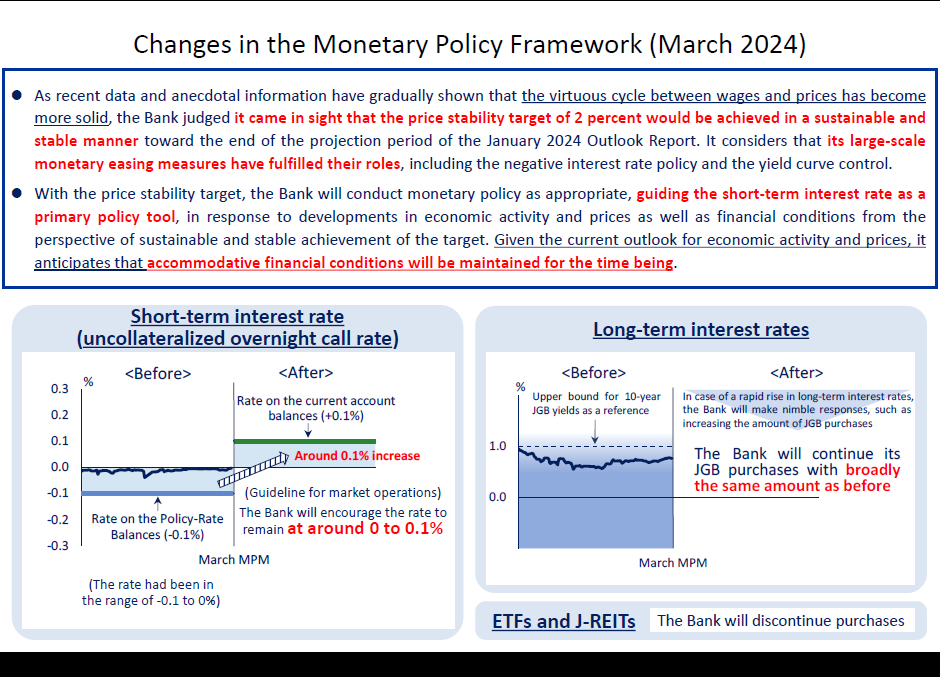
In a landmark decision that marks a significant shift in Japan's monetary policy, BoJ announced the termination of its Yield Curve Control framework and negative interest rate policy, signifying that these measures "have fulfilled their roles."
This pivotal move is underpinned by BoJ's assessment that a "virtuous cycle between wages and prices" has come in sight and that the long-standing 2% inflation target is on track to be "achieved in a sustainable and stable manner."
Setting the overnight call rate to a range of 0-0.1%, the decision was reached with a majority vote of 7-2.
BoJ will continue its purchase of JGBs at "broadly the same amount as before," ensuring a measure of stability in the bond market. This part of the decision was made with an 8-1 vote. Meanwhile, BoJ has pledged to "respond nimbly" in the event of a rapid rise in long-term interest rates
Additionally, BoJ has outlined plans to discontinue the purchase of ETFs and J-REITs, while the procurement of commercial paper and corporate bonds will be gradually reduced, aiming for discontinuation within approximately one year.
RBA stands pat, not ruling anything in or out
RBA has opted to maintain cash rate target unchanged at 4.35% today, aligning with broad market expectations. The central bank's stance reflects a cautious approach, emphasizing the prevailing uncertainty in both the global and domestic economic environments. RBA's declaration that the path of interest rates remains "uncertain" and that it is "not ruling anything in or out" underscores a flexible policy outlook, leaving the door open for rate adjustments in the future, including the possibility of further hikes.
On the inflation front, RBA acknowledges a moderating trend, consistent with its latest forecasts. This moderation is attributed primarily to slowdown in goods inflation. However, services inflation remains stubbornly high, and ism ode rating at a slower pace. Wages growth, a critical factor in the inflation equation, appears to have peaked.
Addressing the economic outlook, RBA paints a picture of significant uncertainty. Internationally, questions loom over China's economic outlook and the broader impacts of geopolitical conflicts in Ukraine and the Middle East. Domestically, uncertainties pertain to the lag effects of monetary policy adjustments, firms' pricing decisions, wages dynamics, and household consumption patterns.
Looking ahead
Swiss trade balance and SECO economic forecasts will be released in European session. Germany will publish ZEW economic sentiment. Later in the day, Canada CPI is the main focus while US will release building permits and housing starts.
USD/JPY Daily Outlook
Daily Pivots: (S1) 148.93; (P) 149.13; (R1) 149.35; More...
USD/JPY's rally from 146.47 continues today and intraday bias stays on the upside for retesting 150.87/89 key resistance. Decisive break there will confirm larger up trend resumption. Next near term target will be 61.8% projection of 140.25 to 150.87 from 146.47 at 153.03. On the downside, below 148.90 minor support will delay the bullish case and turn intraday bias neutral first. But outlook will now remain bullish as long as 146.47 support holds.
In the bigger picture, correction from 151.87 (2023) high could have completed at 140.25 already. Rise from 127.20 (2023 low), as part of the long term up trend, is probably ready to resume. Decisive break of 151.93 resistance (2022 high) will confirm this bullish case. Also, this will remain the favored case as long as 140.25 support holds, in case of another fall.
Economic Indicators Update
| GMT | Ccy | Events | Actual | Forecast | Previous | Revised |
|---|---|---|---|---|---|---|
| 03:30 | AUD | RBA Interest Rate Decision | 4.35% | 4.35% | 4.35% | |
| 03:36 | JPY | BoJ Interest Rate Decision | 0.10% | 0.00% | -0.10% | |
| 04:30 | AUD | RBA Press Conference | ||||
| 04:30 | JPY | Industrial Production M/M Jan F | -6.70% | -7.50% | -7.50% | |
| 07:00 | CHF | Trade Balance (CHF) Feb | 3.50B | 4.74B | ||
| 08:00 | CHF | SECO Economic Forecasts | ||||
| 10:00 | EUR | Germany ZEW Economic Sentiment Mar | 21 | 19.9 | ||
| 10:00 | EUR | Germany ZEW Current Situation Mar | -80 | -81.7 | ||
| 10:00 | EUR | Eurozone ZEW Economic Sentiment Mar | 25.4 | 25 | ||
| 12:30 | CAD | CPI M/M Feb | 0.60% | 0.00% | ||
| 12:30 | CAD | CPI Y/Y Feb | 3.10% | 2.90% | ||
| 12:30 | CAD | CPI Median Y/Y Feb | 3.40% | 3.30% | ||
| 12:30 | CAD | CPI Trimmed Y/Y Feb | 3.50% | 3.40% | ||
| 12:30 | CAD | CPI Common Y/Y Feb | 3.60% | 3.40% | ||
| 12:30 | USD | Building Permits Feb | 1.50M | 1.47M | ||
| 12:30 | USD | Housing Starts Feb | 1.43M | 1.33M |
BoJ ends YCC and negative rates as they have fulfilled their roles
In a landmark decision that marks a significant shift in Japan's monetary policy, BoJ announced the termination of its Yield Curve Control framework and negative interest rate policy, signifying that these measures "have fulfilled their roles."
This pivotal move is underpinned by BoJ's assessment that a "virtuous cycle between wages and prices" has come in sight and that the long-standing 2% inflation target is on track to be "achieved in a sustainable and stable manner."
Setting the overnight call rate to a range of 0-0.1%, the decision was reached with a majority vote of 7-2.
BoJ will continue its purchase of JGBs at "broadly the same amount as before," ensuring a measure of stability in the bond market. This part of the decision was made with an 8-1 vote. Meanwhile, BoJ has pledged to "respond nimbly" in the event of a rapid rise in long-term interest rates
Additionally, BoJ has outlined plans to discontinue the purchase of ETFs and J-REITs, while the procurement of commercial paper and corporate bonds will be gradually reduced, aiming for discontinuation within approximately one year.
RBA stands pat, not ruling anything in or out
RBA has opted to maintain cash rate target unchanged at 4.35% today, aligning with broad market expectations. The central bank's stance reflects a cautious approach, emphasizing the prevailing uncertainty in both the global and domestic economic environments. RBA's declaration that the path of interest rates remains "uncertain" and that it is "not ruling anything in or out" underscores a flexible policy outlook, leaving the door open for rate adjustments in the future, including the possibility of further hikes.
On the inflation front, RBA acknowledges a moderating trend, consistent with its latest forecasts. This moderation is attributed primarily to slowdown in goods inflation. However, services inflation remains stubbornly high, and ism ode rating at a slower pace. Wages growth, a critical factor in the inflation equation, appears to have peaked.
Addressing the economic outlook, RBA paints a picture of significant uncertainty. Internationally, questions loom over China's economic outlook and the broader impacts of geopolitical conflicts in Ukraine and the Middle East. Domestically, uncertainties pertain to the lag effects of monetary policy adjustments, firms' pricing decisions, wages dynamics, and household consumption patterns.
(RBA) Statement by Michele Bullock, Governor: Monetary Policy Decision
At its meeting today, the Board decided to leave the cash rate target unchanged at 4.35 per cent and the interest rate paid on Exchange Settlement balances unchanged at 4.25 per cent.
Inflation continues to moderate but remains high.
Recent information suggests that inflation continues to moderate, in line with the RBA's latest forecasts. The headline monthly CPI indicator was steady at 3.4 per cent over the year to January, with momentum easing over recent months, driven by moderating goods inflation. Services inflation remains elevated, and is moderating at a more gradual pace. The data are consistent with continuing excess demand in the economy and strong domestic cost pressures, both for labour and non-labour inputs.
Higher interest rates are working to establish a more sustainable balance between aggregate demand and supply in the economy. Accordingly, conditions in the labour market continue to ease gradually, although they remain tighter than is consistent with sustained full employment and inflation at target. Wages growth picked up a little further in the December quarter, but appears to have peaked with indications it will moderate over the year ahead. Nevertheless, this level of wages growth remains consistent with the inflation target only on the assumption that productivity growth increases to around its long-run average. Inflation is still weighing on people's real incomes and household consumption growth is weak, as is dwelling investment.
The outlook remains highly uncertain.
While there are encouraging signs that inflation is moderating, the economic outlook remains uncertain. The December quarter national accounts data confirmed growth has slowed. Household consumption growth remains particularly weak amid high inflation and the rise in interest rates. After recent declines, real incomes have stabilised and are expected to grow from here, which is expected to support growth in consumption later in the year.
Meanwhile, growth in unit labour costs remains very high. It has begun to moderate slightly as measured productivity growth has picked up in the past two quarters but whether this trend will be sustained is uncertain.
The central forecasts are for inflation to return to the target range of 2–3 per cent in 2025, and to the midpoint in 2026. Services price inflation is expected to decline gradually as demand moderates and growth in labour and non-labour costs eases. Employment is expected to continue to grow moderately, and the unemployment rate and the broader underutilisation rate are expected to increase a bit further.
While there have been favourable signs on goods price inflation abroad, services price inflation has remained persistent and the same could occur in Australia. There also remains a high level of uncertainty around the outlook for the Chinese economy and the implications of the conflicts in Ukraine and the Middle East. Domestically, there are uncertainties regarding the lags in the effect of monetary policy and how firms' pricing decisions and wages will respond to the slower growth in the economy at a time of excess demand, and while the labour market remains tight. The outlook for household consumption also remains uncertain.
Returning inflation to target is the priority.
Returning inflation to target within a reasonable timeframe remains the Board's highest priority. This is consistent with the RBA's mandate for price stability and full employment. The Board needs to be confident that inflation is moving sustainably towards the target range. To date, medium-term inflation expectations have been consistent with the inflation target and it is important that this remains the case.
While recent data indicate that inflation is easing, it remains high. The Board expects that it will be some time yet before inflation is sustainably in the target range. The path of interest rates that will best ensure that inflation returns to target in a reasonable timeframe remains uncertain and the Board is not ruling anything in or out. The Board will rely upon the data and the evolving assessment of risks. The Board will continue to pay close attention to developments in the global economy, trends in domestic demand, and the outlook for inflation and the labour market. The Board remains resolute in its determination to return inflation to target.
Crude Oil Price Reclaims $80, Can Bulls Push It To $85?
Key Highlights
- Crude oil bulls are eyeing an upside break above the $82.80 resistance.
- There was a break above a major bearish trend line with resistance at $79.45 on the 4-hour chart.
- Gold prices started a downside correction from the $2,195 zone.
- Bitcoin struggled above $72,000 and corrected below $70,000.
Crude Oil Price Technical Analysis
After forming a base above the $76.80 level, Crude oil prices started a fresh increase. The bulls pushed the price above the $80.00 resistance zone.
Looking at the 4-hour chart of XTI/USD, there was a break above a major bearish trend line with resistance at $79.45. The price settled above the $80.00 level, the 200 simple moving average (green, 4-hour), and the 100 simple moving average (red, 4-hour).
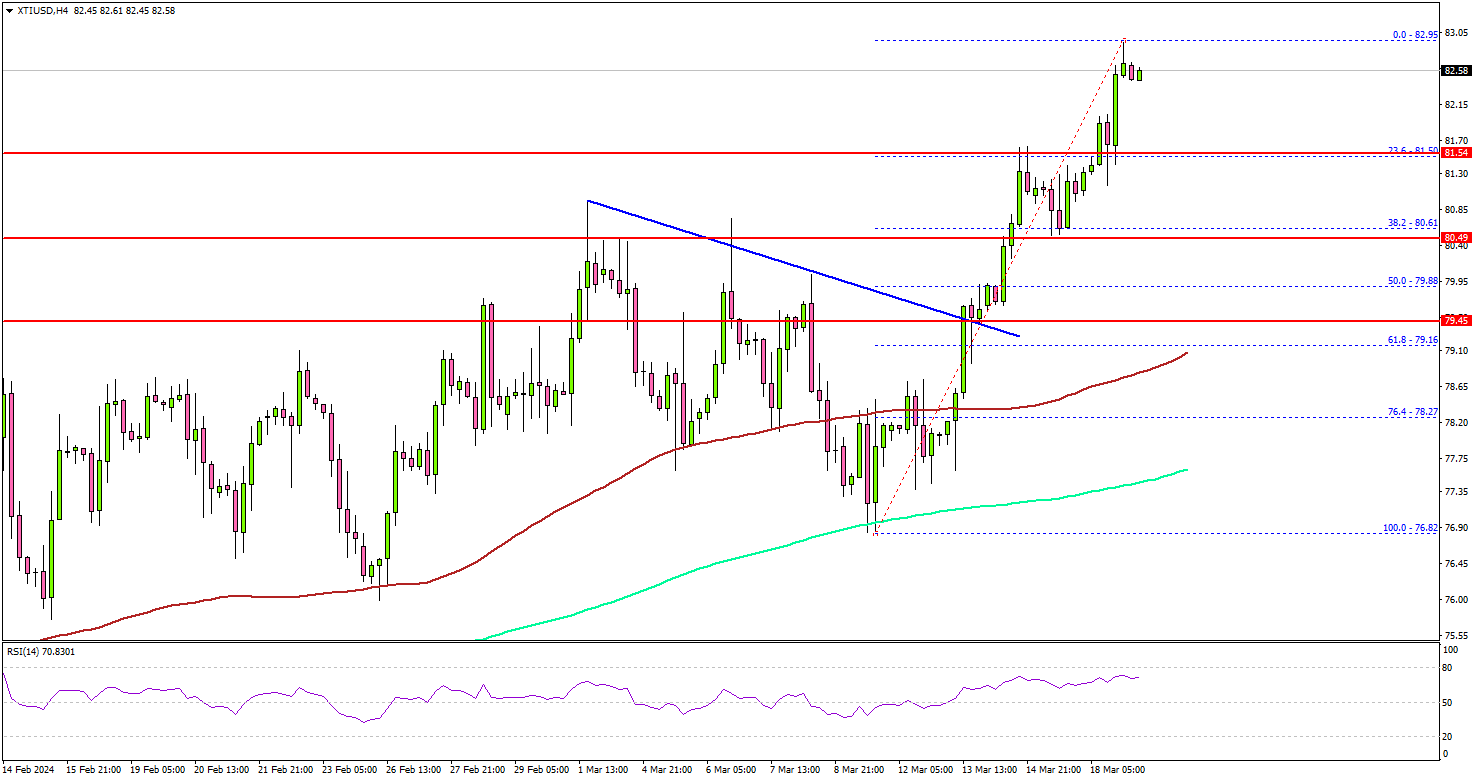
The price tested the $82.80 resistance and recently started a consolidation phase. The current price action suggests a high chance of more upsides above $82.80.
On the upside, the price is facing hurdles near the $82.80 level. The next major resistance is near the $83.00 zone, above which the price may perhaps accelerate higher. In the stated case, it could even visit the $85.00 resistance.
If not, the price might correct lower and test the $80.80 support. The first major support on the downside is near the $80.00 level. The next major support is at $79.40, below which the price might test the 100 simple moving average (red, 4-hour). Any more losses might send oil prices toward $78.00.
Looking at Gold, the price started a downside correction below the $2,165 level and might even test the $2,120 support.
Economic Releases to Watch Today
- Canadian Consumer Price Index for Feb 2024 (MoM) – Forecast +0.6%, versus 0% previous.
- Canadian Consumer Price Index for Feb 2024 (YoY) – Forecast +3.1%, versus +2.9% previous.
AUD: Markets Prepare for RBA Rates Statement.
The Reserve Bank of Australia (RBA) is widely anticipated to maintain its current interest rates at 4.35% following its two-day meeting concluding on Tuesday. Despite holding rates steady since December, the RBA has hinted at the possibility of further rate hikes due to persistently high inflation, which has exceeded its target range of 2% to 3%. During its February meeting, some RBA members advocated for a 25 basis points increase in interest rates. While the RBA is not expected to raise rates in March, it is likely to maintain a hawkish stance due to concerns about inflation. Analysts predict that the RBA may wait until inflation moderates within its target range, which they expect to occur in the September quarter of 2024. However, the RBA's hawkishness may be constrained by a cooling Australian economy, as evidenced by sluggish GDP growth in the December quarter.
AUDJPY - H4 Timeframe
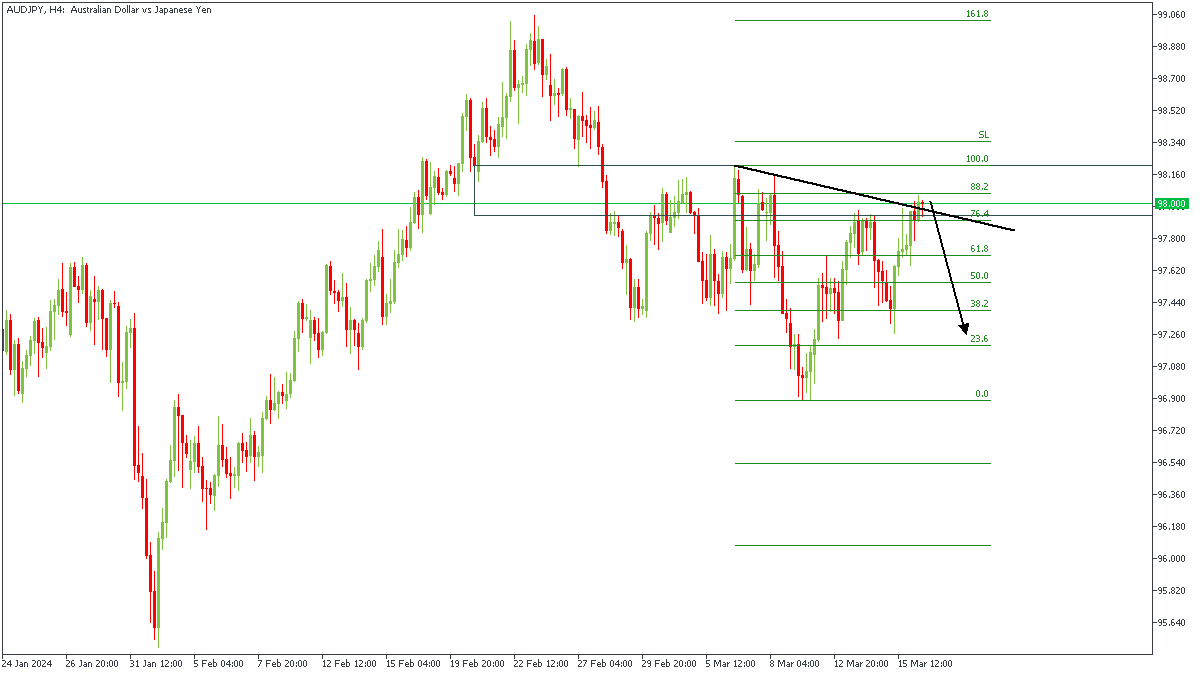
At the moment, on the H4 timeframe of AUDJPY, we see price currently riding into the trendline resistance and the 88% Fibonacci retracement level. Also, there is a pivot zone from the daily timeframe being respected by the current price action - which leads me to expect a bearish impulse from the aftermath of the rates decision.
Analyst’s Expectations:
- Direction: Bearish
- Target: 97.215
- Invalidation: 98.231
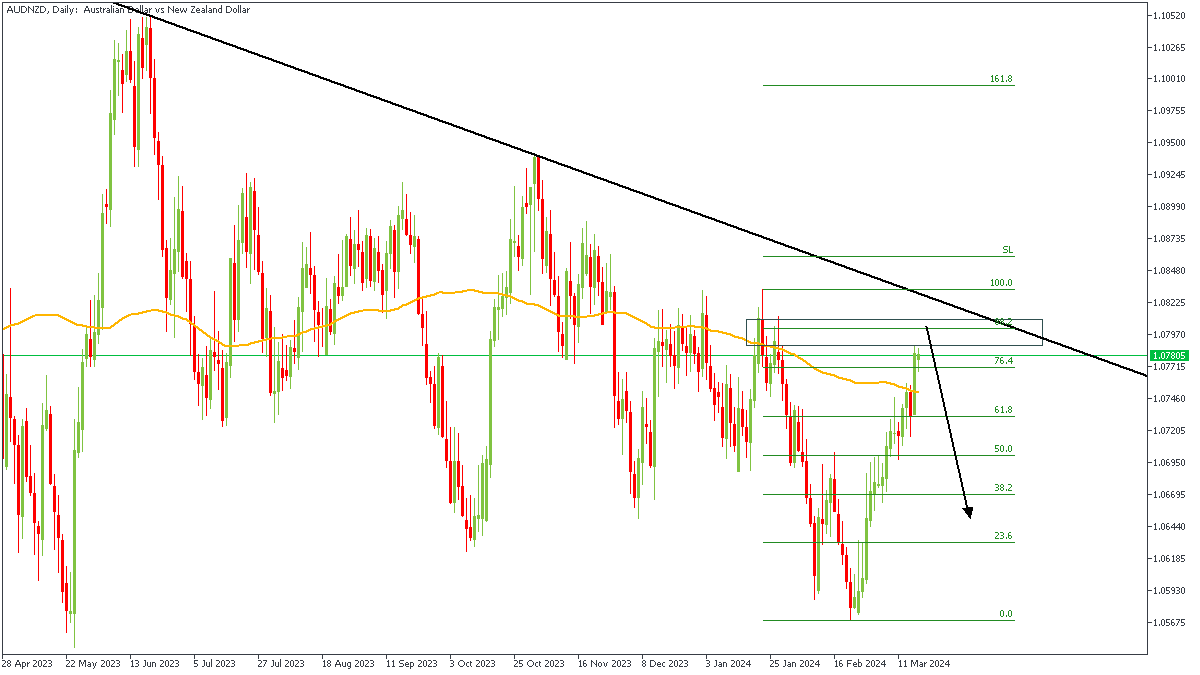
AUDNZD - D1 Timeframe
On the Daily timeframe of AUDNZD, we can see price approaching the 88% of the Fibonacci retracement level, as well as the trendline resistance. The market structure also appears clearly bearish. All of these factors point to a possible bearish impulse following the rate statement release.
Analyst’s Expectations:
- Direction: Bearish
- Target: 1.06373
- Invalidation: 1.08365
AUDUSD - D1 Timeframe
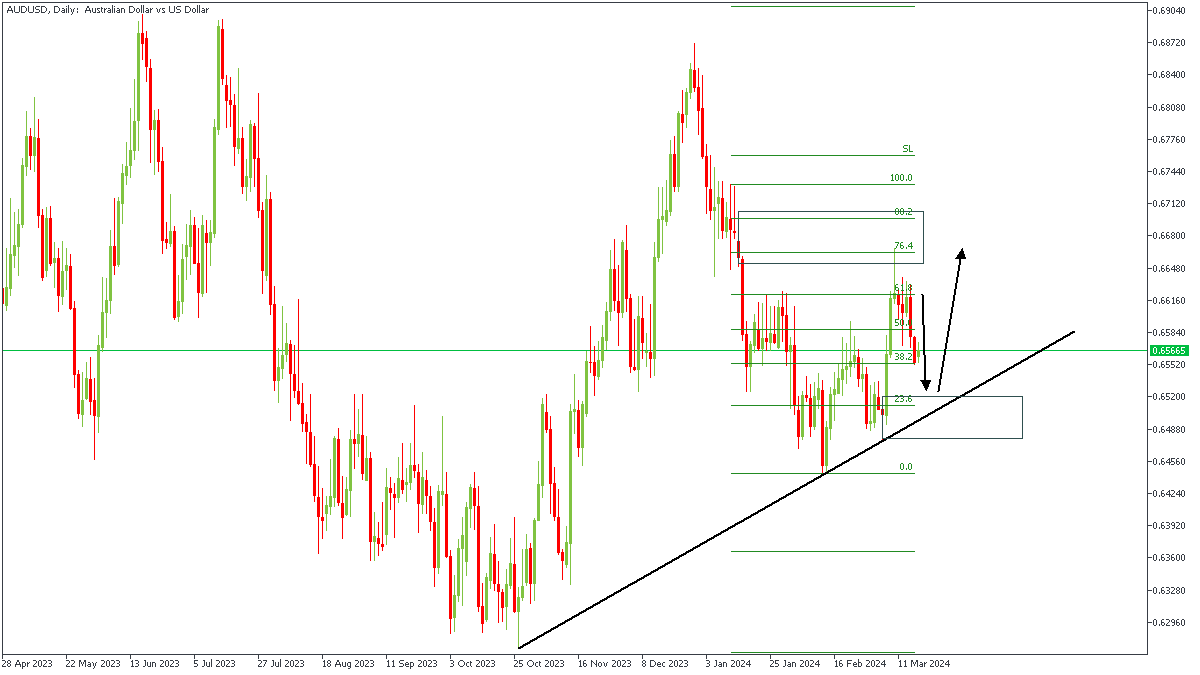
In line with the analysis last week, we’ve seen good movement from the bearish momentum on AUDUSD, but I believe we may see a change in the market direction shortly. From the chart we can see the price action currently approaching the trendline support and the demand zone. The outcome of the RBA’s rate statement could provide just the right motivation to turn the direction of the market around.
Analyst’s Expectations:
- Direction: Bullish
- Target: 0.66611
- Invalidation: 0.64779
CONCLUSION
The trading of CFDs comes at a risk. Thus, to succeed, you have to manage risks properly. To avoid costly mistakes while you look to trade these opportunities, be sure to do your due diligence and manage your risk appropriately.