Sample Category Title

EUR/JPY Daily Outlook

Daily Pivots: (S1) 183.75; (P) 184.29; (R1) 184.76; More...

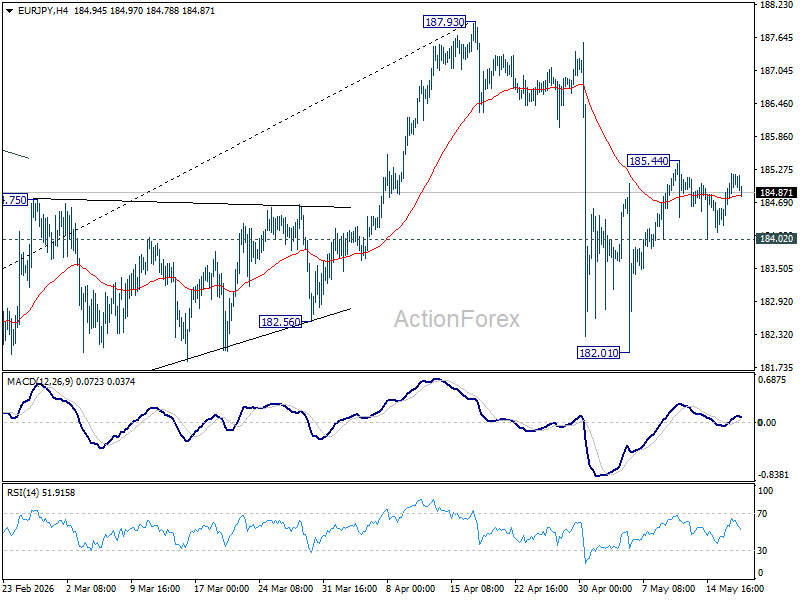
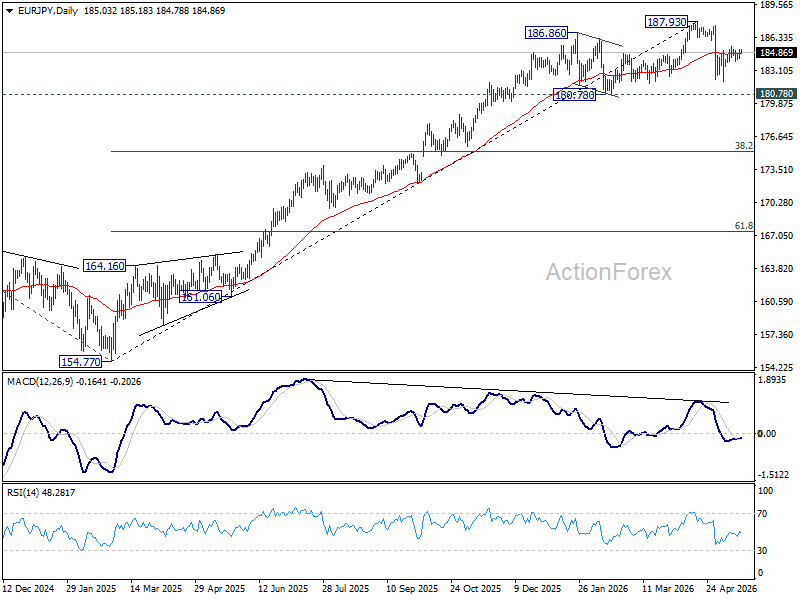
Intraday in EUR/JPY is turned neutral first with current retreat. Outlook is unchanged that correction from 186.86 should have completed with three waves down to 180.78. Above 184.75 will bring retest of 186.22/86 resistance zone. Decisive break there will confirm larger up trend resumption. Next target is 61.8% projection of 172.24 to 186.86 from 180.78 at 189.81. Overall, outlook will remain bullish as long as 38.2% retracement of 172.24 to 186.86 at 181.27, in case of deep retreat.

In the bigger picture, current development suggests that price actions from 186.86 are merely a near term corrective pattern. In other words, the long term up trend is still in progress. Firm break of 186.86 will pave the way to 78.6% projection of 124.37 (2022 low) to 175.41 (2025 high) from 154.77 at 194.88 next. This will now remain the favored case as long as 180.78 support holds.

EUR/AUD Daily Outlook

Daily Pivots: (S1) 1.6536; (P) 1.6612; (R1) 1.6654; More...

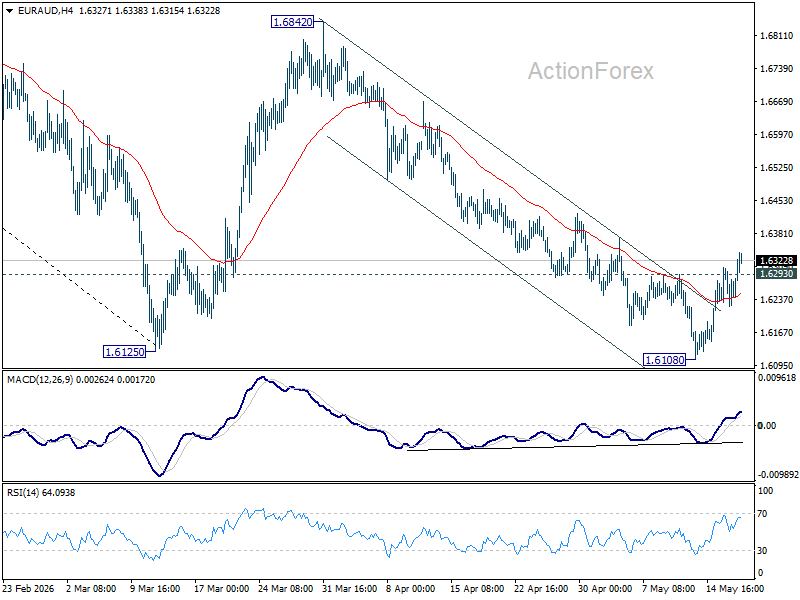
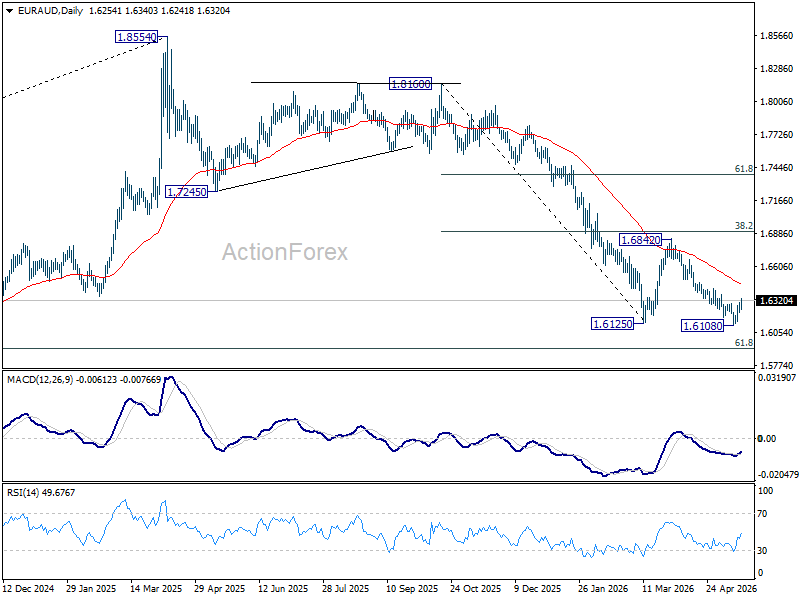
There is no clear sign of bottoming in EUR/AUD yet despite loss of momentum as seen in 4H MACD. Intraday bias remains on the downside. Fall from 1.8554 is in progress and should target 138.2% projection of 1.8554 to 1.7245 from 1.8160 at 1.6351 next. Near term outlook will remain bearish as long as 1.6830 resistance holds, in case of recovery.

In the bigger picture, fall from 1.8554 medium term top is seen as reversing the whole up trend from 1.4281 (2022 low). Deeper decline should be seen to 61.8% retracement of 1.4281 to 1.8554 at 1.5913, which is slightly below 1.5963 structural support. For now, risk will stay on the downside as long as 1.7245 support turned resistance holds, even in case of strong rebound.

EUR/GBP Daily Outlook

Daily Pivots: (S1) 0.8718; (P) 0.8738; (R1) 0.8769; More…

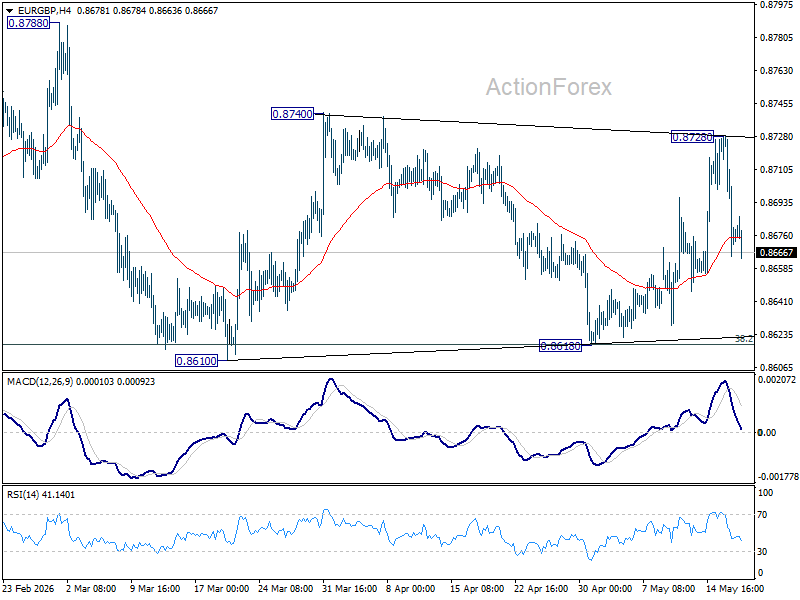
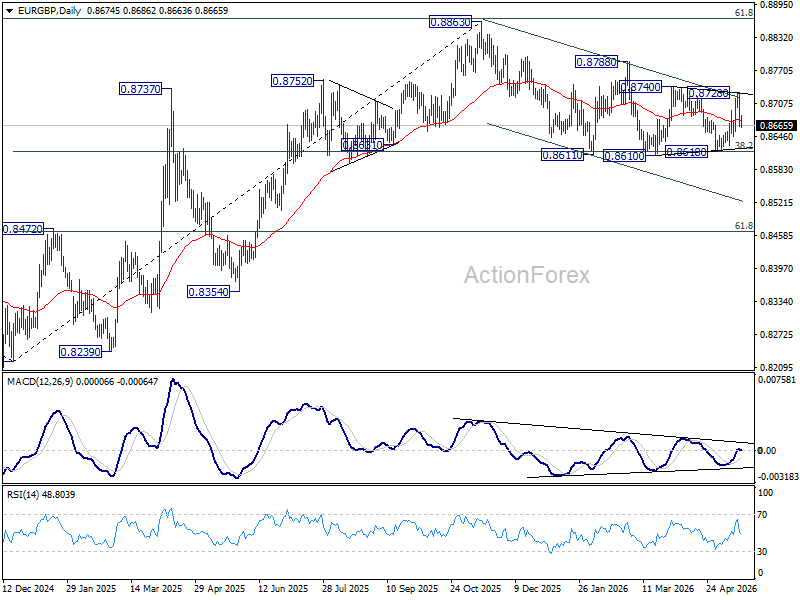
EUR/GBP's rebound from 0.8611 is resuming and intraday bias is back on the upside. Sustained trading above 0.8744 resistance will solidify the case that fall from 0.8863 has completed as a correction at 0.8661. Further rise should then be seen back to retest 0.8663 high. On the downside, below 0.8705 support will turn intraday bias neutral again first. But near term outlook will stay bullish as long as 38.2% retracement of 0.8221 to 0.8663 at 0.8618 holds.
In the bigger picture, focus remains on 61.8% retracement of 0.9267 to 0.8221 at 0.8867. Rejection by this level will keep the rise from 0.8221 medium term bottom (2024) as a corrective move. Sustained trading below 55 W EMA (now at 0.8636) should confirm that this corrective bounce has completed. However, decisive break of 0.8867 will suggest that EUR/GBP is already reversing whole decline from 0.9267 (2022 high). That should pave the way back to 0.9267.

Sterling Attempts Downside Break as Loonie Awaits GDP

Forex markets are closing out February in subdued fashion, with activity thinning as traders hold back from fresh positioning ahead of a heavy data calendar next week. Aussie remains the standout performer, supported by stronger-than-expected inflation data earlier this week, which reinforced expectations that the RBA will deliver another rate hike in May. Swiss Franc and Euro are also on the firmer side, reflecting a mild defensive undertone beneath the surface.

At the other end, Yen remains the weakest currency of the week. Bets for an April hike by the BoJ have receded amid political noise and mixed inflation signals. While some officials have kept March or April alive as possibilities, markets appear skeptical that tightening will come again that soon. Dollar and Loonie are also soft, though not under heavy selling pressure. Greenback is struggling to extend any rebound as risk sentiment stabilizes, while Canadian Dollar is cautious ahead of domestic growth data.

Sterling stands out as the notable underperformer today. The currency has fallen broadly and is attempting to break below its near-term range against Euro. There is no single headline driving the move, but expectations for a March rate cut by the BoE are continuing to build.

Political uncertainty may be compounding the pressure. The UK Labour looks set to lose the Gorton and Denton by-election, a constituency traditionally aligned with the party. A defeat there would deal another blow to Prime Minister Keir Starmer, who has faced mounting political headwinds since the start of the year. Some analysts speculate that a loss—particularly to the Green Party—could push Chancellor Rachel Reeves toward a looser fiscal stance in the upcoming Spring Statement, to regain left-leaning voters. That prospect, combined with easing expectations, weighs on Sterling.

Attention later today will turn to Canada’s GDP release. Monthly GDP is expected to rise 0.1% mom in December, with Q4 growth seen essentially flat. The numbers will be closely watched for confirmation that the economy is stabilizing rather than slipping.

The BoC is currently in an extended pause, having brought rates to 2.25% and signaled that easing may be complete. Market pricing reflects a broadly steady path from here. However, a surprise contraction in Q4 would challenge that narrative and revive speculation of a “fine-tuning” cut to cushion against a deeper slowdown.

In Asia, at the time of writing, Nikkei is up 0.14%. Hong Kong HSI is up 0.77%. China Shanghai SSE is down -0.17%. Singapore Strait Times is up 0.33%. Japan 10-year JGB yield is down -0.027 at 2.130. Overnight, DOW rose 0.03%. S&P 500 fell -0.54%. NASDAQ fell -1.18%. 10-year yield fell -0.031 to 4.017.

Subsidy effect pulls Tokyo core CPI down to 1.8%, but underlying inflation firms

Inflation in Tokyo eased further in February, with core CPI (ex-fresh food) falling to 1.8% yoy from 2.0% yoy. While slightly above market expectations of 1.7% yoy, the reading marks the third straight monthly slowdown and the lowest level since October 2024, slipping back under the BoJ’s 2% target.

The primary driver was a sharp drop in energy prices, which declined -9.2% yoy as the government’s temporary utility subsidies began to take effect. The program has mechanically dampened readings and was broadly expected to weigh on inflation for several months.

Beneath the surface, however, price dynamics remain more persistent. Core-core inflation (excluding fresh food and energy) rose to 2.5% yoy from 2.4% yoy, suggesting domestic demand conditions and wage-driven pricing remain intact. Headline CPI also ticked up modestly from 1.5% yoy to 1.6% yoy.

Japan's industrial production rose 2.2% mom on auto strength, but forward signals soft

Japan’s industrial production rose 2.2% mom in January, marking the first increase in three months, though falling well short of expectations for a 5.5%. .

Production expanded in 13 of 15 sectors, with automakers posting a notable 9.1% gain amid solid demand for passenger vehicles both domestically and overseas. However, weakness persisted in production machinery, where output declined on softer demand for semiconductor-manufacturing equipment.

The Ministry of Economy, Trade and Industry maintained its assessment that industrial production “fluctuates indecisively”. Officials noted that companies remain wary of US tariff policy developments and the Chinese growth outlook, even if no direct impact was evident in the latest data.

Looking ahead, manufacturers expect output to dip -0.5% in February and -2.6% in March.

In contrast, retail sales surprised to the upside, rising 1.8% yoy against expectations of just 0.2%.

PBOC cuts FX risk reserve to temper Yuan strength, but downtrend in USD/CNH intact

The People's Bank of China announced today that it will lower the foreign exchange risk reserve requirement for financial institutions purchasing foreign exchange via forwards to zero from 20%, effective March 2. The move reverses a September 2022 tightening measure that had been introduced to curb rapid Yuan depreciation and stem capital outflows.

At the time, the higher reserve requirement made it more costly to bet against the Yuan. Now, with the currency having surged to a near three-year high against Dollar, the adjustment signals a shift in priorities. The central bank framed the decision as support for enterprises in managing exchange-rate risks, while reiterating its commitment to maintaining the renminbi at a “reasonable and balanced level.”

Markets widely interpret the move as an attempt to slow the pace of rapid appreciation rather than to trigger depreciation outright. Yuan strength has been broad-based this week, reflecting improving sentiment around China’s trade positioning and a softer Dollar backdrop.

USD/CNH recovered mildly on the news, but the bounce has not altered the prevailing technical picture. The pair has broken through 200% projection of 7.2224 to 7.0840 from 7.1381 at 6.8613 this week, and there is no clear sign of bottoming. Technically, near-term outlook remains bearish as long as 6.9106 resistance caps rebounds. The next downside target lies at the 261.8% projection at 6.7758.

EUR/GBP Daily Outlook

Daily Pivots: (S1) 0.8718; (P) 0.8738; (R1) 0.8769; More…

EUR/GBP's rebound from 0.8611 is resuming and intraday bias is back on the upside. Sustained trading above 0.8744 resistance will solidify the case that fall from 0.8863 has completed as a correction at 0.8661. Further rise should then be seen back to retest 0.8663 high. On the downside, below 0.8705 support will turn intraday bias neutral again first. But near term outlook will stay bullish as long as 38.2% retracement of 0.8221 to 0.8663 at 0.8618 holds.

In the bigger picture, focus remains on 61.8% retracement of 0.9267 to 0.8221 at 0.8867. Rejection by this level will keep the rise from 0.8221 medium term bottom (2024) as a corrective move. Sustained trading below 55 W EMA (now at 0.8636) should confirm that this corrective bounce has completed. However, decisive break of 0.8867 will suggest that EUR/GBP is already reversing whole decline from 0.9267 (2022 high). That should pave the way back to 0.9267.


Economic Indicators Update

GMT CCY EVENTS Act Cons Prev Rev
23:30 JPY Tokyo CPI Y/Y Feb 1.60% 1.50%
23:30 JPY Tokyo CPI Core Y/Y Feb 1.80% 1.70% 2.00%
23:30 JPY Tokyo CPI Core-Core Y/Y Feb 2.50% 2.40%
23:50 JPY Industrial Production M/M Jan P 2.20% 5.50% -0.10%
23:50 JPY Retail Trade Y/Y Jan 1.80% 0.20% -0.90%
00:01 GBP GfK Consumer Confidence Feb -19 -15 -16
00:30 AUD Private Sector Credit M/M Jan 0.50% 0.10% 0.80%
05:00 JPY Housing Starts Y/Y Jan -2.00% 1.30%
07:00 EUR Germany Import Price M/M Jan 0.60% -0.10%
07:45 EUR France GDP Q/Q Q4 0.20% 0.20%
08:00 CHF GDP Q/Q Q4 0.20% -0.50%
08:00 CHF KOF Economic Barometer Feb 103.1 102.5
08:55 EUR Germany Unemployment Change Jan 3K 0K
08:55 EUR Germany Unemployment Rate Jan 6.30% 6.30%
13:00 EUR Germany CPI M/M Feb P 0.50% 0.10%
13:00 EUR Germany CPI Y/Y Feb P 2.00% 2.10%
13:30 CAD GDP M/M Dec 0.10% 0.00%
13:30 USD PPI M/M Jan 0.30% 0.50%
13:30 USD PPI Y/Y Jan 2.60% 3.00%
13:30 USD PPI Core M/M Jan 0.30% 0.70%
13:30 USD PPI Core Y/Y Jan 3.00% 3.30%
14:45 USD Chicago PMI Feb 52.6 54


USD/JPY Climbs Higher, Bulls Eye Fresh Upside Extension Ahead

Key Highlights

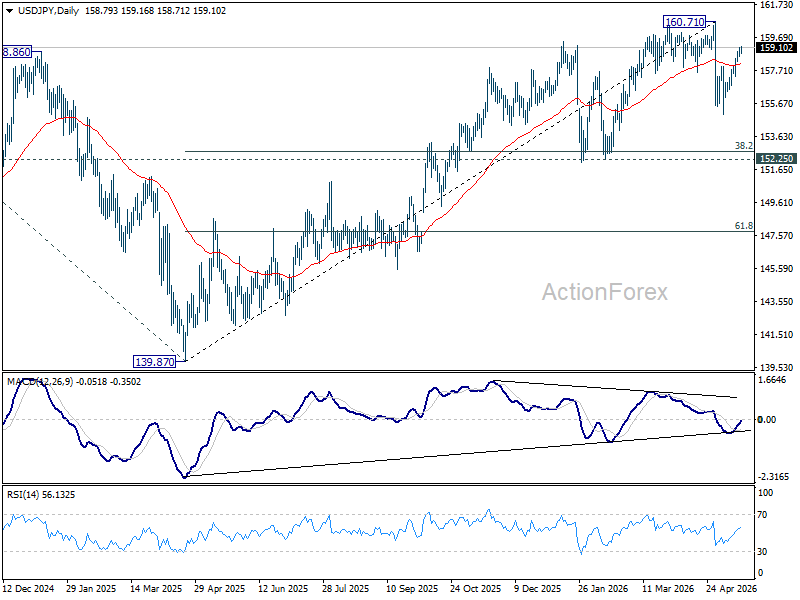
  • USD/JPY regained traction and climbed above the 155.00 resistance.
  • A rising channel is forming with support at 155.50 on the 4-hour chart.
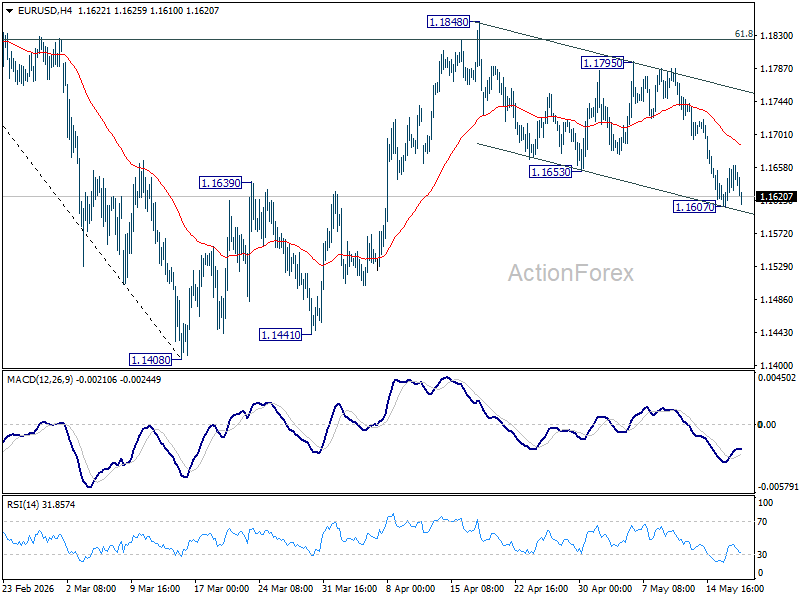
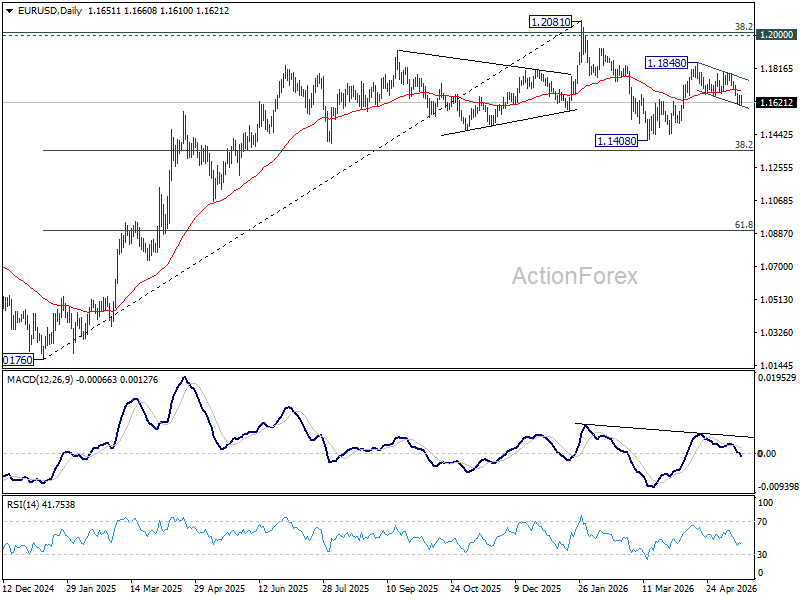
  • EUR/USD is struggling to clear the 1.1840 and 1.1860 resistance levels.
  • Crude Oil prices trimmed some gains and corrected below $65.20.

USD/JPY Technical Analysis

The US Dollar formed a base above 154.00 against the Japanese Yen. USD/JPY started a steady increase above 154.80 and 155.00.

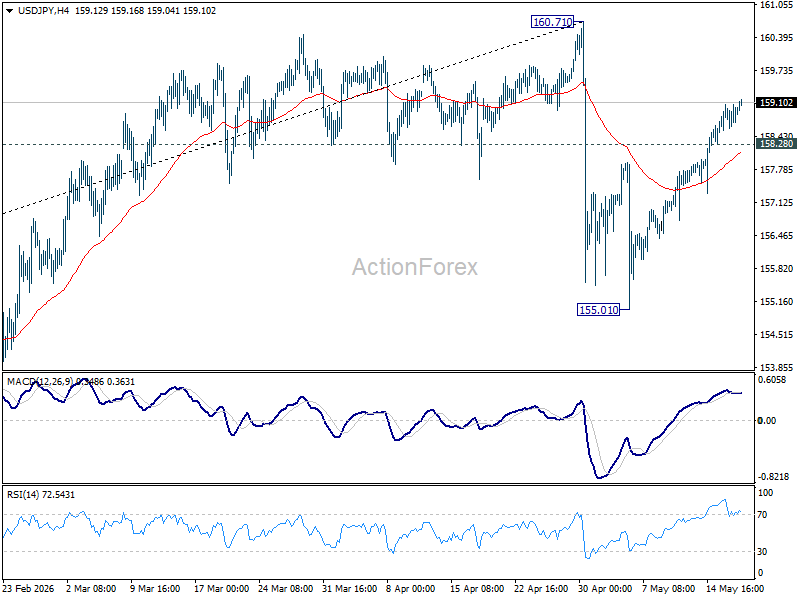
Looking at the 4-hour chart, the pair settled above 155.00, the 100 simple moving average (red, 4-hour), and the 200 simple moving average (green, 4-hour). There was a clear move above the 61.8% Fib retracement level of the downward move from the 157.66 swing high to the 152.27 low.

On the upside, the pair is now facing hurdles near 156.50. The first major resistance sits at 156.80. A close above 156.80 could open the doors for more gains. In the stated case, the bulls could aim for a move to 157.20. The main resistance sits near 158.00.

Immediate support could be 155.50. There is also a rising channel forming with support at 155.50. The first major area for the bulls might be near 155.00 or the 100 simple moving average (red, 4-hour).

The main support sits at 154.70, below which the pair might gain bearish momentum. In the stated case, it could even revisit 153.80 in the coming days.

Looking at EUR/USD, the pair started a recovery wave, but the bears seem to be active near the 1.1840 and 1.1860 levels.

Upcoming Key Economic Events:

  • US Producer Price Index for Jan 2026 (MoM) – Forecast +0.3%, versus +0.5% previous.
  • US Producer Price Index for Jan 2026 (YoY) – Forecast +2.6%, versus +3.0% previous.
  • Chicago Purchasing Manager’s Index for Feb 2026 – Forecast 52.8, versus 54.0 previous.

PBOC cuts FX risk reserve to temper Yuan strength, but downtrend in USD/CNH intact

The People's Bank of China announced today that it will lower the foreign exchange risk reserve requirement for financial institutions purchasing foreign exchange via forwards to zero from 20%, effective March 2. The move reverses a September 2022 tightening measure that had been introduced to curb rapid Yuan depreciation and stem capital outflows.

At the time, the higher reserve requirement made it more costly to bet against the Yuan. Now, with the currency having surged to a near three-year high against Dollar, the adjustment signals a shift in priorities. The central bank framed the decision as support for enterprises in managing exchange-rate risks, while reiterating its commitment to maintaining the renminbi at a “reasonable and balanced level.”

Markets widely interpret the move as an attempt to slow the pace of rapid appreciation rather than to trigger depreciation outright. Yuan strength has been broad-based this week, reflecting improving sentiment around China’s trade positioning and a softer Dollar backdrop.

USD/CNH recovered mildly on the news, but the bounce has not altered the prevailing technical picture. The pair has broken through 200% projection of 7.2224 to 7.0840 from 7.1381 at 6.8613 this week, and there is no clear sign of bottoming. Technically, near-term outlook remains bearish as long as 6.9106 resistance caps rebounds. The next downside target lies at the 261.8% projection at 6.7758.

Japan’s industrial production rises 2.2% mom on auto strength, but forward signals soft

Japan’s industrial production rose 2.2% mom in January, marking the first increase in three months, though falling well short of expectations for a 5.5%. .

Production expanded in 13 of 15 sectors, with automakers posting a notable 9.1% gain amid solid demand for passenger vehicles both domestically and overseas. However, weakness persisted in production machinery, where output declined on softer demand for semiconductor-manufacturing equipment.

The Ministry of Economy, Trade and Industry maintained its assessment that industrial production “fluctuates indecisively”. Officials noted that companies remain wary of US tariff policy developments and the Chinese growth outlook, even if no direct impact was evident in the latest data.

Looking ahead, manufacturers expect output to dip -0.5% in February and -2.6% in March.

In contrast, retail sales surprised to the upside, rising 1.8% yoy against expectations of just 0.2%.

Subsidy effect pulls Tokyo core CPI down to 1.8%, but underlying inflation firms

Inflation in Tokyo eased further in February, with core CPI (ex-fresh food) falling to 1.8% yoy from 2.0% yoy. While slightly above market expectations of 1.7% yoy, the reading marks the third straight monthly slowdown and the lowest level since October 2024, slipping back under the BoJ’s 2% target.

The primary driver was a sharp drop in energy prices, which declined -9.2% yoy as the government’s temporary utility subsidies began to take effect. The program has mechanically dampened readings and was broadly expected to weigh on inflation for several months.

Beneath the surface, however, price dynamics remain more persistent. Core-core inflation (excluding fresh food and energy) rose to 2.5% yoy from 2.4% yoy, suggesting domestic demand conditions and wage-driven pricing remain intact. Headline CPI also ticked up modestly from 1.5% yoy to 1.6% yoy.


You Will Comply With the AI

AI can speed up the drudge work and allow humans to redirect effort to higher-value tasks. But if the drudge work is demonstrating compliance with regulation, will the regulators allow this?

  • Breathless commentary on the job-destroying effects of AI partly reflects how quickly the technology is changing, making its implications hard to assess. But it also misses important nuances: when assessing the job impacts, it assumes jobs are made up of disconnected tasks.
  • Academic research points to better ways to think about the issue. One recent paper suggests that firms will automate tasks where AI can achieve current output quality, and not those where it does not. Worker time is freed up as some tasks are automated, and reallocated to other tasks, increasing the quality of output for these tasks. This raises the quality bar for automating them later, and could make human labour more valuable, not less.
  • Some tasks will be ripe for automation, because they require significant effort just to achieve bare-minimum quality. Compliance-related tasks are a good example of this, provided the regulators allow it. The result could be a better-quality product from the perspective of customers. But new issues arise, including compliance issues raised by the technology, and the possibility that regulatory expectations rise as automation makes compliance cheaper.

From breathless essays to suspiciously AI-style social media posts, the (potentially disruptive) effects of AI are front of mind for many people. The disruption narrative has become so much part of the zeitgeist that “software developer who lost his job to AI and now has no health insurance” was the backstory for a patient in a recent episode of Grey’s Anatomy.

One reason for the angst is that things are moving so quickly that the humans are struggling to make sense of things. Reasoning models are only a year and a half old, after all. The capabilities of the leading models leapt ahead in just the past three months. Any intuitions you had about AI’s impact based on what the models could do six months ago are obsolete. Add in the policy and geopolitical chaos of the Trump administration, and it is no wonder that investors throw up their hands and sell.

Aside from its own speed of development, one of the things that make it hard to assess the implications of AI is that people are using a simplistic ‘bag of tasks’ view of work. If too many of your tasks are automated rather than augmented by AI, goes the thinking, then your job is at risk.

A better approach was suggested in a recent paper by two University of Toronto professors, Joshua Gans and Avi Goldfarb. Instead of a bag of disconnected tasks, they model production as a set of tasks with varying quality. The quality of the final output is the product of each task’s quality, that is, multiplying quality across tasks. If any task has zero quality, the whole output has zero quality. (These are known as “O-ring” models of production, after the parts failure that was the proximate cause of the Challenger disaster.)

In this setup, firms will automate tasks that the technology can produce to the required quality and reallocate the human effort to the remaining tasks. Worker time is reallocated rather than ‘saved’ in the form of layoffs, because there is a return to improving the quality of the non-automated tasks. It is this variable quality of tasks and output that the ‘bag of tasks’ literature ignores. A concrete example of this time reallocation effect comes from a recent speech by Fed Governor Chris Waller. He noted that AI-based coding tools reduced time spent on routine tasks. Developers at the Fed can instead focus on enhancing security and quality of the end product. This has also been our experience: faster coding means more time for thinking and writing.

Gans and Goldfarb’s model has some interesting implications beyond the lack of layoffs. Once some tasks are automated, it becomes harder to automate the remaining tasks, because they are now being done to a higher quality than before. This means that automation will not be a smooth process but could happen in fits and starts. It could also make human labour more valuable than before, by focusing it on remaining high-value tasks. The barrier to automating everything might therefore be higher than people realise, and the question of what gets automated when depends on what was automated first.

The O-ring model also allows for some useful extensions that the Gans and Goldfarb paper does not mention (and for which the mathematical workings will be available on request). In the standard O-ring model, zero effort on a task translates to zero quality, but any time spent on a task produces positive quality and thus positive final output. Consider the case where significant effort must be spent on a task to reach even zero quality. An example of this might be the effort involved in achieving and demonstrating compliance with legal or regulatory requirements. Expending positive but less than this minimum threshold effort still results in the zero-quality output disaster of a finding of non-compliance.

If one task involves this fixed-effort ‘compliance tax’ and the others do not, it will be one of the tasks firms seek to automate first, because it frees up much more time to do other things than automating the other tasks would. Again, the ‘bag of tasks’ view misses this possibility.

The issue then becomes: will the regulators permit automation of compliance activities or demonstrating that compliance? Is it enough for an AI to check against a list or rules, or are costly manual sign-offs needed for accountability? Will regulators who are themselves taking a cautious approach to the new technologies be over-cautious? And will automation just shift compliance tasks to other forms, such as managing vendor risk, or ensuring model results are explainable and that the systems do not hallucinate? Another complication is that different regulators could take different stances on this issue.

A further wrinkle arises if effort is required to meet bare compliance, but there is also a ceiling beyond which further effort on the compliance task is fruitless. Think of a five-star or ‘fully compliant’ rating, but no sixth star to shoot for. If the manual effort to comply is large enough, the firm will choose to automate even if that means going from five-star to bare pass, if that raises the quality of other activities enough.

That choice will be most attractive if the over-compliance is insurance rather than an expression of risk appetite. If manual effort has uncertain outcomes, firms will choose to over-comply to avoid occasional non-compliant outcomes. An aspect of this uncertainty, as Westpac has previously highlighted in its submission to the productivity roundtable process, is that regulators in Australia tend not to confirm that what the entity is doing complies, but rather, wait for those moments of non-compliance and enact consequences. Over-compliance is the natural response to this regulatory approach; a more reliable, less-manual process might not need as large a buffer. If automated outcomes are more reliable and certain as well as faster and cheaper, then the firm may rationally choose not to over-comply the way it did when everything was done manually. Firms will need to ask themselves: are they over-complying to ensure reliability of the process, or is it part of the brand and culture that they want to retain?

Regulators might not be pleased to see regulated entities remaining compliant, but no longer five-star. They will need to ask themselves if their assessment criteria emphasise process rather than outcome. On the other hand, once real-time automated data checking becomes possible, periodic manual sampling will seem inadequate. The bar on compliance could inexorably rise as compliance becomes faster and cheaper. The reliability and explainability of the regulated entities’ processes will also matter.

So you probably will comply using the AI, and you will certainly want to, given the payoff of freeing up time for other things. Key questions for Australia’s future technology adoption and productivity growth are: what other issues does it raise, and will the various regulators agree to the change?

Cliff Notes: Capacity is Key

Key insights from the week that was.

The January CPI came in above expectations, prices rising 0.4% in the month and 3.8%yr (WBC 3.6%yr; consensus 3.7%yr). On a seasonally adjusted basis, price growth was a touch firmer at 0.5%. Electricity, garments and footwear were the key supports in the month. A portion of this strength was netted out of the core inflation calculation, however, the trimmed mean gaining 0.3% in the month as expected to be up 3.4%yr. We view the detail of this release as consistent with our existing forecast for the March quarter, which is 0.9%, 3.5%yr for trimmed mean inflation and 1.1%, 3.8%yr for the headline measure.

This week’s investment partials point to some modest downside risks for next week’s Q4 GDP. However, the longer-term view is favourable. Construction activity highlighted the rotation underway from public to private investment. And, inclusive of construction and equipment spending, private CAPEX surprised on the upside, growing 7.8% over the year to December. Underlying the headline CAPEX result, investment in buildings and structures rose robustly in the quarter and had breadth across non-mining industries, but it was offset by a pull-back in spending on data-centre related equipment. Excluding the impact of data-centre CAPEX, non-mining investment in machinery and equipment increased a healthy 3.0% in the quarter. CAPEX plans point to the current growth pace being maintained through the remainder of FY2026 for a 7.6%yr inflation-adjusted gain. The first estimate for FY2027 implies growth will continue beyond June too.

A full preview for next week’s Q4 GDP report will be released later today on Westpac IQ. And, for an in-depth view of Australia’s businesses, refer to the latest Westpac Quarterly Business Snapshot. Meanwhile, Chief Economist Luci Ellis’ focus this week has been AI’s effect on job specification, productivity and labour demand.

In the US, last Friday the Supreme Court struck down US President Donald Trump’s use of the International Emergency Economic Powers Act to institute country-specific tariffs. Whether refunds will be required is still to be determined. But, to shore up future revenue collection, President Trump immediately instituted a 10% global tariff under Section 122 of the 1974 Trade Act and threatened to lift the rate to 15%. Note though, this avenue is only available for up to 150 days without Congressional approval – an immense challenge right before the mid-term elections. The net effect is a temporary marginal increase in the US’ effective tariff rate, but with some countries experiencing a more material increase (or decrease) depending on their starting position. President Trump intends to hold individual nations to agreed deals and industry tariffs remain valid. For some countries though, holding to their agreed deal will put them at a disadvantage. So far, leaders of countries impacted have largely kept quiet, taking time to assess the implications.

Also received late last week, US GDP surprised to the downside in Q4, activity rising 1.4% annualised against a 2.8% expectation. Personal consumption gained 2.4% annualised, however, in line with the historic trend, and non-residential investment maintained a moderate pace of growth, 3.7% annualised. Offsetting was another decline in residential investment, -1.5% annualised, and government consumption falling 5.1% annualised because of the shutdown – Federal Government spending plunged 16.6% annualised. Despite the disappointment, we remain of the view that the US’ underlying pulse is consistent with momentum at or above trend through 2026, fuelled by a tight labour market and robust nominal wage gains. However, we remain mindful of the downside risks posed by cost-of-living pressures – nominal personal spending increased by 0.4% in December, but real spending lifted just 0.1%.

Over in Japan, Prime Minister Takaichi appointed two new members to the Bank of Japan’s policy board, Ayano Sato and Toichiro Asada. Both are considered to be dovish but replace members who have exercised caution on further rate increases, seeing the Board become only marginally more dovish. In a speech this week, member Hajime Takata did not comment on the new appointments but did note the BoJ can step in in times of excessive bond market volatility. We hold the view that while there may be volatility in the short term, fundamentals point to the 10-year bond yield falling to 2.0% over time. On monetary policy, Takata said little on the policy outlook, noting only that the Board is not on a pre-set path and highlighting the importance of the currency to inflation.