

Sample Category Title
ECB’s Lagarde watches Q1 wage talks for clues on lasting disinflation
ECB President Christine Lagarde described Q4 wage figures as "obviously encouraging numbers". However, she underscored the importance of caution, stating that the Governing Council needs to gain "more confidence" in the sustainability of the disinflationary process currently underway.
Lagarde also pointed to ongoing wage negotiations across various sectors and employee groups, expected to conclude in Q1, with data becoming available in May. The outcomes of these negotiations are anticipated to be a critical factor in the ECB's assessment of the inflationary outlook.
"Those numbers will — especially if they continue to be encouraging — will be important for us to assess going forward in order to reach confidence," Lagarde remarked in a press conference today.
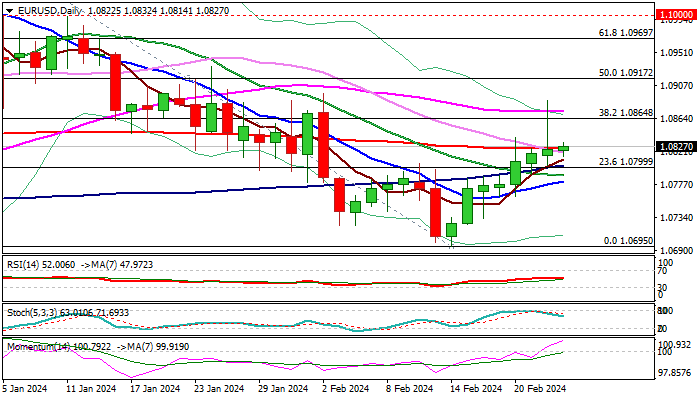
EUR/USD: Final Close Above 200DMA to Strengthen Near Term Structure
The Euro is holding within a narrow range on Friday but keeps slight bullish bias on strong positive momentum and the pair being on track for the first bullish weekly close in five weeks.
On the other hand, multiple failure to clear 200DMA barrier (1.0824) and Thursday’s strong upside rejection which left daily candle with long upper shadow, weighs on near-term action.
Improved German business climate in February (Ifo report) and Q4 GDP in line with expectations, contribute to supportive factors for the single currency.
Markets will focus on today’s close with fresh bullish signal expected on eventual close above 200DMA which will open way for retest of barriers at 1.0864/74 (Fibo 38.2% of 1.1139/1.0695 / 55DMA) and possibly spark stronger bullish acceleration on clear break higher.
Caution on repeated failure at 200DMA which will initially signal prolonged sideways mode while the price action stays above daily Tenkan-sen (1.0791).
Res: 1.0864; 1.0874; 1.0897; 1.0917.
Sup: 1.0814; 1.0791; 1.0768; 1.0740.
New Zealand Dollar Edges Lower After Soft Retail Sales
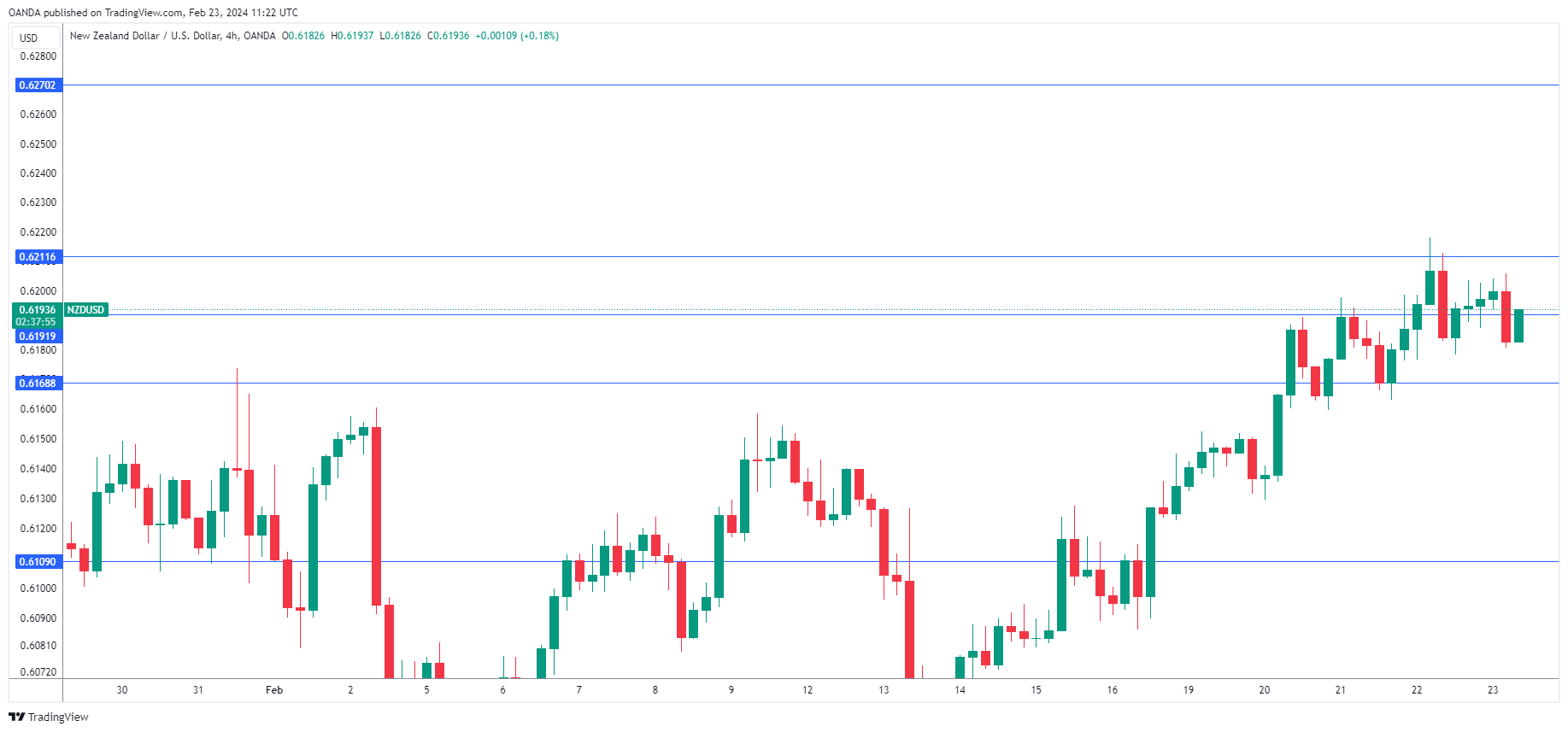
The New Zealand dollar has been on a roll but is in danger of snapping a seven-day rally during which it gained over 2% against the US dollar. NZD/USD is trading in the European session at 0.6185, down 0.16%.
New Zealand retail sales decline by 1.9%
Another retail sales report, another decline. New Zealand retail sales fell by 1.9% q/q in the fourth quarter of 2023, marking the eighth straight quarter of decline in retail spending. This was much lower than the revised 0.8% decline in Q3 and the market estimate of -0.4%.
The downswing was felt across the economy, as 14 of 15 retail industries recorded a fall in retail activity. On an annualized basis, retail sales slid 4.1%, down from -3.4% in Q3 and below the forecast of -3.6%, the fifth straight quarter of decline.
The weak data indicates that consumer spending is sputtering and that could mean New Zealand’s economy is in a recession. GDP growth contracted in the third quarter by 0.3% and if Q4 also records negative growth would meet the definition of a technical recession.
The retail sales release is doubly significant as it is the final key release before the Reserve Bank of New Zealand meets on February 28th. Governor Orr has not ruled out further rate hikes as part of a pushback against market expectations for a rate cut in mid-2024. Still, a rate hike doesn’t seem likely, especially after the weak retail sales report. The RBNZ has maintained the cash rate at 5.50% since April 2023 and it would be a major surprise if it does not hold rates next week.
NZD/USD Technical
- NZD/USD is putting pressure on resistance at 0.6211. Above, there is resistance at 0.6270
- 0.6168 and 0.6109 are providing support
ECB Survey: Consumer inflation expectations for next tear rise to 3.3%
ECB's Consumer Expectations Survey for January showed that inflation expectations for the upcoming year have seen a slight uptick, increasing by 0.1% to 3.3%, while the forecast for three years ahead remains steady at 2.5%.
On a more optimistic note, the survey indicates a slight improvement in expectations for economic growth over the next year. The mean expectation for economic growth has become less negative, adjusting from -1.3% to -1.1%.
Furthermore, the expected mean unemployment rate for the next 12 months shows a slight decrease, moving from 10.8% to 10.6%.
ECB’s Nagel: Rate cut may be tempting, but it’s not time yet
In the annual report from Bundesbank, ECB Governing Council member Joachim Nagel emphasized the importance of caution and patience. "Even though it may be very tempting, it is too early to cut interest rates. This is because the price outlook is not yet clear enough," Nagel stated.
Furthermore, Nagel's call for perseverance reflects an understanding of the challenges inherent in steering monetary policy towards achieving price stability. "We should not let ourselves stray away from the path we have embarked on," he advised, emphasizing the need for consistency and resilience in ECB's policy stance.
Holzmann: ECB’s monetary policy often trails behind Fed’s
In an interview with Bloomberg TV, ECB Governing Council member Robert Holzmann pointed out that historically, ECB tends to follow Fed's policy adjustments with a delay, typically around half a year.
"Typically the Fed always in the last few years has always gone first by about half a year so I would assume, ceteris paribus, as things are, that we would also follow with delay," he stated, indicating a likelihood that ECB would not preempt Fed in cutting its policy rates.
The Governing Council member also highlighted ongoing inflation risks, particularly from geopolitical tensions affecting shipping routes in the Red Sea. Holzmann cautioned that these factors could contribute to persistent inflationary pressures.
He specifically mentioned the possibility of an escalation in the Red Sea conflict affecting oil prices, a scenario that, while slim, poses a real risk to inflation and economic stability.
Holzmann also expressed skepticism towards market expectations for significant policy easing in Eurozone this year. He warned that market bets for 90 basis points of easing "may be much too high".
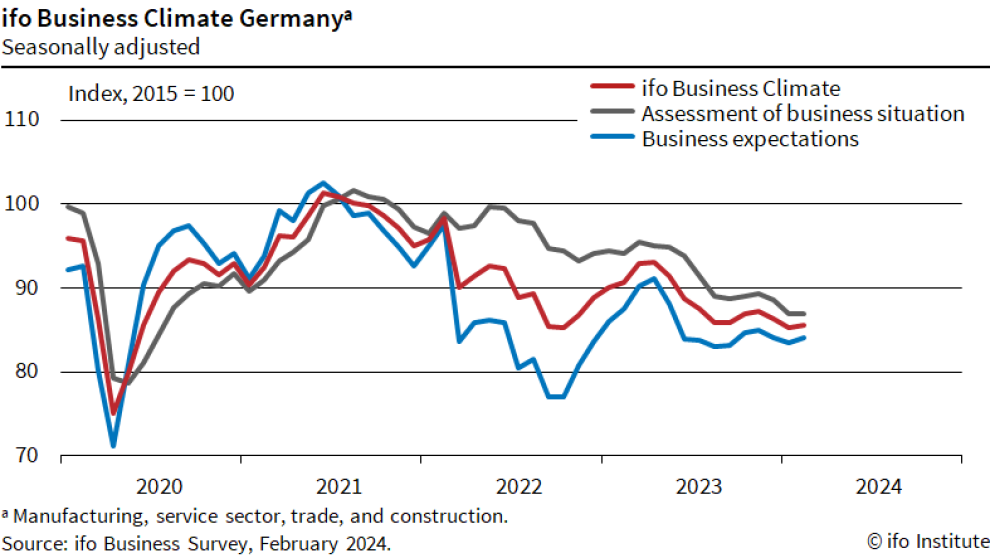
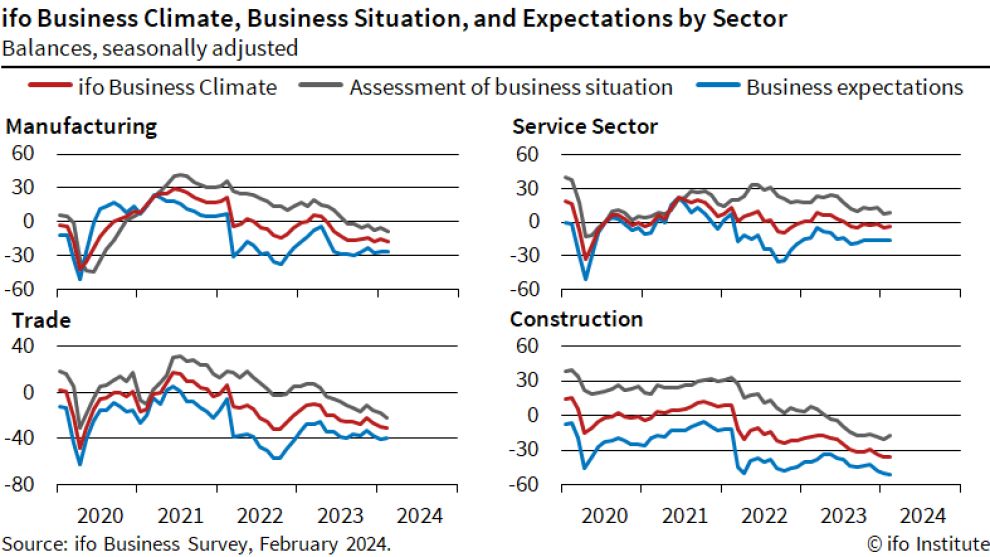
German Ifo edges up to 85.5, stabilizing at a low level
German Ifo Business Climate ticked up from 85.2 to 85.5 in February, matched expectations. Current Assessment Index is unchanged at 86.9, a touch below expectation of 87.0. Expectations Index rose slightly from 83.5 to 84.1, above expectation of 83.8.
By sector, manufacturing fell from -15.8 to -17.4. Services rose from -4.8 to -4.1. Trade fell from -29.7 to -30.87. Construction rose from -35.8 to -35.4.
Ifo said that the German economy is "stabilizing at a low level".
Silver (XAGUSD) With Bearish Extension and Intraday Target at 22.34
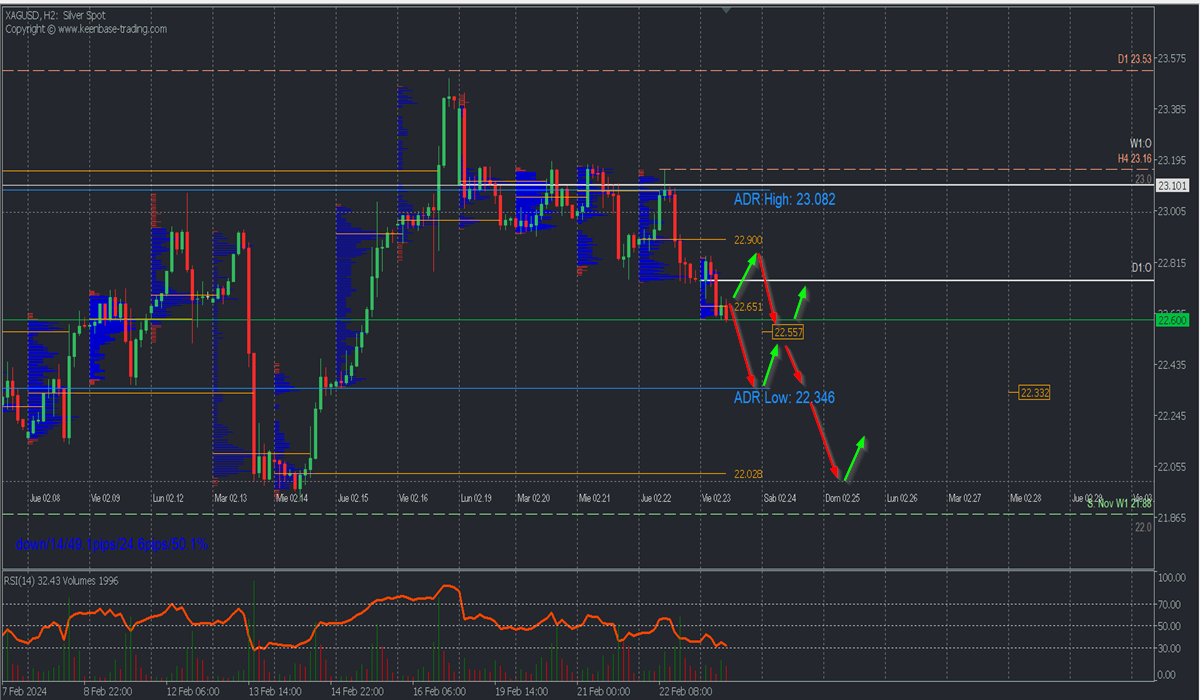
Bearish Scenario: Selling below 22.65 with TP1: 22.34 (intraday) and TP2: 22.02 (swing). It is recommended to place a stop loss around 22.80, at least 1% of the account capital**. A trailing stop can be used.
Bullish Scenario: Buying above 22.70 with TP1: 22.90. It is recommended to set a stop loss (S.L.) below 22.60 or at least 1% of the account capital**.
Analysis from the daily chart. Volume Profile and Structure.
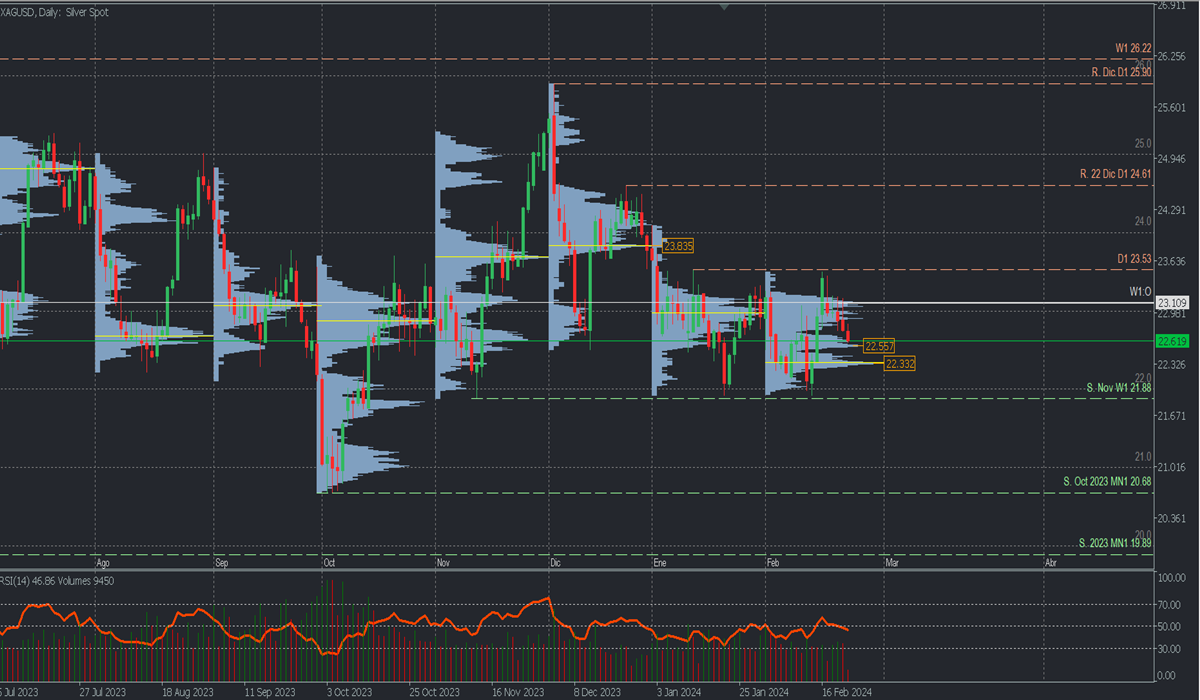
XAGUSD has been consolidating since January above the November support at 21.88 and an October high volume node that has halted the price decline three times since November.
February has been forming a broad buying zone between 22.33 and 22.55, implying that as long as prices remain above this zone, a new price rally seeking to surpass the consolidation resistance at 23.53 towards the December volume concentration around 24.00 is more likely to occur.
However, a decisive breakout of the buying zone and a bearish extension below 21.88 will indicate that bearish strength outweighs buying. Consequently, the price will seek the next high liquidity zone, around the first October high volume node between 21.20 and 21.00.
Scenario from the H2 chart:
The first possible scenario is the bearish continuation seeking more liquidity in the previously indicated buying zones, so it is observed that prices remain below yesterday's uncovered POC* at 22.90 and the Asian POC at 22.65, leaving a clear intraday bearish scenario with targets in the bearish average range of 22.34 intraday and more extendedly Monday's uncovered POC from Wednesday 14 at 22.02. Both zones can trigger bullish entry towards the previously left sales zones for a new rally.
However, if we take into account the RSI position touching the oversold zone, we can consider the possibility of an early retracement towards 22.80 and 22.90 as selling zones, from where to resume the bearish continuation towards 22.33 and even 22.02 in extension.
*Uncovered POC: POC = Point of Control: It is the level or zone where the highest volume concentration occurred. If previously, there was a bearish movement, it is considered a selling zone and forms a resistance zone. On the contrary, if previously, there was a bullish impulse, it is considered a buying zone, usually located at lows so they form support zones.
**Consider this risk management suggestion.
**It is very important that risk management is based on capital and traded volume. For this, a maximum risk of 1% of capital is recommended. It is suggested to use risk management indicators like Easy Order.
USDCAD Uptrend Loses Power
- USDCAD lacks strength but holds near key support zone
- Short-term bias looks neutral
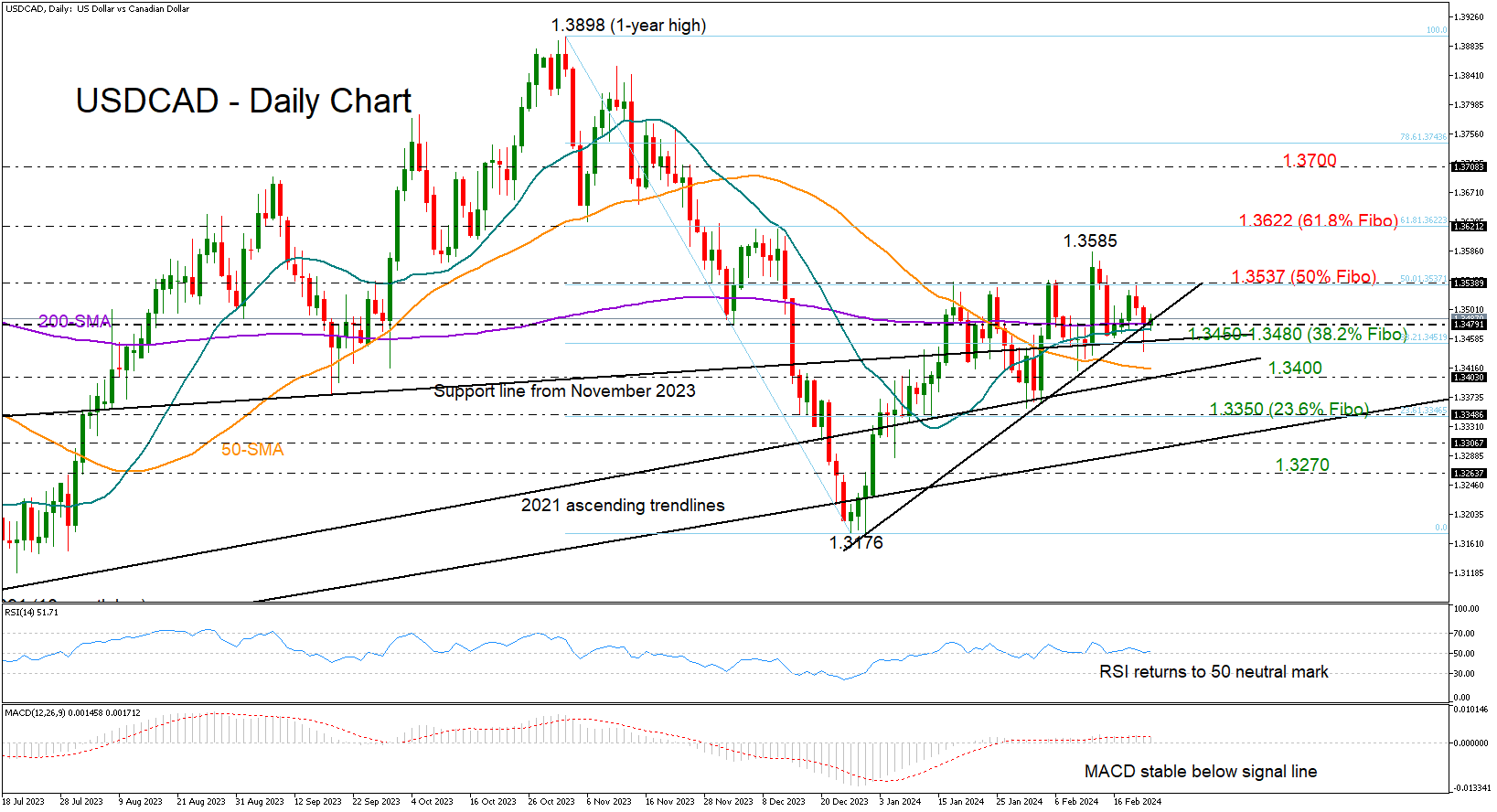
USDCAD has been facing difficulties in printing new higher highs for more than a week now, shifting to the sidelines to trade around 1.3480.
The technical indicators are mirroring the absence of buying interest, with the RSI easing towards its 50 neutral mark and the MACD remaining muted below its red signal line. The flattening simple moving averages (SMAs) is another indication of an indecisive market.
On a positive note, the price has not dropped below the protective trendline zone of 1.3450-1.3480 yet, and if that floor holds firm again, the pair might crawl up to retest the 50% Fibonacci retracement of the previous downleg at 1.3537. A successful move higher would re-activate the short-term uptrend, bringing the 61.8% Fibonacci of 1.3622 next into view.
In the bearish scenario, where the bears take control below 1.3450, support could develop around the 1.3400 mark. This is where the 50-day SMA and the ascending trendline from 2021 are converging. Hence, another failure there might prompt a decline towards the 1.3300-1.3350 territory. Should that base crack too, the pair could tumble towards December’s bottom of 1.3176, unless the 1.3270 constraining zone comes to the rescue beforehand.
Summing up, USDCAD keeps trading within a neutral territory in the short-term picture. A step below 1.3450 could dampen sentiment, whilst a bounce above 1.3537 could bolster buying appetite.
Crypto Market Opts for Caution
Market picture
The crypto market lost around 1.2% overnight to $1.95 trillion, according to CoinMarketCap. The Crypto Fear and Greed Index rose to 76 (Extreme Greed). This is a somewhat lagging indicator, reflecting sentiment the day before rather than at the moment. Since Friday morning, crypto has been dominated by selling despite all-time highs in many global equity indices. As a very sensitive indicator, the crypto market may be signalling that investors have become a little more cautious.
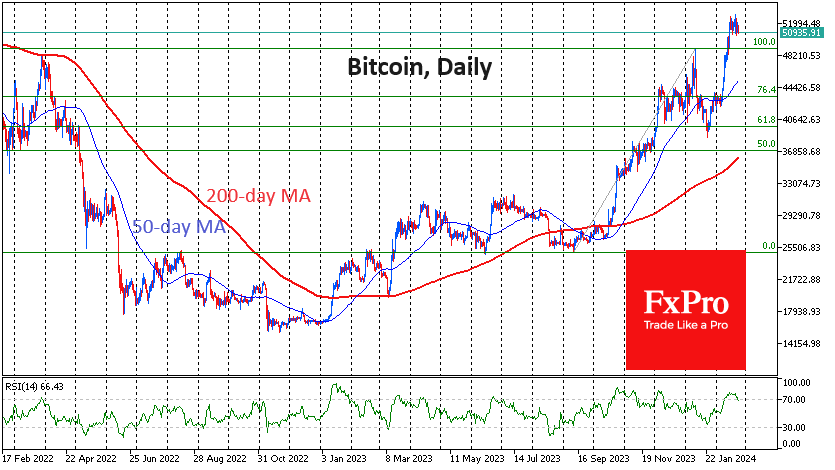
The price of Bitcoin has fallen below $51K, which is near the bottom of the consolidation range of the last eight days. Without a bounce from here, we could see a deeper correction begin, potentially as low as $47-49K.
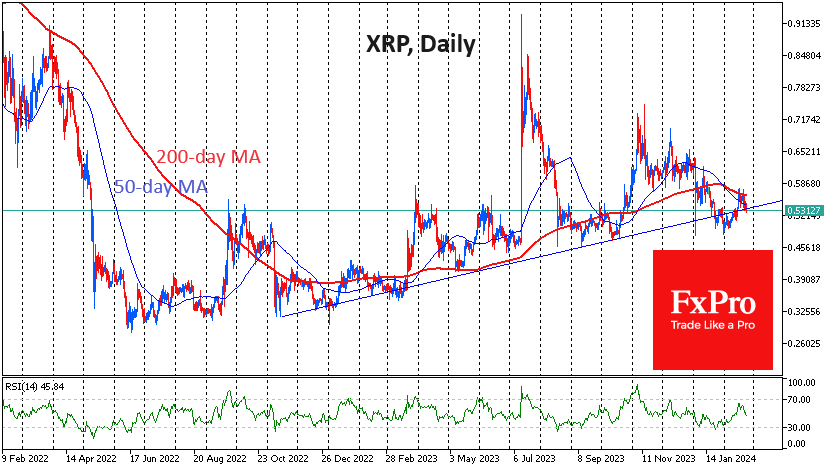
XRP failed to break above its 200-day moving average resistance again this week. It also fell below its 50-day MA on Friday morning. Both curves are pointing down, reinforcing the bearish signal. XRP is testing a long-term support line that has been in place since November 2022, the low point of the crypto market in the current cycle.
News background
The crypto market is at the beginning of its fourth major cycle, ushering in a bullish period for cryptocurrencies for the next 18 months to two years, according to a new report from Pantera Capital. The growing functionality of Bitcoin and its use in layer two networks is becoming a key element in the development of a new decentralised financial system comparable in scale to the Ethereum ecosystem.
Nvidia beat earnings expectations in the fourth quarter, fuelling growth in artificial intelligence-related tokens. The company reported revenues of $22.1 billion, beating analyst forecasts by almost $2 billion.
Fundstrat’s Thomas Lee suggested that bitcoin will top $150K in 2024 due to its halving in April and high demand for spot ETFs.
According to The Block, the meme coin segment has seen capital outflows in the last week amid an increase in overall crypto market growth. Nansen attributes this to investors switching to Bitcoin and Ethereum.
The launch of spot ETFs on Ethereum could concentrate a significant amount of ETH in the same hands, posing risks of centralisation of the ETH network, according to S&P Global Ratings. The emergence of new institutional custodians for cryptocurrencies could mitigate the risks.
According to Deribit, bitcoin call options expiring at the end of June have concentrated above the $60K strike price, signalling bullish sentiment. In February, open interest in call options is locked between strike prices of $53K and $60K. The “maximum pain point” is at $48K. However, Deribit notes that the market could face increased selling pressure after the halving in April.