

Sample Category Title
USD/JPY Daily Outlook
Daily Pivots: (S1) 150.14; (P) 150.42; (R1) 150.81; More...
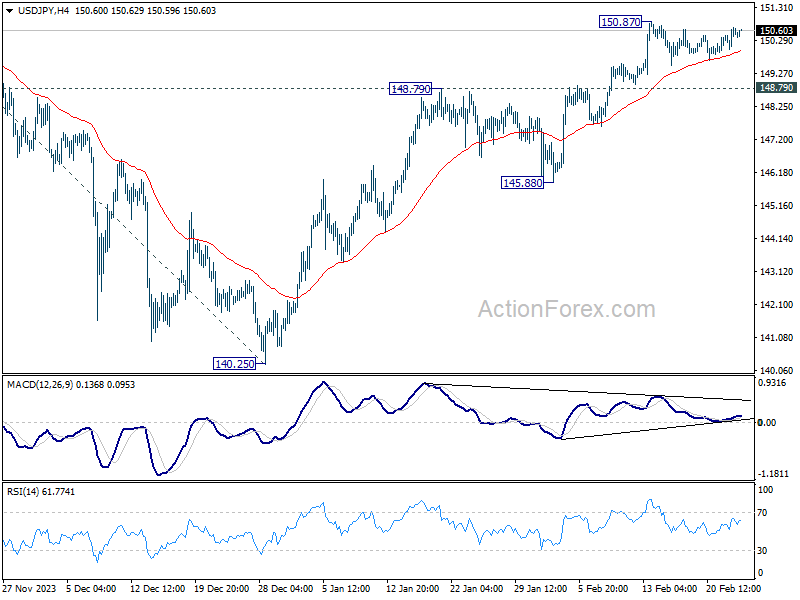
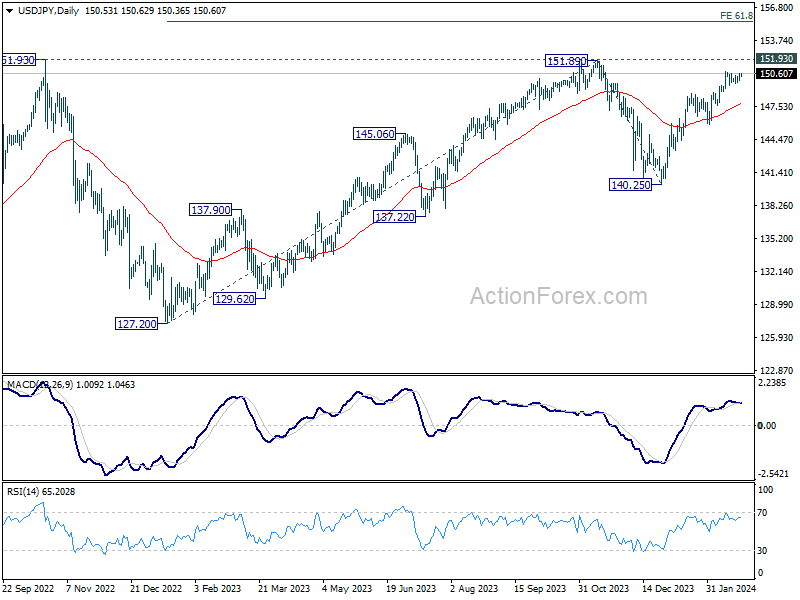
Intraday bias in USD/JPY remains neutral for the moment as consolidation from 150.78 is extending. Another retreat cannot be ruled out, but downside should be contained by 148.79 resistance turned support to bring rise resumption. Above 150.87 will resume the rally from 140.25 to 151.89/93 key resistance zone. Decisive break there will confirm larger up trend resumption of 155.50 projection level next. However, firm break of 148.79 will turn bias to the downside for 145.88 support.
In the bigger picture, fall from 151.89 is seen as a correction to the rally from 127.20, which might have completed at 140.25 already. Firm break of 151.89/93 resistance zone will confirm up trend resumption, and next target will be 61.8% projection of 127.20 to 151.89 from 140.25 at 155.50. This will now remain the favored case as long as 140.25 support holds.
USD/CAD Daily Outlook
Daily Pivots: (S1) 1.3446; (P) 1.3477; (R1) 1.3514; More...
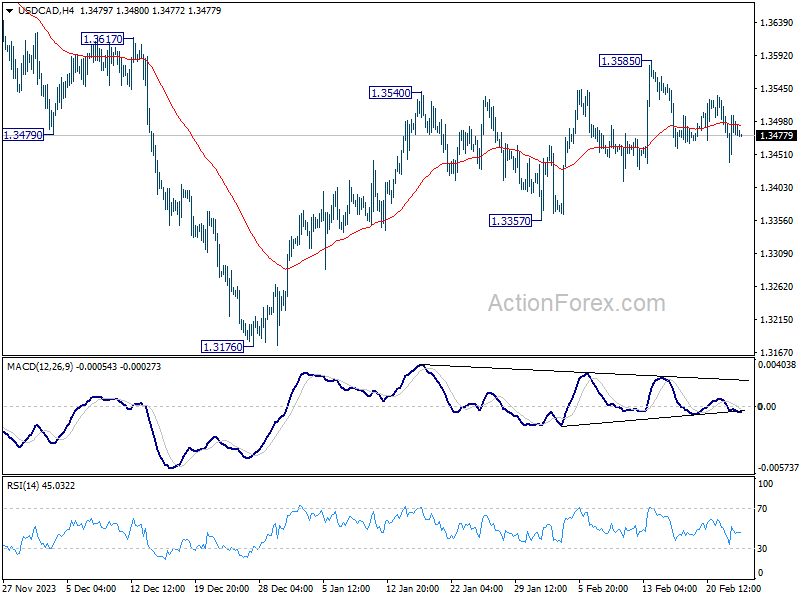
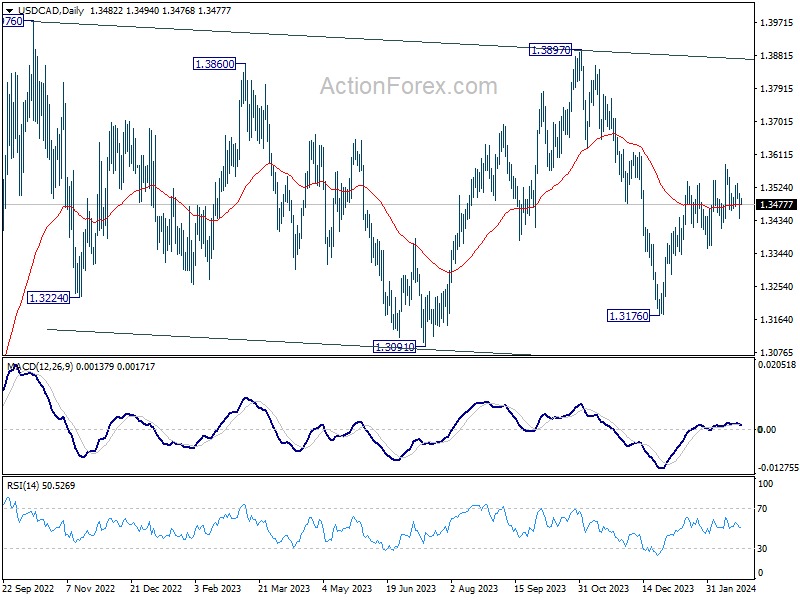
Intraday bias in USD/CAD remains neutral as range trading continues inside 1.3357/3585. With 1.3357 support intact, further rally is expected. On the upside, firm break of 1.3585 will resume the rebound from 1.3176 for 1.3897 resistance. However, break of 1.3357 will argue that the rebound from 1.3176 has completed and bring retest of this low.
In the bigger picture, price actions from 1.3976 (2022 high) are viewed as a corrective pattern only. In case of another fall, strong support should emerge above 1.2947 resistance turned support to bring rebound. Overall, larger up trend from 1.2005 (2021 low) is still expected to resume through 1.3976 at a later stage.
AUD/USD Daily Report
Daily Pivots: (S1) 0.6533; (P) 0.6564; (R1) 0.6588; More...
AUD/USD's recovery resumed by breaching 0.6578 but upside is capped below 0.6621 resistance. Intraday bias stays neutral for the moment, and larger fall is still in favor to continue. On the downside, below 0.6520 minor support will turn bias to the downside for retesting 0.6442 first. Firm break there will resume the the decline from 0.6870 towards 0.6269 low. Nevertheless, considering bullish convergence condition in 4H MACD, decisive break of 0.6621 will turn near term outlook bullish for 0.6870 resistance instead.
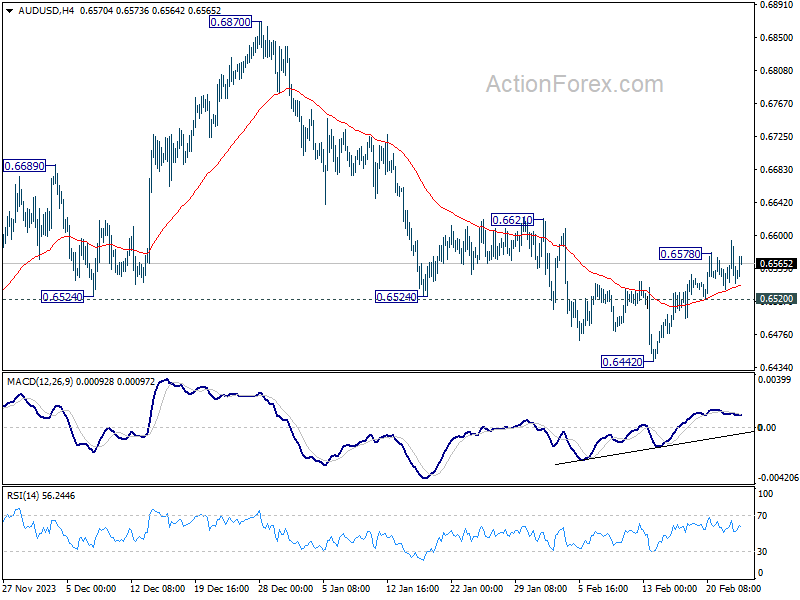
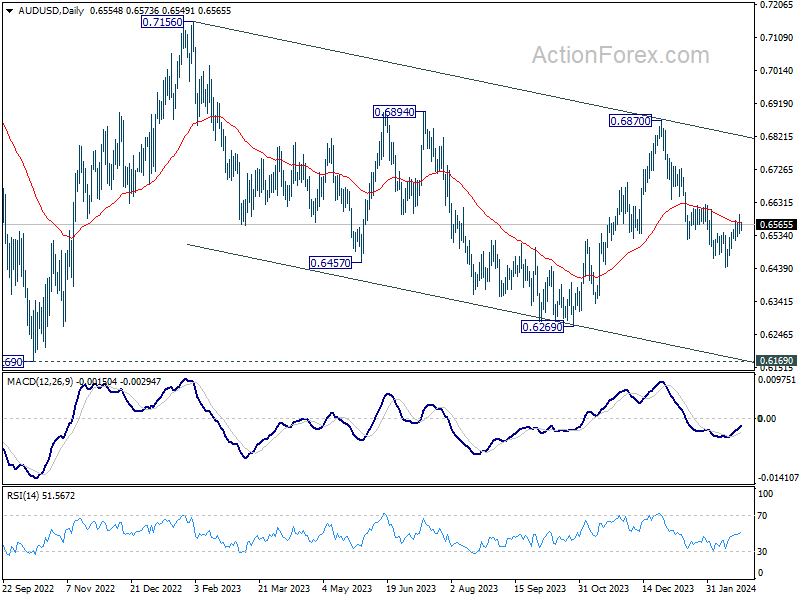
In the bigger picture, price actions from 0.6169 (2022 low) are seen as a medium term corrective pattern to the down trend from 0.8006 (2021 high). Fall from 0.7156 (2023 high) is seen as the second leg, which might still be in progress. Overall, sideway trading could continue in range of 0.6169/7156 for some more time. But as long as 0.7156 holds, an eventual downside breakout would be mildly in favor.
Market Optimism Hits Highs, Yen and Dollar Falter as Equities Soar to New Heights
The global financial markets is riding a wave of strong risk-on sentiment, propelling DOW and S&P 500 to historical highs overnight, while NASDAQ achieved its best daily gain in over a year. That followed the record closes in DAX, CAC and Nikkei yesterday. This enthusiasm for risk has led to the yen, dollar, and Swiss Franc emerging as the week's underperformers, given their safe-haven status which tends to be less attractive during bullish market phases.
In the currency realm, Australian and New Zealand Dollars stand out as the strongest currencies, buoyed by the prevailing risk-on market sentiment. Meanwhile, Canadian dollar faces challenges following weaker-than-expected CPI data earlier in the week. Euro and Sterling find themselves positioned in the middle, with Sterling holding a slight advantage.
The tone in today's Asian session, nevertheless, is more subdued, with stocks in Hong Kong and Singapore in red, while Japan observes a holiday. The market might now be taking a breather. With a relatively light economic calendar today, market participants' focus might shift towards remarks from notable central bank figures, including BoE's Megan Greene, ECB's Joachim Nagel, and SNB's Martin Schlegel. However, the overarching direction in the risk markets is expected to continue driving forex movements.
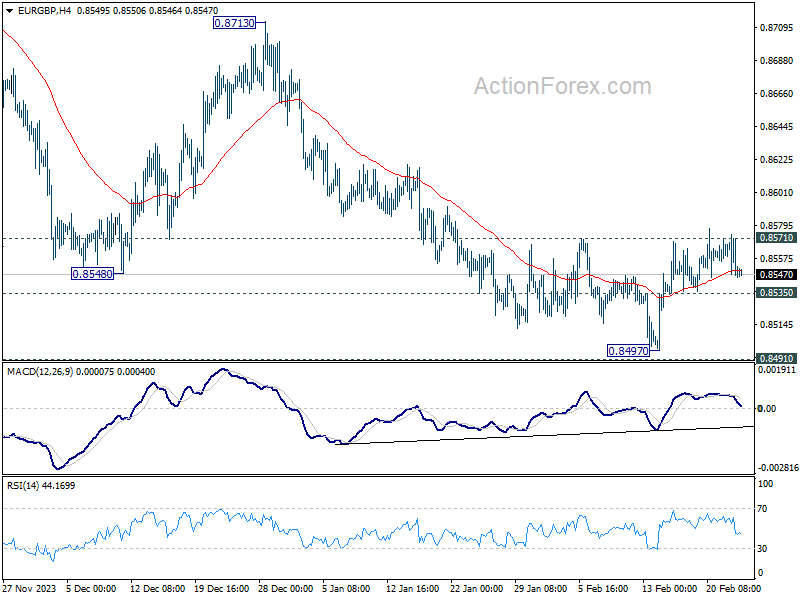
Technically, EUR/GBP is a pair to watch today. Rebound from 0.8497 lost much momentum, as seen in 4H MACD, as the cross struggled to break through 0.8571 resistance decisively. Break of 0.8535 minor support will indicate rejection by 0.8571 and retain near term bearishness. Further fall would then be seen to retest 0.8491/7 support zone, or below to resume larger down trend.
In Asia, at the time of writing, Hong Kong HSI is down -0.19%. China Shanghai SSE is up 0.05%. Singapore Strait Times is down -1.25%. Overnight, DOW rose 1.18%. S&P 500 rose 2.11%. NASDAQ rose 2.96%. 10-year yield rose 0.002 to 4.327.
Fed's Waller seeks additional months to assess January CPI as speed bump or pothole
Fed Governor Christopher Waller advocated for Fed to "wait a little longer," suggesting that "at least another couple more months" of economic data would be crucial before commencing any policy easing.
In a speech overnight, Waller expressed concerns regarding the recent high CPI inflation reading, describing it as potentially "a bump in the road" or a more serious indication that the significant progress made in controlling inflation over the past year could be "stalling."
This uncertainty solidifies his viewpoint that a patient approach to policy adjustments is warranted, allowing more time to assess whether January data represents "a speed bump or a pothole".
While Waller anticipates that it may become appropriate to begin easing monetary policy sometime within the year, he clarified that the timing and extent of policy adjustments would heavily rely on incoming economic data.
Fed's Cook to wait for clearer inflation convergence before rate cuts
In a speech overnight, Fed Governor Lisa Cook articulated her stance on waiting for more definitive signs of inflation moving towards 2% target before considering any policy rate reductions.
"I would like to have greater confidence that inflation is converging to 2% before beginning to cut the policy rate," she said.
Further, Cook shared an optimistic view on the inflation outlook, suggesting that a forecast showing 12-month PCE inflation moving towards target over time remains a "reasonable" baseline scenario.
However, Cook also advocated for a measured and data-driven approach to policy decisions. "We should continue to move carefully as we receive more data," she advised, stressing the importance of maintaining the current level of policy restriction to achieve "sustainable" price stability.
Fed's Harker warns against immediate expectations for rate cuts
Philadelphia Fed President Patrick Harker did not dismiss the possibility of a rate cut as early as May meeting. But he emphasized the importance of observing "a couple more months" of economic data before making such a decision. "I think we're close," Harker stated overnight, advocating for patience by suggesting, "just give us a couple meetings."
"We may be in the position to see the rate decrease this year," he remarked. But he also tempered expectations with a reminder of the need for deliberate consideration: "But I would caution anyone from looking for it right now and right away. We have time to get this right, as we must."
Harker acknowledged the challenges inherent in the disinflation process, describing it as "bumpy and uneven at times." This acknowledgment underscores the necessity for the Fed to demand "more evidence" before altering its policy course, aiming to discern genuine economic trends from the "vagaries of monthly data."
In contemplating the initiation of policy easing, Harker advocated for a cautious approach: "let's start on a steady, slow reduction, because that to me minimizes risk."
New Zealand's retail woes deepen with eighth consecutive quarterly decline
New Zealand's retail sales volumes dropped by -1.9% qoq, a figure far below the expected decline of -0.2% qoq. This also marked the eighth consecutive quarter of contraction. Excluding auto sales, the decline was marginally less severe but still substantial at -1.7% qoq, again well below the anticipated -0.1% qoq decrease.
Melissa McKenzie, business financial statistics manager, highlighted the extent of the downturn, noting that "Ongoing falls in retail activity over the last two years were marked by a fall in most industries in the December quarter."
The contraction in retail sales was widespread, with 14 out of 15 retail industries reporting lower sales volumes compared to the previous quarter. The most significant downturns were observed in motor vehicle and parts retailing, which fell by -2.5%, food and beverage services, which saw a -2.4% decline, and fuel retailing, which dropped by -3.6%.
In terms of retail sales value, there was a qoq decrease of -1.5%, with ten of the sixteen regions experiencing lower seasonally adjusted sales values.
Looking ahead
Germany's GDP final and Ifo business climate are the only features of the day.
AUD/USD Daily Report
Daily Pivots: (S1) 0.6533; (P) 0.6564; (R1) 0.6588; More...
AUD/USD's recovery resumed by breaching 0.6578 but upside is capped below 0.6621 resistance. Intraday bias stays neutral for the moment, and larger fall is still in favor to continue. On the downside, below 0.6520 minor support will turn bias to the downside for retesting 0.6442 first. Firm break there will resume the the decline from 0.6870 towards 0.6269 low. Nevertheless, considering bullish convergence condition in 4H MACD, decisive break of 0.6621 will turn near term outlook bullish for 0.6870 resistance instead.
In the bigger picture, price actions from 0.6169 (2022 low) are seen as a medium term corrective pattern to the down trend from 0.8006 (2021 high). Fall from 0.7156 (2023 high) is seen as the second leg, which might still be in progress. Overall, sideway trading could continue in range of 0.6169/7156 for some more time. But as long as 0.7156 holds, an eventual downside breakout would be mildly in favor.
Economic Indicators Update
| GMT | Ccy | Events | Actual | Forecast | Previous | Revised |
|---|---|---|---|---|---|---|
| 21:45 | NZD | Retail Sales Q/Q Q4 | -1.90% | -0.20% | 0.00% | -0.80% |
| 21:45 | NZD | Retail Sales ex Autos Q/Q Q4 | -1.70% | -0.10% | 1.00% | 0.40% |
| 00:01 | GBP | GfK Consumer Confidence Feb | -21 | -18 | -19 | |
| 07:00 | EUR | Germany GDP Q/Q Q4 F | -0.30% | -0.30% | ||
| 09:00 | EUR | Germany IFO Business Climate Feb | 85.5 | 85.2 | ||
| 09:00 | EUR | Germany IFO Current Assessment Feb | 87 | 87 | ||
| 09:00 | EUR | Germany IFO Expectations Feb | 83.8 | 83.5 |
Cliff Notes: A Game of Patience
Key insights from the week that was.
In Australia, the RBA February Minutes put forward a familiar account of the Board’s deliberations and assessment of risks, providing more colour on the key themes presented in various communications since the decision. The case to raise the cash rate further – centred on the observation that it would take “some time” for inflation to return to target – is becoming increasingly improbable given continued progress on inflation which is broadly consistent with the Board’s central forecast.
Before rate cuts can be delivered however, the Board will need to be fully convinced that inflation’s return to target will be sustained. That is expected to take several months, with the most likely date for the first cut being September – a view discussed in depth by Chief Economist Luci Ellis. We expect that policy easing will be delivered at a measured pace thereafter, 25bps per quarter through to September 2025, supporting a gradual recovery in GDP growth towards trend while ensuring inflation remains in the target range.
The Wage Price Index – one of the broadest measures of wage inflation – lifted 0.9% (4.2%yr) in Q4, in line with Westpac’s forecast. Compositionally, the headline result looks to have been bolstered by recent changes to enterprise bargaining agreements in health care and education/training, seeing the pace of public sector wage inflation lift to its highest rate since December 2008 (1.3%; 4.3%yr). Westpac estimates that individual arrangements – the agreement type most responsive to current economic conditions – are currently tracking a much softer pace of wage inflation (3.4%yr) than enterprise arrangements (5.7%yr) and award wages (5.2%yr). We remain of the view that current dynamics – including labour market softening and inflation’s deceleration – will continue to drive a moderation in wages growth into year-end, to a forecast 3.2%yr.
Ahead of next week’s partials on business investment and the Q4 GDP release on March 6th, two perspectives on Australia’s investment outlook were published this week.
For mining investment, the concentrated “burst” over 2023 was caused by pandemic-related delays that disrupted the flow of project starts. This dynamic is expected to fade going forward and, given the lacklustre underlying trend in this sector since 2016, momentum in project starts is likely to recede over the course of the year.
In contrast, the pipeline of electricity supply projects is clearly progressing, with the value of projects moving from “potential” to “committed” or “under construction” lifting from $27bn in 2022 to $38bn in 2023. While this may be, in part, a result of rising costs associated with Snowy Hydro, other renewable energy projects such as the $3bn Goyder South renewables zone are now beginning construction and will soon add to Australia’s electricity capacity. Investment into renewable energy projects and the evolution of Australia’s electricity supply will prove a vital determinant of Australia’s productive capacity and long-run economic success.
In a quiet week offshore, the FOMC’s January meeting minutes were of greatest significance.
The overall tone of the minutes suggest the FOMC are pleased with progress to date but believe “restrictive” policy has more work to do. Employment and inflation were characterised as ‘moving towards’ the FOMC’s goals, so too the overall balance between supply and demand. The FOMC continues to be concerned over inflation getting stuck above the 2% target however, owing to persistence in services inflation which the shelter component personifies.
The pace and scale of downward momentum in services inflation is critical to the aggregate outlook as the deceleration in goods prices that has come about because of normalising supply chains is likely to moderate going forward. Helpfully, regional indicators suggest businesses are finding it harder to pass on higher costs to consumers. Our recent analysis of the CPI also highlights that price growth across the CPI basket excluding shelter is now comfortably below target on an annualised basis from 1 to 11 months. Risks remain, but patience to mid-year should deliver annual inflation at, or very near, target and justify the beginning of the next easing cycle. Note though that our rate cut profile from June 2024 to December 2025 is only 200bps in total; that will leave the fed funds rate at a modestly contractionary level of 3.375% relative to FOMC’s longer run 2.50% ‘neutral’ view.
In Europe meanwhile, the January CPI final release confirmed that goods prices continue to weigh on aggregate inflation, the annual rate 0.1ppt lower at 2.8%yr. Energy prices are reaccelerating in monthly terms however, and could pose an upside risk to headline inflation as Europe enters winter. This development could partially account for the reacceleration in input prices, and subsequently selling prices, as measured by the Eurozone PMIs. While prices charged by manufacturers for their output fell in the month, services prices saw a sharp increase, the fourth increase in a row. Further outlining the divergence between manufacturing and services, the employment sub-index was strong for services, but manufacturers further reduced their demand for labour.
To date in 2024, ECB speakers have highlighted services inflation and strong wage growth as key factors in deciding when to cut rates. The data so far suggests they will need to balance a diverging outlook across countries and industries when making their decisions. We continue to expect a modest easing cycle by the ECB from mid-year, largely in sync with the US FOMC’s cycle.
EURUSD 5 Swing Rally Favors More Upside
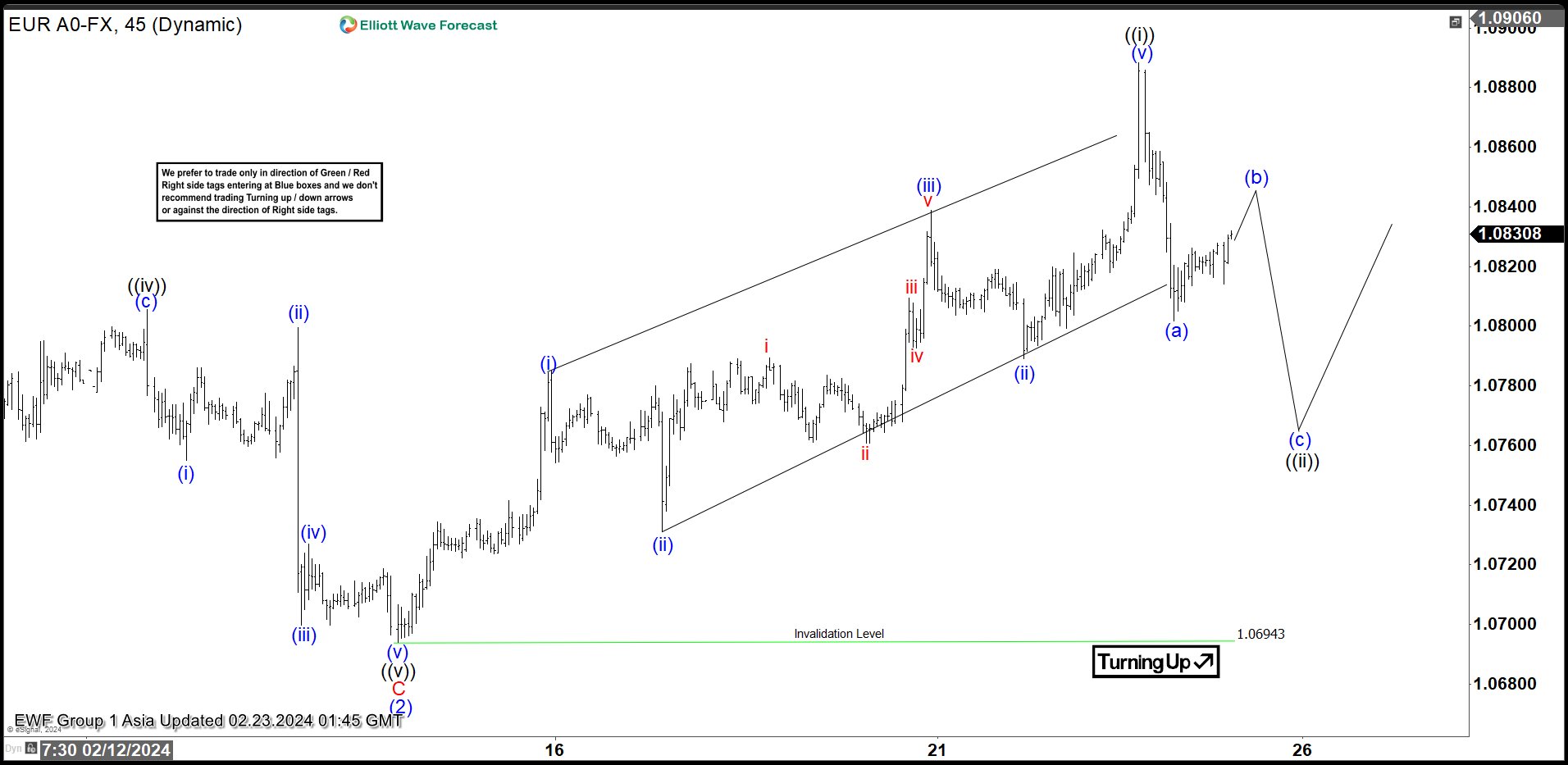
Rally from 10.3.2023 low in EURUSD is ongoing as a 5 waves impulse Elliott Wave Structure. Up from 10.3.2023 low, wave (1) ended at 1.11395 and pullback in wave (2) ended at 1.0694. Pair has turned higher in wave (3), but it needs to break above wave (1) at 1.11395 to rule out a double correction. Up from wave (2), wave (i) ended at 1.0785 and wave (ii) ended at 1.0731. Pair rallies higher in wave (iii) towards 1.0839 and pullback in wave (iv) ended at 1.0789. Final leg wave (v) ended at 1.088 which completed wave ((i)) in higher degree.
Wave ((ii)) pullback is now in progress as a zigzag structure to correct cycle from 2.14.2024 low before pair resumes higher. Down from wave ((i)), wave (a) ended at 1.0802. Expect pair to rally in wave (b) then it should turn lower in wave (c) to finish wave ((ii)) in higher degree before pair resumes higher. As far as pivot at 1.0694 low stays intact, expect pullback to find support in 3, 7, or 11 swing for further upside. Due to the 5 swing structure from 2.14.2024, at minimum we should get another leg higher while it stays above 1.0694.
EURUSD 45 Minutes Elliott Wave Chart
EURUSD Elliott Wave Video
https://www.youtube.com/watch?v=H8uqBmJrHq0
New Zealand’s retail woes deepen with eighth consecutive quarterly decline
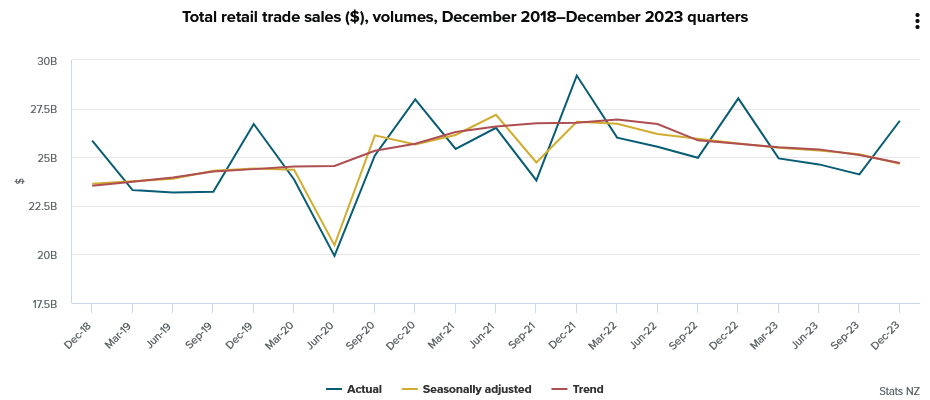
New Zealand's retail sales volumes dropped by -1.9% qoq, a figure far below the expected decline of -0.2% qoq. This also marked the eighth consecutive quarter of contraction. Excluding auto sales, the decline was marginally less severe but still substantial at -1.7% qoq, again well below the anticipated -0.1% qoq decrease.
Melissa McKenzie, business financial statistics manager, highlighted the extent of the downturn, noting that "Ongoing falls in retail activity over the last two years were marked by a fall in most industries in the December quarter."
The contraction in retail sales was widespread, with 14 out of 15 retail industries reporting lower sales volumes compared to the previous quarter. The most significant downturns were observed in motor vehicle and parts retailing, which fell by -2.5%, food and beverage services, which saw a -2.4% decline, and fuel retailing, which dropped by -3.6%.
In terms of retail sales value, there was a qoq decrease of -1.5%, with ten of the sixteen regions experiencing lower seasonally adjusted sales values.
Fed’s Waller seeks additional months to assess January CPI as speed bump or pothole
Fed Governor Christopher Waller advocated for Fed to "wait a little longer," suggesting that "at least another couple more months" of economic data would be crucial before commencing any policy easing.
In a speech overnight, Waller expressed concerns regarding the recent high CPI inflation reading, describing it as potentially "a bump in the road" or a more serious indication that the significant progress made in controlling inflation over the past year could be "stalling."
This uncertainty solidifies his viewpoint that a patient approach to policy adjustments is warranted, allowing more time to assess whether January data represents "a speed bump or a pothole".
While Waller anticipates that it may become appropriate to begin easing monetary policy sometime within the year, he clarified that the timing and extent of policy adjustments would heavily rely on incoming economic data.
USD/JPY Aims For Fresh High, Dips Supported
Key Highlights
- USD/JPY is eyeing a fresh increase above the 150.80 resistance.
- A connecting bullish trend line is forming with support at 150.00 on the 4-hour chart.
- Gold is still facing resistance near the $2,040 zone.
- Bitcoin price could start a downside correction if it trades below $50,000.
USD/JPY Technical Analysis
The US Dollar found support near 149.50 against the Japanese Yen. USD/JPY formed a base and started a fresh increase above the 150.00 resistance.
Looking at the 4-hour chart, the pair traded above the 50% Fib retracement level of the downward move from the 150.88 swing high to the 149.52 low. It is also well above the 100 simple moving average (red, 4-hour) and the 200 simple moving average (green, 4-hour).
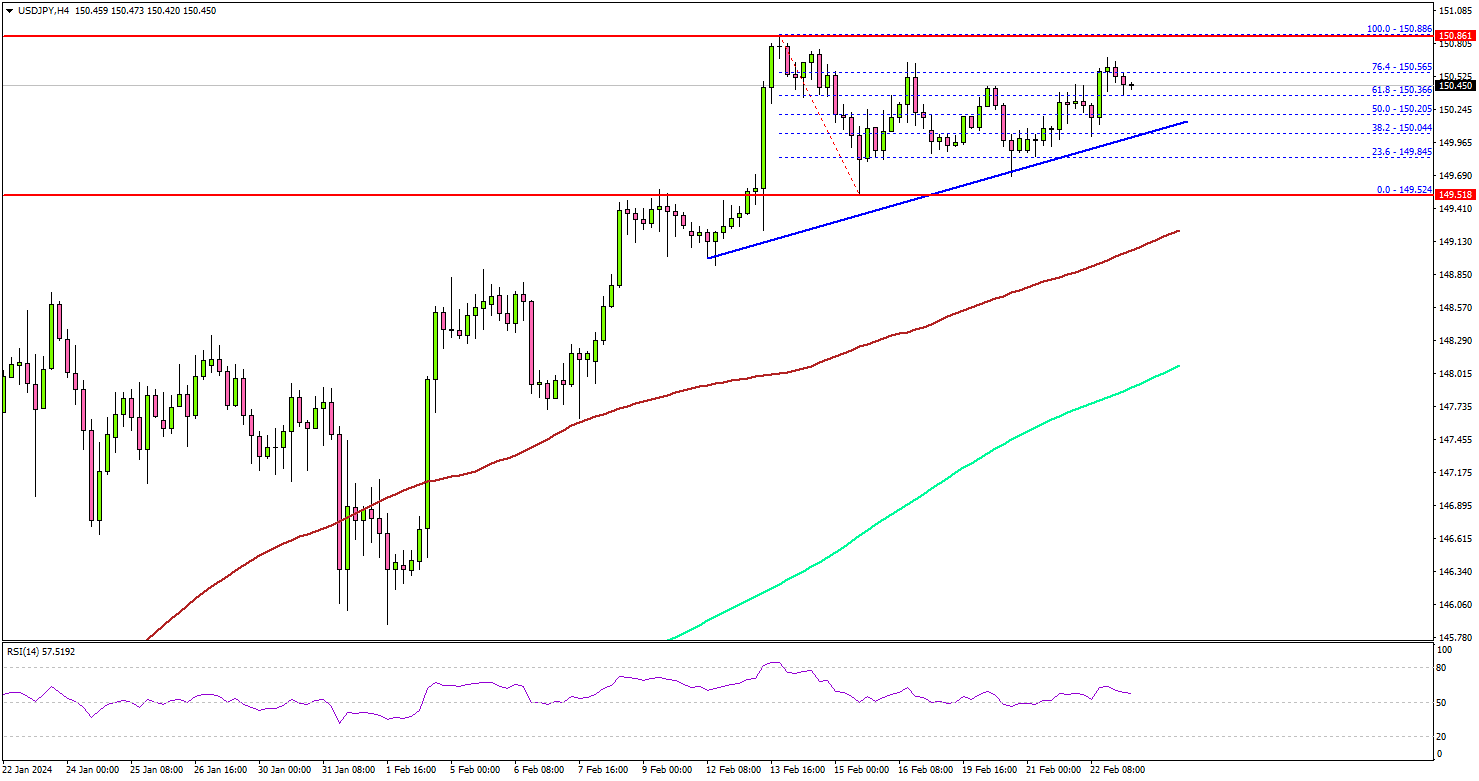
Besides, there is a connecting bullish trend line forming with support at 150.00 on the same chart. On the upside, the pair is facing resistance near the 150.80 level.
A close above the 150.80 zone could open the doors for more upsides. The next stop for the bulls might be 152.00. Any more gains might send USD/JPY toward 153.20.
Immediate support is near the 150.20 level. The first major support sits near the 150.00 level and the trend line. The next major support sits at 149.50, below which the pair might gain bearish momentum. In the stated case, the pair could even visit the 148.40 support level.
Looking at Bitcoin, the price is still consolidating gains above the $50,000 level and might start a downside correction.
Economic Releases
- Fed Monetary Policy Report.
Fed’s Cook to wait for clearer inflation convergence before rate cuts
In a speech overnight, Fed Governor Lisa Cook articulated her stance on waiting for more definitive signs of inflation moving towards 2% target before considering any policy rate reductions.
"I would like to have greater confidence that inflation is converging to 2% before beginning to cut the policy rate," she said.
Further, Cook shared an optimistic view on the inflation outlook, suggesting that a forecast showing 12-month PCE inflation moving towards target over time remains a "reasonable" baseline scenario.
However, Cook also advocated for a measured and data-driven approach to policy decisions. "We should continue to move carefully as we receive more data," she advised, stressing the importance of maintaining the current level of policy restriction to achieve "sustainable" price stability.