Sample Category Title
ECB press conference live stream
https://www.youtube.com/watch?v=F-rSIPzhXYw
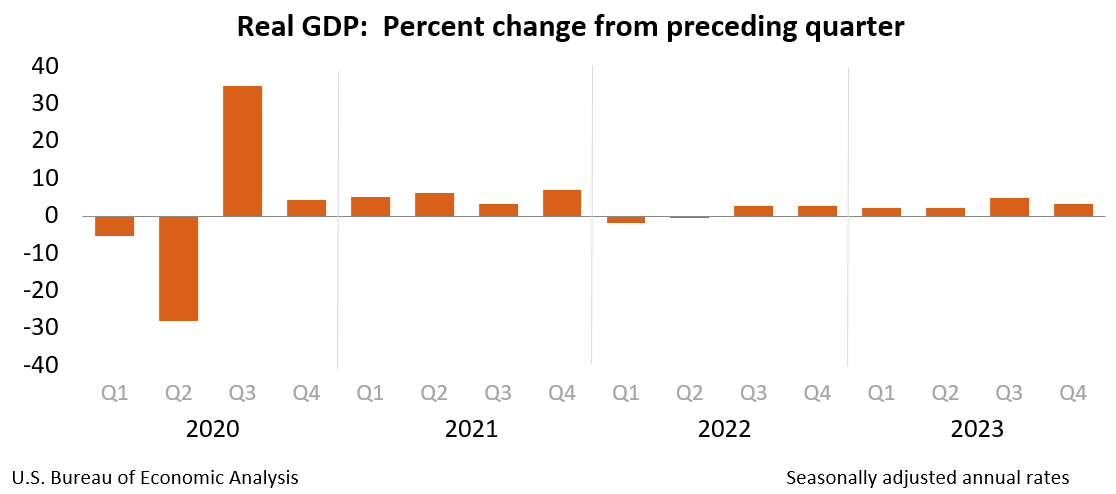
US GDP grows 3.3% annualized in Q4, core PCE prices unchanged at 2%
US GDP grew 3.3% annualized in Q4, well above expectation of 2.0%. Looking at some details, consumer spending slowed from 3.1% to 2.8%. Goods spending slowed from 4.9% to 3.8%, but services spending growth rose from 2.2% to 2.4%. Gross private domestic investment growth slowed notably from 10.0% to 2.1%.
Headline PCE prices slowed notably from 2.6% to 1.7%. Meanwhile, PCE core prices was unchanged at 2.0%.
Also released, initial jobless claims rose from 189k to 214k in the week ending January 19, above expectation of 199k. Goods trade deficit narrowed from USD -90.3B to USD -88.5B, versus expectation of USD -88.7B. Durable goods orders rose 0.0% mom in December, below expectation of 1.0% mom. But ex-transport orders rose 0.6% mom, above expectation of 0.2% mom.
BTCUSD Pauses Selloff and Battles with 40,000
- BTCUSD manages to halt its short-term decline
- But its rebound encounters resistance around 40,000
- Momentum indicators still deep in their negative zones
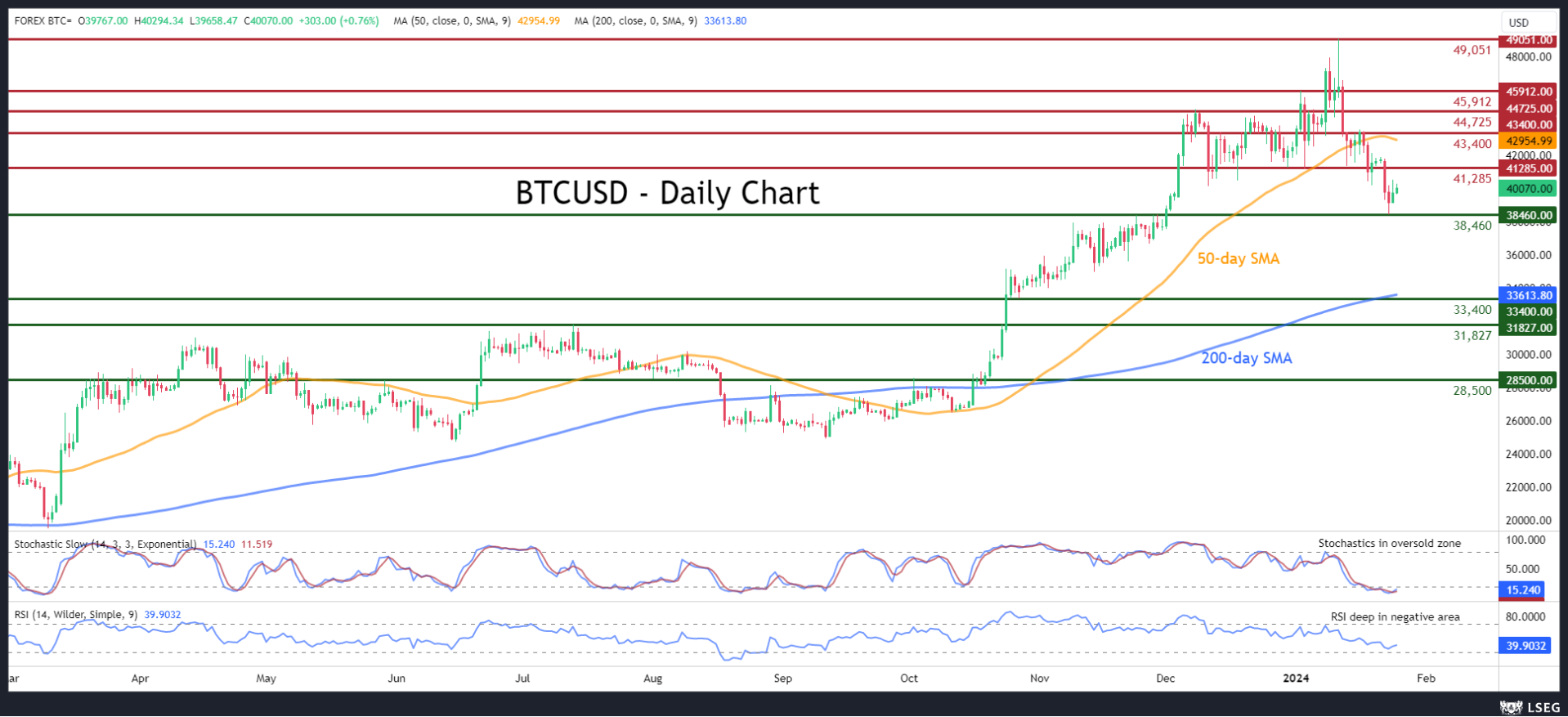
BTCUSD (Bitcoin) has experienced a strong decline from its recent two-year peak of 49,051, dropping to as low as 38,460. Despite the price’s attempt for recovery, the short-term oscillators are still heavily tilted to the downside, painting a rather dire technical picture.
If the price manages to extend its rebound, the inside swing low of 41,285 could prevent initial advances. Conquering this barricade, the bulls might attack the January resistance of 43,400 ahead of the December peak of 44,725. A jump above the latter could shift the spotlight to 45,912.
On the flipside, should bullish pressures abate, Bitcoin could revisit its almost two-month low of 38,460. In case of a downside violation, there is no prominent support until the October hurdle of 33,400. Even lower, the previous resistance of 31,827 could provide downside protection.
In brief, it seems that BTCUSD’s decline has temporarily halted, but it's too early to call for a sustained recovery. That being said, a clear close above the 40,000 mark is needed to revive the bulls’ hopes for more upside.
ECB stands pat, declining trend in underlying inflation continues
ECB left monetary policy unchanged as widely expected. Main refinancing, marginal lending and deposit rates are held at 4.50%, 4.75%, and 4.00% respectively.
In the accompanying statement, ECB noted that incoming information has "broadly confirmed its previous assessment of the medium-term inflation outlook. "Aside from an energy-related upward base effect", the declining trend in underlying inflation "has continued.
The central bank also maintained that current interest rates, "maintained for a sufficiently long duration", will make substantial contribution to bringing down inflation to target. Future policy decisions will follow a "data-dependent approach" to determine both the level of duration of monetary restriction.
(ECB) Monetary policy decisions
The Governing Council today decided to keep the three key ECB interest rates unchanged. The incoming information has broadly confirmed its previous assessment of the medium-term inflation outlook. Aside from an energy-related upward base effect on headline inflation, the declining trend in underlying inflation has continued, and the past interest rate increases keep being transmitted forcefully into financing conditions. Tight financing conditions are dampening demand, and this is helping to push down inflation.
The Governing Council is determined to ensure that inflation returns to its 2% medium-term target in a timely manner. Based on its current assessment, the Governing Council considers that the key ECB interest rates are at levels that, maintained for a sufficiently long duration, will make a substantial contribution to this goal. The Governing Council's future decisions will ensure that its policy rates will be set at sufficiently restrictive levels for as long as necessary.
The Governing Council will continue to follow a data-dependent approach to determining the appropriate level and duration of restriction. In particular, the Governing Council's interest rate decisions will be based on its assessment of the inflation outlook in light of the incoming economic and financial data, the dynamics of underlying inflation and the strength of monetary policy transmission.
Key ECB interest rates
The interest rate on the main refinancing operations and the interest rates on the marginal lending facility and the deposit facility will remain unchanged at 4.50%, 4.75% and 4.00% respectively.
Asset purchase programme (APP) and pandemic emergency purchase programme (PEPP)
The APP portfolio is declining at a measured and predictable pace, as the Eurosystem no longer reinvests the principal payments from maturing securities.
The Governing Council intends to continue to reinvest, in full, the principal payments from maturing securities purchased under the PEPP during the first half of 2024. Over the second half of the year, it intends to reduce the PEPP portfolio by €7.5 billion per month on average. The Governing Council intends to discontinue reinvestments under the PEPP at the end of 2024.
The Governing Council will continue applying flexibility in reinvesting redemptions coming due in the PEPP portfolio, with a view to countering risks to the monetary policy transmission mechanism related to the pandemic.
Refinancing operations
As banks are repaying the amounts borrowed under the targeted longer-term refinancing operations, the Governing Council will regularly assess how targeted lending operations and their ongoing repayment are contributing to its monetary policy stance.
***
The Governing Council stands ready to adjust all of its instruments within its mandate to ensure that inflation returns to its 2% target over the medium term and to preserve the smooth functioning of monetary policy transmission. Moreover, the Transmission Protection Instrument is available to counter unwarranted, disorderly market dynamics that pose a serious threat to the transmission of monetary policy across all euro area countries, thus allowing the Governing Council to more effectively deliver on its price stability mandate.
The President of the ECB will comment on the considerations underlying these decisions at a press conference starting at 14:45 CET today.
EUR/GBP: Initial Reversal Signals Need More Work at the Upside for Validation
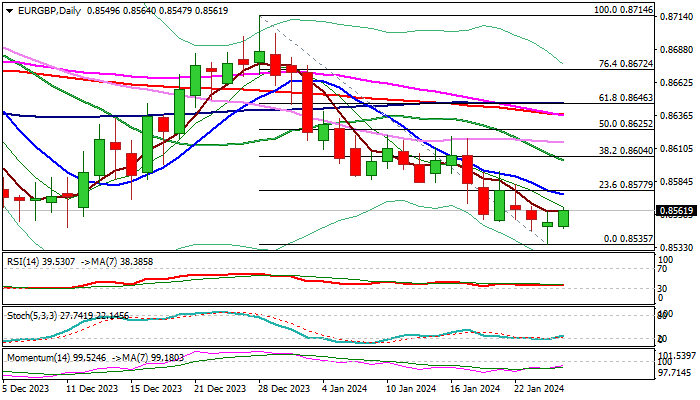
EURGBP rose in early Thursday’s trading, adding to initial signal of formation of reversal pattern on the daily chart, after Wednesday’s action ended in long-legged Doji candle, signaling indecision.
Oversold studies contributed to fresh profit-taking, though 14-d momentum is still in negative territory, signaling that underlying bears remain firmly in play for now.
Fresh gains see violation of initial resistances at 0.8574/77 (falling 10DMA / Fibo 23.6% of 0.8714/0.8535 bear-leg) as a minimum requirement to spark stronger recovery and expose next pivotal barriers at 0.8600 zone (descending 20DMA / Fibo 38.2%).
Otherwise, limited correction is likely to offer better selling opportunities for continuation of larger downtrend from 0.8714 (Dec 28 peak).
Res: 0.8574; 0.8592; 0.8604; 0.8625.
Sup: 0.8535; 0.8523; 0.8499; 0.8471.
Crypto Market Takes a Breath after the Storm
Market Picture
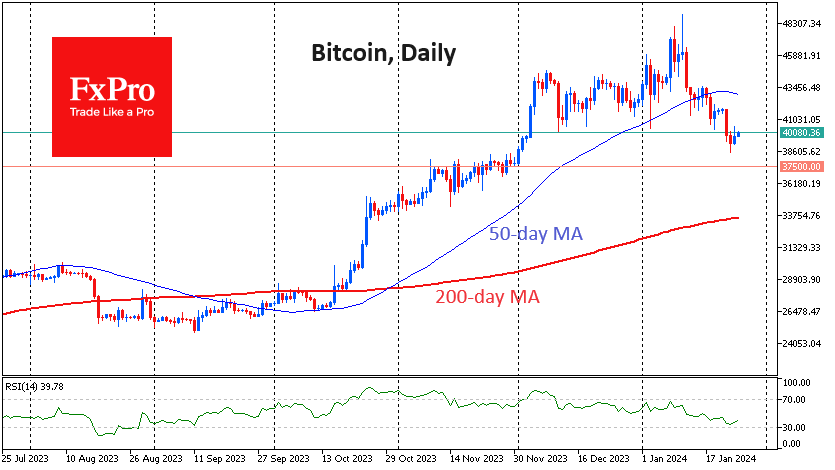
The crypto market saw lower volatility in the last 24 hours, with capitalisation at $1.56 trillion and the price of Bitcoin hovering around $40K. Major altcoins have also avoided strong moves. The Fear and Greed Index is wandering around a neutral 50.
A cautious uptrend can be discerned in Bitcoin since Tuesday, as some players are looking to lock in profits from short positions or buy after a sharp sell-off. We note that Bitcoin was not oversold before stabilising, and bears may use the current lull to hoard liquidity before another sell-off.
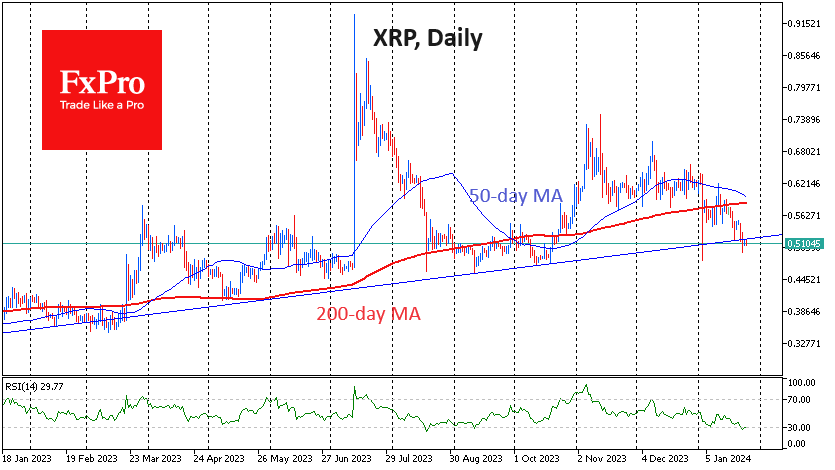
Unlike Bitcoin, XRP has almost completely erased the gains of the rally since October, returning to the $0.51 area. On the daily timeframes, the RSI has touched oversold territory, setting the stage for increased volatility and the potential for a reversal in the coming days. However, there is a cause for alarm. Since November 2022, XRP has been forming an upward trend, and the movement of the last few days has broken it.
News Background
According to a Deutsche Bank survey, more than a third of respondents believe Bitcoin will fall below $20K by the end of the year. And only 15% of respondents expect to see BTC above $40K by then.
PlanB, the creator of the Stock-to-Flow model, on the other hand, believes Bitcoin will consolidate around $40K and prepare for a rise to $60K.
CoinShares noted the potential for increased inflows into Ethereum if the Dencun hardfork is successful and a spot ETF based on the asset is possibly approved.
Spot Ethereum-ETFs do not require a judicial process for approval, SEC Commissioner Hester Peirce said, referring to the court’s decision to convert the Grayscale Bitcoin Trust into a spot ETF.
The US FINRA found potential violations in 70% of information materials about cryptocurrency products. Fair and balanced advertising rules explicitly prohibit ‘false, exaggerated, promising, unsubstantiated or misleading statements’.
Switzerland approved the first retail platform that will allow citizens to trade tokenised securities and digital assets.
Euro in Holding Pattern Ahead of ECB Decision
The euro is showing limited movement on Thursday. In the European session, EUR/USD is trading at 1.0895, up 0.10%.
Eurozone PMIs, released on Wednesday, pointed to trouble in the manufacturing and services sectors. Manufacturing has been in deep-freeze, although the January manufacturing PMI improved to 46.6, up from 44.4 and above the consensus estimate of 44.8. Manufacturing PMI hasn’t posted a reading over 50, which indicates growth, since June 2022. The upswing in the January reading may be misleading since the sharp drop in the delivery times index due to tensions in the Red Sea boosted the headline number.
The services sector, which dominates economic activity, dropped to 48.4, down from 48.8 in December and shy of the consensus estimate of 49.0. This marked a six straight contraction in services activity. German PMIs were slightly lower, at 45.4 for manufacturing and 47.6 for services.
ECB expected to hold rates
Against this background of weak economic activity, the ECB makes its first rate announcement for 2024 later today. The ECB has pushed back against rate cut expectations, despite a weak eurozone economy and the sharp drop in inflation. The central bank has kept the benchmark rate at 4.0% since September and has likely ended its rate-tightening cycle but is in no rush to start chopping rates. The markets have been much more aggressive and have priced in 140 basis points in cuts, with the first cut expected in the summer.
The ECB will very likely pause once again at today’s meeting, and investors will be keeping a close eye on the rate statement and ECB President Lagarde’s follow-up press conference. Will Lagarde push back hard against rate cut fever, as she did at the previous meeting? If not, expectations of a rate cut will rise and the euro could come under pressure as a result.
EUR/USD Technical
- EUR/USD is testing resistance at 1.0888. Above, there is resistance at 1.0929
- There is support at 1.0843 and 1.0802

Japan downgrades export outlook, raises concerns over earthquake impacts
In the new Monthly Economic Report, the Japanese Government continues to observe that the economy is "recovering at a moderate pace", even though it's "pausing in part". A significant shift in this report is the revised perspective on exports, now viewed as "appearing to be pausing for picking recently". The report also calls for heightened vigilance regarding the economic repercussions of the 2024 Noto Peninsula Earthquake.
Apart from the change in export assessment and the earthquake's impact, the report's overall tone remained consistent with previous evaluations. Key economic indicators such as private consumption is characterized as "picking up", although business investment appears to be "pausing". Industrial production is also showing signs of recovery.
The report paints a positive picture of corporate health, noting improvements as a whole. The employment scenario reflects positive trends, with signs of ongoing improvement. Lastly, consumer prices have been identified as "rising moderately"
Germany Ifo business climate falls to 85.2, stuck in recession
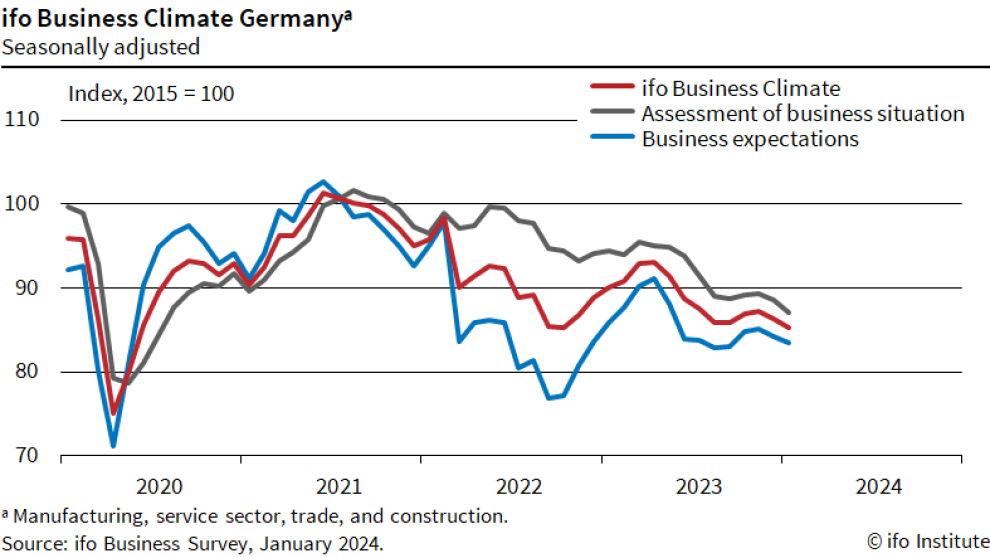
German Ifo Business Climate fell from 86.3 to 85.2 in January, below expectation of 86.7. Current Assessment Index fell from 88.5 to 87.0, below expectation of 88.6. Expectations Index fell from 84.2 to 83.5, below expectation of 84.9.
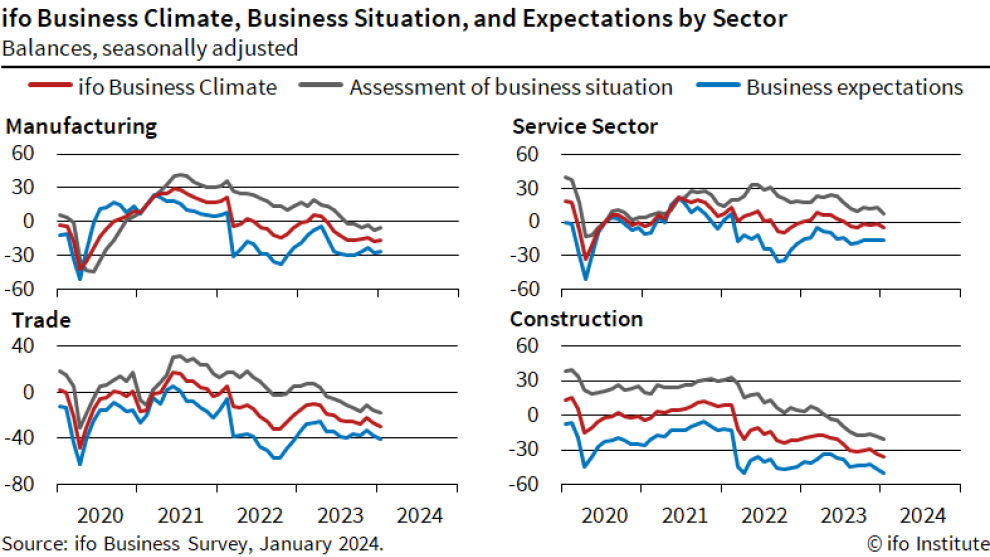
But sector, manufacturing rose from -17.4 to -16.0. Services fell from -1.7 to -4.9. Trade fell from -26.7 to -29.7. Construction fell from -33.5 to -35.9.
Ifo said, sentiment among German companies has deteriorated further at the beginning of the year. The German economy is "stuck in recession".