Sample Category Title
GBPJPY Showing Incomplete Bearish Sequence
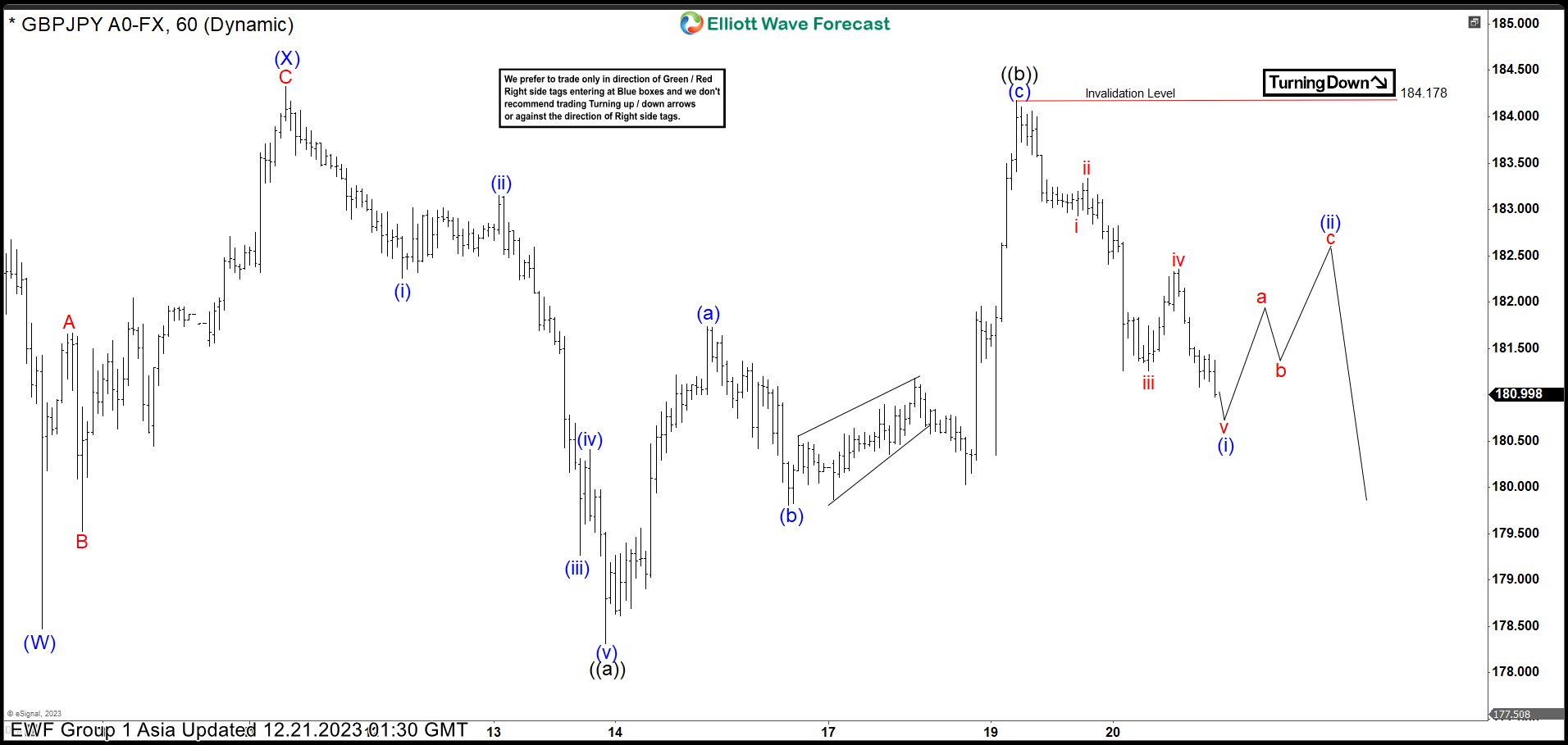
Short Term Elliott Wave View in GBPJPY shows that it has ended wave ((3)) at 188.66. Pullback in wave ((4)) is currently in progress as a double three Elliott Wave structure. Down from wave ((3)), wave A ended at 185.06 and wave B ended at 186.18. Wave C lower made a strong drop ended at 178.47 which completed wave (W). The yen pair then corrected in wave (X) as a zigzag structure. Up from wave (W), wave A ended at 182.04 and wave B ended at 180.45. Wave C higher ended at 184.32 which completed wave (X).
The GPBJPY then turned lower in wave (Y). Down from wave (X), wave ((a)) ended at 178.32 breaking the low of wave (W) opening the idea of a incomplete bearish sequence. Wave ((b)) pullback was very high retesting wave (X) ended at 184.17. The yen pair is now trading lower in wave ((c)) of W. Down from wave ((b)), wave (i) is expected to end soon, then it should pullback in wave ((ii)), followed by further downside in wave (iii) of ((c)). Then, as far as pivot at 184.18 high remains intact, the GBPJPY has scope to see further downside in a larger double three in wave (Y).
GBPJPY 60 Minutes Elliott Wave Chart
GBPJPY Elliott Wave Video
https://www.youtube.com/watch?v=u078O8vqYxM
Technical Outlook and Review
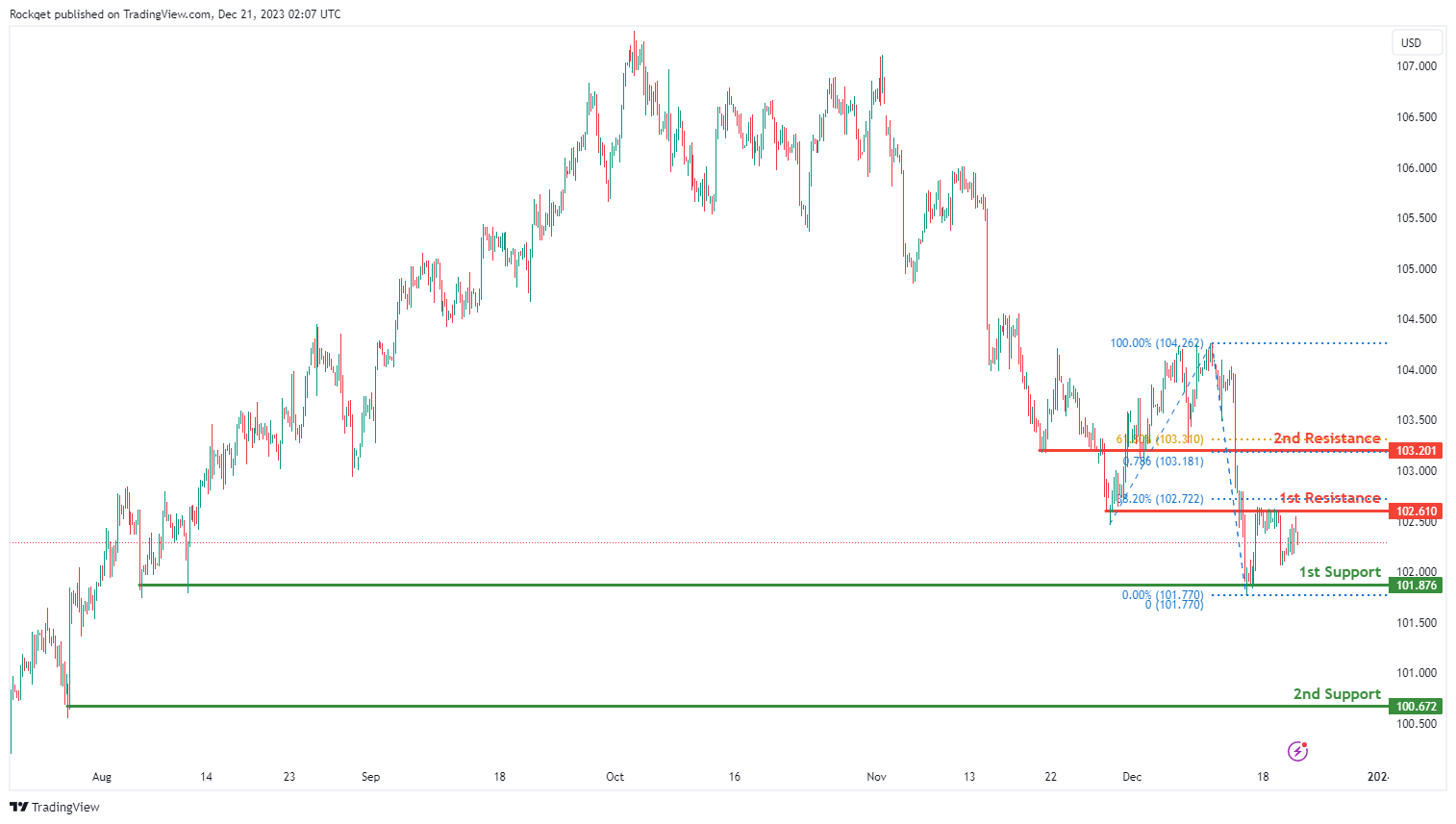
DXY:
The DXY (US Dollar Index) chart currently shows an overall bearish momentum, indicating a potential for price to make a bearish continuation towards the 1st support.
The 1st support level at 101.87 is identified as a multi-swing-low support. Further below, the 2nd support level at 100.67 is noted as a swing-low support, further reinforcing its importance as a potential key support level.
To the upside, the 1st resistance level at 102.61 is identified as an overlap resistance that aligns close to the 38.20% Fibonacci retracement level. Higher up, the 2nd resistance level at 103.20 is also marked as an overlap resistance that aligns with a confluence of Fibonacci levels i.e. the 61.80% retracement and the 78.60% projection levels, suggesting a potential barrier for further upside movement.
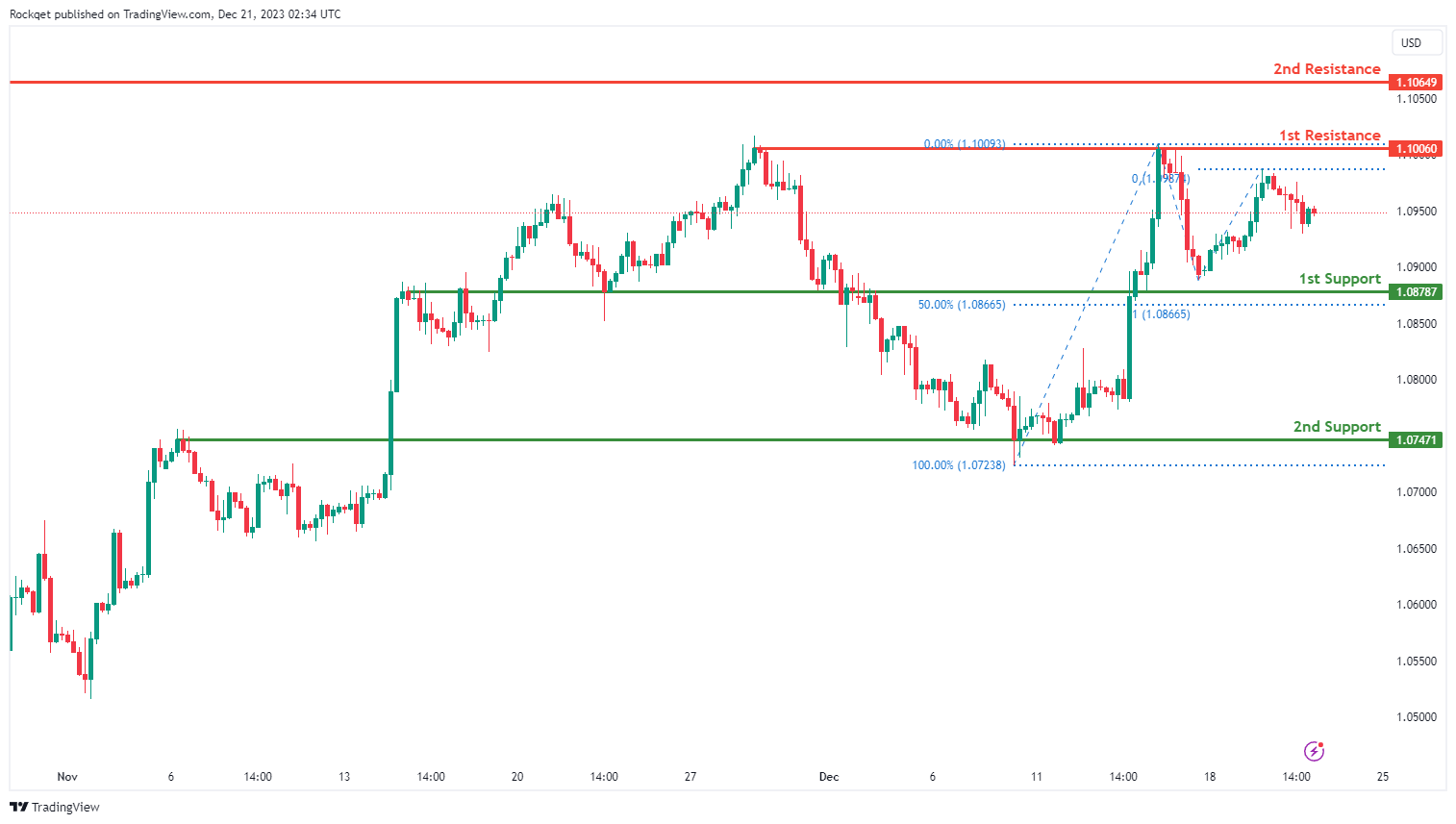
EUR/USD:
The EUR/USD chart currently exhibits an overall bullish momentum. In this context, there is a potential scenario for price to make a bullish continuation towards the 1st resistance.
The 1st resistance level at 1.1006 is identified as a multi-swing-high resistance. Higher up, the 2nd resistance level at 1.1064 is noted as a swing-high resistance, suggesting a potential barrier for further upside movement.
To the downside, the 1st support level at 1.0878 is identified as an overlap support that aligns close to the 50.00% Fibonacci retracement level. Further below, the 2nd support level at 1.0747 is also marked as an overlap support, further reinforcing its importance as a potential key support level.
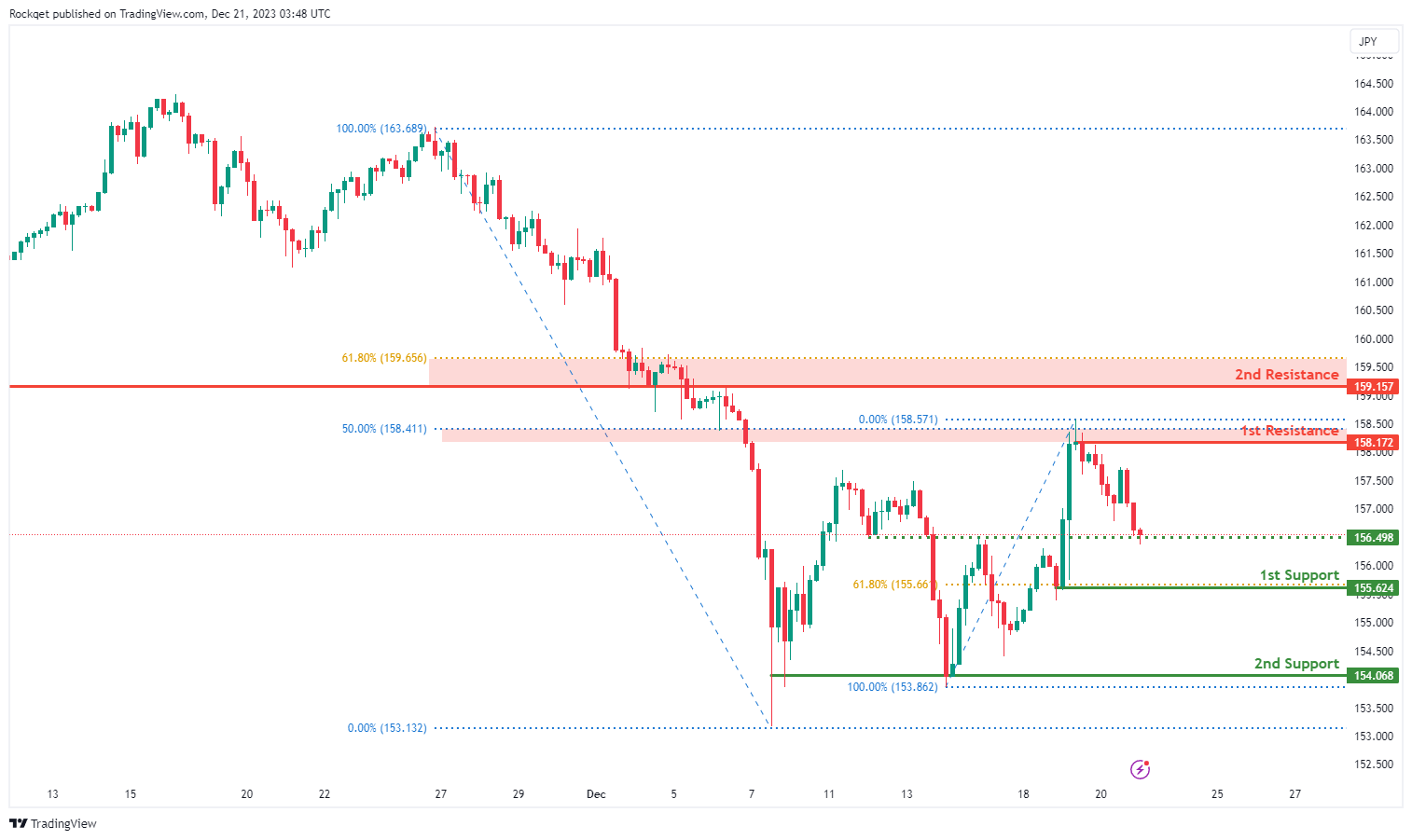
EUR/JPY:
The EUR/JPY chart currently exhibits a bearish overall momentum, suggesting a potential scenario for a bearish continuation towards the 1st support.
he 1st support at 155.62 is deemed significant as it is identified as a pullback support and aligns with the 61.80% Fibonacci Retracement level. This level represents a historical area where buying interest has been present, reinforcing its significance as a key support zone.
Additionally, the 2nd support at 154.07 is considered a multi-swing low support, providing an additional layer of potential support for the currency pair.
On the resistance side, the 1st resistance at 158.17 is associated with a pullback resistance and the 50% Fibonacci Retracement, indicating a level where selling interest could intensify, potentially causing a temporary pause or reversal in the bearish trend.
Furthermore, the 2nd resistance at 159.16 is linked to an overlap resistance and the 61.80% Fibonacci Retracement, presenting a potential challenge for the price to surpass these levels.
EUR/GBP:
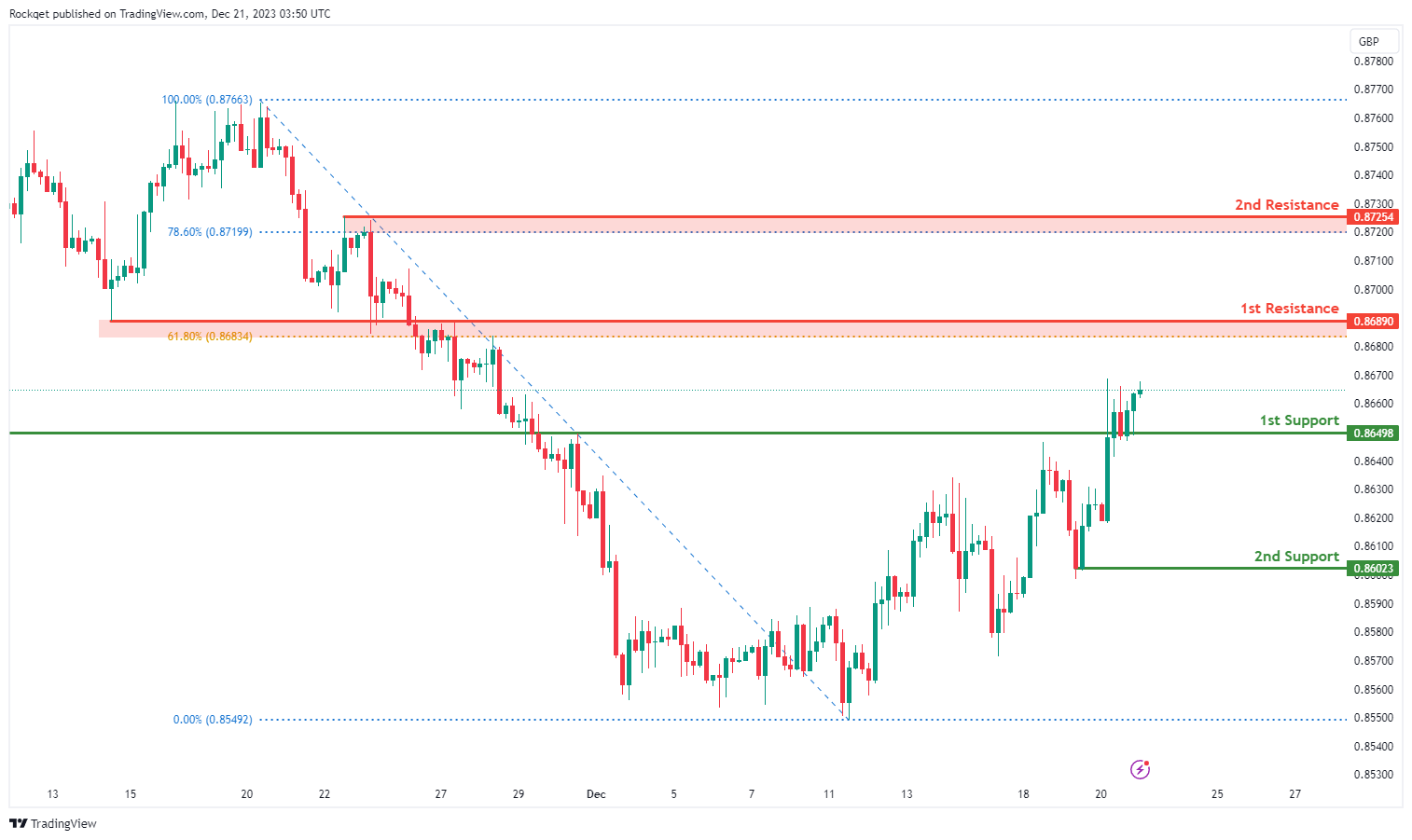
The EUR/GBP chart currently exhibits a bullish overall momentum, indicating a potential scenario for a bullish continuation towards the 1st resistance.
The 1st support at 0.8650 is considered significant as it represents an overlap support. This level indicates a historical area where buying interest has been present, reinforcing its potential as a crucial support zone.
Additionally, the 2nd support at 0.8602 is identified as a pullback support, providing an extra layer of potential support for the currency pair.
On the resistance side, the 1st resistance at 0.8689 is associated with an overlap resistance and the 61.80% Fibonacci Retracement. This level may act as a barrier where selling interest could intensify, potentially causing a temporary pause or reversal in the bullish trend.
Furthermore, the 2nd resistance at 0.8725 is linked to a pullback resistance and the 78.60% Fibonacci Retracement, presenting an additional challenge for the price to surpass these levels.
GBP/USD:
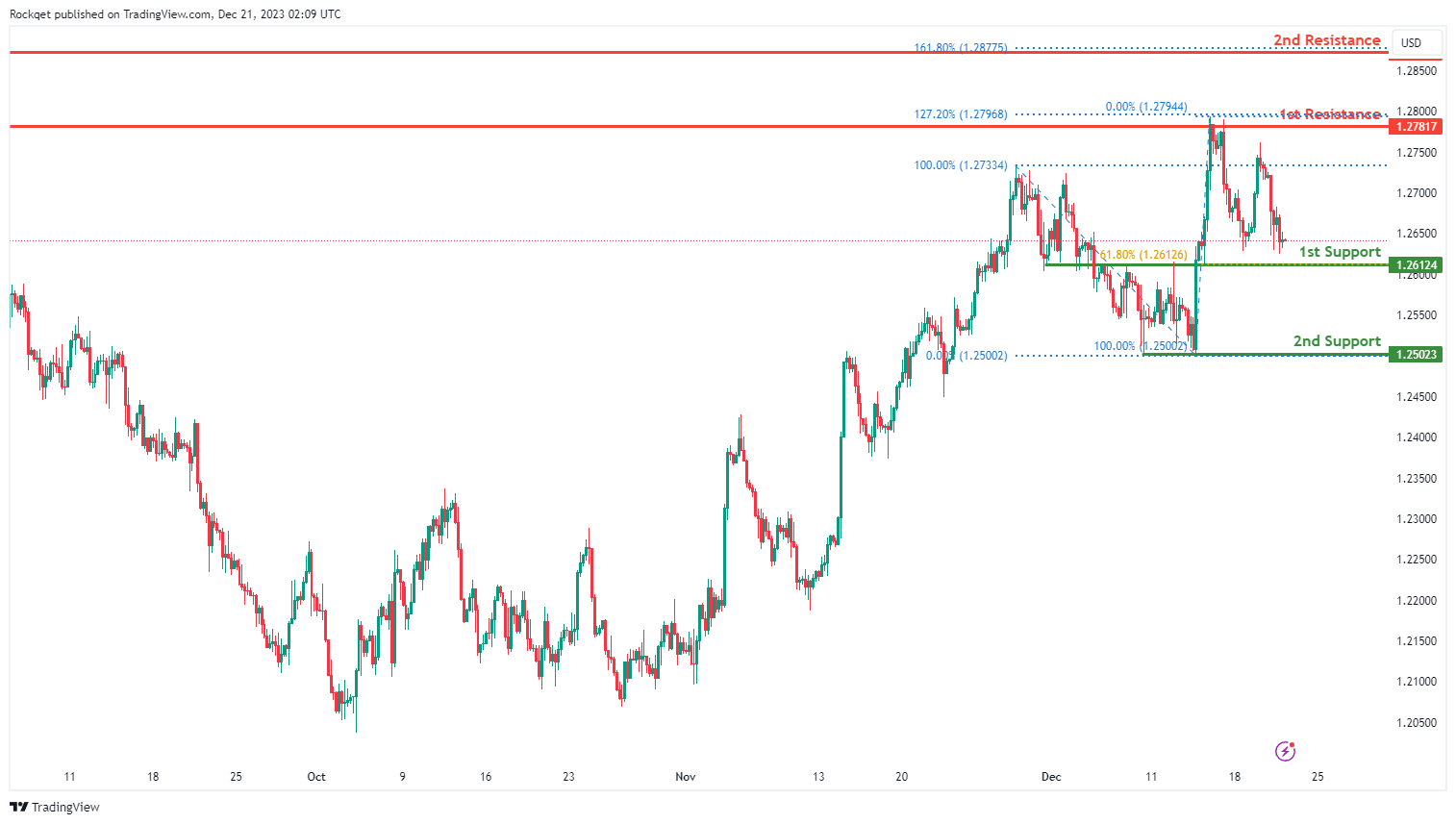
The GBP/USD chart currently exhibits an overall bearish momentum. In this context, there is a potential scenario for price to make a bearish continuation towards the 1st support.
The 1st support level at 1.2612 is identified as an overlap support that aligns with the 61.80% Fibonacci retracement level. Further below, the 2nd support level at 1.2502 is marked as a swing-low support, further reinforcing its importance as a potential key support level.
To the upside, the 1st resistance level at 1.2781 is identified as a multi-swing-high resistance that aligns with the 127.20% Fibonacci extension level. Higher up, the 2nd resistance level at 1.2872 is noted as a pullback resistance that aligns with the 161.80% Fibonacci extension level, suggesting a potential barrier for further upside movement.
GBP/JPY:
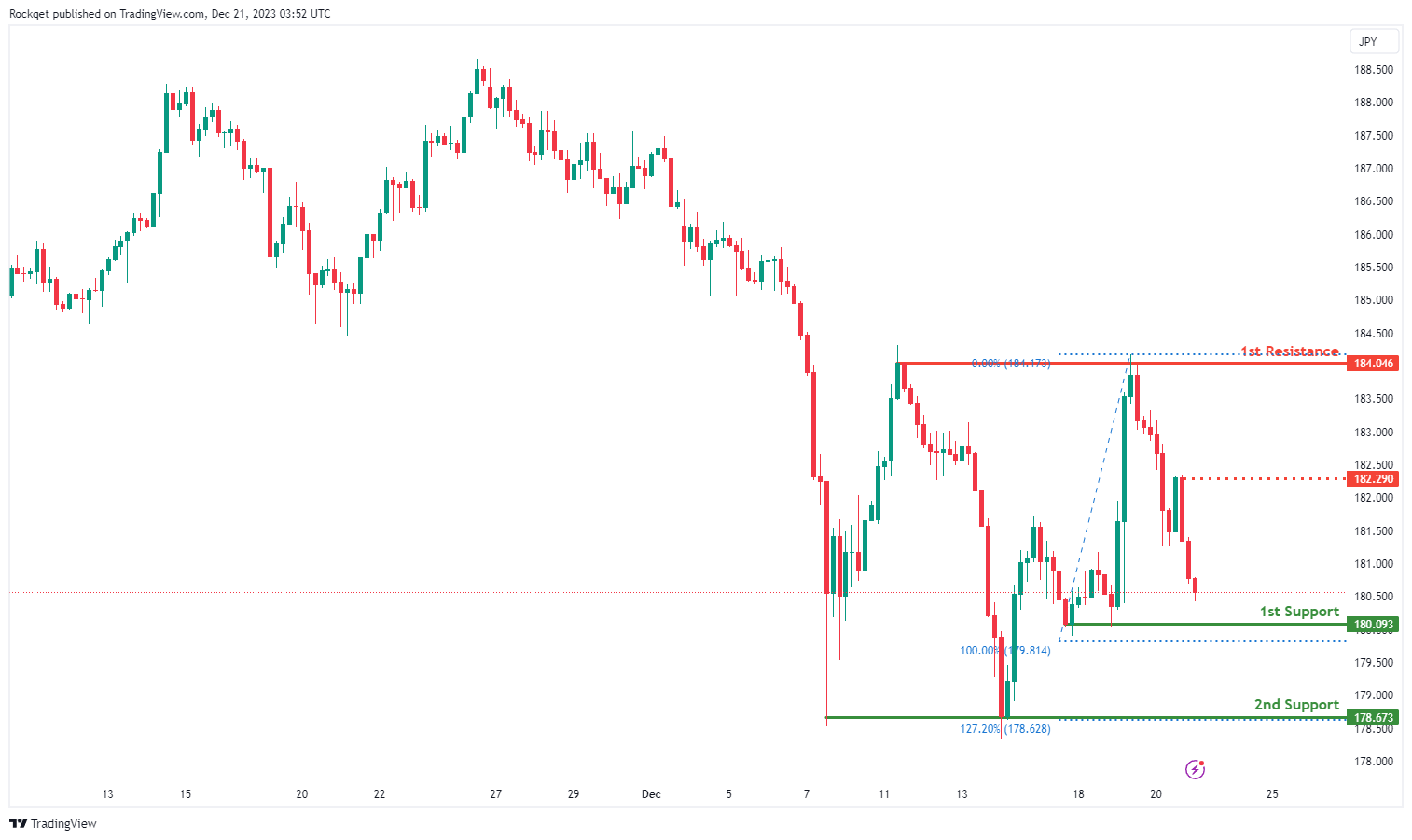
The GBP/JPY chart currently exhibits a bearish overall momentum, suggesting a potential scenario for a bearish continuation towards the 1st support.
The 1st support at 180.09 is considered significant as it represents a pullback support. This level indicates a historical area where buying interest has been present, reinforcing its potential as a crucial support zone.
Additionally, the 2nd support at 178.67 is identified as a multi-swing low support and is associated with the 127.20% Fibonacci Extension, providing an additional layer of potential support for the currency pair.
On the resistance side, the intermediate resistance at 182.29 is linked to a pullback resistance. This level may act as a barrier where selling interest could intensify, potentially causing a temporary pause or reversal in the bearish trend.
Furthermore, the 1st resistance at 184.05 is associated with a multi-swing high resistance, presenting an additional challenge for the price to surpass these levels.
USD/CHF:
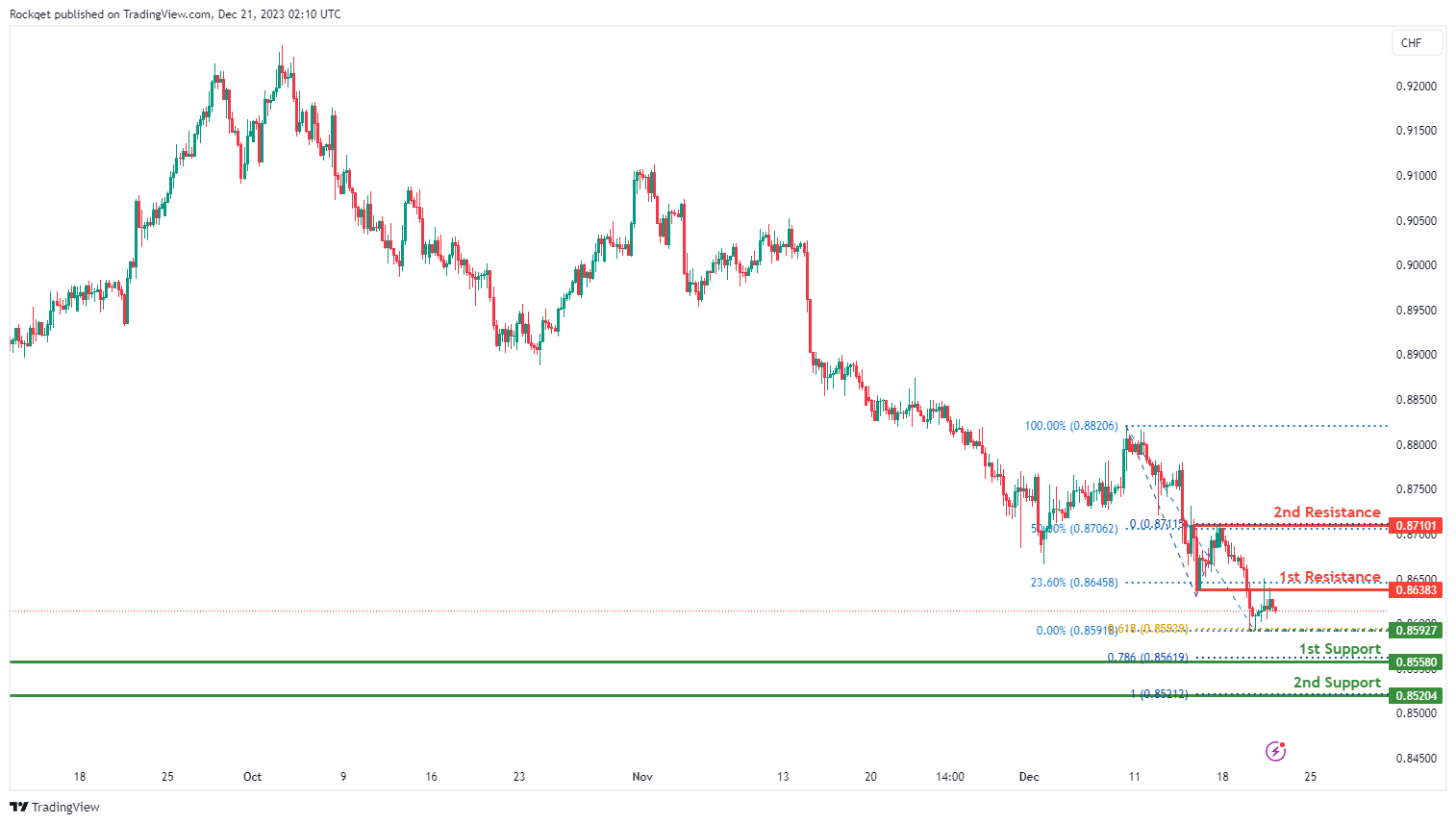
The USD/CHF chart currently exhibits an overall bearish momentum. In this context, there is a potential scenario for price to make a bearish continuation towards the 1st support.
The intermediate support level at 0.8592 is identified as a pullback support that aligns with the 61.80% Fibonacci projection level while the 1st support level at 0.8558 is marked as a multi-swing-low support that aligns with the 78.60% Fibonacci projection level. Further below, the 2nd support level at 0.8520 is noted as a swing-low support that aligns with the 100.00% Fibonacci projection level, further reinforcing its importance as a key support level.
To the upside, the 1st resistance level at 0.8638 is identified as a pullback resistance that aligns close to the 23.60% Fibonacci retracement level. Higher up, the 2nd resistance level at 0.8710 is also marked as a pullback resistance that aligns with the 50.00% Fibonacci retracement level, suggesting a potential barrier for further upside movement.
USD/JPY:
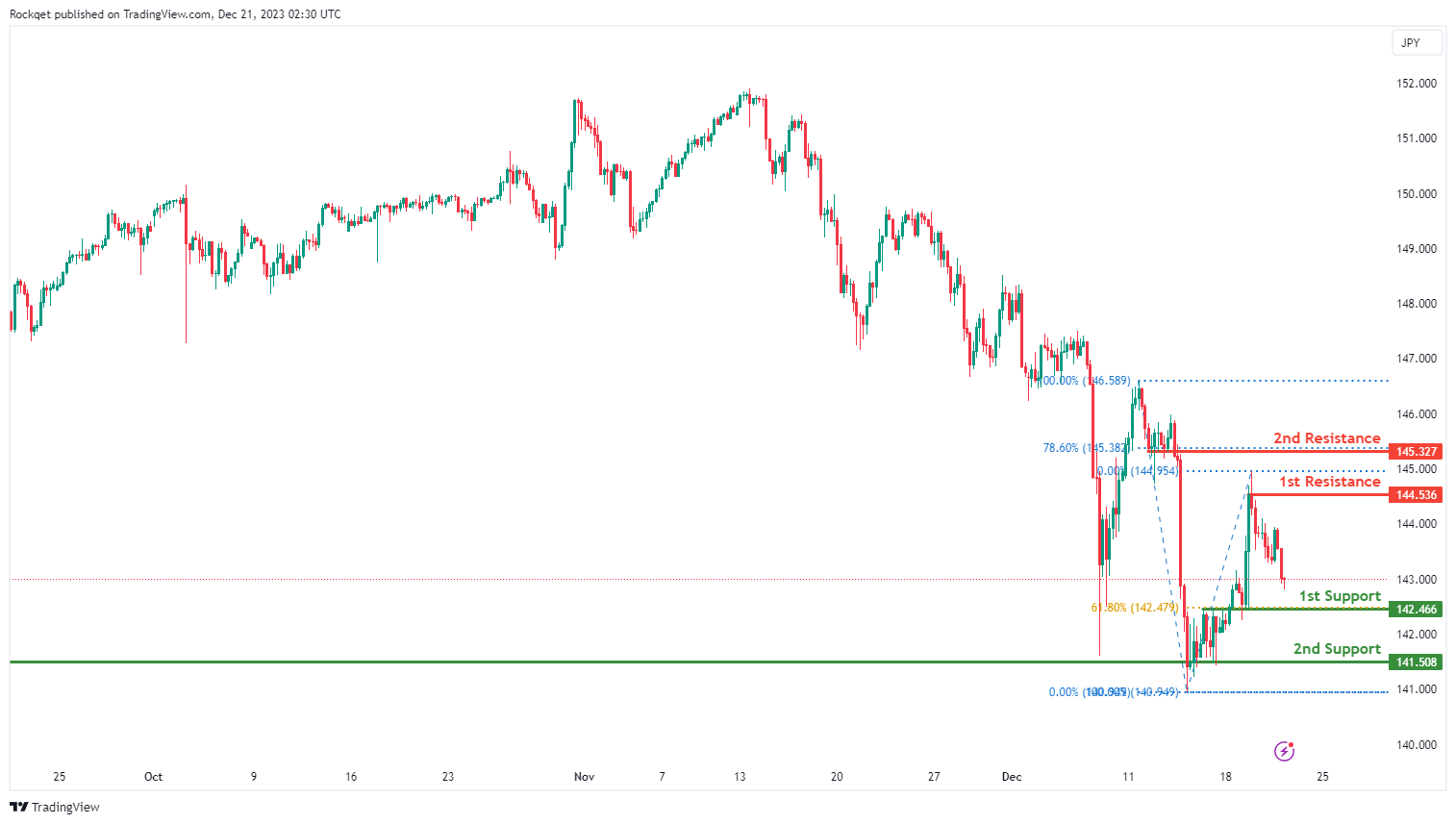
The USD/JPY chart currently exhibits an overall bearish momentum, indicating a potential for price to make a bearish continuation towards the 1st support.
The 1st support level at 142.46 is identified as an overlap support that aligns with the 61.80% Fibonacci retracement level. Further below, the 2nd support level at 141.50 is noted as a multi-swing-low support, further reinforcing its importance as a key support level.
To the upside, the 1st resistance level at 144.53 is identified as a pullback resistance. Higher up, the 2nd resistance level at 145.32 is also marked as a pullback resistance that aligns with the 78.60% Fibonacci retracement level, suggesting a potential barrier for further upside movement.
USD/CAD:
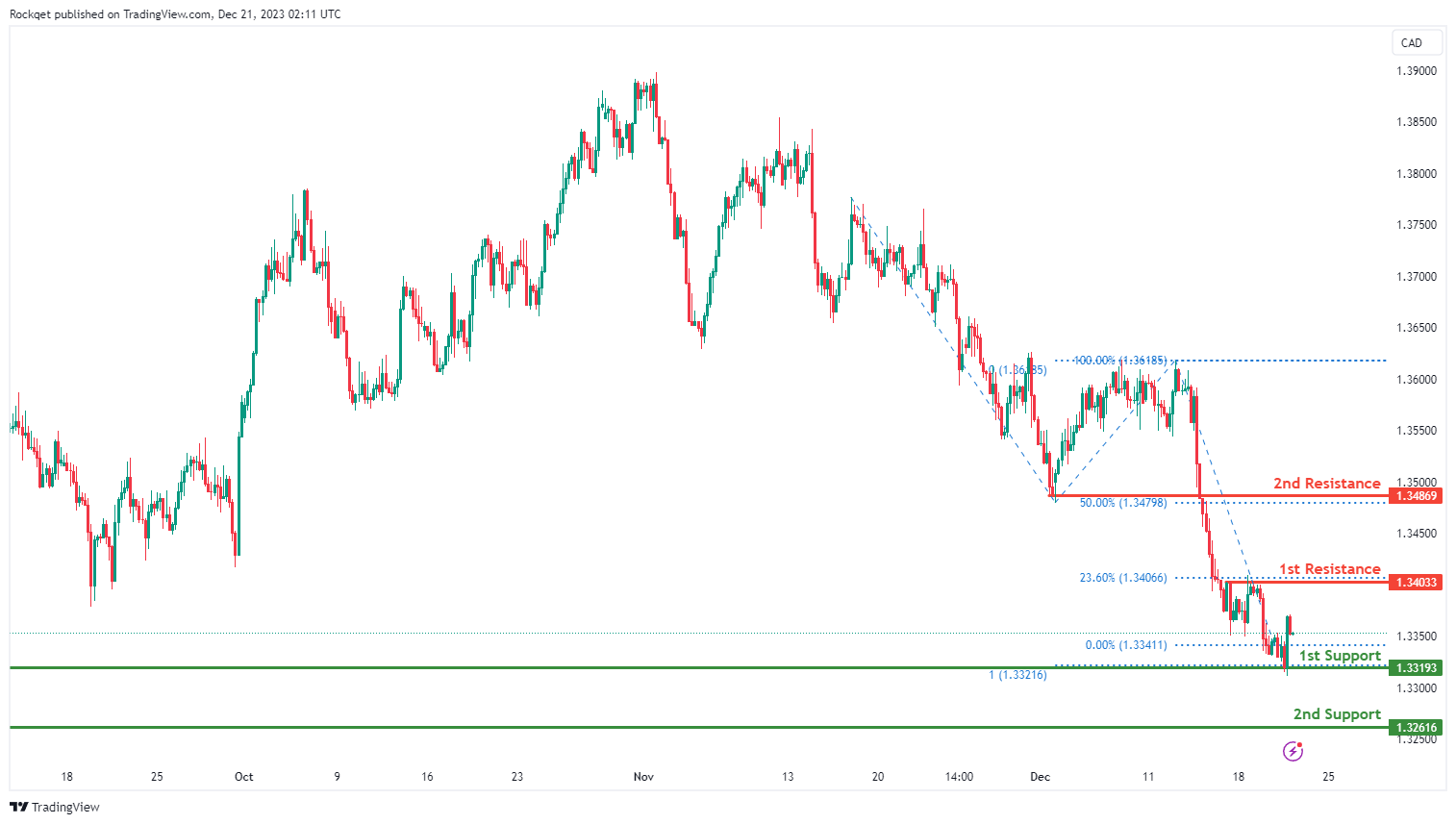
The USD/CAD chart currently exhibits an overall bearish momentum, indicating a potential for a drop towards the 1st support.
The 1st support level at 1.3319 is identified as a pullback support that aligns with the 100.00% Fibonacci projection level. Further below, the 2nd support level at 1.3261 is noted as an overlap support, further reinforcing its importance as a key support level.
To the upside, the 1st resistance level at 1.3403 is identified as a pullback resistance that aligns with the 23.60% Fibonacci retracement level. Higher up, the 2nd resistance level at 1.3486 is also marked as a pullback resistance that aligns with the 50.00% Fibonacci retracement level, suggesting a potential barrier for further upside movement.
AUD/USD:
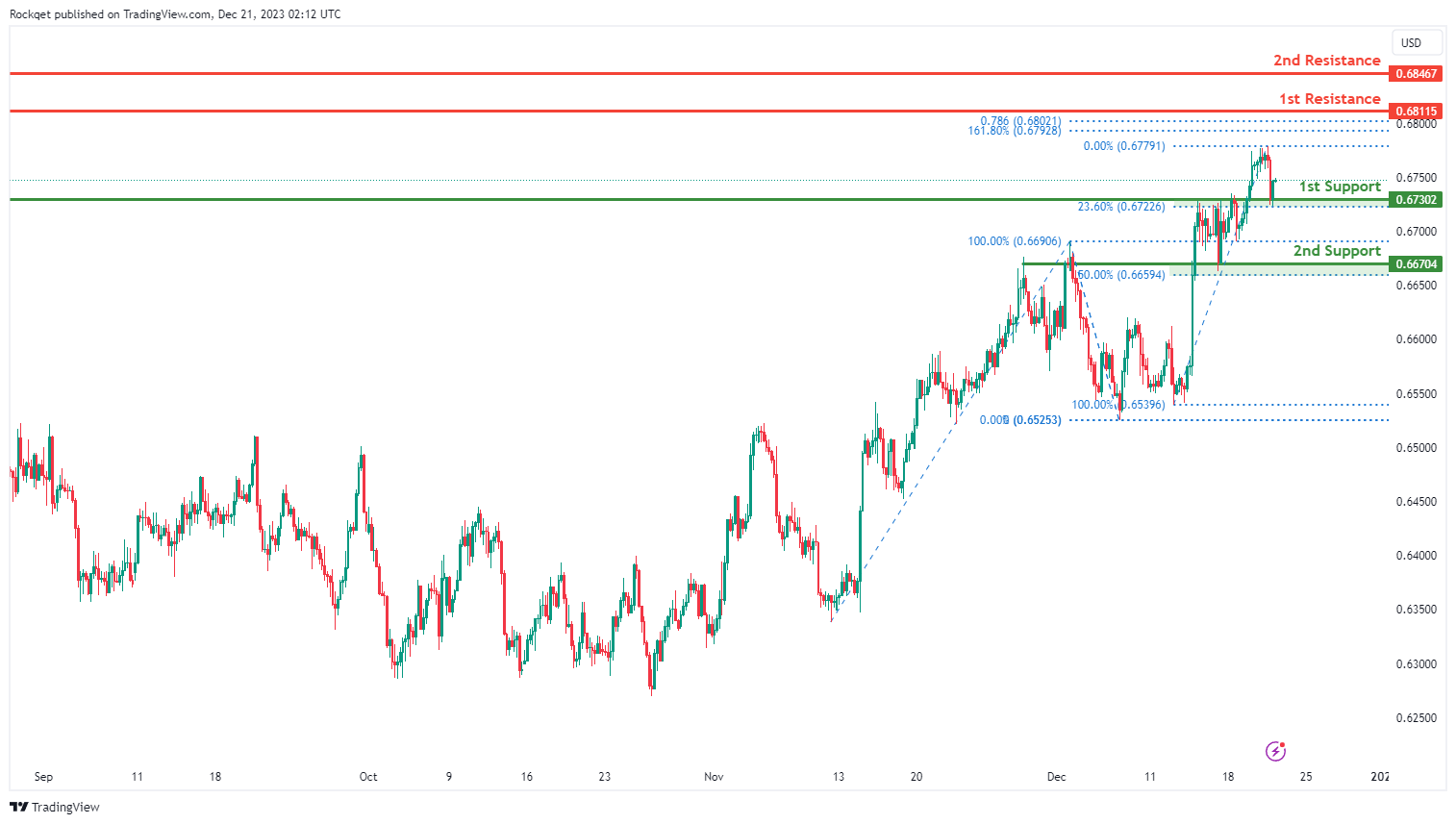
The AUD/USD chart currently exhibits an overall bullish momentum. In this context, there is a potential scenario for price to make a bullish continuation towards the 1st resistance.
The 1st resistance level at 0.6811 is identified as a swing-high resistance that aligns with a confluence of Fibonacci levels i.e. the 161.80% extension and the 78.60% projection levels. Higher up, the 2nd resistance level at 0.6846 is also noted as a swing-high resistance, indicating its potential significance as a barrier for further upward movement.
To the downside, the 1st support level at 0.6730 is identified as an overlap support that aligns with the 23.60% Fibonacci retracement level. Further below, the 2nd support level at 0.6670 is also marked as an overlap support that aligns close to the 50.00% Fibonacci retracement level, further reinforcing its importance as a key support level.
NZD/USD
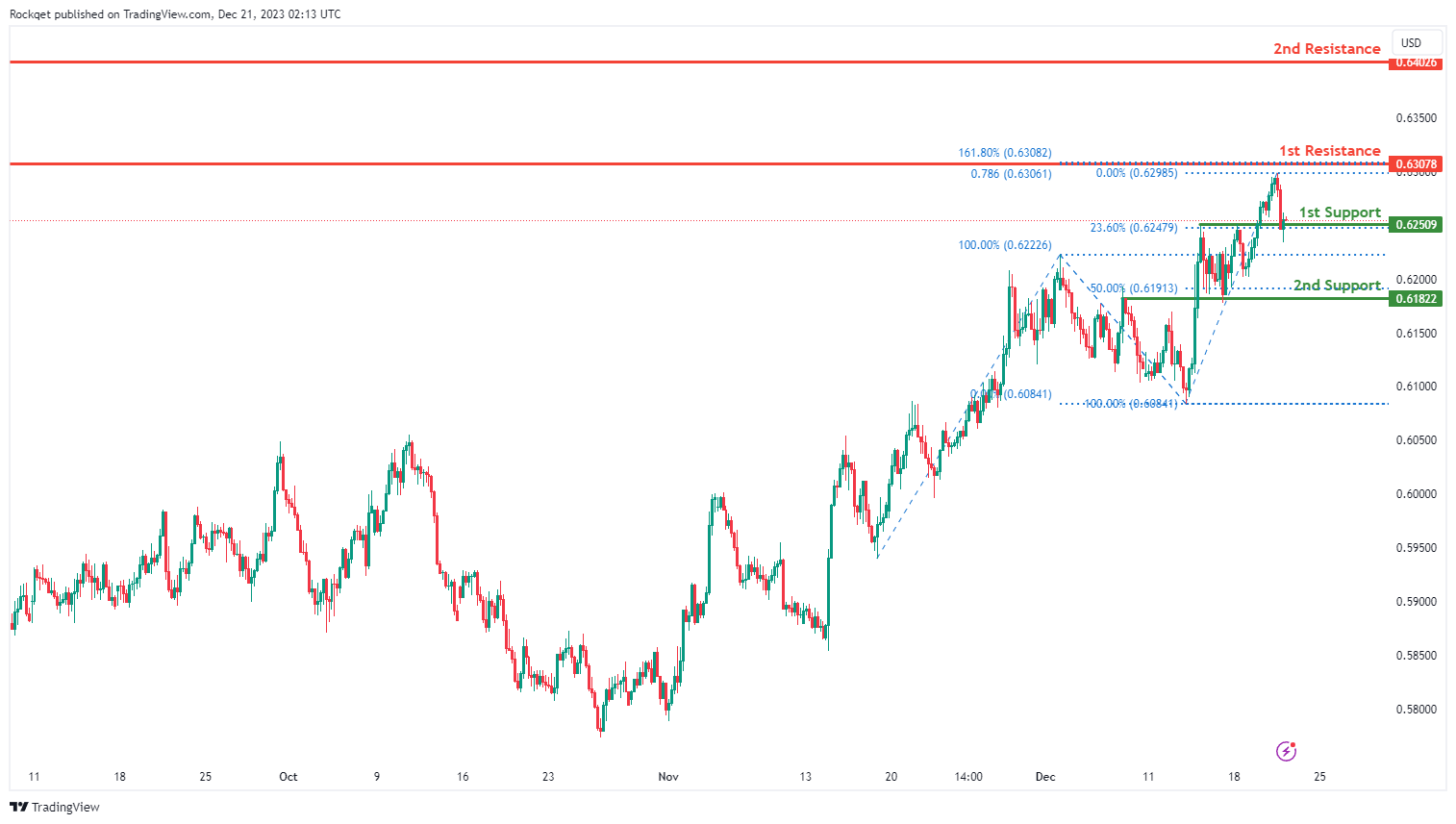
The NZD/USD chart currently exhibits an overall bullish momentum. In this context, there is a potential scenario for price to make a bullish bounce off the 1st support and rise towards the 1st resistance.
The 1st support level at 0.6250 is identified as an overlap support that aligns with the 23.60% Fibonacci retracement level. Further below, the 2nd support level at 0.6182 is also noted as an overlap support that aligns close to the 50.00% Fibonacci retracement level, further reinforcing its importance as a key support level.
To the upside, the 1st resistance level at 0.6307 is identified as a swing-high resistance that aligns with a confluence of Fibonacci levels i.e. the 161.80% extension and the 78.60% projection levels. Higher up, the 2nd resistance level at 0.6402 is also marked as a swing-high resistance, indicating its potential significance as a barrier for further upward movement.
DJ30:
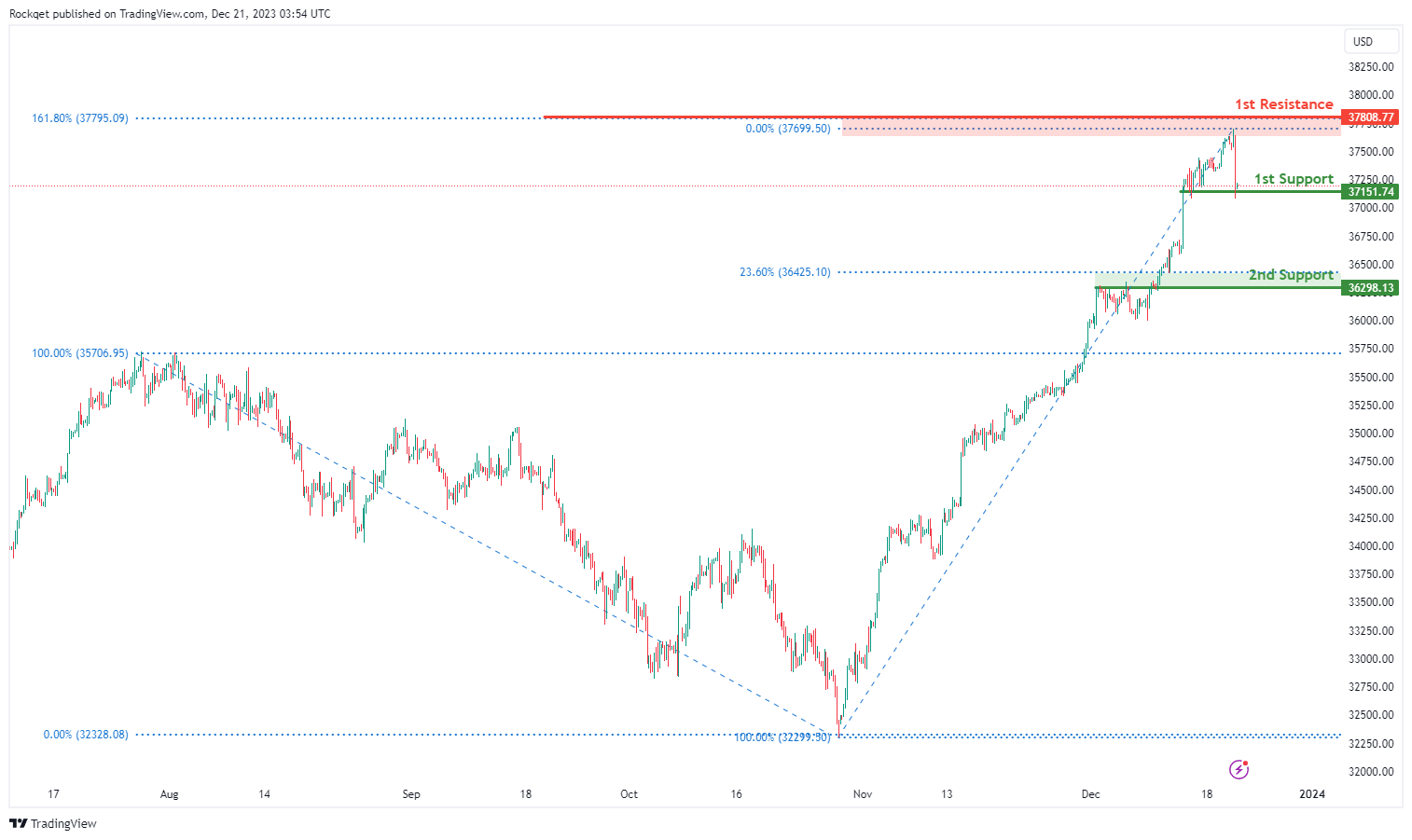
The DJ30 chart currently exhibits a bullish overall momentum, indicating a potential scenario for a bullish bounce off the 1st support and a subsequent move towards the 1st resistance.
The 1st support at 37151.74 is considered significant as it represents an overlap support, signifying a historical area where buying interest has been present. This reinforces its potential as a crucial support zone for the index.
Additionally, the 2nd support at 36298.13 is identified as both an overlap support and associated with the 23.60% Fibonacci Retracement, providing an additional layer of potential support.
On the resistance side, the 1st resistance at 37808.77 is linked to the 161.80% Fibonacci Extension. This level may act as a barrier where selling interest could intensify, potentially causing a temporary pause or reversal in the bullish trend.
GER40:
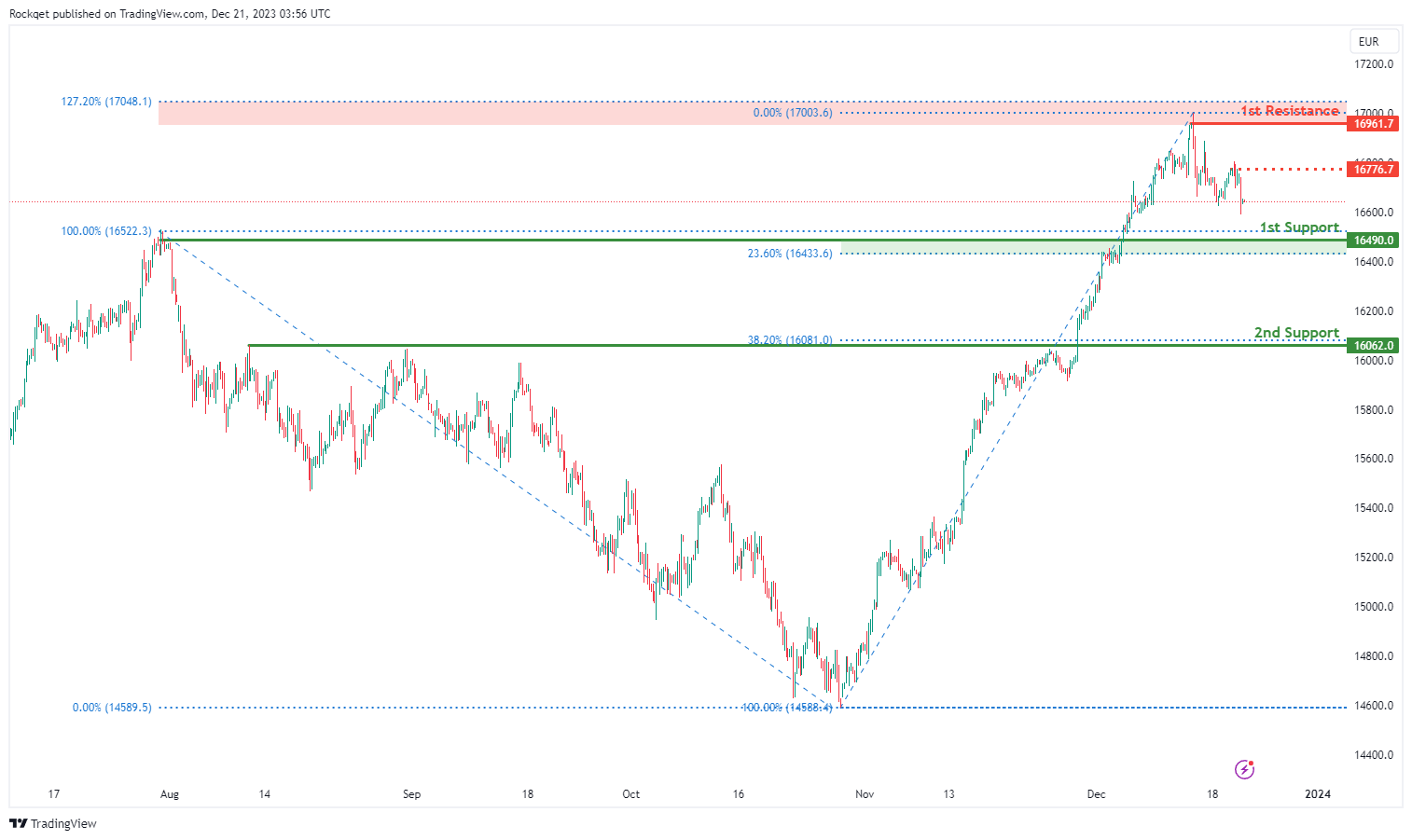
The GER40 chart currently demonstrates a neutral overall momentum, with factors contributing to this state. As a result, the price could potentially make fluctuations between the 1st resistance and 1st support levels.
The 1st support at 16490.00 is considered significant as it represents an overlap support and is associated with the 23.60% Fibonacci Retracement. This level indicates a historical area where buying interest has been present, reinforcing its potential as a crucial support zone.
Additionally, the 2nd support at 16062.00 is identified as a pullback support and is linked to the 38.20% Fibonacci Retracement, providing an additional layer of potential support for the index.
On the resistance side, the intermediate resistance at 16776.70 is associated with a pullback resistance, indicating a level where selling interest could intensify.
Furthermore, the 1st resistance at 16961.70 is linked to a swing high resistance and the 127.20% Fibonacci Extension, highlighting a potential challenge for the price to surpass these levels.
US500:
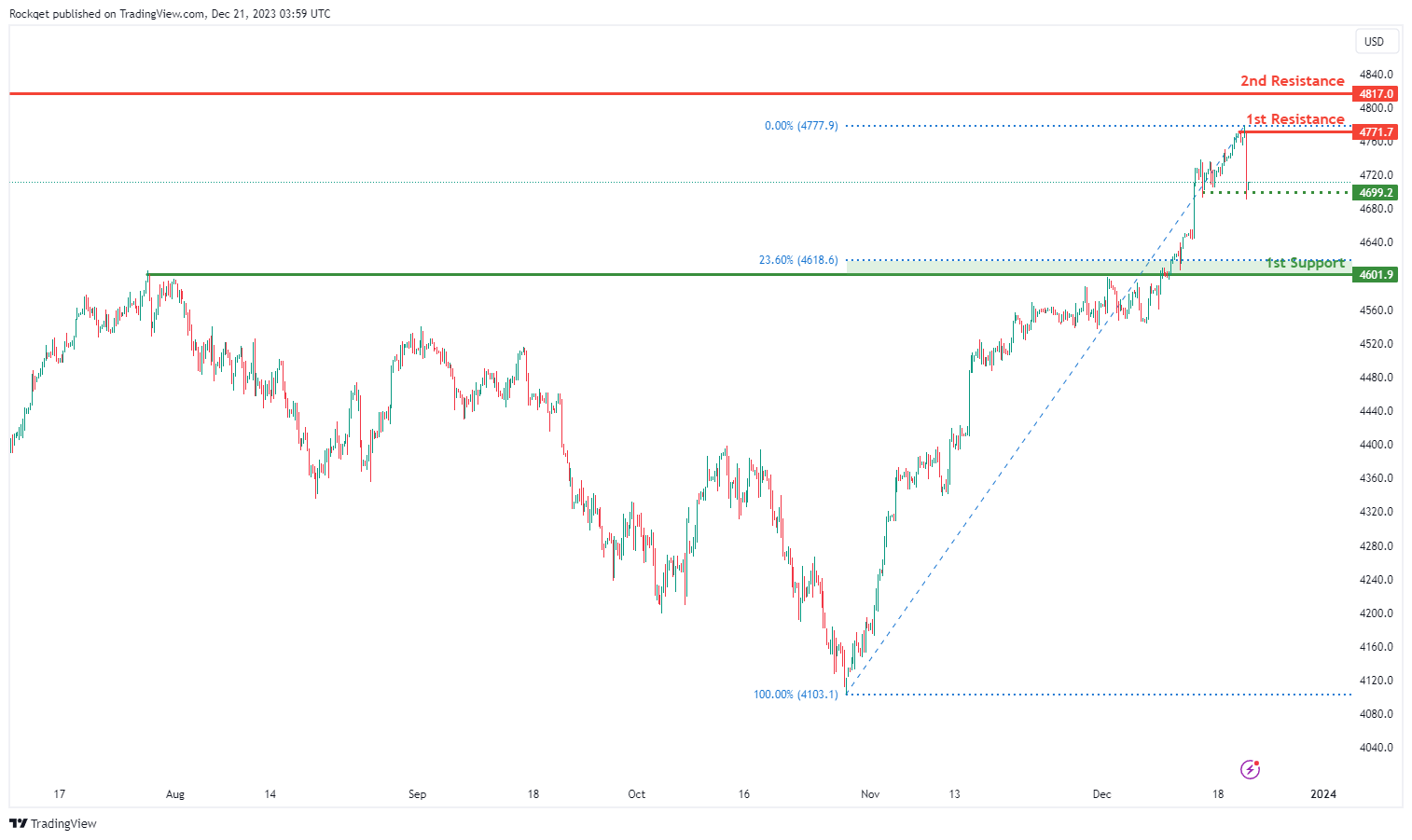
The US500 chart currently demonstrates a bullish overall momentum, with several factors contributing to this positive sentiment. As a result, the price could potentially make a bullish continuation towards the 1st resistance.
The intermediate support at 4699.2 is considered significant as it represents a multi-swing low support, indicating a historical area where buying interest has been present.
Additionally, the 1st support at 4601.9 is identified as an overlap support and is associated with the 23.60% Fibonacci Retracement, providing an additional layer of potential support for the index.
On the resistance side, the 1st resistance at 4771.7 is linked to a swing high resistance, and the 2nd resistance at 4817.0 is also associated with a swing high resistance. These levels represent potential barriers where selling interest could intensify, potentially causing a temporary pause or reversal in the bullish trend.
BTC/USD:
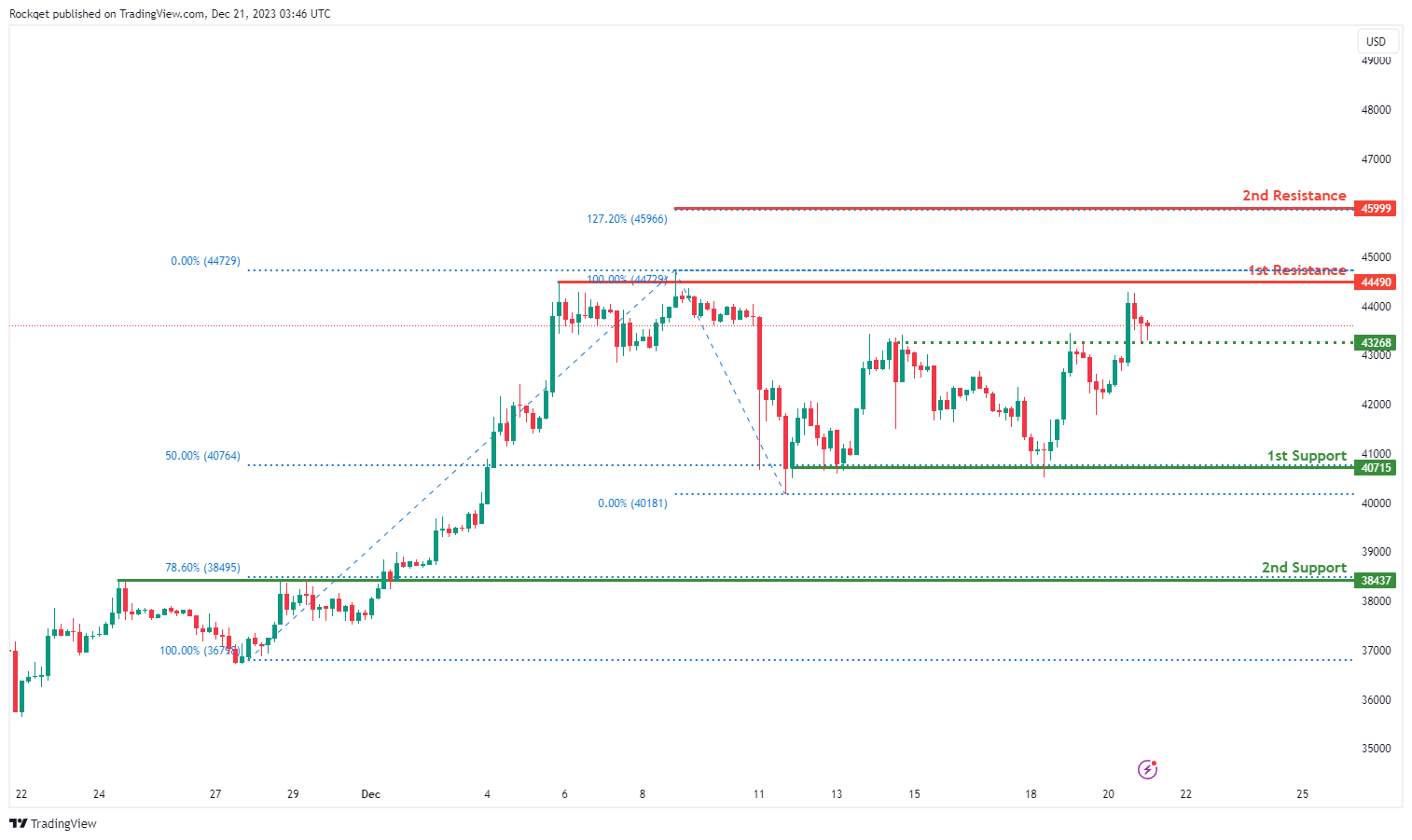
The BTC/USD chart currently demonstrates a bullish overall momentum, suggesting a potential scenario for a bullish continuation towards the 1st resistance.
The 1st support at 40715 is noteworthy as it corresponds to a swing low support and aligns with the 50% Fibonacci Retracement level. This level indicates a historical area where buying interest has been prevalent, reinforcing its significance as a crucial support zone.
Additionally, the 2nd support at 38437 is identified as an overlap support and is associated with the 78.60% Fibonacci Retracement, providing an additional layer of potential support for the cryptocurrency.
On the resistance side, the 1st resistance at 44490 is linked to a swing high resistance, marking a level where selling interest could intensify, potentially causing a temporary pause or reversal in the bullish trend.
Furthermore, the 2nd resistance at 45999 is associated with the 127.20% Fibonacci Extension, presenting a potential challenge for the price to surpass these levels.
ETH/USD:
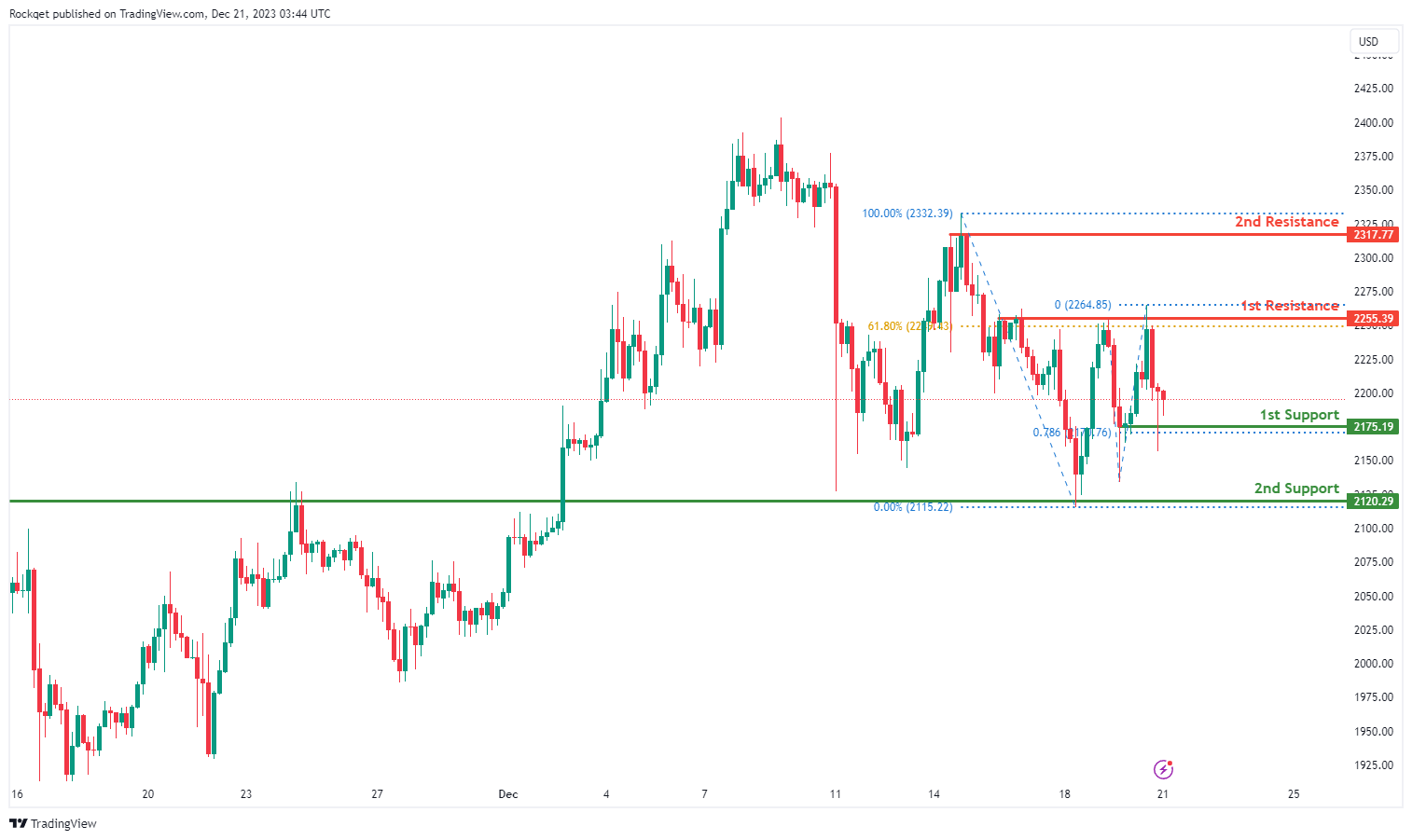
The ETH/USD chart currently exhibits a bearish overall momentum, suggesting a potential scenario for a bearish continuation towards the 1st support.
The 1st support at 2175.19 is significant as it is identified as a pullback support and coincides with the 78.60% Fibonacci Retracement level. This level indicates a historical area where buying interest has been present, reinforcing its importance as a key support zone.
Additionally, the 2nd support at 2120.29 is considered a swing low support, providing an additional layer of potential support for the cryptocurrency.
On the resistance side, the 1st resistance at 2255.39 is associated with a pullback resistance and the 61.80% Fibonacci Retracement, indicating a level where selling interest could intensify, potentially causing a temporary pause or reversal in the bearish trend.
Furthermore, the 2nd resistance at 2317.77 is linked to a swing high resistance and the 100% Fibonacci Retracement, presenting a potential challenge for the price to surpass these levels.
WTI/USD:
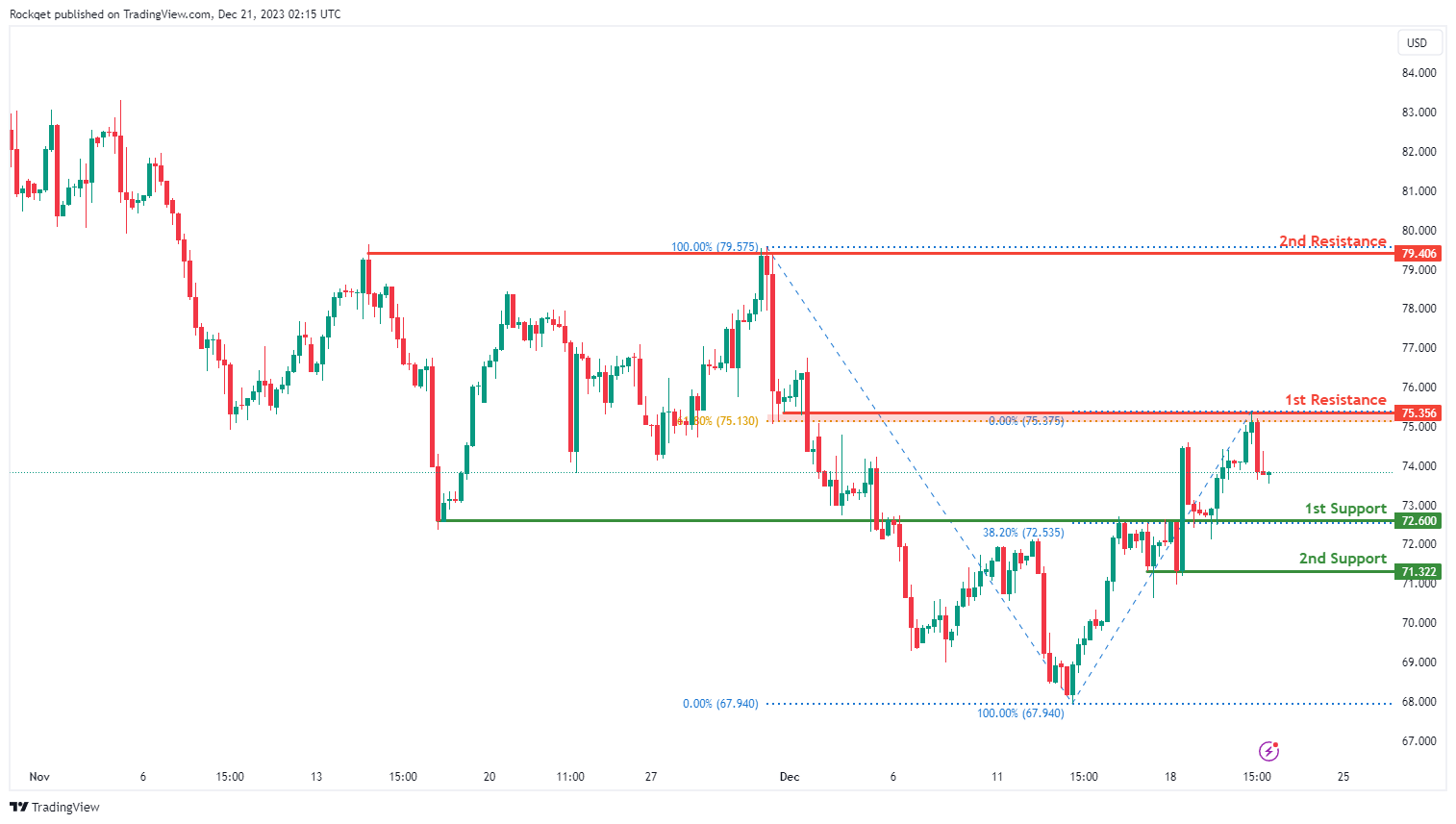
The WTI chart currently exhibits an overall bullish momentum, suggesting a prevailing uptrend. In this context, there is a potential scenario for price to make a bullish continuation towards the 1st resistance.
The 1st resistance level at 75.35 is identified as an overlap resistance that aligns close to the 61.80% Fibonacci retracement level. Higher up, the 2nd resistance level at 79.40 is noted as a multi-swing-high resistance, further indicating its potential significance as a barrier for further upward movement.
To the downside, the 1st support level at 72.60 is identified as an overlap support that aligns with the 38.20% Fibonacci retracement level. Further below, the 2nd support level at 71.32 is marked as a pullback support, reinforcing its importance as a key support level.
XAU/USD (GOLD):
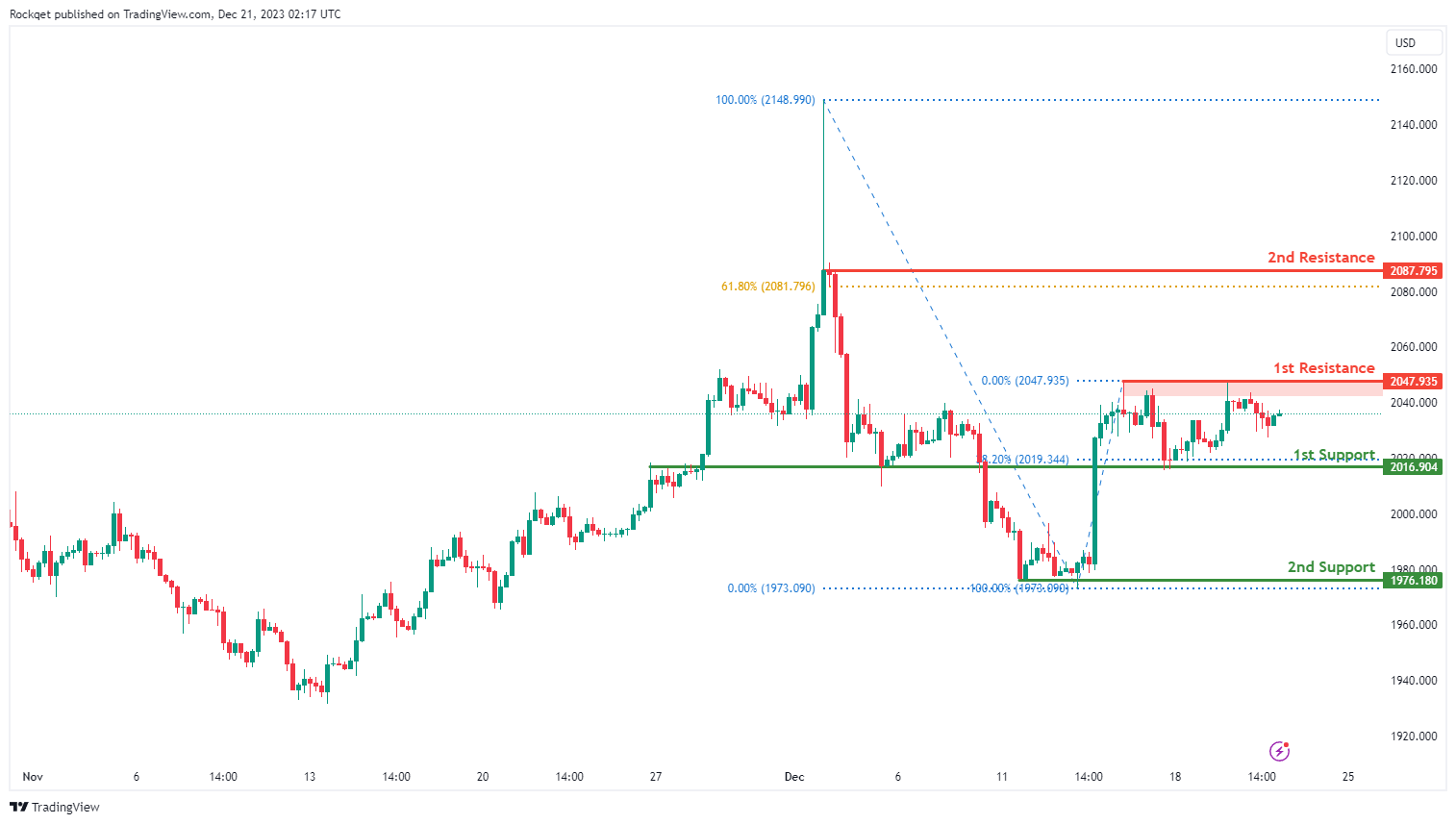
The XAU/USD chart currently demonstrates a neutral momentum, indicating a potential for price to fluctuate between the 1st support and the 1st resistance.
The 1st support level at 2,016.90 is identified as an overlap support that aligns with the 38.20% Fibonacci retracement level. Further below, the 2nd support level at 1,976.18 is noted as a pullback support, reinforcing its importance as a key support level.
To the upside, the 1st resistance level at 2,047.93 is identified as a pullback resistance. Higher up, the 2nd resistance level at 2,087.79 is also marked as a pullback resistance that aligns close to the 61.80% Fibonacci retracement level, further indicating its potential significance as a barrier for further upward movement.
GBP/JPY Daily Outlook
Daily Pivots: (S1) 180.70; (P) 182.02; (R1) 182.76; More...
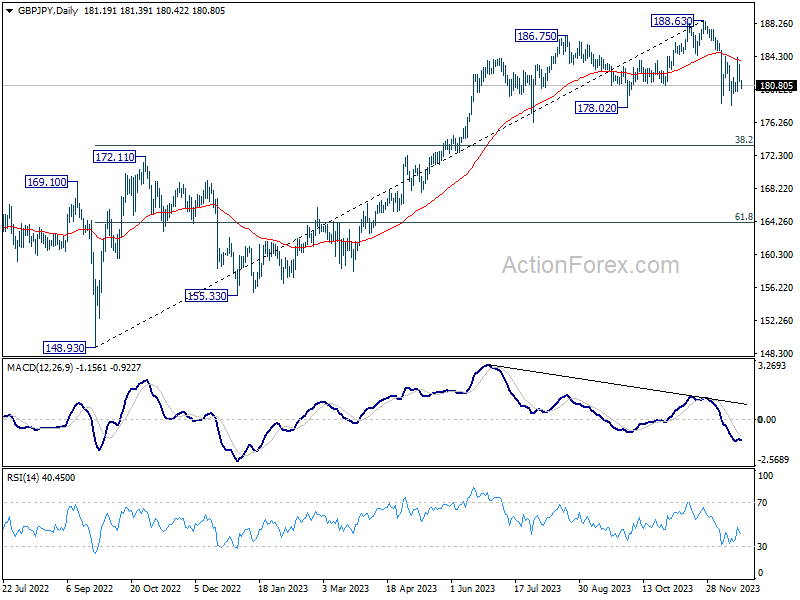
GBP/JPY's fall from 184.15 extends lower today but overall it's staying in range above 178.32. Intraday bias remains neutral and further decline is expected. On the downside, break of will resume the decline from 188.63 and target 38.2% retracement of 148.93 to 188.63 at 173.46. However, decisive break of 184.30 will argue that pull back from 188.63 has completed and bring retest of this high.
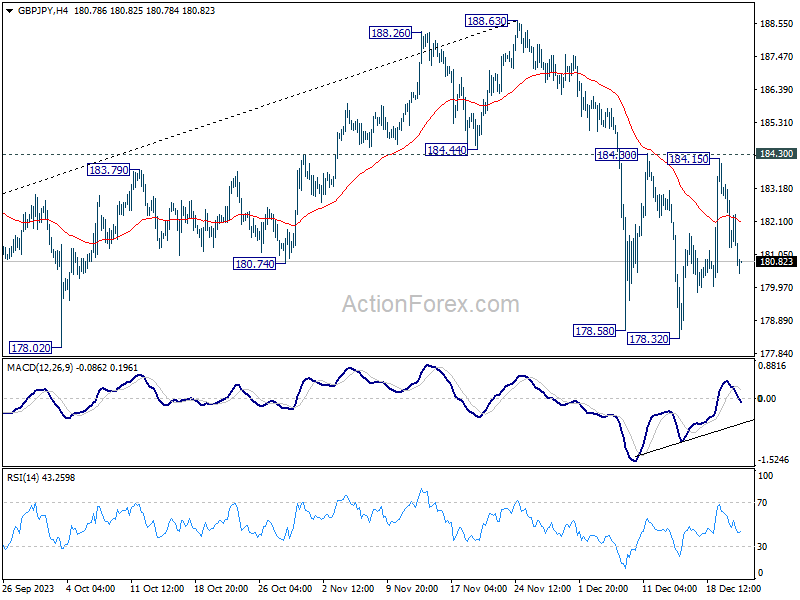
In the bigger picture, price actions from 188.63 medium term top are currently seen as a correction to the up trend from 148.93 (2022 low) only. As long as 172.11 resistance turned support holds, larger up trend from 123.94 (2020 low) is still in favor to resume through 188.63 at a later stage.
Yen Rebounds on Upgraded Growth Forecasts, Global Risk-On Sentiment Eases
Yen rebounds broadly in today's Asian trading session, buoyed by optimistic revisions in Japan's economic growth forecasts. The government, in its semi-annual economic report, upgraded its growth projections for both the current and next fiscal years. Forecast for fiscal 2023 was raised from 1.3% to 1.6%, while projection for fiscal 2024 saw an increase from 1.2% to 1.3%. Furthermore, core inflation in Japan is anticipated to slow down from current fiscal year's rate of 3.0% to 2.5% in the next fiscal year. That is, core inflation is projected to stay above BoJ's 2% target.
Despite Yen's recovery today, it remains the weakest performer for the week. Nevertheless, the currency's post-BoJ selloff seems to have concluded, setting the stage for a period of consolidation. While a new high for Yen is unlikely, the range for near-term consolidation seems to have been established. Meanwhile, Sterling is the second weakest currency, largely due to the sell-off triggered by the latest UK CPI data yesterday. Dollar follows as the third weakest. On the other end of the spectrum, Swiss Franc has shown remarkable strength, becoming the best performer this week. Australian Dollar and the New Zealand Dollar are also showing firmness, while Euro and Canadian are mixed.
A notable development was observed in the stock market overnight, with DOW having a significant pullback after hitting new record high. This movement may reflect broader trend of position adjustments by investors as the year-end holiday season approaches. If this trend continues, the Aussie could lose its upward momentum and may enter a phase of consolidation as well.
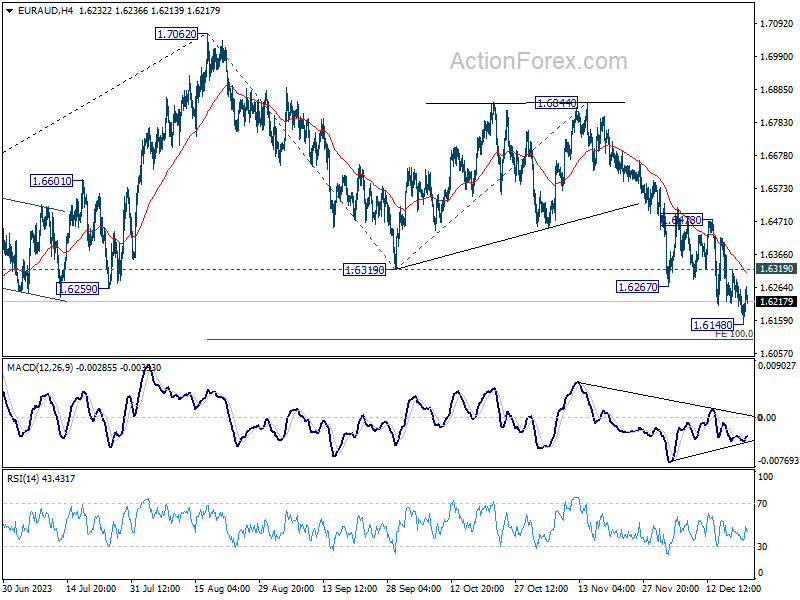
Technically, break of 1.6319 resistance in EUR/AUD would indicate short bottoming just ahead of 100% projection of 1.7062 to 1.6319 from 1.6844 at 1.6106, on bullish convergence condition in 4H MACD. Stronger rebound would then be seen to 1.6478 resistance.
In Asia, at the time of writing, Nikkei is down -1.56%. Hong Kong HSI is down -0.03%. China Shanghai SSE is up 0.34%. Singapore Strait Times is up 0.22%. Overnight, DOW fell -1.27%. S&P 500 fell -1.47%. NASDAQ fell -1.50%. 10-year yield fell -0.045 to 3.877.
Fed's Harker: Cautious path to future rate cuts, inflation fight continues
Philadelphia Fed President Patrick Harker, in a local radio interview overnight, shared expressed that while there will be a need to lower interest rates eventually, this shift should not happen "right away" or "too fast."
Harker stated, "I've been in the camp of, let's hold rates where they are for a while, let's see how this plays out, we don't need to raise rates anymore."
Looking ahead, Harker acknowledged the necessity of reducing rates, saying, "it's important that we start to move rates down." However, he emphasized a gradual approach: "we don't have to do it too fast, we're not going to do it right away, it's going to take some time."
Harker also added a note of caution regarding the economic outlook, particularly concerning inflation. "Let me be clear: The job on inflation is not done, but we are moving in the right direction, things are starting to look better and better."
BoC minutes indicate greater confidence in current monetary policy restrictiveness
Summary of BoC's December 6 meeting showed members collectively agreed "the likelihood that monetary policy was sufficiently restrictive to achieve the inflation target had increased."
However, members also unanimously agreed that "risks to the inflation outlook remained." Hence, BoC did not rule out the possibility of further interest rate hikes.
To effectively assess underlying inflationary pressures, BoC members agreed to focus on several key economic indicators. These include the balance of supply and demand in the economy, wage growth, corporate pricing behavior, and inflation expectations.
It's clarified that while these indicators are not intermediate targets, they "provided helpful information on where inflation is headed."
ECB's Kazaks sees mid-2024 rate cuts, urges caution on early reduction
ECB Governing Council member Martins Kazaks, in an interview overnight, indicated that the most likely period for rate reductions could be around the "middle of next year", specifically pointing to June or July as probable months.
However, Kazaks expressed caution about reducing rates too soon, stating, "But in the spring at the current moment that's too early." He also noted a disparity between his outlook and market expectations, particularly concerning the possibility of an initial rate cut in March, which he views as overly "optimistic".
Kazaks also noted that interest rates are likely to remain at 4% for a while before any reduction is considered.
GBP/JPY Daily Outlook
Daily Pivots: (S1) 180.70; (P) 182.02; (R1) 182.76; More...
GBP/JPY's fall from 184.15 extends lower today but overall it's staying in range above 178.32. Intraday bias remains neutral and further decline is expected. On the downside, break of will resume the decline from 188.63 and target 38.2% retracement of 148.93 to 188.63 at 173.46. However, decisive break of 184.30 will argue that pull back from 188.63 has completed and bring retest of this high.
In the bigger picture, price actions from 188.63 medium term top are currently seen as a correction to the up trend from 148.93 (2022 low) only. As long as 172.11 resistance turned support holds, larger up trend from 123.94 (2020 low) is still in favor to resume through 188.63 at a later stage.
Economic Indicators Update
| GMT | Ccy | Events | Actual | Forecast | Previous | Revised |
|---|---|---|---|---|---|---|
| 07:00 | GBP | Public Sector Net Borrowing (GBP) Nov | 13.2B | 14.0B | ||
| 13:30 | CAD | Retail Sales M/M Oct | 0.80% | 0.60% | ||
| 13:30 | CAD | Retail Sales ex Autos M/M Oct | 0.50% | 0.20% | ||
| 13:30 | USD | Initial Jobless Claims (Dec 15) | 220K | 202K | ||
| 13:30 | USD | GDP Annualized Q3 | 5.20% | 5.20% | ||
| 13:30 | USD | GDP Price Index Q3 | 3.60% | 3.60% | ||
| 13:30 | USD | Philadelphia Fed Manufacturing Survey Dec | -3 | -5.9 | ||
| 15:30 | USD | Natural Gas Storage | -82B | -55B |
BoC minutes indicate greater confidence in current monetary policy restrictiveness
Summary of BoC's December 6 meeting showed members collectively agreed "the likelihood that monetary policy was sufficiently restrictive to achieve the inflation target had increased."
However, members also unanimously agreed that "risks to the inflation outlook remained." Hence, BoC did not rule out the possibility of further interest rate hikes.
To effectively assess underlying inflationary pressures, BoC members agreed to focus on several key economic indicators. These include the balance of supply and demand in the economy, wage growth, corporate pricing behavior, and inflation expectations.
It's clarified that while these indicators are not intermediate targets, they "provided helpful information on where inflation is headed."
AUD/USD Rally Pauses, Traders Cautious As US GDP Approaches
Key Highlights
- AUD/USD gained traction above the 0.6700 resistance zone.
- A connecting bullish trend line is forming with support near 0.6745 on the 4-hour chart.
- EUR/USD and GBP/USD are consolidating above key support zones.
- The US GDP could grow 5.2% in Q3 2023.
AUD/USD Technical Analysis
The Aussie Dollar started a steady increase above the 0.6620 level against the US Dollar. AUD/USD broke many hurdles near 0.6650 and 0.6700 to enter a positive zone.

Looking at the 4-hour chart, the pair settled above the 0.6700 level, the 100 simple moving average (red, 4 hours), and the 200 simple moving average (green, 4 hours).
Finally, there was a tiny bearish reaction near the 0.6775 level. The pair seems to be consolidating gains ahead of the US GDP release. There is also a connecting bullish trend line forming with support near 0.6745 on the same chart.
The next major support is 0.6690, below which the pair might decline and test the 100 simple moving average (red, 4 hours) at 0.6630.
On the upside, immediate resistance is near the 0.6775 level. The next key resistance is near the 0.6800 level. A close above the 0.6800 zone could open the doors for more upsides. The next stop for the bulls might be 0.6880.
Looking at EUR/USD, the pair struggled to clear the 1.1000 resistance and seems to be consolidating gains above 1.0860.
Economic Releases
- US Initial Jobless Claims - Forecast 215K, versus 202K previous.
- US Gross Domestic Product for Q3 2023 (Preliminary) – Forecast 5.2% versus previous 5.2%.
ECB’s Kazaks sees mid-2024 rate cuts, urges caution on early reduction
ECB Governing Council member Martins Kazaks, in an interview overnight, indicated that the most likely period for rate reductions could be around the "middle of next year", specifically pointing to June or July as probable months.
However, Kazaks expressed caution about reducing rates too soon, stating, "But in the spring at the current moment that's too early." He also noted a disparity between his outlook and market expectations, particularly concerning the possibility of an initial rate cut in March, which he views as overly "optimistic".
Kazaks also noted that interest rates are likely to remain at 4% for a while before any reduction is considered.
Fed’s Harker: Cautious path to future rate cuts, inflation fight continues
Philadelphia Fed President Patrick Harker, in a local radio interview overnight, shared expressed that while there will be a need to lower interest rates eventually, this shift should not happen "right away" or "too fast."
Harker stated, "I've been in the camp of, let's hold rates where they are for a while, let's see how this plays out, we don't need to raise rates anymore."
Looking ahead, Harker acknowledged the necessity of reducing rates, saying, "it's important that we start to move rates down." However, he emphasized a gradual approach: "we don't have to do it too fast, we're not going to do it right away, it's going to take some time."
Harker also added a note of caution regarding the economic outlook, particularly concerning inflation. "Let me be clear: The job on inflation is not done, but we are moving in the right direction, things are starting to look better and better."
NZDUSD Wave Analysis
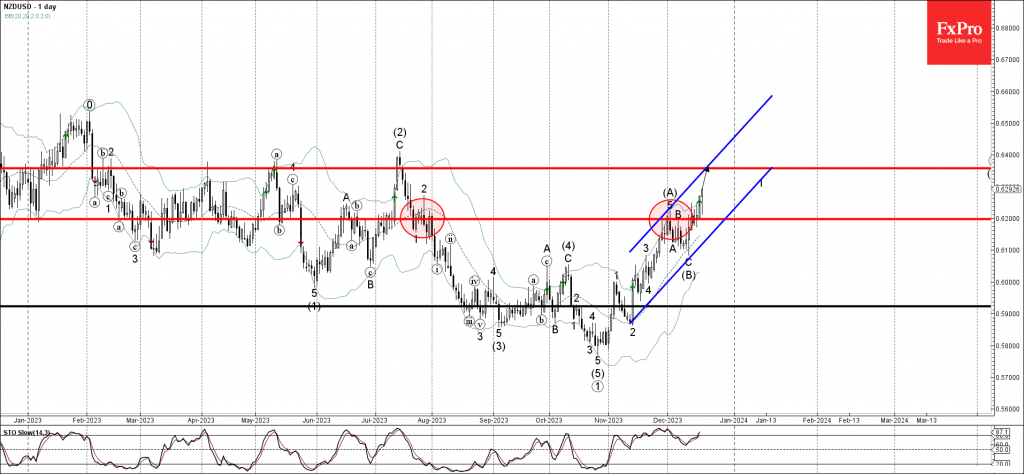
- NZDUSD broke key resistance level 0.6200
- Likely to rise to resistance level 0.6360
NZDUSD currency pair under the bullish pressure after breaking the key resistance level 0.6200 (which has been reversing the price from the end of July).
The breakout of the resistance level 0.6200 accelerated the active minor impulse wave 1 of the medium-term upward impulse wave (C).
NZDUSD can be expected to rise further to the next resistance level 0.6360 (former resistance from April, March and July).
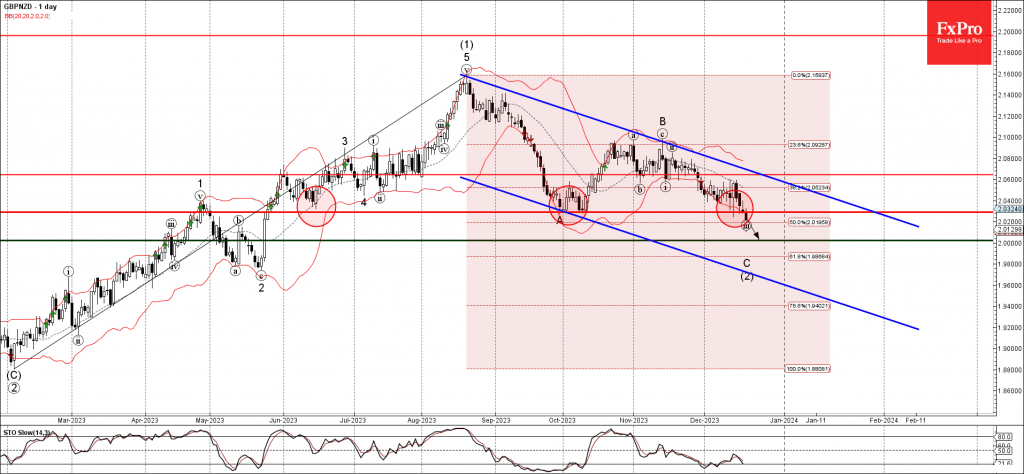
GBPNZD Wave Analysis
- GBPNZD broke key support level 2.0290
- Likely to fall to support level 2.0000
GBPNZD currency pair recently broke the key support level 2.0290 (which has been reversing the price from the middle of June).
The breakout of the support level 2.0290 coincided with the breakout of the 50% Fibonacci correction of the upward impulse from April.
Given the strongly bearish sterling sentiment, GBPNZD can be expected to fall further to the next round support level 2.0000.