Sample Category Title
RBA’s hawkish SoMP points to another rate hike
RBA's latest Statement on Monetary Policy presents a more hawkish picture than market observers anticipated, with upward revisions in both headline and underlying inflation projections, alongside stronger growth outlook.
More importantly, these projections rest on the assumption that cash rate will peak around 4.50%, comparing to the current 4.35%, suggesting another rate hike could be imminent.
RBA's heightened vigilance against inflation is clear: "The weight of recent information suggests that the risk of inflation remaining higher for longer has increased," the bank stated, highlighting domestic inflation persistence and possible global factors, such as energy market disruptions and food price hikes tied to El Niño effects.
Economic projections now show a year-average GDP growth expected to hit 2.00% in 2023, rising to 1.75% in 2024, and reaching 2.25% in 2025. These figures mark an upgrade from June's forecast of 1.50%, 1.25%, and 2.00% respectively, suggesting a resilient economy that could withstand tighter monetary policy.
Inflation forecasts have also been adjusted upward, with headline CPI inflation now seen at 4.50% at the year's end in 2023, followed by 3.50% in 2024, and softening to 3.00% in 2025. They are upgraded from 4.25%, 3.25% and 2.75% respectively.
The trimmed mean inflation follows a similar upward trajectory, projected to be at 4.50% in year-ended 2023, 3.25% in 2024, and 3.00% in 2025, up from prior forecast of 4.00%, 3.00%, and 2.75% respectively.
Underpinning these projections are technical assumptions of a cash rate peaking at around 4.50%, with a gradual decline to approximately 3.50% by the end of 2025, indicating a higher rate path than previously used.
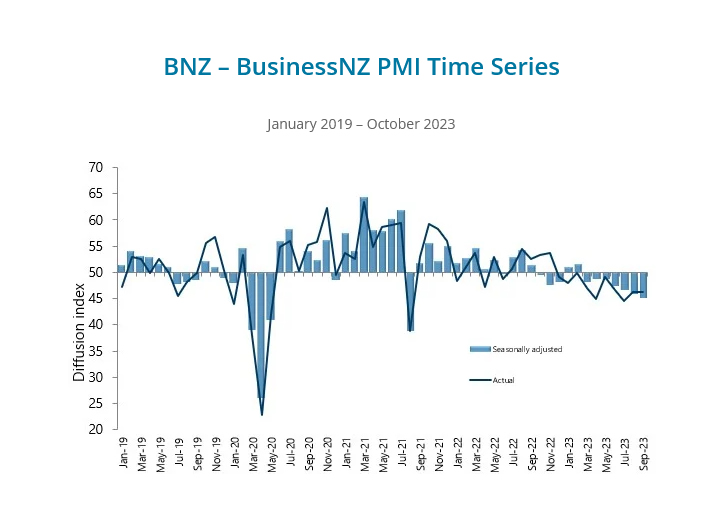
NZ BNZ PMI fell to 42.5, manufacturing downturn reaches lowest point since 2009
October has marked a significant downturn for New Zealand's manufacturing sector, with BusinessNZ Performance of Manufacturing Index plummeting from 45.1 to 42.5. This figure not only represents the fifth consecutive month of declining activity but also stands as the lowest activity level for a month unaffected by COVID-19 restrictions since May 2009, deeply underscoring the sector's distress.
Delving into the components, the bleak picture becomes clearer: Production has taken a hit, sliding down from 44.3 to 41.5, and employment in the sector is also suffering, with a drop from 45.1 to 43.3. New orders barely held ground, marginally decreasing from 44.8 to 44.1. A significant retreat was seen in finished stocks, which contracted from 51.2 to 45.7, and deliveries were also on the downturn from 44.3 to 42.9.
Amidst these figures, the voice of the industry has tilted towards concern, with 65.1% of comments categorized as negative, albeit slightly less pessimistic than previous months, at 68.8% in September and 66.7% in August.
BNZ Senior Economist, Doug Steel, highlighted the potential ramifications for the broader economy: "Today's PMI is not a good look for GDP and employment growth," he noted. With the current forecasts including a downturn in manufacturing for the latter half of 2023, Steel warned, "There's a chance that decline is bigger than we think, if the PMI does not bounce in the final months of the year."
Cliff Notes: Inflation Remains the Market’s Chief Concern
Key insights from the week that was.
This week, the RBA Board opted to raise the cash rate by 25bps to 4.35%. As detailed by Chief Economist Luci Ellis, this decision marked a direct response to persistence in inflation and upside risks to the outlook. The underlying tone of the real economy has shifted in recent months, the household sector exhibiting resilience against intense interest rate and cost-of-living pressures. This has, in part, contributed to the more worrisome inflation outlook, with the Board noting that “the prices of many services are continuing to rise briskly” and, regarding inflation’s return to target, that “progress looks to be slower than earlier expected”. Indeed, the RBA Board have revised up their inflation projections – from 3.3% to 3.5% in 2024 and 2.8% to 2.9% in 2025 – and now expect a firmer labour market, with the unemployment rate expected to rise to just 4.3% (previously 4.5%). A full update of the RBA’s forecasts and assessment of risks is available in the just released November Statement on Monetary Policy.
On the outlook for policy, we are of the view that the RBA Board will not raise rates further from here. If the real economy continues to evolve as we anticipate, i.e. economic growth remains well below-trend and slack emerges in the labour market, inflation should continue to decelerate at pace. That will give the RBA Board confidence that policy is working as intended, shifting the focus towards when it is most appropriate to begin easing policy, which we anticipate will be in Q3 2024. However, if there were to be further material upside surprises to the inflation outlook in the near-term – something that the RBA Board clearly has a low tolerance for – the risk of another interest rate increase is not dismissible. For more information on our views on the Australian economy and global outlook, see the November edition of Westpac’s Market Outlook on Westpac IQ.
Moving offshore, Chinese annual CPI inflation fell back below zero in October to -0.2%yr as a result of deflation in food prices. Upward pressure on the CPI came from services where momentum has been accelerating the last few months. Consistent with the 2.6%yr decline in the PPI, the decline in consumer goods also endured. The potential impact of persistent weak inflation on the consumer mindset is likely being assessed by PBOC policymakers. Market participants expect a further 10bp reduction in the 1-year loan prime rate and 25bp cut in the Reserve Requirement Ratio in the near future. However, with the property sector outlook still highly uncertain, it will take a lot more stimulus for consumer demand to grow strongly on a sustainable basis.
Overnight, FOMC Chair Powell spoke at an IMF Panel on monetary policy. His remarks were balanced, recognising the significant progress made in the fight against inflation but also that 2% is still a long way away and that risks remain, and so if “it becomes appropriate to tighten policy further, we will not hesitate to do so”. However, the “risk of overtightening” is also front of mind for the FOMC, particularly as the full effects of the tightening in monetary policy and financial conditions are yet to be felt. This was a point highlighted by the FOMC’s Barkin this week and the latest Senior Loan Officers Survey which showed a further tightening of loan conditions and increased credit spreads. We expect both US economic activity and the labour market to soften in coming months; if inflation also continues to ease over the period, then the FOMC will have cause to ease from March to stop a further tightening in the real stance of policy. Financial conditions will also prove critical to this decision making process, however. If term yields fall further, the market could be argued to have done the FOMC’s easing for it.
Chair Powell’s speech is also interesting for its views on the potential implications for inflation of supply shocks and constraints. These are forces that threaten to hold inflation above target even with growth at or below trend. Balancing the risks between inflation and growth is set to remain a concern not only for the next few months, but into the medium term.
Fed Chair Powell vows to tighten further if needed amid inflation head fakes
Fed Chair Jerome Powell, speaking at an IMF event, conveyed a vigilant stance on monetary policy, expressing uncertainty over whether current interest rates are adequate to curb inflation. With a steadfast commitment to FOMC's inflation target, Powell emphasized the readiness to adjust policy in response to economic indicators.
"The FOMC is committed to achieving a stance of monetary policy that is sufficiently restrictive to bring inflation down to 2 percent over time; we are not confident that we have achieved such a stance," Powell stated
At the same time, "we are not confident that we have achieved such a stance," he added.
Highlighting the deceptive nature of recent inflation trends, he added, "Inflation has given us a few head fakes". Hence, "ongoing progress toward our 2 percent goal is not assured"
Powell was unequivocal about the Fed's resolve: "If it becomes appropriate to tighten policy further, we will not hesitate to do so."
Fed’s Paese emphasizes prudence, awaits data before additional tightening
St. Louis Fed President Kathleen O'Neill Paese emphasized the current effectiveness of monetary policy in exerting "modest downward pressure on inflation."
"We can afford to await further data before concluding that additional policy tightening is appropriate," Paese stated.
Despite this cautious approach, she warned against complacency, asserting that prompt action must be taken if the downward trend in inflation shows signs of stalling.
"However, if progress toward achieving 2% inflation stalls, I believe that the committee should act promptly to ensure that high inflation does not become entrenched," she noted.
Paese also reminded that the high-interest-rate environment is expected to persist as part of the long-term strategy to rein in inflation.
Fed’s Barkin suggests inflation might ease back to target with no further rate hikes
Richmond Fed President Thomas Barkin deliberated on Fed's monetary policy stance in light of the ongoing economic slowdown and its implications for inflation during an MNI Webcast.
Barkin addressed the possibility that the current economic environment might not necessitate further intervention: "Whether a slowdown that settles inflation requires more from us remains to be seen, which is why I supported our decision to hold rates at our last meeting," he remarked.
He emphasized the opportunity for Fed to assess the economic outlook before taking further action: "With rates restrictive and financial conditions tightened, we have time to reconcile competing narratives on demand and to test different views on the trajectory of inflation," Barkin explained.
He also allowed for the possibility that the current policy stance might suffice, suggesting, "perhaps inflation could return to target without more help from us and without too much damage to demand."
Fed’s Bostic and Barkin discuss restrictive policy and inflation outlook
In a dual appearance at an event in New Orleans overnight, Richmond Fed President Thomas Barkin and Atlanta Fed President Raphael Bostic provided insights into the Federal Reserve's ongoing efforts to tame inflation.
Bostic expressed confidence in the current policy stance, which it "likely sufficiently restrictive", predicting that it should be enough to curb inflationary pressures, albeit with potential challenges ahead. "Inflation is going to get to 2%," he assured, committing to maintaining a restrictive policy until that target is firmly within sight.
Barkin focused on the anticipated impacts of Fed's policies, noting that "we are still not seeing the full effects of policy". He forecasted an economic downturn as necessary for achieving the Fed's targets: "I believe there's a slowdown coming. I believe we're going to need that slowdown, because I think that's what it's going to take to convince price-setters the days of pricing power are over."
EURCAD Wave Analysis
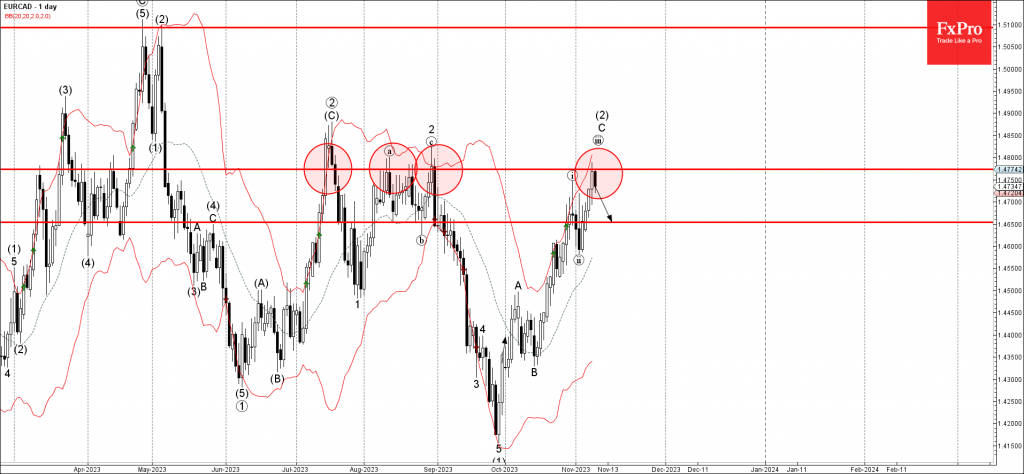
- EURCAD reversed from pivotal resistance level 1.4775
- Likely to fall to support level 1.4650
EURCAD recently reversed down from the pivotal resistance level 1.4775 (which has been reversing the pair from the start of July).
The downward reversal from the resistance level 1.4775 stopped the earlier medium-term ABC correction (2).
Given the strength of the resistance level 1.4775 and the bearish euro sentiment seen across the FX markets, EURCAD can be expected to fall further toward the next support level 1.4650.
AUDNZD Wave Analysis
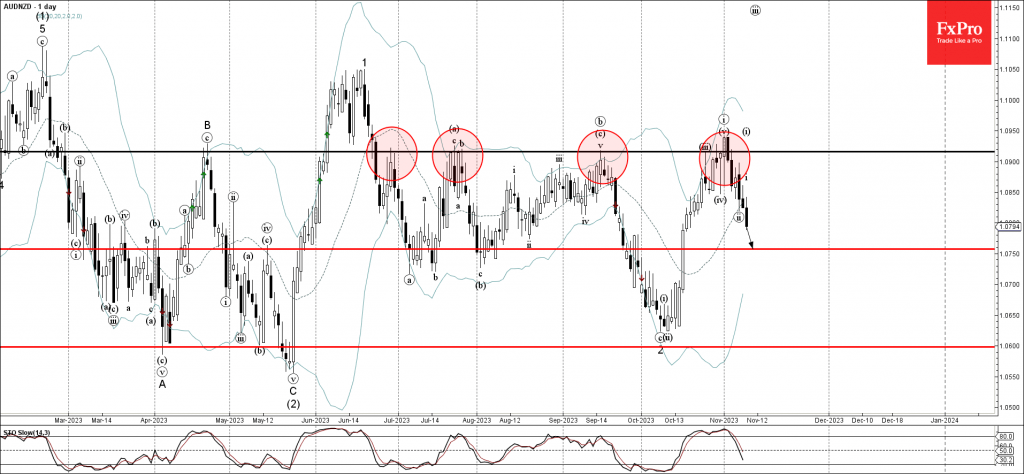
- AUDNZD reversed from powerful resistance level 1.0915
- Likely to fall to support level 1.0750
AUDNZD continues to fall after the earlier downward reversal from the powerful resistance level 1.0915 (which has been reversing the pair from the end of June).
The downward reversal from the resistance level 1.0915 stopped the earlier short-term impulse wave (3).
Given the clear bearish AUD sentiment seen today, AUDNZD can be expected to fall further toward the next support level 1.0750.