Sample Category Title
GBP/USD Mid-Day Outlook
Daily Pivots: (S1) 1.2258; (P) 1.2305; (R1) 1.2348; More
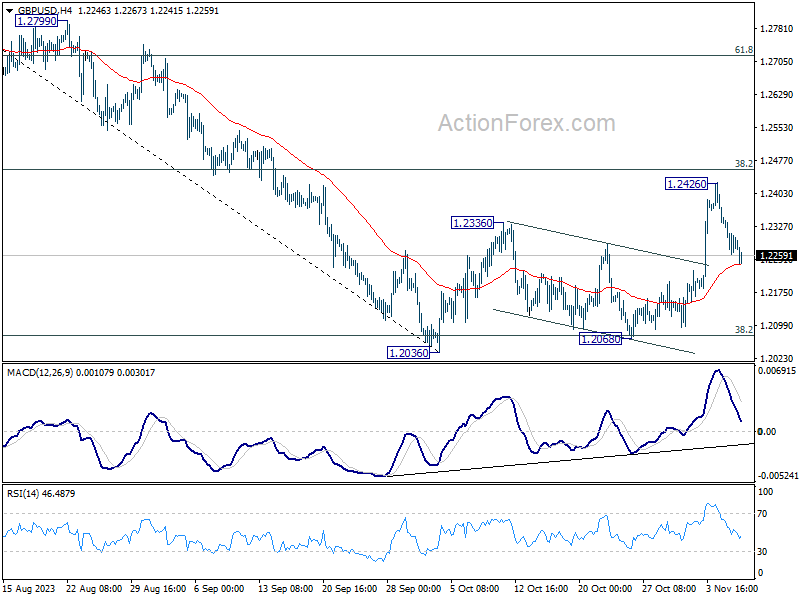
Intraday bias in GBP/USD remains neutral first, with focus on 55 4H EMA (now at 1.2239). Strong rebound from this EMA will maintain near term bullishness for another rise to 38.2% retracement of 1.3141 to 1.2036 at 1.2458. However, sustained break of 4H 55 EMA will revive near term bearishness and bring retest of 1.2036 low instead.
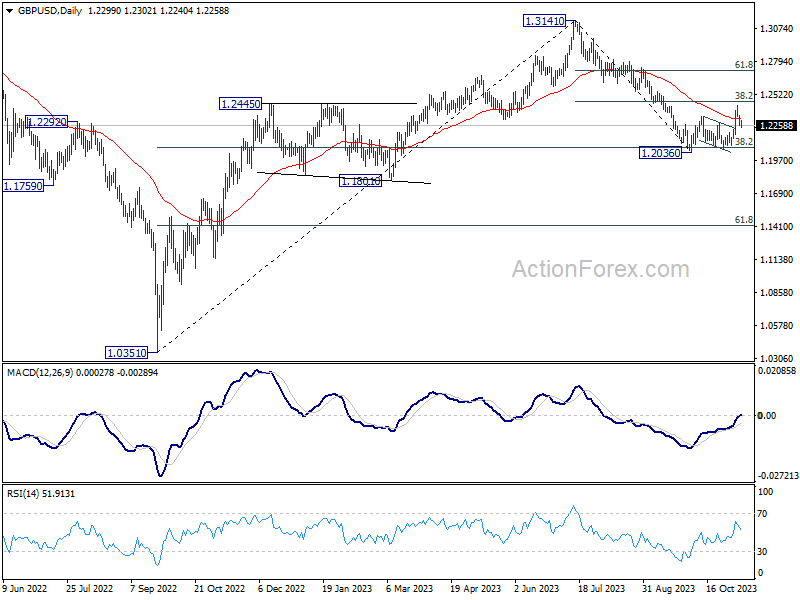
In the bigger picture, the strong rebound from 38.2% retracement of 1.0351 to 1.3141 at 1.2075 argues that price action from 1.3141 are merely a correction to rise from 1.0351 (2022 low). Current rally from 1.2036 is tentatively seen as the second leg of the pattern. Hence, while further rally is in favor, upside should be limited by 1.3141 to start the third leg.
USD/CHF Mid-Day Outlook
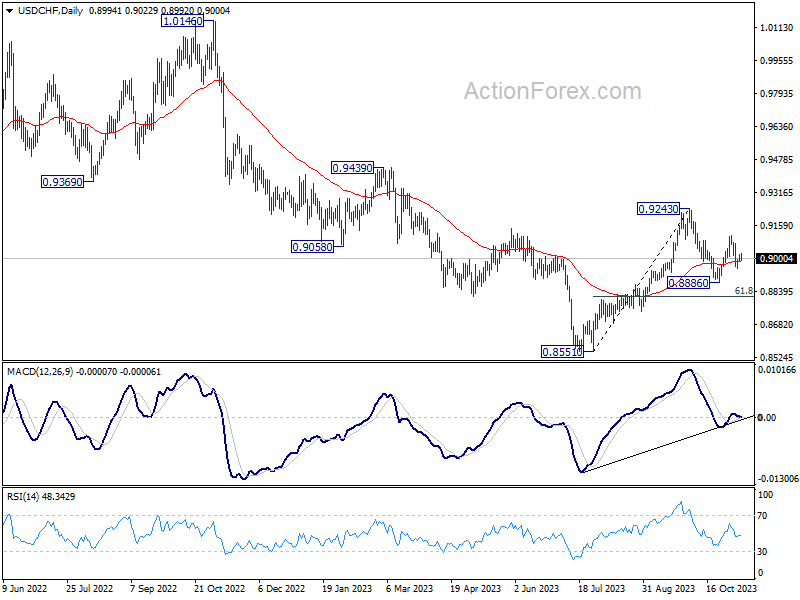
Daily Pivots: (S1) 0.8967; (P) 0.8982; (R1) 0.9010; More....
Intraday bias in USD/CHF stays neutral as range trading continues above 0.8952 temporary low. On the downside, below 0.8952 will target a test on 0.8886 support first. Break there will resume whole decline from 0.9243 to 0.8815 fibonacci level. However, break of 0.9111 will resume the rebound from 0.8886 instead, and target 0.9243 resistance.
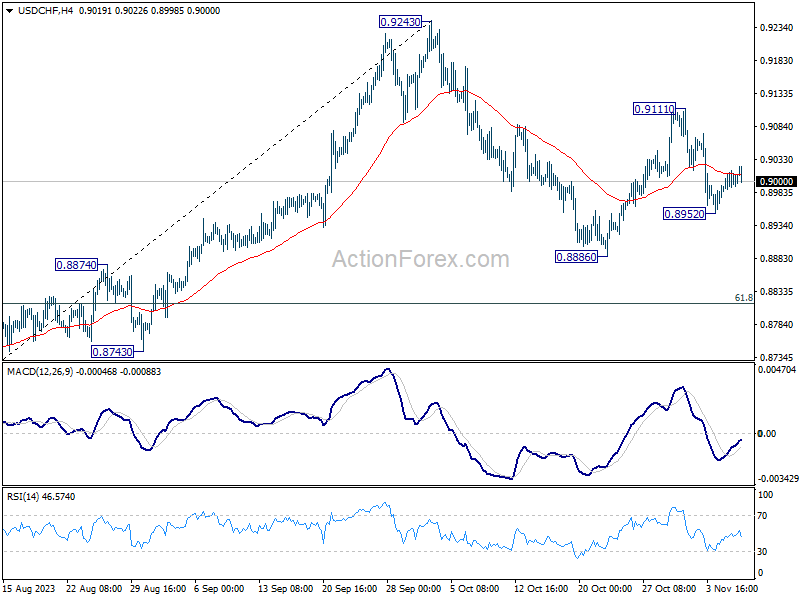
In the bigger picture, outlook is mixed up by the deeper than expected pull back from 0.9243. Yet there was no follow through selling after hitting 0.8886. On the upside, break of 0.9243 resistance will revive the case of medium term bottoming at 0.8851, and turn outlook bullish. However, sustained break of 61.8% retracement of 0.8551 to 0.9243 at 0.8815 will argue that larger decline from 1.0146 is ready to resume through 0.8551 low.
USD/JPY Mid-Day Outlook
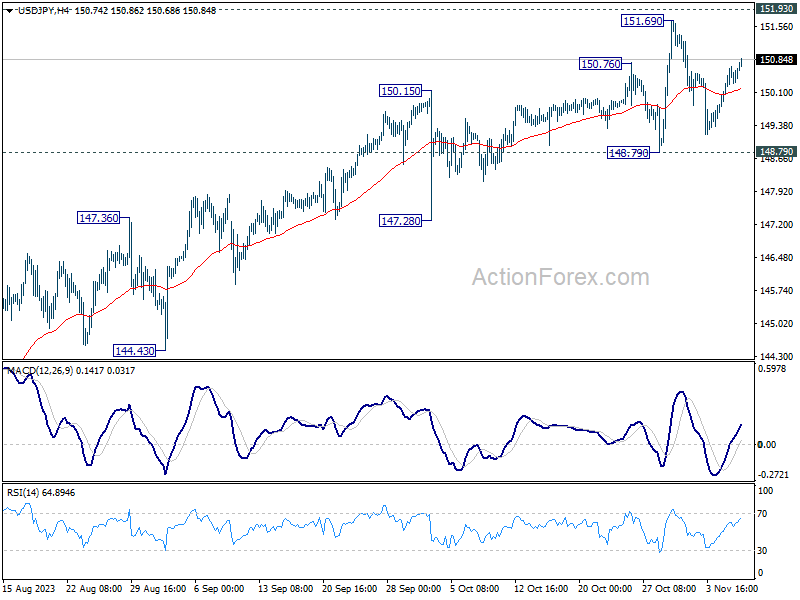
Daily Pivots: (S1) 150.01; (P) 150.35; (R1) 150.77; More...
USD/JPY's rebound continues today but it's still bounded in range of 148.79/151.69. Intraday bias stays neutral and outlook is unchanged. Further rally is expected as long as 148.79 support holds. Firm break of 151.69 high will resume larger up trend. However, decisive break of 148.79 will indicate rejection by 151.93 key resistance, and bring deeper fall through 147.28 support.
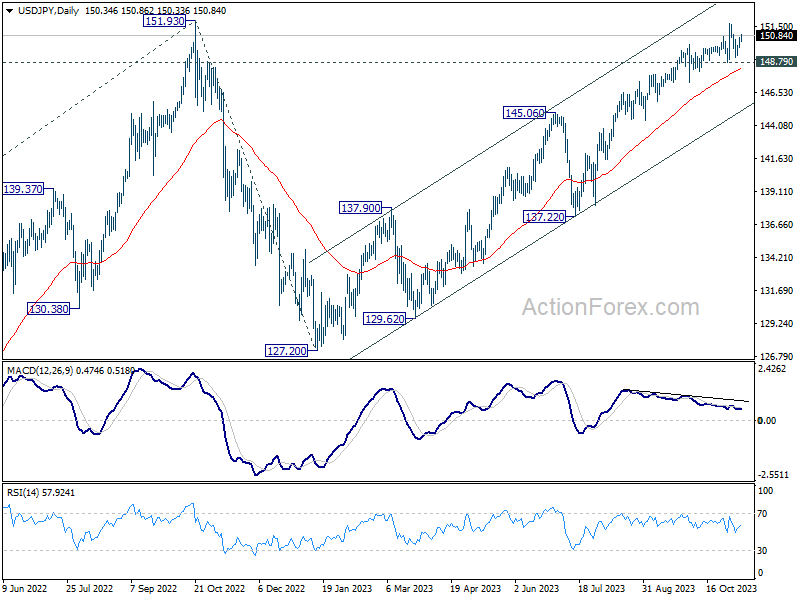
In the bigger picture, immediate focus is on 151.93 resistance (2022 high). Rejection by 151.93, followed by sustained break of 145.06 resistance turned support will argue that rise from 127.20 has completed, and turn outlook bearish for 137.22 support and below. However, sustained break of 151.93 will confirm resumption of long term up trend. Next target will be 61.8% projection of 102.58 to 151.93 from 127.20 at 157.69.
Euro Extends Losses After Soft Eurozone Retail Sales
- Eurozone retail sales decline by 2.9%
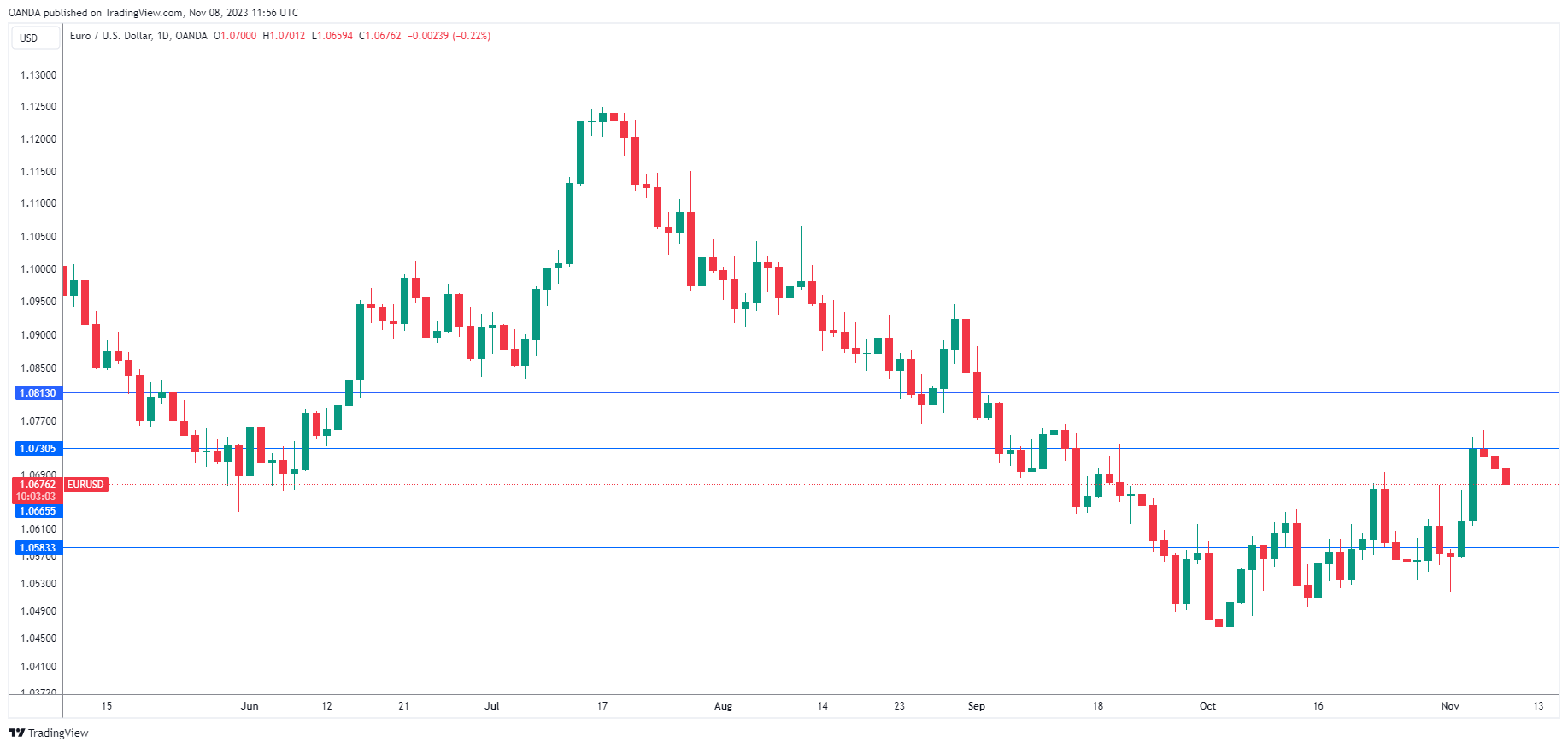
The euro is down on Wednesday, after a two-day losing streak. In the European session, EUR/USD is trading at 1.0675, down 0.23%.
Eurozone retail sales slide
The eurozone economy has been sputtering, so it’s no wonder that consumers are in a sour mood and holding tight on the purse strings. Eurozone retail sales slowed to -2.9% y/y in September, down from a revised -1.8% in August and just above the market consensus of -3.1%. This marked a twelfth straight month of decline, pointing to prolonged weakness in consumer demand, as consumers have been squeezed by high prices and elevated borrowing costs. On a monthly basis, retail sales declined by 0.3%, compared to -0.7% in August and below the market consensus of -0.2%.
Germany, the largest economy in the eurozone, continues to reel off soft numbers. On Tuesday, Industrial Production declined by 1.4%, and the most recent service and manufacturing PMIs were below 50, which points to contraction.
US exceptionalism has boosted the US dollar in recent months, and the euro has been steamrolled, falling as much as 9.5% since July. The US dollar has run into some headwinds since Friday’s soft nonfarm payrolls, but the US economy remains strong and the Fed isn’t likely to trim rates anytime soon. This means that the euro will be hard-pressed to keep pace with the greenback, barring a strong recovery in the eurozone.
Fed Chair Powell delivers public remarks later today and the markets will be all ears. Powell has tried to sound hawkish as he battles to bring inflation back down to the 2% target. The Fed has stuck to its “higher for longer” stance on interest rates, but the markets are increasingly convinced that the Fed has wrapped up its rate-tightening cycle. The soft nonfarm payrolls report on Friday provided support for the view that rates have peaked.
EUR/USD Technical
- There is resistance at 1.0727 and 1.0813
- EUR/USD continues to test support at 1.0665. Below, there is support at 1.0583
The Crypto Market is on the Rise Again
Market Picture
The crypto market cap added another 1.5% overnight to $1.34 trillion as the corrective reset quickly turned to buying. Bitcoin is up 2%, while Solana and Chainlink are up 6%. This pair also led the gains over the past 30 days, indicating robust demand for them. In contrast, BNB loses 0.6% in 24 hours and adds 17% in 30 days.
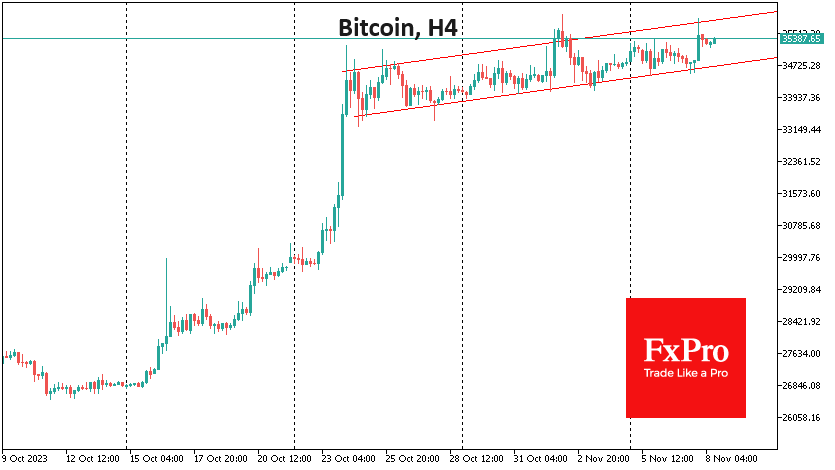
Bitcoin continues to trade in a bullish corridor, finding buyers on dips from slightly higher levels. A second failed attempt at $36,000 on Tuesday night suggests that most players are not looking to accelerate, further confirming a shift in focus to altcoins.
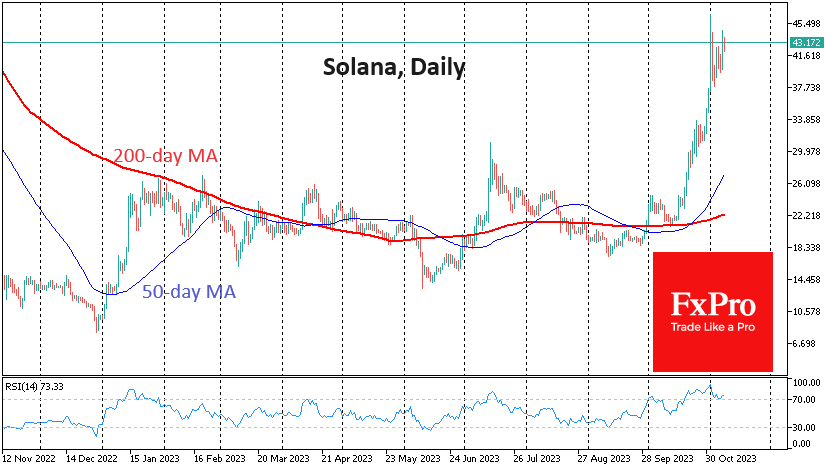
Solana has returned to growth quickly after a period of pressure earlier this month. At $43, it is trading close to a 15-month high. A locally important milestone for the coin could be the $48 level. An easy break of this level would open a direct path to $75.
News Background
The US Securities and Exchange Commission (SEC) is having difficulty hiring crypto experts because the right people are unwilling to sell their digital assets. This is according to a report from the agency’s Office of the Inspector General.
The capitalisation of the largest stablecoin, Tether (USDT), is up 22% since January to $85.42 billion, according to IntoTheBlock, and Tether has accumulated up to 69% of the funds placed in the real collateralised digital currency market, according to DeFiLlama.
Germany’s third largest bank, DZ Bank, announced the launch of its digital asset custody platform. The bank plans to offer institutional investors and private clients the opportunity to buy cryptocurrencies.
Rein Lõhmus, a co-founder of Estonia’s LHV Bank, lost the password to a wallet containing 250,000 ETH (over $473 million) and plans to use artificial intelligence to recover it.
New Zealand Dollar Shrugs as Inflation Expectations Dip
- Inflation expectations ease to a two-year low
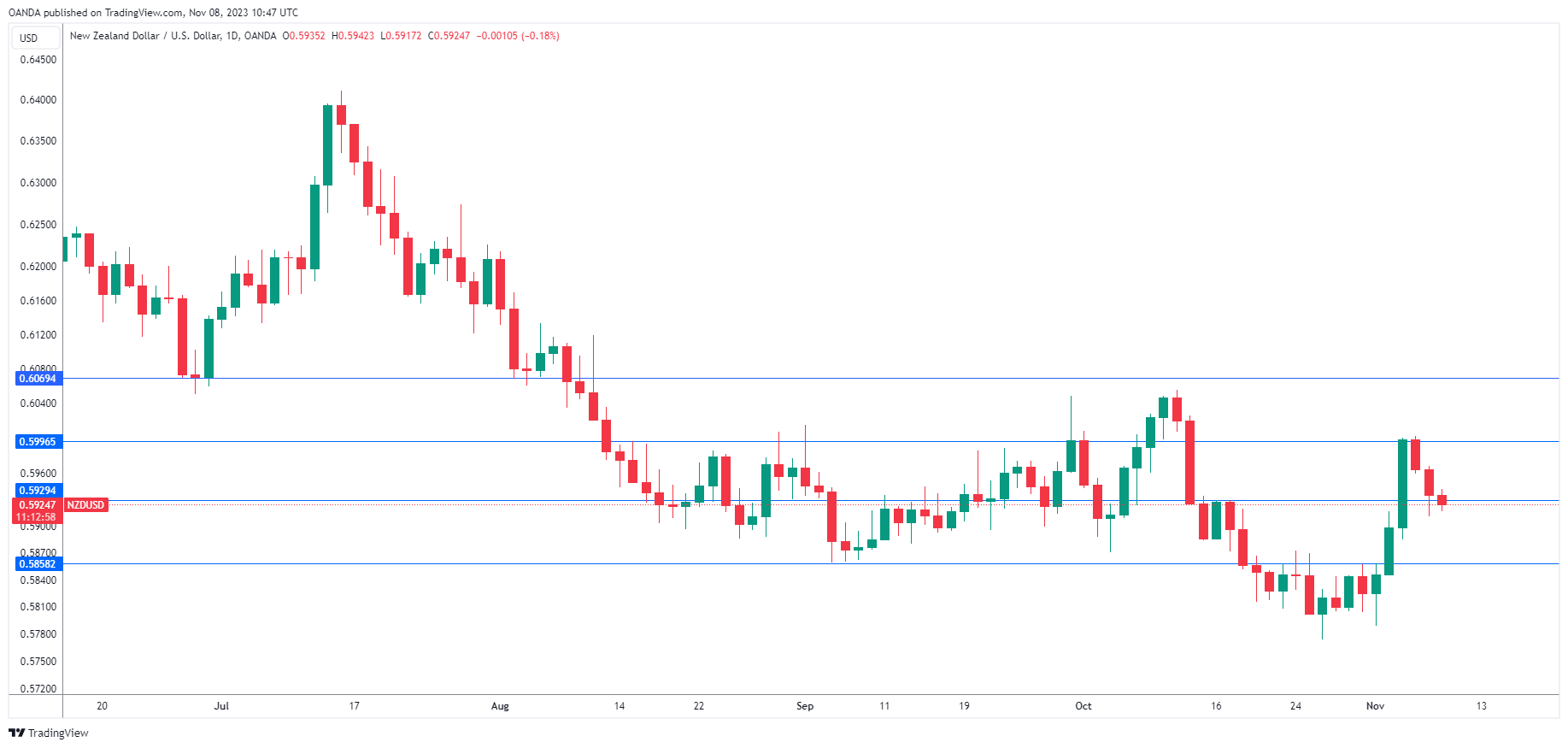
The New Zealand dollar is slightly lower on Wednesday. In the European session, NZD/USD is trading at 0.5924, down 0.19%.
NZ inflation expectations dip
New Zealand’s inflation rate has been dropping, albeit slowly. Inflation fell to 5.6% in the third quarter, down from 6.0% in Q4. The downward trend is certainly encouraging for the Reserve Bank of New Zealand but policy makers are also concerned about inflation expectations and not just the latest inflation numbers.
Inflation expectations are a primary driver of inflation and the central bank needs to ensure that high inflation expectations don’t get anchored; otherwise, the battle against inflation will become that much more difficult.
The fourth-quarter release was positive, as inflation expectations fell to 2.76%, down from 2.83% in Q3 and its lowest level in two years. As we saw with inflation data, the direction is downward, but slowly.
The RBNZ held rates for a third straight time at the October meeting, leaving the cash rate at 5.50%. The central bank meets next on November 29th and is expected to pause again. The RBNZ is confident that inflation will fall more quickly, projecting an inflation rate of 2.7% by Q3 of 2024.
China is New Zealand’s largest trading partner, which means the New Zealand dollar is sensitive to Chinese releases. China has been grappling with an economic slowdown, manifested by deflationary pressures. On Thursday, China releases consumer inflation data.
CPI came in at 0.0% y/y in September and the market consensus for October is -0.1%. On a monthly basis, inflation is expected to fall in October from 0.2% to 0.0%. A soft inflation release could unnerve investors and send the New Zealand dollar lower.
NZD/USD Technical
- NZD/USD continues to test support at 0.5929. The next support line is 0.5858
- There is resistance at 0.5996 and 0.6069
ECB’s Lane: Some progress on underlying inflation, but not enough
ECB Chief Economist Philip Lane indicated that although there is "some progress" in mitigating underlying inflationary, he is not fully convinced of the sufficiency of these efforts to date.
"This is why we are in this period now of holding interest rates at a significantly high level until this process makes further progress," Lane explained,
Lane also conveyed his reservations about the steep decline in headline inflation numbers, attributing the fall primarily to the base effect from last year's energy price surges.
Looking ahead, Lane projected that the descent in inflation rates might pause, with inflation likely hovering in the "high twos or low threes" range in 2024.
He anticipates that a reversion to the ECB's desired 2% inflation target would not materialize until 2025, suggesting a prolonged journey ahead for the central bank in its fight against persistent inflation.
ECB survey reveals heightened short-term inflation expectations and economic pessimism
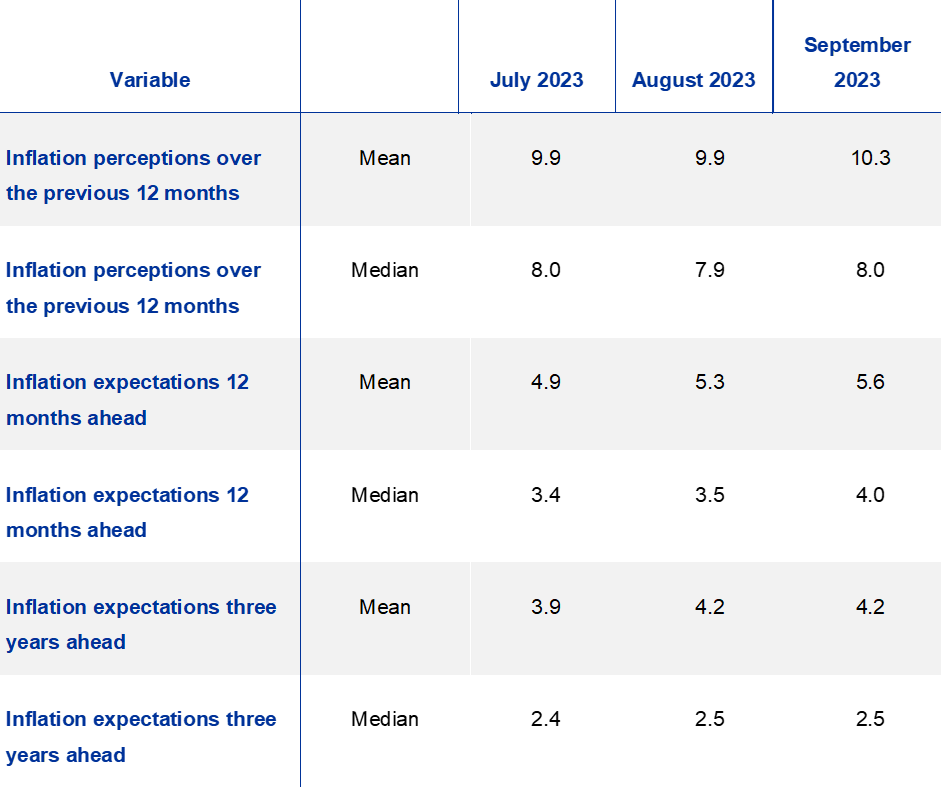
ECB's latest Consumer Expectations Survey has provided a snapshot of the current economic mood, characterized a heightened anticipation of inflation pressures in the near term juxtaposed with a more pessimistic outlook on economic growth.
The survey results for September show a discernible uptick in median consumer inflation expectations for the coming year, escalating from 3.5% to 4.0%. However, that consumers' median inflation expectations over a three-year horizon held steady at 2.5%.
Contrastingly, the survey indicates no change in the mean expectations for nominal income growth, which remains anchored at 1.2%. This static view on income growth, coupled with the slight increase in anticipated nominal spending growth from 3.3% to 3.4%, hints at a potential squeeze on real consumer spending power.
The more negative tilt in expectations for economic growth, which have slipped from -0.8% to -1.2%, reflects an escalating concern over the economic direction. Furthermore, the anticipated unemployment rate has edged up from 11.1% to 11.4% for the coming year.
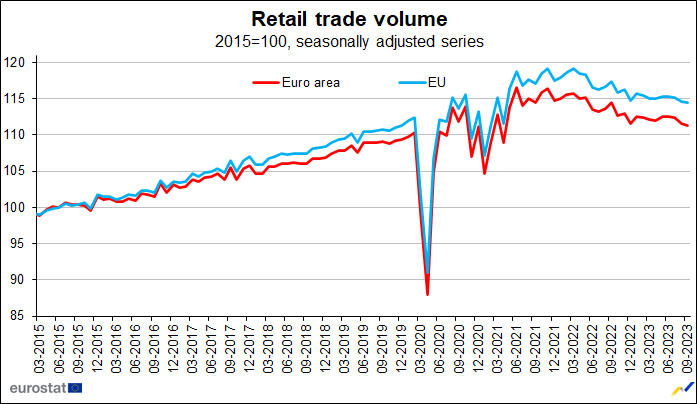
Eurozone retail sales down -0.3% mom in Sep, EU fell -0.2% mom
Eurozone retail sales volume fell -0.3% mom in September, worst than expectation of -0.2% mom. Volume of retail trade decreased by -1.9% for non-food products and by -0.9% for automotive fuels, while it increased by 1.4% for food, drinks and tobacco.
EU retail sales volume was down -0.2% mom, Among Member States for which data are available, the largest monthly decreases in the total retail trade volume were registered in Slovakia (-2.0%), Sweden (-1.1%), Germany and the Netherlands (both -0.8%). The highest increases were observed in Slovenia (+1.1%), Poland (+1.0%) and Denmark (+0.9%).
NZDUSD Pulls Back from November Peak
- NZDUSD attempts to rebound from its 2023 lows
- Gets rejected at 0.6000 but 50-day SMA provides support
- Momentum indicators remain cautiously tilted to the upside
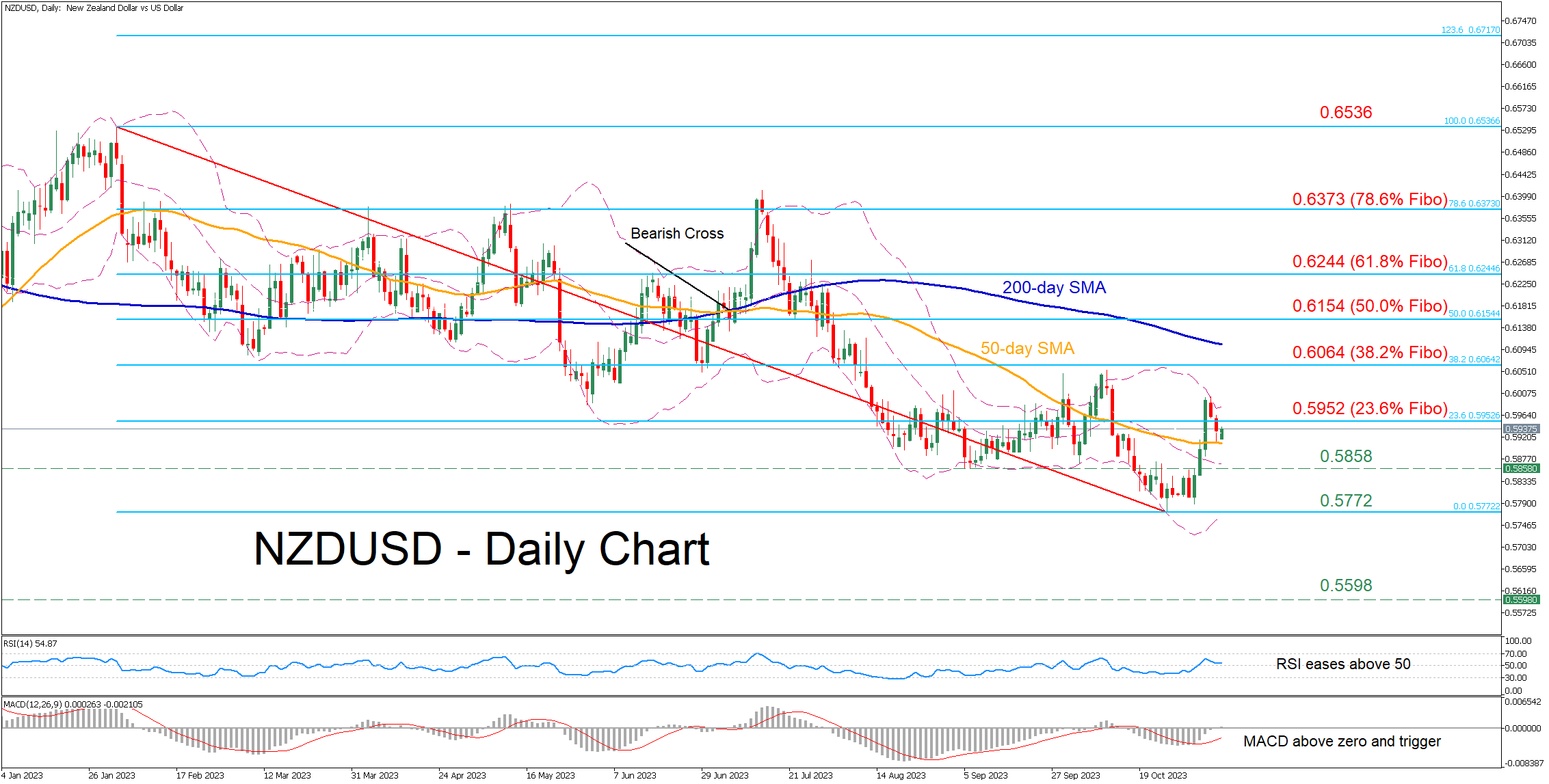
NZDUSD has been in a steady downtrend throughout 2023, posting a fresh one-year low of 0.5772 on October 26. Although the pair showed some signs of life lately, its rebound fell short around the 0.6000 handle, with the 50-day simple moving average (SMA) pausing the setback for now.
Should the price bounce off its 50-day SMA and storm back higher, immediate resistance could be found at 0.5952, which is the 23.6% Fibonacci retracement of the 0.6536-0.5772 downtrend. Piercing through that wall, the pair might challenge the 38.2% Fibo of 0.6064 before the 50.0% Fibo of 0.6154 gets tested. Further advances could then cease at the 61.8% Fibo of 0.6244.
On the flipside, if the bullish pressures wane, the pair could extend its latest retreat towards the September low of 0.5858. A break below that zone may pave the way for the 2023 bottom of 0.5772. Sliding beneath that floor, the price could descend towards fresh multi-month lows, where the September 2022 support of 0.5598 could provide downside protection.
Overall, NZDUSD’s attempts for a solid rebound faltered, but the short-term oscillators are still in their positive territories as the 50-day SMA prevented further declines. Can the bulls put the price back on the rails to recovery?