Sample Category Title
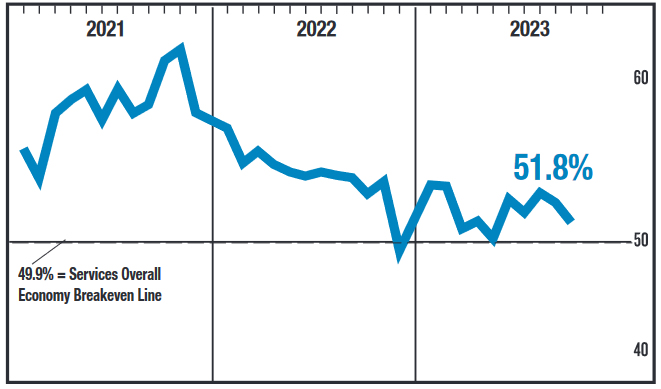
US ISM services fell to 51.8, corresponds to 0.7% annualized GDP growth
US ISM Services fell from 53.6 to 51.8 in October, below expectation of 53.2. Business activity/production fell from 58.8 to 54.1. New orders rose from 51.8 to 55.5. Employment dropped from 53.4 to 50.2. Prices ticked down from 58.9 to 58.6.
ISM said: "The past relationship between the Services PMI and the overall economy indicates that the Services PMI for October (51.8 percent) corresponds to a 0.7-percent increase in real gross domestic product (GDP) on an annualized basis."
Is it Growth Correction in Crypto or Something More?
Market picture
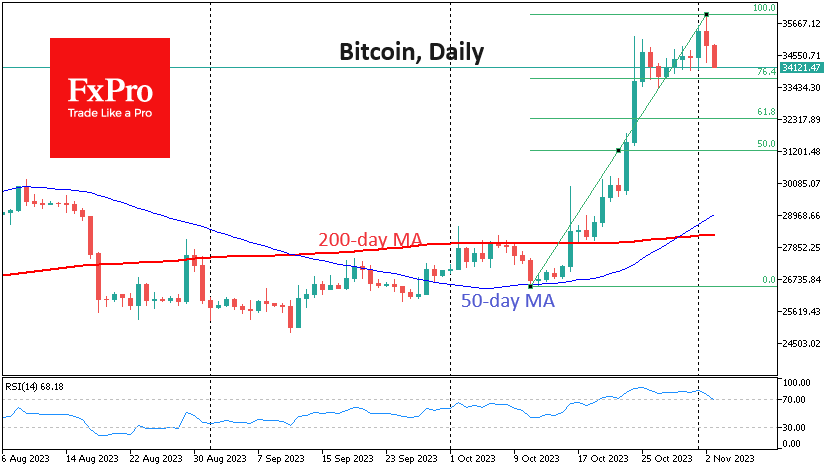
Crypto market investors rush to lock in profits from the recent growth, selling off coins. Capitalisation has rolled back to 1.27 trillion (-2.8% in 24 hours). Such dynamics fit pretty well into the definition of Bitcoin as a safe asset. The demand impulse for shares, in this case, plays against the largest crypto. But we advise not to rely too much on the crypto’s defensive nature. On the contrary, we see Bitcoin as the most sensitive to changes in risk demand and often leads to these changes. And its latest turnaround could foreshadow an intensifying sell-off in equities.
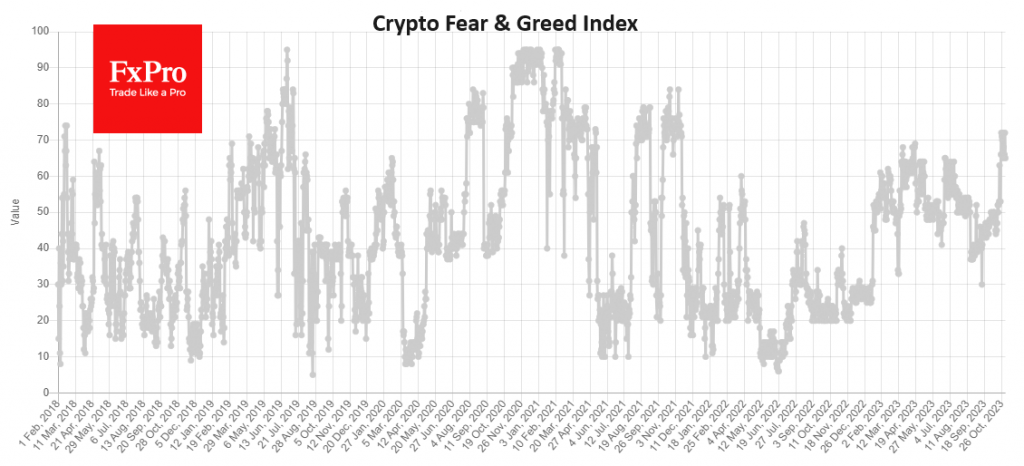
The Crypto Fear and Greed Index posted tops at 72 (Greed zone) several times since late October, a two-year high. The last time we saw such highs in the Index was in November 2021, when Bitcoin hit an all-time high near $69K.
Nowadays, Bitcoin has likely entered a correction phase from the upward momentum since mid-October. This scenario remains workable with a price above $32300. A failure below would make the latest rise be considered false.
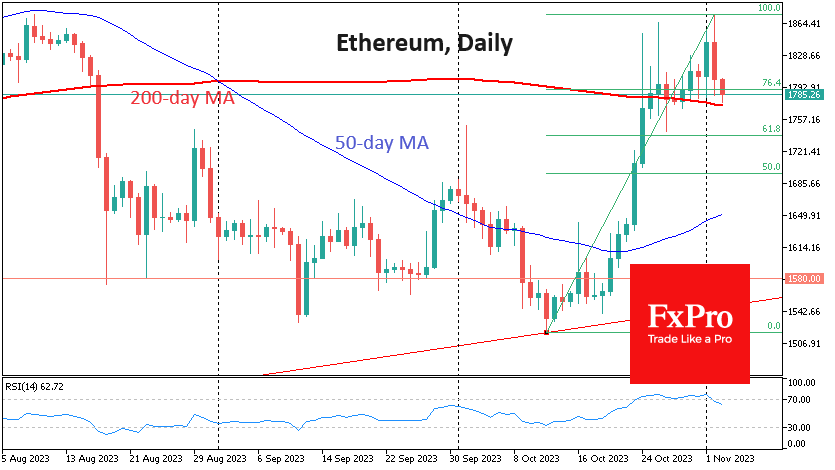
Ethereum fell back and struggled for support at its 200-day moving average just above $1770. Bulls have room for a decline down to $1740, while a move below would go beyond the regular correction.
News Background
Michael van de Poppe expressed confidence that the US Federal Reserve has completed its policy tightening cycle, which could have a positive impact on risk assets, including the first cryptocurrency.
Fidelity Investments called bitcoin “exponential gold” and a “commodity currency” seeking to become a savings vehicle and a defence against the depreciation of money.
MicroStrategy last month increased its bitcoin reserves by 155 BTC to 158,400. Third-quarter purchases totalled 6,067 BTC at an average price of $27,531.
CoinShares noted digital asset managers’ interest in Ethereum. The second most capitalised cryptocurrency was mentioned in the survey by 44% of respondents. In comparison, 39% of respondents voted for Bitcoin and 7% for Solana.
The US SEC has started investigating PayPal’s PYUSD stablecoin, which launched in August. The launch of PYUSD raised concerns in the US Congress due to the lack of a regulatory framework for such assets.
US: Hiring Slows in October, Unemployment Rate Rises to a Near Two-Year High of 3.9%
Non-farm payroll employment rose by 150k in October, slightly below expectations calling for a gain of 180k. Employment readings for the two prior months were revised lower, subtracting 101k from the previously reported figures.
- Hiring over the last three-months averaged 204k jobs per-month, a stepdown from the 233k averaged between July-September and well off the 334k averaged over the three-months ending in January.
Private payrolls rose just 99k, with gains entirely concentrated in the service sector (+110k) while goods-producing industries shed 11k jobs. However, the pullback in the latter was entirely concentrated in manufacturing (-35k), which was largely attributed to the UAW strike – estimated to have temporarily removed 33k workers from payrolls. Across the service sector, gains were largely concentrated in healthcare (+77k), but professional & business services (+15k) and leisure & hospitality (+19k) also chipped in. Hiring across the public sector remained robust, rising by 51k last month.
In the household survey, employment (-348k) fell by more than the labor force (-201k), which pushed the unemployment rate to a near two-year high of 3.9%. The participation rate edged down by 0.1 percentage points to 62.7%.
Average hourly earnings were up 0.2% month-on-month – a modest deceleration from the upwardly revised 0.3% m/m gains recorded in each of the two months' prior. The 12-month change slipped to 4.1% – the slowest pace of wage growth since June 2021.
Key Implications
Job growth slowed considerably in October, with the U.S. economy adding the fewest jobs in four months and recording the second weakest monthly gain since December 2020. That said, some of the 'softness' can be chalked up to labor strikes spanning the auto, entertainment, and healthcare industries, as striking workers aren't counted on payrolls. The Bureau of Labor Statistics estimates that just over 48,000 workers were on strike during the survey period last month – the highest monthly total since February 2004. However, with tentative labor agreements between the UAW and the Big 3 automakers now reached, a significant number of these workers will be recounted in next month's payrolls.
In the press briefing following Wednesday's interest rate announcement, Chair Powell acknowledged that the recent tightening in financial conditions (if sustained) could act as a substitute for future rate hikes. However, Powell also underscored that policymakers have a low conviction on whether today's policy stance is 'sufficiently restrictive' – hence the need to proceed carefully and take a meeting-by-meeting approach. We suspect the Fed will need to see a few more softer employment reports met by a further easing in inflationary pressures before they have enough evidence to call it quits.
Canada’s Labour Market Posts Modest Gain in October
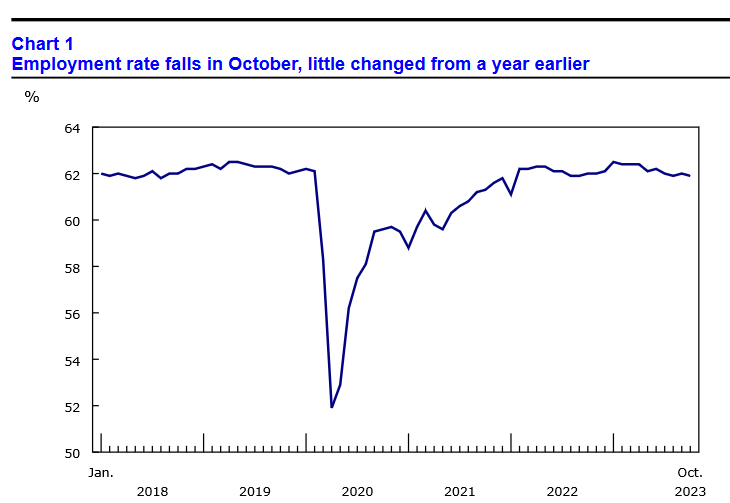
The Canadian labour market added 17.5k positions in October, with full-time employment down 3.3k and part-time employment up 20.8k.
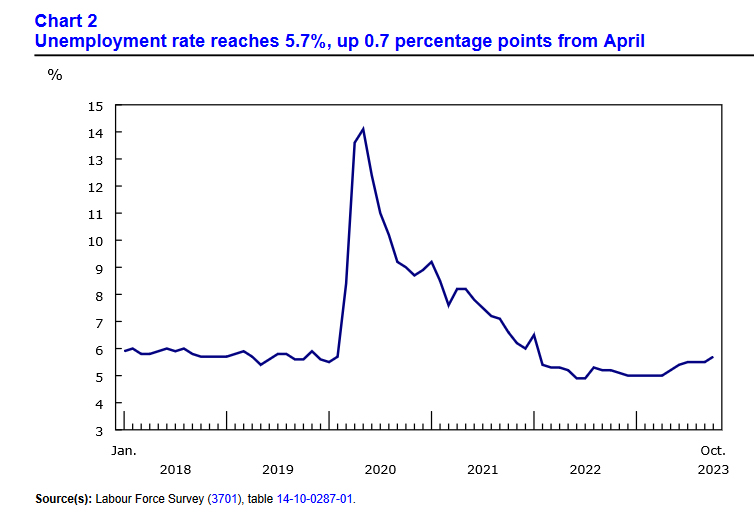
The unemployment rate rose 0.2 percentage points to 5.7% and the participation rate was unchanged at 65.6%.
Employment by sector showed gains in construction (+23k) and information, culture and recreation (+21) being offset by declines in wholesale and retail trade (-22k) and manufacturing (-19k).
Lastly, total hours worked were flat at 0.02% month-on-month and wages were up 4.8% year-on-year (versus 5.0% in September).
Key Implications
The Canadian jobs market is moving back towards balance following two strong monthly prints. The 18k monthly job gain once again failed to keep up with the 58k gain in the population-driven boost to the labour force. The "is this a recession?" debate will continue to swirl, with the unemployment rate rising by 0.7 percentage points since April. While this certainly isn't a recession as there is no depth, duration, or breadth, weakness is present. The number of unemployed workers keeps rising, while cyclically sensitive private sector hiring has been retreating for months.
When the Bank of Canada decided to hold rates at 5% last week, it did so because of a notable slowing in economic momentum. While this has been apparent in reduced consumer spending and a weakening housing market, the labour market left the BoC wanting more. But, given the rise in the unemployment rate and continued weakening in the underlying details, today's report is likely to make the BoC feel more comfortable about its decision to hold. Looking forward, we are expecting this employment trend to continue, while high rates and persistent inflation make the case for the BoC to remain on hold in December.
USD/JPY Mid-Day Outlook
Daily Pivots: (S1) 149.89; (P) 150.43; (R1) 151.02; More...
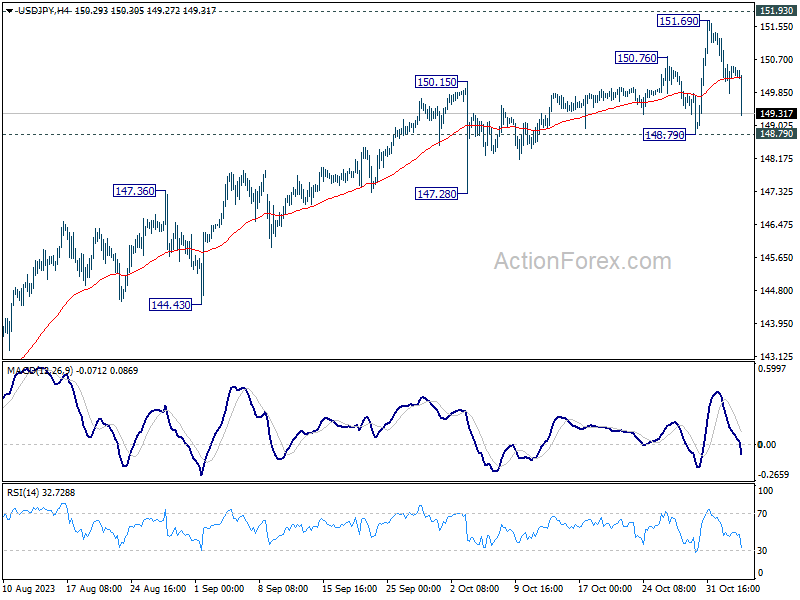
While USD/JPY's fall from 151.69 is extending, it's still holding above 148.79 support. Intraday bias remains neutral first. Price actions from 151.69 could still be seen as a consolidation pattern only. However, firm break of 148.79 will indicate rejection by 151.93 key resistance, and bring deeper fall through 147.28 support.
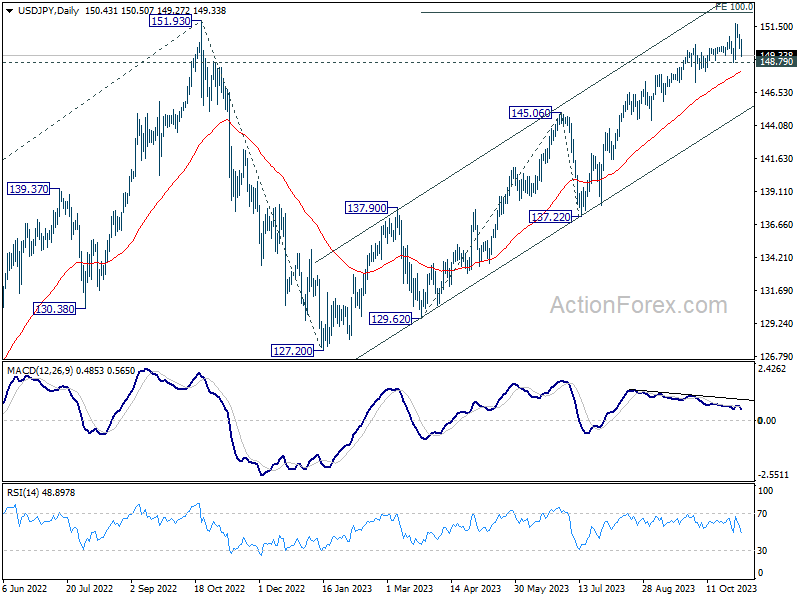
In the bigger picture, immediate focus is now on 151.93 resistance (2022 high). Rejection by 151.93, followed by sustained break of 145.06 resistance turned support will argue that rise from 127.20 has completed, and turn outlook bearish for 137.22 support and below. However, sustained break of 151.93 will confirm resumption of long term up trend. Next target will be 61.8% projection of 102.58 to 151.93 from 127.20 at 157.69.
USD/CHF Mid-Day Outlook
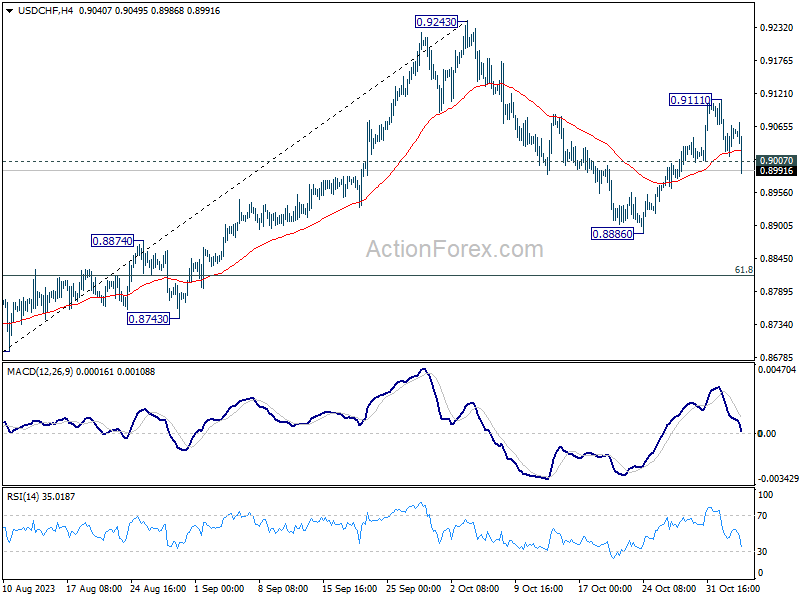
Daily Pivots: (S1) 0.9023; (P) 0.9054; (R1) 0.9089; More....
Break of 0.9005 support support argues that USD/CHF's rebound from 0.8886 has completed at 0.9111 already. Intraday bias is back on the downside for retesting 0.8886. Firm break there will resume whole fall from 0.9243 to 0.8815 fibonacci level. For now, risk will be on the downside as long as 0.9111 resistance holds, in case of recovery.
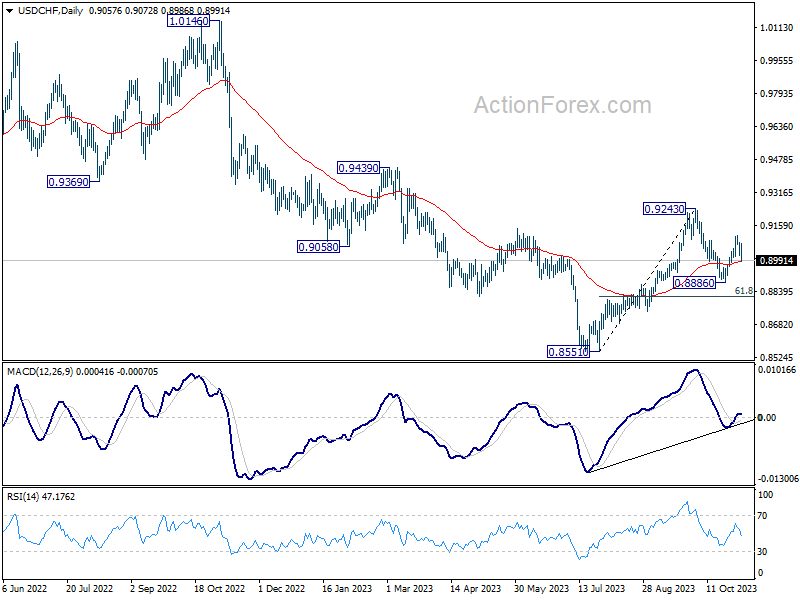
In the bigger picture, outlook is mixed up by the deeper than expected pull back from 0.9243. Yet there was no follow through selling after hitting 0.8886. On the upside, break of 0.9243 resistance will revive the case of medium term bottoming at 0.8851, and turn outlook bullish. However, sustained break of 61.8% retracement of 0.8551 to 0.9243 at 0.8815 will argue that larger decline from 1.0146 is ready to resume through 0.8551 low.
GBP/USD Mid-Day Outlook
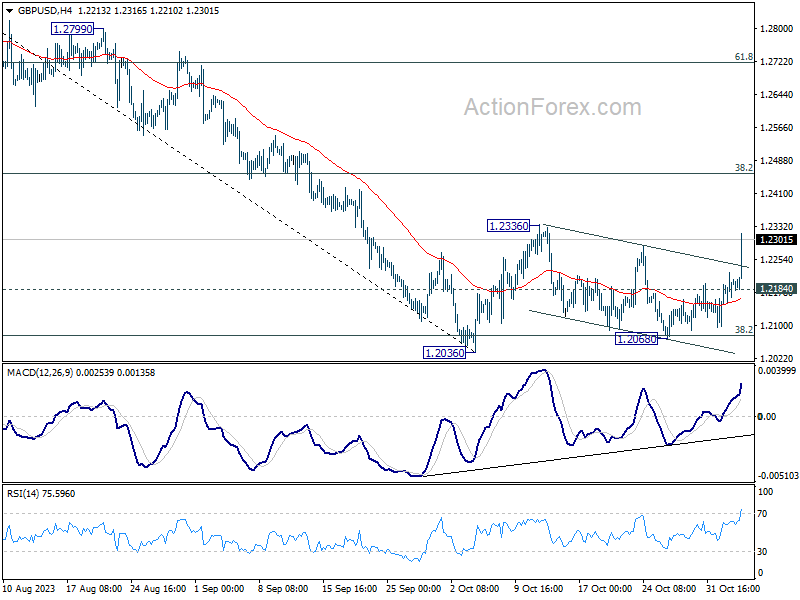
Daily Pivots: (S1) 1.2152; (P) 1.2189; (R1) 1.2240; More
Break of 1.2287 resistance argues that rebound from 1.2036 is resuming. Intraday bias is back on the upside for 1.2336 resistance first. Firm break there will target 38.2% retracement of 1.3141 to 1.2036 at 1.2458. On the downside, below 1.2184 minor support will turn intraday bias neutral first.
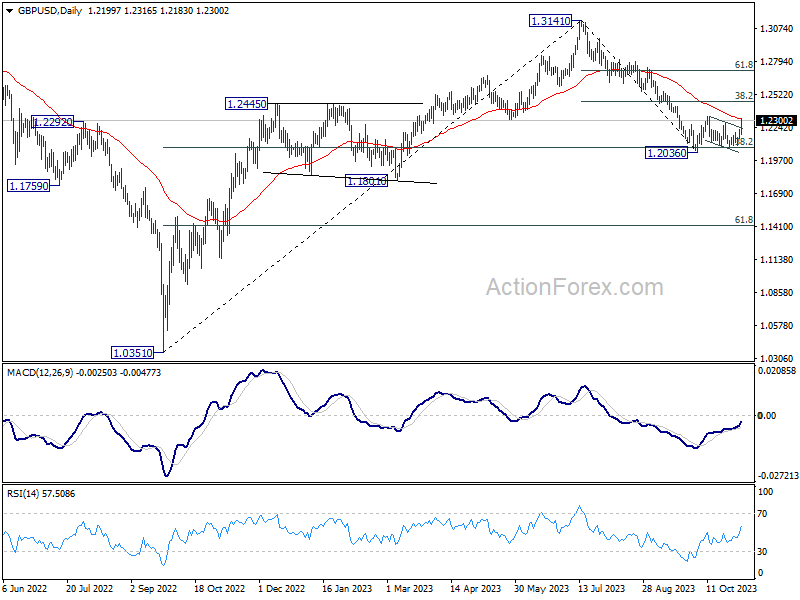
In the bigger picture, fall from 1.3141 medium term top could be viewed as part of a correction to rise from 1.0351 (2022 low). An interim bounce could be seen as the second leg of the pattern. But upside should be limited well below 1.3141 to start the third leg. Nevertheless, the pattern would be a range pattern as long as 38.2% retracement of 1.0351 to 1.3141 at 1.2075 holds.
EUR/USD Mid-Day Outlook
Daily Pivots: (S1) 1.0570; (P) 1.0619; (R1) 1.0672; More...
EUR/USD's rebound from 1.0447 resumed by breaking through 1.0693 resistance. Intraday bias is back on the upside for 1.0764 cluster resistance (38.2% retracement of 1.1274 to 1.0447 at 1.0763). Decisive break there will pave the way to 61.8% retracement at 1.0958 next On the downside, below 1.0609 minor support will turn intraday bias neutral first.
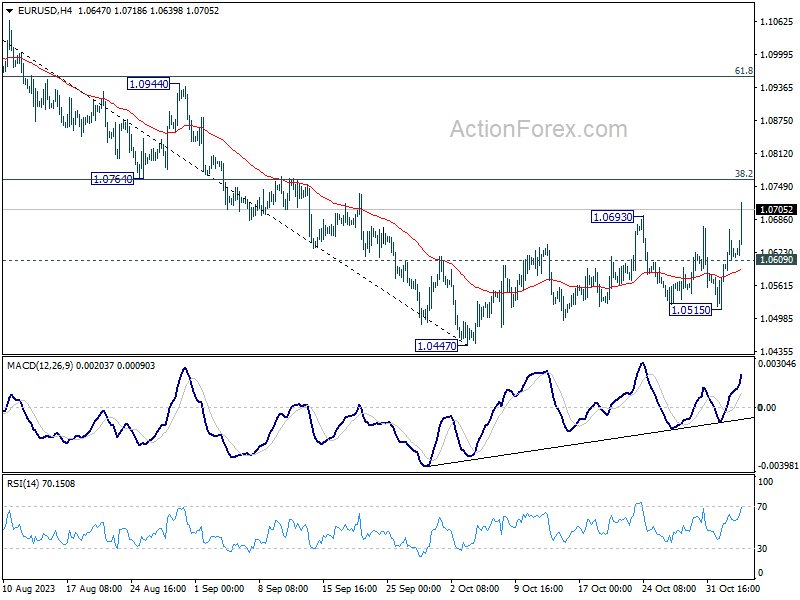
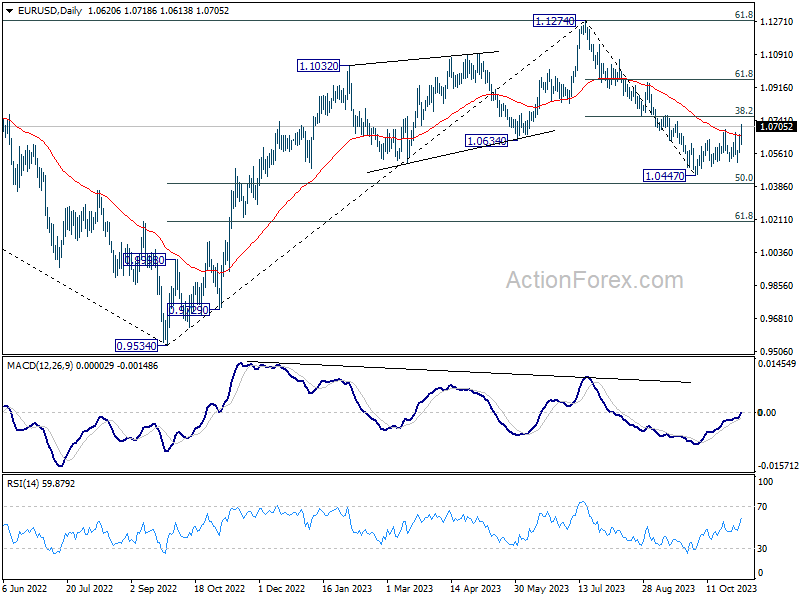
In the bigger picture, fall from 1.1274 medium term top could be viewed part of a correction to rise from 0.9534 (2022 low). An interim bounce from current level, as the second leg of the pattern, cannot be ruled out. But upside should be limited well below 1.1274 resistance to start the third leg. The pattern would likely at least have a take on 61.8% retracement of 0.9534 to 1.1274 at 1.0199 before completion.
Disappointing NFP Data Fuels Market Optimism Dollar and Yields Tumble
Markets reacted with notable positivity to the latest US. non-farm payroll report, which showed weaker-than-expected growth in jobs, a higher unemployment rate, and subdued wage inflation. Stock futures leaped as the data appeared to assuage investor concerns about further tightening by Fed. In a sharp response, 10-year Treasury yield plunged through 4.55% level, exacerbating the week's precipitous decline and signalling a potential shift in investor expectations regarding the trajectory of interest rates. Dollar experienced a broad sell-off, intensifying its decline for the week.
While Canadian dollar was burdened by its own disappointing employment figures, it nevertheless surged against Dollar, reflecting the greenback's broad weakness. Meanwhile, New Zealand and Australian dollars emerged as the strongest performers for the day, buoyed not only by the narrowing yield differential but also by a surge in risk appetite.
Euro and Sterling capitalized on Dollar's weakness, with both currencies making substantial gains. Conversely, Yen and Swiss Franc were notable laggards in the currency markets, potentially due to their status as safe havens which are less attractive in an environment where risk sentiment is on the rise.
In Europe, at the time of writing, FTSE is down -0.02%. DAX is up 0.44%. CAC is up 0.15%. Germany 10-year yield is down -0.062 to 2.659. Earlier in Asia, Nikkei rose 1.10%. Hong Kong HSI rose 2.52%. China Shanghai SSE rose 0.71%. Singapore Strait Times rose 1.98%. Japan 10-year JGB yield dropped -0.0433 to 0.916.
US NFP grows 150k, unemployment rate rose to 3.9%
US non-farm payroll employment grew 150k in October, below expectation of 172k. That's well below average monthly gain of 258k over the prior 12 months.
Unemployment rate rose from 3.8% to 3.9%, above expectation of being unchanged at 3.8%. Participation rate dropped from 62.8% to 62.7%.
Average hourly earnings rose 0.2% mom, below expectation of 0.3% mom. Over the 12 months, average hourly earnings rose 4.1% yoy.
Canada's employment grew 17.5k, unemployment rate rose to 5.9%
Canada's employment grew 17.5k in October, below expectation of 25.7.
Employment was up in construction (+23,000; +1.5%) and information, culture and recreation (+21,000; +2.5%) in October. This was offset by decreases in wholesale and retail trade (-22,000; -0.7%) and manufacturing (-19,000; -1.0%).
Unemployment rate rose from 5.7% to 5.9%, above expectation of 5.8%.
On a year-over-year basis, average hourly wages rose 4.8% yoy in October, following an increase of 5.0% yoy in September.
Eurozone unemployment rate rose to 6.5%, EU unchanged at 6.0%
Unemployment rate in Eurozone ticked up in September, rising to 6.5% from the previous month's 6.4%. This uptick defied market expectations that the unemployment rate would hold steady.
Despite the month-over-month increase, the broader picture shows a labor market that has seen a significant year-over-year improvement, with Eurozone unemployment shrinking by -212k compared to September 2022. However, the monthly rise in unemployment, with 69k more individuals without work in the Eurozone, suggests that the region's labor market might be facing new challenges as it enters the final quarter of the year.
The EU-wide unemployment rate remained constant at 6.0%, underscoring a more stable job market situation across the broader European Union. Nevertheless, the total number of unemployed persons in the EU rose by 95k month-over-month, bringing the number to approximately 13.026m, of which 11.017m are within the Eurozone.
UK PMI services finalized at 49.5, shallow downturn persists
UK PMI Services index was finalized at to 49.5 in October up fractionally from 49.3 in September, lingering in contraction territory for the third consecutive month. PMI Composite showed a minor improvement to 48.7 from an 8-month nadir of 48.5
Economics Director at S&P Global Market Intelligence, Tim Moore, highlighted, "A shallow downturn in UK service sector activity persisted in October as businesses struggled to make headway against a backdrop of worsening domestic economic conditions and stretched household budgets."
The outlook remains cautious at best. "Forward-looking survey indicators suggested that service providers will continue to skirt with recession," said Moore, noting that business optimism has dipped to its lowest point of the year.
On the brighter side, there was a silver lining with a slight uptick in new export sales. Furthermore, input cost inflation showed signs of easing, reaching its softest point in over two years due to reduced raw material prices and supplier discounting.
Nevertheless, this hasn't stopped businesses from hiking prices. "Higher wages and fuel bills were still passed on to clients, which resulted in the strongest increase in average prices charged inflation for three months," Moore explained.
China Caixin PMI services ticks to 50.4, composite fell to 50
China's service sector showed a glimmer of resilience in October, with Caixin PMI Services edging up marginally from 50.2 to 50.4, meeting expectations. However, this slight uptick could not buoy the overall PMI Composite, which leveled at the neutral 50.0 threshold, down from 50.9 in the previous month.
The slight uptick in the services sector was overshadowed by a dip in manufacturing (which fell from 50.6 to 49.5). The details reveal a mixed scenario: composite new business inched forward at its weakest pace in ten months. Service providers and goods producers alike witnessed decelerated growth in sales.
Employment trends also painted a picture of caution. There was a small overall decline in jobs, with manufacturing bearing the brunt through more pronounced job losses, while employment in the service sector hit a plateau.
On the pricing front, inflationary pressures were somewhat contained. Input costs across the combined sectors rose modestly, maintaining a muted pattern of cost escalation. Despite this, firms nudged their selling prices upwards, continuing a trend that could suggest confidence in passing on costs, albeit the rate of charge inflation was just marginally lower than the 18-month peak seen in September.
EUR/USD Mid-Day Outlook
Daily Pivots: (S1) 1.0570; (P) 1.0619; (R1) 1.0672; More...
EUR/USD's rebound from 1.0447 resumed by breaking through 1.0693 resistance. Intraday bias is back on the upside for 1.0764 cluster resistance (38.2% retracement of 1.1274 to 1.0447 at 1.0763). Decisive break there will pave the way to 61.8% retracement at 1.0958 next On the downside, below 1.0609 minor support will turn intraday bias neutral first.
In the bigger picture, fall from 1.1274 medium term top could be viewed part of a correction to rise from 0.9534 (2022 low). An interim bounce from current level, as the second leg of the pattern, cannot be ruled out. But upside should be limited well below 1.1274 resistance to start the third leg. The pattern would likely at least have a take on 61.8% retracement of 0.9534 to 1.1274 at 1.0199 before completion.
Economic Indicators Update
| GMT | Ccy | Events | Actual | Forecast | Previous | Revised |
|---|---|---|---|---|---|---|
| 01:45 | CNY | Caixin Services PMI Oct | 50.4 | 50.4 | 50.2 | |
| 07:00 | EUR | Germany Trade Balance (EUR) Sep | 16.5B | 16.3B | 16.6B | 17.7B |
| 07:45 | EUR | France Industrial Output M/M Sep | -0.50% | 0.00% | -0.30% | -0.10% |
| 09:30 | GBP | Services PMI Oct F | 49.5 | 49.2 | 49.2 | |
| 10:00 | EUR | Eurozone Unemployment Rate Sep | 6.50% | 6.40% | 6.40% | |
| 12:30 | USD | Nonfarm Payrolls Oct | 150K | 172K | 336K | 297K |
| 12:30 | USD | Unemployment Rate Oct | 3.90% | 3.80% | 3.80% | |
| 12:30 | USD | Average Hourly Earnings M/M Oct | 0.20% | 0.30% | 0.20% | 0.30% |
| 12:30 | CAD | Net Change in Employment Oct | 17.5K | 25.7K | 63.8K | |
| 12:30 | CAD | Unemployment Rate Oct | 5.70% | 5.60% | 5.50% | |
| 13:45 | USD | Services PMI Oct F | 50.9 | 50.9 | ||
| 14:00 | USD | ISM Services PMI Oct | 53.2 | 53.6 |
Canada’s employment grew 17.5k, unemployment rate rose to 5.9%
Canada's employment grew 17.5k in October, below expectation of 25.7.
Employment was up in construction (+23,000; +1.5%) and information, culture and recreation (+21,000; +2.5%) in October. This was offset by decreases in wholesale and retail trade (-22,000; -0.7%) and manufacturing (-19,000; -1.0%).
Unemployment rate rose from 5.7% to 5.9%, above expectation of 5.8%.
On a year-over-year basis, average hourly wages rose 4.8% yoy in October, following an increase of 5.0% yoy in September.