Sample Category Title
USD/CHF Mid-Day Outlook
Daily Pivots: (S1) 0.8991; (P) 0.9014; (R1) 0.9048; More....+
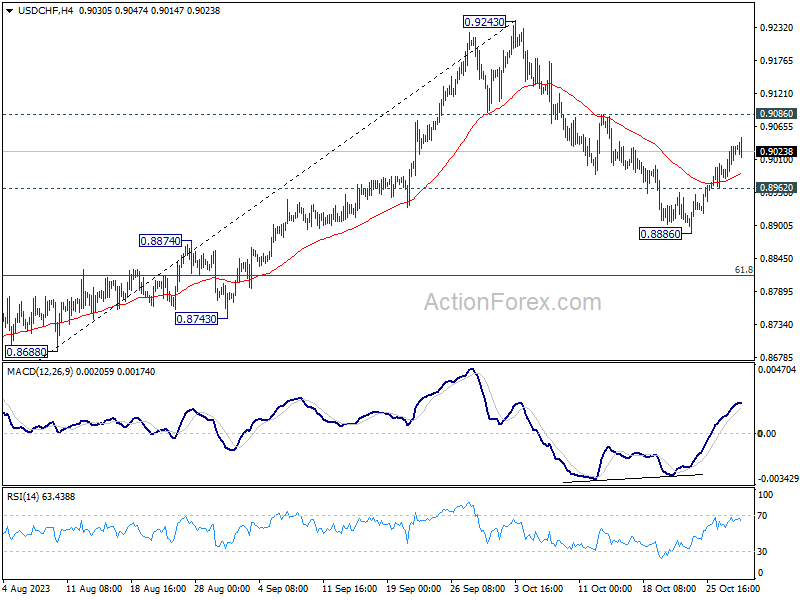
USD/CHF's rebounded from 0.8886 is still in progress and intraday bias stays on the upside. Sustained break of 0.9086 resistance will pave the way back to 0.9342 resistance next. On the downside, however, below 0.8962 minor support will turn bias back to the downside for 0.8886 and possibly below.
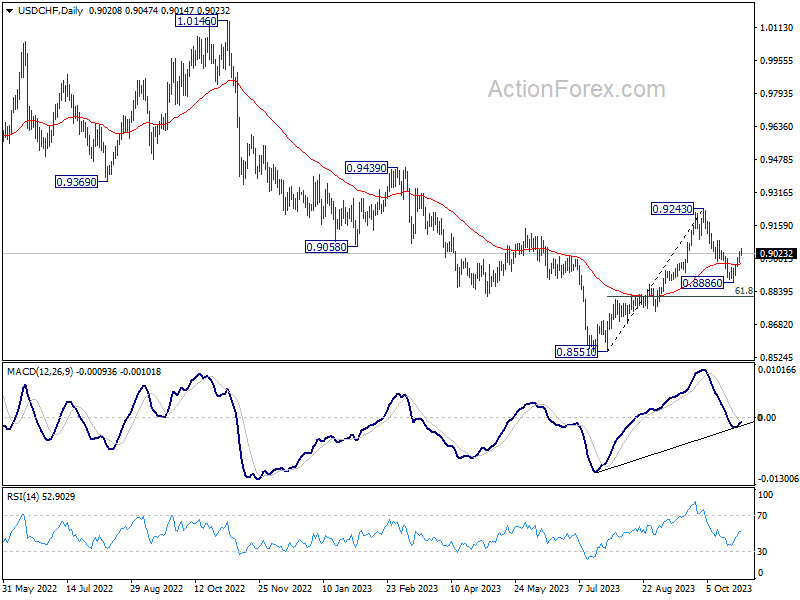
In the bigger picture, outlook is mixed up by the deeper than expected pull back from 0.9243. Yet there was no follow through selling after hitting 0.8886. On the upside, break of 0.9243 resistance will revive the case of medium term bottoming at 0.8851, and turn outlook bullish. However, sustained break of 61.8% retracement of 0.8551 to 0.9243 at 0.8815 will argue that larger decline from 1.0146 is ready to resume through 0.8551 low.
GBP/USD Mid-Day Outlook
Daily Pivots: (S1) 1.2098; (P) 1.2130; (R1) 1.2155; More
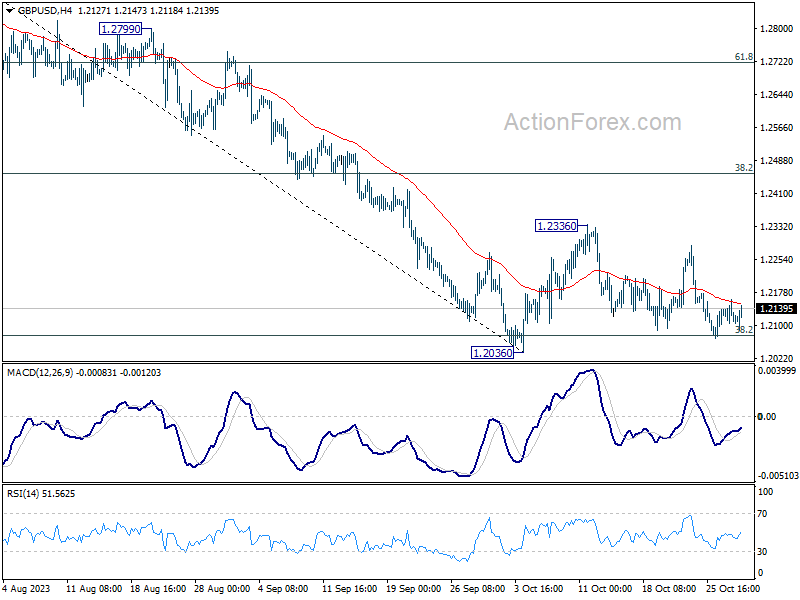
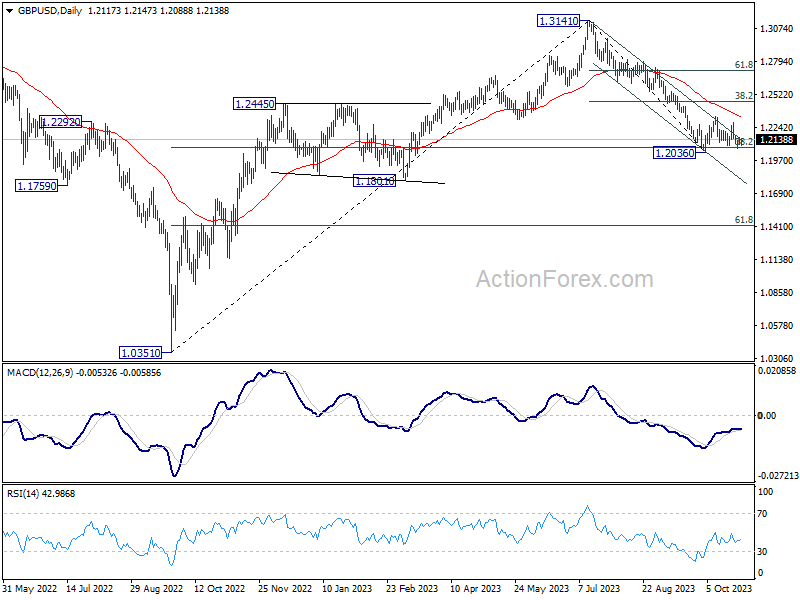
Range trading continues in GBP/USD and intraday bias stays neutral. Outlook also remains bearish with 1.2336 resistance intact. On the downside, firm break of 1.2036 will resume whole decline from 1.3141 for 1.1801 support next. However, break of 1.2336 will turn bias back to the upside for 38.2% retracement of 1.3141 to 1.2036 at 1.2458.
In the bigger picture, fall from 1.3141 medium term top could still be a correction to up trend from 1.0351 (2022 low) only. But risk of complete trend reversal is rising. Sustained break of 38.2% retracement of 1.0351 to 1.3141 at 1.2075 will pave the way to 61.8% retracement at 1.1417. For now, risk will stay on the downside as long as 55 D EMA (now at 1.2346) holds, in case of rebound.
EUR/USD Mid-Day Outlook
Daily Pivots: (S1) 1.0534; (P) 1.0566; (R1) 1.0596; More...
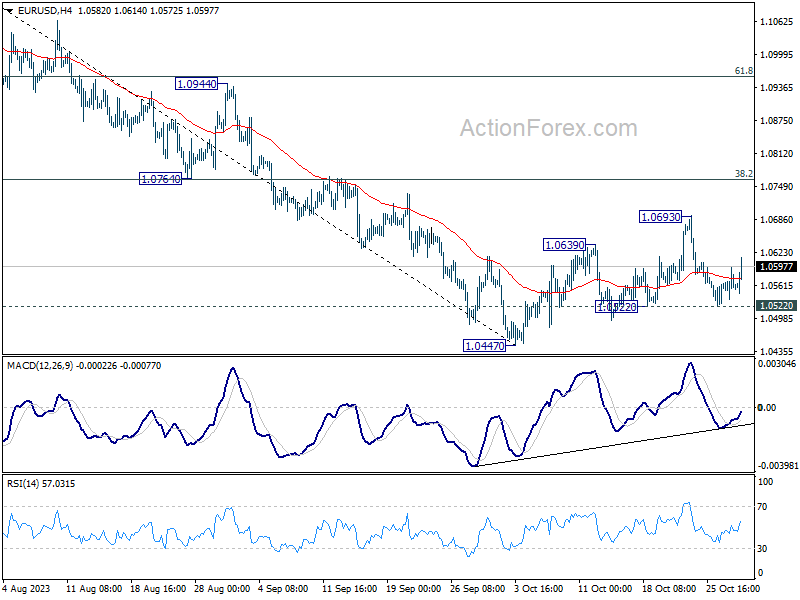
EUR/USD rebounded notably today but stays below 1.0693 resistance at this point. Intraday bias remains neutral first. On the downside, break of 1.0522 support will turn bias back to the downside for retesting 1.0447 low. Break there will resume larger fall from 1.1274. On the other hand, strong bounce from current level, followed by break above 1.0693, rebound from 1.0447 to 1.0764 cluster resistance (38.2% retracement of 1.1274 to 1.0447 at 1.0763).
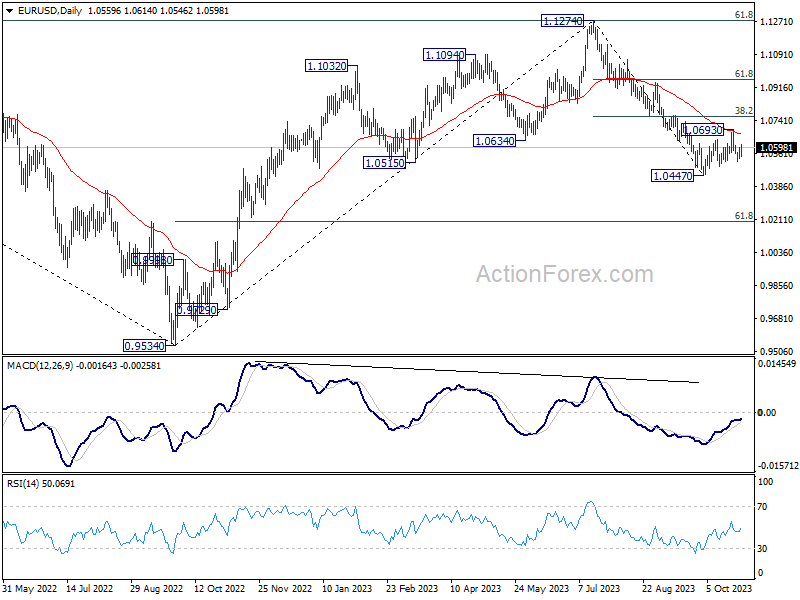
In the bigger picture, fall from 1.1274 medium term top could still be a correction to rise from 0.9534 (2022 low). But chance of a complete trend reversal is rising. In either case, current fall should target 61.8% retracement of 0.9534 to 1.1274 at 1.0199 next. For now, risk will stay on the downside as long as 55 D EMA (now at 1.0665) holds, in case of rebound.
Euro Gathers Steam While Improved Risk Appetite Dims Yen, Franc, and Dollar
Yen, Swiss Franc, and Dollar are weakening in early US session, with a discernible shift in European market sentiment that suggests a mild recovery. Major European stock indexes have inched upwards, and US futures market also indicates a higher opening. Despite early signals suggesting Yen might rebound, likely in light of tomorrow's BoJ policy announcement, such hopes were short-lived. Yen reversed quickly and, as a result, it's is currently the day's most underperforming currency.
Conversely, commodity currencies, led by Australian Dollar, are rebounding. The unexpected robustness in retail sales data has bolstered Aussie's momentum. This is set against the backdrop of anticipated monetary policy action from RBA, with market watchers keenly anticipating another rate hike on November 7.
Euro and Sterling are currently showing mixed performance, though Euro seems to be holding a slight advantage. This can be attributed, in part, to comments from ECB officials who downplayed the likelihood of rate cut in the first half of the upcoming year. Lower than expected German inflation data is ignored.
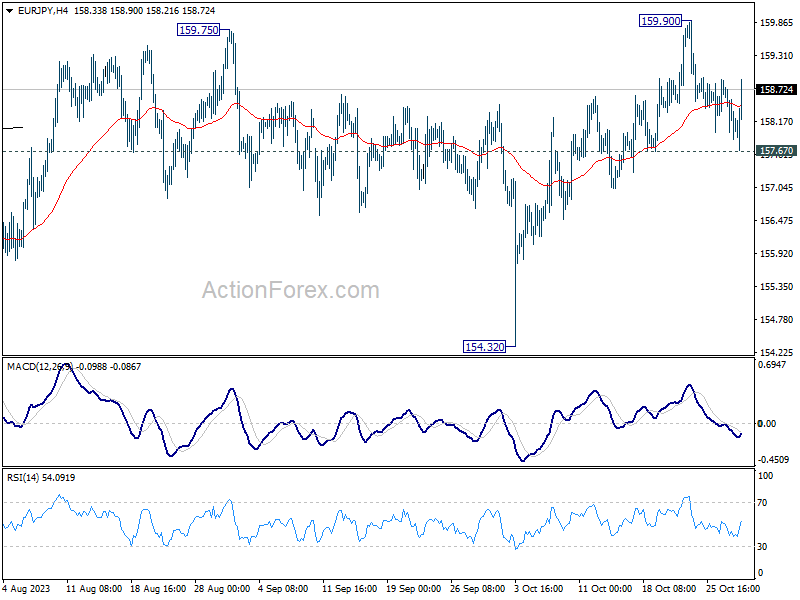
From a technical perspective, the spotlight is on Euro's movement during the remainder of the session. Both EUR/USD and EUR/JPY have seen rebounds from support levels of 1.0522 and 157.67 respectively. Further break of 1.0693 and 159.90 resistance levels will resume their near term rises. Additionally, surpassing the 0.8739 resistance in EUR/GBP might also signify the continuation of its ascent from 0.8491. Should all these levels be surpassed, it would be a strong indication of burgeoning bullish momentum for the Euro.
In Europe, at the time of writing, FTSE is up 0.75%. DAX is up 0.45%. CAC is up 0.55%. Germany 10-year yield is up 0.019 at 2.852. Earlier in Asia, Nikkei dropped -0.95%. Hong Kong HSI rose 0.04%. China Shanghai SSE rose 0.12%. Singapore Strait Times rose 0.08%. Japan 10-year JGB yield rose 0.0209 to 0.897.
ECB's Kazimir dismisses rate cut expectations; urges patience on policy decisions
ECB Governing Council member Peter Kazimir dismissed speculations of impending rate cuts in the early months of 2024. Speaking earlier today, he stated emphatically, "Bets on rate cuts happening already in the first half of next year are entirely misplaced." Instead, he alluded to a persistent approach, suggesting that "We will have to stay at the peak for the next few quarters."
Addressing the growing sentiment that the current policy cycle is nearing its end, Kazimir urged caution. "All those voices coining this as the end of the cycle should hold their horses," he remarked. "It's too soon to declare victory and say the job's done."
While not entirely closing the door on further adjustments, Kazimir implied that any future policy decisions would be data-driven. "Additional tightening could come, if incoming data force us to take such a step," he explained.
The unfolding situation in the Middle East remains a concern, especially given its potential implications on inflation. Kazimir shared, "I will eagerly await the December update of our inflation forecast to get a clearer picture, confirmation, that the decline in inflation is sustained. I hope that renewed upside inflation risks from the escalating tragic conflict in the Middle East will not materialize."
Furthermore, Kazimir highlighted the significance of upcoming milestones before any definitive policy stance is taken. "December forecasts are one of two key milestones needed to pass. March is the latter. By then, it should have become clearer how wage negotiations for the whole year turned out and whether the risks of a spiral of high prices and high wages were off the table," he added.
ECB's Simkus: Current restrictive rates sufficient, talk about cuts premature
ECB Governing Council member Gediminas Simkus said today, "In my view, if there's no new staggering data, current restrictive levels are sufficient," to steer inflation back to target.
Highlighting the bank's current approach, Simkus clarified, "There is and there was no need to raise rates at this point." But, "Will we need this in the future? We still have to wait and see. I'm hopeful this won't be needed."
Addressing the speculation around potential rate cuts, Simkus was clear in his stance. "Inflation is still high, too high. Any talk about cuts is premature. We need strategic patience to keep rates at restrictive levels," he asserted.
Dispelling any immediate expectations of a rate reduction, he added, "I'd be highly surprised to see a rate cut in the first half. I don't think so."
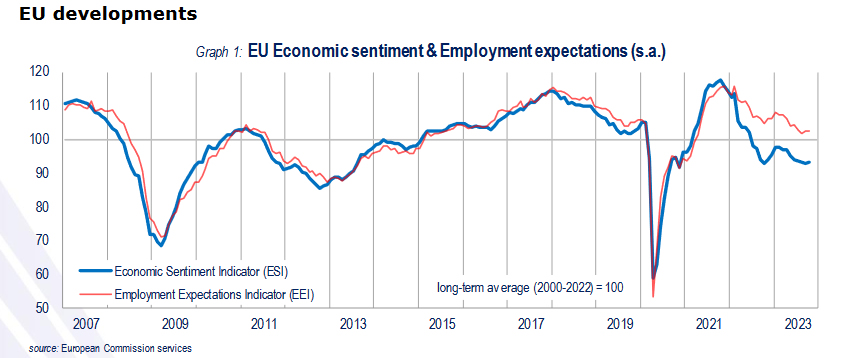
Eurozone economic sentiment ticks down to 93.3
Eurozone Economic Sentiment Indicator fell slightly from 93.4 to 93.3 in October. Employment Expectations Indicator fell from 102.9 to 102.8. Economic Uncertainty Indicator rose from 21.5 to 22.7. Industrial confidence fell from -8.9 to -9.3. Services confidence rose from 4.1 to 4.5. Consumer confidence ticked down from -17.8 to -17.9. Retail trade confidence fell from -5.7 to -7.8. Construction confidence rose from -6.0 to -5.9.
EU ESI rose from 92.9 to 93.1. EEI fell from 102.6 to 102.3. EUI rose from 21.1 to 22.2. Amongst the largest EU economies, the ESI improved in Poland (+1.4), Spain (+1.2) and Germany (+0.5). By contrast, sentiment deteriorated markedly in France (-2.9) and, to a lesser extent, Italy (-0.9). The ESI remained unchanged in the Netherlands (±0.0).
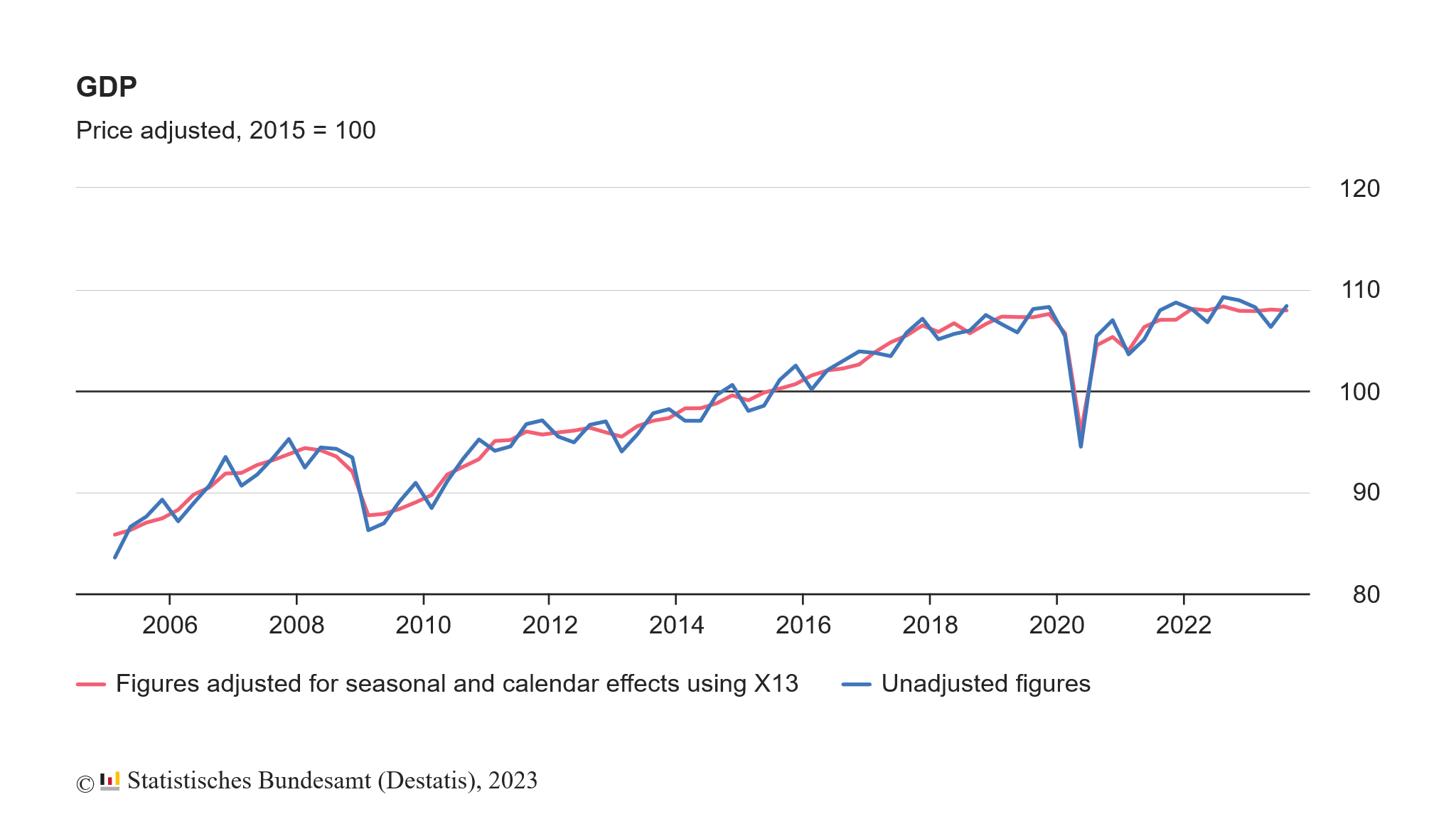
German GDP contracts -0.1% qoq in Q3, less severe than expected
Germany's GDP (price, seasonally, and calendar adjusted) shrank by -0.1% qoq in Q3. This decline, however, was slightly less severe than the anticipated -0.2% qoq contraction. This contraction comes in the wake of a modest 0.1% growth in Q2 and a state of stagnation in Q1.
On a year-over-year basis, the picture appears more pronounced. GDP was down by -0.8% (price adjusted) and down by -0.3% (price and calendar adjusted) compared to the same quarter a year earlier.
Destatis said a key factor contributing to the contraction was decrease in household final consumption expenditure. There were positive contributions from gross fixed capital formation in machinery and equipment.
Swiss KOF ticked down to 95.8, stable but underwhelming
Swiss KOF Economic Barometer demonstrated a minor dip, decreasing by -0.1 to settle at 95.8 in September. This figure modestly surpassed the expected mark of 95.6, indicating a slightly more favorable scenario than anticipated.
However, this marginal decrease also reflects that Barometer is continuing its trend of hovering just below the long-term average. The KOF (Swiss Economic Institute) elaborated on this trend, noting that "together with the small movements of the Barometer since the summer, this indicates a weak but stable development of the Swiss economy towards the end of this year."
KOF pointed out that "the slight decline is primarily attributable to bundles of indicators from the manufacturing sector and to indicators concerning foreign demand."
It's not all subdued tones. KOF also highlighted some positive aspects, stating, "Indicators from the finance and insurance sector and the hospitality sector are sending positive signals."
Australian retails rose 0.9% mom, strong Sep in subdued 2023
Australia's retail sales turnover registered a 0.9% mom growth in September to AUD 35.87B. This robust performance dwarfed the modest analyst expectations of a 0.3% mom growth. On an annual basis, sales turnover presented a rise of 2.0% yoy compared to the same month in the preceding year.
Speaking on the development, Ben Dorber, ABS head of retail statistics, elucidated, "The strong rise in September came from a diverse range of factors across the Retail industry." He pinpointed the uncommonly warm onset of spring as a significant catalyst while technology and energy-conscious programs also had their roles.
However, while September's figures paint a buoyant picture, Dorber pointed to a more restrained broader context.
"While the rise in September was the largest since January, subdued spending for most of 2023 means that underlying growth in Retail turnover remains historically low," he said.
Adding weight to this perspective, he shared that "Retail turnover in trend terms is up only 1.5 per cent compared to September 2022 - the smallest trend growth over 12 months in the history of the series."
EUR/USD Mid-Day Outlook
Daily Pivots: (S1) 1.0534; (P) 1.0566; (R1) 1.0596; More...
EUR/USD rebounded notably today but stays below 1.0693 resistance at this point. Intraday bias remains neutral first. On the downside, break of 1.0522 support will turn bias back to the downside for retesting 1.0447 low. Break there will resume larger fall from 1.1274. On the other hand, strong bounce from current level, followed by break above 1.0693, rebound from 1.0447 to 1.0764 cluster resistance (38.2% retracement of 1.1274 to 1.0447 at 1.0763).
In the bigger picture, fall from 1.1274 medium term top could still be a correction to rise from 0.9534 (2022 low). But chance of a complete trend reversal is rising. In either case, current fall should target 61.8% retracement of 0.9534 to 1.1274 at 1.0199 next. For now, risk will stay on the downside as long as 55 D EMA (now at 1.0665) holds, in case of rebound.
Economic Indicators Update
| GMT | Ccy | Events | Actual | Forecast | Previous | Revised |
|---|---|---|---|---|---|---|
| 00:30 | AUD | Retail Sales M/M Sep | 0.90% | 0.30% | 0.20% | 0.30% |
| 08:00 | CHF | KOF Economic Barometer Oct | 95.8 | 95.6 | 95.9 | |
| 09:00 | EUR | Germany GDP Q/Q Q3 P | -0.10% | -0.20% | 0.00% | |
| 09:30 | GBP | Mortgage Approvals (GBP) Sep | 43K | 44K | 45K | |
| 09:30 | GBP | M4 Money Supply M/M Sep | -1.10% | 0.10% | 0.20% | |
| 10:00 | EUR | Eurozone Economic Sentiment Indicator Oct | 93.3 | 93.3 | 93.3 | |
| 10:00 | EUR | Eurozone Industrial Confidence Oct | -9.3 | -9.5 | -9 | |
| 10:00 | EUR | Eurozone Services Sentiment Oct | 4.5 | 3.4 | 4 | |
| 10:00 | EUR | Eurozone Consumer Confidence Oct F | -17.9 | -17.9 | -17.9 | |
| 13:00 | EUR | Germany CPI M/M Oct P | 0.00% | 0.20% | 0.30% | |
| 13:00 | EUR | Germany CPI Y/Y Oct P | 3.80% | 4.00% | 4.50% |
USD/JPY Technical: Bearish Elements Sighted at Key Resistance Zone
- Last Friday, 27 Oct price actions of the USD/JPY led to the formation of a weekly bearish reversal “Shooting Star” candlestick right at a key resistance zone of 150.30/150.90.
- Medium-term momentum has turned lacklustre as indicated by the bearish divergence condition seen in the daily RSI.
- Watch the potential downside trigger level of 149.30 (20-day moving average) on the USD/JPY.
Last Friday, 27 October, the price actions of USD/JPY failed to make any headway above a key resistance zone of 150.30/150.90. It printed an intraday high of 150.78 on Thursday, 26 October before it traded lower throughout Friday’s session on the backdrop of a hotter Tokyo’s CPI print where the growth of the core-core inflation rate (excluding fresh food and energy) surged to 2.7% y/y, beat expectations of 2.3% y/y, and surpassed its August year-to-date peak of 2.6% y/y to hit a 31-year high.
Emergence of weekly bearish reversal “Shooting Star” ahead of BoJ
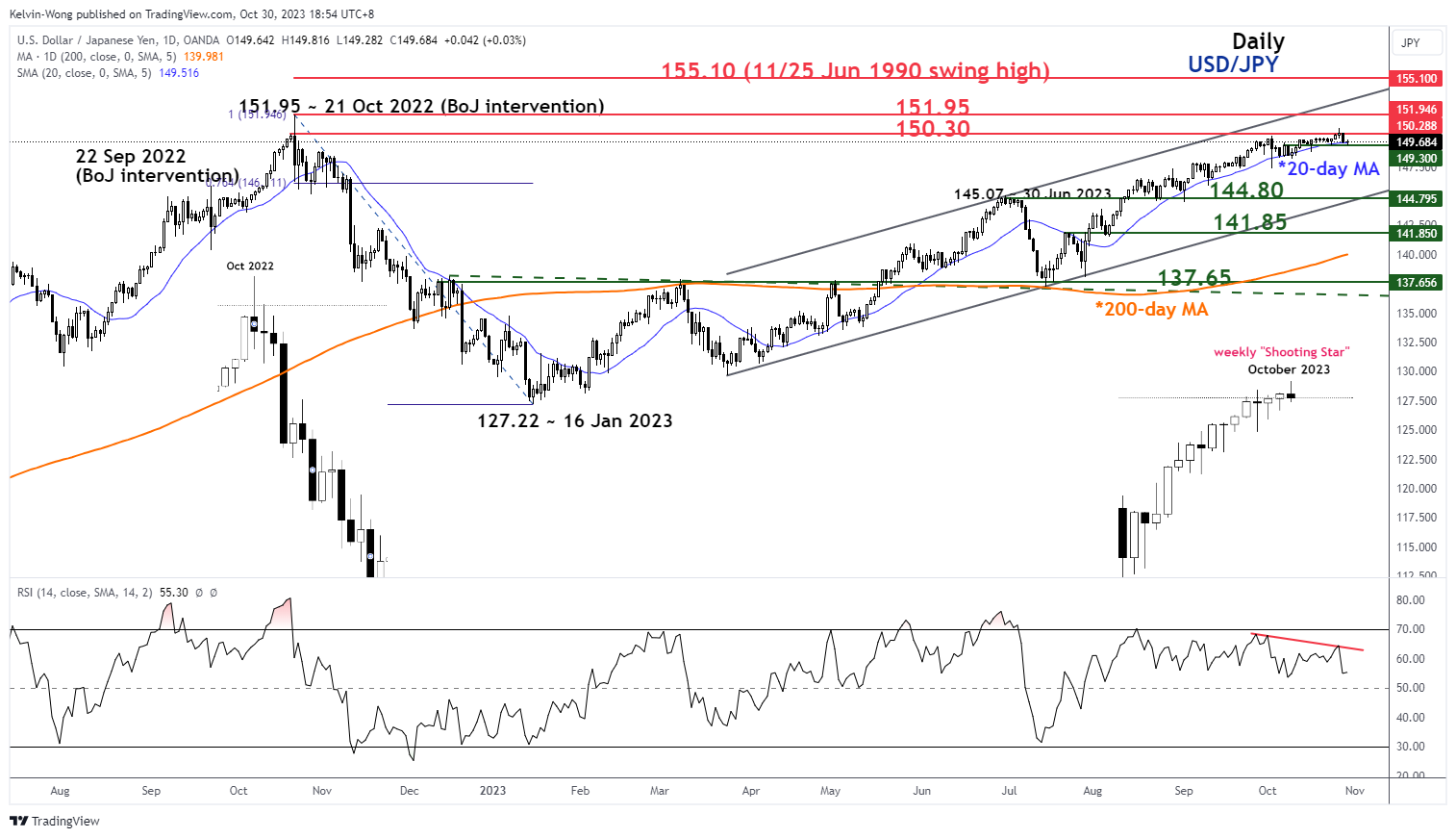
Fig 1: USD/JPY medium-term & major trends as of 30 Oct 2023 (Source: TradingView, click to enlarge chart)
Interestingly, last week’s price actions of the USD/JPY have formed a bearish weekly reversal candlestick pattern called “Shooting Star” ahead of the Bank of Japan (BoJ) monetary policy decision outcome and the release of its latest inflation and growth forecasts in its quarterly outlook report tomorrow, 31 October.
The weekly “Shooting Star” formed at the key resistance zone of 150.30/150.90 increases the odds of a bullish exhaustion scenario which suggests that the year-long rally of USD/JPY in place since the 16 January 2023 low of 127.22 is at risk for a potential multi-week medium-term corrective decline to retrace at least 38.2% of the major uptrend phase from 16 January 2023 low to 26 October 2023 high which gives rise to a potential downside target of a key medium-term support at 141.85 (also close to the key 200-day moving average).
A key point to note will be the prior relentless push up to last year, 21 October 2022 major swing high of 151.95 that saw a three-month decline of -16% thereafter had taken a similar form of weekly bearish reversal candlestick before the former plunge occurred.
In addition, the daily RSI momentum indicator flashed out a bearish divergence condition on last Friday, 27 October which indicates another sign of bullish exhaustion.
Watch the near-term support of 149.30
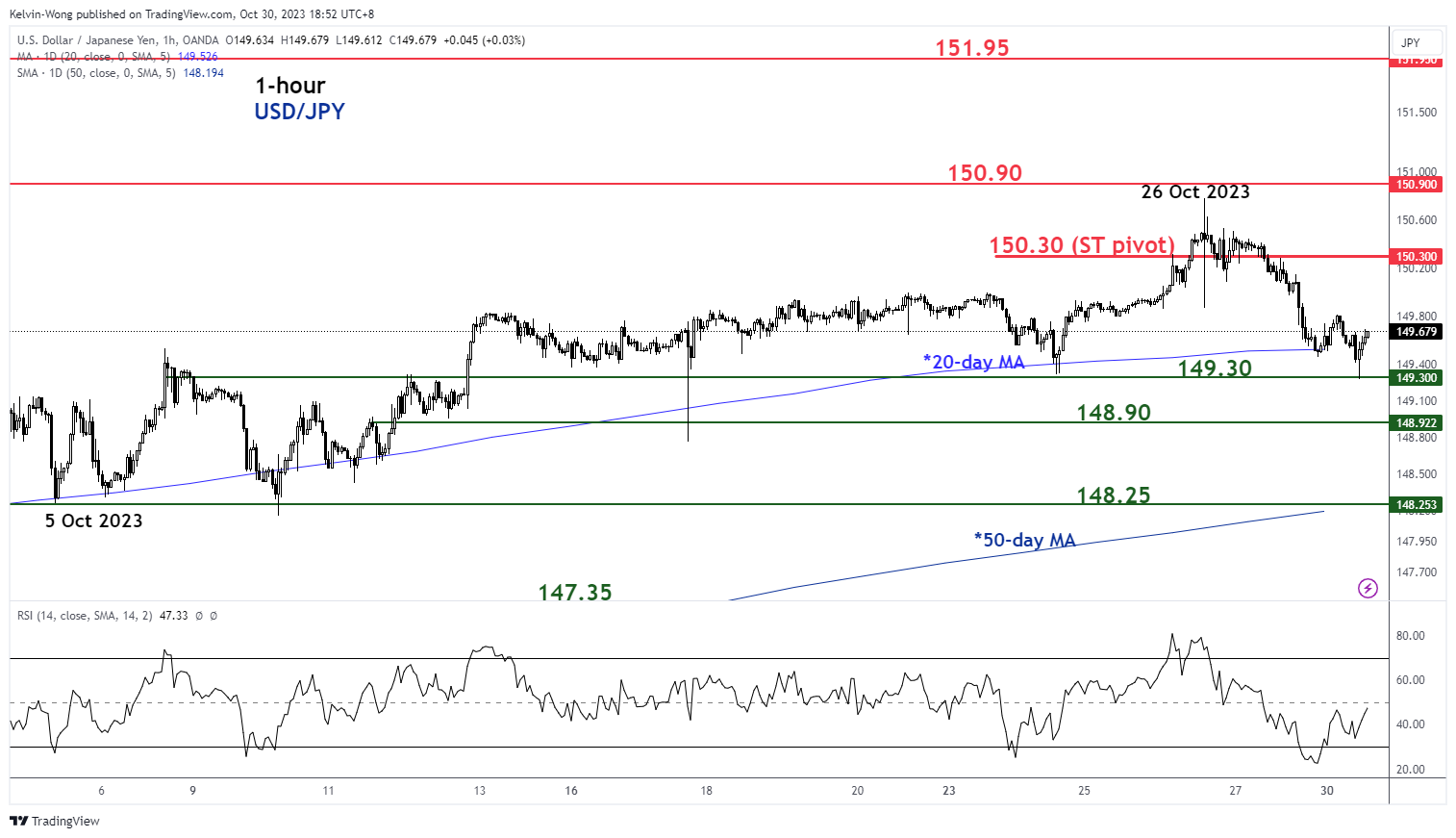
Fig 2: USD/JPY short-term minor trend as of 30 Oct 2023 (Source: TradingView, click to enlarge chart)
In the shorter term as seen on the 1-hour chart, the recent slide in the USD/JPY on last Friday and today’s Asian session (30 October) has managed to stall again at the 20-day moving average that is acting as a support at 149.30.
So far, the 20-day moving average support of USD/JPY has managed to prevent any deeper slide in price actions since 31 July 2023 which in turn makes it a potential downside trigger level.
Watch the 150.30 key short-term pivotal resistance and a clear breakdown with an hourly close below the 20-day moving average support at 149.30 is likely to unleash a further potential down move sequence at least in the short-term towards the next intermediate supports at 148.90 and 148.25 (minor swing lows of 5/10 October 2023 & 50-day moving average) in the first step.
However, a clearance above 150.30 negates the bearish tone for a retest on the upper limit of the key medium-term resistance at 150.90, and above it sees the major resistance coming in at 151.95.
ECB’s Simkus: Current restrictive rates sufficient, talk about cuts premature
ECB Governing Council member Gediminas Simkus said today, "In my view, if there's no new staggering data, current restrictive levels are sufficient," to steer inflation back to target.
Highlighting the bank's current approach, Simkus clarified, "There is and there was no need to raise rates at this point." But, "Will we need this in the future? We still have to wait and see. I'm hopeful this won't be needed."
Addressing the speculation around potential rate cuts, Simkus was clear in his stance. "Inflation is still high, too high. Any talk about cuts is premature. We need strategic patience to keep rates at restrictive levels," he asserted.
Dispelling any immediate expectations of a rate reduction, he added, "I'd be highly surprised to see a rate cut in the first half. I don't think so."
ECB’s Kazimir dismisses rate cut expectations; urges patience on policy decisions
ECB Governing Council member Peter Kazimir dismissed speculations of impending rate cuts in the early months of 2024. Speaking earlier today, he stated emphatically, "Bets on rate cuts happening already in the first half of next year are entirely misplaced." Instead, he alluded to a persistent approach, suggesting that "We will have to stay at the peak for the next few quarters."
Addressing the growing sentiment that the current policy cycle is nearing its end, Kazimir urged caution. "All those voices coining this as the end of the cycle should hold their horses," he remarked. "It's too soon to declare victory and say the job's done."
While not entirely closing the door on further adjustments, Kazimir implied that any future policy decisions would be data-driven. "Additional tightening could come, if incoming data force us to take such a step," he explained.
The unfolding situation in the Middle East remains a concern, especially given its potential implications on inflation. Kazimir shared, "I will eagerly await the December update of our inflation forecast to get a clearer picture, confirmation, that the decline in inflation is sustained. I hope that renewed upside inflation risks from the escalating tragic conflict in the Middle East will not materialize."
Furthermore, Kazimir highlighted the significance of upcoming milestones before any definitive policy stance is taken. "December forecasts are one of two key milestones needed to pass. March is the latter. By then, it should have become clearer how wage negotiations for the whole year turned out and whether the risks of a spiral of high prices and high wages were off the table," he added.
Eurozone economic sentiment ticks down to 93.3
Eurozone Economic Sentiment Indicator fell slightly from 93.4 to 93.3 in October. Employment Expectations Indicator fell from 102.9 to 102.8. Economic Uncertainty Indicator rose from 21.5 to 22.7. Industrial confidence fell from -8.9 to -9.3. Services confidence rose from 4.1 to 4.5. Consumer confidence ticked down from -17.8 to -17.9. Retail trade confidence fell from -5.7 to -7.8. Construction confidence rose from -6.0 to -5.9.
EU ESI rose from 92.9 to 93.1. EEI fell from 102.6 to 102.3. EUI rose from 21.1 to 22.2. Amongst the largest EU economies, the ESI improved in Poland (+1.4), Spain (+1.2) and Germany (+0.5). By contrast, sentiment deteriorated markedly in France (-2.9) and, to a lesser extent, Italy (-0.9). The ESI remained unchanged in the Netherlands (±0.0).
German GDP contracts -0.1% qoq in Q3, less severe than expected
Germany's GDP (price, seasonally, and calendar adjusted) shrank by -0.1% qoq in Q3. This decline, however, was slightly less severe than the anticipated -0.2% qoq contraction. This contraction comes in the wake of a modest 0.1% growth in Q2 and a state of stagnation in Q1.
On a year-over-year basis, the picture appears more pronounced. GDP was down by -0.8% (price adjusted) and down by -0.3% (price and calendar adjusted) compared to the same quarter a year earlier.
Destatis said a key factor contributing to the contraction was decrease in household final consumption expenditure. There were positive contributions from gross fixed capital formation in machinery and equipment.
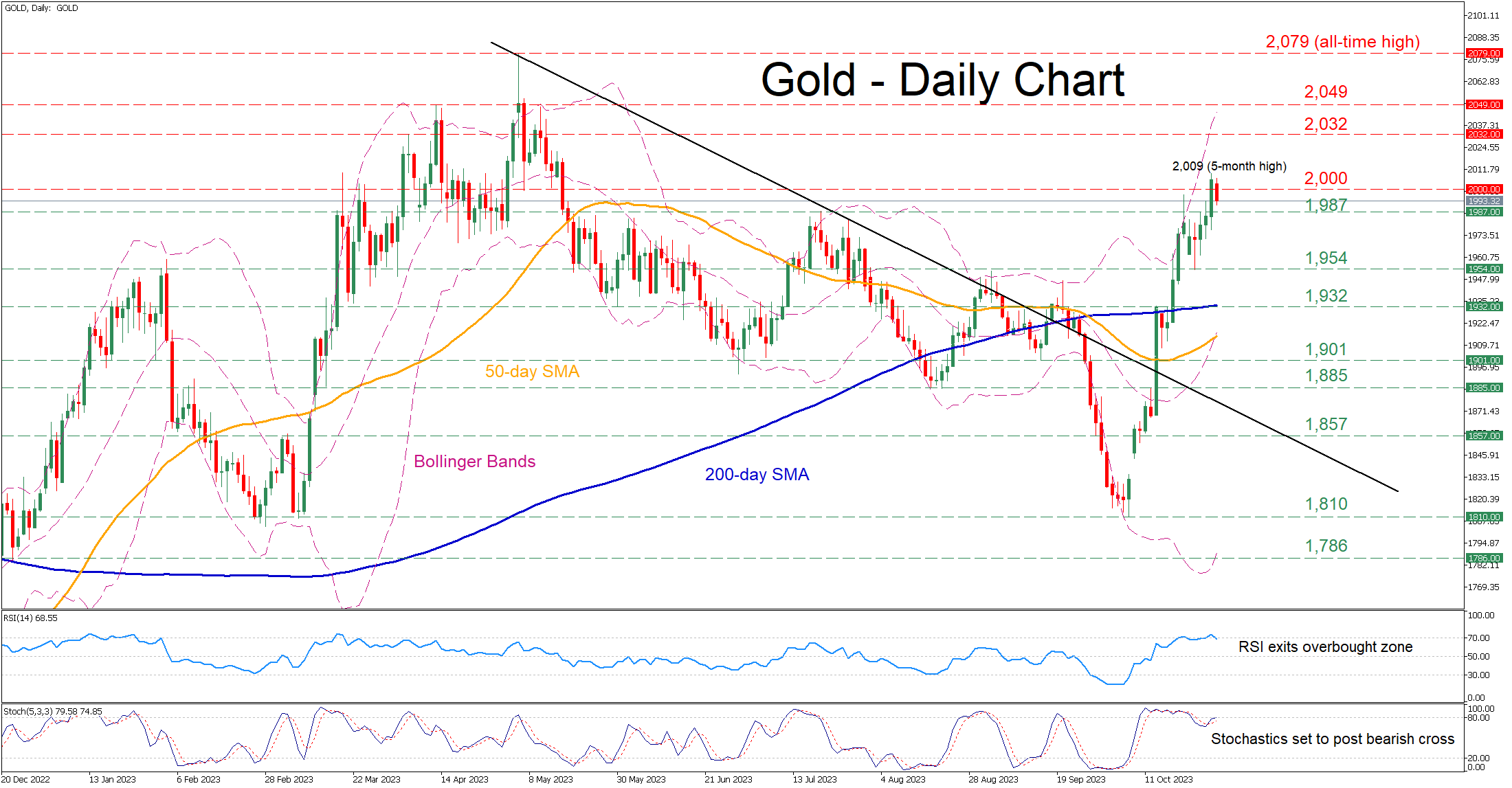
Gold Faces Setback after Hitting 5-Month Peak
- Gold surges to a fresh 5-month high amid increasing geopolitical tensions
- Pulls back below the 2,000 psychological mark in the following session
- Momentum indicators ease from overbought levels
Gold has been in a steep uptrend since October 10, reclaiming crucial technical regions such as the 200-day simple moving average (SMA) and the 2,000 psychological mark before posting a fresh five-month peak of 2,009. However, bullion experienced a minor pullback probably due to reaching overbought conditions.
Should gold extend its recent correction, the bears could attack the July resistance of 1,987, which could now act as support. Piercing through that wall, the price could slide towards the October support of 1,954. Further declines could then cease at the June hurdle of 1,932, which overlaps with the 200-day SMA.
Alternatively, if buying interest persists and the price jumps back above the 2,000 psychological zone, immediate resistance could be met at the five-month peak of 2,009. A break above that territory could bring the April resistance of 2,032 under examination. Surpassing that region, bullion could then challenge the April-May resistance zone of 2,049.
In brief gold seems to be under relentless upside pressure, which has resulted in a series of consecutive multi-month highs. Although the short-term oscillators are hinting that the advance is overstretched, fresh geopolitical concerns may add more fuel to the latest rally.