Sample Category Title
USD/JPY dips briefly after Japan Suzuki’s verbal intervention
Japan's Finance Minister Shunichi Suzuki said today that the government is closely watching the currency market's developments with a "heightened sense of urgency." His comments reverberate a growing concern amidst Japanese policymakers about the recent depreciation of Yen.
Suzuki emphasized that "appropriate action" would be taken to counter any excessive volatility, without ruling out any options. The finance minister stressed the government's position that currency movements should remain stable and echo the economic fundamentals Additionally, he rejected the notion that the government has set specific intervention levels in mind.
This vigilance is echoed by Vice Minister of Finance for International Affairs, Masato Kanda, who warned on Wednesday that "all options are on the table" if such fluctuating trends persist, signaling a high readiness to intervene to maintain market stability.
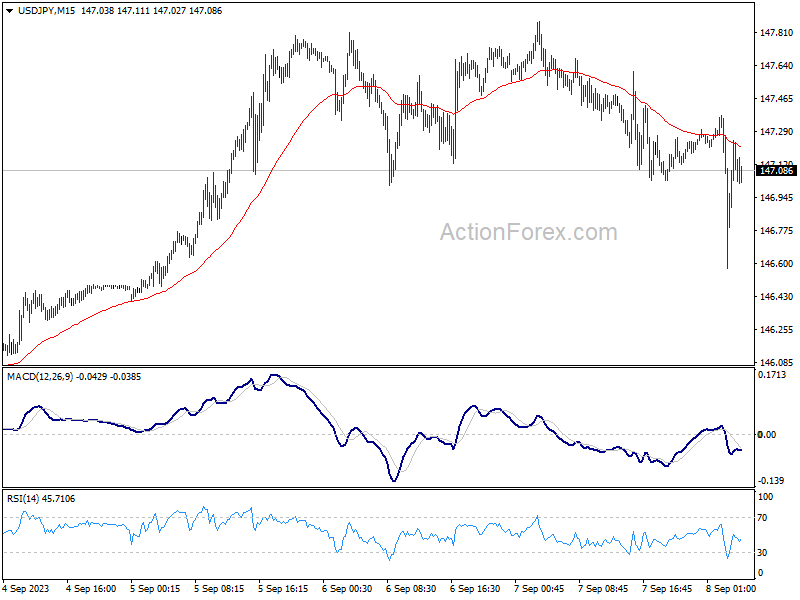
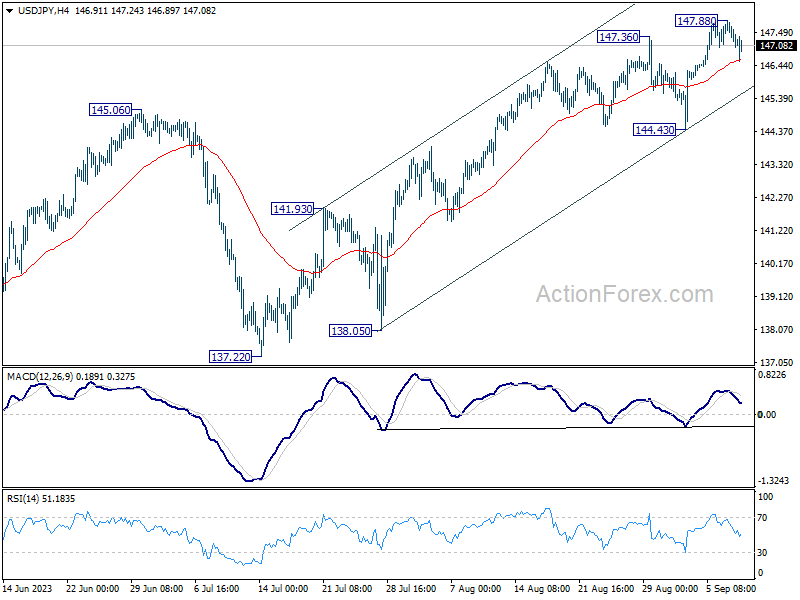
Following the minister's comments, USD/JPY spiked lower to 146.57, but it rapidly recuperated, reclaiming 147 handle shortly after. The current downturn from 147.88 is perceived as a short-term correction as of now. 55 4H EMA is furnishing support at present, with no overt signs pointing towards a trend reversal in the USD/JPY just yet.
USD/JPY Could Correct Gains But Dips Might Be Limited
Key Highlights
- USD/JPY climbed toward 147.80 before the bears appeared.
- Many key supports are forming near 146.55 and 146.15 on the 4-hour chart.
- EUR/USD extended losses and traded below 1.0720.
- GBP/USD took a major hit and traded below 1.2500.
USD/JPY Technical Analysis
The US Dollar remained in a positive zone above the 145.00 level against the Japanese Yen. USD/JPY traded above the 146.50 and 147.00 levels to move further into a positive zone.
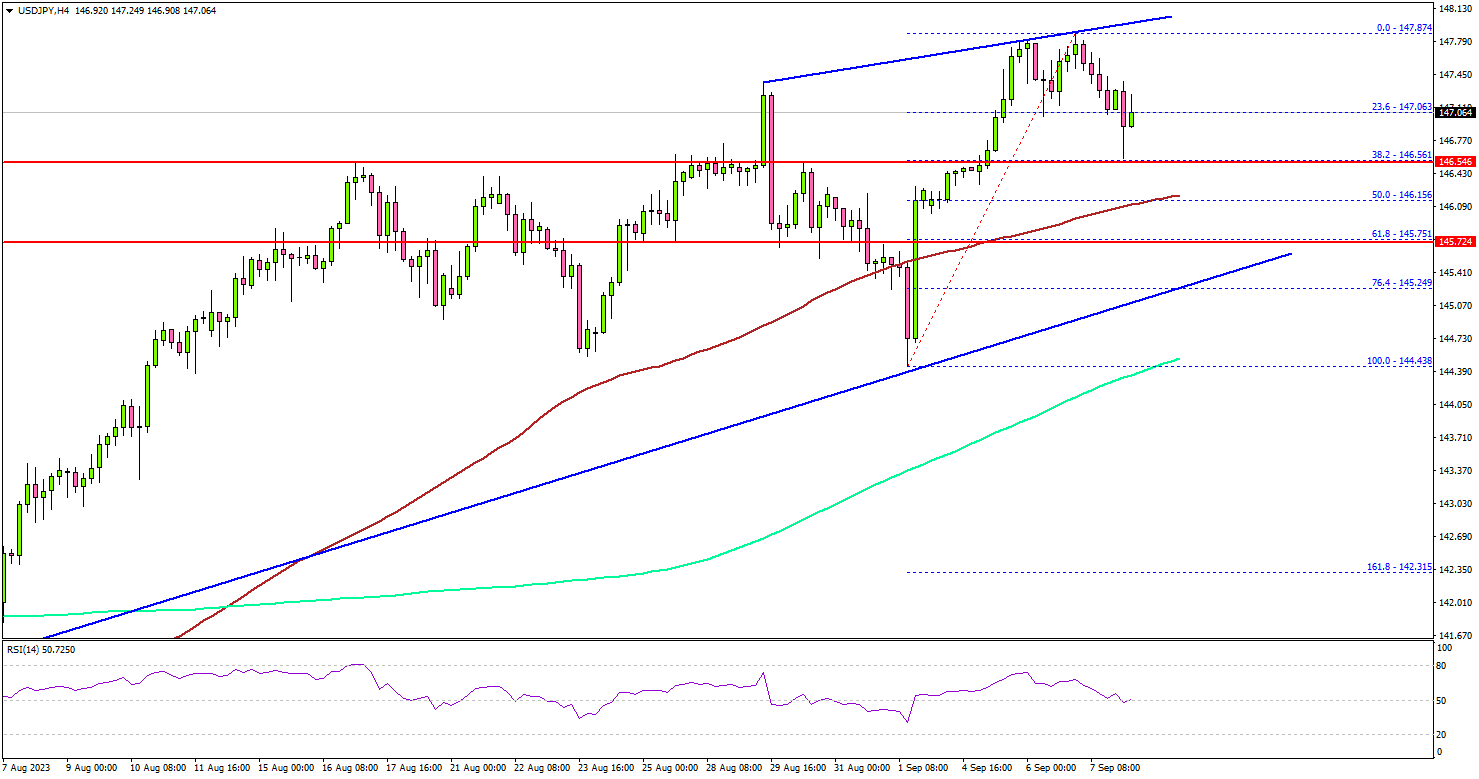
Looking at the 4-hour chart, the pair settled above 147.00, the 100 simple moving average (red, 4 hours), and the 200 simple moving average (green, 4 hours).
Finally, it faced resistance near the 147.85 zone. A high is formed near 147.87 and recently started a downside correction. On the downside, immediate support is near 146.75. The next key support is seen near the 146.55 level.
The first major support is near 146.15 and the 100 simple moving average (red, 4 hours). If there is a move below 146.15, the pair could dive toward 145.50. Any more losses might send the pair toward the 144.40 level and the 200 simple moving average (green, 4 hours).
On the upside, an initial resistance is near the 147.85 level. The first major resistance is near the 148.00 level. A close above 148.00 could start another decent increase.
In the stated case, the pair could rise toward the 149.20 level. Any more gains could send the pair toward the 130.00 handle.
Looking at EUR/USD, the pair remained in a bearish zone and there was an extended decline below the 1.0720 support.
Economic Releases
- Canada’s employment Change for August 2023 – Forecast 15K, versus -16.4K previous.
- Canada’s Unemployment Rate for August 2023 - Forecast 5.6%, versus 5.5% previous.
- US Wholesale Inventories for July 2023 (preliminary) – Forecast -0.1%, versus -0.1% previous.
Japan cash earnings growth slows to 1.3% yoy, real wages down for 16th month
In July, Japan experienced slowdown in growth of labor cash earnings, recording increase of 1.3% yoy, a figure notably below expectation of 2.4% yoy. This decline comes in the wake of a 2.3% yoy surge in June and a 2.9% yoy hike in May.
Drilling down into the details, while the base annual salary grew 1.6% yoy, outpacing June's 1.3% yoy rise, overtime pay experienced a reduced uplift of 0.5% yoy, a significant deceleration from the 1.9% yoy in June.
One of the more concerning revelations is the continued drop in real wages, which adjusted for inflation, decreased by -2.5% yoy, a deepening from June's -1.6% yoy decline. This marks the 16th consecutive month of falling real wages, spotlighting inability of salaries to keep pace with escalating prices, thereby exacerbating the financial strain on households.
Corroborating this trend is separate data published earlier this week which highlighted a pronounced drop in household spending in July, plummeting -5.0% yoy, marking its most substantial decline in close to two and a half years.
Fed Logan: Skipping in Sep does not imply stopping
Dallas Fed President Lorie Logan remains unconvinced that the central bank has fully "extinguished excess inflation", and "there is work left to do."
With the upcoming FOMC meeting slated for September 19-20, Logan noted "another skip could be appropriate." However, she was quick to add that "skipping does not imply stopping," suggesting that further policy actions might still be on the table.
Logan expressed a consciousness of the dual risks presented at this junction: the peril of sustained high inflation and the danger of dampening the economy too much.
With this in mind, she emphasized, "In coming months, further evaluation of the data and outlook could confirm that we need to do more to extinguish inflation."
Fed Goolsbee foresees change in rate debate focus
Chicago Fed President Austan Goolsbee expressed a cautious optimism in an interview with Marketplace Radio yesterday, noting that the focal point of discussions surrounding interest rates might soon shift.
Goolsbee acknowledged "overall level of inflation is still above where we want to be." Despite the circumstances, he demonstrated a semblance of confidence that "There's a growing confidence that we can pull it off."
However, he asserted that the achievement wasn't set in stone, adding a note of caution: "that's not a guarantee."
Goolsbee foresees a change in narrative in the coming times. Instead of deliberating on the scale of rate hikes, he envisaged that the discourse would gravitate towards the duration for which rates should be maintained at the established levels to steer the economy back on the desired path.
Putting it succinctly, he remarked, "We are very rapidly approaching the time when our argument is not going to be about how high should the rates go."
Elaborating on this, he stated, "it's going to be an argument of how long do we need to keep the rates at this position before we're sure that we're on the path back to the target."
Fed Williams: Still an open question as we go forward
New York Fed President John Williams, engaged in a discussion moderated by Bloomberg yesterday, where he noted that while is "pretty clear we're restrictive" on monetary policy, there remains "still an open question as we go forward."
Williams expressed optimism that "things are moving in the right direction and we've got policy in a good place." However, he insisted on the continuous need to be "data-dependent" and closely watch economic developments to make informed decisions regarding monetary policy trajectory.
He urged for sustained focus on comprehensive data analysis, stating, "We'll have to keep watching the data carefully analyzing all of that and really asking ourselves the question: is this sufficiently restrictive."
BoC Macklem concerned that inflation progress has slowed
BoC Governor Tiff Macklem said in a speech overnight that 2% inflation target is now in sight". However, he cautioned, "we are not there yet and we are concerned progress has slowed". Also, "monetary policy still has work to do".
In a bid to harmonize the potentially conflicting risks of "under- and over-tightening," BoC opted to hold policy rate at 5% this week. Macklem didn't rule out the possibility of further rate hike, mentioning that such a step might become necessary "if inflationary pressures persist."
As Canada navigates a period riddled with economic uncertainties, the central bank adopts a vigilant stance, closely monitoring an array of indicators to assess the trajectory of inflation. Macklem highlighted the multifaceted nature of the factors affecting inflation data month on month, distinguishing between temporary influences and those with a potential for a lasting impact.
CADCHF Wave Analysis
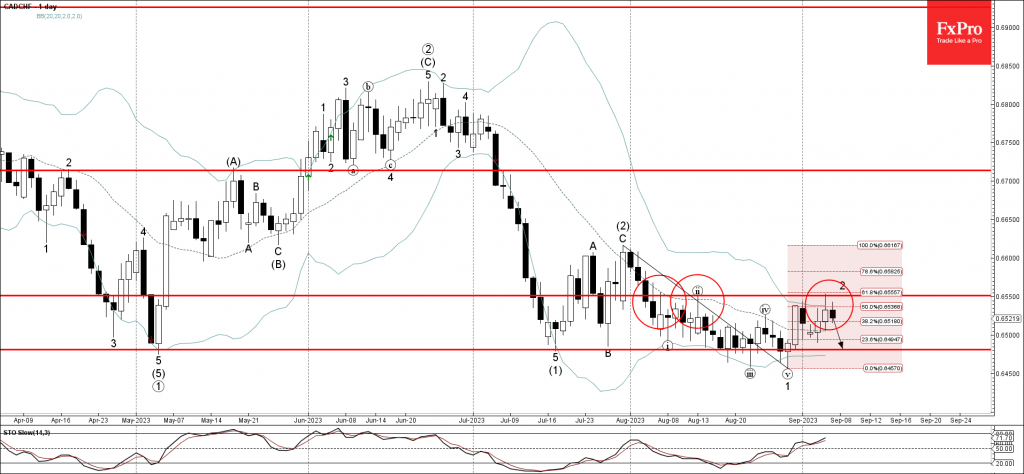
- CADCHF reversed from resistance level 0.6550
- Likely to fall to support level 0.6480
CADCHF currency pair recently reversed down from the pivotal resistance level 0.6550 (which has been repeatedly reversing the pair from the start of August), intersecting with the upper daily Bollinger Band and the 61.8% Fibonacci correction of the downward impulse from July.
The downward reversal from the resistance level 0.6550 stopped the previous short-term correction 2.
Given the strong daily downtrend, CADCHF can be expected to fall toward the next support level 0.6480 (which has been reversing the price from May).
GBPCAD Wave Analysis
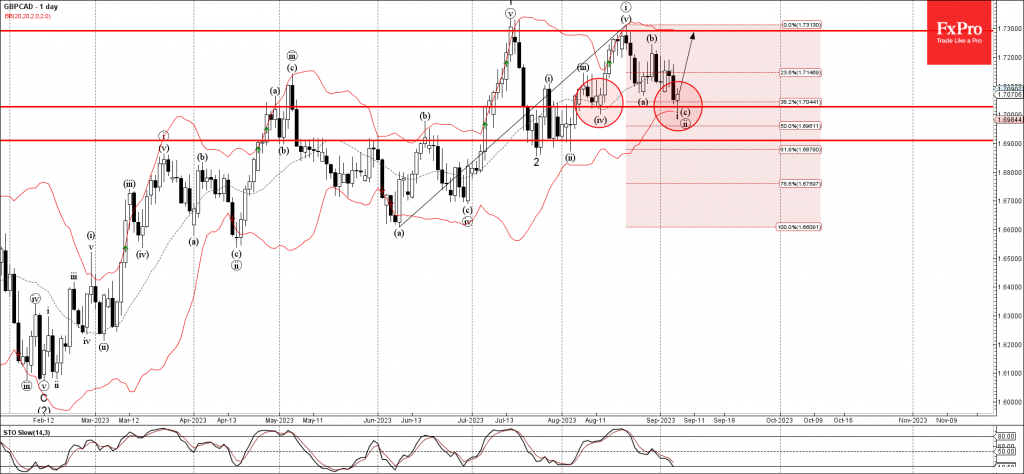
- GBPCAD reversed from key support level 1.7025
- Likely to rise to resistance level 1.7300
GBPCAD currency pair recently reversed up from the key support level 1.7025 (low of the previous minor correction iv), intersecting with the lower daily Bollinger Band.
The support level 1.7025 was strengthened by the 38.2% Fibonacci correction of the previous sharp upward impulse from June.
Given the clear daily uptrend, GBPCAD can be expected to rise toward the next resistance level 1.7300 (which reversed the previous waves 1 and i).
How Surging Oil Prices Impact The US Dollar
Recently, oil prices significantly increased, boosting the US Dollar. This matters because countries that don't export much oil deal with higher prices and slower economic growth. Due to this tricky situation, the US economy stands out as one of the largest oil exporters.
Oil skyrocketed because OPEC+ leaders decided to cut oil supplies until the end of 2023. Brent crude oil costs around $90 per barrel, and WTI crude is close to $86 per barrel, which we haven't seen since last November.
Many experts believe rising oil prices highlight the risk of stagflation worldwide, making the US Dollar stronger than G10 countries' currencies.
The US Dollar index is at its highest point since March 2023. At the same time, the Pound to Dollar exchange rate fell below 1.25, and the Euro to Dollar exchange rate almost reached 1.07.
Another factor pushing the US dollar higher is the relative economic strength of the US, especially in contrast to the ongoing softness in Europe and China.
If rising oil prices boost inflation again, the Federal Reserve will have no choice but to raise the key rate, supporting the greenback.
XBRUSD technical analysis
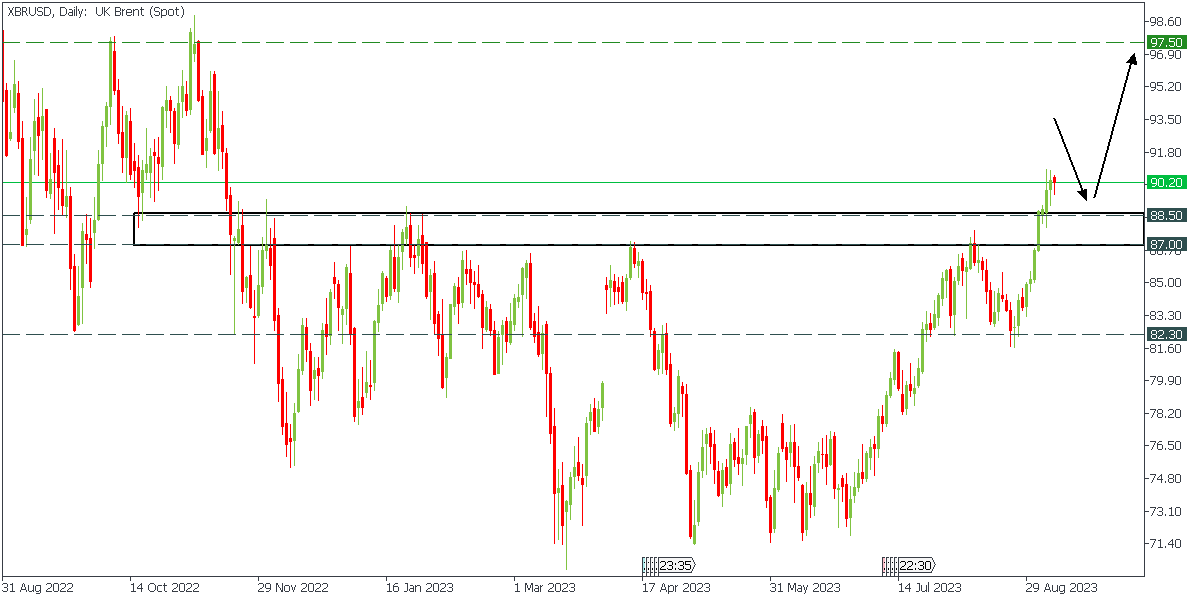
Recently, XBRUSD broke above the significant resistance range of 87.00 - 88.50, currently the major price’s support. Traders may look for buy opportunities on the retest of this area. The major target for XBRUSD remains at 97.50.
USDCAD technical analysis
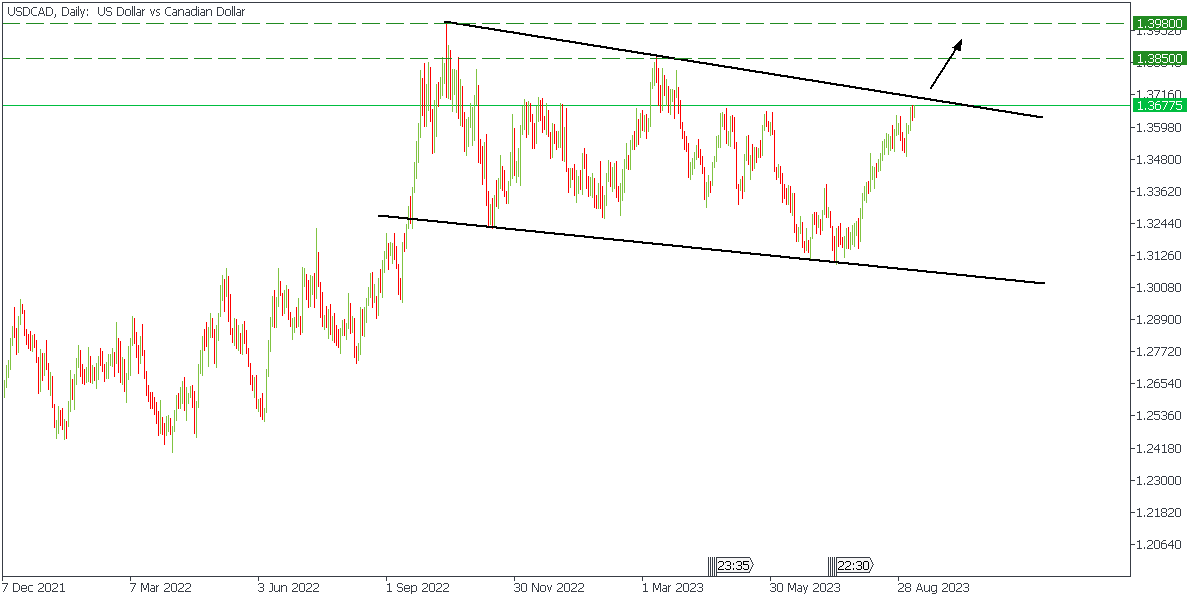
USDCAD has one of the most exciting trading setups among USD currency pairs. The price has formed a global bullish wedge, and an upcoming breakout is only a matter of time.
While Intraday traders may try to catch some short-term bounces off the resistance trendline. The overall sentiment is highly bullish. Therefore, opening buy trades after a breakout would be the best option. Middle-term targets for USDCAD are 1.3850 and 1.3980.