

Sample Category Title

AUD/USD Mid-Day Report

Daily Pivots: (S1) 0.6555; (P) 0.6574; (R1) 0.6593; More...

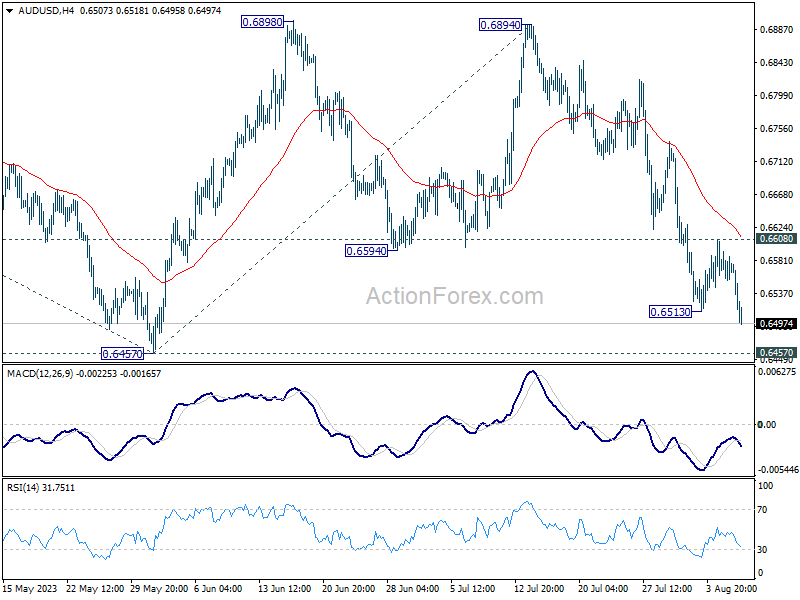
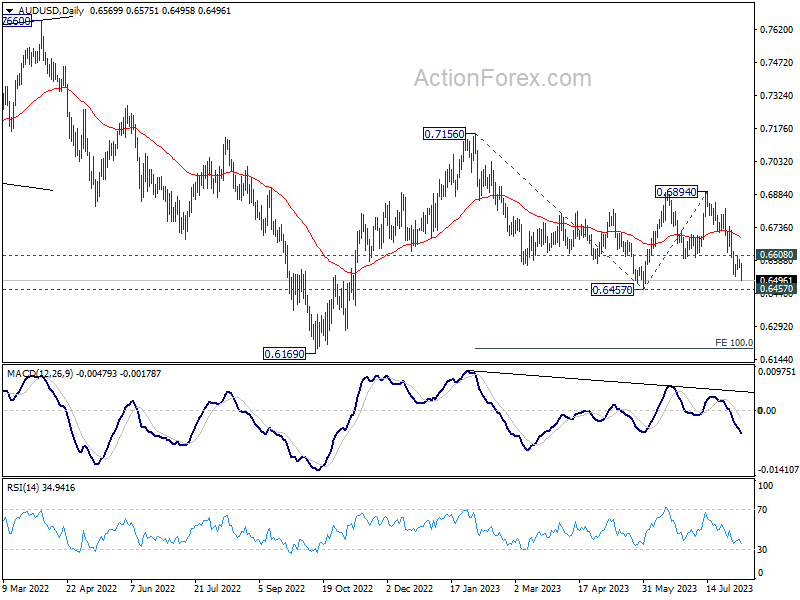
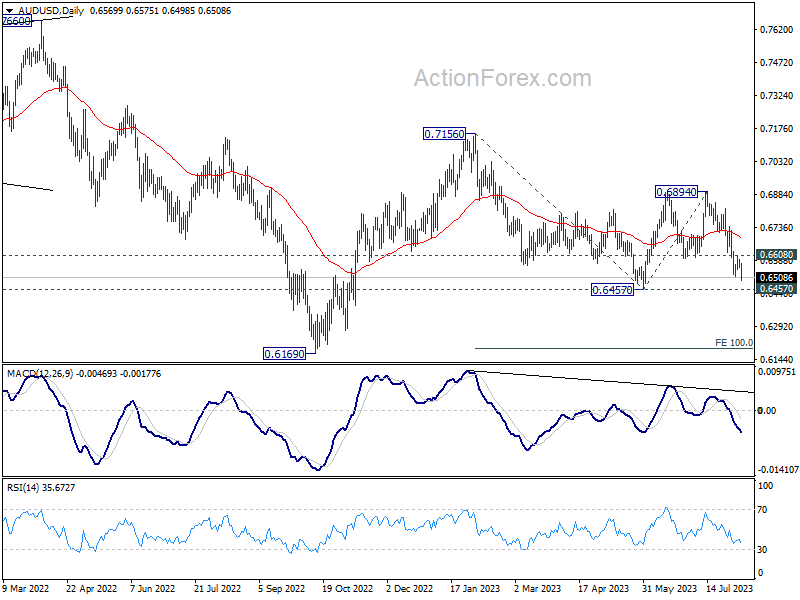
AUD/USD's fall from 0.6894 resumed by breaking through 0.6513 and intraday bias is back on the downside. Current development argues that larger fall from 0.7156 is still in progress. Firm break of 0.6457 support will confirm this case and target 100% projection of 0.7156 to 0.6457 from 0.6894 at 0.6195. For now, outlook will stays bearish as long as 0.6608 resistance holds, in case of recovery.

In the bigger picture, outlook is mixed for now as AUD/USD failed to sustain above both 55 D EMA (now at 0.6686) and 55 W EMA (now at 0.6769). On the upside, break of 0.6894 resistance will solidify the case that down trend from 0.8006 (2021 high) has already completed, and target 0.7156 resistance for confirmation. However, break of 0.6457 will likely resume the down trend through 0.6169 (2022 low).

USD/JPY Mid-Day Outlook

Daily Pivots: (S1) 141.81; (P) 142.19; (R1) 142.87; More...

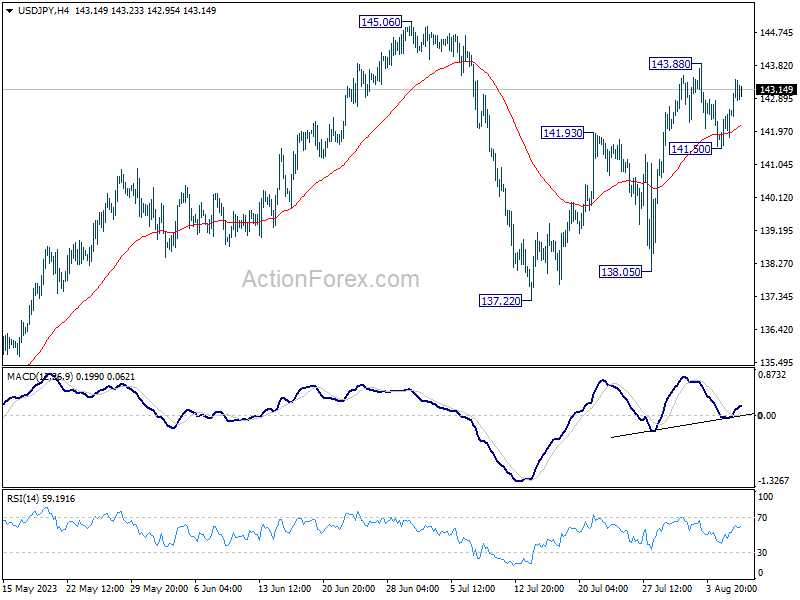
Intraday bias in USD/JPY remains neutral for the moment. On the upside, break of 143.88 will resume the rebound from 137.22 to retest 145.06. Decisive break there will resume whole rally from 127.20. On the downside, however, break of 141.50 will turn bias back to the downside for 55 D EMA (now at 140.60).

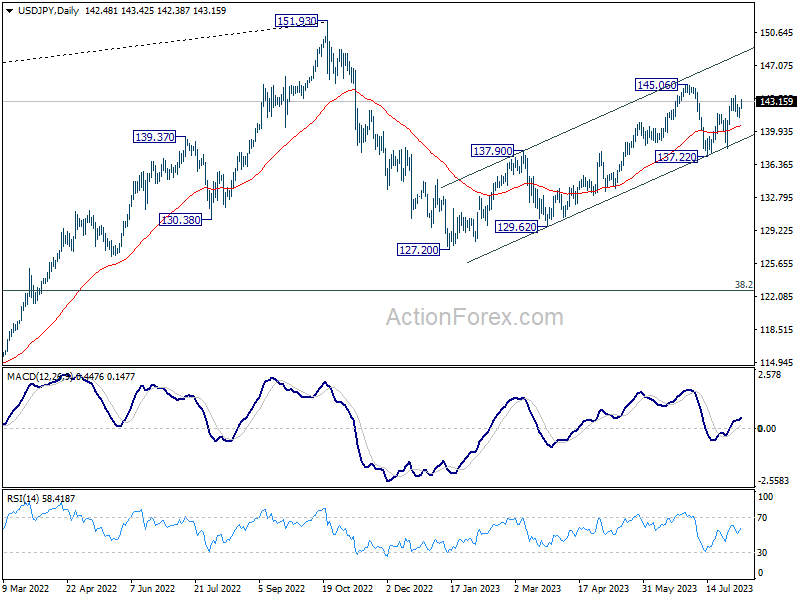
In the bigger picture, overall price actions from 151.93 (2022 high) are views as a corrective pattern. Rise from 127.20 is seen as the second leg of the pattern and could still be in progress. But even in case of extended rise, strong resistance should be seen from 151.93 to limit upside. Meanwhile, break of 137.22 support should confirm the start of the third leg to 127.20 (2023 low) and below.

USD/CHF Mid-Day Outlook

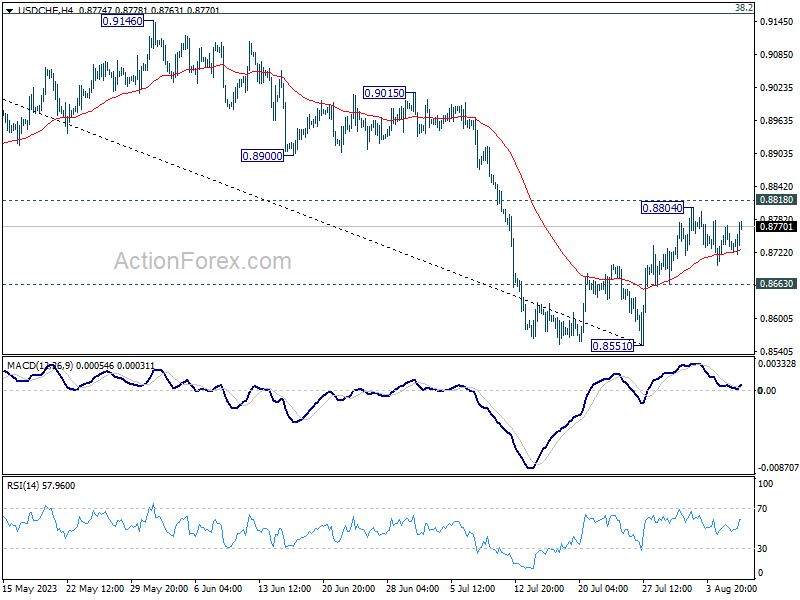
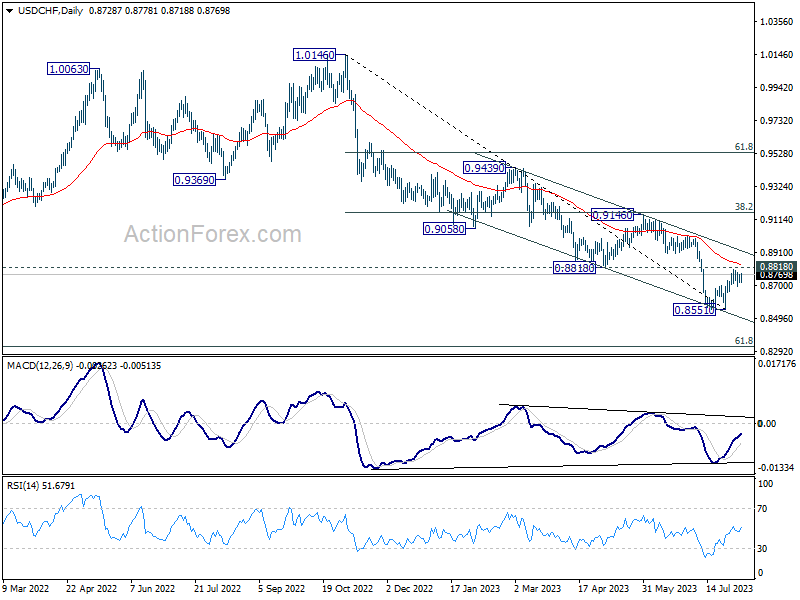
Daily Pivots: (S1) 0.8705; (P) 0.8740; (R1) 0.8763; More....

Range trading continues in USD/CHF and intraday bias stays neutral at this point. On the downside break of 0.8663 minor support should confirm rejection by 0.8818 and turn intraday bias back to the downside for retesting 0.8551 first. Nevertheless, decisive break of 0.8818 will carry larger bullish implication, and target 0.9146 cluster resistance next.

In the bigger picture, down trend from 1.0146 is seen as in progress as long as 0.8188 support turned resistance holds. Next target is 61.8% retracement of 0.7065 (2011 low) to 1.0342 (2016 high) at 0.8317. However, sustained break of 0.8818 should indicate medium term bottoming, and bring stronger rise back to 0.9146 cluster resistance (38.2% retracement of 1.0146 to 0.8551 at 0.9160), even as a correction.

GBP/USD Mid-Day Outlook

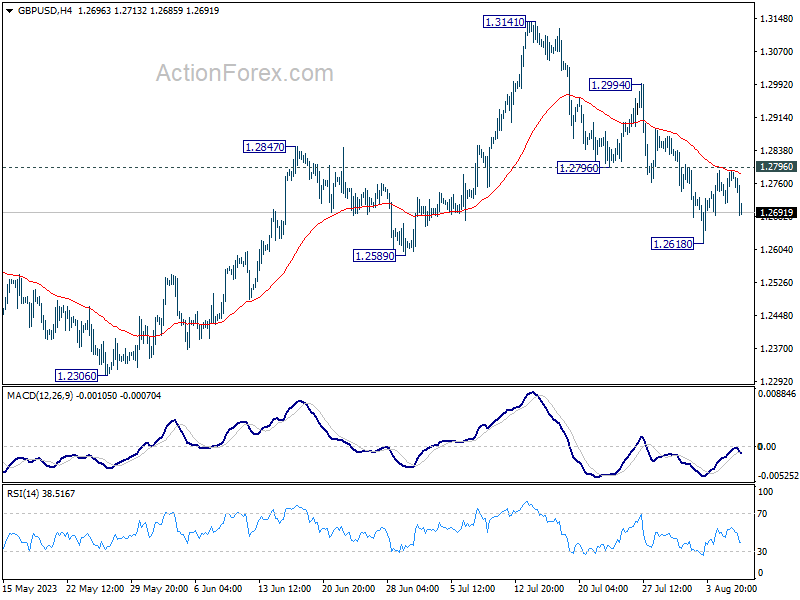
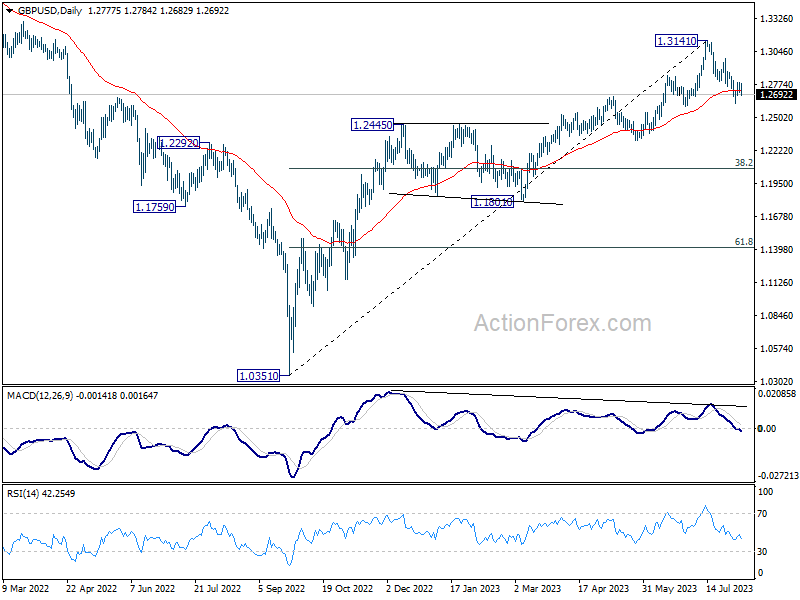
Daily Pivots: (S1) 1.2735; (P) 1.2762; (R1) 1.2811; More...

Intraday bias in GBP/USD is staying neutral for the moment. On the downside, below 1.2618, and sustained trading below 1.2678 resistance turned support will argue that it's already in a larger correction. Deeper decline would then be seen to 1.2306 support next. Nevertheless, firm break of 1.2796 will indicate that the pull back has completed, and turn bias back to the upside for stronger rebound.

In the bigger picture, a medium term top could be in place at 1.3141 already, on bearish divergence condition in D MACD. Sustained trading below 55 D EMA (now at 1.2726) should confirm this case, and bring deeper fall to 38.2% retracement of 1.0351 to 1.3141 at 1.2075, as a correction to up trend from 1.0351 (2022 low). For now, rise will stay mildly on the downside as long as 1.3141 resistance holds, in case of strong rebound.

EUR/USD Mid-Day Outlook

Daily Pivots: (S1) 1.0973; (P) 1.0995; (R1) 1.1026; More...

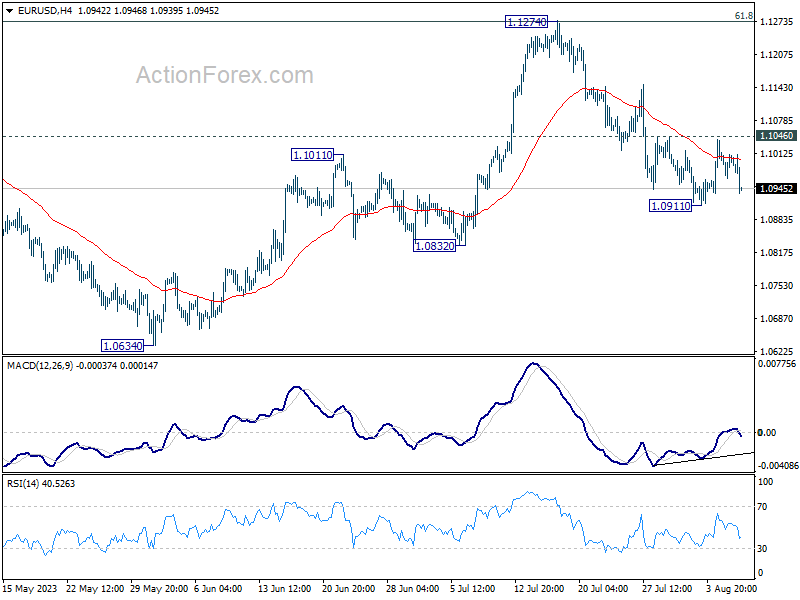
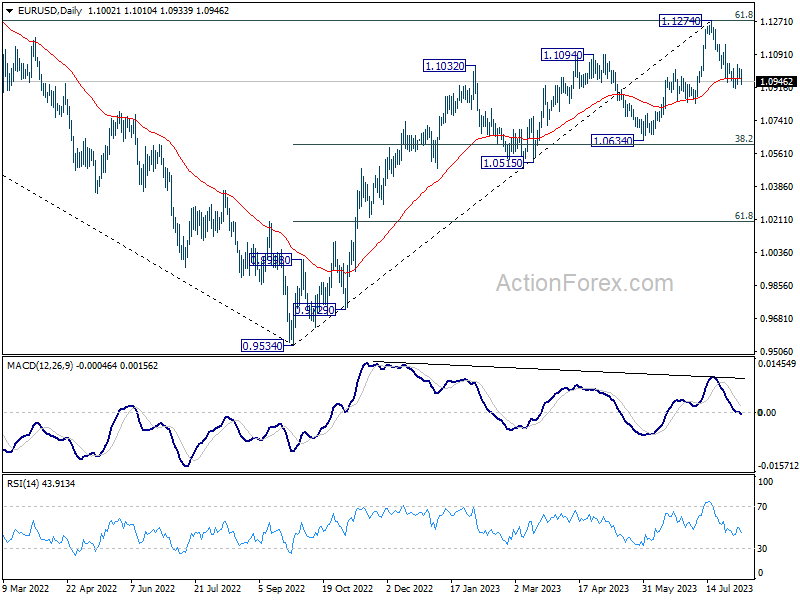
Intraday bias in EUR/USD stays neutral first and further decline is in favor. On the downside, break of 1.0911 will resume the fall from 1.1274 to 1.0832 support. Sustained trading below there will target 1.0609/34 cluster support. However, firm break of 1.1046 minor resistance will argue that pull back from 1.1274 has completed, and bring stronger rebound.

In the bigger picture, a medium term top could be formed at 1.1274, after failing to break through 61.8% retracement of 1.2348 (2021 high) to 0.9534 at 1.1273 decisively, on bearish divergence condition in D MACD. Sustained trading below 55 D EMA (now at 1.0966) will bring deeper correction to 1.0634 cluster support (38.2% retracement of 0.9534 to 1.1274 at 1.0609). Strong support could be seen there, at least on first attempt, to set the range for consolidation.

Dollar Jumps as Moody’s Bank Rating Cuts Spark Risk Selloff

Dollar is surging broadly in early US session as risk aversion appears to be intensifying slightly. The appears to be a reaction to Moody's cut the credit ratings of a host of small and mid-sized U.S. banks late Monday, and changed its outlook to negative for 11 banks. 10-year yield sinks below 4% handle on safe haven too. Yen reversed earlier losses on risk aversion, and follows the greenback as the second strongest, and then Swiss Franc.

Commodity currencies are the worst performances. Aussie's selloff started earlier today on poor China trade data, and the decline is accelerating on risk-off sentiment in early US session. Kiwi and Loonie are following closely. Euro and Sterling are mixed for now but start to look vulnerable against the greenback.

Technically, AUD/USD's decline form 0.6894 resumes today by breaking through last week's low at 0.6513. Retest of 0.6457 support could be seen soon. Firm break there will resume whole fall from 0.7156 towards 0.6169 low. In any case, outlook will now stay cautiously bearish as long as 0.6608 resistance holds. Let's seen if Thursday's US CPI would trigger the downside breakout.

In Europe, at the time of writing, FTSE is down -0.60%. DAX is down -1.24%. CAC is down -0.96%. Germany 10-year yield is down -0.146 at 2.453. Earlier in Asia, Nikkei rose 0.38%. Hong Kong HSI dropped -1.81%. China Shanghai SSE dropped -0.25%. Singapore Strait Times rose 0.12%. Japan 10-year JGB yield dropped -0.0167 to 0.611.

Fed's Harker foresees stable rates and soft landing

Philadelphia Fed President Patrick Harker suggested a pause on rate changes in the coming months, emphasizing the importance of allowing current monetary policy measures to take effect.

He said today, "Absent any alarming new data between now and mid-September, I believe we may be at the point where we can be patient and hold rates steady and let the monetary policy actions we have taken do their work."

He also cautioned against expecting immediate rate reductions, noting, "The pandemic taught us to never say never, but I do not foresee any likely circumstance for an immediate easing of the policy rate."

Harker indicated that there might be a slight rise in the unemployment rate, which was most recently recorded at 3.5% in July, along with a deceleration in the GDP's growth rate.

Nonetheless, he remains optimistic, stating, "In sum, I expect only a modest slowdown in economic activity to go along with a slow but sure disinflation."

"I do see us on the flight path to the soft landing we all hope for and that has proved quite elusive in the past, he added.

ECB consumer survey: Easing inflation expectations, but waning spending optimism

In June ECB Consumer Expectations Survey, consumer concerns over inflation appear to be receding, with expectations for both short-term and three-year horizons declining. Despite steady views on income growth over the next year, there's a palpable decrease in optimism around consumer spending. Meanwhile, the outlook for economic growth sees a marginal uptick, albeit remaining muted.

Notably, consumers seem to be less concerned about rampant inflation. Expectations for inflation over the next 12 months have retreated, with mean prediction decreasing from 5.1% to 4.7%. Median inflation outlook for the same period experienced a steeper decline, shifting from 3.9% down to 3.4%. This downward trend also extends to longer-term predictions. Mean inflation expectations for a three-year horizon have decreased from 4.0% to 3.8%, while median expectations for the same period have edged down from 2.5% to 2.3%.

Consumer views on household income for the next 12 months remained steady, with both mean and median expectations unmoved at 1.2% and 0.1% respectively. However, there's growing pessimism concerning consumer spending. Expectations for mean household spending over the next year have slightly decreased from 3.5% to 3.4%, while median forecast has descended more markedly from 2.4% to 2.1%.

In terms of economic performance, consumers are marginally less bearish about near-term growth outlook. Mean expectation for economic growth over the next year has improved slightly from -0.7% to -0.6%, even though median remains unchanged at flat 0.0%. Interestingly, there were no alterations in consumer outlook for unemployment over the next year, with predictions holding steady.

Japan's wages growth and household spending miss expectations, supports ultra-loose BoJ

Today's wage growth data out of Japan came in softer than anticipated, reinforcing BoJ's position towards maintaining its ultra-loose monetary strategy. Furthermore, the consistent decline in real wages continues to weigh down consumer spending.

Nominal cash earnings for workers in June grew by only 2.3% yoy, missing the projected 3.0% yoy rise. This marks a deceleration from previous month's impressive 2.9% yoy – the most robust growth observed in nearly 30 years. Delving deeper, June's base salary advance was logged at 1.4% yoy, , also under May's 1.7% yoy .

Economists have previously estimated that wage increases of 3% or more are crucial to sustain consumer inflation above BoJ's 2% target.

Compounding concerns, real cash earnings continued their downward trajectory, recording a decline of -1.6% yoy, faring worse than the anticipated stasis at -0.9% yoy. This represents the 15th consecutive month of negative readings in this domain.

Furthermore, overall household spending for June saw a contraction of -4.2% yoy, veering further off the expected -3.5% yoy decline. This marks the fourth consecutive month of shrinking household spending.

These lackluster wage figures pose a challenge for the BoJ. As Governor Kazuo Ueda remarked, the trajectory of income trends is pivotal in determining the realistic prospects of accomplishing lasting inflation. Today's data lends credence to the BoJ's recent evaluation that consistently achieving price increments beyond 2% remains a distant goal. Consequently, the need to uphold its ultra-accommodative monetary parameters becomes ever more evident.

Australia's Consumer Sentiment down -0.4%, no lift from RBA pause

Australia's Westpac Consumer Sentiment Index for August indicated a slight decline, registering at 81, a drop of -0.4% mom from July's reading of 81.3. Westpac's analysis suggests that this decrease cements the prevailing pessimistic mood among consumers. Interestingly, RBA's decision to pause rate hikes did not notably influence this sentiment. The prevailing concerns about inflation continue to overshadow, although confidence in the job market did see a marginal improvement.

Regarding RBA's upcoming meeting on September 5, Westpac anticipates the central bank will maintain its current stance, leaving rates untouched at 4.1%. This cash rate is expected to be the zenith of this financial cycle. It is now up to incoming data and unfolding economic scenarios to present a compelling argument for further monetary tightening.

Westpac emphasized that for RBA to be prompted into action, any economic developments would need to be not just surprising, but also substantial, essentially posing a challenge to the bank's medium-term outlook.

Australia NAB business confidence rose to 2, inflationary pressures on the rise

Australia's NAB Business Confidence Index for July revealed an upward tick, moving from -1 in June to 2. However, Business Conditions saw a slight dip from 11 to 10. Delving into specific metrics, readings for trading conditions, profitability, and employment remained unchanged with the previous month, all settling at 16, 10, and 6 respectively.

Notably, the month saw a pronounced rise in price and cost growth. Labour cost growth surged to 3.7% in quarterly equivalent terms, up from June's 2.3%, and purchase cost growth escalated to 2.6%, a jump from the previous month's 2.2%. Furthermore, final price growth climbed to 2%, doubling June's 1%.

Commenting on the findings, NAB Chief Economist, Alan Oster, remarked, "Business conditions in July remained resilient and have largely held steady at above-average levels over the past few months."

He added, "While business confidence rebounded to positive territory, overall confidence remains muted."

Oster further noted the inflationary pressures highlighted by the survey, noting, "Despite the Q2 CPI release indicating an improvement, the survey underscores that the upward pressure on inflation remains significant."

China's exports down -14.5% yoy in Jul, shipments to ASEAN down -21.4% yoy

July saw a sharper-than-expected contraction in China's exports, with decline of -14.5% yoy to USD 281.76B. This marked the steepest drop since February 2020 and exceeded market expectations, which had forecasted a decline of -12.5% yoy. Concurrently, imports also took a hit, plunging by -12.4% yoy to USD 201.16B, much steeper than anticipated -5% yoy drop.

With these declines, China's trade surplus unexpectedly widened. July's figures show surplus expanding from USD 70.6B to USD 80.6B, surpassing the market forecast of USD 67.8B.

A key observation was the sharp decline in shipments to ASEAN – one of China's primary trade partners. Exports to ASEAN dropped by a significant -21.43% yoy in July, marking its second straight monthly decline. This is noteworthy as ASEAN had played a pivotal role in bolstering China's export sector earlier in the year.

In addition, exports to EU and US followed suit with declines of -20.62% yoy and -23.12% yoy, respectively. The dip in shipments to US represents a continued trend, with July marking the twelfth consecutive month of decline.

EUR/USD Mid-Day Outlook

Daily Pivots: (S1) 1.0973; (P) 1.0995; (R1) 1.1026; More...

Intraday bias in EUR/USD stays neutral first and further decline is in favor. On the downside, break of 1.0911 will resume the fall from 1.1274 to 1.0832 support. Sustained trading below there will target 1.0609/34 cluster support. However, firm break of 1.1046 minor resistance will argue that pull back from 1.1274 has completed, and bring stronger rebound.

In the bigger picture, a medium term top could be formed at 1.1274, after failing to break through 61.8% retracement of 1.2348 (2021 high) to 0.9534 at 1.1273 decisively, on bearish divergence condition in D MACD. Sustained trading below 55 D EMA (now at 1.0966) will bring deeper correction to 1.0634 cluster support (38.2% retracement of 0.9534 to 1.1274 at 1.0609). Strong support could be seen there, at least on first attempt, to set the range for consolidation.

Economic Indicators Update

GMT Ccy Events Actual Forecast Previous Revised
23:01 GBP BRC Like-For-Like Retail Sales Y/Y Jul 1.80% 3.00% 4.20%
23:30 JPY Labor Cash Earnings Y/Y Jun 2.30% 3.00% 2.50% 2.90%
23:30 JPY Overall Household Spending Y/Y Jun -4.20% -3.50% -4.00%
23:50 JPY Bank Lending Y/Y Jul 2.90% 3.10% 3.20%
23:50 JPY Current Account (JPY) Jun 2.35T 2.24T 1.70T
00:30 AUD Westpac Consumer Confidence Aug -0.40% 2.70%
01:30 AUD NAB Business Conditions Jul 10 9 11
01:30 AUD NAB Business Confidence Jul 2 0 -1
03:00 CNY Trade Balance (USD) Jul 80.6B 67.8B 70.6B
03:00 CNY Trade Balance (CNY) Jul 576B 470B 491B
05:00 JPY Eco Watchers Survey: Outlook Jul 54.4 54.5 53.6
06:00 EUR Germany CPI M/M Jul F 0.30% 0.30% 0.30%
06:00 EUR Germany CPI Y/Y Jul F 6.20% 6.20% 6.20%
06:45 EUR France Trade Balance (EUR) Jun -6.7B -8.0B -8.4B
10:00 USD NFIB Business Optimism Index Jul 91.9 90.6 91
12:30 USD Trade Balance (USD) Jun -65.5B -65.2B -69.0B -68.3B
12:30 CAD Trade Balance (CAD) Jun -3.7B -1.7B -3.4B -2.7B
14:00 USD Wholesale Inventories Jun F -0.30% -0.30%

Fed’s Harker foresees stable rates and soft landing

Philadelphia Fed President Patrick Harker suggested a pause on rate changes in the coming months, emphasizing the importance of allowing current monetary policy measures to take effect.

He said today, "Absent any alarming new data between now and mid-September, I believe we may be at the point where we can be patient and hold rates steady and let the monetary policy actions we have taken do their work."

He also cautioned against expecting immediate rate reductions, noting, "The pandemic taught us to never say never, but I do not foresee any likely circumstance for an immediate easing of the policy rate."

Harker indicated that there might be a slight rise in the unemployment rate, which was most recently recorded at 3.5% in July, along with a deceleration in the GDP's growth rate.

Nonetheless, he remains optimistic, stating, "In sum, I expect only a modest slowdown in economic activity to go along with a slow but sure disinflation."

"I do see us on the flight path to the soft landing we all hope for and that has proved quite elusive in the past, he added.


US CPI Could Define the Fed’s Next Hike

After the Fed said it would be data-dependent about its next rate decision, the latest economic figures have become much more likely to jolt the market. Last week's jobs numbers were a bit of a mixed bag, but Fed officials later said they were largely in line with expectations. That would somewhat imply that the Fed's view that another rate hike is still preserved.

Which means there is more weight being transferred to the upcoming CPI figures. If there is another miss like last time, the markets could be convinced that the Fed won't go through with its next hike. With more and more traders betting on a soft landing, this could bring risk appetite back. While that might not be good for the dollar, commodity currencies could get a boost.

But there is a flip side

This rosy outlook contradicts the views of economists, who are expecting inflation to tick back up when it's reported next Thursday. Part of this is due to "base effects", where the current rate is higher than the corresponding month last year. Thus, even if the inflation rate stayed the same (which is what economists are forecasting) last month, the annual rate will tick up.

Since the Fed cares more about the core rate than the headline rate, that's where the market could end up being disappointed. The latest reports show that wages in the US continue to grow at above a 4.0% rate, which puts pressure on the core inflation rate. On the other hand, the recent Manheim report showed the price of used cars fell in July, which could help bring down the core rate.

The second mandate in focus

Until recently, with inflation peaking above levels not seen in several decades, the Fed has been primarily focused on getting consumer price changes to behave. But with inflation around the 3.0% level, the Fed could switch its focus towards the jobs market. That means that if July's CPI figures are largely in line with expectations, it could still mean the Fed is lined up for a rate hike. The Fed could be moving to take on the labor market in order to bring down the core rate.

The other thing that could diminish the impact of Thursday's data is that there will be another round of CPI figures coming out in early September before the Fed meets on the 20th. That could present an opportunity for another change in direction, particularly if the data surprises investors.

What to look out for

US July headline inflation is expected to tick up to 3.1% from 3.0% prior. This makes it quite easy for the markets to be spooked, since that implies inflation is rising even faster. That could increase bets that the Fed will hike, even if the core rate comes in as expected. The rising price of gasoline over the last month due to higher crude prices could increase the risk of CPI beating expectations.

The core inflation rate for July is expected to stay steady at 4.8%. Almost 90% of traders expect another rate pause in September, but a move back above 5.0% could shake that consensus. On the other hand, a few more traders joining an already solid pause consensus is less likely to move the markets.

BTC/USD Price Analysis: ADX Indicator Falls to the Lowest Level of 2023

The latest news from the world of cryptocurrencies could be both bearish and bullish drivers:→ PayPal launches a stablecoin that will be pegged to the dollar and backed by US Treasuries;

→ Cathie Wood believes that the SEC can approve several BTC ETFs at the same time;

→ the Central Bank of Brazil plans to launch its digital currency called DREX in 2024;

→ rumors about problems with the USDC stablecoin are spreading in the network;

→ the US Department of Justice is considering filing fraud charges against Binance.

However, the BTC/USD rate has stabilized around USD 29,000 per coin since July 25th. The bitcoin market is showing unusually low volatility (except for the surge associated with news from the Fed). At the same time, the ADX indicator, which helps determine the presence of a trend, fell to its lowest level since 2023. Obviously, this indicates that the market is flat. But note the trend that followed in early 2023 as the ADX fell close to its current low
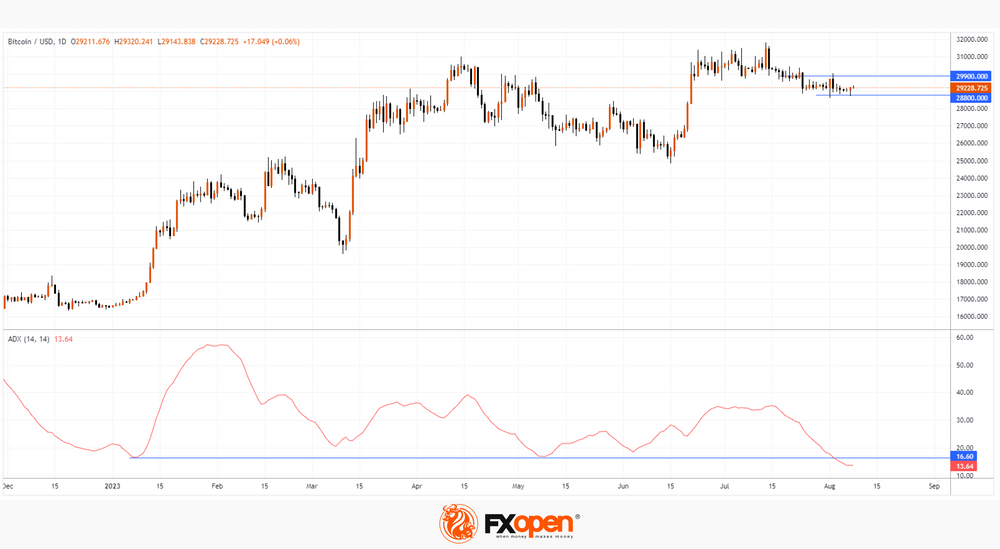
At the beginning of August, the BTC/USD rate was limited by the resistance level of 29,900 and the support level of 28,800. A breakdown of one of these levels can lead to the beginning of a strong trend against the backdrop of a low ADX value — this has happened more than once historically.

This article represents the opinion of the Companies operating under the FXOpen brand only. It is not to be construed as an offer, solicitation, or recommendation with respect to products and services provided by the Companies operating under the FXOpen brand, nor is it to be considered financial advice.
AUD/USD Maintains Bearish Trend on Disappointing China Data

  • China’s exports post worst plunge since February 2020
  • China’s imports from Australia fell 10.9% y/y, which was a major reversal from the 6.2% gain seen last month
  • Also adding pressure on AUD was PBOC fixing, which sent the yuan to weakest level in almost a month

Global economic recovery suffers major blow on China woes

Commodity currencies across the board tumbled after China’s trade data signaled global economic is in trouble over the short-term.  A steadily improving Chinese economic recovery has not occurred as the domestic economy remains very weak.  This economic report posted some of the weakest data points since early in the pandemic.

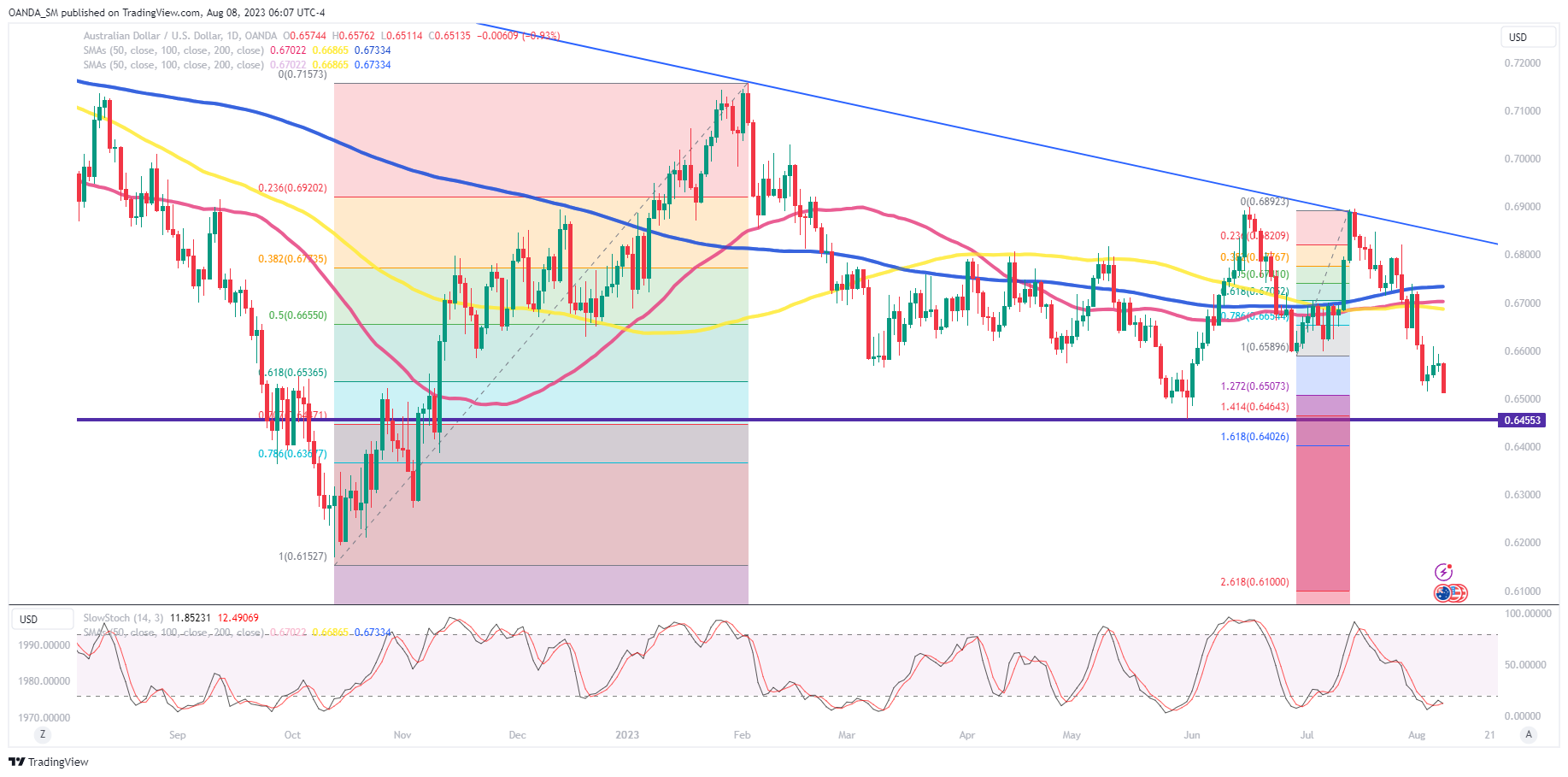
The Australian dollar is maintaining a clear bearish trajectory that has been in place over the past two weeks, since the double-top pattern formed around the 0.6895 level.

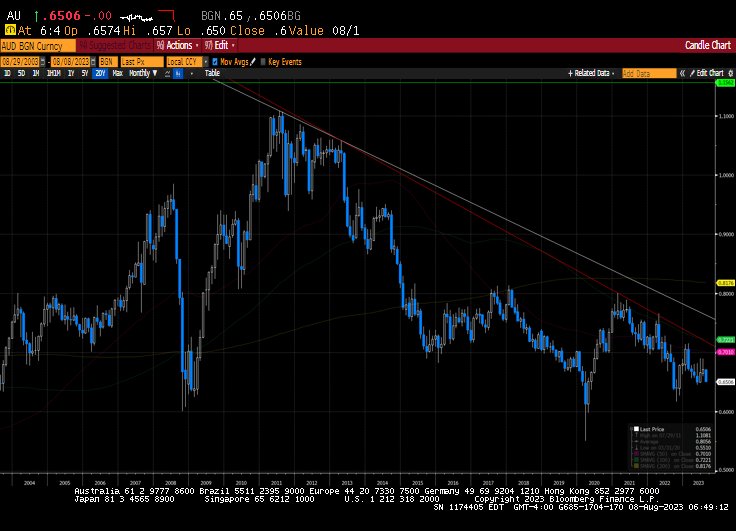
Supporting this bearish technical bias are the downward sloping trendlines that continue to be respected since early last decade.  The fundamentals were supposed to be turning around now but that won’t happen as the world’s second largest economy struggles to gain any momentum.  Adding to China’s woes is struggling property sector, which should keep the pressure to deliver more stimulus. Banking sector fears are back again and if Country Garden, the biggest privately owned developer in China goes down, that could trigger a crisis in confidence for the property sector.

In the event that AUD/USD sees further downside that breaks below the 0.6450 level, a continuation of the downward trend could initially target 0.6402, with key residing at the 0.6370 level. If risk appetite stabilizes and the Australian currency rebounds, major resistance resides at the 0.6700 level.

The New Zealand dollar also tumbled, down 0.90%, while the Canadian dollar weakened by 0.56%.