

Sample Category Title
AUD/NZD dips after RBA, but holding above 1.0795 temp low
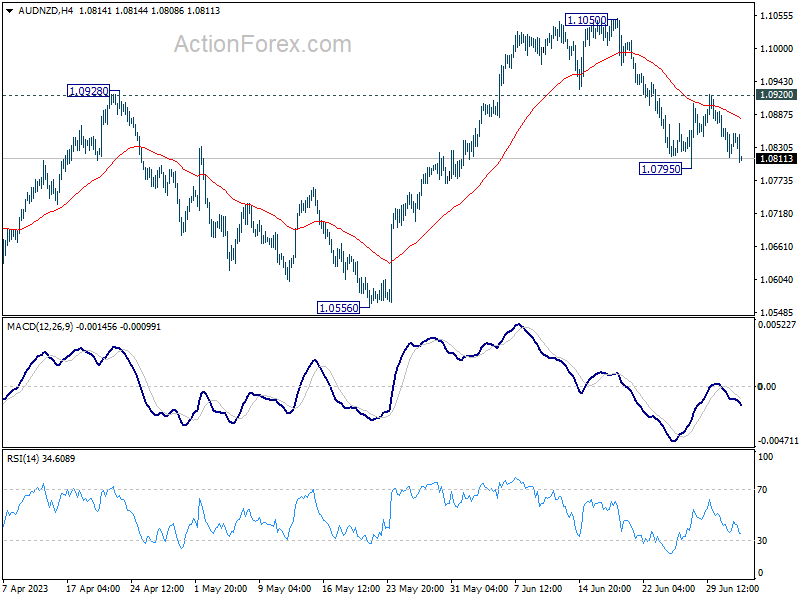
Australian Dollar dips broadly after RBA's hold, but loss is so far limited. AUD/NZD is staying above 1.0795 temporary low for now, even though near term bearish bias is maintained after prior rejection by 55 4H EMA.
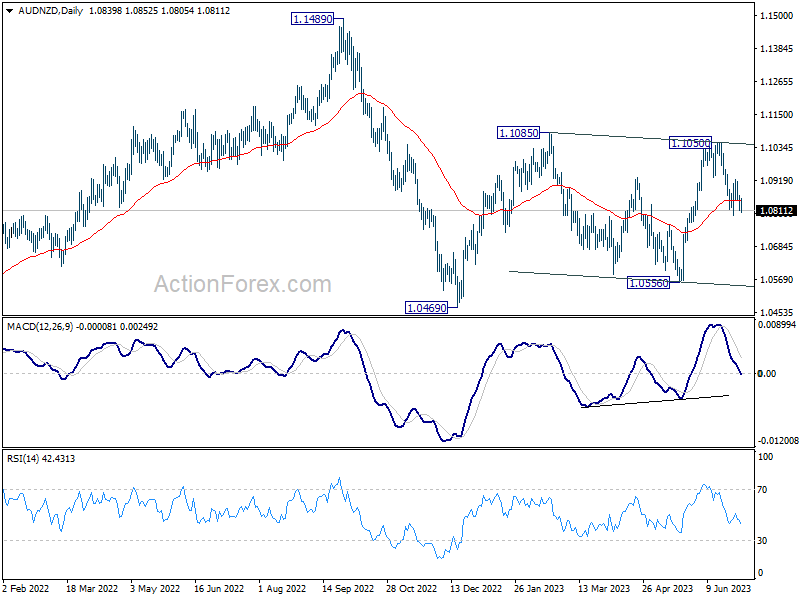
Current fall in AUD/NZD from 1.1050 is seen as the third leg of the pattern from 1.1085 for now. Deeper decline is expected as long as 1.0920 resistance holds. Break of 1.0795 will target 1.0056 support and possibly below. But in that case, buying should emerge above 1.0469 support to finish the fall from 1.1050, as well as the pattern from 1.1085.
RBA holds cash rate steady, further tightening may be in the offing
RBA keeps cash rate target at 4.10% today, leaving room for further evaluation of the economic landscape. However, the central bank's statement hinted at the possible need for further tightening of monetary policy in the future.
The statement noted, "Some further tightening of monetary policy may be required to ensure that inflation returns to target in a reasonable timeframe," with the stipulation that this would be dependent on how the economy and inflation evolve.
The bank justifies its decision to keep rates unchanged, stating it "provides the Board with more time to assess the state of the economy and the economic outlook and associated risks."
The statement highlighted concerns over the risk of persistent high inflation leading to broader increases in both prices and wages. This concern is heightened due to the limited spare capacity in the economy coupled with a very low unemployment rate.
In response to these potential inflationary pressures, RBA pledged vigilance, stating it "will continue to pay close attention to both the evolution of labour costs and the price-setting behaviour of firms."
(RBA) Statement by Philip Lowe, Governor: Monetary Policy Decision
At its meeting today, the Board decided to leave the cash rate target unchanged at 4.10 per cent and the interest rate paid on Exchange Settlement balances unchanged at 4.00 per cent.
Interest rates have been increased by 4 percentage points since May last year. The higher interest rates are working to establish a more sustainable balance between supply and demand in the economy and will continue to do so. In light of this and the uncertainty surrounding the economic outlook, the Board decided to hold interest rates steady this month. This will provide some time to assess the impact of the increase in interest rates to date and the economic outlook.
Inflation in Australia has passed its peak and the monthly CPI indicator for May showed a further decline. But inflation is still too high and will remain so for some time yet. High inflation makes life difficult for everyone and damages the functioning of the economy. It erodes the value of savings, hurts household budgets, makes it harder for businesses to plan and invest, and worsens income inequality. And if high inflation were to become entrenched in people's expectations, it would be very costly to reduce later, involving even higher interest rates and a larger rise in unemployment. For these reasons, the Board's priority is to return inflation to target within a reasonable timeframe.
Growth in the Australian economy has slowed and conditions in the labour market have eased, although they remain very tight. Firms report that labour shortages have lessened, yet job vacancies and advertisements are still at very high levels. Labour force participation is at a record high and the unemployment rate remains close to a 50-year low. Wages growth has picked up in response to the tight labour market and high inflation. At the aggregate level, wages growth is still consistent with the inflation target, provided that productivity growth picks up.
The Board remains alert to the risk that expectations of ongoing high inflation will contribute to larger increases in both prices and wages, especially given the limited spare capacity in the economy and the still very low rate of unemployment. Accordingly, it will continue to pay close attention to both the evolution of labour costs and the price-setting behaviour of firms.
The Board is still expecting the economy to grow as inflation returns to the 2–3 per cent target range, but the path to achieving this balance is a narrow one. A significant source of uncertainty continues to be the outlook for household consumption. The combination of higher interest rates and cost-of-living pressures is leading to a substantial slowing in household spending. While housing prices are rising again and some households have substantial savings buffers, others are experiencing a painful squeeze on their finances. There are also uncertainties regarding the global economy, which is expected to grow at a below-average rate over the next couple of years.
Some further tightening of monetary policy may be required to ensure that inflation returns to target in a reasonable timeframe, but that will depend upon how the economy and inflation evolve. The decision to hold interest rates steady this month provides the Board with more time to assess the state of the economy and the economic outlook and associated risks. In making its decisions, the Board will continue to pay close attention to developments in the global economy, trends in household spending, and the forecasts for inflation and the labour market. The Board remains resolute in its determination to return inflation to target and will do what is necessary to achieve that.
GBP/USD Bulls Aim Fresh Increase To 1.2850
Key Highlights
- GBP/USD corrected lower and tested the 1.2600 support.
- A major bearish trend line is forming with resistance near 1.2715 on the 4-hour chart.
- Gold price is attempting a fresh increase toward the $1,945 resistance.
- The US ISM Manufacturing Index declined from 46.9 to 46.0 in June 2023.
GBP/USD Technical Analysis
The British Pound started a downside correction below the 1.2750 support against the US Dollar. GBP/USD even traded below the 1.2680 level before it found support.
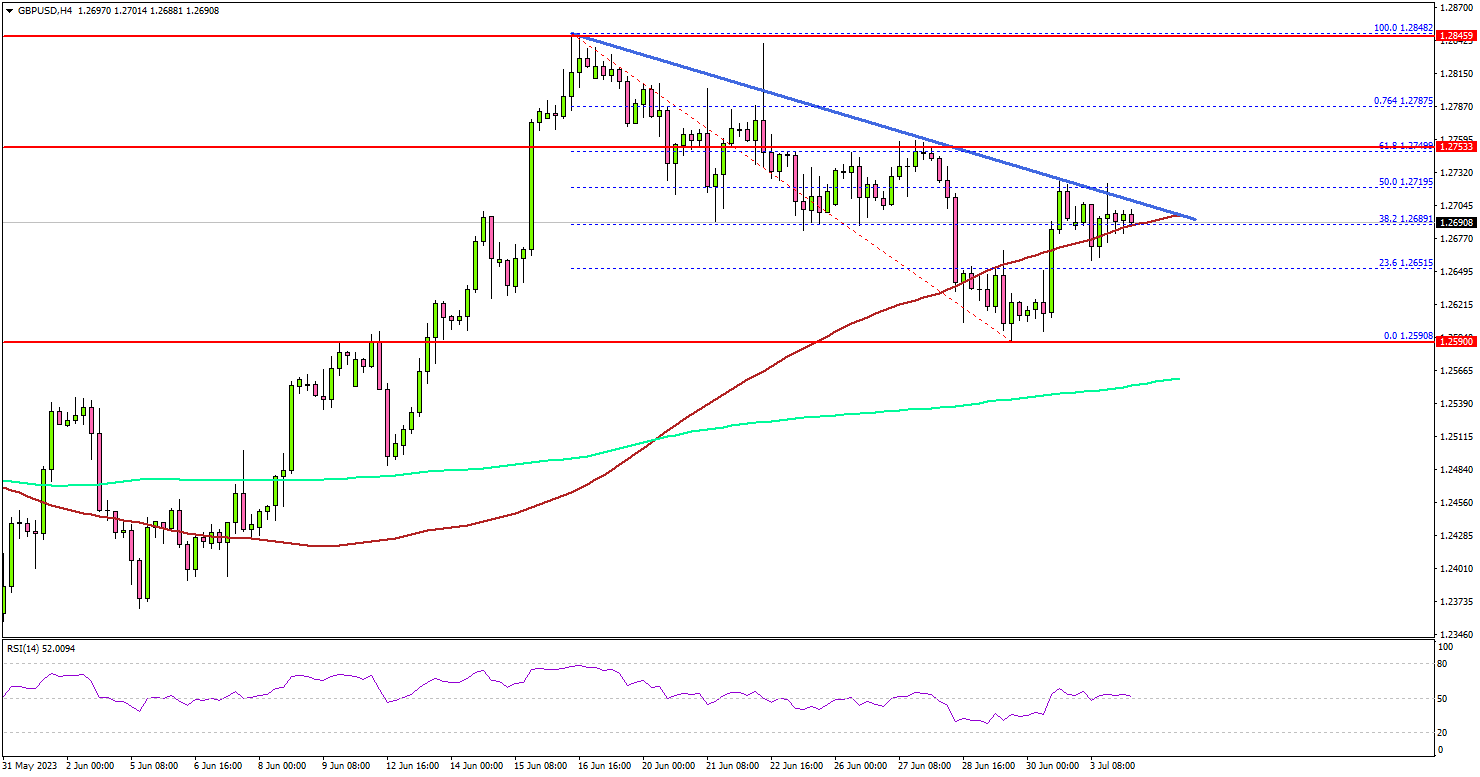
Looking at the 4-hour chart, the pair tested the 1.2600 support zone. It traded as low as 1.2590 and recently started a fresh increase. There was a move above the 1.2650 resistance zone and the 100 simple moving average (red, 4 hours).
It is also trading well above the 200 simple moving average (green, 4 hours). On the upside, the first major resistance is near 1.2720.
There is also a major bearish trend line forming with resistance near 1.2715 on the same chart. The trend line is close to the 50% Fib retracement level of the downward move from the 1.2848 swing high to the 1.2590 low.
If there is a move above the 1.2720 resistance, the pair could rise toward 1.2780. Any more gains might send GBP/USD toward the 1.2850 level.
Immediate support is near the 1.2650 level. The next major support is near the 1.2590 level. If there is a downside break below the 1.2590 support, the pair could decline toward the 1.2550 support and the 200 simple moving average (green, 4 hours).
Looking at EUR/USD, the pair is stable above the 1.0835 support and might start a move toward the 1.1000 resistance zone in the near term.
Economic Releases
- Germany’s Trade Balance for May 2023 - Forecast €17.0B, versus €18.4B previous.
AUD/USD Technical: Positive Momentum ahead of RBA
- AUD/USD rallied by 97 pips from last Thursday, 29 June low of 0.6593.
- Staged a minor bullish breakout ahead of RBA’s monetary policy decision today.
- Watch 0.6630 key short-term support to maintain the current bullish tone.
Since its 0.6593 minor low printed last Thursday, 29 June, the AUD/USD has managed to stage a rebound of 97 pips to print an intraday high of 0.6692 yesterday, 3 July ahead of Australia central bank, RBA’s monetary policy decision out later today at 0430 GMT.
The interest rates futures market has implied a reduction in the odds of a 25 basis points (bps) hike due to the recent softer-than-expected annualized monthly CPI data for May; 5.6% from 6.8% in April and below expectations of 6.1%. As of 3 July 2023, the ASX 30-day interbank cash rate futures has priced in a 16% chance of a 25 bps hike on the cash rate, down from a 53% chance that was priced two weeks ago on 16 June.
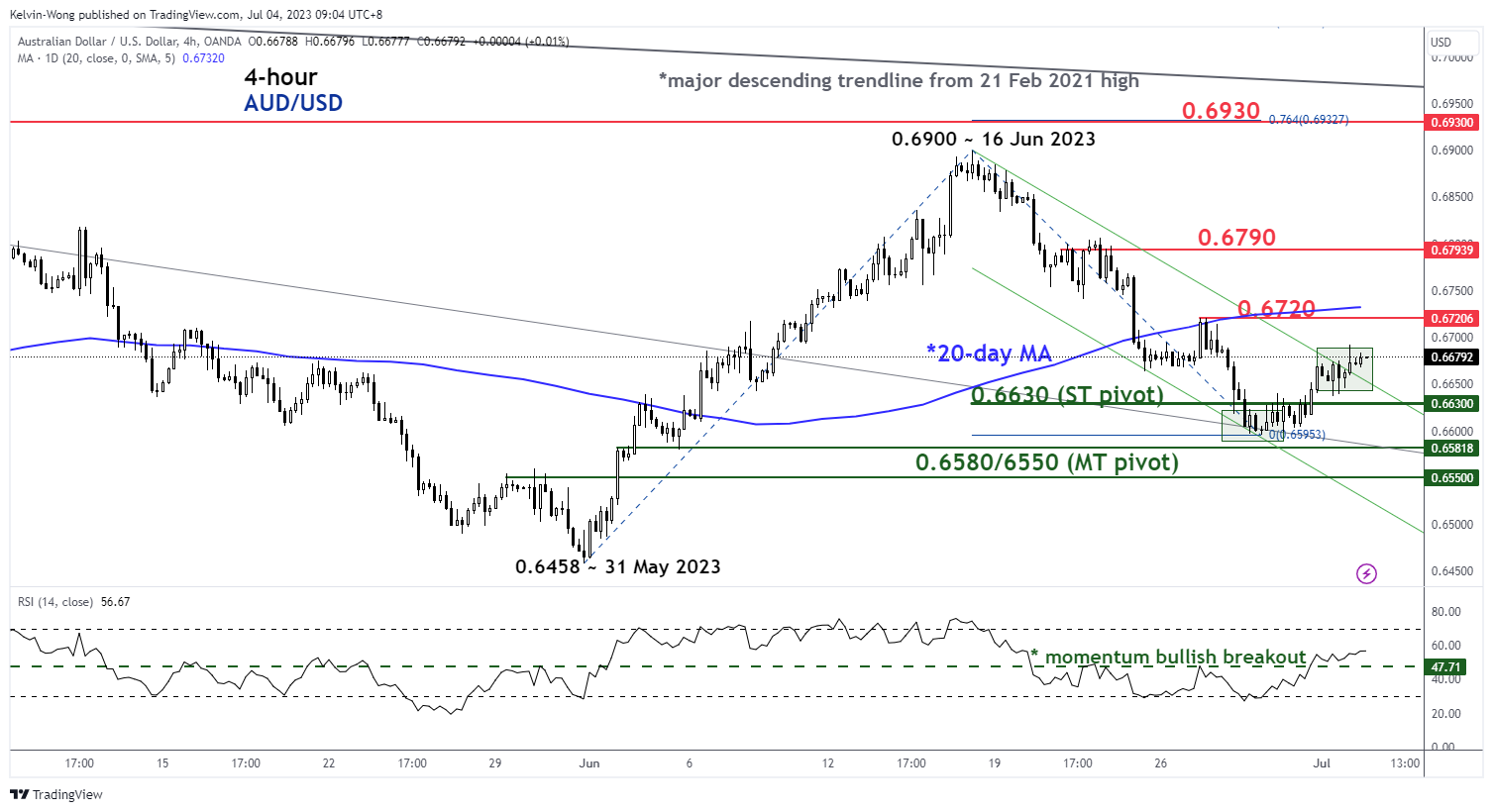
Fig 1: AUD/USD short-term trend as of 4 Jul 2023 (Source: TradingView, click to enlarge chart)
Minor bullish breakout
The AUD/USD has managed to exit from the upper limit of a minor descending channel that was in place since its 16 June 2023 high of 0.6900 now acting as a pull-back support at 0.6630.
This latest set of price actions has indicated that the minor downtrend phase from the 16 June 2023 high of 0.6900 to the 29 June 2023 low of 0.6593 is likely to have ended.
Short-term positive momentum has resurfaced
The hourly RSI oscillator has just broken above a corresponding resistance at the 47 level after it exited from its oversold region last Thursday 29 June.
Watch the 0.6690 short-term pivotal support (the pull-back of the former minor descending channel resistance & former minor swing high area of 29/30 June 2023) and clearance above 0.6790 (20-day moving average) sees the next resistance coming in at 0.6790.
However, failure to hold above 0.6630 negates the bullish tone to expose the 0.6580/6550 key medium-term pivotal support zone.
NZDCAD Wave Analysis
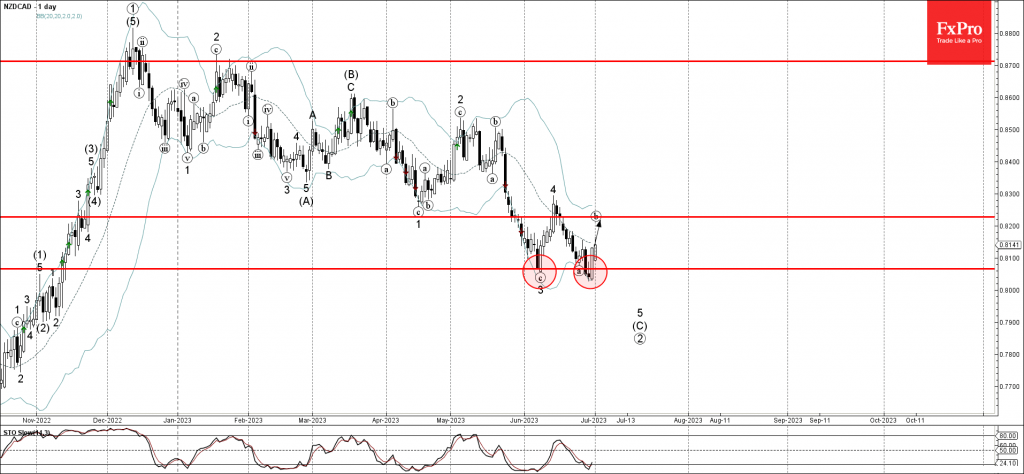
- NZDCAD reversed from strong support level 0.8065
- Likely to rise to resistance level 0.8230
NZDCAD currency pair recently reversed up with the daily Morning Star from the strong support level 0.8065 (low of the previous impulse wave 3) intersecting with the lower daily Bollinger Band.
The upward reversal from the support level 0.8065 started the (b)-wave of the active ABC correction (B) from the end of June.
Given the strength of the support level 0.8065, NZDCAD can be expected to rise further toward the next resistance level 0.8230 (target price for the completion of the active wave (b)).
GBP/USD Resumes Increase While EUR/GBP Faces Hurdle
GBP/USD jumped above the 1.2650 and 1.2690 resistance levels. EUR/GBP declined and now trading below the 0.8595 resistance.
Important Takeaways for GBP/USD and EUR/GBP Analysis Today
- The British Pound is trading in a bullish zone above 1.2650 against the US Dollar.
- There was a break above a key bearish trend line with resistance near 1.2650 on the hourly chart of GBP/USD at FXOpen.
- EUR/GBP started a fresh decline from the 0.8660 resistance zone.
- There is a major bearish trend line forming with resistance near 0.8595 on the hourly chart at FXOpen.
GBP/USD Technical Analysis
On the hourly chart of GBP/USD at FXOpen, the pair started a fresh increase from the 1.2600 support zone. The British Pound climbed above the 1.2650 resistance zone against the US Dollar.
The bulls were able to pump the pair above 1.2690 and the 50-hour simple moving average. The pair settled above the 61.8% Fib retracement level of the downward move from the 1.2759 swing high to the 1.2591 low.
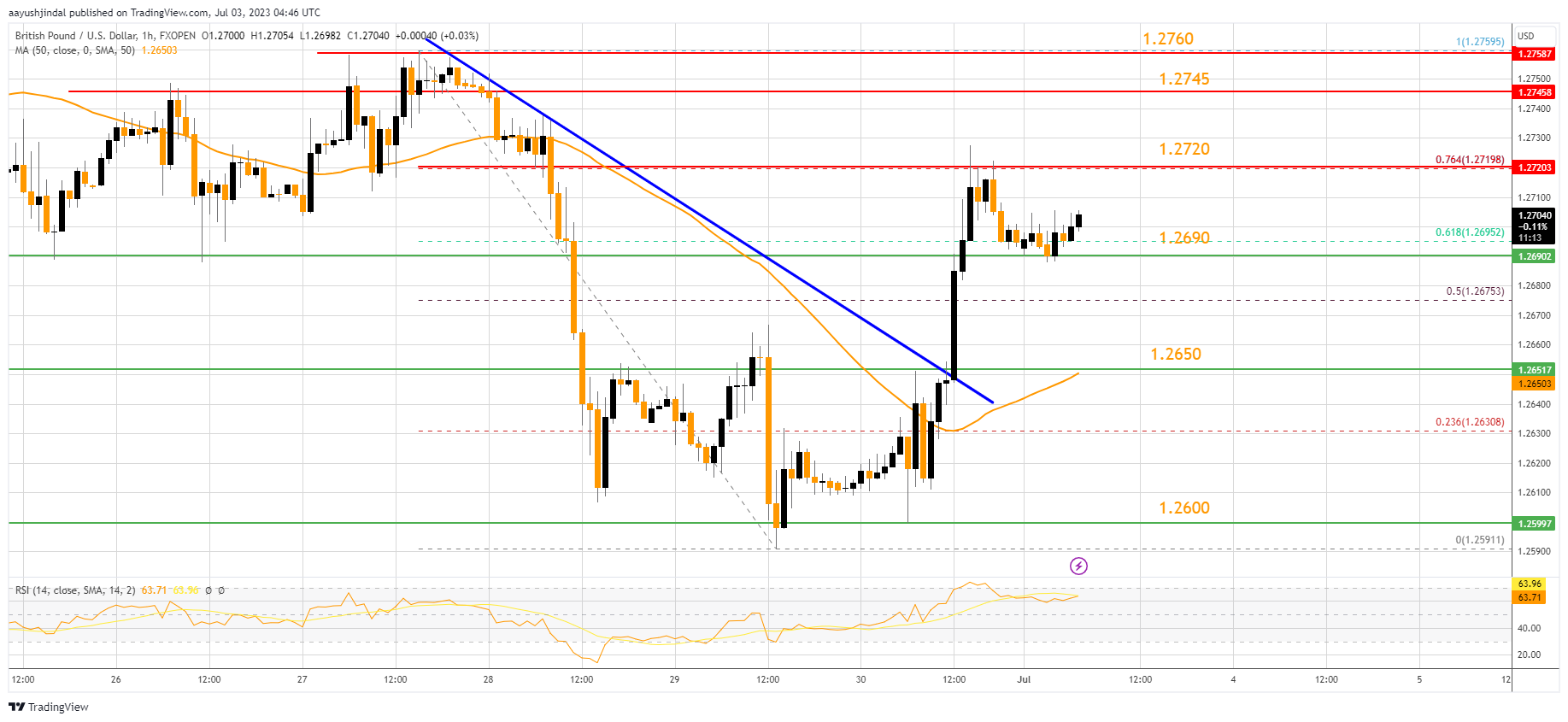
Finally, the pair climbed above 1.2700 but struggled to clear the 1.2720 resistance zone. The pair is now consolidating above 1.2690. The GBP/USD chart indicates that the pair is facing resistance near the 76.4% Fib retracement level of the downward move from the 1.2759 swing high to the 1.2591 low at 1.2720.
The next major resistance is near the 1.2745 level. If the RSI moves above 70 and the pair climbs above 1.2745, there could be another rally. In the stated case, the pair could rise toward the 1.2800 level or even 1.2840.
On the downside, there is a major support forming near the 50-hour simple moving average at 1.2650. If there is a downside break below the 1.2650 support, the pair could accelerate lower.
The next major support is near the 1.2600 zone, below which the pair could test 1.2550. Any more losses could lead the pair toward the 1.2500 support.
EUR/GBP Technical Analysis
On the hourly chart of EUR/GBP at FXOpen, the pair started a fresh decline from the 0.8660 resistance. The Euro traded below the 0.8620 support to move into a bearish zone against the British Pound.
The EUR/GBP chart suggests that the pair settled below the 50-hour simple moving average and 0.8595. A low is formed near 0.8576 and the pair is now consolidating losses. The RSI is attempting a recovery toward 50.
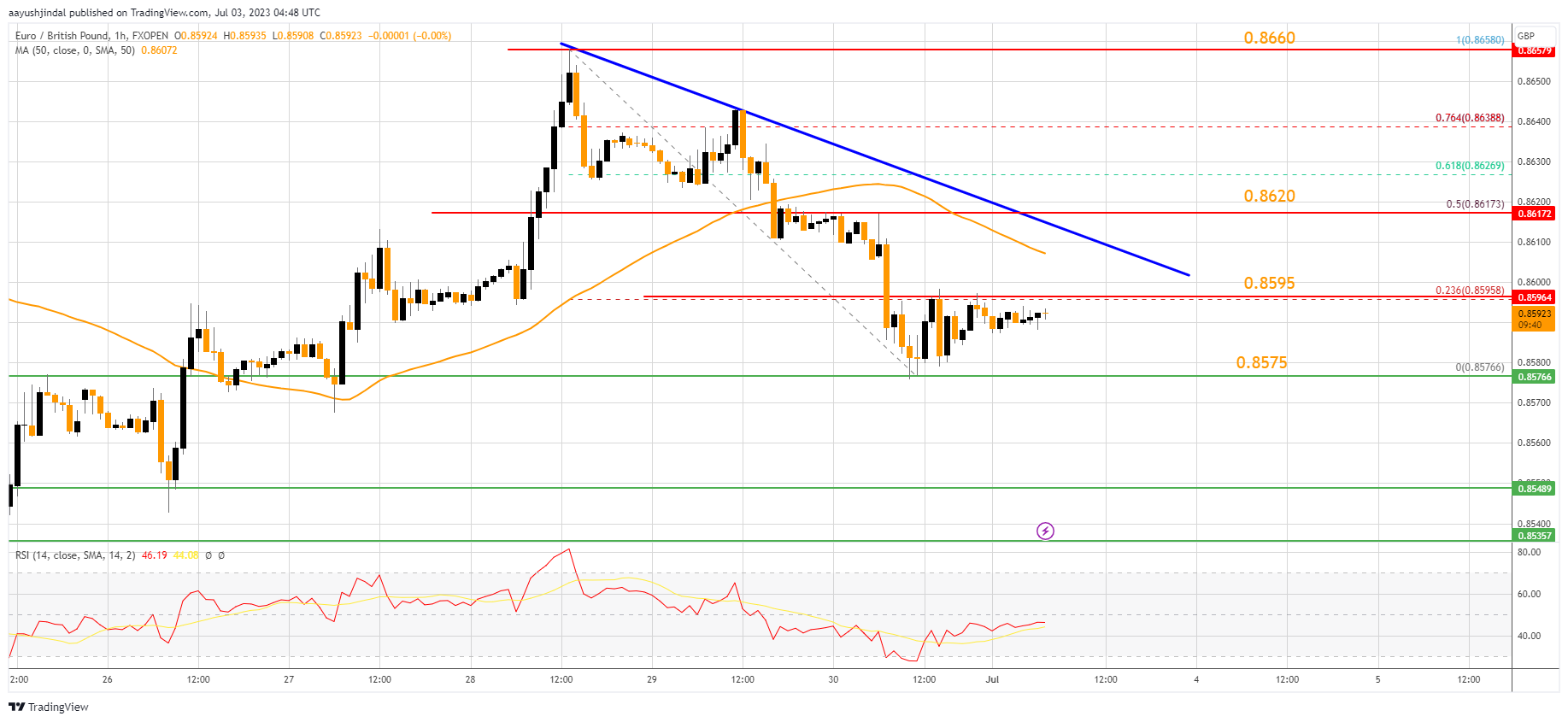
Immediate resistance is near a major bearish trend line at 0.8595. It coincides with the 23.6% Fib retracement level of the downward move from the 0.8658 swing high to the 0.8576 low.
The next major resistance for the bulls is near the 60% Fib retracement level of the downward move from the 0.8658 swing high to the 0.8576 low at 0.8620. A close above the 0.8620 level might accelerate gains.
In the stated case, the bulls may perhaps aim for a test of 0.8660. Any more gains might send the pair toward the 0.8720 level.
If there is no move above 0.8595, the pair could continue to move down. Immediate support sits at 0.8575. The next major support is near 0.8550. A downside break below the 0.8550 support might call for more downsides. In the stated case, the pair could drop toward the 0.8500 support level.
Crypto’s Bullish Calm
Market picture
Bitcoin closed last week at zero, failing to move meaningfully away from the $30K level on good news about spot ETF bids or terrible news about SEC claims against it. As a result, the exchange rate is stomping around $30.6K on Monday. Ethereum has added 4.3% in seven days, to $1960. Other leading altcoins from the top 10 are adding between 0.5% (XRP) and 25% (Solana).
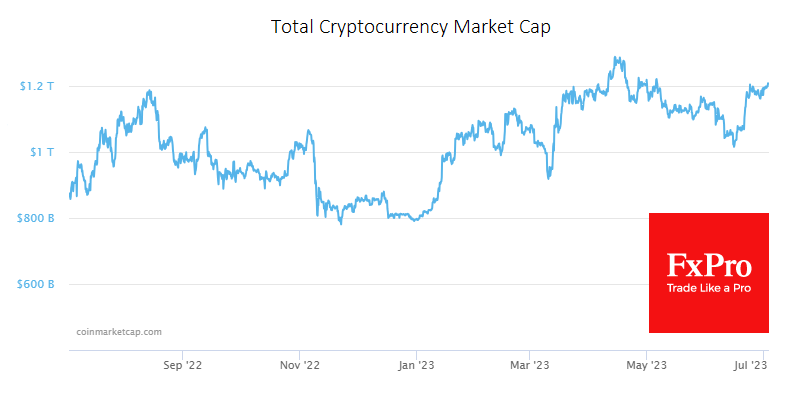 The total capitalisation of the crypto market, according to CoinMarketCap, rose 2.5% to $1.207 trillion for the week.
On the tech analysis side, Bitcoin has been consolidating in a sideways range for the past ten days, cooling off after jumping $5K up from local lows in June. Only a sustained step outside the $30-31K range would signal that the market has decided on a medium-term direction for a breakout. The long-term trend has been bullish since last November, within which severe drawdowns sometimes occur.
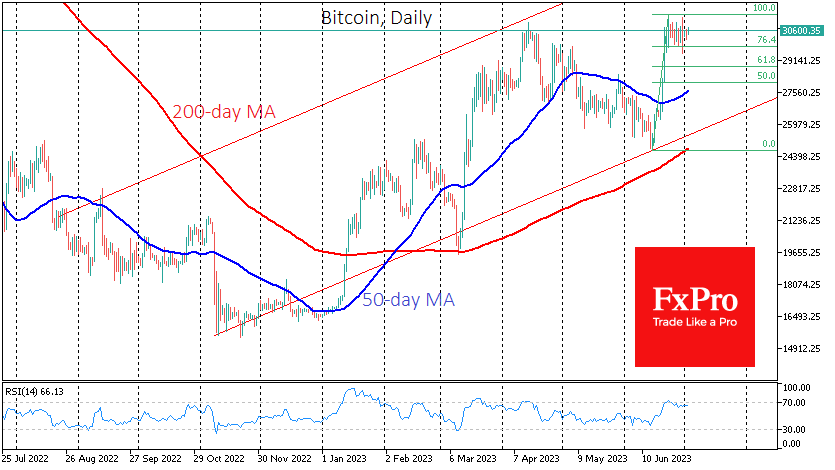
In terms of seasonality, July is considered quite successful for BTC. Over the past 12 years, bitcoin has ended the month up eight times and down four times. The average rise was 22.3%, and the average decline was 8.8%.
News background
Bitcoin rises predominantly during the US session thanks to institutional investors, K33 Research noted. It also expects growth to continue as BTC attracts major investors such as BlackRock, Fidelity, and Citadel. In addition, BTC has had little correlation with the stock market of late. The correlation has turned negative for the first time since January 2021.
Fred Thiel, CEO of mining company Marathon Digital, also noted the declining correlation between bitcoin and gold, which investors see as financial risk hedges.
Bids for spot bitcoin-ETFs from BlackRock, Fidelity and others have not been “clear and comprehensive” and have not included sufficient information regarding the so-called joint monitoring agreement or details of the mechanism; the SEC told the Nasdaq and CBOE exchanges, the Wall Street Journal reported citing sources. The CBOE plans to update and resubmit the documents.
Dollar Down Slightly after ISM Manufacturing, Aussie Awaits RBA
Dollar falls broadly after ISM Manufacturing index indciates further deterioration in the sector. But loss is so far limited. Overall markets remain quiet. Swiss Franc and Yen persist are the softer performers. The Franc felt slight impact of Swiss CPI readings, which were lower than anticipated. However, market reaction remains mild, considering SNB's prior forecast of slowing inflation in the current year. The central bank's concern primarily lies in the potential for a resurgence in inflation thereafter. Meanwhile, Euro, Sterling, and Canadian Dollar remain steady, bounded within the range defined by Friday's trading.
On the other side of the spectrum, Australian and New Zealand Dollars are showing minor strength. Volatility around Aussie is set to surge in the forthcoming Asian session as the market braces for RBA rate decision. It's a split verdict among market observers, who are equally divided on the likelihood of a rate hike or a pause by the central bank. With two market surprises already in its repertoire for this year, the RBA may not shy away from a third.
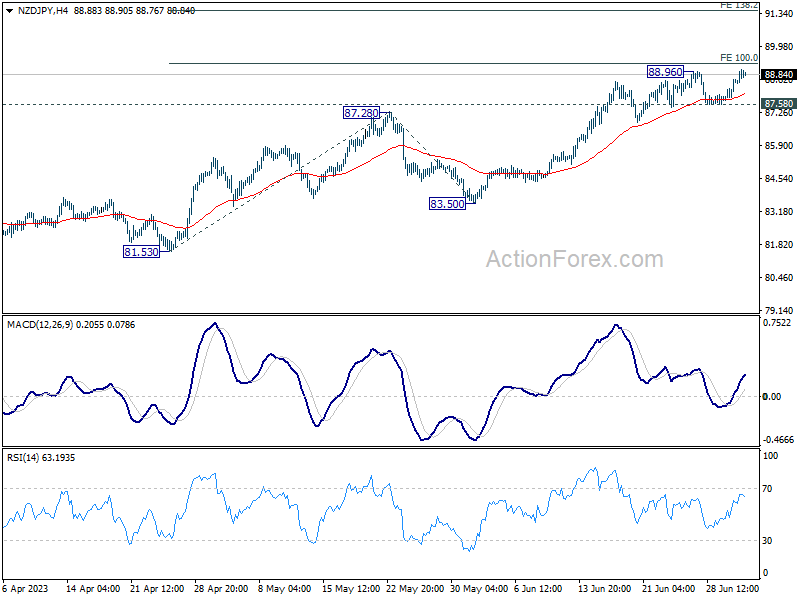
Technically, NZD/JPY is trying to resume recent rally by breaking through 88.96 resistance. But there's a big question on whether it could power through 100% projection of 81.53 to 87.28 from 83.50 at 89.25. Rejection by this projection level, followed by break of 87.58 support, should confirm short term topping, and even reversal. But decisive break there will pave the way to 138.2% projection at 91.44. The next move could hinge on reaction to RBA.
In Europe, at the time of writing, FTSE is down -0.04%. DAX is down -0.24%. CAC is down -0.07%. Germany 10-year yield is up 0.017 at 2.411. Earlier in Asia, Nikkei rose 1.70%. Hong Kong HSI rose 2.06%. China Shanghai SSE rose 1.31%. Singapore Strait Times is up 0.04%. Japan 10-year JGB yield is up 0.0068 at 0.406.
Bundesbank Nagel: ECB still has a way to go with tightening
Bundesbank President Joachim Nagel acknowledged the rising doubt and escalating criticism around the necessity for more rate hikes. Yet, he insisted on the need for further tightening. He attributed his stance to the robust health of the labour market and the positive growth in the economy.
"We still have a way to go," Nagel stated, referring to the ECB's inflation-fighting measures. "Monetary policy signals are clearly pointing in the direction of more tightening".
Furthermore, Nagel voiced his advocacy for the significant reduction of the Eurosystem's balance sheet in the forthcoming years, following its expansion due to massive bond purchases and bank loans.
Eurozone PMI manufacturing finalized at 43.4, reacting negatively to ECB hikes
The final Eurozone PMI Manufacturing reading for June marked a further descent to 43.4, compared to May's 44.8 - a slump to a low not seen in 37 months. The PMI Manufacturing Output Index also ended lower at 44.2, an 8-month low from May's 46.4.
The decline wasn't restricted to a single nation, but spread across several member states, demonstrating widespread economic pressure. Greece was a rare positive outlier, reaching a two-month high at 51.8. In contrast, Spain slid to a 6-month low at 48.0, while Ireland plummeted to a 37-month low at 47.3. France achieved a slight uptick to a 3-month high of 46.0, while Netherlands, Italy, and Germany dipped to 37- and 38-month lows. Austria reached the lowest level, falling to a 38-month low at 39.0.
Cyrus de la Rubia, Chief Economist at Hamburg Commercial Bank, articulated the stark economic picture: "Eurozone manufacturing production contracted for the third month in a row in June...with the rate of decline accelerating, pointing to a worsening of factory conditions."
He also pointed to the negative reaction of the capital-intensive industrial sector to the ECB's interest rate hikes. For the first time since January 2021, surveyed companies reported a reduction in their headcount. Additionally, purchasing activity declined at one of the most severe rates on record. As demand weakened and costs deflated rapidly, companies cut their sales prices for the second consecutive month.
On a slightly brighter note, de la Rubia noted the continued normalization of delivery times since February, but cautioned that material shortages remain a persisting issue.
UK PMI manufacturing finalized at 46.5, continued to report recessionary conditions
UK PMI Manufacturing was finalized at 46.5 in June, down from May's 47.1, a six-month low. S&P Global noted that output fell in intermediate and investment goods sectors. Input prices and output charges both fell.
Rob Dobson, Director at S&P Global Market Intelligence, said:
"The UK manufacturing sector continued to report recessionary conditions in June. The headline PMI dropped to a six-month low as output, new orders and employment all suffered further declines. Producers are being hit by weak domestic and export market conditions with clients showing a greater reluctance to commit to spending due to market uncertainty, increased competition and elevated costs. This is also impacting business optimism and stoking fears among some manufacturers that client spending may shift to lower cost rivals and markets.
"Although some respite is being offered in the short-term by reduced pressures on supply chains and costs, these remain a symptom of the current weakness of demand faced by the sector and are therefore unlikely to play a role in boosting production moving forward. Manufacturers therefore remain in defence mode, looking to cut back spending on purchasing and employment wherever possible and release capital tied up in stocks."
Swiss CPI slowed to 1.7% yoy in Jun, imported products down -0.1% yoy
Swiss CPI rose 0.1% mom in Jun, below expectation of 0.2% mom. Core CPI (excluding fresh and seasonal products, energy and fuel) was flat mom. Domestic products prices rose 0.2%. Imported products prices dropped -0.3% mom.
For the 12 month period, CPI slowed from 2.2% yoy to 1.7% yoy, below expectation of 1.8% yoy. Core CPI ticked down from 1.9% yoy to 1.8% yoy. Domestic products inflation dropped from 2.4% yoy to 2.3% yoy. Import products inflation turned negative from 1.4% yoy to -0.1% yoy.
BoJ's Tankan survey indicates renewed confidence amongst Japanese businesses
BoJ's quarterly Tankan survey for Q2 has pointed to an uptick in confidence among Japanese businesses, surpassing market expectations.
Large manufacturing index, a key barometer of Japan's industrial sector, saw an impressive rise from a two-year low of 1 to 5, outperforming the market expectation of 3. This level marks the highest index value since Q4 of 2022, signifying a considerable rebound in sentiment within the manufacturing sector.
Similarly, large non-manufacturing index advanced from 20 to 23, again exceeding market forecasts of 22. This development signals the highest reading since Q2 2019, reflecting a resurgence in confidence within the broader service sector.
Looking forward, outlook for large manufacturers also leaped from 3 to 9, beating market predictions of 5. However, the outlook for large non-manufacturing firms was slightly below expectations at 20, compared to an anticipated figure of 21.
On the capital expenditure front, large firms plan to ramp up their outlays by a notable 13.4% in the current fiscal year ending March 2024, dwarfing the 3.2% increase projected in the Q1 survey.
Interestingly, the Tankan survey also revealed that companies foresee inflation hitting 2.6% a year from now, a slight pullback from the 2.8% projection made in March. Looking further ahead, inflation expectations stand at 2.2% for three years' time, a slight reduction from March figure of 2.3%, while projection for inflation five years from now remains stable at 2.1%.
Japan PMI manufacturing finalized at 49.8, fractional deterioration in the sector
Japan's Manufacturing PMI was finalized at 49.8 in June, a downturn from May's 50.6, according to au Jibun Bank. The reading fell just short of the neutral 50.0 threshold that separates expansion from contraction, indicating a slight decline in the health of the nation's manufacturing sector.
The report also highlighted that both output and new orders regressed, while supplier performance showed the most significant improvement since March 2016. Input prices increased at the slowest pace observed in the past 28 months.
Usamah Bhatti of S&P Global Market Intelligence noted, "The latest data pointed to a fractional deterioration in the Japanese manufacturing sector at the midpoint of 2023."
However, the slackening in demand and output conditions had a double-edged effect. On one hand, pressure on supply chains eased in June, with average lead times shortening for the second successive month. Simultaneously, easing pressure on supply chains also alleviated inflationary pressures, driving the Input Prices Index to a 28-month low.
China Caixin PMI manufacturing dipped to 50.5, dire job market, deflationary pressure, waning optimism
China's Caixin PMI Manufacturing for June recorded a slight decline from 50.9 in May to 50.5. slightly above expectation of 50.2. Caixin indicated that while output marginally increased, demand growth remained modest. Meanwhile, input prices experienced their sharpest decline since January 2016, and business confidence sank to an eight-month low.
Wang Zhe, Senior Economist at Caixin Insight Group, summed up the situation: "Manufacturing activity growth suffered a marginal slowdown."
"A slew of recent economic data suggests that China's recovery has yet to find a stable footing, as prominent issues including a lack of internal growth drivers, weak demand and dimming prospects remain," Wang added.
"Problems reflected in June's Caixin China manufacturing PMI, ranging from an increasingly dire job market to rising deflationary pressure and waning optimism, also point to the same conclusion."
AUD/USD Daily Report
Daily Pivots: (S1) 0.6618; (P) 0.6645; (R1) 0.6687; More...
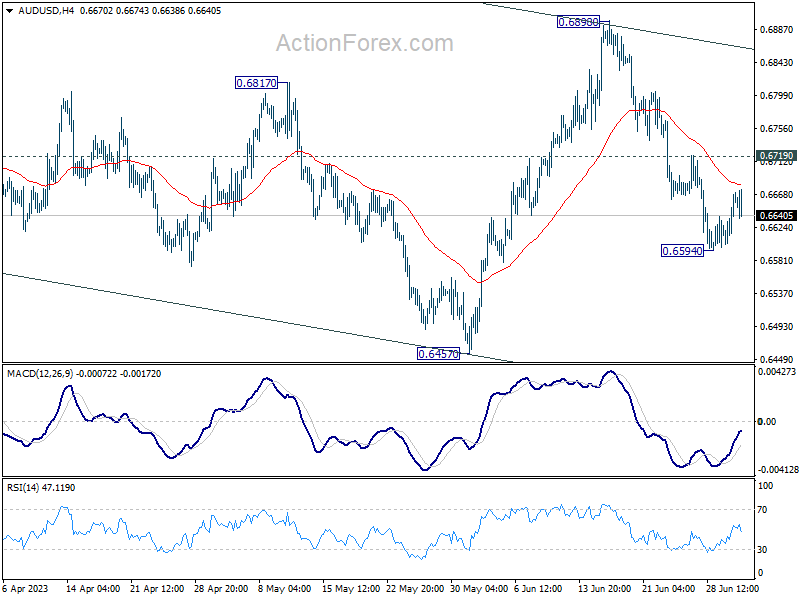
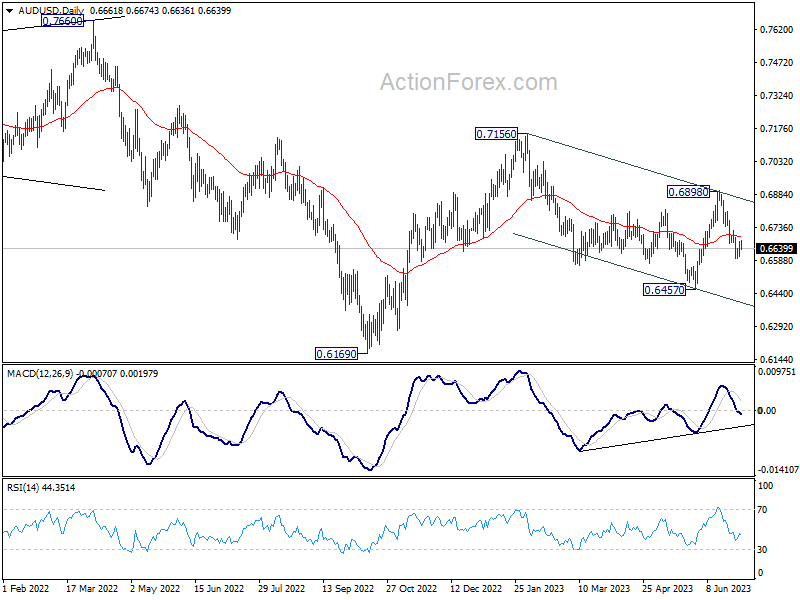
Intraday bias in AUD/USD remains neutral and further fall is in favor with 0.6719 resistance intact. On the downside, break of 0.6594 will resume the decline to 0.6457 support next. Nevertheless, firm break of 0.6719 will turn bias back to the upside for stronger rebound.
In the bigger picture, price actions from 0.7156 are seen as a correction to the rebound from 0.6169 only, rather than part of larger down trend from 0.8006 (2021 high). Break of 0.6457 could be seen but downside should be contained above 0.6169. This will now remain the favored case as high as 0.6898 resistance holds. Nevertheless, break of 0.6898 resistance will argue that rise form 0.6169 is ready to resume through 0.7156.
Economic Indicators Update
| GMT | Ccy | Events | Actual | Forecast | Previous | Revised |
|---|---|---|---|---|---|---|
| 22:45 | NZD | Building Permits M/M May | -2.20% | -2.60% | ||
| 23:50 | JPY | Tankan Large Manufacturing Index Q2 | 5 | 3 | 1 | |
| 23:50 | JPY | Tankan Non - Manufacturing Index Q2 | 23 | 22 | 20 | |
| 23:50 | JPY | Tankan Large Manufacturing Outlook Q2 | 9 | 5 | 3 | |
| 23:50 | JPY | Tankan Non - Manufacturing Outlook Q2 | 20 | 21 | 15 | |
| 23:50 | JPY | Tankan Large All Industry Capex Q2 | 13.40% | 3.20% | ||
| 00:30 | JPY | Manufacturing PMI Jun F | 49.8 | 49.8 | 49.8 | |
| 01:00 | AUD | TD Securities Inflation M/M Jun | 0.10% | 0.90% | ||
| 01:30 | AUD | Building Permits M/M May | 20.60% | 4.90% | -8.10% | -6.80% |
| 01:45 | CNY | Caixin Manufacturing PMI Jun | 50.5 | 50.2 | 50.9 | |
| 06:30 | CHF | CPI M/M Jun | 0.10% | 0.20% | 0.30% | |
| 06:30 | CHF | CPI Y/Y Jun | 1.70% | 1.80% | 2.20% | |
| 07:30 | CHF | Manufacturing PMI Jun | 44.9 | 42.8 | 43.2 | |
| 07:45 | EUR | Italy Manufacturing PMI Jun | 43.8 | 45.4 | 45.9 | |
| 07:50 | EUR | France Manufacturing PMI Jun F | 46 | 45.5 | 45.5 | |
| 07:55 | EUR | Germany Manufacturing PMI Jun F | 40.6 | 41 | 41 | |
| 08:00 | EUR | Eurozone Manufacturing PMI Jun F | 43.4 | 43.6 | 43.6 | |
| 08:30 | GBP | Manufacturing PMI Jun F | 46.5 | 46.2 | 46.2 | |
| 13:45 | USD | Manufacturing PMI Jun F | 46.3 | 46.3 | 46.3 | |
| 14:00 | USD | ISM Manufacturing PMI Jun | 46 | 47.2 | 46.9 | |
| 14:00 | USD | ISM Manufacturing Prices Paid Jun | 41.8 | 44.2 | ||
| 14:00 | USD | ISM Manufacturing Employment Index Jun | 48.1 | 51.4 | ||
| 14:00 | USD | Construction Spending M/M May | 0.90% | 0.50% | 1.20% | 0.40% |