

Sample Category Title
EURCHF Stuck at Lower Part of Prevailing Rectangle
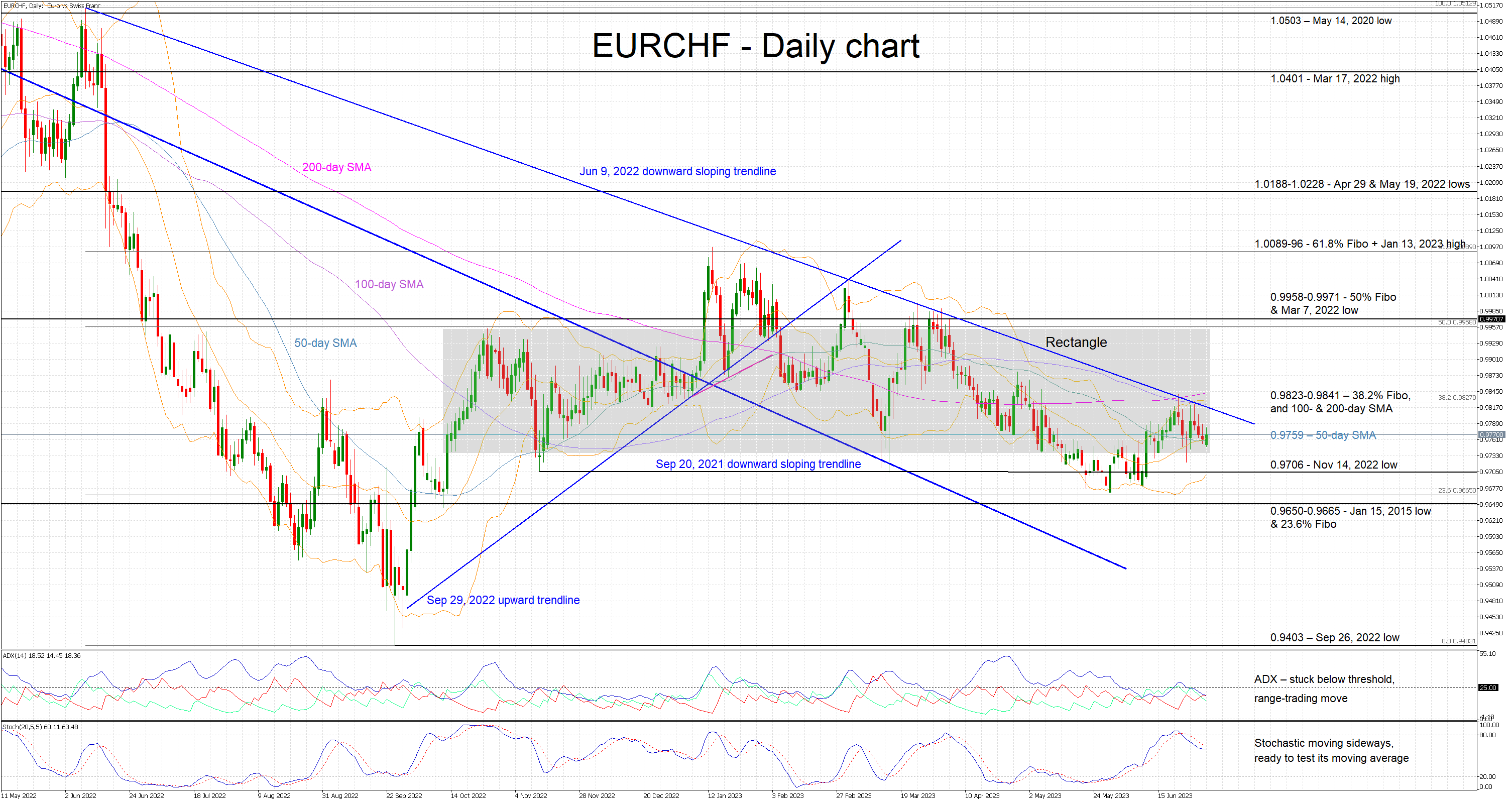
EURCHF remains firmly inside the rectangle that has been defining the price action since October 13, 2022. It is currently trading at the lower section of this rectangle, hovering around the 50-day simple moving average (SMA). The downward sloping trendline from June 9, 2022 appears to cap the upside at this stage with the bears contemplating the idea of another breakout.
The persistent SMAs' convergence is usually associated with an imminent move, but it also reveals a delicate balance between market participants. A balance confirmed by the muted momentum indicators. The Average Directional Movement Index (ADX) remains stuck below its 25-threshold and thus signaling a range-trading market, and the stochastic oscillator is trading sideways, preparing to test the resistance set by its moving average.
Should the bulls decide to push the market higher, they would have to overcome the key June 9, 2022 downward sloping trendline and the much talked-about 0.9823-0.9841 area. This is occupied by the 100- and 200-day simple moving averages (SMAs) and the 38.2% Fibonacci retracement of the June 9, 2022 – September 26, 2022 downtrend respectively. If successful, they would set their eyes on the upper boundary of the rectangle, a tad below the 0.9958-0.9971 range.
On the other hand, the bears are keen on another breakout provided they manage to break the 0.9759 level set by the 50-day SMA. They could then revisit the lower boundary of the rectangle with the real target being the 0.9650-0.9665 range that eluded them at the May 30 drop. This area is defined by the January 15, 2015 low and the 23.6% Fibonacci retracement respectively.
To sum up, EURCHF bears’ continued inability to successfully stage a breakout keeps the door open to upward moves.
USD/CAD Daily Outlook
Daily Pivots: (S1) 1.3209; (P) 1.3247; (R1) 1.3286; More....
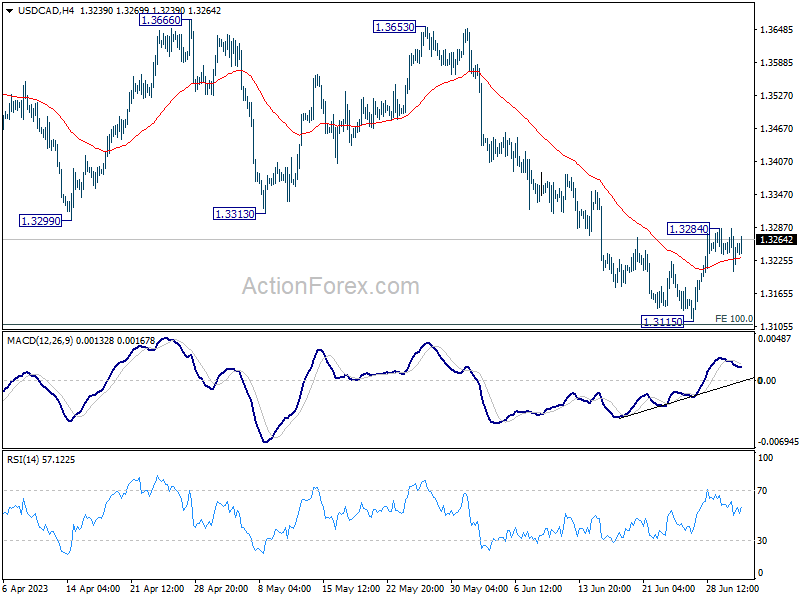
Intraday bias in USD/CAD stays neutral for the moment. Outlook is unchanged that a short term bottom was formed at 1.3115, and further rise is mildly in favor. Break of 1.3284 will resume the rebound from 1.3115 to 55 D EMA (now at 1.3379).
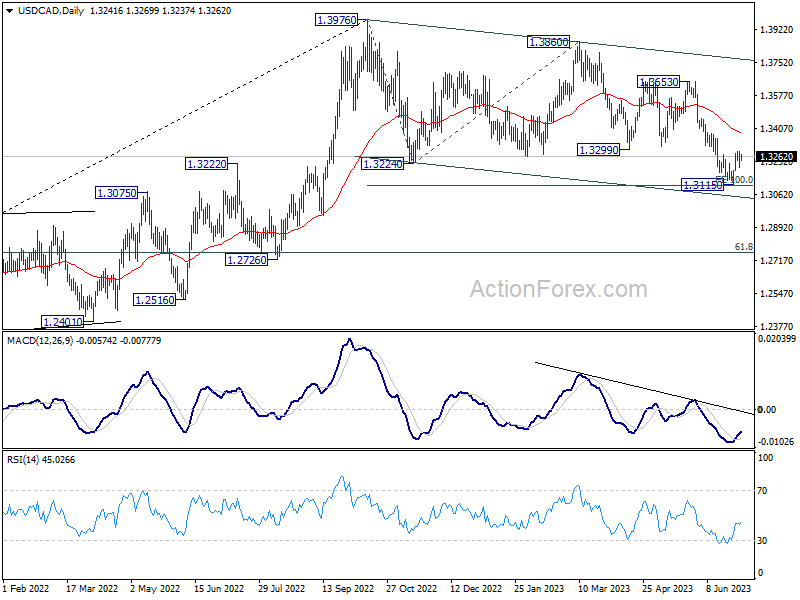
In the bigger picture, price actions from 1.3976 are still viewed as a correction to up trend from 1.2005 (2021 low). Risk will stay on the downside as long as 1.3299 support turned resistance holds. Next target is 61.8% retracement of 1.2005 to 1.3976 at 1.2758. However, sustained trading above 1.3229 will raise the chance that the correction has completed and turn focus back to 1.3653 resistance.
AUD/USD Daily Report
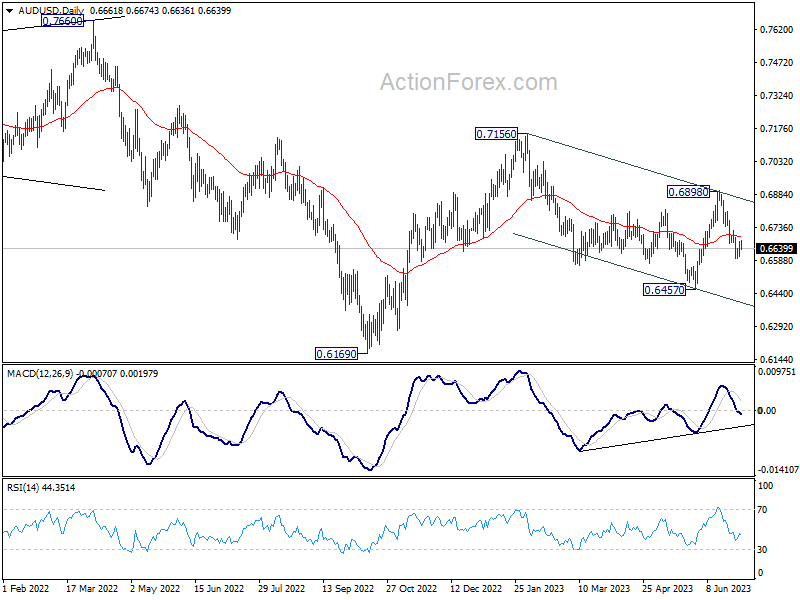
Daily Pivots: (S1) 0.6618; (P) 0.6645; (R1) 0.6687; More...
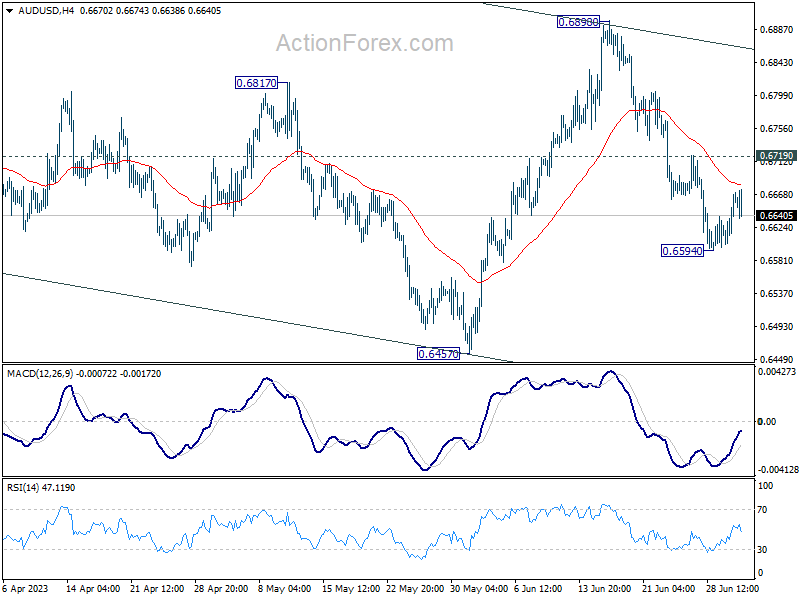
Intraday bias in AUD/USD remains neutral and further fall is in favor with 0.6719 resistance intact. On the downside, break of 0.6594 will resume the decline to 0.6457 support next. Nevertheless, firm break of 0.6719 will turn bias back to the upside for stronger rebound.
In the bigger picture, price actions from 0.7156 are seen as a correction to the rebound from 0.6169 only, rather than part of larger down trend from 0.8006 (2021 high). Break of 0.6457 could be seen but downside should be contained above 0.6169. This will now remain the favored case as high as 0.6898 resistance holds. Nevertheless, break of 0.6898 resistance will argue that rise form 0.6169 is ready to resume through 0.7156.
EUR/USD Daily Outlook
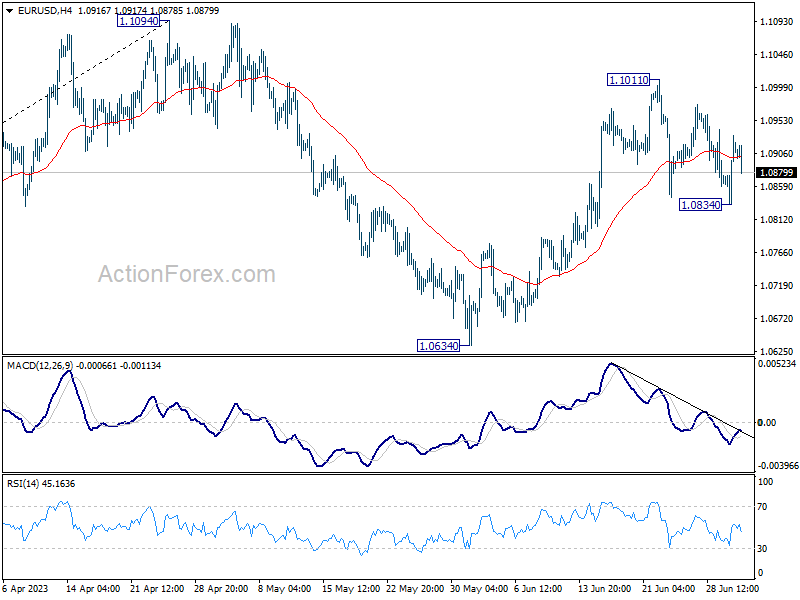
Daily Pivots: (S1) 1.0853; (P) 1.0893; (R1) 1.0950; More...
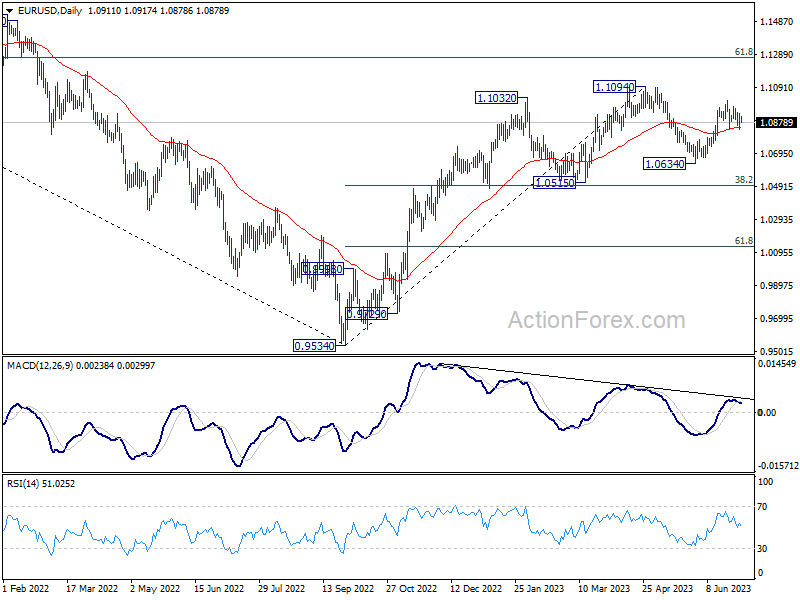
Intraday bias in EUR/USD stays neutral for the moment. Further rally is mildly in favor with 55 D EMA (now at 1.0850) intact). On the upside, break of 1.1011 will resume the rise from 1.0634 and target 1.1094 resistance. Decisive break there will resume larger up trend from 0.9534 to 1.1273 fibonacci level. However, firm break of 1.0834 will turn bias to the downside for 1.0634 support instead.
In the bigger picture, as long as 1.0515 support holds, rise from 0.9534 (2022 low) would still extend higher. Sustained break of 61.8% retracement of 1.2348 (2021 high) to 0.9534 at 1.1273 will solidify the case of bullish trend reversal and target 1.2348 resistance next (2021 high).
GBP/USD Daily Outlook
Daily Pivots: (S1) 1.2621; (P) 1.2674; (R1) 1.2748; More...
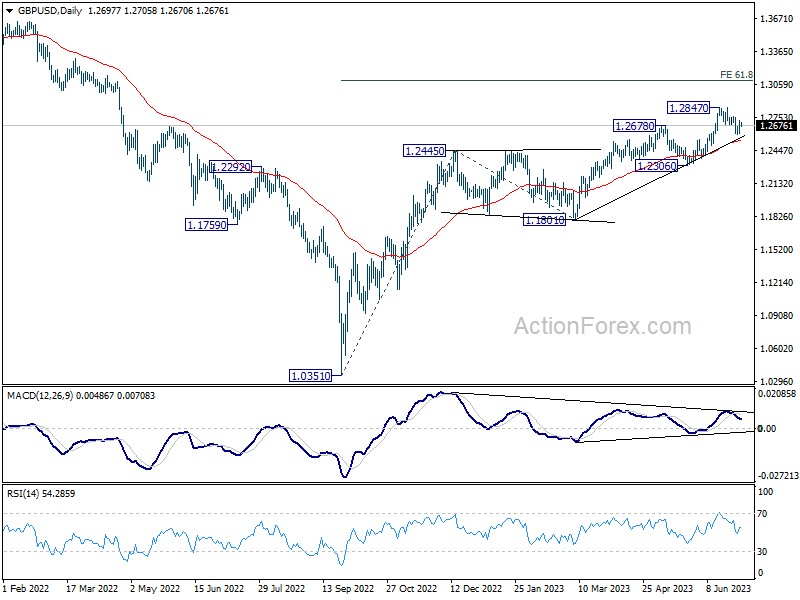
Intraday bias in GBP/USD stays mildly on the upside at this point. Pull back from 1.2847 could have completed at 1.2589. Further rise would be seen to retest 1.2847 high first. Firm break there will resume larger up trend from 1.0351, to 61.8% projection of 1.0351 to 1.2445 from 1.1801 at 1.3095. On the downside, though, break of 1.2589 will extend the fall to 55 D EMA (now at 1.2540).
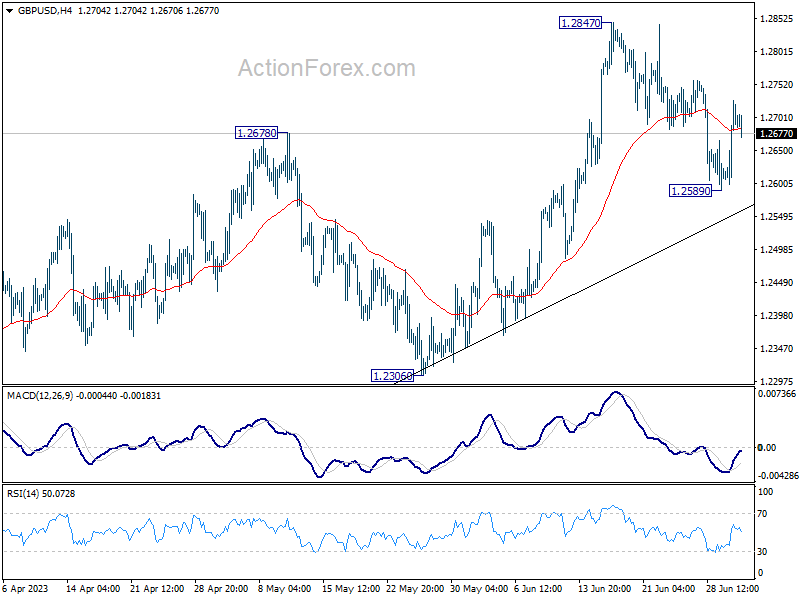
In the bigger picture, the strong support from 55 W EMA (now at 1.2341) is a medium term bullish sign. Outlook will stay bullish as long as 1.2306 support holds. Rise from 1.0351 medium term bottom (2022 low) is expected to extend further to retest 1.4248 key resistance (2021 high).
USD/CHF Daily Outlook
Daily Pivots: (S1) 0.8920; (P) 0.8969; (R1) 0.9001; More...
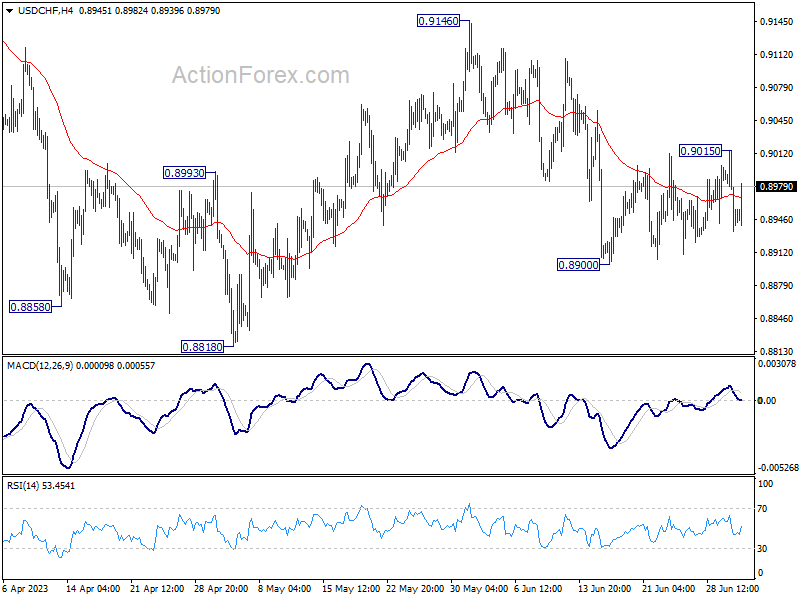
Range trading continues in USD/CHF and intraday bias remains neutral first. Near term outlook stays bearish for now. On the downside, break of 0.8900 will resume the fall from 0.9146 to 0.8818 low or below. On the upside, above 0.9015 will bring stronger rise towards 0.9146 resistance instead.
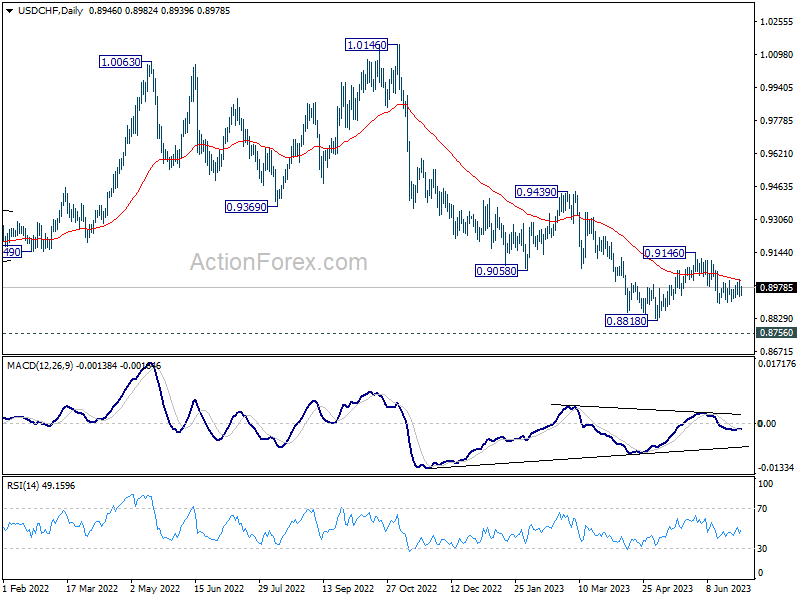
In the bigger picture, fall from 1.1046 (2022 high) is seen as a leg in the long term range pattern from 1.0342 (2016 high). While further decline cannot be ruled out, strong support is expected from 0.8756 long term support to bring reversal. Firm break of 0.9146 resistance should confirm medium term bottoming.
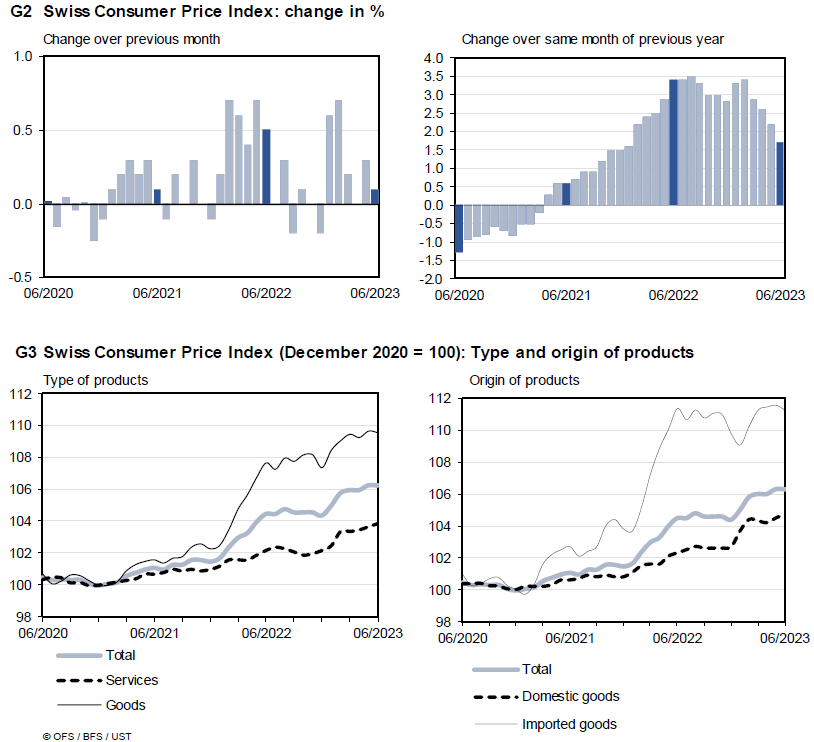
Swiss CPI slowed to 1.7% yoy in Jun, imported products down -0.1% yoy
Swiss CPI rose 0.1% mom in Jun, below expectation of 0.2% mom. Core CPI (excluding fresh and seasonal products, energy and fuel) was flat mom. Domestic products prices rose 0.2%. Imported products prices dropped -0.3% mom.
For the 12 month period, CPI slowed from 2.2% yoy to 1.7% yoy, below expectation of 1.8% yoy. Core CPI ticked down from 1.9% yoy to 1.8% yoy. Domestic products inflation dropped from 2.4% yoy to 2.3% yoy. Import products inflation turned negative from 1.4% yoy to -0.1% yoy.
USD/JPY Hit Resistance at 145 – Level at Which Japanese Officials Intervened Last Sep
Markets
Reaccelerating European core inflation in June came as no surprise to markets last Friday. German yields went up to 3.8 bps (30-y) lower into the weekend even as services inflation (5.4% y/y) bounced to a new series high. US data included personal income/spending and the PCE deflators but failed to inspire US investors. Yields dipped before leaving the intraday lows again in the final trading hours. Daily changes amounted to +3.7-4 bps at the front end of the curve and -0.2 to -3.9 bps at the longer maturities. Stocks ended the first half of the year on excellent footing. European equities rallied 1%, bringing the EuroStoxx 50 close to its YtD/cycle highs. Wall Street added 0.84-1.45% with the Nasdaq once again outperforming. The S&P500 finished at the highest level since April 2022. This bright risk mood pressured the US dollar. EUR/USD in one go erased the Thursday jobless claims losses, rising from the 1.086 area to back above 1.09. The DXY eased sub 103. The yen’s decline halted. USD/JPY hit resistance at 145 – the level at which Japanese officials intervened in September last year.
This morning’s Asian session is extremely quiet. Stocks in the region enter the second half of 2023 in good spirit. Japan rallies up to 1.6% with a more than decent Q2 Tankan supporting the move higher. The Japanese yen fails to profit though. Sentiment among large manufacturers improved from 1 to 5 with the outlook for the sector showing a bigger-than-expected advance, from 3 to 9. Non-manufacturers also showed more confident. The index gauging both the present and the future moved to pre-pandemic highs (23 and 20 respectively). Japanese businesses expect CPI inflation in five years at 2.1%. Chinese regulators fixed the yuan again stronger than expected in growing signs of unease with the weak currency. USD/CNY is trading close to its recent high around 7.24. Other dollar pairs struggle for direction. DXY and EUR/USD hover around Friday’s closing level. Core bonds trade with an upward bias.
Today’s economic calendar won’t break the Summer stalemate. It doesn’t help that the US is celebrating Independence Day tomorrow either, probably keeping many (American) investors sidelined today as well. The manufacturing ISM is due for release but we don’t expect it to have a significant impact on trading. Consensus is for a minor improvement/bottoming out from 46.9 to 47.2. Attention later this week shifts to the Australian central bank policy meeting tomorrow (status quo expected but with outside chance of a follow-up rate hike), FOMC June meeting minutes and the ECB consumer expectations survey on Wednesday, ADP employment, JOLTS and the services ISM on Thursday and finally the payrolls report on Friday.
News and views
Czech National Bank governor Michl in an interview by Pravo newspaper said this weekend that the central bank must keep fighting inflation by holding rates at their peak level for longer. If inflation proves to be more persistent, the CNB could even raise them again especially in combination with a revival in demand. “We’re not thinking about rate cuts at all”. In the base scenario, tight monetary policy, a strong koruna and a drop in consumption should push inflation back to the 2% target next year from 11.1% Y/Y in May. Michl called out for government support, labelling fiscal policy the biggest inflationary risk in the economy along with a potential wage-price spiral. Czech money markets currently start discounting the start of a cutting cycle from early 2024 onwards and attach a 0% probability to another rate hike this year. EUR/CZK at 23.75 trades near the middle of this year’s range (23.20-24.20). Historically, CZK only briefly traded as strong during 2008.
Swedish state-owned lender SBAB published its monthly house price indicator. Prices rose by 1.1% M/M overall with the non-seasonally adjusted housing price index largely unchanged since February. Prices are now 13% lower than in April last year. “Housing prices, and especially the price of apartments, continue to show remarkable resilience against significantly rising interest rates,” SBAB chief economist Boije said in a statement. “However, it may be deceptive as mortgage rates will continue somewhat higher and many housing co-ops will have to raise monthly fees.” The Swedish krone trades historically weak at EUR/SEK 11.75. The Riksbank raised its policy rate last week by another 25 bps to 3.75%, but markets judge the effort and the central bank’s future commitment as too little, too late.
USD/JPY Daily Outlook
Daily Pivots: (S1) 144.00; (P) 144.53; (R1) 144.86; More...
Intraday bias in USD/JPY remains neutral for consolidations below 145.06. Break of 55 4H EMA (now at 143.40) could trigger deeper correction. But further rally will remain in favor as long as 140.90 resistance turned support holds. On the upside, break of 145.06 will resume larger rise to 161.8% projection of 127.20 to 137.90 from 129.62 at 146.93.
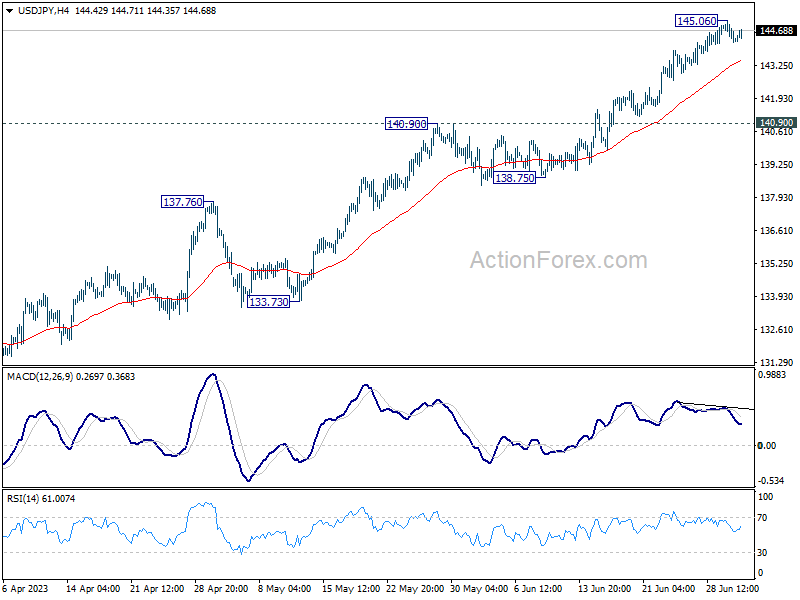
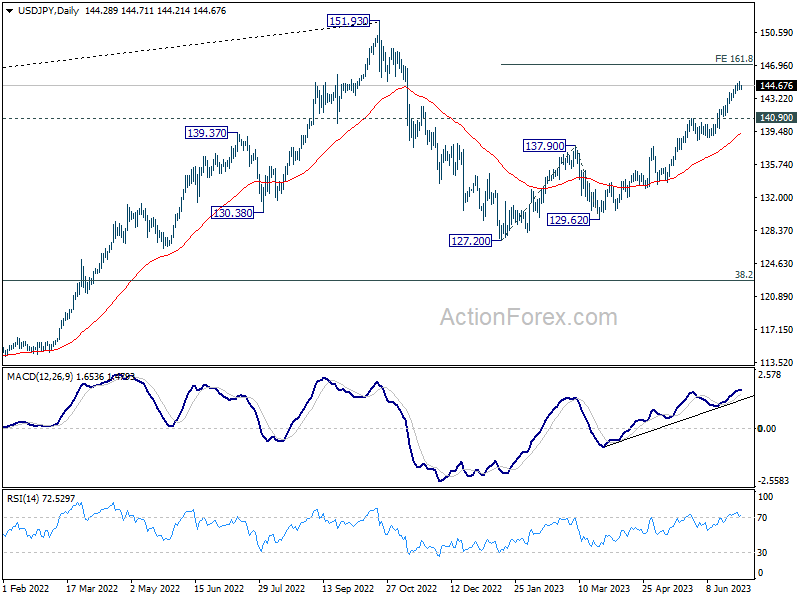
In the bigger picture, rise from 127.20 is currently seen as the second leg of the corrective pattern from 151.93 high. Further rally is expected as long as 138.75 support holds, to retest 151.93. But strong resistance could be seen there to limit upside. Break of 138.75 will indicate the the third leg has started back towards 127.20.
Asian Markets Lifted by Positive BoJ Tankan Survey, Overlook Weak Chinese Manufacturing Data
Asian markets began the trading week on a high note, largely driven by a rise in Japan's Nikkei index, which was buoyed by encouraging results from BoJ Tankan Survey. Meanwhile, market participants seemed to overlook weak data from China's manufacturing sector. Australian and New Zealand dollars led the other currencies, experiencing broad gains, closely trailed by Canadian Dollar. Japanese Yen and the Swiss Franc, however, traded with a weak undertone. Euro, Dollar, and British Pound exhibited mixed trading for the time being.
Although US traders may adopt a more relaxed stance due to the long July 4th weekend, trading may not be entirely subdued. RBA's interest rate decision, scheduled for tomorrow, could indeed stir up some market volatility. Besides, the week is packed with significant economic data releases, including ISM indexes and the much-anticipated non-farm payroll report.
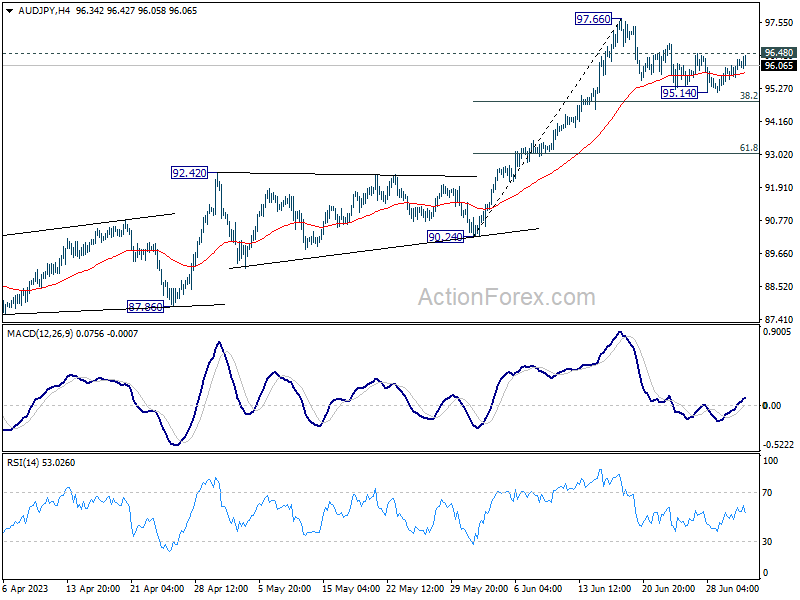
From a technical analysis perspective, the AUD/JPY pair will be of particular interest in the next 24 hours. For now, deeper decline is in favor as long as 96.48 minor resistance holds. In case of another fall, the focus is on whether it could depend 38.2% retracement of 90.24 to 97.66 at 94.82. Nevertheless, break of 96.48 would likely prompt stronger rally back to retest 97.66 high.
 In Asia, Nikkei closed up 1.70%. Hong Kong HSI is up 1.91%. China Shanghai SSE is up 1.29%. Singapore Strait Times is up 0.26%. Japan 10-year JGB yield is up 0.0023 at 0.402.
BoJ's Tankan survey indicates renewed confidence amongst Japanese businesses
BoJ's quarterly Tankan survey for Q2 has pointed to an uptick in confidence among Japanese businesses, surpassing market expectations.
Large manufacturing index, a key barometer of Japan's industrial sector, saw an impressive rise from a two-year low of 1 to 5, outperforming the market expectation of 3. This level marks the highest index value since Q4 of 2022, signifying a considerable rebound in sentiment within the manufacturing sector.
Similarly, large non-manufacturing index advanced from 20 to 23, again exceeding market forecasts of 22. This development signals the highest reading since Q2 2019, reflecting a resurgence in confidence within the broader service sector.
Looking forward, outlook for large manufacturers also leaped from 3 to 9, beating market predictions of 5. However, the outlook for large non-manufacturing firms was slightly below expectations at 20, compared to an anticipated figure of 21.
On the capital expenditure front, large firms plan to ramp up their outlays by a notable 13.4% in the current fiscal year ending March 2024, dwarfing the 3.2% increase projected in the Q1 survey.
Interestingly, the Tankan survey also revealed that companies foresee inflation hitting 2.6% a year from now, a slight pullback from the 2.8% projection made in March. Looking further ahead, inflation expectations stand at 2.2% for three years' time, a slight reduction from March figure of 2.3%, while projection for inflation five years from now remains stable at 2.1%.
Japan PMI manufacturing finalized at 49.8, fractional deterioration in the sector
Japan's Manufacturing PMI was finalized at 49.8 in June, a downturn from May's 50.6, according to au Jibun Bank. The reading fell just short of the neutral 50.0 threshold that separates expansion from contraction, indicating a slight decline in the health of the nation's manufacturing sector.
The report also highlighted that both output and new orders regressed, while supplier performance showed the most significant improvement since March 2016. Input prices increased at the slowest pace observed in the past 28 months.
Usamah Bhatti of S&P Global Market Intelligence noted, "The latest data pointed to a fractional deterioration in the Japanese manufacturing sector at the midpoint of 2023."
However, the slackening in demand and output conditions had a double-edged effect. On one hand, pressure on supply chains eased in June, with average lead times shortening for the second successive month. Simultaneously, easing pressure on supply chains also alleviated inflationary pressures, driving the Input Prices Index to a 28-month low.
China Caixin PMI manufacturing dipped to 50.5, dire job market, deflationary pressure, waning optimism
China's Caixin PMI Manufacturing for June recorded a slight decline from 50.9 in May to 50.5. slightly above expectation of 50.2. Caixin indicated that while output marginally increased, demand growth remained modest. Meanwhile, input prices experienced their sharpest decline since January 2016, and business confidence sank to an eight-month low.
Wang Zhe, Senior Economist at Caixin Insight Group, summed up the situation: "Manufacturing activity growth suffered a marginal slowdown."
"A slew of recent economic data suggests that China's recovery has yet to find a stable footing, as prominent issues including a lack of internal growth drivers, weak demand and dimming prospects remain," Wang added.
"Problems reflected in June's Caixin China manufacturing PMI, ranging from an increasingly dire job market to rising deflationary pressure and waning optimism, also point to the same conclusion."
RBA rate decision in the balance: Market braces for aussie volatility
The much-anticipated RBA rate decision this week presents a fifty-fifty split on whether the central bank will opt for a hike or a pause. This follows a Reuters poll indicating that of the 31 economists surveyed, 16 predict a hike, while 15 expect a pause. Additionally, 16 out of 30 economists forecast that the cash rate will peak at or above 4.60% by the end of September. Thus, should the RBA decide to hold this week, it is more likely to be a pause in the tightening cycle than a definitive end.
This level of uncertainty surrounding RBA's imminent decision, coupled with the accompanying statement, indicates that Australian Dollar may face significant volatility. Contributing additionally to this turbulence are key releases from China - specifically Caixin PMI manufacturing data due on Monday and Caixin PMI services data set for Wednesday. These releases could influence Chinese stocks and Yuan, subsequently impacting Aussie. As such, traders should brace for a potentially tumultuous week.
The release of FOMC minutes is another significant event to watch. However, the minutes are unlikely to diverge significantly from the overarching message that the tightening cycle is not yet complete. In the words of FOMC Chair Jerome Powell, a "strong majority" of FOMC participants expect at least two more hikes by year's end. Hence, the overall impact of the minutes could be overshadowed by high-impact economic data such as ISM indexes and non-farm payroll figures, especially wage growth data.
Additional key economic data releases to watch this week include Swiss CPI, Eurozone PPI and retail sales, Japan's cash earnings and household spending, and Canadian employment data.
Here are some highlights for the week:
- Monday: Japan Tankan survey, PMI manufacturing final; Australia MI inflation gauge, building approvals; China Caixin PMI manufacturing; Swiss CPI; Eurozone PMI manufacturing final; US ISM manufacturing, construction spending.
- Tuesday: New Zealand NIZER business confidence; RBA rate decisions; Germany trade balance; Canada manufacturing PMI.
- Wednesday: China Caixin PMI services; France industrial production; Eurozone PMI services final, PPI; UK PMI services final; US factory orders, FOMC minutes.
- Thursday: Australia trade balance; Germany factory orders; UK PMI construction; Eurozone retail sales; Canada trade balance; US ADP employment, jobless claims, trade balance, ISM services.
- Friday: Japan labor cash earnings, household spending; Swiss unemployment rate; Germany industrial production; US non-farm payrolls; Canada employment, Ivey PMI.
USD/JPY Daily Outlook
Daily Pivots: (S1) 144.00; (P) 144.53; (R1) 144.86; More...
Intraday bias in USD/JPY remains neutral for consolidations below 145.06. Break of 55 4H EMA (now at 143.40) could trigger deeper correction. But further rally will remain in favor as long as 140.90 resistance turned support holds. On the upside, break of 145.06 will resume larger rise to 161.8% projection of 127.20 to 137.90 from 129.62 at 146.93.
In the bigger picture, rise from 127.20 is currently seen as the second leg of the corrective pattern from 151.93 high. Further rally is expected as long as 138.75 support holds, to retest 151.93. But strong resistance could be seen there to limit upside. Break of 138.75 will indicate the the third leg has started back towards 127.20.
Economic Indicators Update
| GMT | Ccy | Events | Actual | Forecast | Previous | Revised |
|---|---|---|---|---|---|---|
| 22:45 | NZD | Building Permits M/M May | -2.20% | -2.60% | ||
| 23:50 | JPY | Tankan Large Manufacturing Index Q2 | 5 | 3 | 1 | |
| 23:50 | JPY | Tankan Non - Manufacturing Index Q2 | 23 | 22 | 20 | |
| 23:50 | JPY | Tankan Large Manufacturing Outlook Q2 | 9 | 5 | 3 | |
| 23:50 | JPY | Tankan Non - Manufacturing Outlook Q2 | 20 | 21 | 15 | |
| 23:50 | JPY | Tankan Large All Industry Capex Q2 | 13.40% | 3.20% | ||
| 00:30 | JPY | Manufacturing PMI Jun F | 49.8 | 49.8 | 49.8 | |
| 01:00 | AUD | TD Securities Inflation M/M Jun | 0.10% | 0.90% | ||
| 01:30 | AUD | Building Permits M/M May | 20.60% | 4.90% | -8.10% | -6.80% |
| 01:45 | CNY | Caixin Manufacturing PMI Jun | 50.5 | 50.2 | 50.9 | |
| 06:30 | CHF | CPI M/M Jun | 0.20% | 0.30% | ||
| 06:30 | CHF | CPI Y/Y Jun | 1.80% | 2.20% | ||
| 07:30 | CHF | Manufacturing PMI Jun | 42.8 | 43.2 | ||
| 07:45 | EUR | Italy Manufacturing PMI Jun | 45.4 | 45.9 | ||
| 07:50 | EUR | France Manufacturing PMI Jun F | 45.5 | 45.5 | ||
| 07:55 | EUR | Germany Manufacturing PMI Jun F | 41 | 41 | ||
| 08:00 | EUR | Eurozone Manufacturing PMI Jun F | 43.6 | 43.6 | ||
| 08:30 | GBP | Manufacturing PMI Jun F | 46.2 | 46.2 | ||
| 13:45 | USD | Manufacturing PMI Jun F | 46.3 | 46.3 | ||
| 14:00 | USD | ISM Manufacturing PMI Jun | 47.2 | 46.9 | ||
| 14:00 | USD | ISM Manufacturing Prices Paid Jun | 44.2 | |||
| 14:00 | USD | ISM Manufacturing Employment Index Jun | 51.4 | |||
| 14:00 | USD | Construction Spending M/M May | 0.50% | 1.20% |