

Sample Category Title
GBP/USD: Cable Rises to New 14-Month High on Hawkish Rate Outlook/Weak Dollar
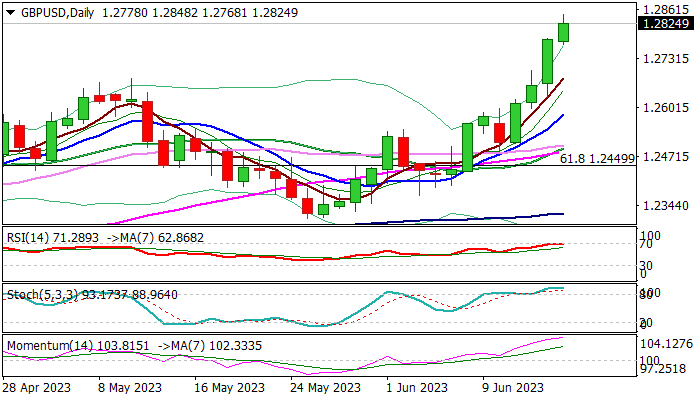
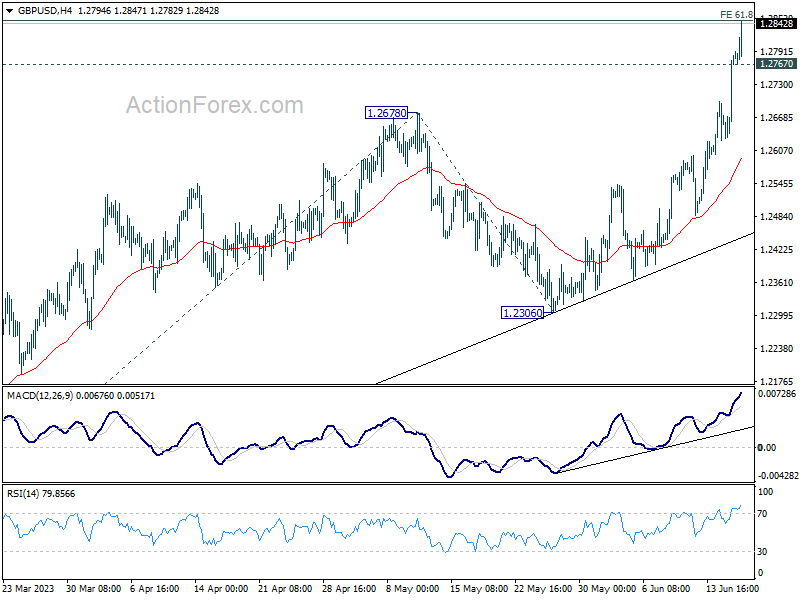
Cable is riding on extended third wave of five-wave cycle from 1.2307 (May 25 higher low) which hit Fibonacci extension 200% on Friday.
Steep upleg from 1.2486 (June 12 trough) extends into fourth consecutive day, hitting new 14-month high (1.2848), as sterling was lifted by weak dollar and hawkish signals from the Bank of England.
BOE MPC meets next week (June 22) and expected to deliver another rate hike (13th consecutive), on track to further diverge from the Fed, which paused rate hikes cycle for the first time in over one year and showed less hawkish expectations in the coming months.
Overbought daily studies warn that recent sharp bullish acceleration may lose steam and enter consolidation before pushing through immediate barrier at 1.2875 (200WMA) towards targets at 1.2946/1.3000 (Fibo 76.4% of 1.3748/1.0348 / psychological).
Dips should find solid support at 1.2679 (previous top of May 10, also the length of corrective wave 2).
Res: 1.2848; 1.2875; 1.2946; 1.3000.
Sup: 1.2768; 1.2679; 1.2583; 1.2540.
Sunset Market Commentary
Markets
ECB governors en masse used the opportunity to speak again after yesterday’s ECB meeting passed by. We kick off with Wunsch. His speeches in the past very often foretold monetary policy. Case in point: he was the first to put a deposit rate of 3% or more in the market when it stood at no more than 0.75%. So when the Belgian governor speaks, we listen. Wunsch today said that rate hikes may have to continue beyond September if core inflation keeps at 5% in coming months. That would imply a deposit rate of at least 4.25%. He floated the 4%+ idea already in February: “Rates are clearly above 4% in the UK and the U.S.; that would also be a reference for me. Why would we stay at 3% if we have more or less similar core numbers?” But the regional bank crisis erupted in the US shortly after, putting the idea temporarily on the shelf. Buba’s Nagel this morning said there’s still a long way to reach the inflation target, adding that the ECB may need to keep raising rates after the summer break. Austria’s Holzmann sided with his German colleague. Slovenia’s Vasle argues for further gradual tightening but he and Lithuania’s Simkus wouldn’t commit to something beyond July for now. French governor and real buzz kill Villeroy jumped in the debate a bit later. He urged against premature conclusions about the policy calendar and the terminal rate, a view shared by Portugal’s Centeno. The slew of comments had only a marginal impact on peak rate pricing though. German yields even lose a few bps (0.3-2.5 bps) for the day. The 2-y easily retains yesterday’s push beyond 3% but the 10-y once again struggled near the 2.55% resistance area. US Treasuries underperform vs Bunds. Yields recuperate more than 9.1 bps at the front, longer maturities add 2.5-5.2 bps. The move is partially inspired by Fed’s Waller. The governor does not “support altering the stance of monetary policy over worries of ineffectual management at a few banks” and said “it’s not clear that recent banking strains will lead to significantly tighter lending conditions in the US”. We can’t help but read it as a critique towards the Fed (not so) unanimous decision to halt the tightening cycle this Wednesday. One final quote: “Let me state unequivocally: The Fed’s job is to use monetary policy to achieve its dual mandate, and right now that means raising rates to fight inflation.” Yen weakness catches the eye on FX markets. The Japanese currency extends losses after the BoJ once again stood pat this morning even as inflationary pressures are strong and building. USD/JPY is set for the highest close since November 22 around 141.26. EUR/JPY surges towards 154.67, compared this week’s open of 149.85. The DXY and EUR/USD stabilize near yesterday’s closing levels in the low 102 and 1.095 area respectively. Sterling tries to push beyond this week’s/YtD highs against the euro. EUR/GBP is headed towards a pivotal next week (UK CPI, BoE) at around 0.853. Equities are in a good place. The EuroStoxx50 (+0.87%) for a third time this quarter attacks the YtD/cycle high.
News & Views
The National Bank of Poland’s May core inflation measure slowed to 0.4% M/M and 11.5% Y/Y, down from 1.2% M/M and 12.2% Y/Y in April. End May, the Polish statistical office reported headline inflation at 0.0% M/M and 13.0% Y/Y. CPI ex food and energy eased to 0.4% M/M and 11.5% Y/Y. CPI ex administered prices was unchanged compared to April, with the Y/Y figure slowing from 14.0% to 12.1%. Especially the decline in the monthly dynamics should give some hope that disinflation is finally gaining traction. NBP MPC members so far were cautious to open the debate on a first rate cut. In comments after the June policy decision (6.75% unchanged), governor Glapinski suggested the debate on rate cuts may start when CPI drops below 10% and when analysis indicates that the decline might continue in the coming quarters. Money markets currently are positioned for a first cautious rate cut in Q4. The zloty earlier this month touched the strongest level against the euro since end 2020 at 4.43 but now shows signs of topping out. EUR/PLN currently trades near 4.465.
UK citizens’ inflation expectations eased compared to February, the Bank of England’s quarterly survey showed. Respondents expect inflation in the coming year at 3.5%, down from 3.9% even as current inflation was still assessed to be higher at 9.6%, up from 9.2%. Asked about longer-term expectations (5-y), the median answer stayed unchanged at 3.0%. 57% of respondents still expect rates to rise further over the next 12 months. When asked whether the BoE is doing its job to set interest rates to control inflation, the net satisfaction balance declined from -4 to -13, a new record low. The survey is important input to the BoE’s policy meeting next week.
Fed Barkin: Inflation comes back stronger if you back off inflation too soon
Richmond Fed President Thomas Barkin reflected upon the lessons of the 1970s, highlighting the risks associated with an early pullback on tackling inflation.
In his exact words, Barkin said, "The '70s provides a clear lesson: If you back off inflation too soon, inflation comes back stronger, requiring the Fed to do even more, with even more damage. That's not a risk I want to take."
Despite acknowledging a softening in demand, Barkin characterizd the situation as "weaker but not yet weak." Further, he noted the robust labor market conditions and the continued spending by higher-income consumers.
Barkin emphasized his continued skepticism towards a quick return to the 2% inflation target, remarking, "I am still looking to be convinced of the plausible story that slowing demand returns inflation relatively quickly" to the goal.
Dollar Index: Profit-taking to Out Bears on Hold
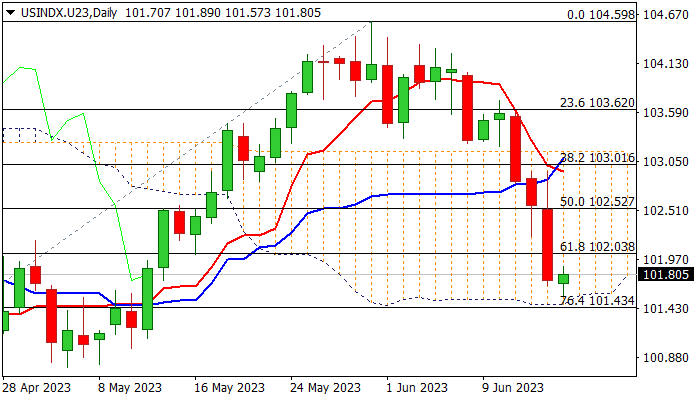
The dollar index is on track for the third consecutive week in red and for the biggest weekly loss since the second week of November.
Sharp bearish acceleration in past three days (down 1.75%) hit five-week low (101.57) where bears faced strong headwinds from daily Ichimoku cloud base and nearby Fibo support at 101.43 (76.4% of 100.45/104.59 rally).
Bears are likely to take a breather here as traders look to collect some profits from the latest fall, as well as at the end of the week, with oversold daily studies contributing to potential scenario.
Larger picture remains bearish, suggesting limited correction before bears regain full control for final push towards key short-term support at 100.45 (2023 low posted on Apr 14) and psychological 100 level.
Thursday’s close below Fibo support at 102.03 (61.8%) generated fresh bearish signal, which will be boosted on weekly close below this level.
Extended corrective upticks should not exceed 102.83 (100DMA) to keep bears in play.
Res: 102.03; 102.32; 102.83; 103.08.
Sup: 101.57; 100.99; 100.72; 100.45.
EUR/USD Mid-Day Outlook
Daily Pivots: (S1) 1.0849; (P) 1.0901; (R1) 1.0998; More...
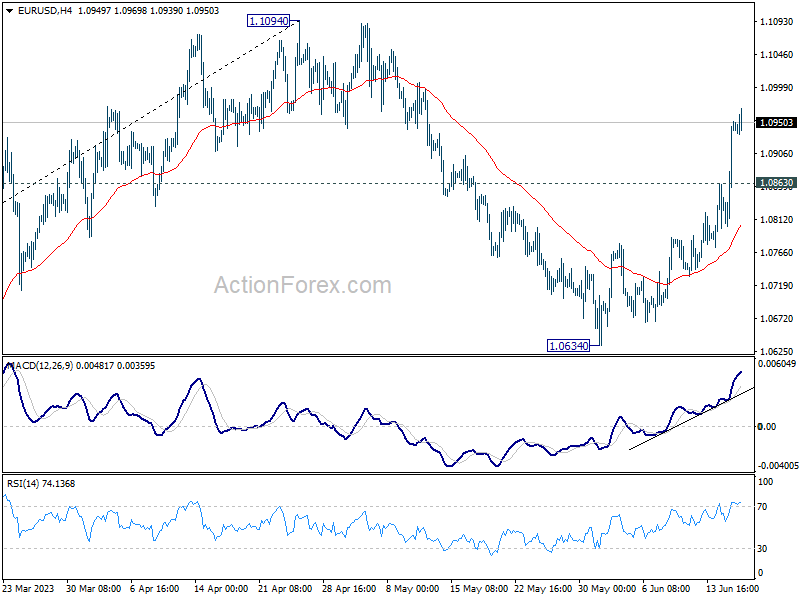
Intraday bias in EUR/USD remains on the upside for the moment. Current rise form 1.0634 should target a retest on 1.1094 high. . Decisive break there will confirm resumption of whole up trend from 0.9534. On the downside, below 1.0863 minor support will turn intraday bias neutral first.
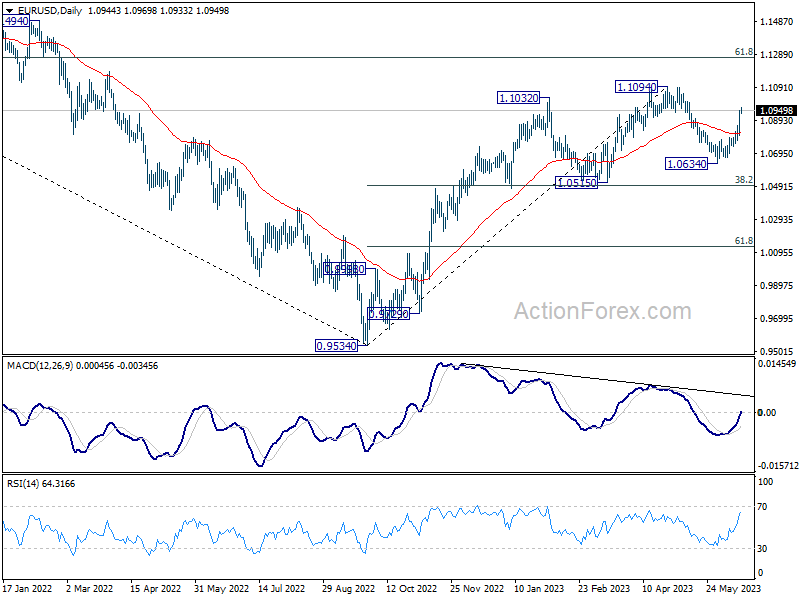
In the bigger picture, as long as 1.0515 support holds, rise from 0.9534 (2022 low) would still extend higher. Sustained break of 61.8% retracement of 1.2348 (2021 high) to 0.9534 at 1.1273 will solidify the case of bullish trend reversal and target 1.2348 resistance next (2021 high).
USD/CHF Mid-Day Outlook
Daily Pivots: (S1) 0.8864; (P) 0.8960; (R1) 0.9013; More...
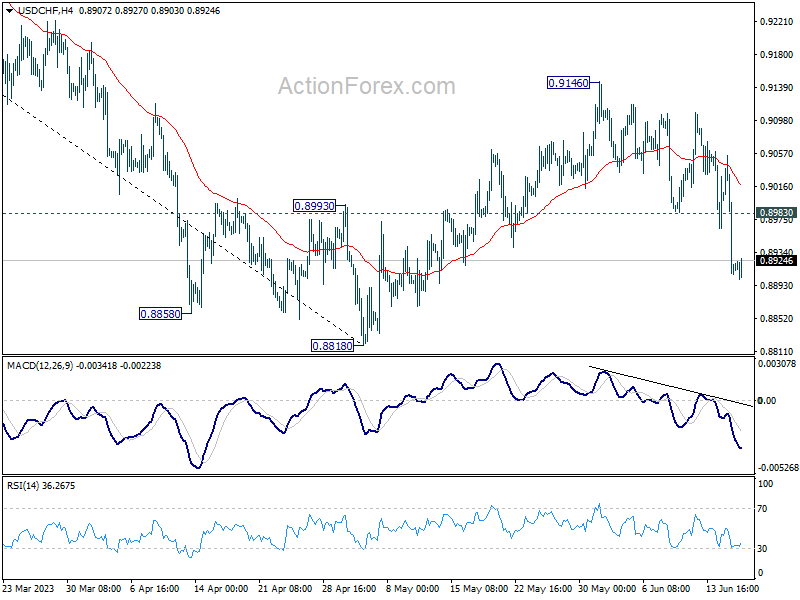
USD/CHF's fall from 0.9146 is still in progress. Intraday bias stays on the downside for 0.8818 support and possibly below. Still, strong support is still expected from 0.8756 to bring reversal. On the upside, above 0.8983 minor resistance will turn intraday bias neutral first.
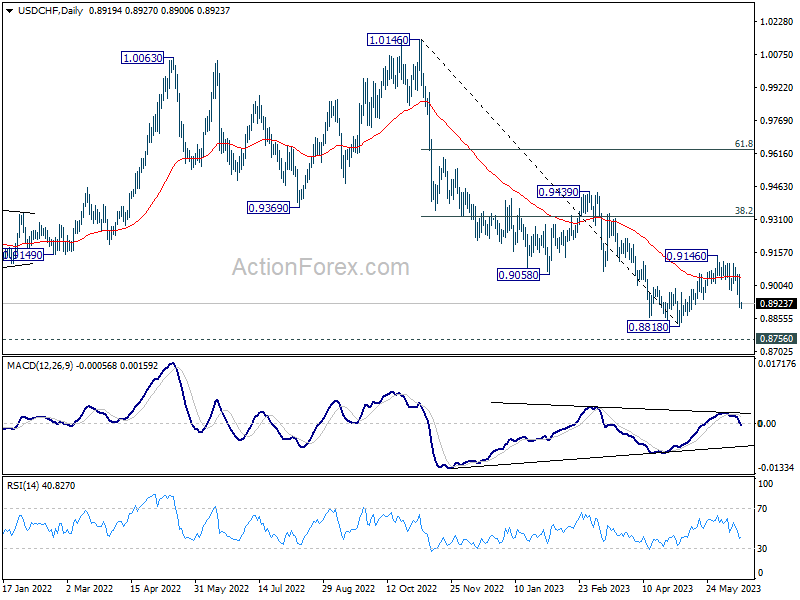
In the bigger picture, fall from 1.1046 (2022 high) is seen as a leg in the long term range pattern from 1.0342 (2016 high), which might have completed at 0.8818 already, just ahead of 0.8756 long term support. Sustained trading above 0.9058 support turned resistance should confirm medium term bottoming. Further break of 0.9439 resistance will confirm bullish trend reversal.
USD/JPY Mid-Day Outlook
Daily Pivots: (S1) 139.65; (P) 140.57; (R1) 141.21; More...
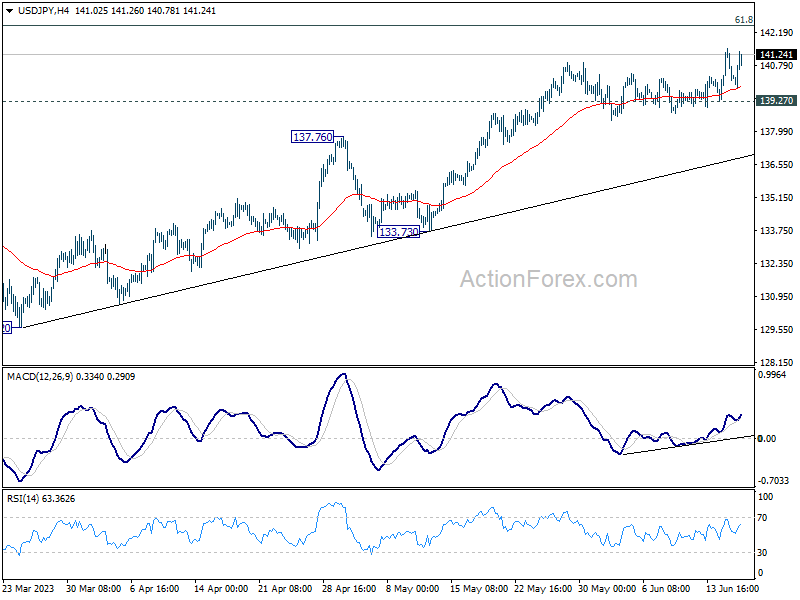
No change in USD/JPY's outlook. With 139.27 support intact, further rally is expected. Current rise from 127.20 should now target 142.48 fibonacci level next. Nevertheless, break of 139.27 will now indicate short term topping and turn bias back to the downside.
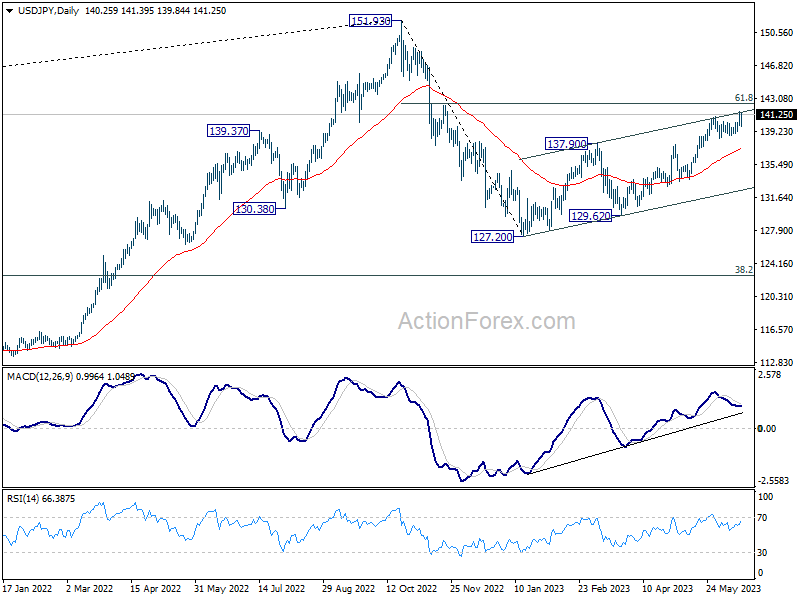
In the bigger picture, rise from 127.20 is seen as the second leg of the corrective pattern from 151.93 high. Stronger rally would be seen to 61.8% retracement of 151.93 to 127.20 at 142.48. Sustained break there will pave the way back to retest 151.93. On the downside, however, decisive break of 137.90 resistance turned support will now be the first indicate that this rebound from 127.20 has completed already.
GBP/USD Mid-Day Outlook
Daily Pivots: (S1) 1.2681; (P) 1.2734; (R1) 1.2837; More...
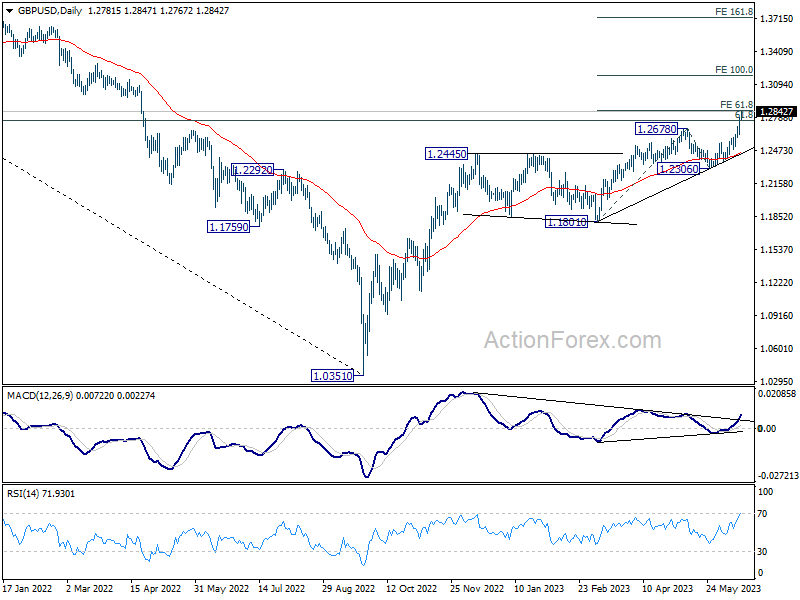
GBP/USD rises to as high as 1.2847 so far today, just an inch below 61.8% projection of 1.1801 to 1.2678 from 1.2306 at 1.2848. intraday bias stays on the upside for the moment. Decisive break of 1.2848 will extend the rally to 100% projection at 1.3183 next. On the downside, below 1.2697 minor support will turn intraday bias neutral and bring consolidations first, before staging another rally.
In the bigger picture, as long as 1.2306 support holds, rise from 1.0351 medium term bottom (2022 low) is expected to extend further. Sustained break of 61.8% retracement of 1.4248 (2021 high) to 1.0351 at 1.2759 will add to the case of long term bullish trend reversal. Next medium term target will then be 1.4248 key resistance.
Euro Extending Rally But Sterling Outperforms, Yen and Dollar Continue Decline
Euro's broad based rally continues today as supported by a chorus of hawkish comments from ECB officials. But Sterling is outperforming on anticipation that BoE will continue with tightening next week, and probably more afterwards.
Despite the strong showings by European majors, Australian Dollar still leads the pack for the week. With the week drawing to a close, it remains to be seen whether Euro and its counterparts can overturn this picture.
Conversely, Yen's post-BoJ selloff is extending, with fresh decline in early US session. Yen's fate as the week's most significant loser is sealed, followed closely by Dollar and then Canadian Dollar.
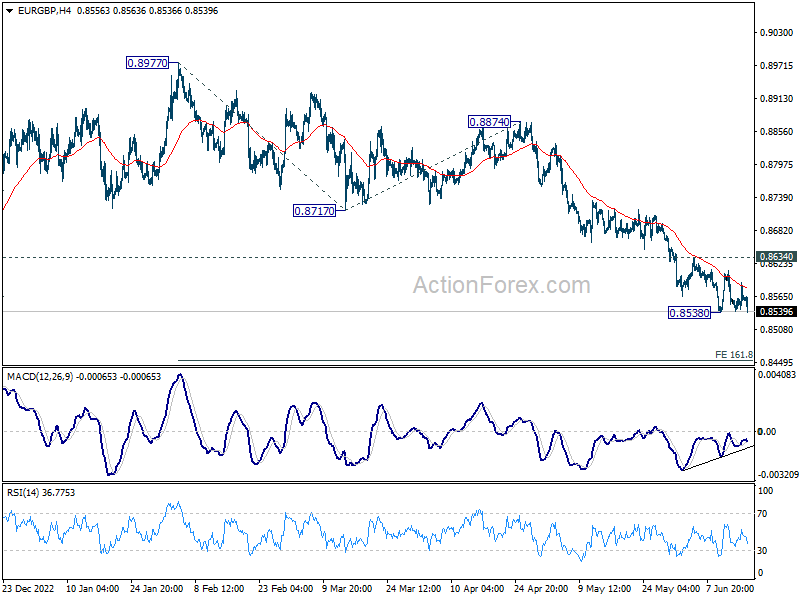
Technically, EUR/GBP appears to be finally breaking out of the near term range to resume the down trend from 0.8997. Next target would be 161.8% projection of 0.8977 to 0.8717 from 0.8874 at 0.8453. If realized, the decline in EUR/GBP is not expected to drag too much on Euro elsewhere. Instead, the fall would more likely give Sterling another lift, in particular against Dollar and Yen.
 In Europe, at the time of writing, FTSE is up 0.17%. DAX is up 0.40%. CAC is up 1.01%. Germany 10-year yield is down -0.0402 at 2.467. Earlier in Asia, Nikkei rose 0.66%. Hong Kong HSI rose 1.07%. China Shanghai SSE rose 0.63%. Singapore Strait times rose 0.53%. Japan 10-year JGB yield fell -0.0279 to 0.404.
Fed Governor Waller dismisses concerns over monetary tightening impact on banking system
In a speech, Fed Governor Christopher Waller robustly defended Fed's tightening of monetary policy, rejecting arguments that such measures have unduly stressed the banking system.
Some critics have posited that Fed's recent rates hikes significantly contributed to the distress and failures within the banking sector, suggesting that these factors should have been taken into account in the policy setting process.
Waller firmly dismissed these claims, stating, "Let me state unequivocally: The Fed's job is to use monetary policy to achieve its dual mandate, and right now that means raising rates to fight inflation."
"It is the job of bank leaders to deal with interest rate risk, and nearly all bank leaders have done exactly that," he added.
He reinforced his stance by adding, "I do not support altering the stance of monetary policy over worries of ineffectual management at a few banks."
He reiterated Fed's commitment to its monetary policy objectives, which ultimately support a healthy financial system.
However, he did acknowledge the importance of Fed's role in ensuring financial stability, affirming that it would continue to leverage its financial stability tools to prevent the accumulation of risks within the financial system and address any emerging strains when necessary.
Eurozone CPI finalized at 6.1% yoy in May, core at 5.3% yoy
Eurozone CPI was finalized at 6.1% yoy in May, down from April's 7.0% yoy. CPI core (all-items ex energy, food, alcohol & tobacco) was finalized at 5.3% yoy, down from prior month's 5.6% yoy.
The highest contribution to the annual Eurozone inflation rate came from food, alcohol & tobacco (+2.54%), followed by services (+2.15%), non-energy industrial goods (+1.51%) and energy (-0.09%).
EU CPI was finalized at 7.1% yoy, down from prior month's 8.1% yoy. The lowest annual rates were registered in Luxembourg (2.0%), Belgium (2.7%), Denmark and Spain (both 2.9%). The highest annual rates were recorded in Hungary (21.9%), Poland and Czechia (both 12.5%). Compared with April, annual inflation fell in twenty-six Member States and rose in one.
ECB policymakers emphasize need to continue tightening
In a chorus of comments today, ECB Governing Council members underscored the need for continued monetary tightening to combat persistently high inflation.
Bundesbank President Joachim Nagel stressed the central bank "still have more ground to cover", adding "we may need to keep raising rates after the summer break."
"Once we have reached the peak, we will stay there until we are sure of a safe and timely return of inflation to our 2% target," Nagel said. He also highlighted the necessity of reducing the central bank's balance sheet to support this policy.
Bostjan Vasle, Chief of Slovenia's central bank, echoed this sentiment. "If it turns out that inflation is more persistent than it seems at the moment...then of course further monetary-policy action will be necessary," he noted.
In Lithuania, Central Bank Chief Simkus expressed concern about the prolonged high inflation, asserting that "over the medium term, inflation is not coming back to an appropriate level." He also questioned market expectations for early 2024 rate cuts, suggesting that such a rapid reversal would be perplexing.
Meanwhile, Estonian Central Bank Chief Madis Muller clarified, "Euro zone interest rates have not yet peaked." He added, "The ultimate goal is clear for the central bank: we need to quickly get the price rise under control."
Finally, Finland's Central Bank Chief Olli Rehn, voiced the need for restrictive interest rates to achieve a timely return of inflation to the 2% medium-term target. "The key ECB interest rates will be brought to levels sufficiently restrictive...and will be kept at those levels for as long as necessary," Rehn concluded.
BoJ holds steady, core CPI to decelerate towards middle of fiscal 2023
In a widely expected move, BoJ today unanimously voted to maintain its existing ultra-loose monetary policy. The central bank kept short-term policy rate at -0.10% under its yield curve control. Yield target on 10-year JGB remains around 0%, with fluctuation band allowed also maintained at about plus and minus 0.50% from the target level. BoJ reiterated its commitment to carry on with its Quantitative and Qualitative Monetary Easing with Yield Curve Control "as long as it is necessary" and affirmed it "will not hesitate to take additional easing measures if necessary."
In its accompanying statement, BoJ noted that it anticipates Japan's economy to witness moderate recovery by around middle of the fiscal year 2023. "Thereafter, as a virtuous cycle from income to spending gradually intensifies, Japan's economy is projected to continue growing at a pace about its potential growth rate," the central bank said.
Discussing the inflation outlook, the bank stated: "The year-on-year rate of increase in the CPI (all items less fresh food) is likely to decelerate toward the middle of fiscal 2023, with a waning of the effects of the pass-through to consumer prices of cost increases led by the rise in import prices.
"Thereafter, the rate of increase is projected to accelerate again moderately, albeit with fluctuations, as the output gap improves and as medium- to long-term inflation expectations and wage growth rise, accompanied by changes in factors such as firms' price- and wage-setting behavior."
BoJ Ueda: It's probably more difficult to deal with an undershoot of inflation
In the press conference following BoJ's decision to stand pat, Governor Kazuo Ueda said, "at present, inflation has exceeded 2% for 13 straight months but could fall below that level ahead. That's why we are not normalizing monetary policy. But if that view changes sharply, we will have to change policy."
"We expect inflation to moderate, but it's true the pace of decline is somewhat slow," he said. "But we're still in the early stages of the moderation. There's uncertainty on whether the future slowdown will be a gradual one, or a quite sharp one."
"What's important is not just our median forecast but how certain that forecast is ... We won't act just by looking at the median forecast. We'd like to look comprehensively at various data including distribution"
"We have to consider what tools we have at our disposal when inflation overshoots, and when it undershoots. When we compare these, it's probably more difficult to deal with an undershoot of inflation."
NZ BNZ PMI ticked up to 48.9, staying in relatively tight band of contraction
New Zealand BusinessNZ Performance of Manufacturing Index ticked up from 48.8 to 48.9 in May, staying well below long-term average activity rate of 53.0. Looking at some details, production dropped from 47.0 to 45.7. Employment rose from 47.7 to 49.5. New orders rose from 49.6 to 50.8. Finished stocks dropped from 52.5 to 51.5. Deliveries dropped from 50.7 to 46.0.
BusinessNZ's Director, Advocacy Catherine Beard said: "New Zealand's manufacturing sector has remained in a relatively tight band of contraction for the last three months. While the overall activity result has crept upwards over that time."
BNZ Senior Economist, Craig Ebert stated that "the range of results in the sub-components is mirrored in the breadth of issues manufacturers are now highlighting in the survey. Gone is the dominance of supply-side laments, especially regarding staff. But new negatives have arisen, for all of them to (still be) outnumbering the positive issues referenced".
GBP/USD Mid-Day Outlook
Daily Pivots: (S1) 1.2681; (P) 1.2734; (R1) 1.2837; More...
GBP/USD rises to as high as 1.2847 so far today, just an inch below 61.8% projection of 1.1801 to 1.2678 from 1.2306 at 1.2848. intraday bias stays on the upside for the moment. Decisive break of 1.2848 will extend the rally to 100% projection at 1.3183 next. On the downside, below 1.2697 minor support will turn intraday bias neutral and bring consolidations first, before staging another rally.
In the bigger picture, as long as 1.2306 support holds, rise from 1.0351 medium term bottom (2022 low) is expected to extend further. Sustained break of 61.8% retracement of 1.4248 (2021 high) to 1.0351 at 1.2759 will add to the case of long term bullish trend reversal. Next medium term target will then be 1.4248 key resistance.
Economic Indicators Update
| GMT | Ccy | Events | Actual | Forecast | Previous | Revised |
|---|---|---|---|---|---|---|
| 22:30 | NZD | Business NZ PMI May | 48.9 | 49.1 | 48.8 | |
| 02:47 | JPY | BoJ Interest Rate Decision | -0.10% | -0.10% | -0.10% | |
| 08:30 | GBP | Consumer Inflation Expectations | 3.50% | 3.90% | ||
| 09:00 | EUR | Eurozone CPI Y/Y May F | 6.10% | 6.10% | 6.10% | |
| 09:00 | EUR | Eurozone CPI Core Y/Y May F | 5.30% | 5.30% | 5.30% | |
| 12:30 | CAD | Wholesale Sales M/M Apr | -1.40% | 0.00% | -0.10% | |
| 14:00 | USD | Michigan Consumer Sentiment Index Jun P | 60.2 | 59.2 |
Fed Governor Waller dismisses concerns over monetary tightening impact on banking system
In a speech, Fed Governor Christopher Waller robustly defended Fed's tightening of monetary policy, rejecting arguments that such measures have unduly stressed the banking system.
Some critics have posited that Fed's recent rates hikes significantly contributed to the distress and failures within the banking sector, suggesting that these factors should have been taken into account in the policy setting process.
Waller firmly dismissed these claims, stating, "Let me state unequivocally: The Fed's job is to use monetary policy to achieve its dual mandate, and right now that means raising rates to fight inflation."
"It is the job of bank leaders to deal with interest rate risk, and nearly all bank leaders have done exactly that," he added.
He reinforced his stance by adding, "I do not support altering the stance of monetary policy over worries of ineffectual management at a few banks."
He reiterated Fed's commitment to its monetary policy objectives, which ultimately support a healthy financial system.
However, he did acknowledge the importance of Fed's role in ensuring financial stability, affirming that it would continue to leverage its financial stability tools to prevent the accumulation of risks within the financial system and address any emerging strains when necessary.