Sample Category Title
Ethereum Touches Support Level, Bitcoin Yet to Follow
Market picture
The crypto market has climbed 2% in the last 24 hours to 1.04 trillion. It took a continuation of the Nasdaq rally and a dollar weakening by more than 1% from its intraday high to revive demand here. Demand also came after Tether’s USD peg was restored, although the exchange rate was still 0.1% lower than 7 and 30 days ago. The cryptocurrency’s fear and greed index rose from 41 to 47, back into neutral territory.
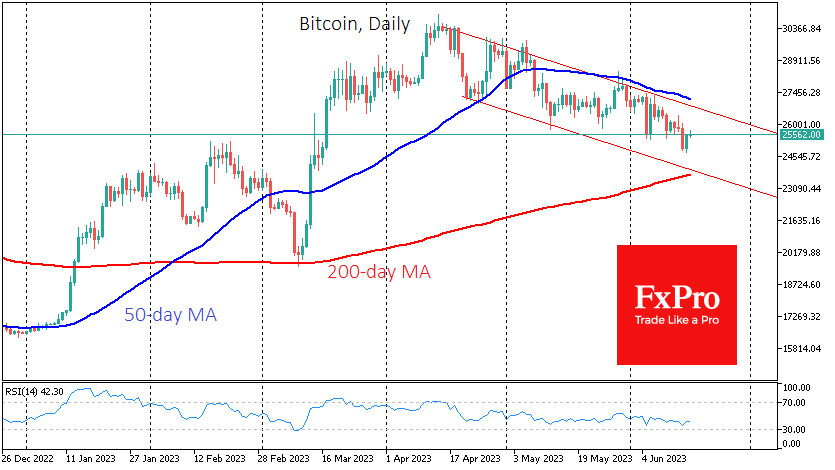
As expected, bitcoin found support on the dip below $25K, leaning on external positivity and short-term oversold conditions. However, the move is still in a downtrend and will remain so until the price breaks above previous local highs – now at $27.3K. Targets for the current downtrend stay in the $23.6K area.
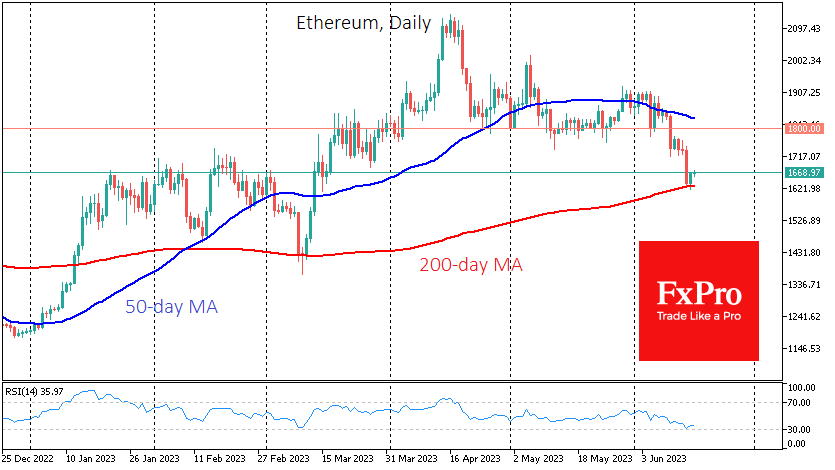
Ethereum has exhausted most of its corrective potential, as it has breached the 200-day moving average at $1630 and briefly touched oversold territory on the daily RSI.
Tether’s USDT stablecoin has moved away from parity with the US dollar. The coin’s weighted average exchange rate fell to 0.9958, according to CoinMarketCap. “The markets are nervous these days, so it’s easy for attackers to take advantage of the general sentiment. We at Tether are as ready as ever,” said Tether CTO Paolo Ardoino.
News background
Investment giant BlackRock is preparing to file for a Bitcoin ETF. The US Securities and Exchange Commission (SEC) has previously rejected almost all applications to register cryptocurrency ETFs.
Apple has rejected a new version of its non-custodial Zeus wallet app for the Lightning Network on the App Store.
Cryptocurrency broker Floating Point Group (FPG), which has $50 billion in assets under management, reported a hack and halted trading, deposits and withdrawals. Damage is tentatively estimated at $15-20 million.
The total number of subscribers to Reddit’s leading cryptocurrency communities, r/Bitcoin and r/Ethereum, reached a new record high of 7 million users. More than 364 thousand people subscribed to the BTC section between 4 and 11 June. The SEC’s litigation with two major cryptocurrency exchanges has likely piqued the community’s interest.
EUR/USD: Bulls May Take a Breather after Strong Post-ECB Rally
The Euro rose further and hit new five-week high on Friday morning, keeping firm bullish tone after 1.06% rally on Thursday (the biggest one-day gain since Feb 2).
The single currency was lifted by hawkish ECB, which raised interest rates by 25 basis points and signaled more hikes in the near future, in continuous fight with high inflation.
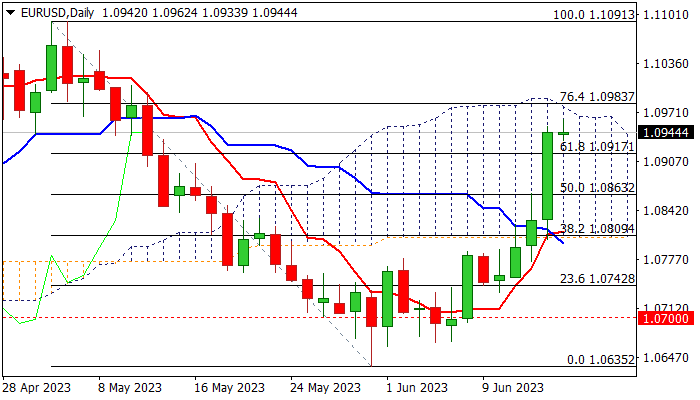
Thursday’s rally closed well above pivotal Fibo barrier at 1.0917 (61.8% retracement of 1.1091/1.0635) adding to positive signals on daily chart.
Rising bullish momentum and formation of daily Tenkan-sen/Kijun-sen bull cross) contribute to positive signals, as bulls pressure barriers at 1.0966/1.0983 (daily cloud top / Fibo 76.4%) and psychological 1.10 level, violation of which to confirm reversal.
Caution on overbought conditions which may slow bulls for consolidation before attacking next targets, with shallow dips to be ideally contained by broken Fibo 61.8% level (1.0917).
The pair is on track for the biggest weekly gains since early November, as large weekly candlestick completed reversal pattern on weekly chart.
Res: 1.0962; 1.0983; 1.1000; 1.1053.
Sup: 1.0933; 1.0917; 1.0881; 1.0863.
GBPJPY Explodes to Fresh 7½-Year Highs
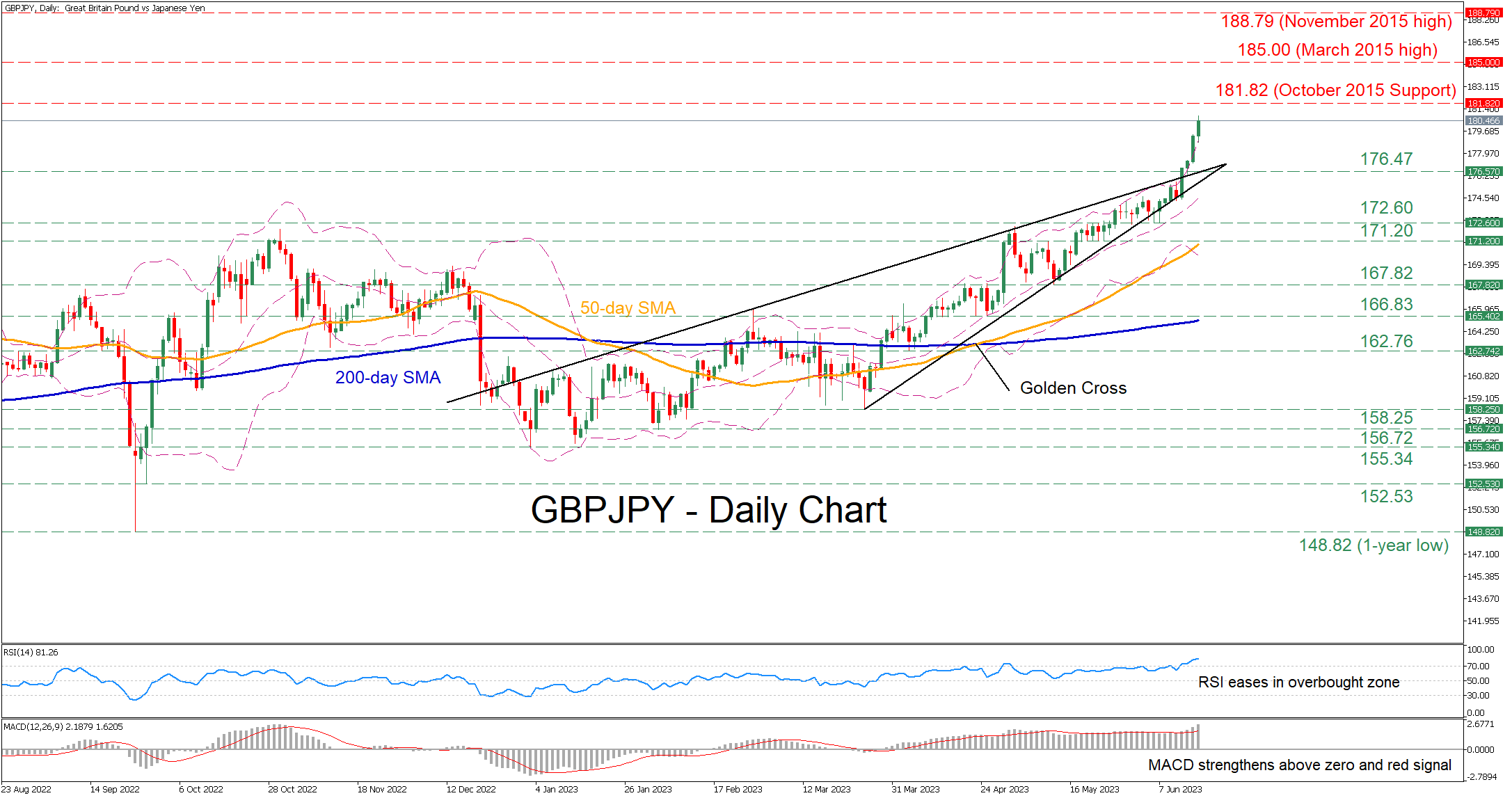
GBPJPY has been stuck in a prolonged uptrend since the beginning of the year, generating a structure of consecutive multi-year highs. In the near-term, the price managed to jump above the restrictive trendline that held strong since January, triggering a strong advance towards a fresh 7½-year peak in today’s session.
The momentum indicators currently suggest that the recent rally could be overstretched as both the RSI and the MACD histogram are strengthening well within their overbought territories, while the price is trading above the upper Bollinger band in the last few sessions. Hence, a potential downside correction may be on the cards.
Should buying pressures persist, the pair could extend its uptrend towards fresh multi-year highs, where the October 2015 support of 181.82 could cap its upside. Slicing through that wall, the price could ascend towards the March 2015 peak of 185.00. If that barrier fails, the bulls might then target the November 2015 high of 188.79.
Alternatively, if the positive momentum wanes and the price reverses lower, the 176.47 hurdle could act as the first line of defence. Further declines could then cease at 172.60 before the June support of 171.20 comes under examination. A dive beneath that zone could open the door for the 167.82 support.
In brief, GBPJPY has adopted a bullish short-term pattern, posting consecutive multi-year highs in the past two weeks. However, a downside correction should not be ruled out as the price has approached overbought conditions.
USD/JPY: Receives Fresh Boost from Unchanged BOJ
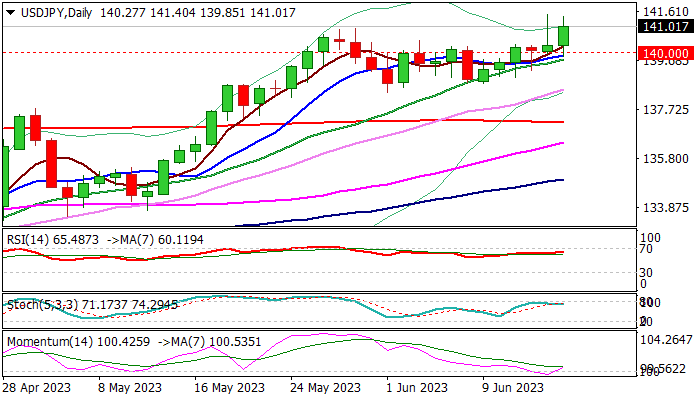
The USDJPY regained traction in early Friday after the Bank of Japan kept its policy unchanged that pushed yen lower across the board.
Fresh strength looks for retest of Thursday’s high at 141.50 (new 2023 peak) after bulls were strongly rejected here but remained in play as the action stayed above pivotal 140.00 support.
Bullish daily studies add to positive fundamentals, keeping near-term focus at the upside, with break of temporary barrier at 141.50 to open way towards target at 142.50 (Fibo 61.8% of 151.94/127.22 downtrend.
Weekly close above 140 level (reinforced by daily Tenkan-sen) is needed to further strengthen near-term structure.
Res: 141.50; 141.97; 142.50; 143.00.
Sup: 140.93; 140.45; 140.00; 139.71.
Eurozone CPI finalized at 6.1% yoy in May, core at 5.3% yoy
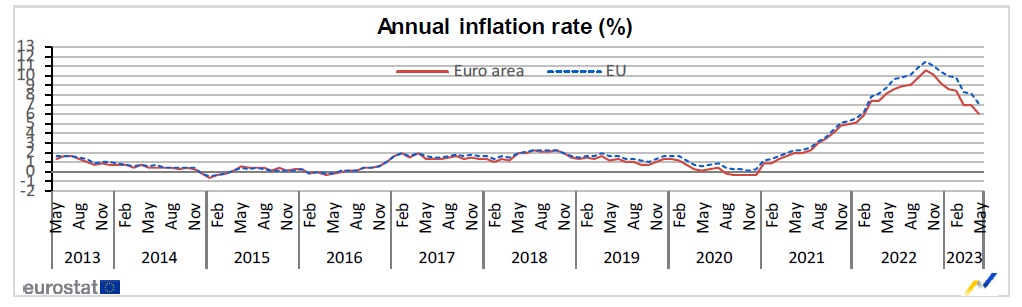
Eurozone CPI was finalized at 6.1% yoy in May, down from April's 7.0% yoy. CPI core (all-items ex energy, food, alcohol & tobacco) was finalized at 5.3% yoy, down from prior month's 5.6% yoy.
The highest contribution to the annual Eurozone inflation rate came from food, alcohol & tobacco (+2.54%), followed by services (+2.15%), non-energy industrial goods (+1.51%) and energy (-0.09%).
EU CPI was finalized at 7.1% yoy, down from prior month's 8.1% yoy. The lowest annual rates were registered in Luxembourg (2.0%), Belgium (2.7%), Denmark and Spain (both 2.9%). The highest annual rates were recorded in Hungary (21.9%), Poland and Czechia (both 12.5%). Compared with April, annual inflation fell in twenty-six Member States and rose in one.
ECB policymakers emphasize need to continue tightening
In a chorus of comments today, ECB Governing Council members underscored the need for continued monetary tightening to combat persistently high inflation.
Bundesbank President Joachim Nagel stressed the central bank "still have more ground to cover", adding "we may need to keep raising rates after the summer break."
"Once we have reached the peak, we will stay there until we are sure of a safe and timely return of inflation to our 2% target," Nagel said. He also highlighted the necessity of reducing the central bank's balance sheet to support this policy.
Bostjan Vasle, Chief of Slovenia's central bank, echoed this sentiment. "If it turns out that inflation is more persistent than it seems at the moment...then of course further monetary-policy action will be necessary," he noted.
In Lithuania, Central Bank Chief Simkus expressed concern about the prolonged high inflation, asserting that "over the medium term, inflation is not coming back to an appropriate level." He also questioned market expectations for early 2024 rate cuts, suggesting that such a rapid reversal would be perplexing.
Meanwhile, Estonian Central Bank Chief Madis Muller clarified, "Euro zone interest rates have not yet peaked." He added, "The ultimate goal is clear for the central bank: we need to quickly get the price rise under control."
Finally, Finland's Central Bank Chief Olli Rehn, voiced the need for restrictive interest rates to achieve a timely return of inflation to the 2% medium-term target. "The key ECB interest rates will be brought to levels sufficiently restrictive...and will be kept at those levels for as long as necessary," Rehn concluded.
BoJ Ueda: It’s probably more difficult to deal with an undershoot of inflation
In the press conference following BoJ's decision to stand pat, Governor Kazuo Ueda said, "at present, inflation has exceeded 2% for 13 straight months but could fall below that level ahead. That's why we are not normalizing monetary policy. But if that view changes sharply, we will have to change policy."
"We expect inflation to moderate, but it's true the pace of decline is somewhat slow," he said. "But we're still in the early stages of the moderation. There's uncertainty on whether the future slowdown will be a gradual one, or a quite sharp one."
"What's important is not just our median forecast but how certain that forecast is ... We won't act just by looking at the median forecast. We'd like to look comprehensively at various data including distribution".
"We have to consider what tools we have at our disposal when inflation overshoots, and when it undershoots. When we compare these, it's probably more difficult to deal with an undershoot of inflation."
Is Gold Set to Rally Yet?
Don't give up on gold just yet! Despite some challenging times, the World Gold Council believes gold should remain a key asset in your strategic arsenal. Even as the Federal Reserve takes a breather from its aggressive monetary policy stance, it's still maintaining a hawkish stance. In fact, they're signaling the possibility of two more rate hikes this year. Joseph Cavatoni, the head market strategist for the Americas at the World Gold Council, emphasized the importance of this hawkish bias. So, please keep your eyes on gold as it navigates these near-term headwinds. It's always good to have a shiny backup plan in the ever-evolving world of forex trading!
US DOLLAR - 4Hour Timeframe
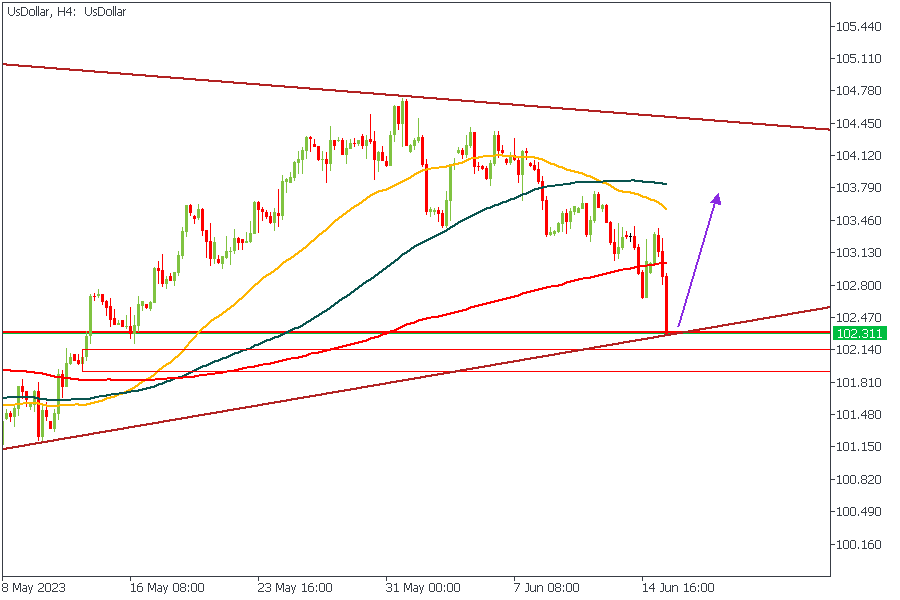
The FOMC’s recent decision to pause the interest rate led to a continued bearish outcome on the US Dollar. Price action on the US Dollar is, however, at this time approaching another key price action area. The price action heading into the demand zone seems solid, so we must exercise caution before deciding. Nonetheless, the confirmations for a bullish reversal include the following:
- Trendline support
- Drop base rally demand zone
- Pivot zone on the Daily timeframe
Analyst’s Expectations:
- Direction: Bullish
- Target: 102.937
- Invalidation: 101.604
XAUUSD - 4Hour Timeframe
XAUUSD is at a confluence zone between two resistance trendlines. Usually, this is a typical confirmation of strong resistance pressure on the price action. However, we have additional confirmations from the 50 and 100 moving averages in this case. Another crucial factor to consider is the descending array of the moving averages - a typical bearish trend indicator. Based on these and the supply zone, I would look forward to opportunities for a clear sell entry heading into the new week.
Analyst’s Expectations:
- Direction: Bearish
- Target: 1937.66
- Invalidation: 1973.38
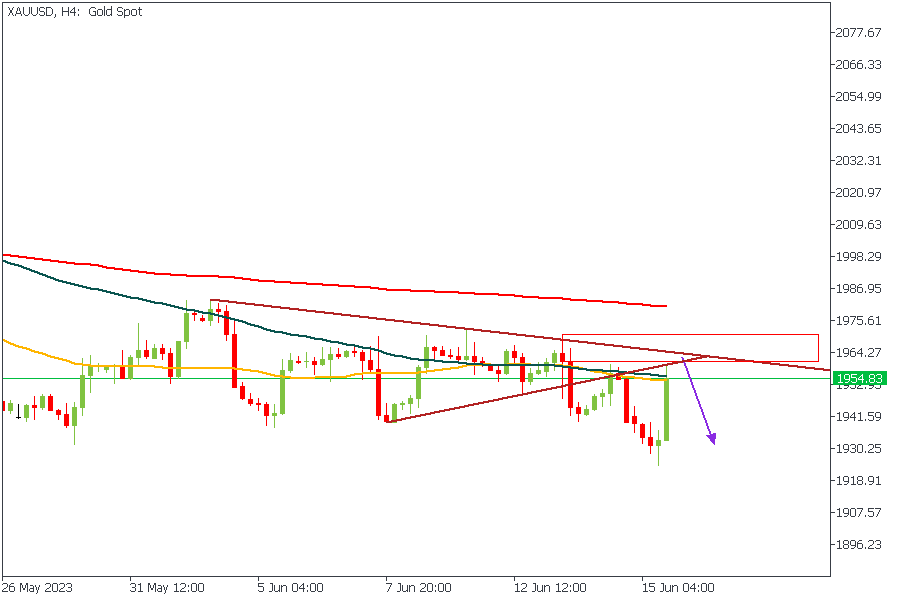
P.S.: The probability of this analysis playing out relies heavily on the observed price action from the US Dollar in the 4-Hour timeframe, following the sentiments above. If the US Dollar breaks below the highlighted demand zone, Gold will soar even higher. Do your due diligence to observe the charts properly for a reliable entry confirmation based on your preferred trading strategy.
CONCLUSION
The trading of CFDs comes at a risk. Thus, to succeed, you have to manage risks properly. To avoid costly mistakes while you look to trade these opportunities, be sure to do your due diligence and manage your risk appropriately.
USDCAD Faces New Bearish Risks
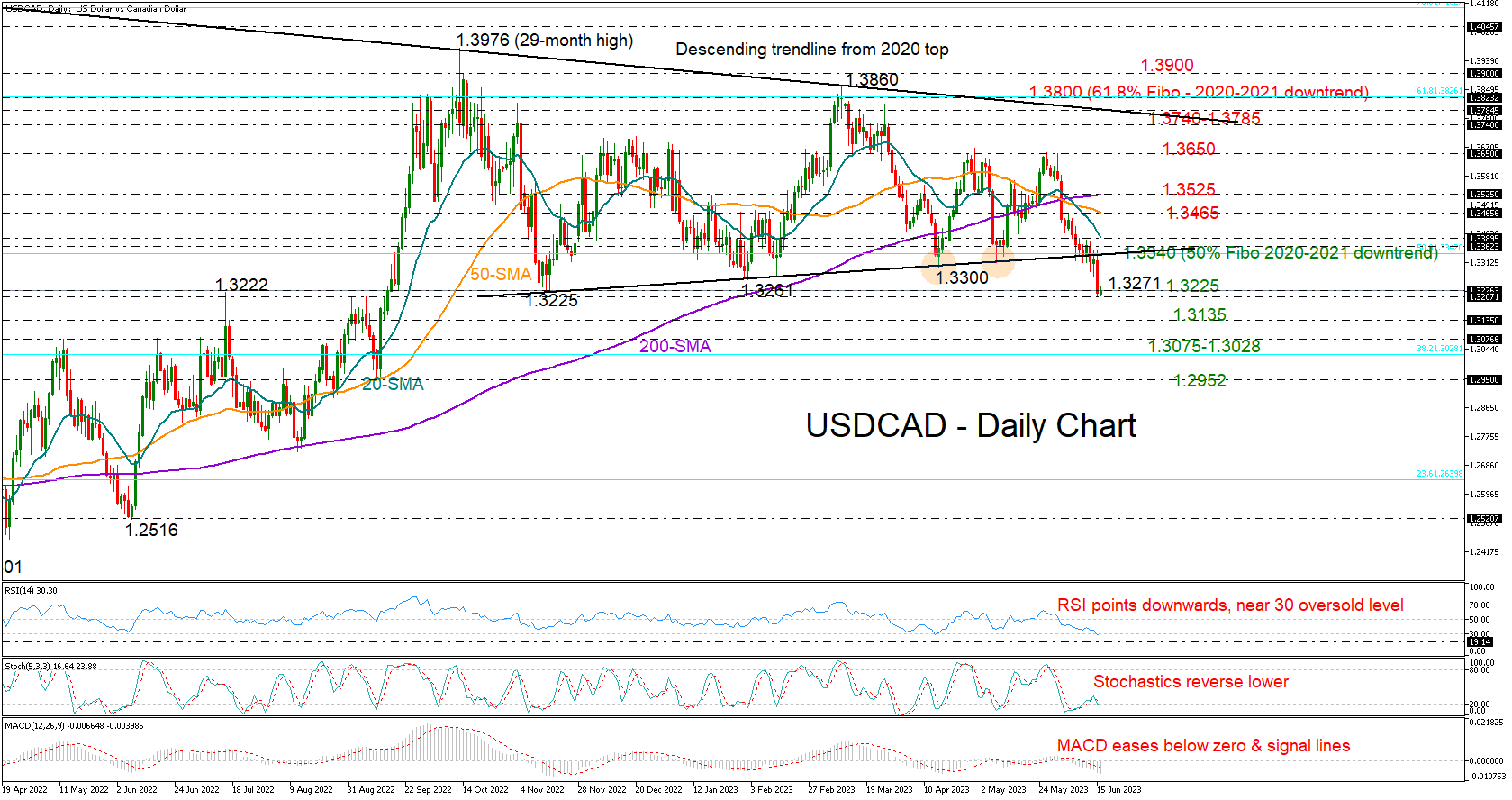
USDCAD corrected sharply lower to a nine-month low of 1.3200 on Thursday, following the close below the support trendline, which had been buffering downside movements since November.
The pair is in the third week of declines and could keep going down despite today's lack of selling pressure. The RSI and stochastic oscillator are close to oversold levels, suggesting a sideways move or upside reversal, but they are not changing direction to the upside yet. The falling MACD is also reflecting dampened market sentiment.
It’s also worthy to note that the 50- and 200-day simple moving averages (SMAs) have posted a death cross for the first time since August 2020. The 20-day SMA has crossed below the longer-term SMAs too, flagging a potential deterioration in the market trend.
Therefore, if the 1.3200 base proves fragile, the bearish wave could stretch towards the 1.3135 barrier and then revisit the 1.3075-1.3028 zone where the 38.2% Fibonacci retracement level of the 1.4667-1.2007 downleg is placed. The 1.2952 low from mid-September could be the next target.
In the case the price edges above the July-November constraining zone of 1.3225, the bulls may revisit the almost flat broken trendline and the 23.6% Fibonacci mark of 1.3340. A decisive close above that border is required to generate fresh buying interest. If efforts prove successful, with the price also piercing through the 20-day SMA, the next resistance could occur somewhere between the 50- and 200-day SMAs at 1.3465 and 1.3525 respectively. Another victory for the bulls here could clear the way towards the tough resistance of 1.3650.
Summing up, a new bearish threat could emerge in USDCAD, but traders need to wait for a confirmation signal below the 1.3200 psychological mark.
AUDJPY Reaches New 2023 High in Exponential Move Since Early June
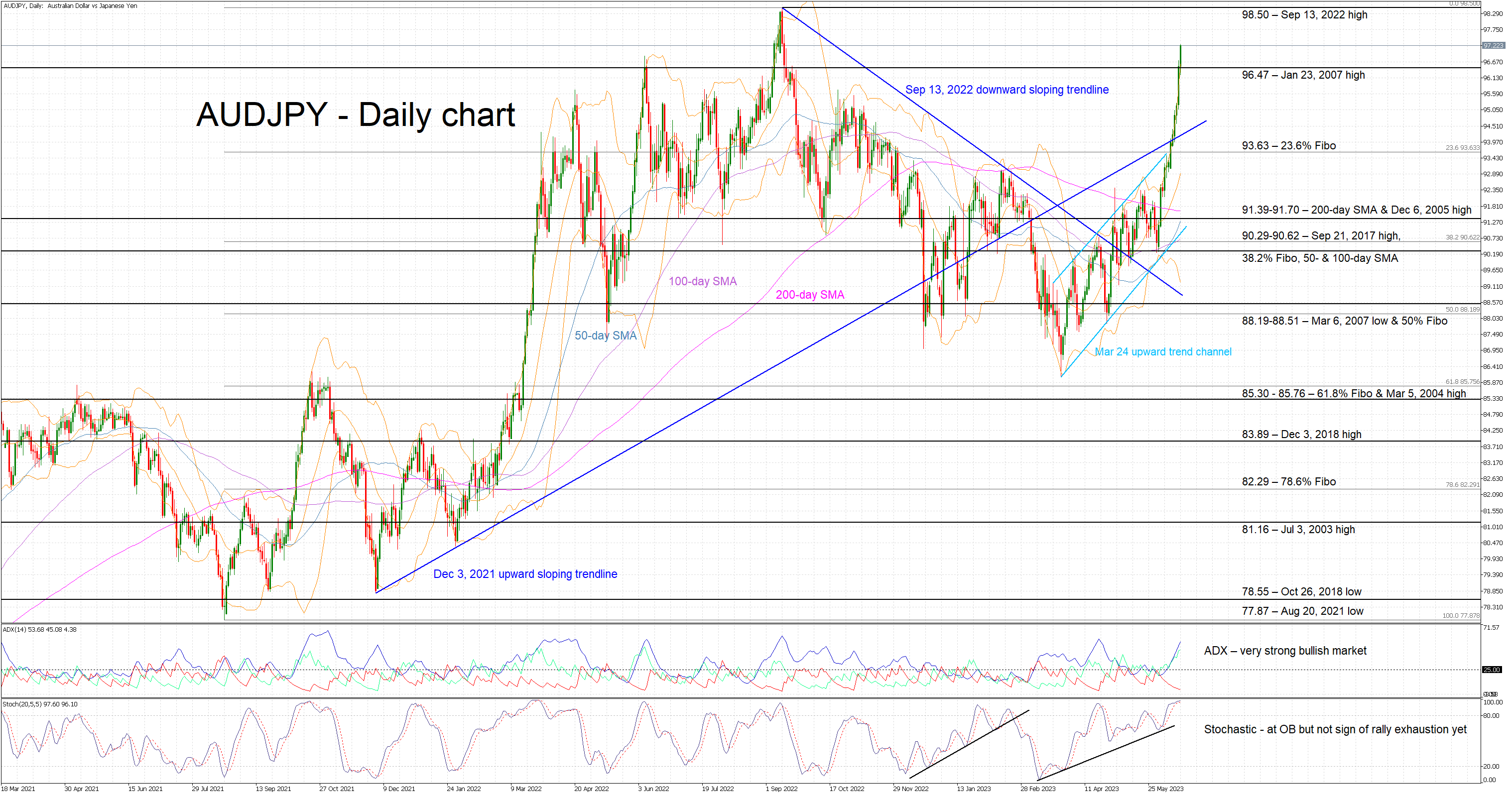
AUDJPY has been recording an exponential move since early June, registering nine consecutive green candlesticks. This is an undeniable confirmation of the underlying strength of the current upleg that pushed this pair to the highest level since September 14, 2022. AUDJPY is now hovering just above the 96.47 level with the bears trying to find an appropriate area to set up their defence.
In the meantime, the Average Directional Movement Index (ADX) has risen to the highest level since mid-April, signaling an aggressive trending market. Any signs of stabilization at this high level could be seen as an indication of rally exhaustion. Similarly, the stochastic oscillator is scraping the top of its overbought (OB) territory, supporting the higher high seen in AUDJPY.
If the bulls remain confident, they would try to keep this pair above the January 23, 2007 high of 96.47. If successful, they could then plot their path towards the September 13, 2022 high of 98.50 and register a new 2023 high.
On the other hand, the bears are desperately looking to put a stop to the current upleg and are expecting the first red candlestick. They would love a push below the 96.47 level and then gradually reduce their losses by engineering a correction towards the 23.6% Fibonacci retracement of the August 20, 2021 – September 13, 2022 downtrend at 93.63.
To sum up, AUDJPY bulls continue to control the market with the technical picture on their side. The first red candlestick could reinvigorate the bears as they attempt to limit their losses.