Sample Category Title
Dollar Declines as Headline and Core CPI Slowed; Sterling Soars on Positive Job Data
Dollar falls significantly in early US session, reacting to reports that both headline and core CPI decelerated in May. This development boosts confidence to Fed policymakers to skip tightening at tomorrow's decision. Meanwhile, Canadian Dollar and Yen are following as the next weakest for now.
Contrarily, Sterling is witnessing a surge, rebounding from its initial dip. Solid job figures, especially strong wage growth, are strengthening the argument for another rate hike by BoE next week. Euro, however, is falling behind following disappointing Germany ZEW data. Australian and New Zealand Dollar are mixed for now, but stay as some of the best performers for the week.
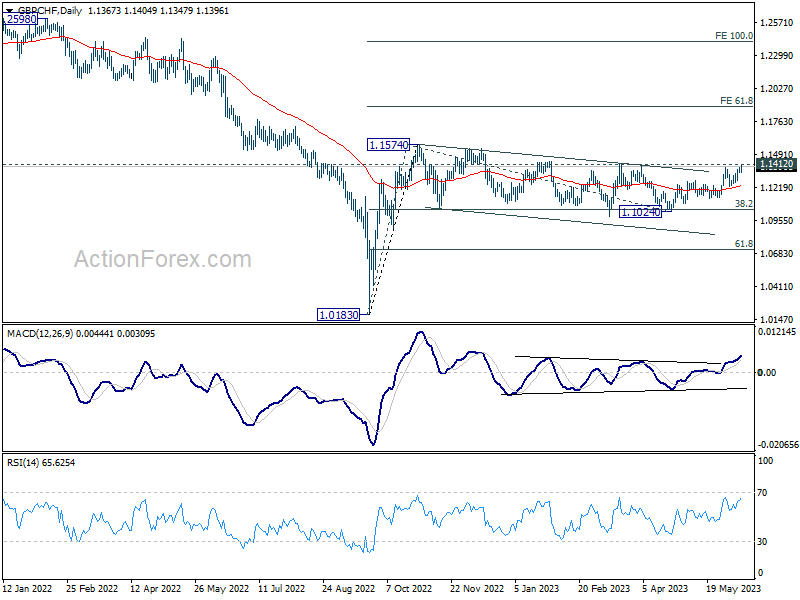
Technically, GBP/CHF is worth some attention this week, in particular with UK GDP data featured tomorrow. It's now pressing 1.1412 resistance. Firm break there will add to case that whole corrective pattern from 1.1574 has completed. More importantly, the up trend from 1.0183 might be ready to resume through 1.1574 high. Let's see how it goes.
 In Europe, at the time of writing, FTSE is flat. DAX is up 0.29%. CAC is up 0.28%. Germany 10-year yield is down -0.028 at 2.363. Earlier in Asia, Nikkei rose 1.80%. Hong Kong HSI rose 0.60%. China Shanghai SSE rose 0.15%. Singapore Strait Times dropped -0.21%. Japan 10-year JGB yield dropped -0.0078 to 0.421.
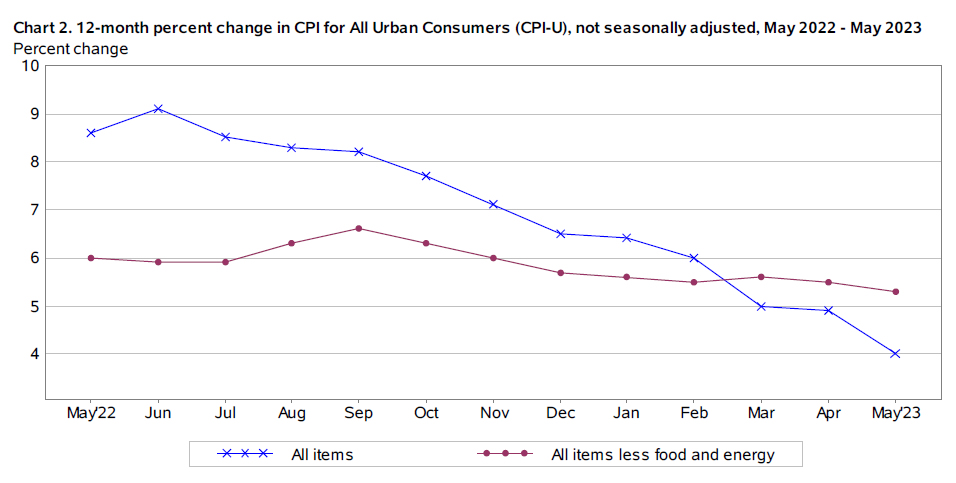
US CPI slowed to 4.0% yoy in May, core CPI down to 5.3% yoy
US CPI rose 0.1% mom in May, below expectation of 0.3% mom. CPI core, all items less food and energy, rose 0.4% mom, matched expectations. Food index rose 0.2% while energy index declined -0.3% mom.
For the 12 months, CPI slowed from 4.9% yoy to 4.0% yoy, below expectation of 4.2% yoy. That's also the lowest reading since March 2021. CPI core slowed from 5.5% yoy to 5.3% yoy, matched expectations. Energy index dropped -11.7% yoy while food index rose 6.7% yoy.
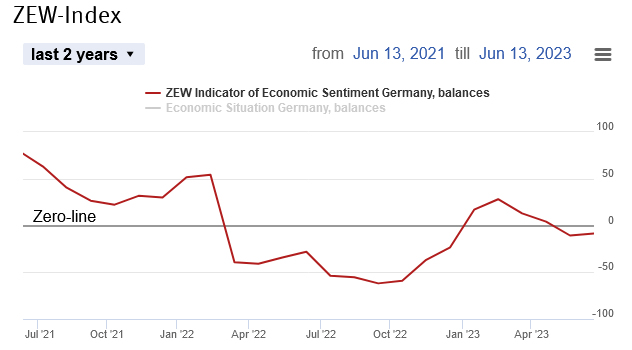
Germany ZEW economic sentiment rose to -8.5, but current situation tumbles very sharply
Germany ZEW Economic Sentiment rose slightly from -10.7 to -8.5 in May, above expectation of -14.7. Current Situation index, however, fell "very sharply" from -34.8 to -56.5, much worse than expectation of -40.
"The ZEW Indicator of Economic Sentiment shows a slight improvement, but it remains in negative territory. This means that experts do not anticipate an improvement in the economic situation during the second half of the year. Particularly, sectors focused on exports are likely to perform poorly due to a weak global economy. However, the current recession is generally not considered particularly alarming," comments ZEW President Achim Wambach.
Eurozone ZEW Economic Sentiment dropped from -9.4 to -10.0, above expectation of -13.1. Current Situation index dropped from -14.4 to -41.9.
Eurozone balance for short-term interest rates stands at 72.3, indicating anticipated rate hikes. On the other hand, balance for short-term interest rates for the US stands at 16.6, indicating no change in interest rates.
UK payrolled employees rose 23k in May, unemployment rate down to 3.8% in Apr
In May, UK payrolled employees rose 0.1% mom or 23k. Comparing with the same month a year ago, payrolled employees rose 1.6% yoy or 460k. Median monthly pay rose 7.0% yoy, highest in the other service activities sector, with an increase of 10.1% yoy, and lowest in the arts, entertainment and recreation sector, with an an increase of 5.4% yoy. Claimant count dropped -13.6k versus expectation of 21.4k.
In the three months to April, unemployment rate dropped to 3.8%, versus expectation of 4.0%. Average earnings excluding bonus accelerated from 6.8% to 7.2%, above expectation of 6.9%. Average earnings including bonus accelerated from 6.1% to 6.5%, above expectation of 6.1%.
Australia Westpac consumer sentiment up 0.2%, dived after RBA hike
Australia Westpac Consumer Sentiment Index rose marginally by 0.2% to 79.2 in June. Nevertheless, the index continues to hover around "recession lows" over the past year, similar to figures recorded during the "deep recessions" of late 1980s/early 1990s.
Significantly, responses gathered within the survey period (June 5-9) reflected the considerable impact of RBA's unexpected rate hike on June 6. Confidence had seen a substantial surge from 79.0 in May to 89.0 prior to the rate hike announcement. However, it experienced a sharp decline post-announcement, plummeting to a severely low level of 72.6.
Westpac pointed out that inflation continues to be the "dominant drag" on consumer confidence, overshadowing even the effects of higher interest rate Nevertheless,confidence in labor market turned as one consistent positive.
In light of the upcoming RBA meeting on July 4, Westpac forecasts another 25 basis point rate hike, taking the rate to 4.35%. It noted, "Given that little further information will be available on expectations and unit labour costs in the near term it seems logical that delaying the tightening for another month, to assess more data, seems unnecessary".
Australia NAB business confidence fell to -4, conditions down to -8
Australia's NAB Business Confidence Index reported a decline in May, dropping from 0 to -4. Furthermore, Business Conditions witnessed a significant drop from 15 to 8. Looking at some details, trading conditions fell from 22 to 14, profitability conditions went down from 12 to 7, and employment conditions also experienced a drop, going from 11 to 4.
"Business conditions recorded a solid decline in May, and it appears the gradual easing we have seen through early 2023 appears to be strengthening," said NAB Chief Economist Alan Oster. "That said, conditions remain above average reflecting just how strong the economy was through 2022."
Oster highlighted that "all three sub-components eased in the month, suggesting that demand growth is now moderating, and trading conditions, profitability and employment are beginning to reflect this."
Business confidence fell back into the negative zone, oscillating within the 0 to -4 index point range in recent months. "Our bigger worry is the sharp decline in forward orders in the month," Oster noted.
Meanwhile, price measures inched upwards again, yet they remain notably below their mid-2022 peaks. "The trend over the coming months will be important as the RBA tries to assess whether it has done enough and if underlying inflation pressures are easing in a timely way," Oster noted.
China cuts key short-term policy rate
China's central bank PBOC cut a key short-term policy rate, the seven-day reverse repurchase rate, by -10bps from 2% to 1.9%. The policy change is anticipated to infuse an additional CNY 2B of liquidity into the economy through its seven-day repos.
This marks the first move in the past 10 months, dating back to last August. It follows hot on the heels of the country's major banks slashing deposit rates last week, which included a decrease in interest rate for five-year time deposits from 2.65% to 2.5%.
The timing of this decision is particularly notable, as it precedes PBoC's medium-lending facility interest rate announcement, which is set to be unveiled this Thursday. Moreover, the bank's loan prime rate is scheduled for release on June 20.
Adding to this week's financial developments, China is expected to publish its May credit lending data along with several key activity indicators such as retail sales and industrial production.
GBP/USD Mid-Day Outlook
Daily Pivots: (S1) 1.2466; (P) 1.2533; (R1) 1.2578; More...
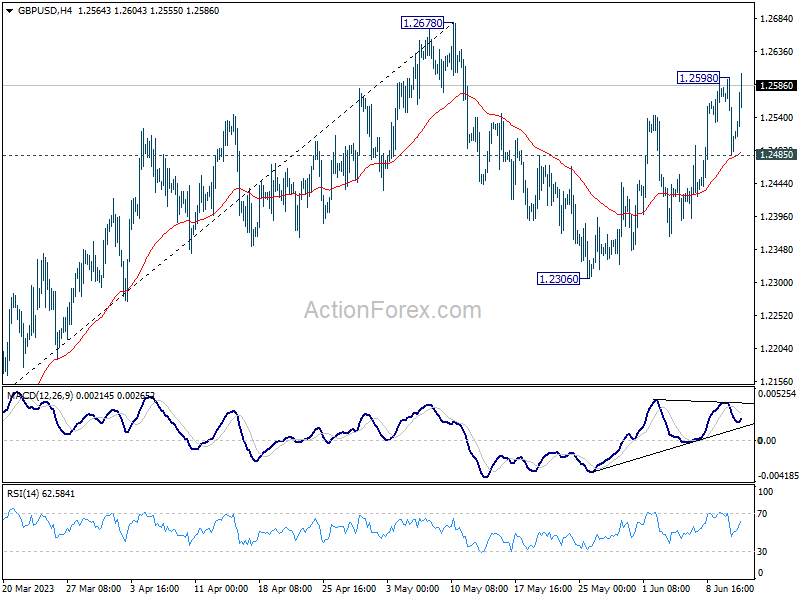
Intraday bias in GBP/USD is back on the upside as rebound from 1.2306 resumed after brief retreat. Further rally should be seen to retest 1.2678 high. Based on current momentum, upside could be limited there, to bring another fall to extend the corrective pattern from 1.2678. On the downside, break of 1.2485 support will turn bias back to the downside for 1.2306 support instead.
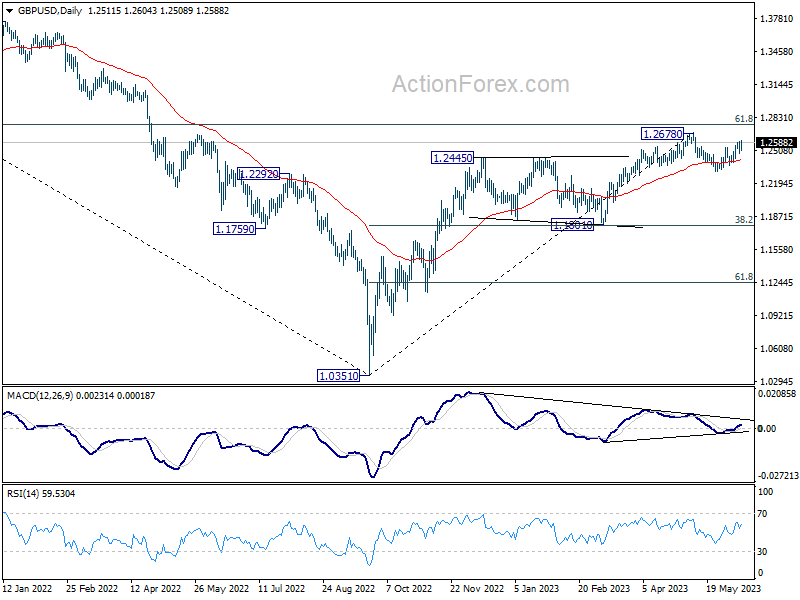
In the bigger picture, as long as 1.1801 support holds, rise from 1.0351 medium term bottom (2022 low) is expected to extend further. Sustained break of 61.8% retracement of 1.4248 (2021 high) to 1.0351 at 1.2759 will add to the case of long term bullish trend reversal. However, firm break of 1.1801 will indicate rejection by 1.2759, and bring deeper decline, even as a correction.
Economic Indicators Update
| GMT | Ccy | Events | Actual | Forecast | Previous | Revised |
|---|---|---|---|---|---|---|
| 23:50 | JPY | BSI Large Manufacturing Index Q2 | -0.4 | -10.5 | ||
| 00:30 | AUD | Westpac Consumer Confidence Jun | 0.20% | -7.90% | ||
| 01:30 | AUD | NAB Business Conditions May | 8 | 14 | ||
| 01:30 | AUD | NAB Business Confidence May | -4 | 0 | ||
| 06:00 | GBP | Claimant Count Change May | -13.6K | 21.4K | 23.4K | |
| 06:00 | GBP | ILO Unemployment Rate (3M) Apr | 3.80% | 4.00% | 3.90% | |
| 06:00 | GBP | Average Earnings Excluding Bonus 3M/Y Apr | 7.20% | 6.90% | 6.70% | 6.80% |
| 06:00 | GBP | Average Earnings Including Bonus 3M/Y Apr | 6.50% | 6.10% | 5.80% | 6.10% |
| 06:00 | EUR | Germany CPI M/M May F | -0.10% | -0.10% | -0.10% | |
| 06:00 | EUR | Germany CPI Y/Y May F | 6.10% | 6.10% | 6.10% | |
| 09:00 | EUR | Germany ZEW Economic Sentiment Jun | -8.5 | -14.7 | -10.7 | |
| 09:00 | EUR | Germany ZEW Current Situation Jun | -56.5 | -40 | -34.8 | |
| 09:00 | EUR | Eurozone ZEW Economic Sentiment Jun | -10 | -13.1 | -9.4 | |
| 10:00 | USD | NFIB Business Optimism Index May | 89.4 | 88.8 | 89 | |
| 12:30 | USD | CPI M/M May | 0.10% | 0.30% | 0.40% | |
| 12:30 | USD | CPI Y/Y May | 4.00% | 4.20% | 4.90% | |
| 12:30 | USD | CPI Core M/M May | 0.40% | 0.40% | 0.40% | |
| 12:30 | USD | CPI Core Y/Y May | 5.30% | 5.30% | 5.50% |
US CPI slowed to 4.0% yoy in May, core CPI down to 5.3% yoy
US CPI rose 0.1% mom in May, below expectation of 0.3% mom. CPI core, all items less food and energy, rose 0.4% mom, matched expectations. Food index rose 0.2% while energy index declined -0.3% mom.
For the 12 months, CPI slowed from 4.9% yoy to 4.0% yoy, below expectation of 4.2% yoy. That's also the lowest reading since March 2021. CPI core slowed from 5.5% yoy to 5.3% yoy, matched expectations. Energy index dropped -11.7% yoy while food index rose 6.7% yoy.
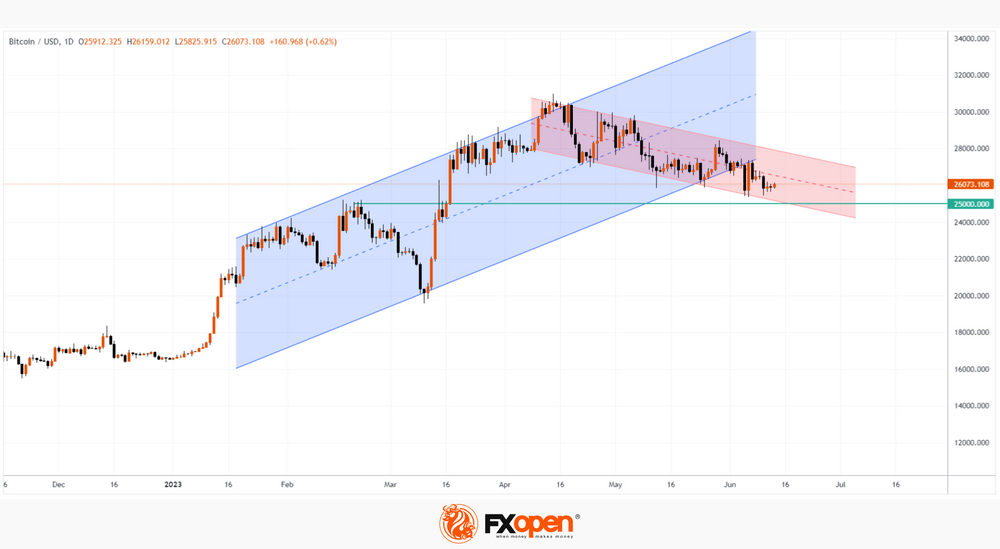
BTCUSD Analysis: Clients Fleeing Binance
According to various estimates, from USD 2.36 billion to USD 3.35 billion was withdrawn from the largest cryptocurrency exchange in 1 week. The head of the exchange, Changpeng Zhao, said that the drop in the balance could be exaggerated due to the depreciation of cryptocurrencies against the dollar, but fears are growing.
Hearings will be held today to freeze the assets of the Binance.US exchange in a lawsuit filed by the SEC. By the way, Binance also received a complaint from regulators in Nigeria, a country leading in the adoption of cryptocurrencies in Africa.
Cryptocurrency market enthusiasts are given hope by a bill introduced yesterday by Congressmen Warren Davids and Tom Emmer, which involves the restructuring of the SEC and the dismissal of its head, Gary Gensler. However, believing that this will happen may be too naive.
In one week after the lawsuits from the SEC, the market capitalization of crypto decreased by approximately USD 75 billion. The decline leaders are crypto assets that the SEC classified as securities - ADA, BNB, MATIC and others - about 60 assets in total. Fortunately for enthusiasts, ETH and BTC are not among them.
However, the price of bitcoin is under pressure. The BTC/USD rate has broken through the ascending channel, tested it (as we indicated), and is near an important support around USD 25k. It could be breached if there is a decision to freeze Binance.US funds, or news about the US economy that affects the value of the US dollar.
EURGBP Rebounds But Stays in Downtrend
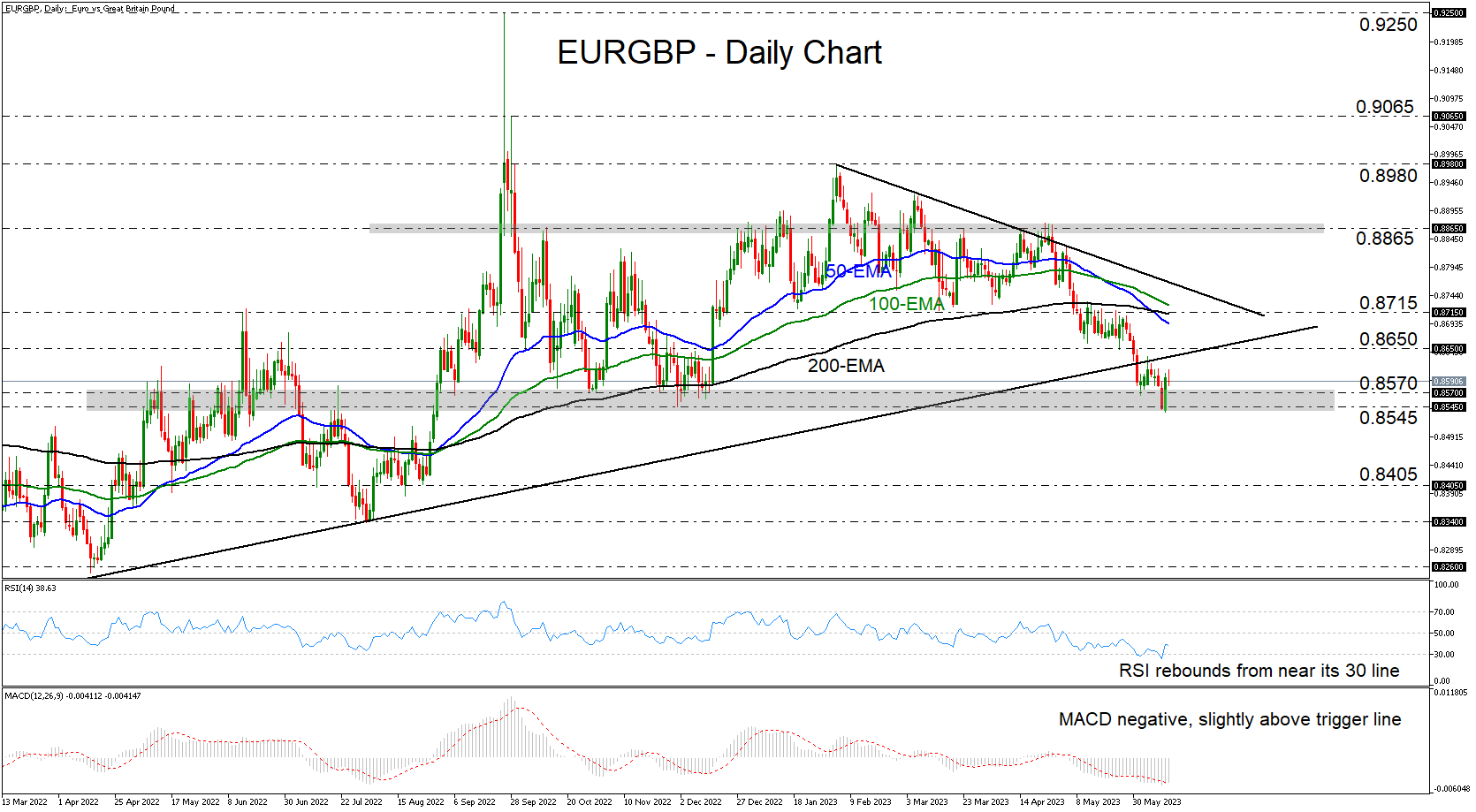
EURGBP rebounded yesterday after triggering some buy orders near the 0.8545 zone, marked as support by the low of December 1. That said, the pair remains below the upward sloping line drawn from the low of March 7, which implies that yesterday’s recovery may be just a corrective bounce within the broader downtrend.
Both the RSI and the MACD reflect the rebound and suggest that it could extend for a while longer, perhaps until the pair tests the aforementioned uptrend line. The RSI rebounded from slightly below its 30 line, while the MACD, although negative, poked its nose above its trigger line.
If the bears are willing to recharge from below the uptrend line, they may attack the 0.8545 barrier again. Nonetheless, a break below that zone may be needed to signal a downtrend continuation. Such a dip could set the stage for declines all the way down to the low of August 24 at around 0.8405.
On the upside, a break above 0.8650 could dismiss the bearish case and perhaps turn the outlook neutral, but the move signaling that the bulls have stolen all the bears’ swords may be a strong break above the 0.8865 territory, which acted as a ceiling on several occasions in the recent past. If at some point in the not-too-distant future, the bulls are strong enough to achieve such a recovery, they may then feel confident to climb to the peak of February 3 at 0.8980.
To recap, EURGBP posted some gains yesterday, but in the bigger picture, the outlook likely remains negative as the pair continues to trade below the uptrend line drawn from the low of March 7.
EURAUD Getting Closer to Key Area
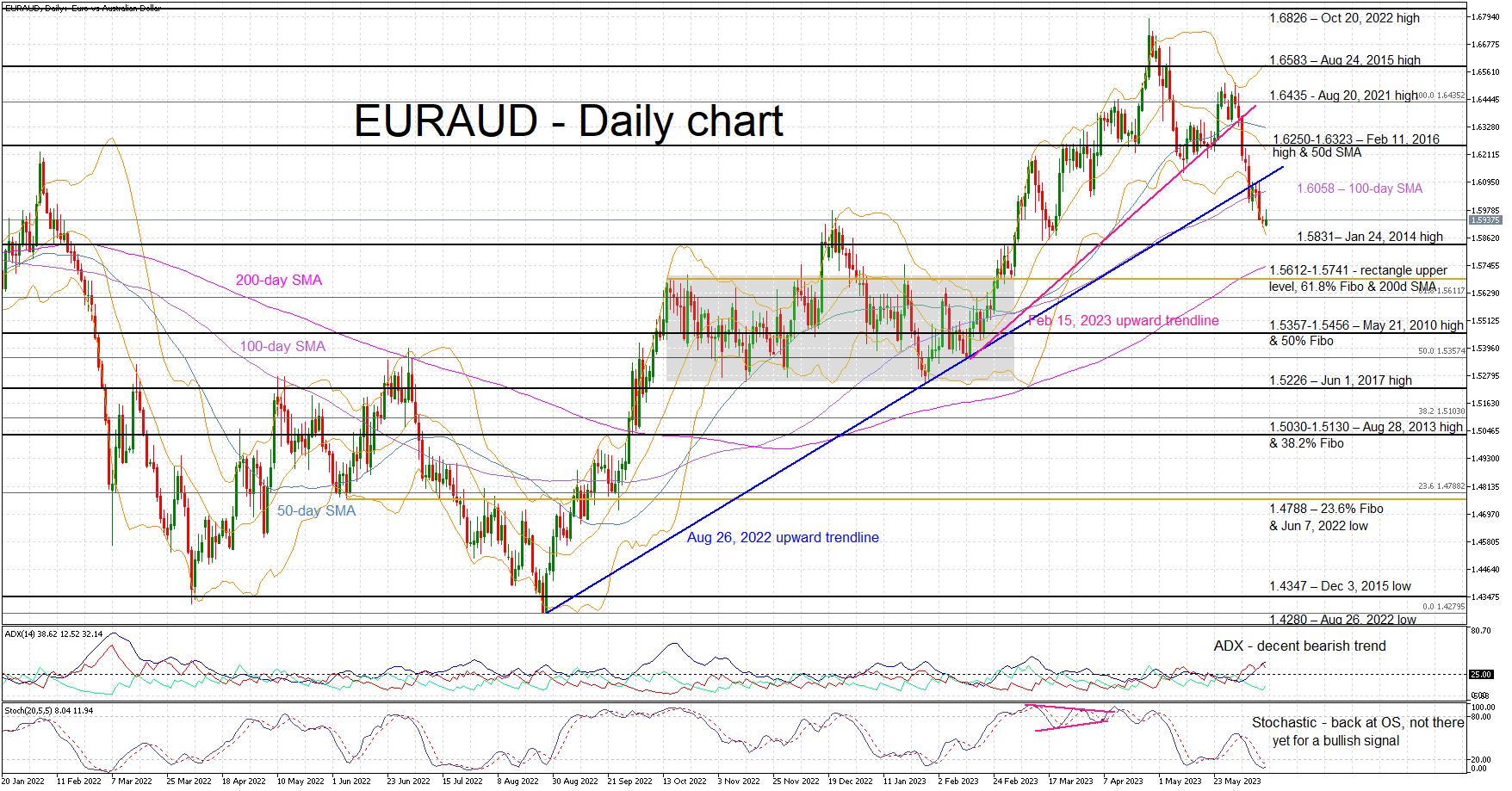
EURAUD’s drop continues, cancelling out most of the upward move recorded since the March 6, 2023 bullish breakout. The pair is hovering just above the 1.5831 level as a pattern of lower higher and lower lows is in place. This raises the possibility of a small upleg from current levels, setting the scene for an even more aggressive sell-off afterwards.
The recent price action continues to enjoy the support of the momentum indicators. The Average Directional Movement Index (ADX) is pointing to a decent bearish trend, but it appears to be very close to its peak. In addition, the stochastic oscillator has returned to its oversold area, where it can stay there for a while before signaling the next bullish move.
Should the bulls decide to stage a small recovery, they would try to break the 100-day simple moving average (SMA) at 1.6058. The path then becomes trickier at the busy 1.6250-1.6323 area. This range has repeatedly proved its importance and it is currently defined by the February 11, 2016 high and the 50-day simple moving average (SMA).
On the other hand, the bears appear determined for a move towards the 1.5612-1.5741 range where the upper boundary of the October 2022-March 2023 rectangle resides. However, they firstly have to overcome the support set by the January 24, 2014 high at 1.5831. Even lower, the 1.5357-1.5465 area could prove tougher to crack.
To sum up, EURAUD bears are finally staging their comeback, but their true determination is yet to be put to the test.
Gold Technical: Potential Breakdown to Resume Short-Term Downtrend
Gold Technical: Potential Breakdown to Resume Short-Term Downtrend
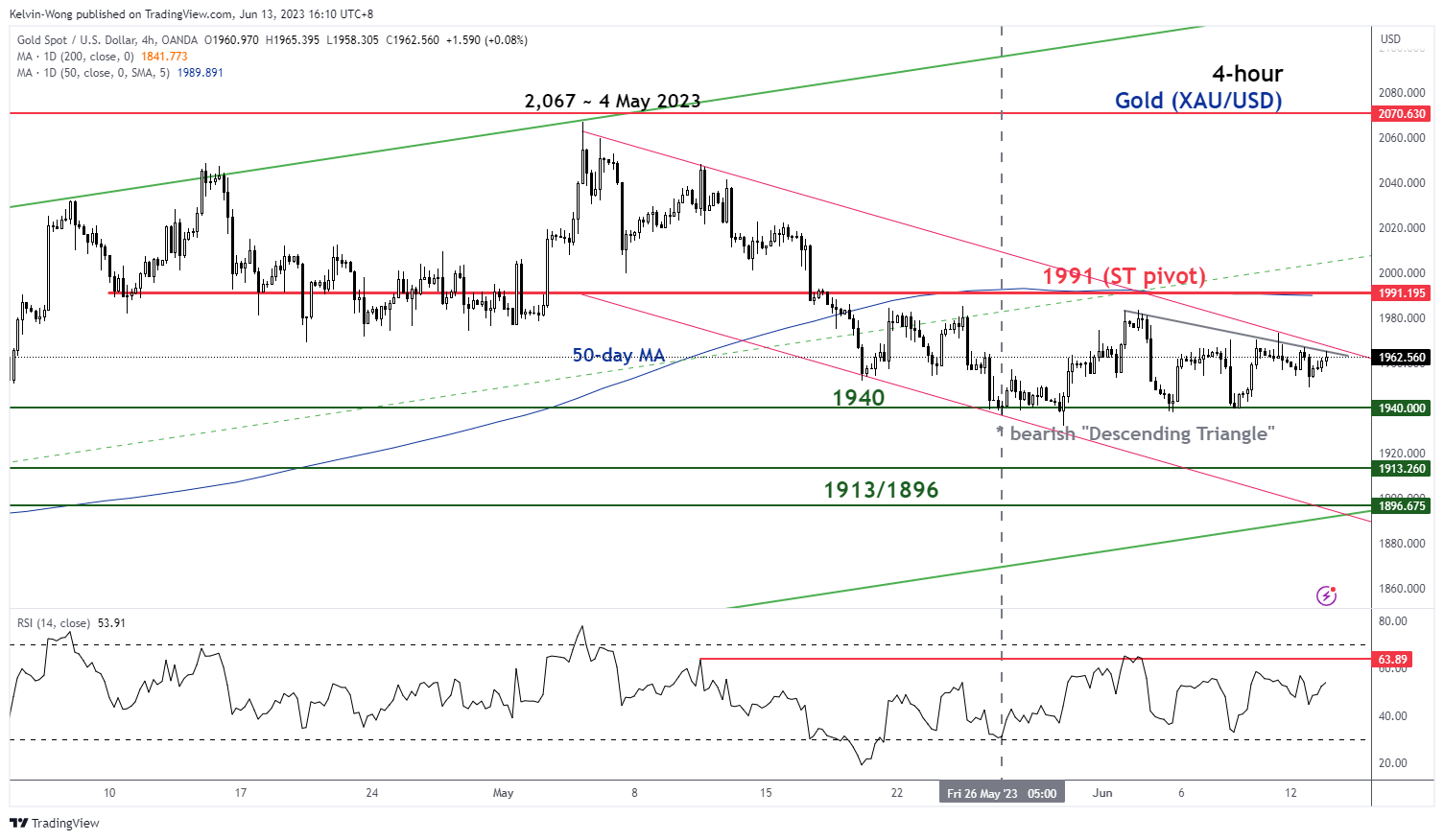
- In the past 3 weeks, Gold (XAU/USD) has been evolving with a minor “Descending Triangle” with its range support at US$1,940.
- Price actions have failed to surpass the 50-day moving average now acting as a resistance at US$1,991.
- Short-term downtrend phase from the 4 May 2023 high remains intact.
Fig 1: Gold (XAU/USD) major trend as of 13 Jun 2023 (Source: TradingView, click to enlarge chart)
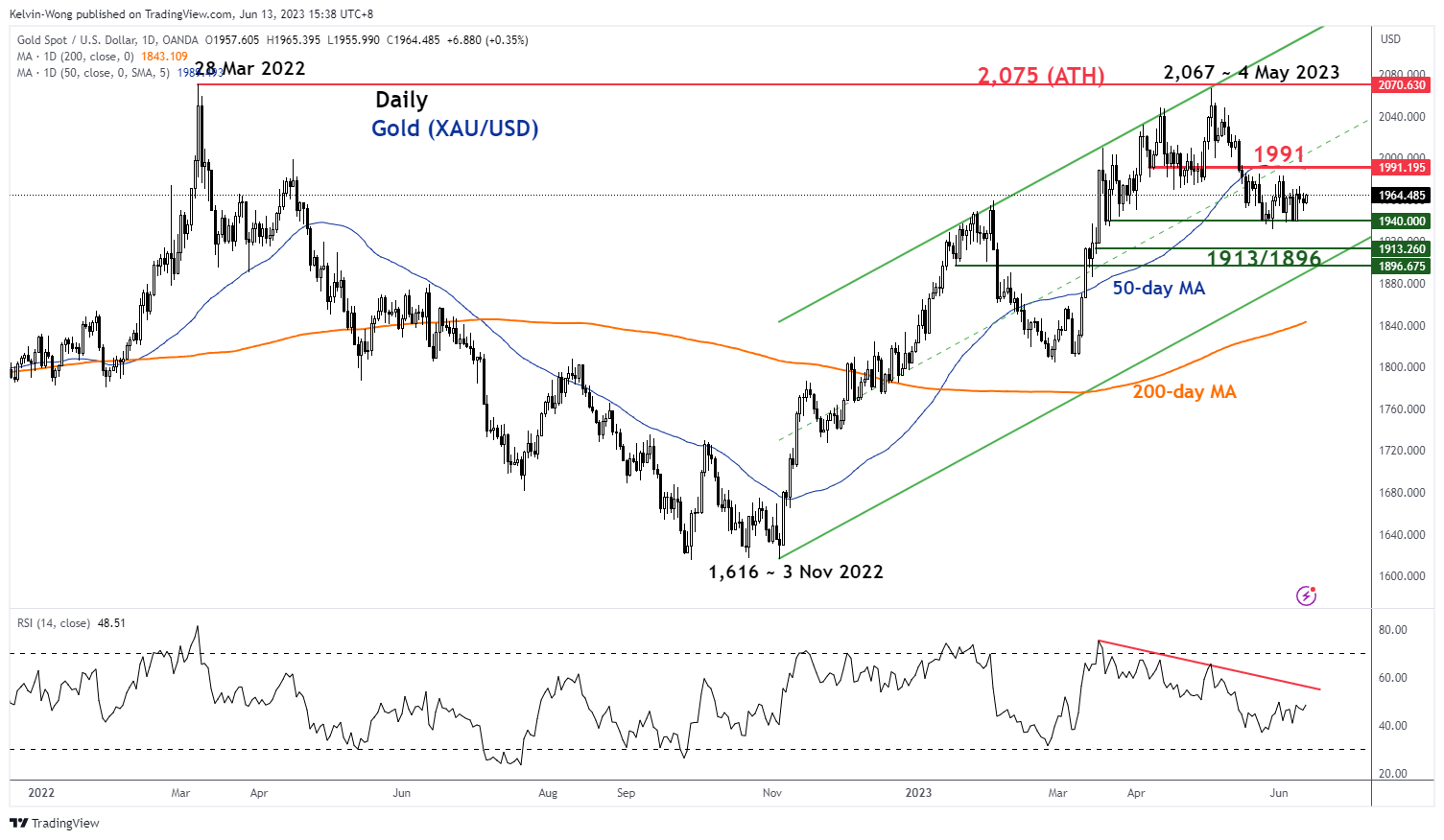
Fig 2: Gold (XAU/USD) short-term trend as of 13 Jun 2023 (Source: TradingView, click to enlarge chart)
This is a follow-up to our previous analysis, “Gold Technical – a potential short-term downtrend in play” published on 22 May 2023.
The price actions of Gold (XAU/USD) have declined by -2.2% since 22 May and hit the support of US$1,940 on 26 May.
Sideways within a bearish “Descending Triangle” range configuration in the past 3 weeks
Since the test on its US$1,940 support on 26 May 2023, Gold (XAU/USD) has traded sideways and retested US$1,940 on three occasions within the past 3 weeks. The price reactions that bounced off the US$1,940 support have been lacklustre as they formed “lower highs” which gave rise to the formation of a bearish “Descending Triangle” range configuration (refer to the 4-hour).
Minor short-term downtrend phase from the 4 May 2023 high remains intact
Since its 4 May 2023 high of US$2,067 (also its current 52-week high), Gold (XAU/USD) has been evolving within a short-term downtrend phase within a major uptrend phase in place since 3 November 2022 low of US$1,616 (see daily chart)
US$1,991 remains the key short-term pivotal resistance to maintain the short-term bearish tone and a break below the minor “Descending Triangle” range support of US$1,940 exposes the medium-term support zone of US$1,913/1,896 (also the lower boundary of the major ascending channel from 3 November 2022 low).
However, a clearance above US$1,991 sees the next resistance coming in at US$2,067/2,075.
Aussie Edges Higher Despite Lukewarm Confidence Data, US Inflation Next
- Australian consumer confidence holds steady, business confidence falls
- US inflation expected to ease
- Inflation release could be a game-changer for Fed decision on Wednesday
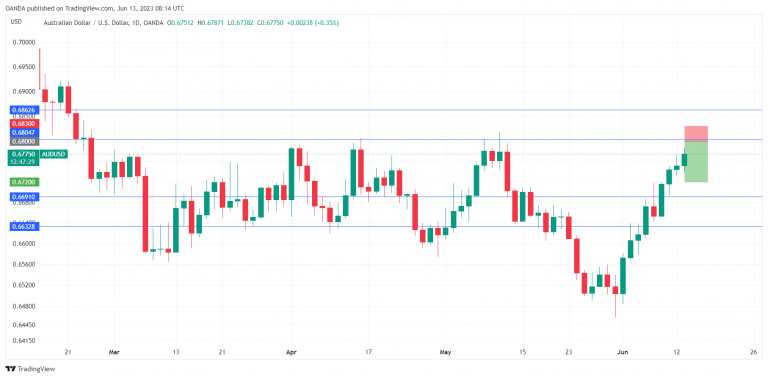
The Australian dollar remains on a roll and is trading at 0.6775, up 0.35% on the day. The Aussie has been a tear in June, surging 4.15% against the US dollar.
Australia released lukewarm confidence data today, but that didn’t put a crimp in the Australian dollar’s upswing, which has continued for a fourth straight day. Westpac Consumer Confidence posted a small 0.2% gain in June, after a 7.9% plunge in May. The index remains at weak levels as consumers have been hammered by the cost-of-living crisis and high interest rates.
The NAB Business Confidence Index slipped into negative territory in May with a reading of -4. This was below the April reading and consensus of zero. Business conditions also weakened in May. The business sector is concerned that the RBA’s aggressive rate policy may not achieve a soft landing and economic conditions will deteriorate.
All eyes on US inflation
After a light data calendar on Monday, the week gets busy with the US inflation report today and the FOMC rate decision on Wednesday.
US inflation has been heading lower, and the trend is expected to continue in the May report. Headline CPI is projected to fall from 4.9% to 4.1% and core CPI is expected to ease from 5.5% to 5.3%. The Fed’s tightening policy has succeeded in pushing inflation lower, but the question is whether the Fed feels that inflation is dropping fast enough.
Market rate pricing has been swinging wildly for weeks, as expectations of a pause in rates switched to a hike and back to a pause. Currently, the markets have priced in a pause at 75%, with an outside chance of a rate hike. Today’s inflation release could be a game-changer if it is hotter than expected, as that could convince the Fed to increase rates on Wednesday. If the Fed decides to stay on the sidelines, we could end up with a “hawkish skip” in which the Fed takes a breather but signals that more rate hikes are coming in the second half of the year.
AUD/USD Technical
- AUD /USD is putting pressure on resistance at 0.6804. Next, there is resistance at 0.6863
- 0.6691 and 0.6632 are providing support
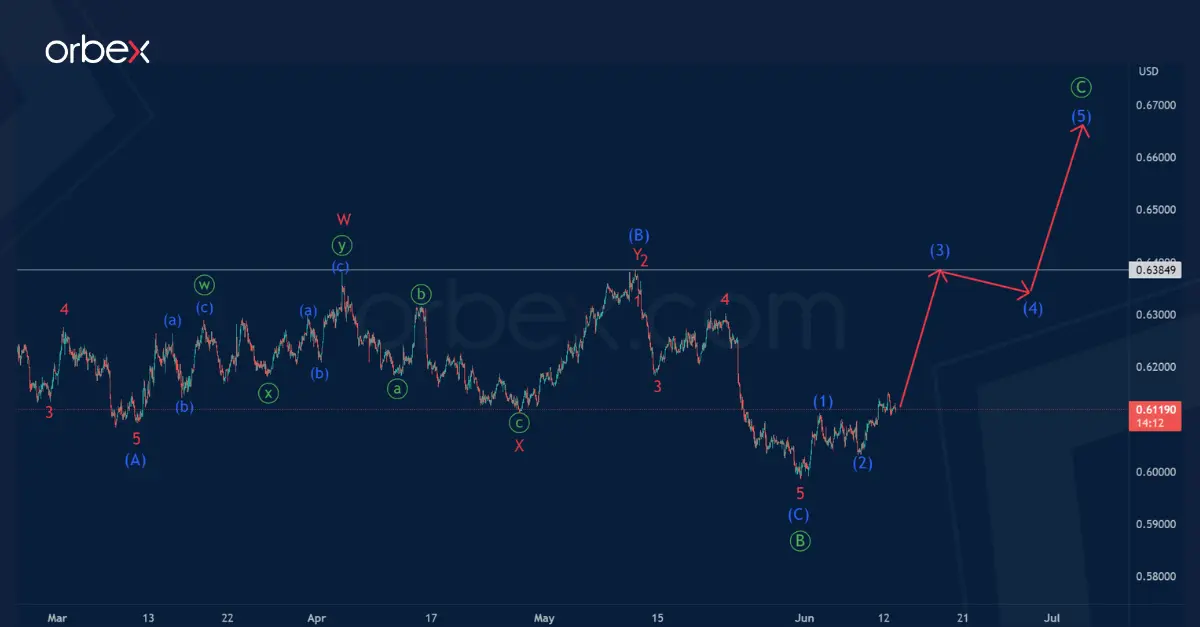
NZD/USD: Intermediate Impulse (C) May Soon Complete Global Correction
The NZDUSD pair is presumably building a correction pattern. We can see a zigzag consisting of three primary waves Ⓐ-Ⓑ-Ⓒ.
The bearish correction Ⓑ is currently under development, its structure is similar to the standard zigzag (A)-(B)-(C). The impulse (A) and correction (B) can be considered completed, it is a minor double zigzag W-X-Y.
The pair moves down in an intermediate impulse (C) consisting of sub-waves 1-2-3-4-5, approximately to 0.591. At that level, primary correction Ⓑ will be at 61.8% of actionary wave Ⓐ.
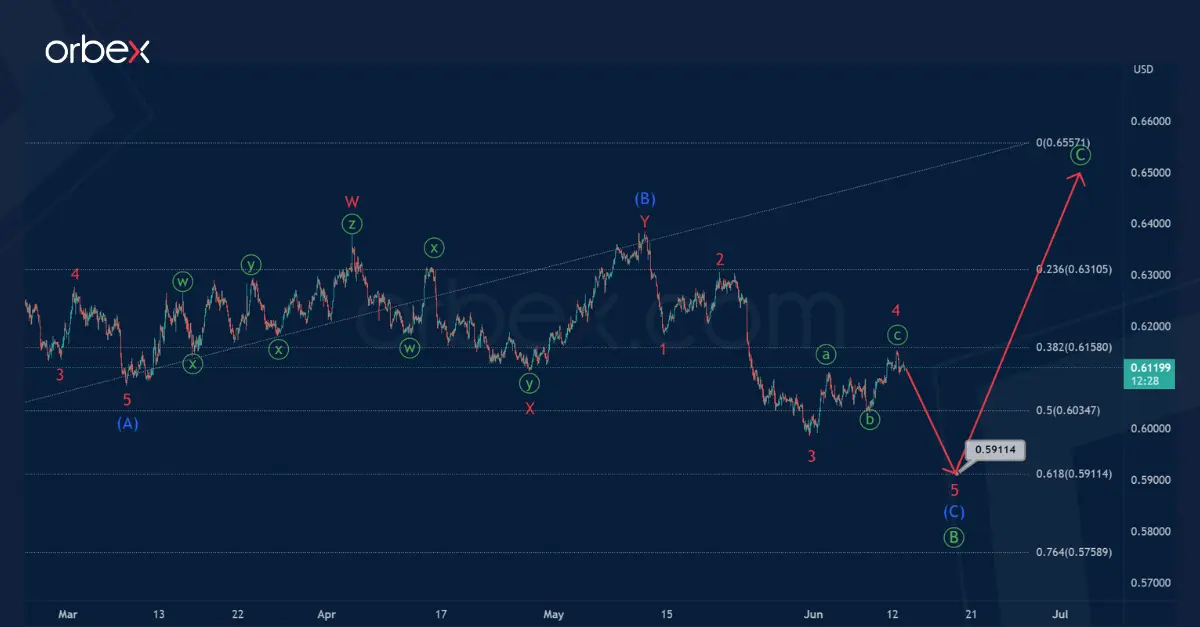
Let's assume a variant where the primary correction Ⓑ is fully formed. It is a standard intermediate zigzag (A)-(B)-(C).
Thus, in the last section of the chart, we can observe the beginning of the development of the primary wave Ⓒ. If this scenario is confirmed, we will see the development of a bullish trend.
The first target where the bulls can go is a maximum of 0.638, where the minor sub-waves W and Y were completed.
EUR/USD: Bulls Crack Key Barrier, Awaiting US Inflation Data for Fresh Signals
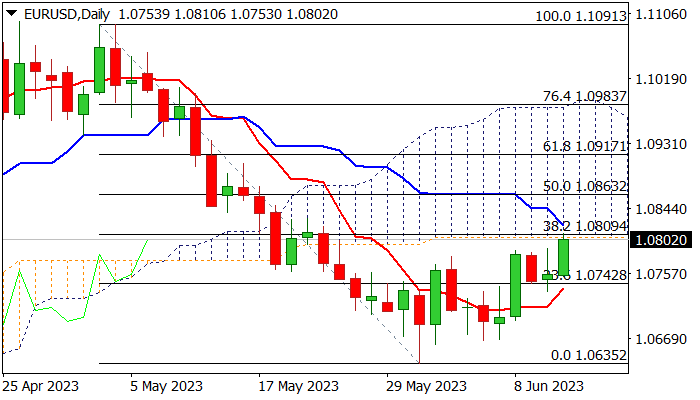
The Euro advanced nearly 0.5% in early Tuesday, driven by weaker dollar ahead of release of US May inflation data.
Fresh risk appetite on expectations that inflation will cool further in May and add to Fed’s plans to stay on hold in June policy meeting which starts today, as markets are currently pricing over 80% chance that the Fed will keep interest rates unchanged.
The Euro is expected to benefit from such scenario and extend recovery from 1.0635 (May 31 low).
Conversely, higher than expected US inflation in May would sour risk sentiment on negative signals to the Fed.
Fresh rally on Tuesday cracked key resistances at 1.0805/10 zone (base of thick daily cloud / Fibo 38.2% of 1.1091/1.0635 / 100DMA) but facing strong headwinds and is likely to stay around these levels and await fresh direction signals from US CPI data.
Firm break of 1.0805/10 zone would generate strong bullish signal for extension towards Fibo barriers at 1.0863 and 1.0917 (50% and 61.8% retracement respectively).
On the other hand, failure to break higher would generate initial signal of recovery stall and shift near-term risk to the downside, with dip below 10DMA (1.0734) to confirm upside rejection.
Res: 1.0810; 1.0863; 1.0917; 1.0980.
Sup: 1.0787; 1.0748; 1.0734; 1.0700.
Germany ZEW economic sentiment rose to -8.5, but current situation tumbles very sharply
Germany ZEW Economic Sentiment rose slightly from -10.7 to -8.5 in May, above expectation of -14.7. Current Situation index, however, fell "very sharply" from -34.8 to -56.5, much worse than expectation of -40.
"The ZEW Indicator of Economic Sentiment shows a slight improvement, but it remains in negative territory. This means that experts do not anticipate an improvement in the economic situation during the second half of the year. Particularly, sectors focused on exports are likely to perform poorly due to a weak global economy. However, the current recession is generally not considered particularly alarming," comments ZEW President Achim Wambach.
Eurozone ZEW Economic Sentiment dropped from -9.4 to -10.0, above expectation of -13.1. Current Situation index dropped from -14.4 to -41.9.
Eurozone balance for short-term interest rates stands at 72.3, indicating anticipated rate hikes. On the other hand, balance for short-term interest rates for the US stands at 16.6, indicating no change in interest rates.