

Sample Category Title
What to Trade in June
Hey guys, this is the last full trading week in May, and many forward-looking individuals like myself are already preparing themselves to seize whatever opportunities June may have in store. On this note, I will review a few commodities that have satisfied my quest for swing-trading opportunities in the coming month. Follow me!
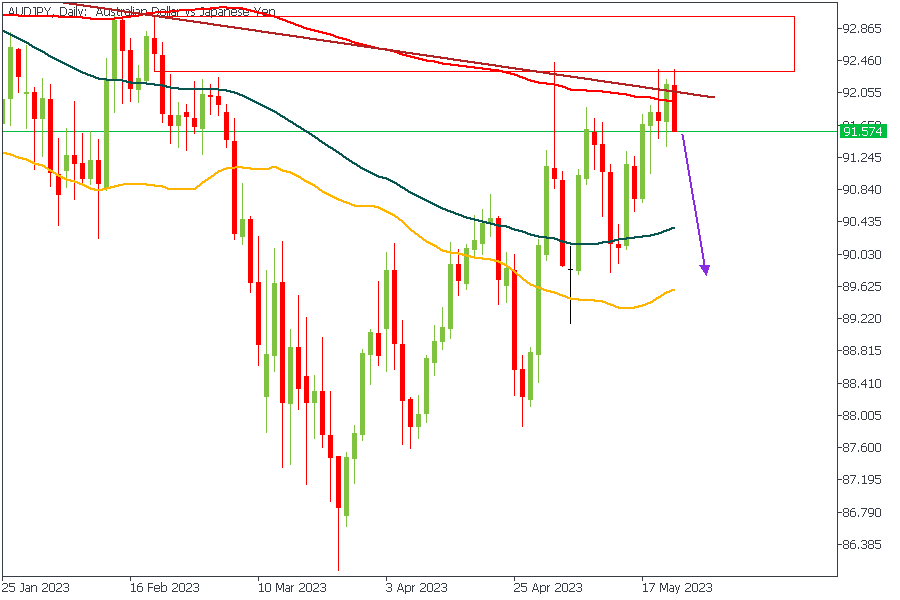
AUDJPY - Daily Timeframe
The daily timeframe of AUDJPY already gave an initial reaction from the combined resistance from the supply zone, the resistance trendline, and the 200-Day moving average. Looking at how the moving averages are also clearly arrayed in descending order, it is safe to expect a good amount of bearish volatility on AUDJPY soon.
Analyst’s Expectations:
- Direction: Bearish
- Target: 88.899
- Invalidation: 92.373
CADJPY - Daily Timeframe
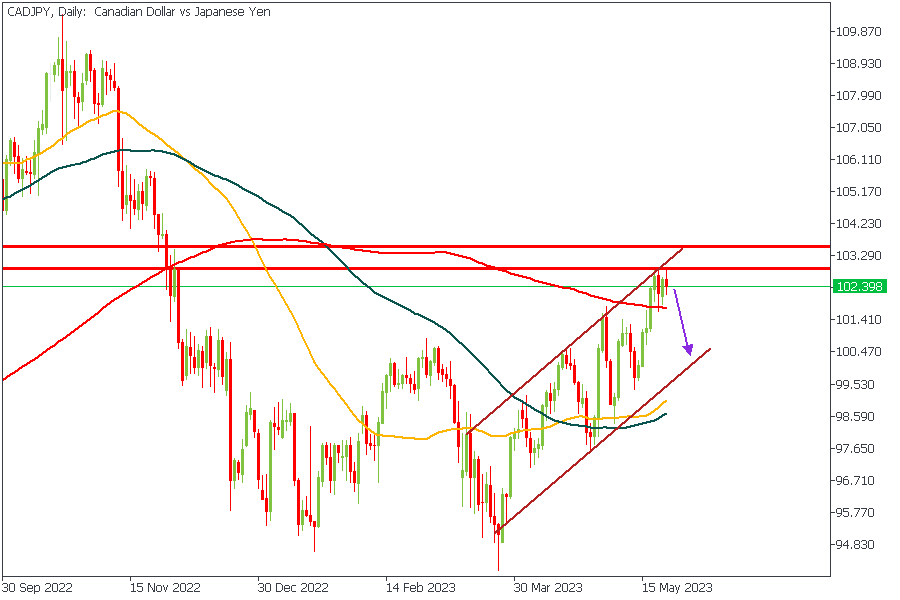
CADJPY, as shown in the attached chart, is currently trading within a rising channel, with an initial rejection from the confluence of the resistance trendline of the channel and the pivot zone. It is essential to mention that the pivot zone also doubles as a drop-base-drop supply zone. Fair warning, though, be wary of the 200-period moving average as it is still undecided whether or not it would act as a support.
Analyst’s Expectations:
- Direction: Bearish
- Target: 100.636
- Invalidation: 102.985
EURGBP - H4 Timeframe
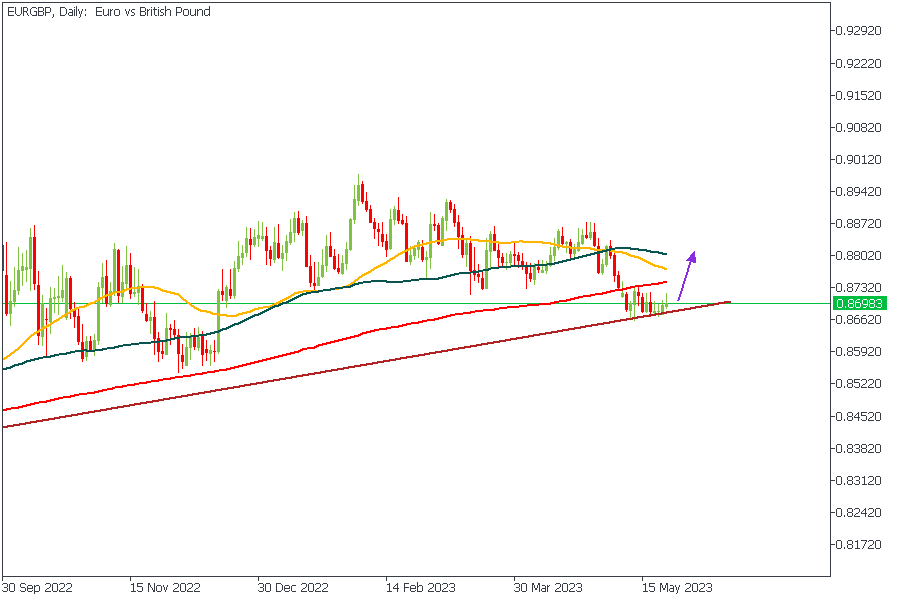
On the monthly timeframe, EURGBP is currently resting on the 50-period moving average, which suggests the possibility of a bullish reaction. In line with that, we see the price reacting to the support trendline on the daily timeframe, as attached above, just a few pips below the 200-Day moving average. However, the good thing about this is that traders can easily use an oscillating indicator to determine whether or not to take an entry from this point.
Analyst’s Expectations:
- Direction: Bullish
- Target: 0.87873
- Invalidation: 0.86519
GBPCHF - Daily Timeframe
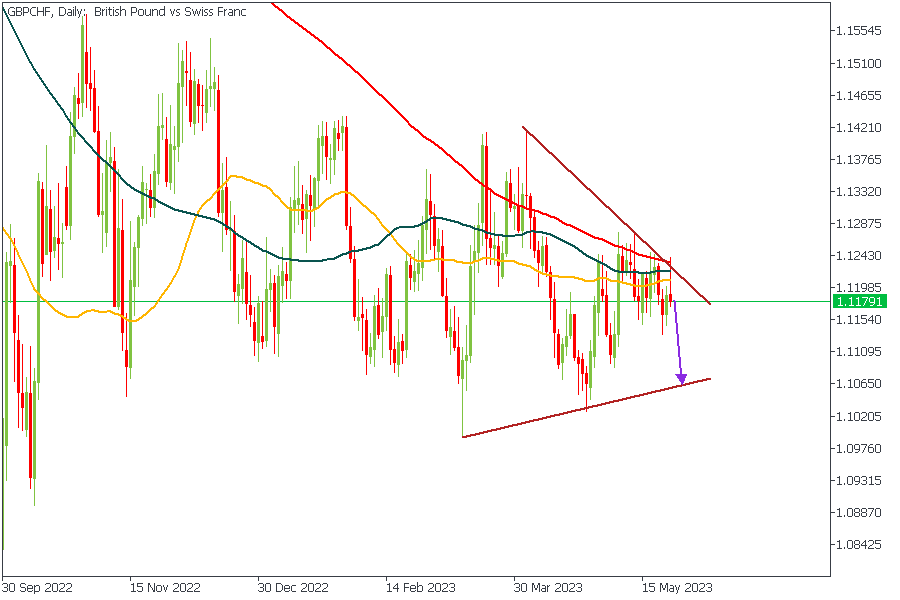
Looking at the order of arrangement of the moving averages, I'm sure you would already be able to guess my sentiment on GBPCHF - Bearish. The 200-period moving average has also greatly resisted the bullish price action. The resistance trendline's confluence serves as the final hint to figuring out the analysis.
Analyst’s Expectations:
- Direction: Bearish
- Target: 1.10813
- Invalidation: 1.12280
CONCLUSION
The trading of CFDs comes at a risk. Thus, to succeed, you have to manage risks properly. To avoid costly mistakes while you look to trade these opportunities, be sure to do your due diligence and manage your risk appropriately.
Sunset Market Commentary
Markets
In the statements accompanying the March and May policy decisions, the Bank of England ‘guided’ that ‘If there were to be evidence of more persistent pressures, then further tightening in monetary policy would be required’. If these pressure would fade, the debate was open. Two policy members already voted to leave the policy rate unchanged as they assessed that the impact of the energy price shock and other cost push inflation to be unwinding. Using market interest rate curves, inflation even was seen at risk of falling below the target over the medium term. Other MPC members including BoE governor Bailey and Chief economist Pill recently took a more guarded stance but also ‘hoped’ that UK inflation was close to a turning point allowing to open the debate on the BoE nearing the top of its hiking cycle. The UK inflation data published today at least made it very clear the BoE has much time left to debate the consequences of a fast fall in inflation. UK headline inflation indeed ‘eased’ from 10.1% Y/Y to 8.7% Y/Y, but this was still much higher than expected (8.2%). M/M price rises even reaccelerated from 0.8% to 1.2%. Core CPI (ex food and energy) jumped from 6.2% from 6.8%. Goods inflation still rose 0.8% M/M while services inflation jumped 1.6% M/M. The inflation shocker caused a massive repositioning on UK interest rate markets. UK bond yields currently add between 20 bps (2-y) and unchanged (30-y), with especially longer term yields substantially higher immediately after the release. Money markets discount that the BoE will (have to) raise its policy rate to at least 5.25% by autumn. ‘Luckily’ for the BoE, next (May) inflation data will be published the day just before the June 22 policy decision. Remarkably, the sharp rise in UK yield didn’t help sterling. EUR/GBP briefly tried a test below the 0.8660 support, but this was almost immediately reversed. EUR/GBP again trades near 0.87. FX market apparently don’t like ‘forced’ rate support. The feeling is that the BoE only raises rates to what is strictly necessary rather than take a really proactive action to eradicate inflation. In this respect, the BoE policy approach in one way or other is facing a similar, admittedly more modest, FX reaction as is the case for the likes of the Riksbank or the Norges Bank.
Building on yesterday’s price action, global market stay in risk-off modus. The Eurostoxx 50 is shedding 2.0%. The S&P 500 opens about 0.5%% lower. Uncertainty on US debt ceiling remains a source of investor caution. Declines in cyclical commodities including copper suggest lingering doubts on growth. US yield are trading little changed (2-y benchmark change). German yields are easing between -1.0 bp (2-y) and -5 bps (30-y). German Ifo business confidence printed weaker than expected at 91.7 from 93.4, on a decline in the expectations sub-index. The risk-off initially supported the dollar, but gains could not be sustained. DXY temporarily broke above the 103.6 resistance, but again trades little changed (103.5). Similar narrative for EUR/USD, testing 1.0750/60 before returning to 1.078.
News & Views
Belgium business confidence declined from -7.8 to -9.2 in May. Sentiment in all sectors but trade deteriorated. The latter turned less negative (from -15.9 to -9.2) mainly on improved demand expectations. In manufacturing (from -12.1 to -14.3) expected demand and to a lesser extend employment were the main factors weighing. In business-related services (from +11.4 to +10.5) a better assessment of current activity did not make up for weaker activity expected going forward. The building industry (from -5.4 to -6.6) suffered from a sharp deterioration in orders. National Bank of Belgium also published its quarterly business survey on credit conditions. 39% indicated to see conditions being tight, (from 34.3%), the highest since 2009. The quarterly worsening was most outspoken in the manufacturing (38.8%, up from 30.5% in January) but the services sector still finds itself most constrained (41.1%).
Riksbank deputy governor Floden said the Swedish krone is “clearly undervalued”. EUR/SEK today rose beyond recent highs to 11.50 amid risk-off. It’s the weakest level for the krone on record aside from a six-day period in March 2009. The SEK has been losing significant ground for quite some time already. It has recently drawn the attention of the central bank as a weak(ening) currency thwarts the fight against inflation. The Riksbank raised rates to 3.5% in April and won’t meet until June 29, giving it few official opportunities to address the matter. Floden said concerns about the Swedish economy are a factor but overblown, saying it is strong, with well-functioning frameworks, strong public finances and efficient wage formation. But at the same time the country’s very rate-sensitive housing market is faltering and weighing on sentiment and spending.
Euro Steady Despite Weak Business Confidence Data
- Germany’s Ifo Business Climate falls
- German GDP expected to stall in Q4
EUR/USD is drifting higher on Wednesday and is trading at 1.0781, up 0.11%.
German Business Confidence dips
Germany’s Ifo Business Climate for May fell to 91.7, following a downwardly revised 93.4 in April and shy of the estimate of 93.0 points. This was the first decline after a six-month expansion. Business expectations fared worse, dropping from 91.7 to 88.6 and missing the estimate of 91.9 points.
German businesses are worried about economic conditions for the next 6 months, with the banking turmoil in the US, a rocky Chinese reopening and a weak eurozone economy all weighing on sentiment. Manufacturers reported a steep decline in expectations, which is not surprising, given that manufacturing PMI readings continue to indicate persistent contraction.
The markets are expecting more soft data out of Germany on Thursday – GfK consumer confidence is expected to come in at -24.0 for June, following -25.7 in May. Germany’s GDP is projected at 0.0% in the fourth quarter, unchanged from Q3. On an annualized basis, fourth-quarter GDP is expected to remain unchanged at -0.1%. If GDP surprises to the downside, the euro could lose ground.
US debt ceiling remains at a standoff
Congress remains at a standoff over the debt ceiling, despite Treasury Secretary Yellen’s warning that the US could default as early as June 1st. Republicans have countered that Yellen is scaremongering with a made-up deadline. Still, even if the actual deadline is a week or two later, Congress seems to be playing with fire to score political points. Investors are jittery, and stock markets have fallen while safe-havens such as gold and the US dollar have benefited from the crisis. We’ve seen this movie before, and Congress has always reached a deal before the deadline. Still, we can expect risk sentiment to slide and the US dollar to gain ground if the impasse continues.
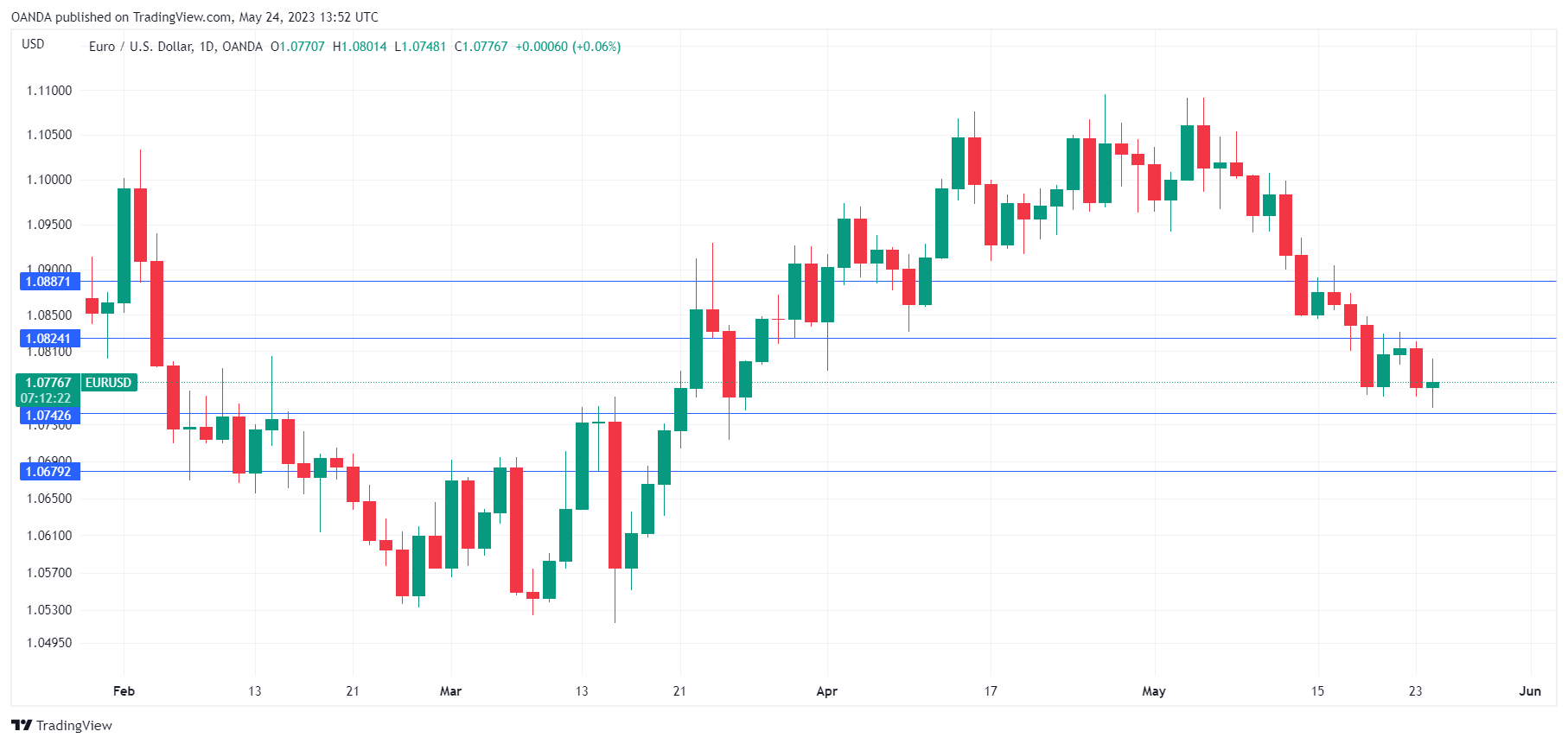
EUR/USD Technical
- EUR/USD faces resistance at 1.0887 and 1.0969
- 1.0824 and 1.0742 are providing support
AUD/USD: Key Support Zone Under Increased Pressure
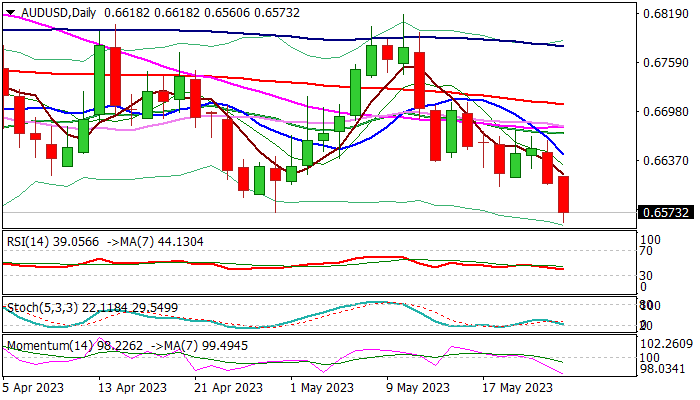
Australian dollar hit new (marginally lower) 2023 low on Tuesday, in extension of fresh weakness, sparked by higher US dollar and drop in base metal prices.
Bears cracked the floor of a larger range (0.6563/0.6818, since early March) and also pressure nearby key Fibo support at 0.6547(61.8% retracement of 0.6170/0.7157 uptrend), with sustained break of support zone to signal continuation of a downtrend from 0.7157 (2023 high of Feb 2) which was paused for consolidation in past 2 ½ months.
Bearish daily studies support the action, though significance of the support (annual low which resisted several attacks) and south-heading stochastic about to break into oversold territory, warn of increased headwinds.
Bears may slow at this area but expected to remain in play while the price action stays below falling 10DMA (0.6645).
Sustained break of 0.6560/47 pivots to spark fresh acceleration lower and expose next targets at 0.6400 zone (Fibo 76.4% / Nov 10 low).
Only firm break of upper pivots lay at 0.6670/80 zone would sideline bears and signal prolonged range-trading.
Res: 0.6618; 0.6645; 0.6680; 0.6707.
Sup: 0.6547; 0.6516; 0.6480; 0.6422.
Euro Sees Near-Term Boost, Commodity Currencies Pressured
Today's trading session saw broad selling pressure on commodity currencies, partially due to risk-off sentiment prevalent in the market and partly due to the dovish rate hike from RBNZ. As it stands, Euro seems to be the major benefactor, in part due to its rebound against Swiss Franc. However, despite a slight recovery, the common currency is still considered bearish against Dollar in the near term. The uplift in Sterling following the Consumer Price Index (CPI) data proved to be short-lived. Yen, for its part, is consolidating its recent losses and appears still poised for a near-term decline.
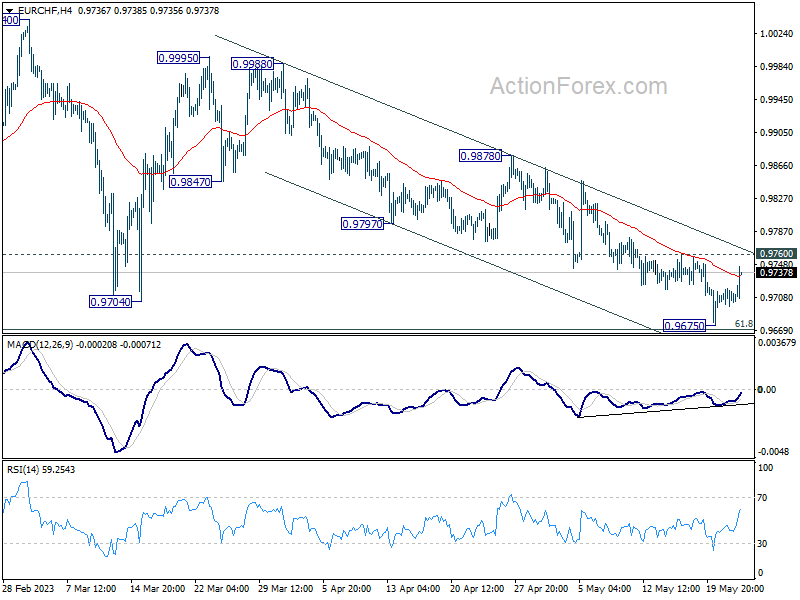
From a technical perspective, EUR/CHF could be a focal point for the remainder of the day. Break of 0.9760 resistance level will confirm short-term bottoming at 0.9675, with a bullish convergence condition in 4H MACD. This could lead to a stronger rebound towards 0.9878 resistance level. If this occurs, stronger bounce in EUR/CHF could potentially aid Euro in rebounding further against both the Dollar and Sterling.
In Europe, at the time of writing, FTSE is down -1.77%. DAX is down -1.68%. CAC is down -1.76%. Germany 10-year yield is down -0.0206 at 2.451. Earlier in Asia, Nikkei dropped -0.89%. Hong Kong HSI dropped -1.62%. China Shanghai SSE dropped -1.28%. Singapore Strait Times dropped -0.12%. Japan 10-year JGB yield rose 0.0045 to 0.409.
Bundesbank: German economy expected to have slight uptick in Q2
In their most recent monthly report, the experts at Bundesbank forecast that Germany's economic output will experience a modest increase in the second quarter of 2023. A confluence of factors, including easing supply bottlenecks, a substantial backlog of orders, and a decrease in energy prices, are all expected to bolster the ongoing recovery of the industrial sector.
Despite the continuing high inflation, the sharp rise in wages should prevent further declines in the real net income of private households. As a result, private consumption is predicted to remain steady, rather than falling.
Bundesbank stated, "The German economy stagnated in the first quarter of 2023 after shrinking in the previous quarter". The bank's experts maintain an overall slightly positive outlook for the labor market, although they note that its prospects have not brightened further in recent months.
In light of the robust labor market, high inflation, and the anticipated economic improvement, the Bundesbank predicts, "high wage agreements can also be expected in the coming months".
Germany Ifo dropped to 91.7, businesses skeptical about upcoming summer
Germany Ifo Business Climate dropped from 93.4 to 91.7 in may, below expectation of 93.4. This also marked the first decline in the index after six increases in a row. Current Assessment Index dropped from 95.1 to 94.8, worse than expectation of 95.2. Expectations Index, also dropped from 91.7 to 88.6, below expectation of 91.7.
By sector, manufacturing dropped sharply from 6.3 to -0.3. That's the largest decrease since March 2022, after the start of the war in Ukraine. Services ticked down from 6.9 to 6.8. Trade tumbled from -10.7 to -19.1. Construction also dropped from -16.6 to -18.2.
Ifo said: "Sentiment in the German economy has suffered a setback..... Driving this development are the significantly more pessimistic expectations. Managers are somewhat less satisfied with their current situation. German companies are skeptical about the upcoming summer."
UK CPI slowed to 8.7%, CPI core rose to highest since 1992
UK CPI slowed from 10.1% yoy to 8.7% yoy in April, above expectation of 8.2% yoy. On a monthly basis, CPI rose by 1.2% mom, above expectation of 0.8% mom.
CPI core (excluding energy, food, alcohol and tobacco) rose from 6.2% yoy to 6.8% yoy, above expectation of 6.2% yoy. That's the highest level since March 1992.
CPI goods annual rate eased from 12.8% yoy to 10.0% yoy, while the CPI services annual rate rose from 6.6% yoy to 6.9% yoy.
RBNZ delivered dovish rate hike
RBNZ raised OCR by 25bps to 5.50% today, reaching the projected peak interest rate. The decision was made by a 5-2 vote, with two committee members voted for no change. The central bank noted that "The OCR will need to remain at a restrictive level for the foreseeable future, to ensure that consumer price inflation returns to the 1% to 3% annual target range, while supporting maximum sustainable employment."
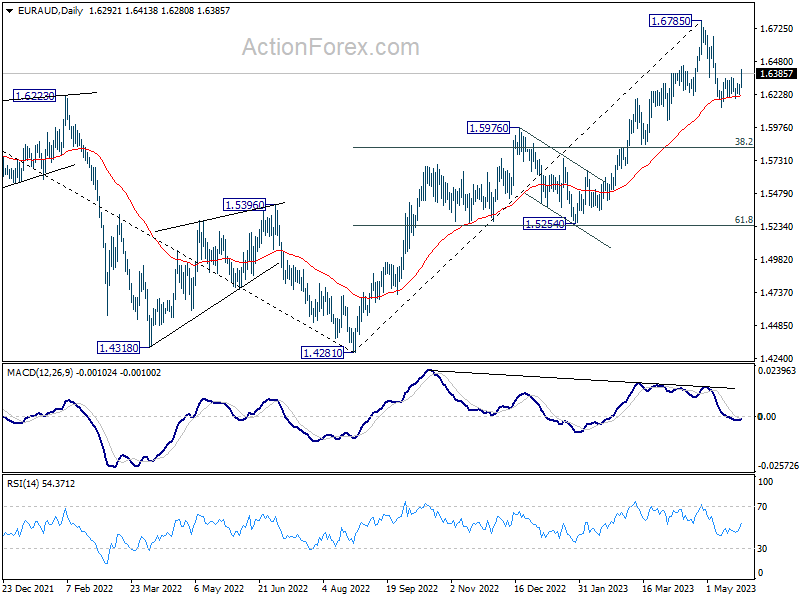
EUR/AUD Daily Outlook
Daily Pivots: (S1) 1.6224; (P) 1.6268; (R1) 1.6299; More...
Range trading continues in EUR/AUD and intraday bias remains neutral. Fall from 1.6785 might be a correction to whole up trend from 1.4281. Break of 1.6134 will target 38.2 retracement of 1.4281 to 1.6785 at 1.5828, which is inside 1.5254/5976 support zone. Nevertheless, sustained break of 1.6354 minor resistance will turn bias back to the upside for retesting 1.6785 high instead.
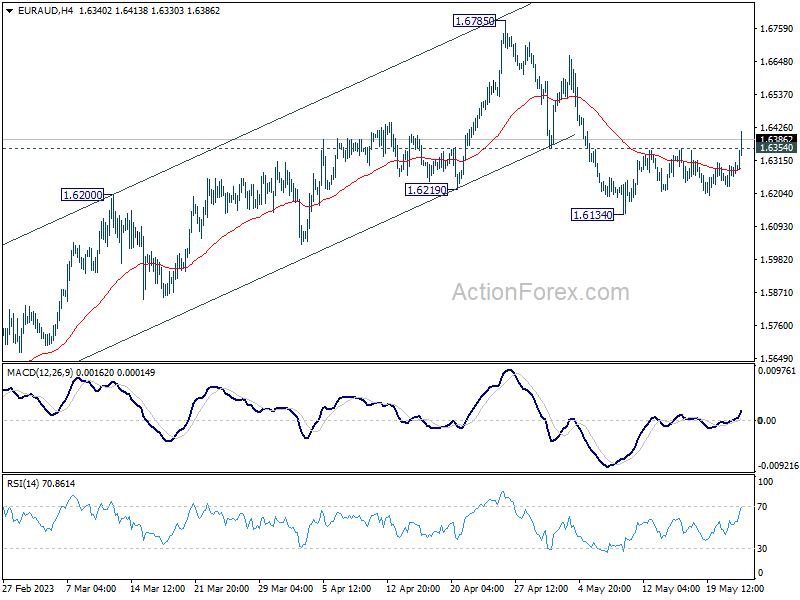
In the bigger picture, whole down trend from 1.9799 (2020 high) should have completed at 1.4281 (2022 low). Further rise should be seen to 61.8% retracement of 1.9799 to 1.4281 at 1.7691 next. For now, outlook will stay bullish as long as 1.5976 resistance turned support holds, even in case of deep pull back.
Economic Indicators Update
| GMT | Ccy | Events | Actual | Forecast | Previous | Revised |
|---|---|---|---|---|---|---|
| 22:45 | NZD | Retail Sales Q/Q Q1 | -1.40% | 0.20% | -0.60% | -1.00% |
| 22:45 | NZD | Retail Sales ex Autos Q/Q Q1 | -1.10% | -1.00% | -1.30% | -1.60% |
| 00:30 | AUD | Westpac Leading Index M/M Apr | 0.00% | 0.00% | ||
| 02:00 | NZD | RBNZ Rate Decision | 5.50% | 5.50% | 5.25% | |
| 03:00 | NZD | RBNZ Press Conference | ||||
| 06:00 | GBP | CPI M/M Apr | 1.20% | 0.80% | 0.80% | |
| 06:00 | GBP | CPI Y/Y Apr | 8.70% | 8.20% | 10.10% | |
| 06:00 | GBP | Core CPI Y/Y Apr | 6.80% | 6.20% | 6.20% | |
| 06:00 | GBP | RPI M/M Apr | 1.50% | 1.70% | 0.70% | |
| 06:00 | GBP | RPI Y/Y Apr | 11.40% | 11.20% | 13.50% | |
| 06:00 | GBP | PPI Input M/M Apr | -0.30% | -0.50% | 0.20% | |
| 06:00 | GBP | PPI Input Y/Y Apr | 3.90% | 3.80% | 7.60% | 7.30% |
| 06:00 | GBP | PPI Output M/M Apr | 0.00% | -0.10% | 0.10% | 0.00% |
| 06:00 | GBP | PPI Output Y/Y Apr | 5.40% | 7.40% | 8.70% | 8.50% |
| 06:00 | GBP | PPI Core Output M/M Apr | 0.00% | 0.10% | 0.30% | |
| 06:00 | GBP | PPI Core Output Y/Y Apr | 6.00% | 7.30% | 8.50% | 8.30% |
| 08:00 | EUR | Germany IFO Business Climate May | 91.7 | 93.4 | 93.6 | 93.4 |
| 08:00 | EUR | Germany IFO Current Assessment May | 94.8 | 95.2 | 95 | 93.1 |
| 08:00 | EUR | Germany IFO Expectations May | 88.6 | 91.7 | 92.2 | 91.7 |
| 14:30 | USD | Crude Oil Inventories | 1.5M | 5.0M | ||
| 18:00 | USD | FOMC Minutes |
ETHUSD Analysis: Hong Kong to Open Cryptocurrency Trading to Retail Investors
While Coinbase is launching an advertising campaign in Washington to convey to government officials that cryptocurrencies are technologies that can move the country forward, Hong Kong has taken a step towards a regulated cryptocurrency market.
The Hong Kong Securities and Futures Commission (SFC) announced on May 23 that rules for retail investors to trade cryptocurrencies on licensed exchanges will come into effect on June 1. It also became known that 152 applications have already been received from key industry players, professional associations and consulting firms.
The regulatory framework will cover important aspects, including asset storage security requirements, avoidance of conflicts of interest, and other standards.
Against the backdrop of positive news from Hong Kong, the price of cryptocurrencies rose yesterday. But today it is declining. For example, the price of ETH on Wednesday morning is down about 3% from the high of May 23rd.
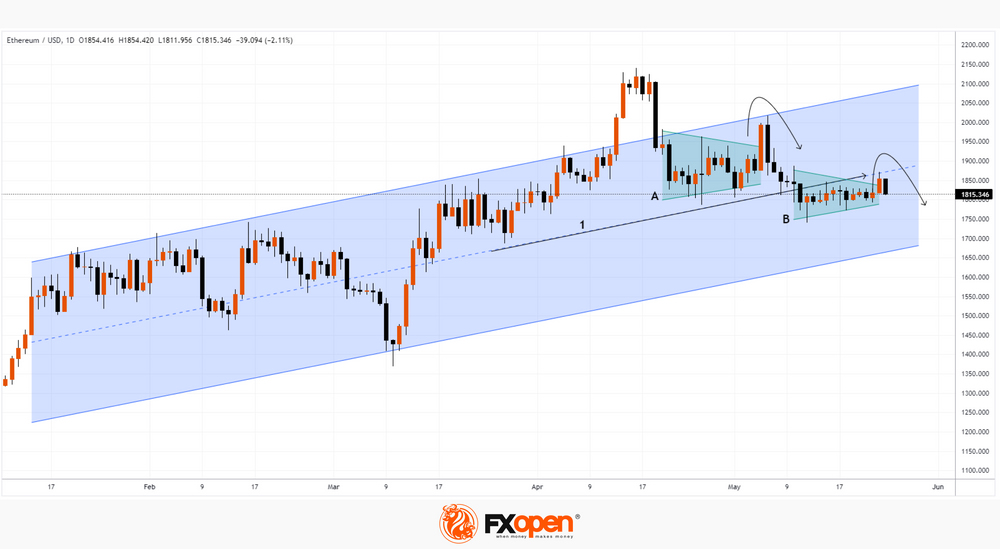
The daily ETH chart shows a disturbing picture.
Firstly, the price of Ethereum tested the median line (1) of the ascending channel yesterday (shown in blue).
Secondly, the pattern of yesterday’s and today’s candlesticks can form a false breakout of balance B. And if the ETH price dynamics develops in the same direction as during the false breakout of balance A (in early May), then the ETH rate against USD may update the lows of the year.
FTSE Drops Rapidly to April Lows Today
The FTSE 100 index is rapidly declining on Wednesday morning amid news of another spike in inflation. The Core CPI (excluding energy, food and tobacco prices) reached 6.8%, the highest in over 30 years. Market participants are now almost certain that the Bank of England will raise interest rates at its next meeting.
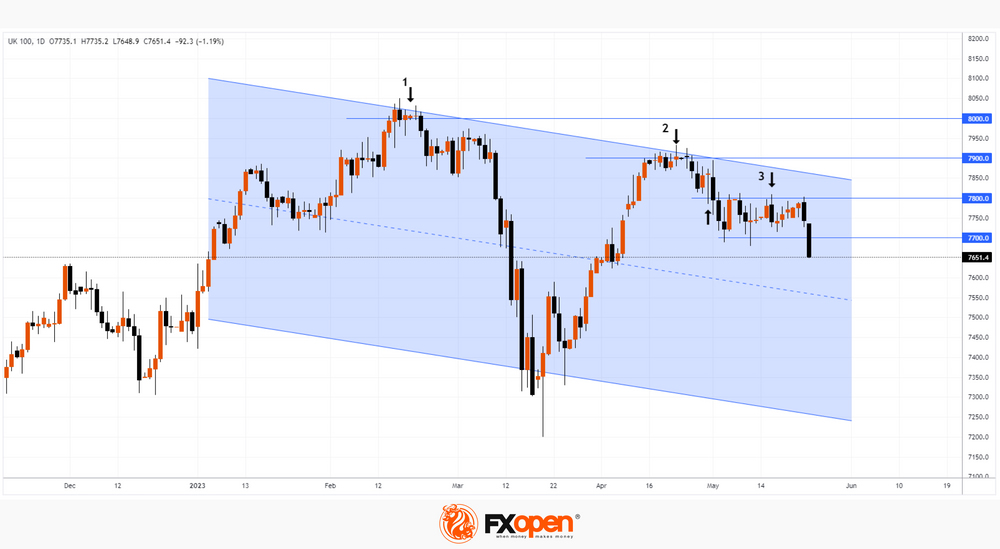
The UK100 chart (a tool that reflects the dynamics of the FTSE 100 index) shows a consistent series of bull failures around psychologically significant levels:
1→ UK100 price failed to settle above 8,000 in February;
2→ UK100 price did not fix above 7,900 in April;
3 → level 7,800 used to be support but is now resisting.
The action of the UK100 price today suggests that the level of 7,700 may now also provide resistance in an attempt to increase. If the downtrend strengthens, the FTSE may continue to decline within the channel (shown in blue), reaching its median line (or even the lower border — which would mean a 2023 low).
Above-Expected Inflation Failed to Impress Pound Buyers
Another release of UK consumer inflation well above expectations has failed to take the issue off the country’s agenda.
The report for April showed a 1.2% rise in consumer prices, compared to the 0.8% that markets were expecting this time and the previous month. Annual inflation slowed from 10.1% to 8.7% (8.2% was expected). This is a 13-month low, but still above the peak inflation levels in the early 1990s, when it was barely above 8% y/y.
The core CPI hit a new multi-year high of 6.8% y/y. It was widely expected to remain at 6.2%. The Bank of England is likely to take note of this acceleration, which demonstrates the depth of the roots of inflation.
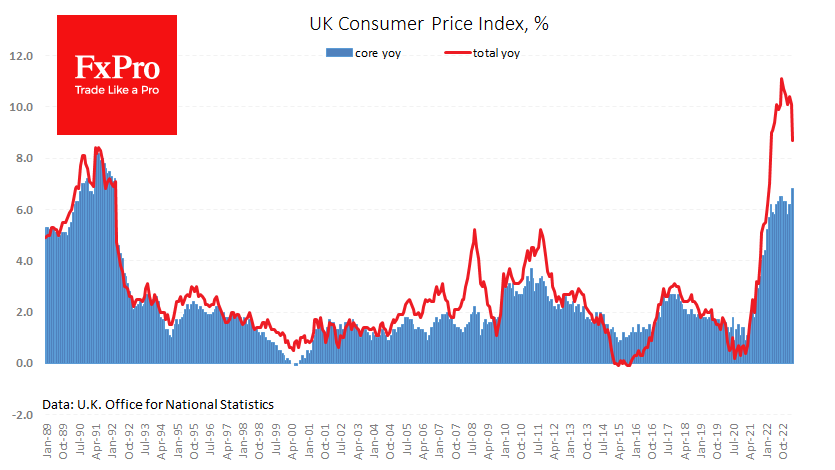
In modern UK history, core and headline inflation have moved in the same direction, albeit to different degrees. Still, the current case is characterised by a sustained rise in core inflation. This divergence is due to a tight labour market and the associated increase in service prices, which continue to rise despite the reversal in commodity prices.
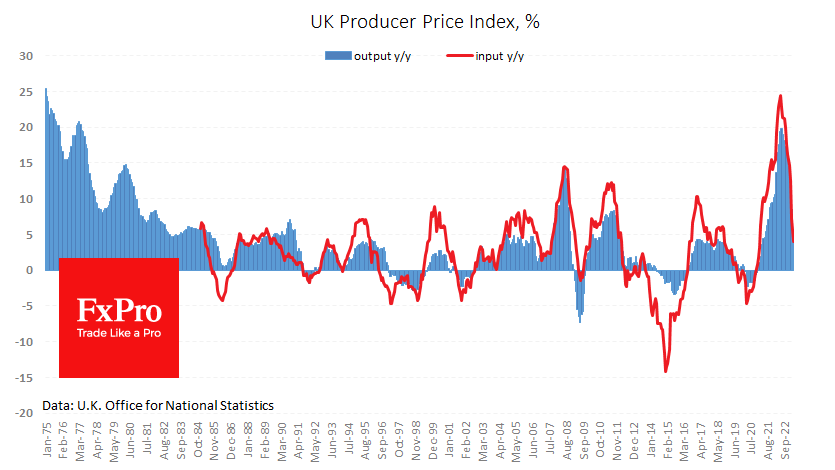
Astonishing in this story is the persistence of price rises, mainly in the final consumption stage. Producer Price Index Input fell by 0.3% in April and has now fallen in four of the last six months. Over the past year, their rise has decreased to 4.0%.
Producer Price Index Output was unchanged for the third month, and the year-on-year rate of increase slowed to 5.4%, compared with 8.5% the previous month and a peak of 19.8% in July last year.
Producer price trends tend to lead consumer price trends by several months.
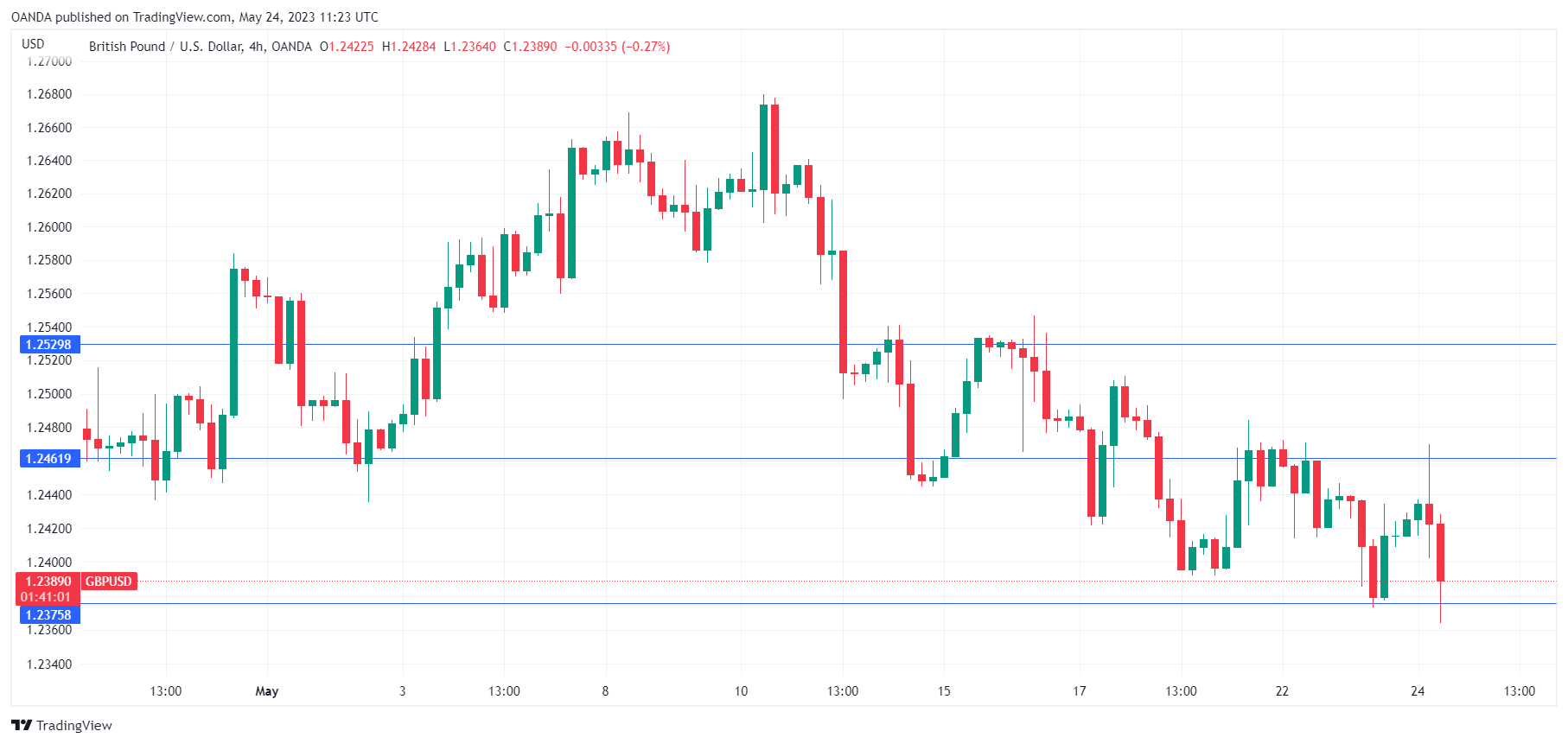
Immediately following the release of the inflation data, the GBPUSD rallied, at one point approaching 1.2470. This was likely the result of algorithmic strategies acting on above-expectation headline CPI numbers.
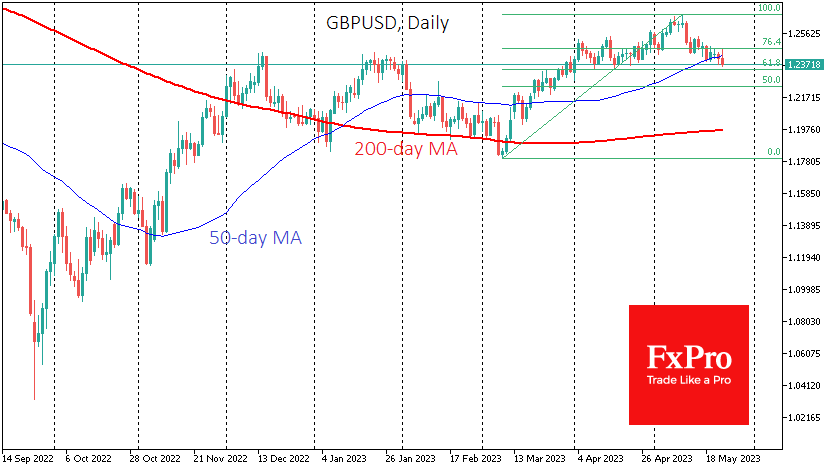
However, the pound soon reversed and fell below 1.2390 for a few hours. This drop brought the British currency back into the downtrend of the last two weeks and prevented the cable from staying above its 50-day moving average. Technically, the decline has a high probability of extending to 1.2340-1.2350, the area of last month’s lows and the 61.8% Fibonacci retracement level of the rise from 1.18 in March to 1.2680 in early May. It is also the area of the December and January highs, making a test of this area even more cautious.
A solid move lower from current levels would signal a market shift in favour of the dollar for many weeks to come. The ability to hold these levels and move higher would signal that the Pound remains within the bullish trend that has been in place since late September.
GBP/USD Dips after Disappointing UK Inflation
- UK headline inflation falls but the core rate jumps
- US debt ceiling impasse continues, boosting US dollar
GBP/USD is down for a third straight day, trading at 1.2374, down 0.33%. Earlier, GBP/USD touched a low of 1.2369, its lowest level since April 18th. The FOMC releases the minutes of the May meeting later today.
UK inflation a mixed bag
The closely-watched UK inflation report for April was a disappointment. There was some good news as headline inflation fell to 8.7%, down sharply from 10.1%. Hopefully, this is the end, finally, of inflation in double-digit territory. Still, the reading was above the estimate of 8.2%.
There was nothing positive about core CPI, which is the more important gauge of inflation. The core rate jumped from 6.2% to 6.8%. Forecasters had expected core CPI to remain at 6.2% and the unexpected rise is clearly a big step backward for the Bank of England in its tenacious battle with inflation. Governor Bailey is speaking at two public engagements today, and we can expect him to make mention of the inflation report.
The BoE has raised rates by 1% this year, bringing the cash rate to 5.25%, but inflation has proven to be persistent. The IMF has projected that UK inflation would fall to around 5% by the end of the year and drop to the 2% target by the middle of 2025. It will be a bumpy road to restore low inflation, and the BoE will probably have to raise rates again in June, unless core inflation surprises dramatically on the downside.
US debt ceiling impasse continues
US lawmakers continue to fight over the debt ceiling, as US Treasury Secretary Yellen has warned that the ceiling could be reached on June 1st, which doesn’t leave a lot of time for an agreement. Republicans have said Yellen’s date isn’t accurate, but even if the deadline is a week or two later, Congress seems to be playing with fire to score political points. Investors are worried, and stock markets are down while safe-havens such as gold and the US dollar are higher. We’ve seen this movie before, and Congress has always reached a deal before the deadline. Still, we can expect risk sentiment to slide and the US dollar to gain ground the longer we go without a deal.
GBP/USD Technical
- GBP/USD tested support at 1.2375 in the European session. Below, there is support at 1.2307
- 1.2461 and 1.2529 are the next resistance levels
Nasdaq 100 Technical: Bulls Getting Exhausted
- Bearish reversal elements have been sighted for Nasdaq 100
- The +30% up move from the 28 December low has reached the upper boundary of the “Ascending Wedge”, a bearish reversal chart pattern.
- The key short-term resistance to watch will be at 13,835.
This is a follow-up on a prior report, “Nasdaq 100 bulls may be too optimistic on US CPI” that has been published earlier on 11 May (click here for a recap).
The Nasdaq 100 has been the strongest performing major US stock index since October 2022 fuelled by solid gains seen in the mega market capitalization-weighted technology stocks; Meta/Facebook, Apple, Amazon, Netflix, Alphabet/Google, Microsoft, and NVIDIA. Interestingly, it underperformed yesterday, 23 May against the other indices with a loss of -1.28%; S&P 500 (-1.12%), Dow Jones Industrial Average (-0.69%), Russell 2000 (-0.43%), its worst daily performance since 25 April.
Nasdaq 100 Technical Analysis – Bearish elements sighted at “Ascending Wedge” resistance
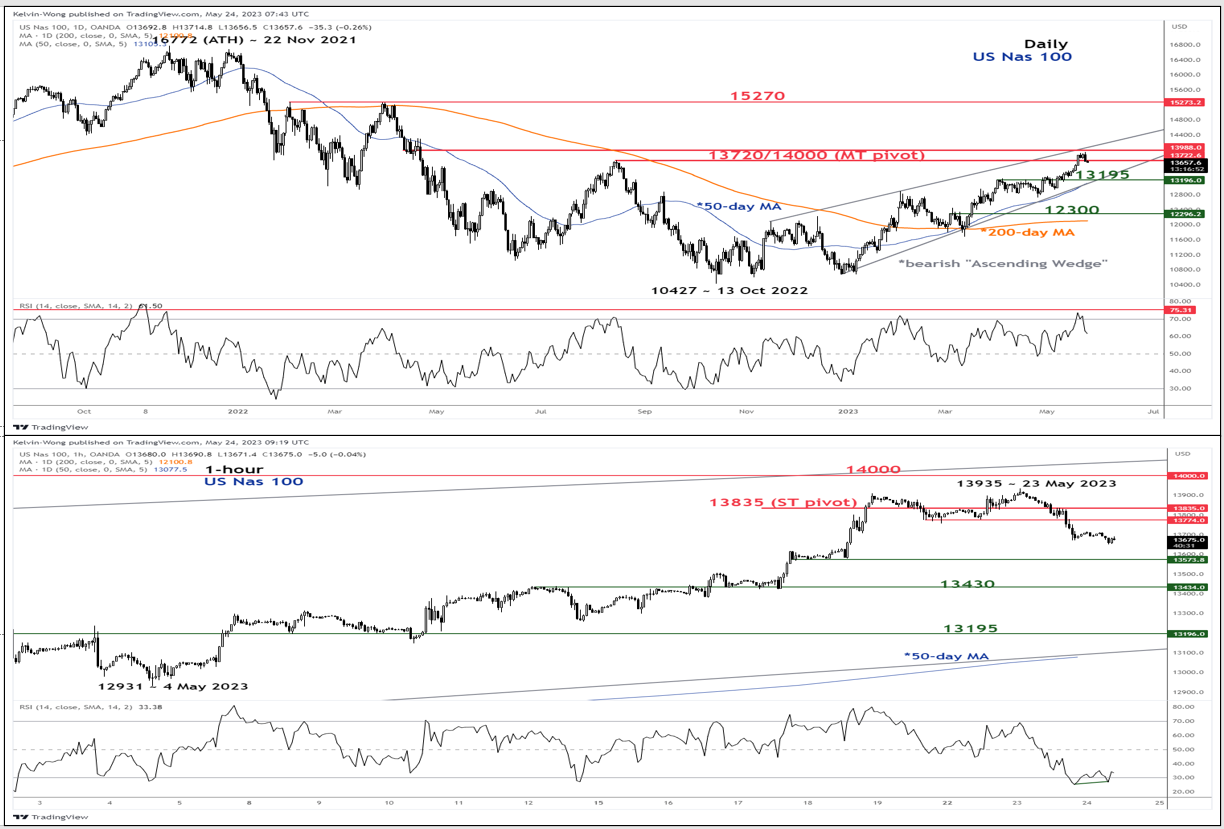
Fig 1: US Nasdaq 100 trend as of 24 May 2023 (Source: TradingView, click to enlarge chart)
The +30% up move seen on the US Nas 100 Index (a proxy for the Nasdaq 100 futures) from its 10,675 low of 28 Dec 2022 to its recent high of 13,935 printed on 23 May 2023 has reached the upper boundary/resistance of a major “Ascending Wedge” configuration which tends to represent a bearish reversal pattern.
In addition, the daily RSI oscillator has just exited from its overbought region which reinforces the view that the upside momentum of the up move from the 28 December 2022 low of 10,675 has dissipated and increased the probability of a bearish reversal move in price actions at this juncture.
In the shorter term as depicted on the hourly chart, yesterday’s slide of -2% from the 23 May 2023 high of 13,935 has led the hourly RSI to reach its oversold region which may see a risk of a minor bounce to retrace a portion of the earlier -2% decline.
Key short-term pivotal resistance at 13,835 to maintain the bearish tone with intermediate support at 13,430 and follow by 13,195 next (50-day moving average & the lower boundary of the “Ascending Wedge”). On the other hand, a clearance above 13,835 negates the bearish tone to see the medium-term resistance coming in at 14,000 (upper boundary of the “Ascending Wedge”).