

Sample Category Title
GBP/USD Mid-Day Outlook
Daily Pivots: (S1) 1.2341; (P) 1.2389; (R1) 1.2426; More...
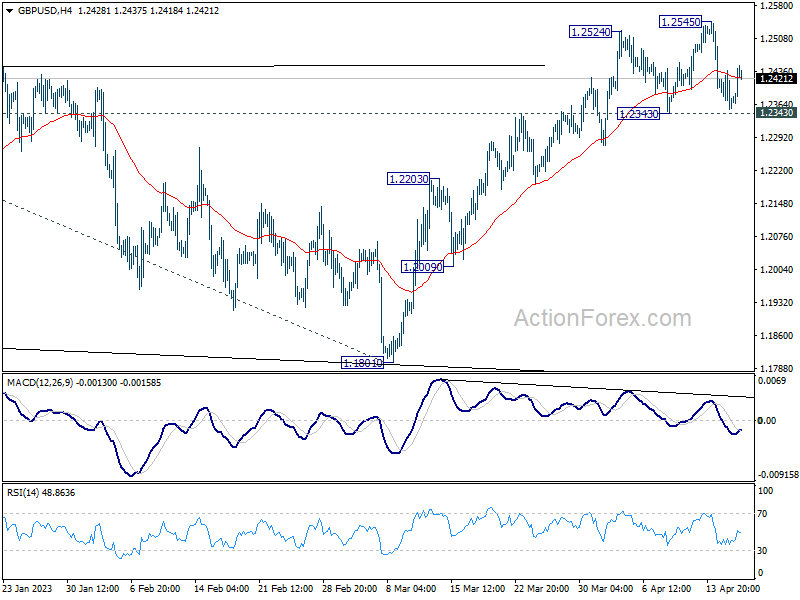
GBP/USD is still bounded in range of 1.2343/2545 and intraday bias remains neutral. Another rise is in favor with 1.2343 support intact. On the upside, above 1.2545 will target 1.2759 fibonacci level first. Firm break there will target 61.8% projection of 1.0351 to 1.2445 from 1.1801 at 1.3095. However, considering bearish divergence condition in 4H MACD, firm break of 1.2343 will confirm short term topping, and turn bias back to the downside for deeper pullback.
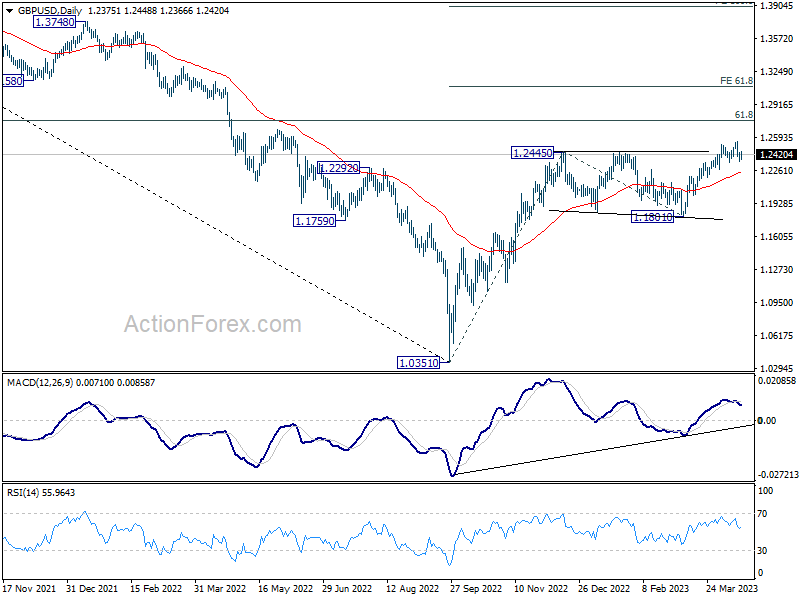
In the bigger picture, the rise from 1.0351 medium term term bottom (2022 low) is in progress for 61.8% retracement of 1.4248 (2021 high) to 1.0351 at 1.2759. Sustained break there will add to the case of long term bullish trend reversal. Further break of 61.8% projection of 1.0351 to 1.2445 from 1.1801 at 1.3095 could prompt upside acceleration to 100% projection at 1.3895. For now, this will remain the favored case as long as 1.1801 support holds, even in case of deep pull back.
USD/CHF Mid-Day Outlook
Daily Pivots: (S1) 0.8941; (P) 0.8968; (R1) 0.9015; More...
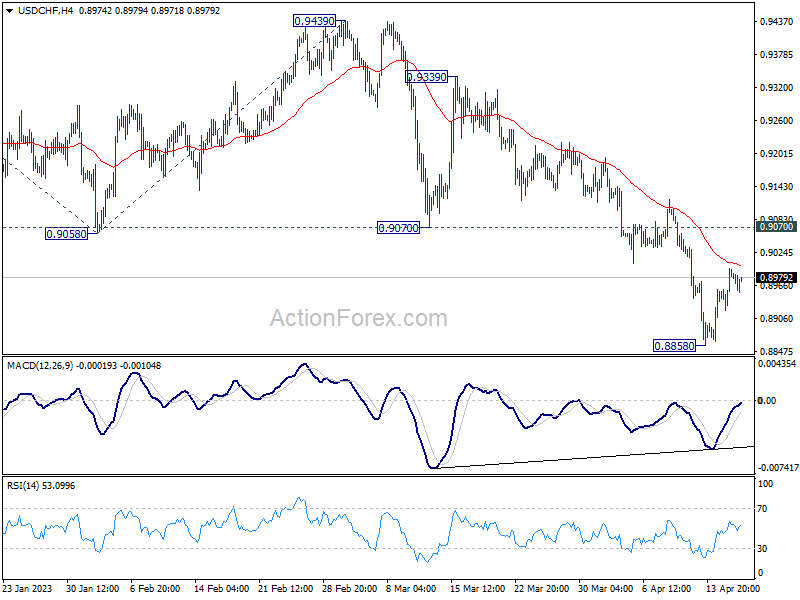
No change in USD/CHF's outlook and intraday bias remains neutral. Another decline cannot be ruled out with 0.9070 support turned resistance intact. On the downside, below 0.8858 will resume the down trend to 61.8% projection of 1.0146 to 0.9058 from 0.9439 at 0.8767, which is close to 0.8756 long term support. Strong support is expected there to bring rebound, at least on first attempt. On the upside, break of 0.9070 support turned resistance will confirm short term bottoming and turn bias back to the upside.
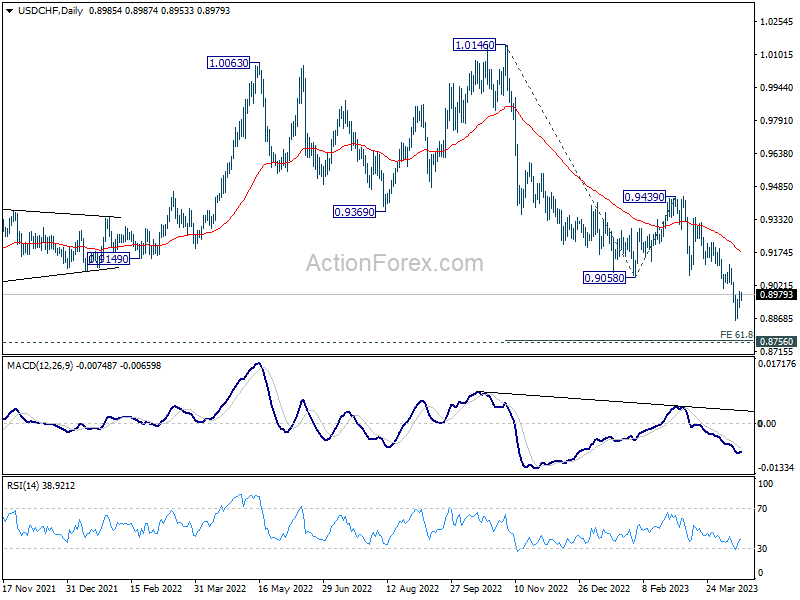
In the bigger picture, fall from 1.1046 (2022 high) is in progress for 0.8756 support (2021 low). But overall, this fall is still seen as a leg in the long term range pattern from 1.0342 (2016 high). So, downside should be contained by 0.8756 to bring reversal. Sustained break of 0.9058 support turned resistance will be the first sign of medium term bottoming. However, decisive break of 0.8756 will carry larger bearish implications.
USD/JPY Mid-Day Outlook
Daily Pivots: (S1) 133.93; (P) 134.25; (R1) 134.79; More...
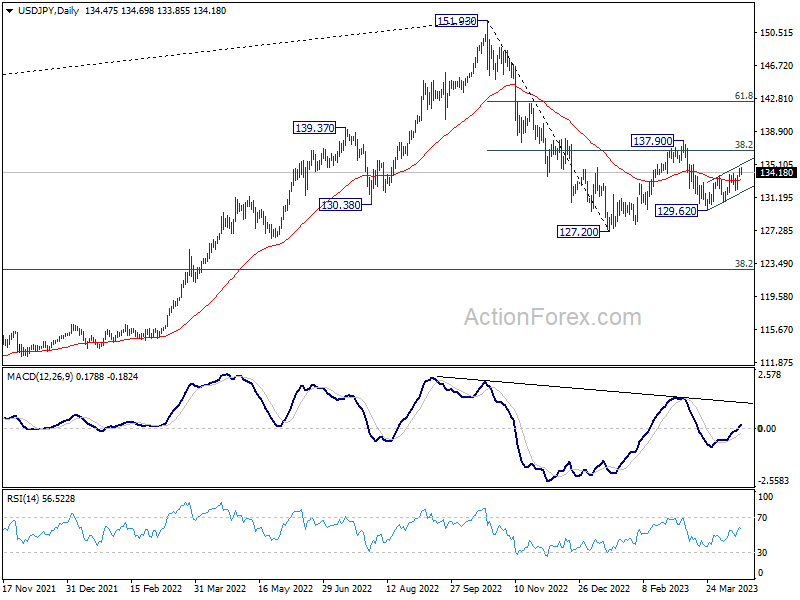
A temporary top is formed at 134.69 in USD/JPY with current retreat. Intraday bias is turned neutral first. But further rally will remain in favor as long as 312.03 support holds. Above 134.69 will resume the rally from 129.62, towards 137.90 resistance next.
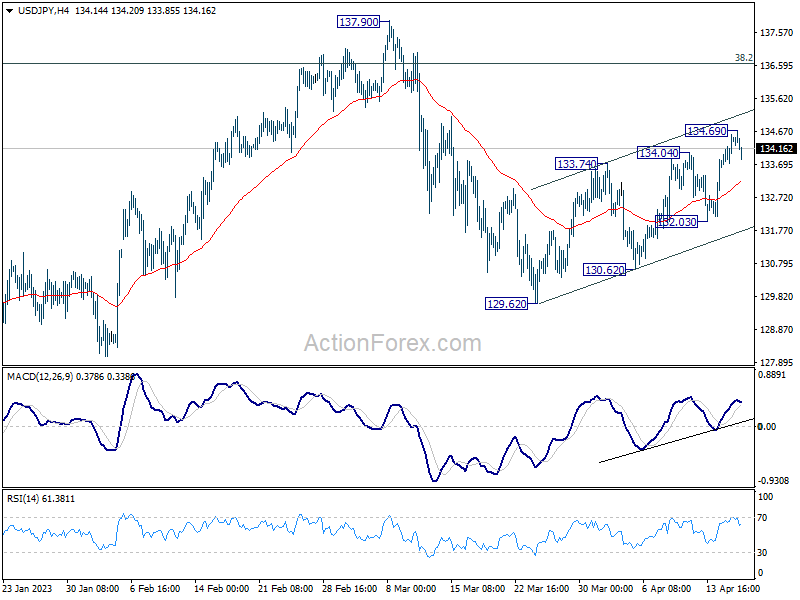
In the bigger picture, corrective pattern from 127.20 might be extending. But after all, down trend from 151.93 is expected to resume at a later stage. Break of 127.20 will resume this down trend and target 61.8% projection of 151.93 to 127.20 from 137.90 at 122.61. This will now be the favored case as long as 137.90 resistance holds.
Canadian Dollar Weakens on Cooling Consumer Inflation, Dollar Reversing Gains
Canadian Dollar weakens broadly in early US session, after data showed that consumer inflation slowed notably in March, in line with market expectations. However, Dollar has emerged as the day's worst performer, reversing some of this week's gains, even when compared to Yen. In contrast, Australian and New Zealand Dollars are performing strongly, buoyed by better-than-expected Chinese GDP and robust retail sales data. British Pound is also faring well due to encouraging job data and solid wage growth, while Euro and Swiss Franc lag behind.
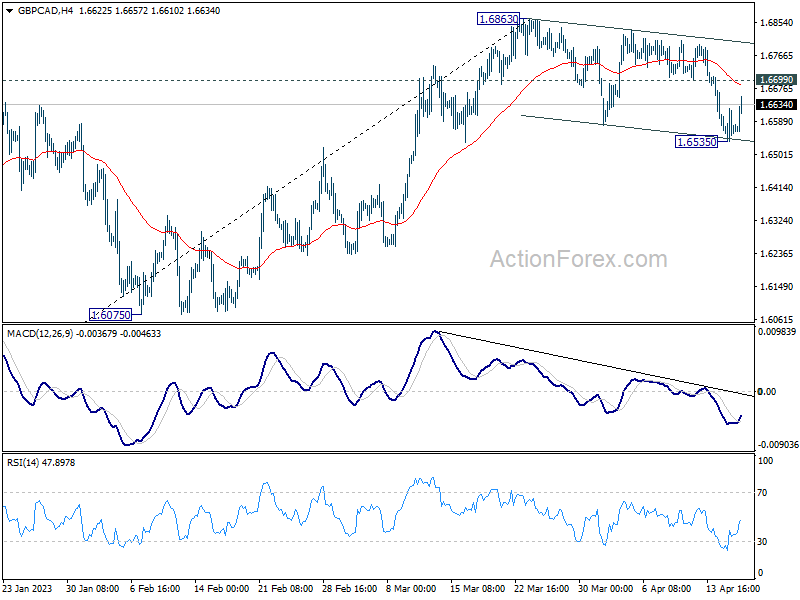
Following up on GBP/CAD, today's bounce is raising the chance that corrective pattern from 1.6863 has completed with three waves down to 1.6535, after drawing support from 55 D EMA (now at 1.6562). Next focus is 1.6699 minor resistance. Sustained break there will solidify this bullish case and bring further rise through 1.6863 to resume larger up trend. However, sustained break of the 55 D EMA will argue that it's already in correction to whole up trend from 1.4069, and open up deeper decline to 1.6075 support and below.
In Europe, at the time of writing, FTSE is up 0.22%. DAX is up 0.73%. CAC is up 0.72%. Germany 10-year yield is down -0.0005 at 2.469. Earlier in Asia, Nikkei rose 0.51%. Hong Kong HSI dropped -0.63%. China Shanghai SSE rose 0.23%. Singapore Strait Times dropped -0.29%. Japan 10-year JGB yield dropped -0.0059 to 0.476.
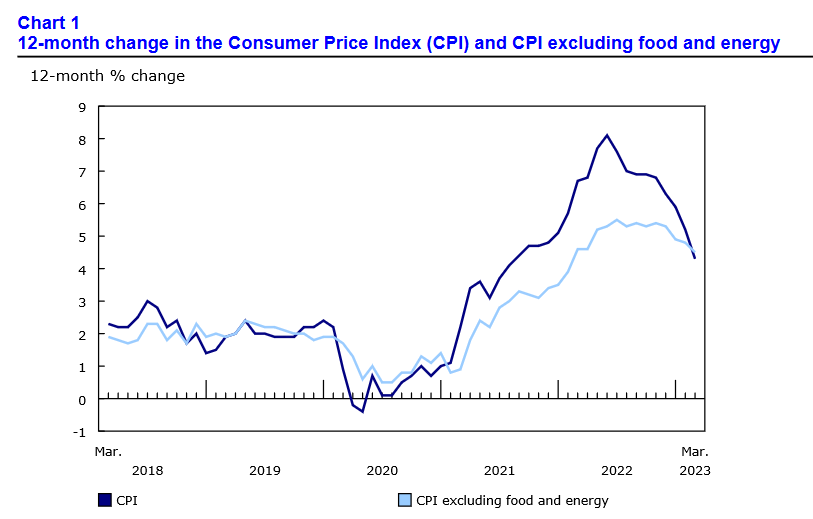
Canada CPI slowed to 4.3% yoy in Mar, lowest since Aug 2021
Canada CPI slowed from 5.2% yoy to 4.3% yoy in March, matched expectations. That was also the smallest annual increase since August 2021. Excluding food and energy, CPI slowed from 4.8% yoy to 4.5% yoy. Excluding mortgage interest costs CPI also slowed from 4.7% yoy to 3.6% yoy.
Statistics Canada noted, "As a result of the steep monthly increase in prices in March 2022 (+1.4%), base-year effects, notably gasoline prices, continued to have a strong downward impact on consumer inflation, contributing to the year-over-year deceleration in March 2023."
Meanwhile, CPI median slowed from 4.9% yoy to 4.6% yoy, above expectation of 4.5% yoy. CPI trimmed slowed from 4.8% yoy to 4.4% yoy, matched expectation. CPI common slowed from 6.4% yoy to 5.9% yoy, below expectation of 6.0% yoy.
German ZEW falls sharply to 4.1, financial market experts still uncertain
ZEW Economic Sentiment Index for Germany experienced a significant drop in April, falling from 13 to 4.1, well below the anticipated 15.1. This suggests that a considerable improvement in the economic situation is unlikely over the next six months. Although the Current Situation Index rose from -46.5 to -32.5, surpassing the forecast of -40.0, the overall economic situation remains relatively negative.
Similarly, the Eurozone's ZEW Economic Sentiment Index dipped from 10 to 6.4, underperforming the expected 11.2. However, the Current Situation Index increased by 14.4 points to -30.2.
ZEW President Professor Achim Wambach stated that several factors negatively affect economic expectations, including experts' anticipation of banks being more cautious with loans and the ongoing impact of high inflation rates and restrictive international monetary policies. Nevertheless, Wambach highlighted that the risk of an acute international financial market crisis appears to have been mitigated.
UK payrolled employment grew 31k in Mar, wage growth maintained in Feb
In March, UK payrolled employment grew 31k , or 0.1% mom. Compared with March 2022, payrolled employment rose 533k, or 1.8% yoy. Median monthly pay increased by 6.3% yoy, highest in finance and insurance sector with 10.1% yoy, and lowest in the education sector, with an increase of 3.6%. Claimant count rose 28.2k, above expectation of 10.2k.
In the three month to February, unemployment rate rose to 3.8%, above expectation of 3.7%, and 0.1% higher the previous three-month period. Employment rate was estimated at 75.8%, 0.2% higher than the previous three-month period. Average earnings excluding bonus rose 6.6% 3moy, unchanged from January's rate and above expectation of 6.2%. Average earnings including bonus was up 5.9% 3moy, unchanged from prior month's figure, beat expectation of 5.1%.
BoJ Governor Ueda: No immediate need to revise joint statement with government
In an appearance at the lower house financial committee of parliament today, BoJ Governor Kazuo Ueda stated that there is no immediate need to review a joint statement issued with the government about a decade ago. This statement, which is not legally binding, outlines the roles that the government and the BOJ should each assume in order to lift Japan out of deflation.
"We are going to approach meeting the 2% inflation target by keeping to monetary easing, although it may take time." He added that "the joint statement is appropriate and I don't see any immediate need to revise the target." Ueda's remarks point to a commitment to maintaining monetary easing in pursuit of the inflation target, while also urging companies to drive economic growth through higher wages and sustained inflation.
In an earlier session, Ueda clarified that the BoJ's Japanese Government Bond (JGB) purchases are managed in the context of achieving the 2% price stability target, and not to assist the government in acquiring financial resources.
RBA minutes reveal considerations of rate hike and pause
The minutes from the RBA April 4 monetary policy meeting revealed that the Board weighed the options of a 25bps rate hike and a pause. On balance, there was a "a stronger case to pause at this meeting and reassess the need for further tightening at future meetings", after having "additional data and an updated set of forecasts". But members emphasized the to communicate clearly that "monetary policy may need to be tightened at subsequent meetings". RBA kept cash rate target unchanged at 3.6% at that meeting.
The case for a 25bps hike was primarily driven by concerns over high inflation and a tight labor market. The potential persistence of high inflation and two additional factors—upgraded near-term population growth projections and the risk of larger wage increases in parts of the economy—also supported further tightening.
On the other hand, the case for a pause stemmed from the already restrictive monetary policy following significant tightening in a short period, with the full effects on the economy yet to be observed. Tighter monetary policy had contributed to a housing market slowdown, decelerated consumption growth, and financial pressure on some households with housing loans. The value of pausing lay in the opportunity to gather additional data on various economic indicators and to receive updated forecasts from the staff, which would be invaluable in reassessing the economic outlook and determining the extent of further tightening needed.
China's Q1 GDP growth surpasses expectations, retail sales bounce
China's Q4 GDP growth outperformed expectations at 4.5% yoy, up from 2.9% in Q4, and beat expectation of 4.0% yoy. Retail sales in March saw a 10.6% yoy increase, the largest since June 2021. Despite the positive figures, industrial production rose by only 3.9% yoy in March, missing the anticipated 4.7%. Additionally, fixed asset investment saw a 5.1% ytd yoy growth in March, falling short of the expected 5.8%.
The National Bureau of Statistics (NBS) report on Tuesday cited challenges faced by China in the first quarter, including a "grave and complex international environment" and domestic tasks for reform, development, and stability.
USD/JPY Mid-Day Outlook
Daily Pivots: (S1) 133.93; (P) 134.25; (R1) 134.79; More...
A temporary top is formed at 134.69 in USD/JPY with current retreat. Intraday bias is turned neutral first. But further rally will remain in favor as long as 312.03 support holds. Above 134.69 will resume the rally from 129.62, towards 137.90 resistance next.
In the bigger picture, corrective pattern from 127.20 might be extending. But after all, down trend from 151.93 is expected to resume at a later stage. Break of 127.20 will resume this down trend and target 61.8% projection of 151.93 to 127.20 from 137.90 at 122.61. This will now be the favored case as long as 137.90 resistance holds.
Economic Indicators Update
| GMT | Ccy | Events | Actual | Forecast | Previous | Revised |
|---|---|---|---|---|---|---|
| 01:30 | AUD | RBA Meeting Minutes | ||||
| 02:00 | CNY | GDP Y/Y Q1 | 4.50% | 4.00% | 2.90% | |
| 02:00 | CNY | Fixed Asset Investment YTD Y/Y Mar | 5.10% | 5.80% | 5.50% | |
| 02:00 | CNY | Industrial Production Y/Y Mar | 3.90% | 4.70% | 2.40% | |
| 02:00 | CNY | Retail Sales Y/Y Mar | 10.60% | 8.00% | 3.50% | |
| 06:00 | GBP | Claimant Count Change Mar | 28.2K | 10.2K | -11.2K | |
| 06:00 | GBP | ILO Unemployment Rate (3M) Feb | 3.80% | 3.70% | 3.70% | |
| 06:00 | GBP | Average Earnings Excluding Bonus 3M/Y Feb | 6.60% | 6.20% | 6.50% | 6.60% |
| 06:00 | GBP | Average Earnings Including Bonus 3M/Y Feb | 5.90% | 5.10% | 5.70% | 5.90% |
| 08:00 | EUR | Italy Trade Balance (EUR) Feb | 2.11B | -3.23B | -4.19B | -4.24B |
| 09:00 | EUR | Germany ZEW Economic Sentiment Apr | 4.1 | 15.1 | 13 | |
| 09:00 | EUR | Germany ZEW Current Situation Apr | -32.5 | -40 | -46.5 | |
| 09:00 | EUR | Eurozone ZEW Economic Sentiment Apr | 6.4 | 11.2 | 10 | |
| 12:30 | USD | Building Permits Mar | 1.41M | 1.46M | 1.52M | 1.55M |
| 12:30 | USD | Housing Starts Mar | 1.42M | 1.41M | 1.45M | 1.43M |
| 12:30 | CAD | CPI M/M Mar | 0.50% | 0.60% | 0.40% | |
| 12:30 | CAD | CPI Y/Y Mar | 4.30% | 4.30% | 5.20% | |
| 12:30 | CAD | CPI Median Y/Y Mar | 4.60% | 4.50% | 4.90% | |
| 12:30 | CAD | CPI Trimmed Y/Y Mar | 4.40% | 4.40% | 4.80% | |
| 12:30 | CAD | CPI Common Y/Y Mar | 5.90% | 6.00% | 6.40% |
Canada CPI slowed to 4.3% yoy in Mar, lowest since Aug 2021
Canada CPI slowed from 5.2% yoy to 4.3% yoy in March, matched expectations. That was also the smallest annual increase since August 2021. Excluding food and energy, CPI slowed from 4.8% yoy to 4.5% yoy. Excluding mortgage interest costs CPI also slowed from 4.7% yoy to 3.6% yoy.
Statistics Canada noted, "As a result of the steep monthly increase in prices in March 2022 (+1.4%), base-year effects, notably gasoline prices, continued to have a strong downward impact on consumer inflation, contributing to the year-over-year deceleration in March 2023."
Meanwhile, CPI median slowed from 4.9% yoy to 4.6% yoy, above expectation of 4.5% yoy. CPI trimmed slowed from 4.8% yoy to 4.4% yoy, matched expectation. CPI common slowed from 6.4% yoy to 5.9% yoy, below expectation of 6.0% yoy.
Domestic Demand Picks Up in China
China released a large set of statistics this morning from which it’s difficult to draw clear conclusions, although GDP growth was stronger than expected.
The Chinese economy grew by 2.2% in the first three months of the year and is 4.5% higher than a year ago. This is stronger than the 4% forecast. Last year, the economy grew by only 3% against a government target of 5.5%. The 5.0% target for 2023 is less ambitious. Given lifted pandemic restrictions and recovering global trade, achieving and exceeding it is relatively easy.
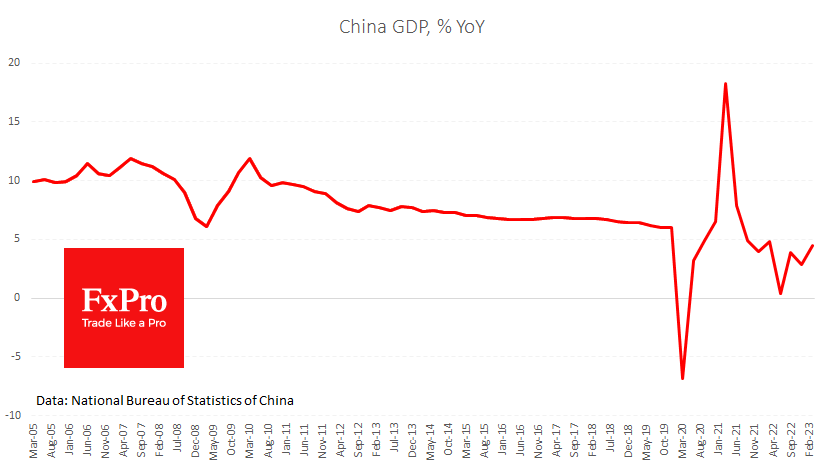
Separate reports on industrial production and retail sales suggest domestic demand remains the main driver, putting it on a faster growth path. Retail sales in March were 10.6% higher than a year earlier (7.3% expected). The cumulative YTD increase was 5.8%, much higher than expectations (3.7%) and the growth rate for the same period last year (+3.3%).
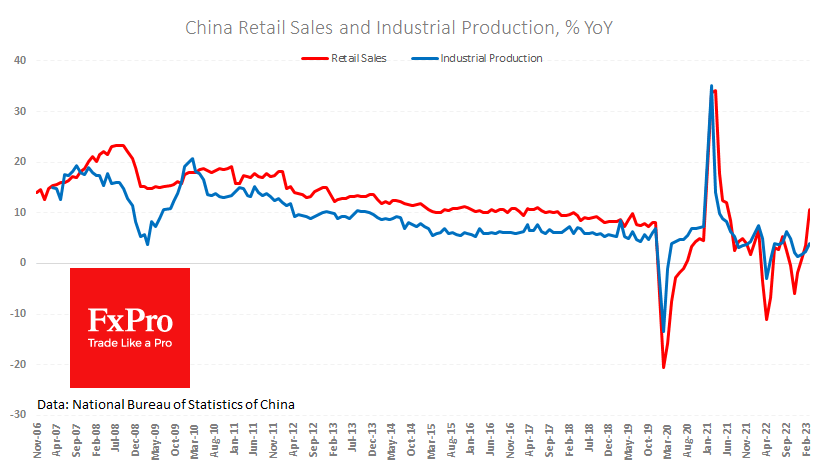
At the same time, the unemployment rate fell from 5.6% to 5.3%, returning to the level of December 2021.
However, industrial production surprised on the downside, rising by 3.9% year-on-year in March, less than the 4.7% expected. China’s industrial production is often seen as a bellwether for a global industry. The low growth rate could signal how hard the global economy is growing under the pressure of rising interest rates. Fixed asset investment has been stagnant at around 5% year-on-year, with a slight downward trend, which is also worrying.
However, in recent months there has been much talk of foreign companies shifting production from China to other Asian countries, which is negative for the former but positive for the latter.
Crypto Market is Quickly Finding its Feet
Market picture
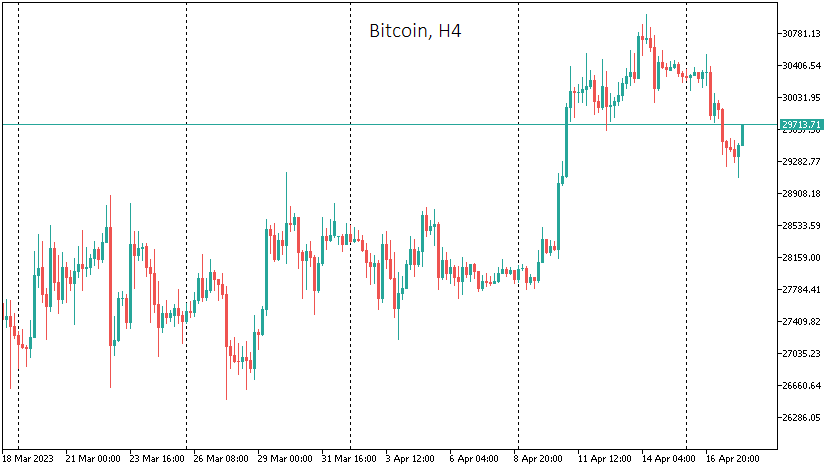
Bitcoin has been correcting its previous rally, falling back to $29K early Tuesday. From this level, it has been on a buying spree and has now risen to $29.6K.
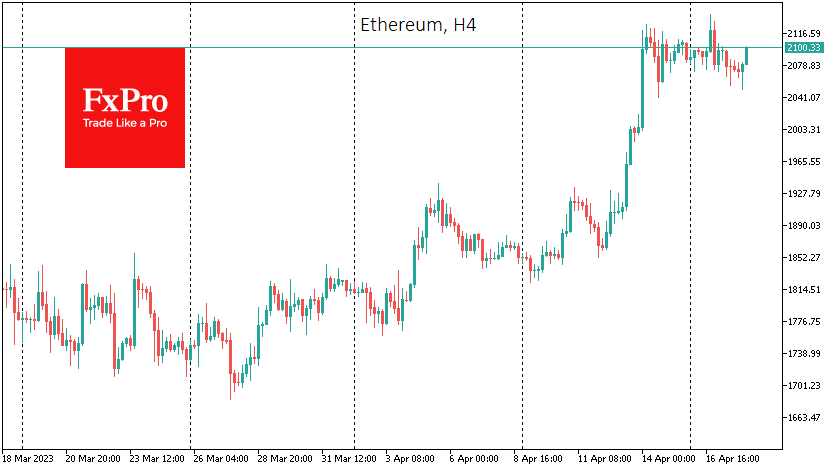
Similarly, total crypto market capitalisation is now 0.8% lower than 24 hours ago but 1.2% higher than today’s low. Further positive momentum during the day cannot be ruled out. Still, doubts remain whether the market will consolidate above 30K for Bitcoin, $2100 for Ether, and $1.28 trillion capitalisations for the entire crypto.
According to CoinShares, investments in crypto funds doubled last week to $114 million, the fourth consecutive week of growth. Investments in Bitcoin rose by $104 million, while Ethereum saw just $0.3 million. Among altcoins, Solana saw the largest outflow ($2.1 million).
News background
Ark Investment’s Katie Wood said that Bitcoin and Ethereum became defensive assets on par with gold during the recent US banking crisis. She said this suggests a much greater acceptance of BTC and ETH and, therefore, a rosier outlook for them.
Ethereum’s rise in recent days is a sign that altcoin season has arrived, said former BitMEX exchange CEO Arthur Hayes. Solana, Cardano and Dogecoin have also seen significant gains over the past week.
The Digital Currency Monetary Authority (DCMA) of the International Monetary Fund (IMF) announced the launch of the Unicoin Universal Currency Unit (UMU), which will be a legal tender for cross-border payments.
According to the Wall Street Journal, the US Securities and Exchange Commission (SEC) has notified cryptocurrency exchange Bittrex of a possible forced termination for failing to register with the agency.
The Kingdom of Bhutan has been diverting some of its reserves to buy cryptocurrency. Forbes writes that Bhutan’s sovereign wealth fund was a customer of the bankrupt BlockFi and Celsius. This is the first public investment in cryptocurrencies by such entities.
EURJPY Just Below the October 2022 High
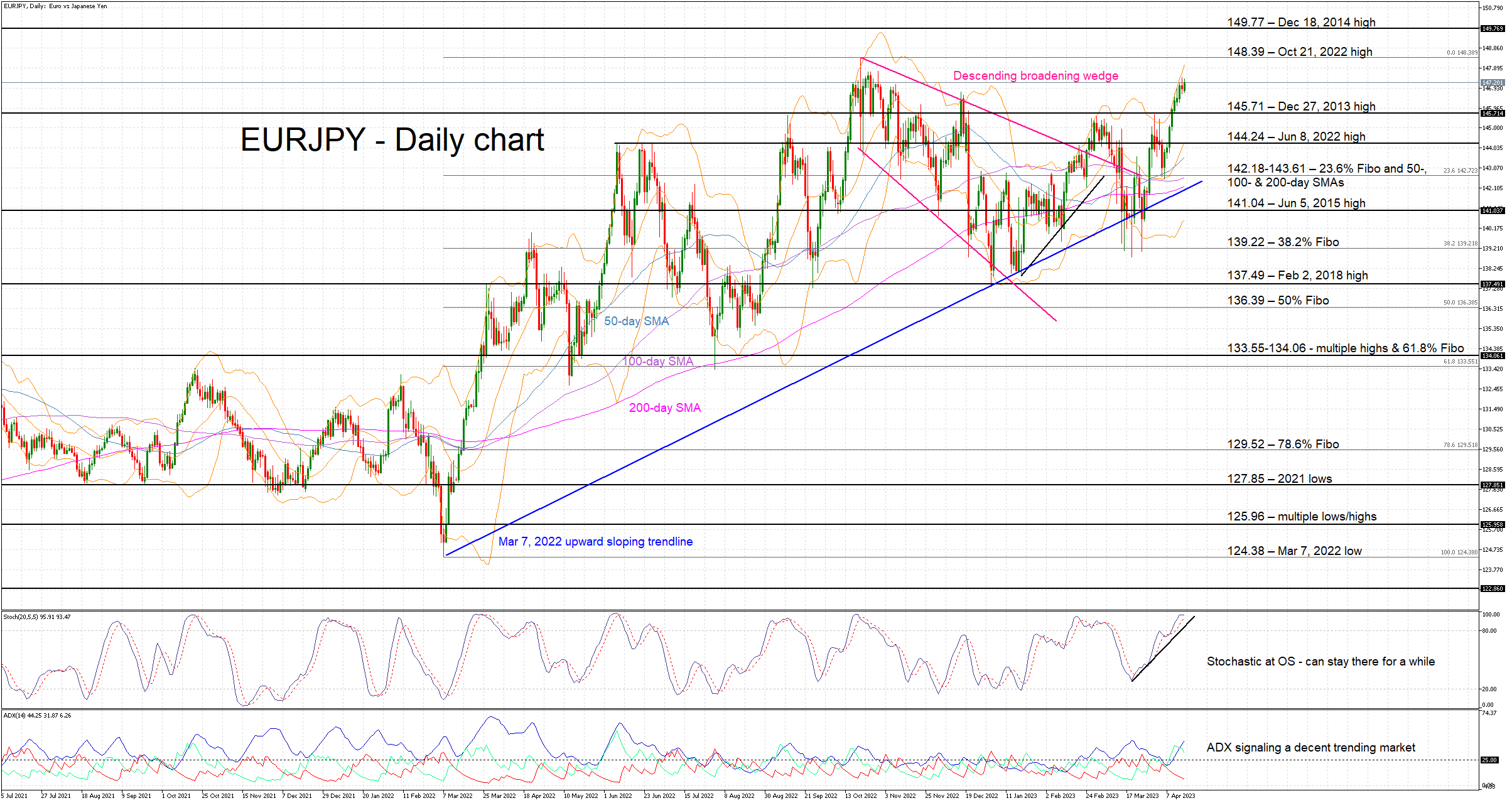
EURJPY is edging higher following the successful break of the 145.71 level that troubled the bulls in February. The pair is currently a tad below the October 21, 2022 high of 148.39 as EUR bears are trying to stage a comeback. This will not be easy as the Average Directional Movement Index (ADX) is hovering well above its 25-threshold, signaling a decent trending market.
Hence, EUR bears have understandably turned their focus to the stochastic oscillator. This is trading at the highest level since the October 21, 2022 peak, thus potentially infusing some confidence into the bears that the November 2022 downward move could be repeated. However, it is worth noting that the stochastic could hover in its overbought area for an extended period of time.
Should the bears decide to take over the market, they would have to deal with the December 27, 2013 high of 145.71. Lower, the June 8, 2022 high at 144.24 could trouble them, ahead of the busier 142.18-143.61 area. This is defined by the 23.6% Fibonacci retracement of the March 7, 2022 – October 21, 2022 uptrend, and the 50-, 100- and 200-day simple moving averages (SMA) respectively. A break of this range would most likely constitute a reversal of the short-term bullish trend.
On the other hand, EURJPY bulls would aim for a retest of the Oct 21, 2022 high of 148.39. A successful break of this level would open the door for the December 18, 2014 high of 149.77. Such a move though is bound to energize the EURJPY bears.
To sum up, EURJPY bulls feel confident following the recent upleg as the bears are trying to stage a reversal. The 145.71 level remains key for short-term momentum.
AUD/USD: Aussie Dollar Rises on Hawkish RBA/Upbeat Chinese GDP
Australian dollar rose by 0.7% in Asia / early Europe on Tuesday, lifted by hawkish RBA and stronger than expected China’s economic expansion in the first quarter.
The minutes of the last policy meeting showed that the Australian central bank considered to hike interest rates for the eleventh time on April 4 meeting before deciding to pause, but showed its readiness to further tighten its monetary policy if inflation remains high.
China’s stronger than expected economic data also contributed to fresh strength of the Aussie dollar.
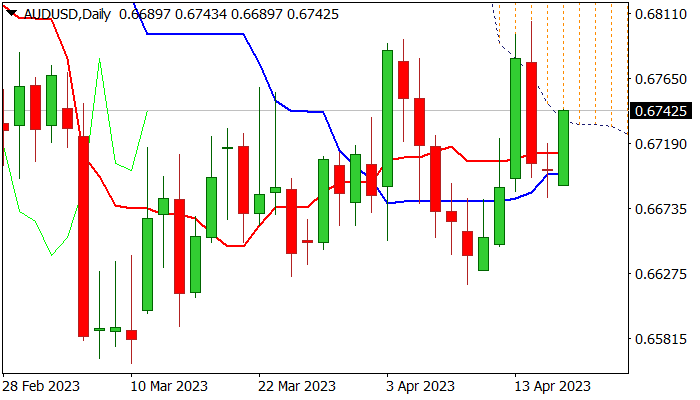
Tuesday’s rally generates reversal signal on daily chart as it follows last Friday’s sharp fall and long-legged daily Doji candle on Monday.
Bulls cracked the lower boundary of strong resistances at 0.6734/42 zone, consisting of daily Ichimoku cloud base; 200DMA and 50% retracement of 0.6805/0.6680 bear-leg, with firm break here needed to reinforce bulls for further recovery, as daily technical studies are still mixed (rising bullish momentum / south-heading stochastic / MA’s in mixed mode and the action weighed by thick daily cloud).
Break of 0.6734/42 pivots would open way for test of falling 55DMA (0.6761) which guards key resistances at 0.6790/93 / 0.6805 (Fibo 38.2% of larger 0.7157/0.6563 downtrend/tops of Apr 4/14, reinforced by 100DMA).
Failure to register close above 200DMA would ease upside pressure however, near-term bullish bias to remain as long as price action stays above broken daily Tenkan-sen (0.6712).
Only drop and close below daily Kijun-sen (0.6697) would sideline bulls and risk further weakness.
Res: 0.6761; 0.6790; 0.6805; 0.6841.
Sup: 0.6712; 0.6697; 0.6680; 0.6646.
German ZEW falls sharply to 4.1, financial market experts still uncertain
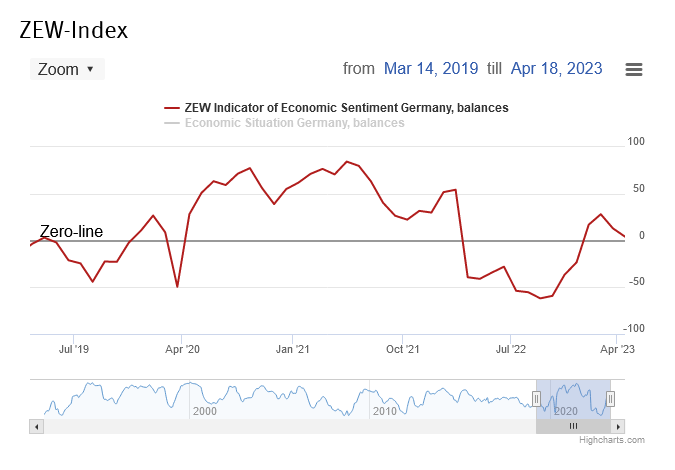
ZEW Economic Sentiment Index for Germany experienced a significant drop in April, falling from 13 to 4.1, well below the anticipated 15.1. This suggests that a considerable improvement in the economic situation is unlikely over the next six months. Although the Current Situation Index rose from -46.5 to -32.5, surpassing the forecast of -40.0, the overall economic situation remains relatively negative.
Similarly, the Eurozone's ZEW Economic Sentiment Index dipped from 10 to 6.4, underperforming the expected 11.2. However, the Current Situation Index increased by 14.4 points to -30.2.
ZEW President Professor Achim Wambach stated that several factors negatively affect economic expectations, including experts' anticipation of banks being more cautious with loans and the ongoing impact of high inflation rates and restrictive international monetary policies. Nevertheless, Wambach highlighted that the risk of an acute international financial market crisis appears to have been mitigated.
Full Germany ZEW release here.